


 by
Tom Gurney
Tom Gurney BSc (Hons) is an art history expert with over 20 years experience
Email:
tomgurney1@gmail.com
/ Phone:
+44 7429 011000
John Steuart Curry Murals: Introduction
John Steuart Curry’s murals brought his forceful figures and expansive landscapes into government buildings and university rooms. Their subjects include migration, law, racial violence, emancipation, agriculture and scientific research. Together they show how an artist associated with rural life addressed institutions that helped define public history and civic values.
The commissions developed under different conditions. Federal officials asked for revisions, Kansas legislators prevented part of a larger programme, and Wisconsin patrons found a setting for an emancipation design rejected in Washington. Following those differences gives a clearer account of Curry’s public art than treating every mural as the product of one government scheme or a single uninterrupted vision.
At a Glance
- Artist John Steuart Curry, 1897–1946.
- Washington settings Department of Justice and Department of the Interior buildings.
- Federal commissioning body The Section of Painting and Sculpture, within the wider history of the Section of Fine Arts.
- Kansas setting Second-floor corridors of the Kansas State Capitol, Topeka.
- Kansas distinction Completed corridor paintings survive; the planned rotunda sequence was not executed.
- Wisconsin settings Law Library and Biochemistry Building at the University of Wisconsin–Madison.
- Major subjects Justice, migration, emancipation, agriculture and public knowledge.
- Material distinction A mural, preparatory study and smaller related painting are separate objects.
Contents
- A painting made for a public building
- The federal Section and the Department of Justice
- Justice of the Plains and expansionist history
- Law Versus Mob Rule and the rejected emancipation design
- Interior Department homesteading scenes
- The Kansas commission and its unfinished programme
- Completed corridors and the abandoned rotunda
- Wisconsin murals and the university
- Materials, architectural setting and later care
- Looking across the different commissions
A painting made for a public building
A mural meets its viewers within a room used for other purposes. People pass through a corridor, gather near a lift or work at a library desk beneath it. Its scale, position and relationship with neighbouring walls shape that encounter. Curry’s public pictures therefore belong to architectural and institutional settings as well as to the history of his paintings .
The commissions also brought several kinds of authority into the making of the work. An artist proposed an image; officials or patrons assessed its subject and suitability; the building supplied practical limits. In Curry’s case, those discussions could alter a composition or decide whether it reached the wall at all. The General Services Administration’s records of the Washington murals preserve examples of that negotiation. [1] [2] [3]
Preparatory work offers another way into the process. A small study can preserve an earlier design, an alternative emphasis or a composition intended for a particular space. It should be identified by its own date, dimensions and location. A sketch held in one courthouse does not become the finished painting installed in another building simply because the two share a subject.
The range of settings matters to interpretation. A scene of migration in the Department of Justice acquires questions about law and settlement. An emancipation image above a law library’s reading room invites reflection on freedom and citizenship. Pictures of agricultural research in a university building connect rural subjects with the institution’s account of scientific work. The relationship between image and place helps explain the different purposes these paintings served.
The federal Section and the Department of Justice
The GSA identifies Curry’s Washington commissions with the Section of Painting and Sculpture. This distinction keeps them separate from the WPA Federal Art Project, another New Deal art programme. The umbrella description of New Deal art is useful, but the individual commission’s administrative history gives a more precise account of who commissioned and reviewed a work. [1]
For the Department of Justice, Curry painted Justice of the Plains: The Movement Westward and Law Versus Mob Rule . Both GSA records date the murals to 1936, identify the medium as oil on canvas and give dimensions of 90 by 240 inches. Their long formats accommodated groups of figures, allowing movement and confrontation to extend across a broad architectural space. [2] [3]
The two subjects approach law through different situations. One follows families moving west; the other presents a person seeking protection from a mob. Considered together, they ask how authority might operate in conditions represented as unstable or dangerous. Their institutional setting made the question of justice central to the selection and revision of imagery.
A related Study for Westward Movement , catalogued by the GSA around 1935, is recorded at the Thomas F. Eagleton U.S. Courthouse in St. Louis. Its much smaller dimensions distinguish it from the Washington mural. Such records allow the preparatory and completed objects to be followed without collapsing them into a single date, place or physical work. [4]
Justice of the Plains and expansionist history
In Justice of the Plains , the GSA describes families advancing across the landscape as a collective body. Its account identifies a self-portrait of Curry at the far right, smoking a corn-cob pipe. The inclusion places the artist within the historical procession, linking his own public identity with the image of western migration. [2]
The commission’s revisions show how institutional expectations affected the picture. According to the GSA, Curry’s initial plan concentrated on migrating families. Reviewers objected that the design failed to represent justice, prompting the addition of riders and a prairie fire on the left. The revised arrangement made danger part of the explanation for the need for law. The public subject emerged through discussion of what the building’s imagery ought to communicate. [2]
The interpretation also has limits that deserve attention. The GSA explicitly criticizes the mural’s celebratory account of expansion for omitting the displacement of Indigenous communities. That omission shapes the historical viewpoint. The people advancing across the land are made the principal bearers of purpose, hardship and hope, while those whose lives were disrupted by settlement do not receive equivalent attention. [2]
Reading the work with that limitation in view makes its construction more apparent. A historical painting selects whose movements to follow, which dangers to show and where sympathy should gather. Curry’s monumental treatment of the travelling family can be understood alongside the exclusions built into that narrative. The image remains evidence of a particular account of the West, produced for a particular public institution in the 1930s.
This is one reason to read the two Justice murals together. Their figures and settings turn law into something visible through bodies under pressure. Yet the historical and racial identities of those bodies affect the argument. The apparently general theme of justice becomes more specific when the viewer asks who receives protection, who stands for danger and who is absent from the scene.
Law Versus Mob Rule and the rejected emancipation design
Law Versus Mob Rule places a white fugitive before a robed figure of justice. The GSA describes one hand protecting the man while the other restrains the advancing mob. A rope and bloodhound give the threat a concrete form. The composition turns the difference between legal protection and vigilante violence into an immediate bodily confrontation. [3]
The mural also underwent a conspicuous change. The GSA records that a threatening figure initially had a skull for a face. Following objections from Attorney General Homer Cummings and the Section, Curry returned three years later and painted a red bandanna over it. This later alteration belongs to the work’s history after its initial completion. It shows that official scrutiny could continue beyond the approval of the first design. [3]
The racial identity of the fugitive matters. Curry also made images of a Black man pursued by a mob, including the 1935 lithograph The Fugitive . The Smithsonian places that print within anti-lynching exhibition activity. Its threatened figure should not be substituted for the white man in the Justice mural. The works approach related public questions through different compositions and historical situations. [5]
The Justice commission’s earlier history makes the distinction more significant. The proposed subject had involved emancipation and immigration, followed by revisions to the programme. GSA commentary describes objections to Curry’s treatment of formerly enslaved people celebrating freedom and the eventual replacement of that design with Law Versus Mob Rule . The dispute concerned the representation of freedom as well as the formal clarity of a large composition. [3]
A surviving Study for Freeing of the Slaves , catalogued around 1935, preserves part of that history. The GSA identifies it as a watercolour study and distinguishes it from the mural later made for Wisconsin. Its continued existence allows viewers to follow an idea that did not disappear when officials rejected it for Washington. [6]
These successive proposals reveal several possible public stories: emancipation, migration and the protection of an individual from violence. The finished walls preserve the subjects that reached approval, while the studies and institutional accounts retain evidence of alternatives. An overview of Curry’s murals needs both kinds of object to explain the choices that shaped the surviving programme.
Interior Department homesteading scenes
The Interior Department murals returned to settlement and the transformation of land. The GSA dates The Homesteading and the Building of Barbed Wire Fences to 1939 and records it as oil on canvas, roughly 2.8 metres high and 6 metres wide. Work, household activity and cultivated ground become parts of one extensive scene. [7]
In the GSA’s account, a farmer establishes a boundary with barbed wire while a mother and daughter prepare food near a sod home. The image links the creation of private property with the routines of family life. The same commentary reads the clouds as anticipating the later environmental crisis of over-farming and drought. That is an institutional interpretation of the painting’s historical outlook, rather than a literal claim that the depicted family foresees the Dust Bowl. [7]
The companion work is catalogued by the GSA as Rush for the Oklahoma Land – 1894 , with an execution date of 1939. Its description emphasizes wagons, horses and a train, bringing different means of movement into a scene of anticipated settlement. The year within the title belongs to the subject label; it is separate from the year Curry painted the mural. [8]
Another object is recorded as The Oklahoma Land Rush : a smaller 1939 oil painting associated with the Oklahoma City Museum of Art. Its canvas measures about 69.5 by 148.6 centimetres. Those dimensions and location distinguish it from the much larger work in Washington. The titles’ similarity makes the separate records particularly useful when comparing reproductions or following the subject through different collections. [9]
Together, the Interior subjects connect the movement toward land with the labour of occupying and cultivating it. They invite questions about how a public institution represented settlement, ownership and environmental change. As with Justice of the Plains , the viewer should consider whose experience organizes the story and what the chosen emphasis leaves outside its main field of attention.
The Kansas commission and its unfinished programme
Curry’s Kansas commission began in 1937 after a campaign by newspaper editors to bring his work to the statehouse. The Kansas Historical Society describes a project intended to tell the state’s history across several connected spaces. The invitation involved both recognition of a prominent Kansas-born artist and expectations about how the state ought to appear in its own Capitol. [10] [11]
The programme assigned different roles to the corridors and rotunda. Tragic Prelude in the east corridor dealt with the earlier historical struggle; the planned rotunda paintings would address settlement, agriculture and the use of land; Kansas Pastoral in the west wing presented contemporary rural abundance. These were parts of a larger sequence, rather than independent pictures placed together by chance. [10]
The proposed connection is especially useful for understanding the agricultural subjects. Barbed wire, crops, cattle and soil management belonged to an account of how people transformed the land and depended on it. The rural world familiar from Curry’s easel paintings became the subject of a programme intended for the state Capitol. Its rewards and dangers were to occupy the same public setting.
Opposition developed over both historical emphasis and apparently smaller descriptive details. The Kansas Historical Society records complaints about John Brown’s prominence, the appearance of animals and a woman’s skirt. Such objections show how closely viewers scrutinized an image presented as representing their state. A bull’s stance or the treatment of clothing could become part of a broader argument about credibility and public identity. [10] [11]
The dispute was therefore more than a disagreement over an individual figure. Curry’s threatening weather, violence and concern about damaged land challenged expectations of a reassuring official portrait. The accounts of the controversy preserve those competing ambitions, while the surviving studies reveal how extensively he had imagined the uncompleted parts.
Watch: John Steuart Curry
Choose a film to explore the artist’s work, its interpretation and its wider setting.
Look at This: John Steuart Curry at MOWA
An exhibition interview with Graeme Reid considers Curry’s work and life in Wisconsin.
Watch on YouTubeCompleted corridors and the abandoned rotunda
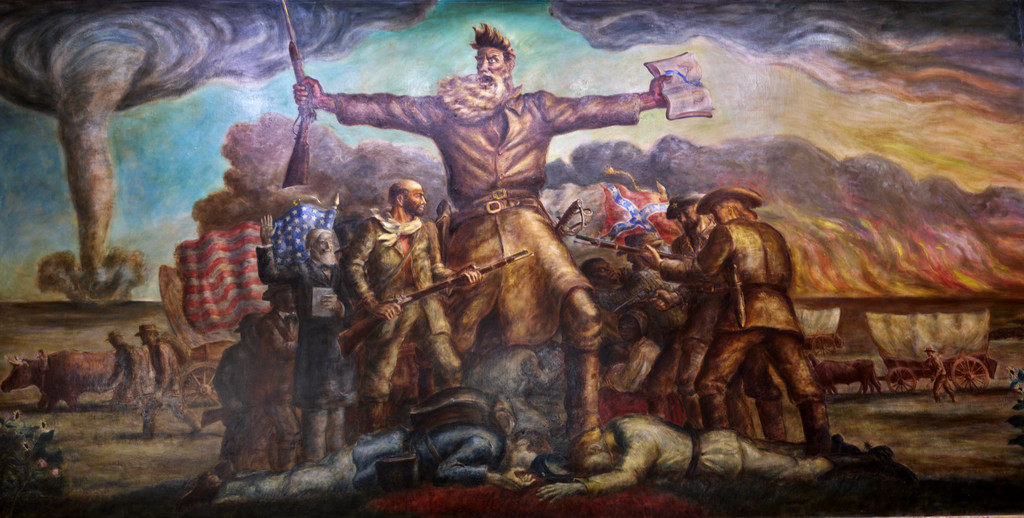
Tragic Prelude extends across the north and east walls of the east corridor. Its best-known section centres on John Brown with a firearm and Bible, his outstretched arms dividing the surrounding groups. The Kansas Historical Society interprets the storm and fire through the gathering conflict that led toward the Civil War. Its historical subject is given the bodily scale and atmospheric force familiar from Curry’s other major works. [10] [12]
The north-wall section rewards attention to different scales of action. Brown’s upright body towers above the fallen figures at his feet. Armed men occupy the middle distance, while wagons, cattle, fire and weather extend the scene across the landscape. The arrangement gathers violence and movement around a central figure whose gestures remain legible from across the corridor.
An isolated photograph of that section cannot show the entire arrangement around the corner. The architectural setting matters: walls turn, doors and lamps interrupt views, and a visitor’s position changes which parts can be seen together. The corridor photograph accompanying this overview helps restore some of that physical context to a composition often encountered as a single flat image.
The Kansas Historical Society dates completion of the main corridor panels to 1940. The planned rotunda work depended on removing marble panels to make room for painting. Legislative opposition to that removal in 1941 prevented the central sequence from proceeding. The site’s mural-tour introduction records the end of Curry’s work in summer 1942. These dates describe different stages of one troubled commission. [10] [11] [13]
The distinction explains why the surviving paintings can be complete as corridor panels while the programme remains unfinished. Curry left them unsigned because the intended whole had not been realized. They were present in the building during his lifetime; their unsigned state does not mean they were first installed after his death. The abandoned rotunda is an absence within the historical design, not a missing portion of Brown’s painted body. [10]
The surviving Kansas Pastoral also belongs to that account. Its abundance provides a different register from the conflict of Tragic Prelude . Read across the intended sequence, the two corridor subjects were meant to relate through the intervening history of settlement and land use. The loss of that connection helps explain the importance Curry attached to the unexecuted work.
The project’s reception continued to change after Curry’s death. The Kansas Historical Society records that a 1992 Senate resolution acknowledged the legislature’s poor treatment of the artist. That later recognition forms another chapter in the murals’ public history. [11]
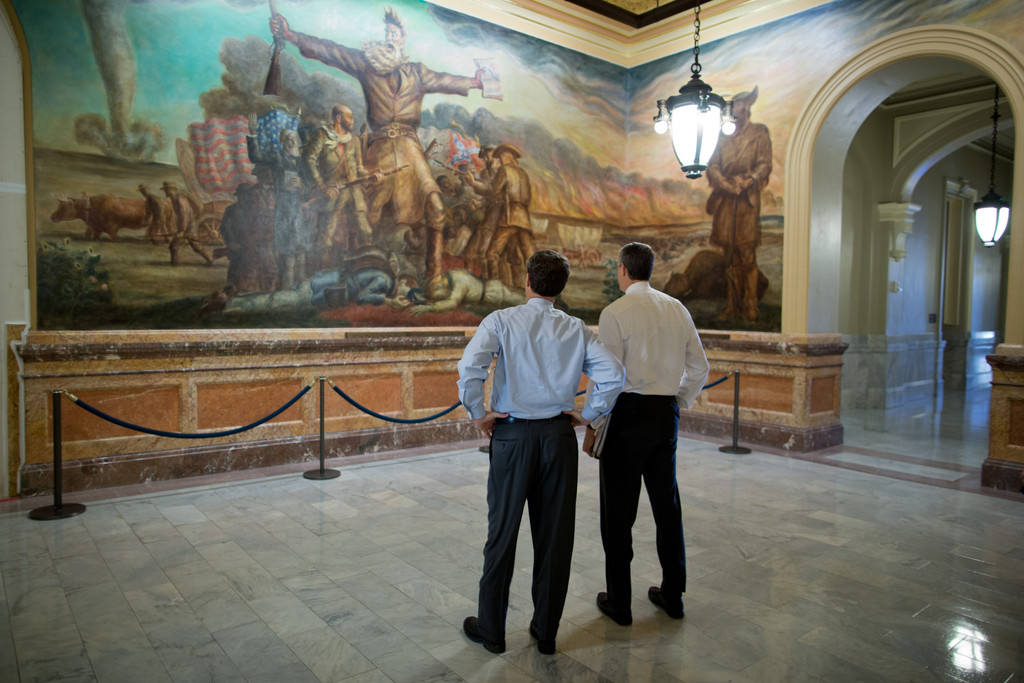
Sam Brownback and Arne Duncan viewing Tragic Prelude at the Kansas State Capitol, 18 September 2012. Photograph by Chuck Kennedy. This installation view includes people and architectural surroundings.
Image source
.
CC BY 2.0
. Proportionally resized; original appearance retained.
Wisconsin murals and the university
Wisconsin provided another institutional setting for Curry’s public art during his years as artist-in-residence. The Law Library’s Freeing of the Slaves , painted in 1942, developed from the design rejected for the Justice Department. The library’s own account identifies Dean Lloyd Garrison as the patron who recognized its possibilities for the reading room. Garrison was the grandson of the nineteenth-century abolitionist William Lloyd Garrison. [14]
The new setting gave the subject a different audience and institutional relationship. A design judged unsuitable for one government building became a major image within a place of legal study. Its history connects public art with individual patronage as well as official review, showing how the fate of a composition could change when another supporter and architectural space became available.
Historian Steve Kantrowitz, in a 2012 university discussion, emphasizes the agency of the Black figures in the composition. His reading places formerly enslaved people at the centre of their own liberation, rather than treating emancipation solely as an action performed for them by others. That interpretation adds a historical argument to the mural’s visible concentration on raised arms and a commanding central body. [15]
Paul Reidinger’s 1985 account supplies a more practical perspective. Reporting the recollections of law librarian Maurice Leon, he describes Curry and an assistant working from scaffolding above a circulation desk that remained in use. The same article describes the image’s canvas-covered support within the shaped space at the top of the north wall. This later institutional account gives the making of the mural a place within the library’s everyday activity. [16]
Curry’s Biochemistry Building murals addressed another university purpose. A 2011 conservation report dates the group to 1941–43 and describes images connecting scientific research with agricultural productivity and household well-being. Scenes of weak crops and animals contrast with healthier, more abundant conditions; scientists, farm life and a family meal belong to an account of research’s social benefits. [17]
The report distinguishes the stairwell foyer from the Seminar Room, where the imagery includes a rainbow over a Wisconsin farmstead. The locations offer different ways of encountering the work: a surrounding architectural ensemble and a room in which several walls carry the painted programme. The agricultural subjects are closely connected with the work of the building that contains them.
The Law Library and Biochemistry commissions broaden the meaning of Curry’s rural identity. On campus he painted emancipation, scientific labour, farms and households within a network of educational spaces. The Wisconsin overview follows that relationship between artistic practice and the university in greater detail.
Materials, architectural setting and later care
The scale of a mural does not identify its technique. The GSA describes the Washington works as oil on canvas, while Wisconsin conservation reporting distinguishes different canvas weights and handling within a single building. Their attachment to walls does not make them frescoes. The style and technique study considers these material differences alongside Curry’s easel paintings. [2] [8] [17]
Surface coatings posed another set of problems. Conservators Lance Mayer and Gay Myers describe Curry’s efforts to manage the appearance of the Kansas murals, including his dissatisfaction with some varnishing results and his exchanges with other artists and manufacturers. Those documentary discussions connect technical choices with the way a large painting appears within a room. [18]
Later care adds another chapter. The Wisconsin conservation account describes cleaning, repair of damaged or detached canvas, treatment of small losses and a protective coating in 2011, informed by records of work in 1985. It also explains the precautions taken during building renovation. Murals can be affected by the maintenance of the architecture around them as well as by changes within their own materials. [17]
These histories help qualify what a reproduction shows. A photograph records a surface under particular lighting, often from below or at an angle. A cropped image can clarify the composition while losing the room’s scale and neighbouring features. Using both a closer view and an architectural photograph allows different parts of the encounter to remain visible without confusing the two.
Looking across the different commissions
The commissions share Curry’s attention to bodies under pressure, but their public arguments differ. The Justice murals frame migration and mob violence through the idea of law. The Interior pictures connect movement, property and labour. Kansas places conflict and agriculture within a contested state history, while Wisconsin links his art with emancipation and the university’s educational mission.
Revisions and refusals are central to that history. A design may change before approval, a figure may be altered after installation, and a subject may find a new destination years after rejection. The surviving walls represent the outcomes of those processes. Studies and documentary accounts make the alternatives visible, helping readers understand how public images acquired their final forms.
Curry’s place among American artists and within American Regionalism becomes richer through these differences. His rural subjects entered institutions with distinct expectations about history, citizenship and knowledge. Looking from one commission to another reveals how the same forceful visual language could serve, question or complicate those expectations.
Artworks and versions directory
Browse 84 selected object, version, edition and reproduction records. Several concern related images or different impressions; this is not a complete lifetime catalogue or a count of unique compositions. Search also finds prints, photographs and reproductions; the medium filter groups paintings and drawings.
Frequently Asked Questions
No. The GSA identifies the Washington murals with the Section of Painting and Sculpture. Their particular programme should be distinguished from the WPA Federal Art Project. [1]
Curry regarded the intended programme as incomplete after the rotunda sequence was prevented. He left the completed corridor paintings unsigned. [10]
Discussion
Look again at the images and ideas explored in John Steuart Curry Murals. These editorial prompts invite your observations.
Reader Insights
How does the meaning of a painting change when it is placed in a justice building, state capitol or university library?
Compare the large central figures in Tragic Prelude and Freeing of the Slaves . What kinds of historical action are organized around each body?
What do rejected studies and unfinished programmes add to an understanding of the murals that reached the wall?
Join the Conversation
Share a detail, comparison or question about John Steuart Curry Murals below.
References
- General Services Administration , John Steuart Curry: artist and collection overview. View source
- General Services Administration , Justice of the Plains: The Movement Westward, 1936. View source
- General Services Administration , Law Versus Mob Rule, 1936. View source
- General Services Administration , Study for Westward Movement, around 1935. View source
- Smithsonian American Art Museum , Oh Freedom! John Steuart Curry. View source
- General Services Administration , Study for Freeing of the Slaves, around 1935. View source
- General Services Administration , The Homesteading and the Building of Barbed Wire Fences, 1939. View source
- General Services Administration , Rush for the Oklahoma Land – 1894, painted 1939. View source
- General Services Administration , The Oklahoma Land Rush, 1939, smaller Oklahoma City canvas. View source
- Kansas Historical Society , Kansas State Capitol: Curry murals. View source
- Kansas Historical Society , Curry’s Studies for Kansas State Capitol. View source
- Kansas Historical Society , Tragic Prelude: online mural tour. View source
- Kansas Historical Society , Curry murals: online tour introduction. View source
- University of Wisconsin–Madison Law Library , 75th Anniversary of John Steuart Curry’s Freeing of the Slaves. View source
- Mary Ellen Gabriel , UW Curry mural tells forgotten emancipation story, 1 November 2012. View source
- Paul Reidinger , The Law School’s Curry Mural, The Gargoyle 16, no. 1 (Summer 1985), pp. 10–11. View source
- Dennis Chaptman , Treasured campus murals conserved for future generations, 25 October 2011. View source
- Lance Mayer and Gay Myers , Old Master Recipes in the 1920s, 1930s, and 1940s: Curry, Marsh, Doerner, and Maroger, JAIC 41, no. 1 (2002), Curry section 2.1–2.5. View source
- Splash image source.
John Steuart Curry, Tragic Prelude, Kansas State Capitol. North-wall composition photographed by Carol M. Highsmith, 2021, Library of Congress. The mural continues onto an adjoining wall. No known restrictions on publication; underlying mural public domain . Proportionally resized; original appearance retained.
View source
More CURRY Paintings
Our Good Earth
1942 painting and its related prints and wartime imagery.
Wisconsin Landscape
1938–39 panorama of working farmland, held by The Met.


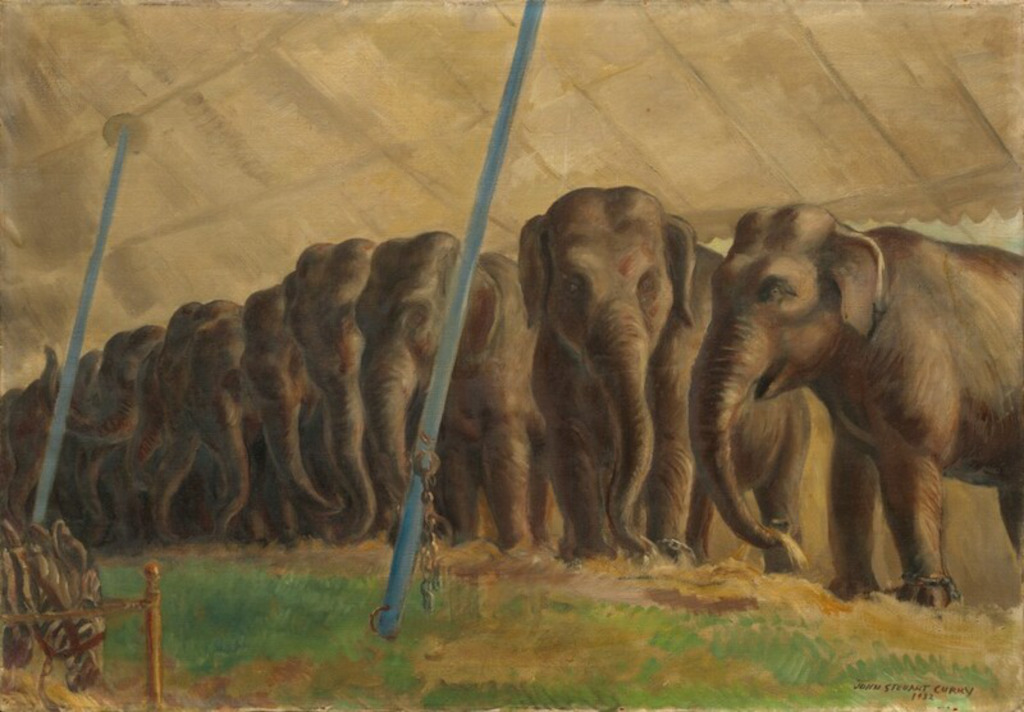
Circus Elephants
1932 painting of elephants, handlers and the work behind the circus.