


 by
Tom Gurney
Tom Gurney BSc (Hons) is an art history expert with over 20 years experience
Email:
tomgurney1@gmail.com
/ Phone:
+44 7429 011000
Wisconsin Landscape by John Steuart Curry: Introduction
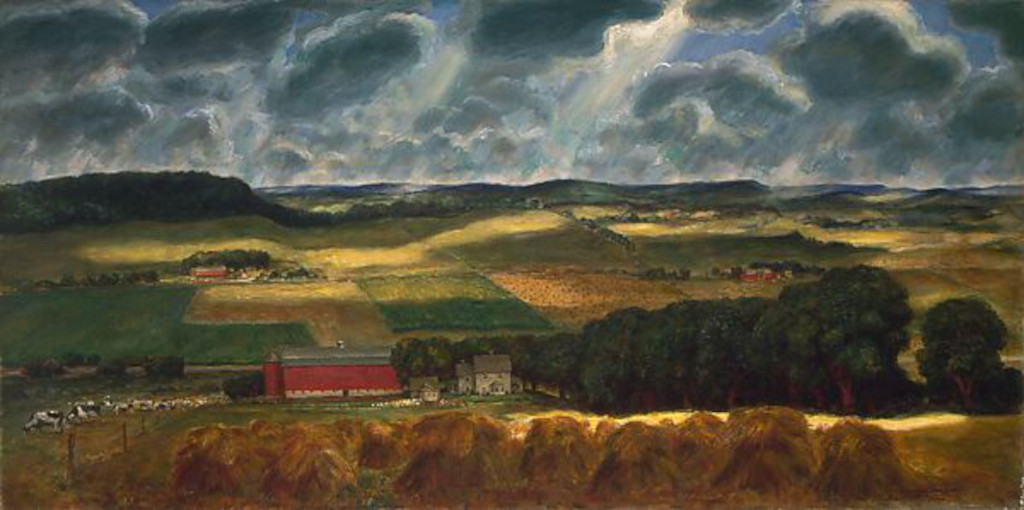
A gathered harvest, dairy cattle, red barns and cultivated fields extend across John Steuart Curry’s Wisconsin Landscape . Above them, an enormous sky gathers the view into a single broad panorama. Painted in 1938–39, the oil on canvas belongs to the Metropolitan Museum of Art, which acquired it in 1942 through the George A. Hearn Fund. [1]
The scene is rich in recognizable farm details, but it does not offer a straightforward map of one property. Its interest lies in how Curry brings those details together: the foreground harvest, sheltered buildings, patterned fields and moving cloud shadows become parts of an ordered agricultural world.
At a Glance
- Artist John Steuart Curry, 1897–1946.
- Title Wisconsin Landscape .
- Date 1938–39.
- Medium Oil on canvas.
- Dimensions 42 × 84 inches, or 106.7 × 213.4 centimetres.
- Collection Metropolitan Museum of Art, New York.
- Credit George A. Hearn Fund, 1942.
- Object number 42.154.
- Related work Study for Wisconsin Landscape , about 1938, Met accession 1997.424.
- Recognition Purchase prize at the Met’s Artists for Victory exhibition.
This work across John Steuart Curry’s career
Circus Elephants
1932 paintingThe Mississippi
1935 paintingAjax
1936–37 oil paintingTragic Prelude
1938–40; project 1937–42Our Good Earth
1942 oil paintingNotes and sources
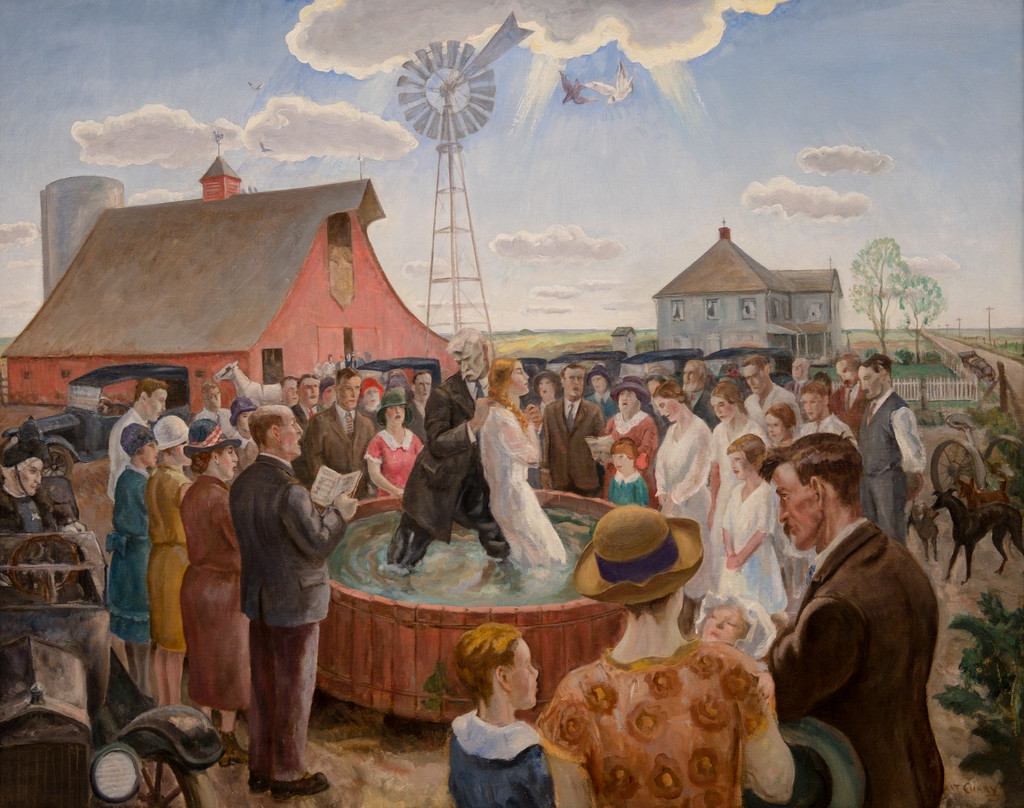
Baptism in Kansas. A remembered Kansas ceremony is staged within a working farmyard. [2]
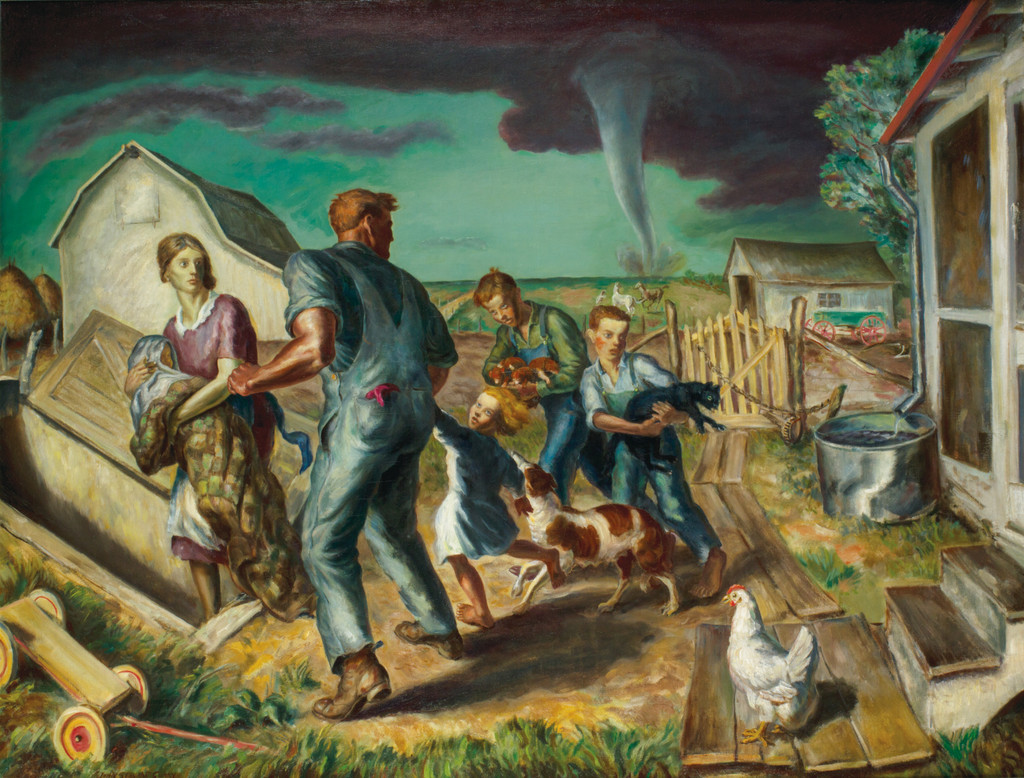
Tornado Over Kansas. A Kansas storm and a family seeking shelter, painted in Curry’s Westport studio. [3]
Circus Elephants. Elephants and handlers occupy the working space beneath a circus tent. [4]
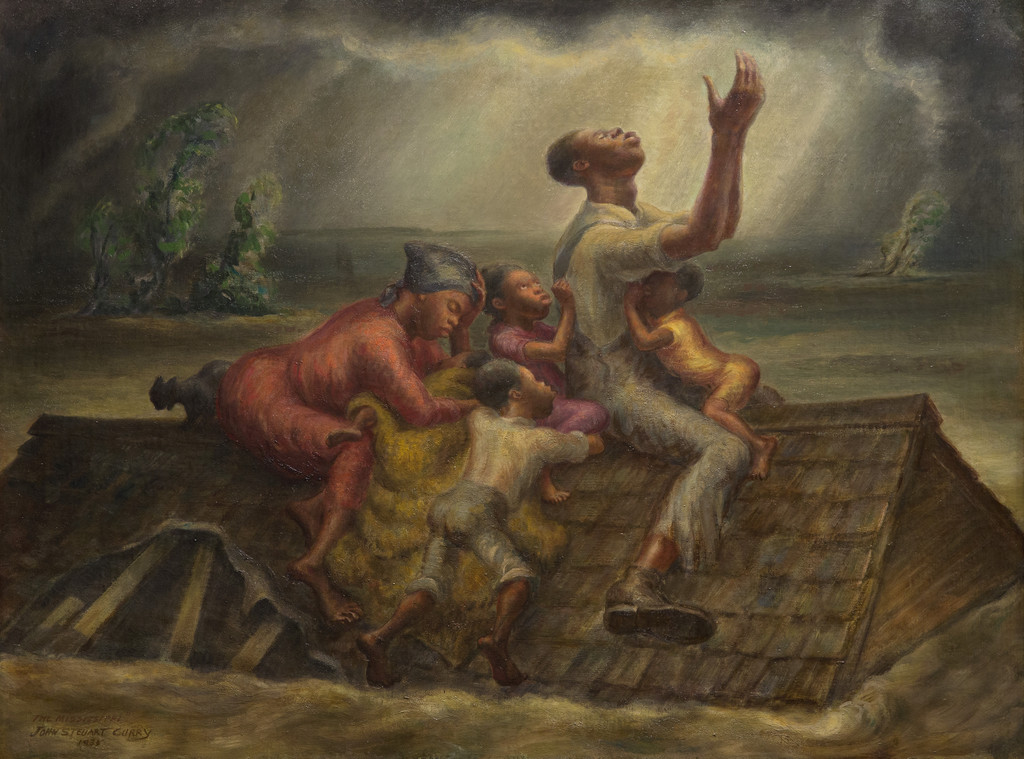
The Mississippi. A family occupies a roof amid floodwater; the painting is tempera on canvas mounted on panel. [5]
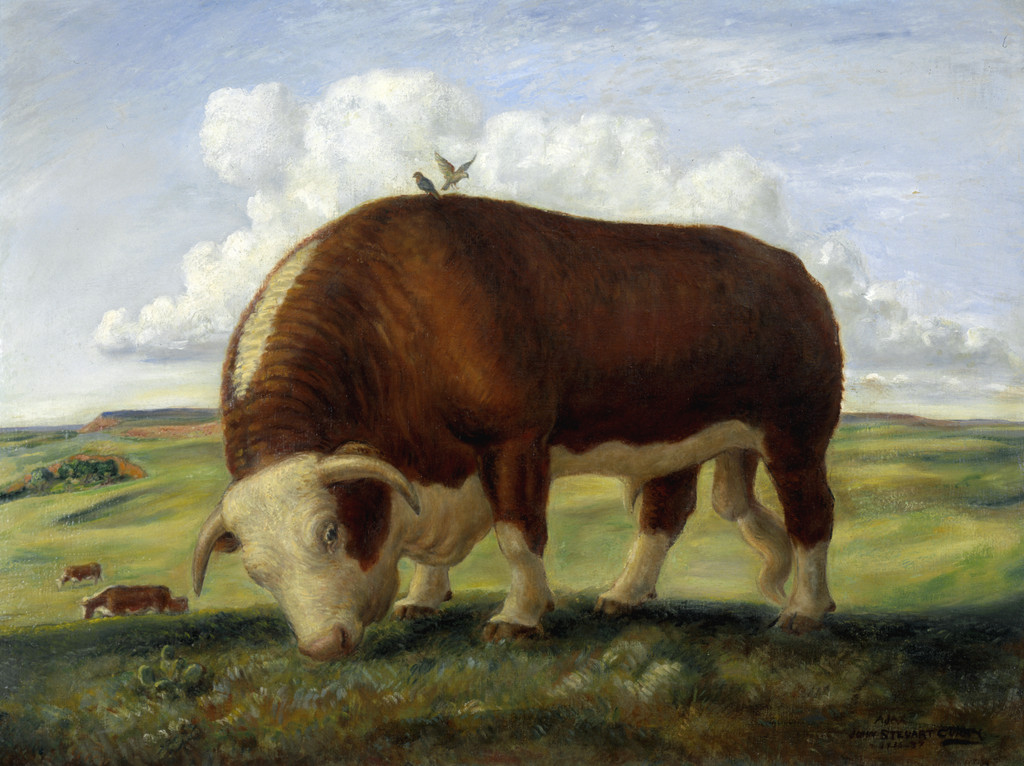
Ajax. The monumental bull in the Smithsonian oil differs from the earlier lithograph. [6]
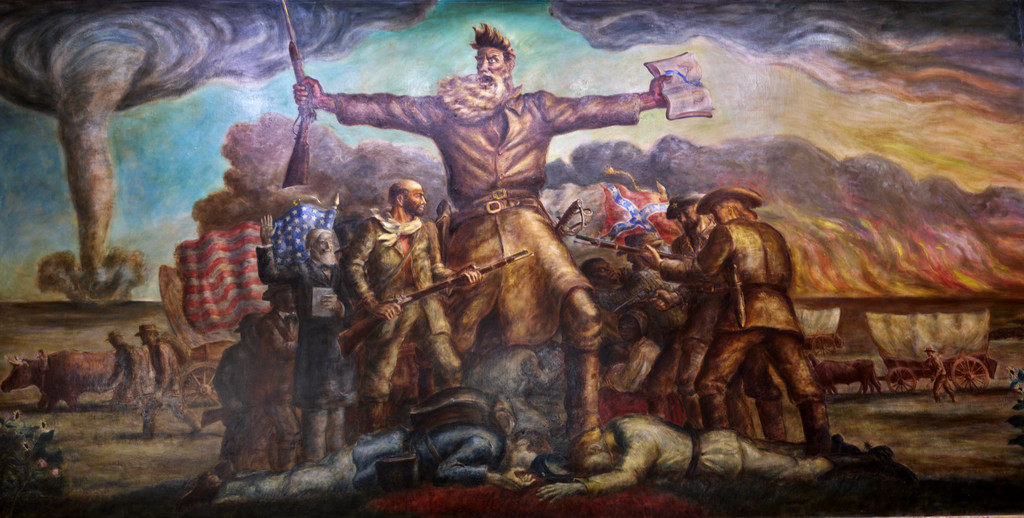
Tragic Prelude. John Brown stands at the centre of a Kansas State Capitol mural continuing across adjoining walls. [7]
Wisconsin Landscape (current article). An extensive farm panorama, distinct from the separately catalogued preparatory study. [1]
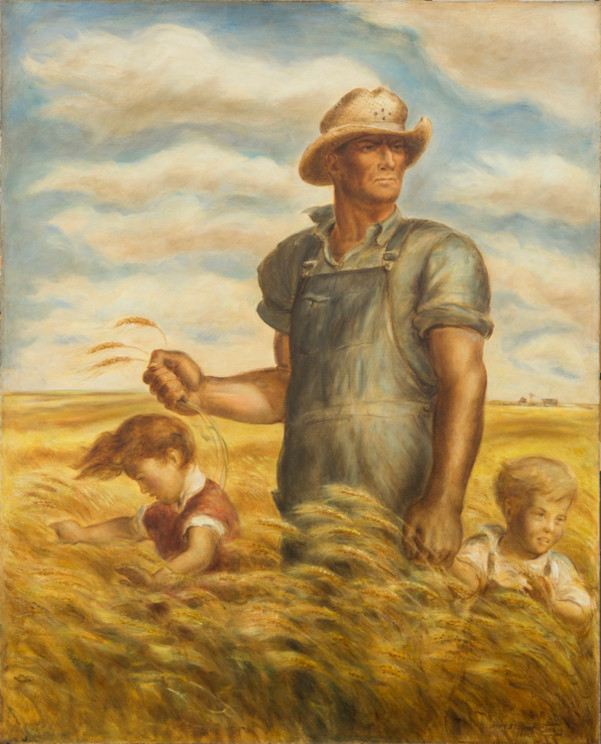
Our Good Earth. The Chazen painting is distinct from the watercolour study, lithographs and wartime posters. [8]
Contents
- A broad view across working farmland
- Harvest, cattle and the farm buildings
- Fields joined by light and cloud shadow
- A composite countryside and its local associations
- The university setting
- The separate preparatory study
- Recognition and the 1942 museum purchase
A broad view across working farmland
The canvas is twice as wide as it is high, giving the countryside room to unfold sideways. The eye can travel from the cattle at the left through the central buildings and across the trees at the right. Beyond that nearer farm, further holdings occupy the rolling land. The picture offers several distances without concentrating everything around one large human figure.
The main barn provides an especially clear point of attention. Its red side and long roof contrast with the surrounding greens and browns. A house and smaller buildings stand nearby, with trees gathering behind and around them. The group makes the farm appear settled within the landscape rather than placed against an empty background.
The distant buildings repeat that relationship on a smaller scale. Their reduced size allows the panorama to remain inhabited far beyond the foreground. The painting’s breadth is therefore measured partly through human constructions: a nearby barn, another farm across the fields, and still smaller signs of occupation toward the horizon.
Harvest, cattle and the farm buildings
Large bundles from the harvest occupy the lower edge. Their rounded, uneven forms introduce a warm foreground before the more regular shapes of the cultivated fields. They give agricultural production a tangible presence close to the viewer, where it can be encountered as material gathered from the land.
At the left, cattle stand beside a fence and lead attention toward the farmyard. Their black-and-white bodies form small, distinct accents against the earth. Along with the barn and surrounding fields, they make the scene a working agricultural setting, even though no dramatic act of labour dominates it.
The buildings and harvest also establish different kinds of order. Roofs and walls provide firm outlines; the gathered crop has a softer, more irregular surface. Both belong within the same cultivated environment. Curry allows the landscape to appear productive through things that have been grown, gathered, built and maintained.
That emphasis gives the painting a different centre from Our Good Earth . There, an imposing farmer makes agricultural strength bodily and immediate. Here, the relationship among fields, animals and structures carries much of the subject’s meaning. The land itself becomes the principal field of attention.
Fields joined by light and cloud shadow
The fields form a patchwork of greens, yellows and brown earth. Their boundaries cut across the rolling ground without eliminating its changes in height. These divisions create a pattern that the eye can follow into the distance, while trees and buildings interrupt it at intervals.
Light prevents that pattern from becoming static. Bright stretches lie beside broad areas of shadow, making some slopes stand out while others recede. The changing illumination connects the land to the clouds above it. What happens in the sky has consequences across the surface below.
The dark tree mass at the right gives particular force to a strip of illuminated ground behind the foreground harvest. The contrast creates depth through alternating bands rather than through a single receding road. Near and far remain connected, but the eye must move through changes of brightness to reach the horizon.
The sky occupies a substantial share of the canvas. Its clouds are large and active, with darker undersides and lighter openings. They introduce a scale beyond the individual farm. The agricultural order appears extensive and established, yet it remains under conditions that human activity cannot fully control.
The relationship between earth and sky gives the picture movement without requiring a central episode. A viewer can move from a sunlit field toward a dark cloud, then return to a different bright patch farther across the valley. The whole view remains available, but it is not apprehended with equal emphasis at every point. Light makes the landscape a sequence of encounters within one continuous space.
Weather carries a different kind of narrative in Curry’s Tornado Over Kansas , where a family moves toward shelter. In Wisconsin Landscape , no comparable emergency organizes the foreground. Attention spreads across the farm and the surrounding land. The clouded sky adds energy and uncertainty to an image whose harvested crop and maintained buildings otherwise suggest the continuity of ordinary agricultural life.
A composite countryside and its local associations
The Met describes the painting as an idealized composite of farm scenes Curry encountered in the Midwest. It also reads the abundance as a vision that sets aside the difficulties farming communities faced during the Great Depression. That interpretation makes the picture’s apparent calm a choice about representation, rather than a complete account of rural conditions. [1]
A contemporary report in the February 1943 Wisconsin Alumnus associated the scene with the area near Belleville in Dane County. The local connection and the museum’s composite interpretation need not produce an exact farm identification. Places Curry knew could contribute to an assembled view without every feature belonging to one observable position. [9]
Corey Coyle’s 2016 photograph of dairy-farm buildings near Belleville supplies a modern view of regional agricultural architecture. Its silos and barn belong to a much later moment. It is useful as geographical context, while keeping the distinction between a photographed property and Curry’s constructed panorama clear. [10]
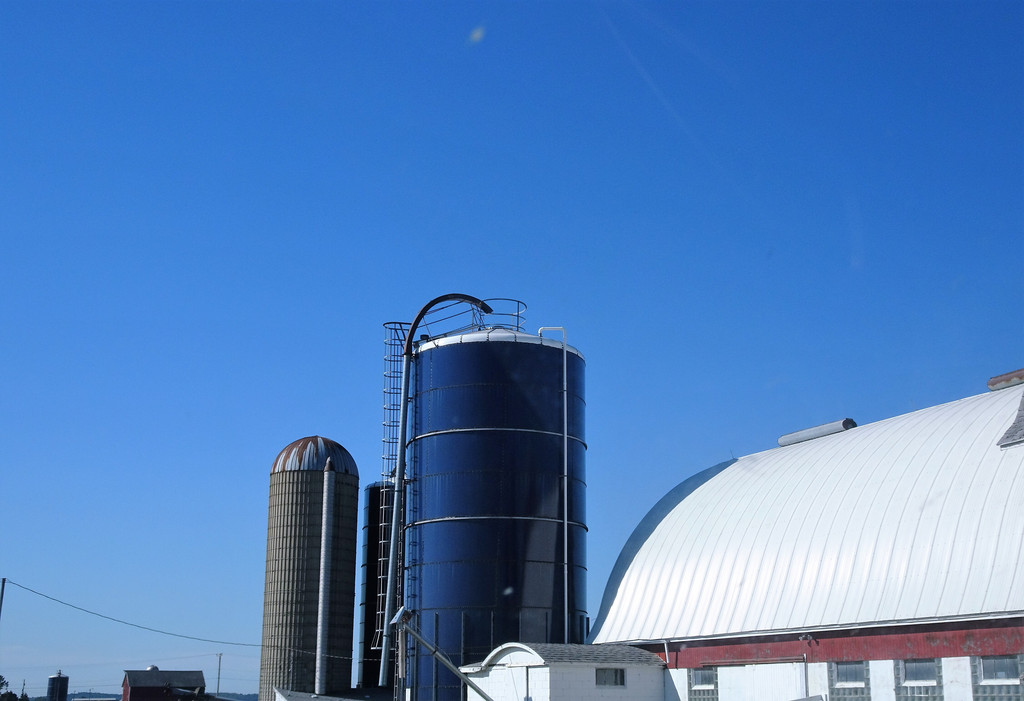
Dairy farm near Belleville, Wisconsin, photographed by Corey Coyle in 2016. Modern regional context, not an identified farm from Curry’s painting.
Image source
.
CC BY 3.0
. Proportionally resized; original appearance retained.
Watch: John Steuart Curry
Choose a film to explore the artist’s work, its interpretation and its wider setting.
Look at This: John Steuart Curry at MOWA
An exhibition interview with Graeme Reid considers Curry’s work and life in Wisconsin.
Watch on YouTubeThe university setting
Curry became artist in residence at the University of Wisconsin–Madison in 1936. A university account of his Wisconsin work emphasizes his contact with farmers and his encouragement of rural residents who made art. The setting helped connect painting with agricultural communities and audiences outside the professional art world. [11]
That relationship provides a useful context for Wisconsin Landscape . Its barns, livestock and harvested crop would have been readily recognizable to many people around the College of Agriculture. Familiarity with the subject, however, does not make the painting a simple inventory of farm life. The broad format, shifts of light and arrangement of distance turn recognizable material into a deliberately composed image.
The picture can be understood within Curry’s Wisconsin career as an expression of sustained attention to his surroundings. The agricultural world receives the scale and breadth of a major landscape, rather than appearing only as background to a portrait or narrative incident.
The separate preparatory study
The Met also owns Study for Wisconsin Landscape , dated about 1938. This smaller oil on canvas measures 50.8 by 76.5 centimetres and entered the museum as a gift from Mrs. John Steuart Curry in 1997, accession 1997.424. Its title and medium establish a related work, but its size, format and acquisition history remain distinct from those of the finished panorama. [12]
The difference in proportions is worth observing: the study’s recorded dimensions are less elongated than the finished painting’s two-to-one format. That establishes a material difference without requiring every part of the compositions to be treated as identical. The two objects document a developing landscape project, rather than one painting with two accession dates.
Recognition and the 1942 museum purchase
The Wisconsin Alumnus reported a $3,500 award for the painting at the Metropolitan Museum’s Artists for Victory exhibition. Published in February 1943, the account shows how its success was being presented to the university community soon after the event. The museum’s own object record gives 1942 as the acquisition year. [9] [1]
The painting’s date, the purchase and the later report therefore describe separate stages. Curry made the landscape in 1938–39; its national recognition and entry into the Met followed. That movement from a Wisconsin subject to a New York museum is part of the work’s history, alongside the particular countryside it celebrates.
Artworks and versions directory
Browse 84 selected object, version, edition and reproduction records. Several concern related images or different impressions; this is not a complete lifetime catalogue or a count of unique compositions. Search also finds prints, photographs and reproductions; the medium filter groups paintings and drawings.
Frequently Asked Questions
The Met dates it to 1938–39. The museum acquired it in 1942.
The Met describes an idealized composite. A 1943 university report links it with the Belleville area, but that does not establish every feature as one literal viewpoint.
No. Accession 1997.424 is a smaller preparatory study. The finished panorama is 42.154.
Discussion
Look again at the images and ideas explored in Wisconsin Landscape by John Steuart Curry. These editorial prompts invite your observations.
Reader Insights
Which feature first directs your eye into the distance: the buildings, the fields or the changing light?
How does the absence of a dominant human figure change the agricultural subject?
What might an idealized farm panorama reveal, and what might it leave outside the frame?
Join the Conversation
Share a detail, comparison or question about Wisconsin Landscape by John Steuart Curry below.
References
- Metropolitan Museum of Art , Wisconsin Landscape, 1938–39, oil on canvas, 42.154: object metadata and composite-landscape interpretation. View source
- Whitney Museum of American Art, John Steuart Curry | Baptism in Kansas | Whitney Museum of American Art. View source
- Muskegon Museum of Art, Tornado Over Kansas - Muskegon Museum of Art. View source
- National Gallery of Art, Circus Elephants: collection object record. View source
- Saint Louis Art Museum, The Mississippi,1935,7:1937: collection record and provenance. View source
- Smithsonian American Art Museum, Ajax. View source
- Kansas Historical Society, Kansas State Capitol - Online tour - Tragic Prelude - Kansas Historical Society. View source
- Chazen Museum of Art, Our Good Earth | 1873 |Chazen Museum of Art. View source
- The Wisconsin Alumnus 44 , no. 2 (February 1943), John Steuart Curry report, printed p. 146: prize and Belleville association; selected reading. View source
- Corey Coyle , Dairy Farm near Belleville, 18 September 2016: photograph and CC BY 3.0 record via Wikimedia Commons. View source
- Käri Knutson , Museum featuring works of UW’s John Steuart Curry, University of Wisconsin–Madison, 8 September 2014. View source
- Metropolitan Museum of Art , Study for Wisconsin Landscape, about 1938, oil on canvas, 1997.424. View source
More CURRY Paintings
Our Good Earth
1942 painting and its related prints and wartime imagery.
Wisconsin Landscape
1938–39 panorama of working farmland, held by The Met.


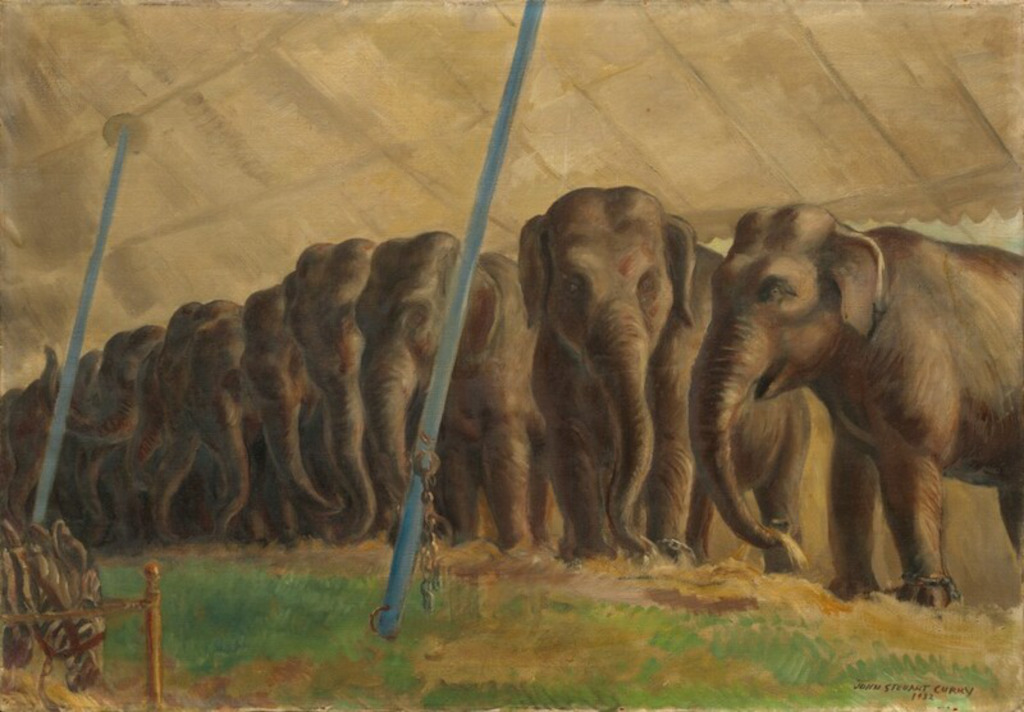
Circus Elephants
1932 painting of elephants, handlers and the work behind the circus.