


 by
Tom Gurney
Tom Gurney BSc (Hons) is an art history expert with over 20 years experience
Email:
tomgurney1@gmail.com
/ Phone:
+44 7429 011000
John Steuart Curry: Life and Career: Introduction
John Steuart Curry’s career connected a Kansas farm childhood with commercial illustration, New York exhibitions, public commissions and a university appointment in Wisconsin. The places changed, but rural experience continued to supply subjects through which he addressed a much wider audience. His life helps explain how a remembered baptism or a family facing a tornado could become part of the national discussion of American art. [1]
Born in 1897, Curry became closely associated with American Regionalism during the 1930s. His development also involved drawing, material experiments and sustained work with people outside the professional art world. The surviving sketchbooks, family papers and public paintings reveal different aspects of that working life. [2]
At a Glance
- Born 14 November 1897, near Dunavant, Kansas.
- Parents Smith Curry and Margaret Steuart Curry.
- Training Kansas City, Chicago, Geneva College in Pennsylvania, and Paris.
- First wife Clara Derrick, married in 1923; died in 1932.
- Second wife Kathleen Gould, married in 1934.
- Major professional settings Leonia, New York, Westport and Madison.
- Wisconsin residency College of Agriculture, 1936–46.
- Public commissions Federal buildings in Washington, the Kansas State Capitol and Wisconsin university buildings.
- Died 29 August 1946, Madison, Wisconsin.
- Buried Winchester, Kansas.
John Steuart Curry in context
Bars show approximate historical periods. c. means circa (about).
Social Realism
c. 1930–1945 [25]American Regionalism
c. 1930–1950 [26]The American Scene
c. 1930–1950 [27]Notes and sources
Social Realism. A connection through particular subjects. The anti-lynching subject of The Fugitive connects part of Curry’s work with art addressing racial violence; it does not define every rural picture. [3]
American Regionalism. A historical association. Curry is closely associated with Grant Wood and Thomas Hart Benton in accounts of American Regionalism. [2]
The American Scene. American subjects in the 1930s. The Smithsonian places Curry among major American Scene painters, drawing subjects from American life and history. [1]
Each bar runs from the artist’s birth to their death.
Harvey Dunn
1884–1952 · Birth–death [28]Thomas Hart Benton
1889–1975 · Birth–death [29]Grant Wood
1891–1942 · Birth–death [30]John Steuart Curry
1897–1946 · Birth–death [31]Reginald Marsh
1898–1954 · Birth–death [32]Notes and sources
Harvey Dunn. Early illustration career. The Archives of American Art describes Dunn’s influence on Curry’s early freelance illustration in Leonia. [2]
Thomas Hart Benton. American Scene and mural materials. The Smithsonian groups the artists within the American Scene; Mayer and Myers discuss Benton’s advice about mural varnish. [1] [4]
Grant Wood. Regionalism and technical exchange. Alongside their Regionalist association, the conservation study documents Curry’s interest in Wood’s materials and grounds. [4]
John Steuart Curry. Explore selected object dates in the Key works view. [1]
Reginald Marsh. Correspondence and technical interests. The Curry finding aid lists Marsh correspondence from 1938, 1940–42 and undated material, including technical notes and illustrated letters. [2]
Circus Elephants
1932 paintingThe Mississippi
1935 paintingAjax
1936–37 oil paintingTragic Prelude
1938–40; project 1937–42Wisconsin Landscape
1938–39Our Good Earth
1942 oil paintingNotes and sources
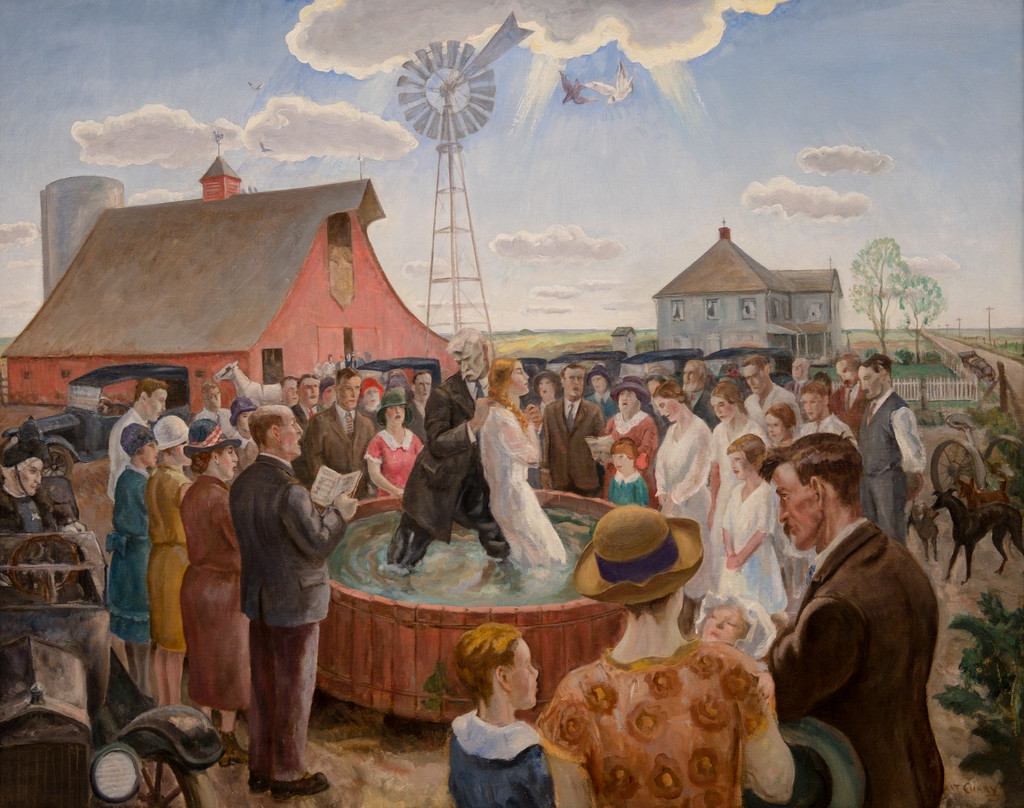
Baptism in Kansas. A remembered Kansas ceremony is staged within a working farmyard. [5]
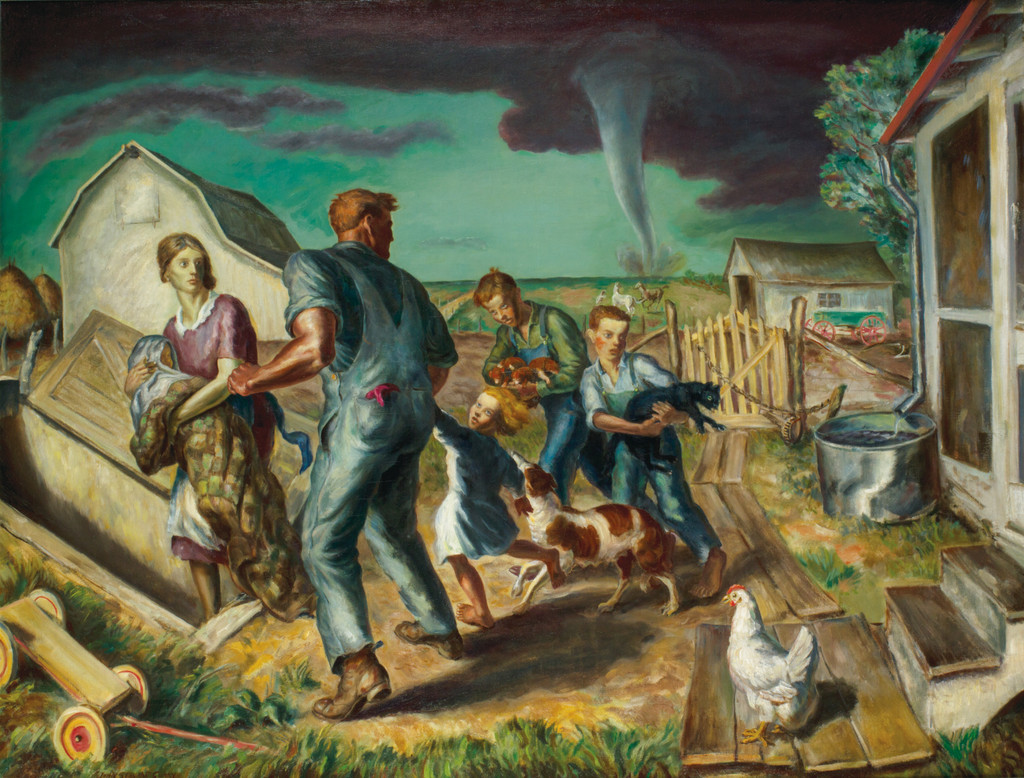
Tornado Over Kansas. A Kansas storm and a family seeking shelter, painted in Curry’s Westport studio. [6]
Circus Elephants. Elephants and handlers occupy the working space beneath a circus tent. [7]
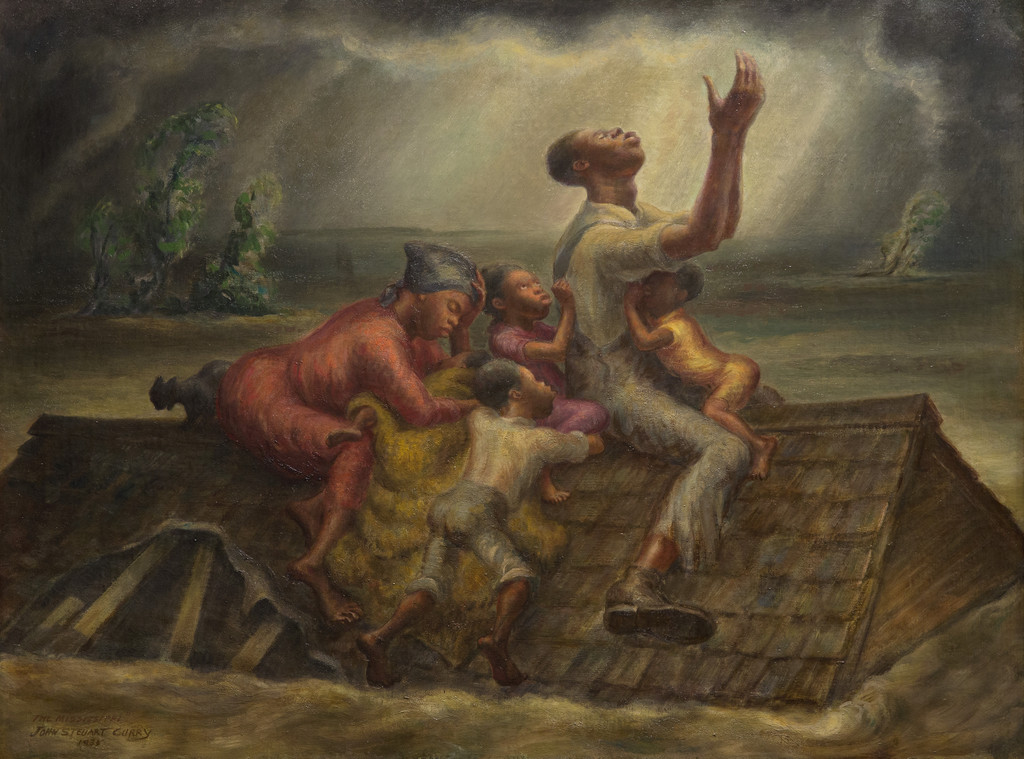
The Mississippi. A family occupies a roof amid floodwater; the painting is tempera on canvas mounted on panel. [8]
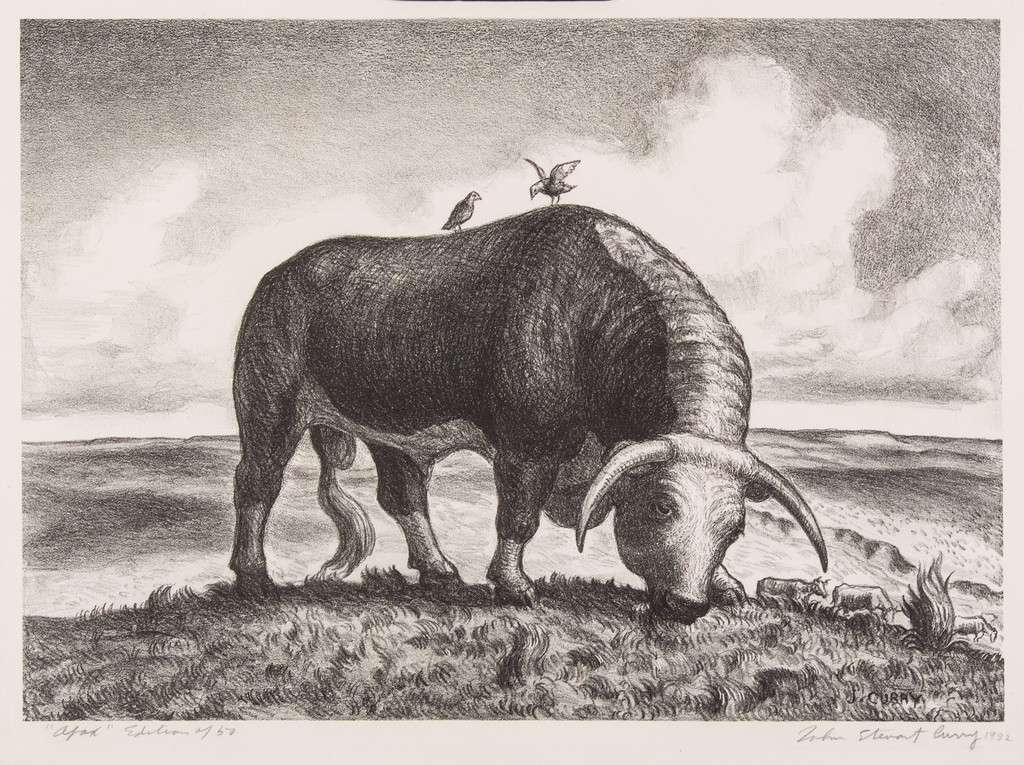
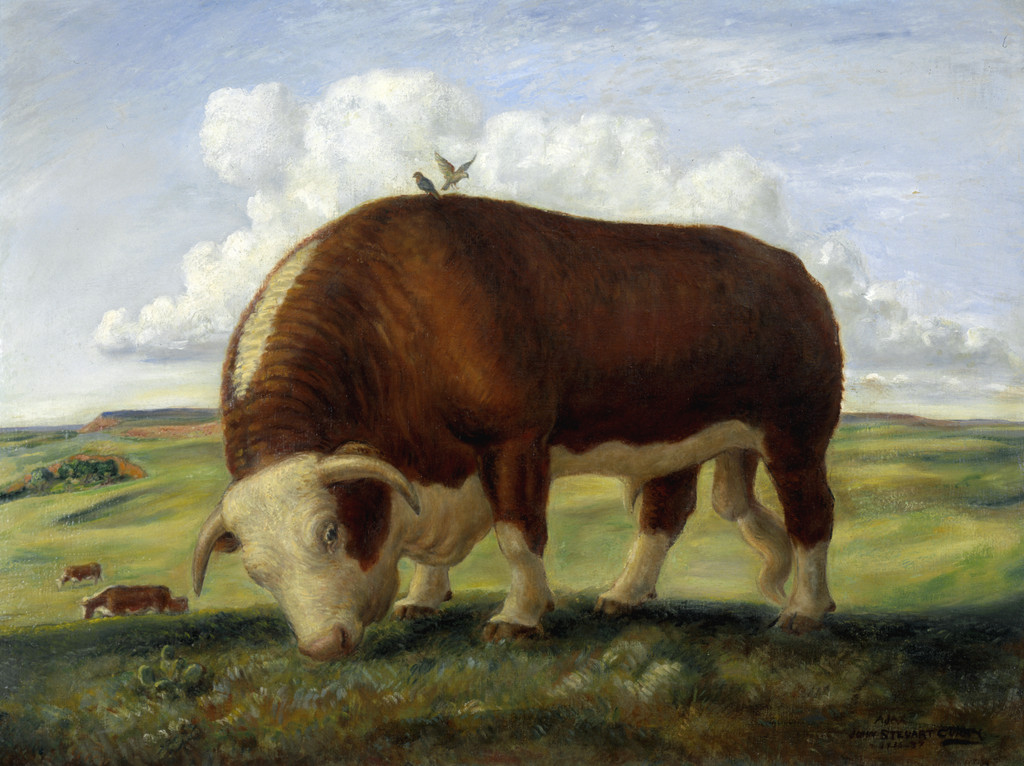
Ajax. The monumental bull in the Smithsonian oil differs from the earlier lithograph. [9]
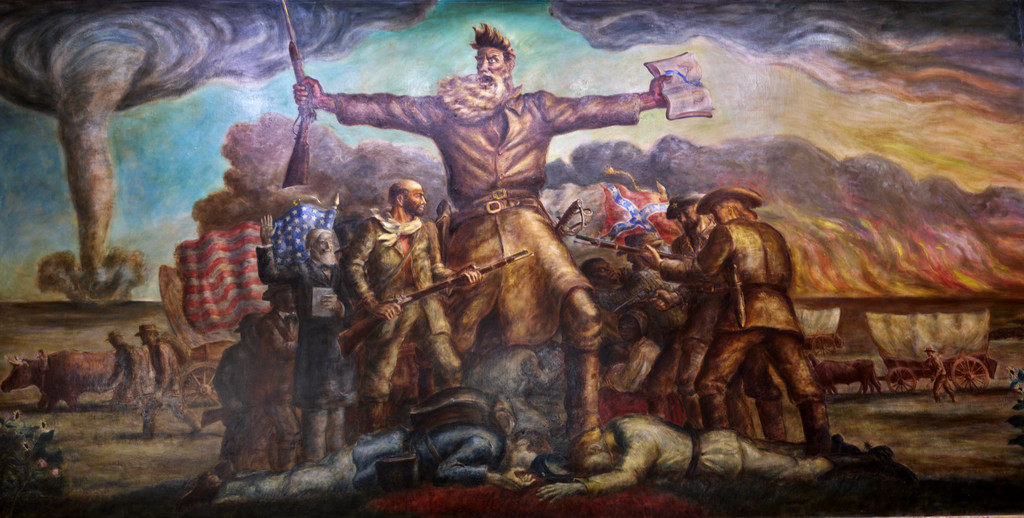
Tragic Prelude. John Brown stands at the centre of a Kansas State Capitol mural continuing across adjoining walls. [10]
Wisconsin Landscape. An extensive farm panorama, distinct from the separately catalogued preparatory study. [11]
Our Good Earth. The Chazen painting is distinct from the watercolour study, lithographs and wartime posters. [12]
Contents
- A farm childhood near Dunavant
- Art schools and commercial illustration
- Marriage and the Paris interval
- New York recognition and the Whitney
- Curry’s remembered Kansas
- The 1932 circus tour and personal loss
- Kathleen and the Wisconsin appointment
- Federal commissions and the Kansas dispute
- The final Wisconsin years
- Reputation, collections and renewed study
A farm childhood near Dunavant
Curry was born on 14 November 1897 on his family’s farm near Dunavant in northeastern Kansas. He was the eldest of five children of Smith and Margaret Curry. The Kansas Historical Society describes parents who were educated and encouraged an appreciation of art. Farm life and artistic interest therefore belonged to the same early environment, rather than to two completely separate stages of his upbringing. [13]
That environment supplied subjects he returned to for decades: livestock, working households, farm buildings, religious gatherings and weather. The later paintings make these experiences visible through selected scenes. A picture of a family entering a storm cellar concentrates the larger dependence of a household on forces beyond its control. A grazing bull offers another account of life on the land, organized around an animal’s weight and the extent of the pasture.
The relationship between childhood and finished painting requires care. Curry’s best-known Kansas pictures were made after he had left the state, and their composition involved choices made in the studio. Familiarity gave him knowledge of his subjects; drawing, memory and revision allowed him to turn that knowledge into pictures. The remembered world could remain artistically productive across changes in home, employment and audience.
Worcester Art Museum’s account of his sketchbooks places drawing throughout this development. It describes work ranging from childhood activity to sketches made near the end of his life. The broad survival of such material makes it possible to consider the adult painter alongside a continuing habit of recording and testing ideas. The dramatic paintings were one result of a much longer relationship with drawing. [14]
Four stages of John Steuart Curry’s career
These periods group related developments; painting, travel and local work overlap across their boundaries.
Learning to make pictures for an audience
A Kansas farm childhood was followed by art-school training and freelance magazine illustration. Harvey Dunn’s influence in Leonia belongs to this early professional development. [2]
From illustration towards painting
Study in Paris in 1926–27 was followed by growing recognition for paintings of American subjects. Curry held a solo exhibition at the Whitney Studio Club in 1930. [2]
Ideas moving across media
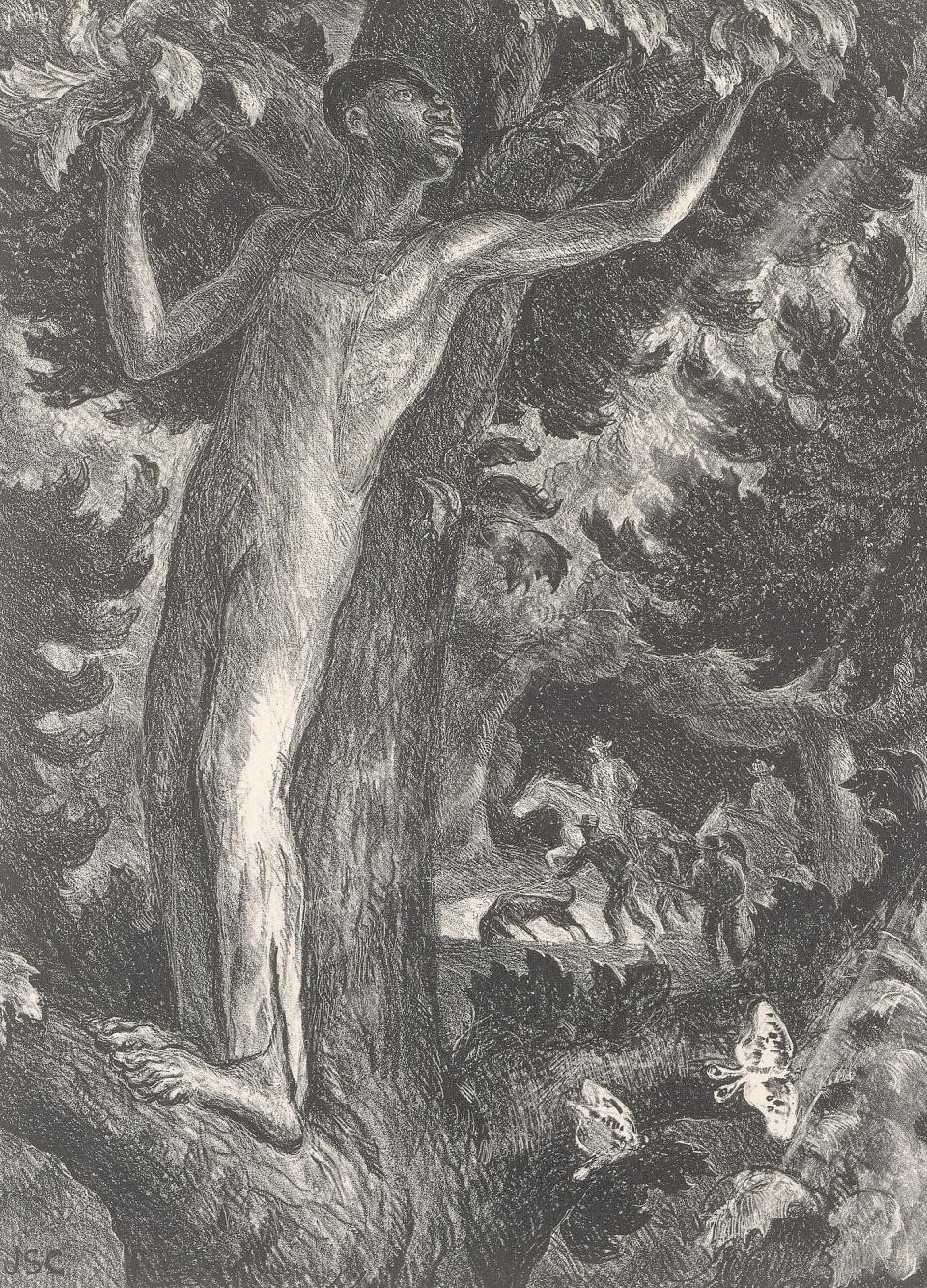
Circus drawings and other sketchbook subjects reveal Curry’s continuing attention to bodies, movement and materials. Finished drawings, experiments and notes coexist in books that record the development of ideas. [14]
An artist working with a wider community
The Wisconsin residency combined Curry’s own painting with guidance for rural artists, lectures and exhibitions. Mural projects in Washington, Kansas and Wisconsin brought further public settings to his work. [2]
Art schools and commercial illustration
Curry’s formal education took him away from the farm. He attended the Kansas City Art Institute briefly before studying at the School of the Art Institute of Chicago. The Smithsonian records his Chicago training in 1916–18 and attendance at Geneva College in 1918–19. Geneva was in Beaver Falls, Pennsylvania. These successive settings brought him into contact with kinds of instruction and professional possibility beyond his childhood surroundings. [1] [13]
Commercial illustration then provided an important field of work. In Leonia, New Jersey, he came under the influence of the illustrator Harvey Dunn. The Archives of American Art’s biographical account identifies freelance illustration as Curry’s early career and records publication in magazines including Boys’ Life , Country Gentleman and The Saturday Evening Post . The illustrated magazine offered an audience whose encounter with an image took place through a printed page. [2]
Illustration belongs within an account of Curry’s artistic experience rather than serving only as a preliminary job. It required attention to recognizable actions, figures and settings. His later paintings likewise often give viewers an event to follow: a gesture of protection, an approaching danger, a performance or a gathering. Those relationships can be examined without assuming that every later composition followed a single commercial formula.
The distinction between an illustration and an independent painting also concerned how the work circulated. Magazine images entered a publication’s sequence of stories and pages, while paintings could be submitted to exhibitions and sold as individual objects. Curry continued to move between different forms of work as his reputation grew. Book illustration and printmaking remained part of a career that eventually included large public walls and a salaried university residency. [2]
Marriage and the Paris interval
Curry married Clara Derrick in 1923. The couple lived in Greenwich Village and then established a home in Westport, Connecticut, in 1924. That East Coast setting became important to his development as a painter, providing a base from which he could work on subjects associated with Kansas while participating in the exhibition world around New York. [2]
In 1926–27 he spent a year studying in Paris with Basil Schoukhaieff. Paris added another setting for his consideration of drawing and painting. The Kansas Historical Society emphasizes his interest in artists including Courbet, Daumier, Titian and Rubens. The Louvre and the experience of European pictures belonged to the education of an artist subsequently celebrated for American subjects. [2] [13]
That history complicates a simple account of Regionalism as an art made entirely apart from Europe. Curry’s experience could include French instruction and attention to older paintings while his subjects remained strongly connected to places he knew in the United States. The large figure, the arrangement of a crowd and the handling of a dramatic event could be considered through more than one artistic tradition.
His return to the United States preceded the paintings that established his wider reputation. The development from illustrator to independent painter unfolded through exhibitions, purchases and the response to particular canvases. It was also a development within a household and a working location: the Westport studio became a place in which remembered Kansas experiences were reconsidered for a new audience.
New York recognition and the Whitney
Baptism in Kansas , completed in 1928, became a decisive picture in Curry’s career. The scene recalled a ceremony he had witnessed at a Kansas farm in 1915. A minister and candidate occupy a water tank while a community gathers around them. The farmyard’s buildings, windmill and vehicles give the religious event a specific social and material setting. [15]
The painting’s early history includes its exhibition at the Corcoran in 1928, Curry’s growing connection with the Whitney organization and his solo exhibition in New York in January 1930. The Whitney acquired the picture in 1930. These events belong to related stages of recognition, but their dates describe different things: the painting’s making, its display, institutional support and its entry into a collection. [15] [16]
Recognition gave Curry’s Kansas subjects a place within a public discussion of American painting. Viewers could encounter rural religion through expressive faces and a carefully assembled gathering, then disagree about the image’s attitude toward the people shown. Scholarship on the picture has traced responses ranging between sincerity and satire. The uncertainty was part of the painting’s force: the familiar ceremony could look both communal and unsettling. [15]
Other exhibition and collection successes followed. The Met purchased Spring Shower in 1932, and The Tornado received second prize at the Carnegie International in 1933. Such events placed Curry among the American artists whose rural subjects were gaining national attention. They also established individual pictures with their own histories, rather than a single uninterrupted story of approval. [2] [6]
Reproduction brought these successes to a different audience. The Tornado appeared in full colour in the 24 December 1934 issue of Time , before its purchase for Muskegon. The sequence helps explain the picture’s prominence: exhibition, magazine reproduction and museum acquisition each supplied another setting in which viewers could encounter it. For an artist who had worked in illustrated magazines, the national circulation of a painting also returned an independent canvas to the printed page, now with the recognition attached to his name and the work itself. [6]
Curry’s remembered Kansas
Tornado Over Kansas was painted in Westport in 1929. The distance between subject and place of execution is significant. Curry knew the experience of storms through his upbringing, but the canvas was a studio construction in which the movements of a family and the position of the storm could be brought into a concentrated relationship. [6]
Its reception shows how an image of one region could reach viewers with memories of another. Muskegon Museum of Art records a 1931 offer from a prospective buyer who associated the picture with his Michigan childhood. The museum’s eventual purchase through Ferargil Galleries came in 1935. The intervening exhibition and publication history helped turn the work into a widely recognized image of the Midwest. [6]
Curry’s position as a Regionalist developed within that wider circulation. Alongside Grant Wood and Thomas Hart Benton, he became identified with American subjects and the life of the Midwest. The association linked artists whose approaches and experiences still differed. A farm, a religious gathering or a rural family could become an artistic subject with significance for audiences far beyond its place of origin. [17]
Memory also operated on another timescale in The Return of Private Davis from the Argonne . The painting developed from 1928 to 1940 around the reburial of a Kansas soldier. Steven Trout’s study examines the work’s prolonged history and the different meanings that a military funeral could carry. The picture joins the remembered Kansas subjects to Curry’s consideration of loss, public ceremony and war. [18]
John Steuart Curry, The Tornado (Tornado Over Kansas), 1929, oil on canvas. Muskegon Museum of Art.
Image source
.
Public domain
. Proportionally resized; original appearance retained.
The 1932 circus tour and personal loss
In the spring of 1932 Curry travelled with the Ringling Bros. and Barnum & Bailey Circus. The National Gallery’s study describes a tour lasting about ten weeks, during which he made sketches that would supply material for paintings and lithographs. The circus brought animals, aerial acts and the practical organization of a travelling show into his field of observation. [19]
After his return to Westport, Curry painted subjects including Circus Elephants and The Flying Codonas . The two pictures offer different problems of physical organization. One considers the presence of large animals beneath a tent; the other turns toward aerial movement and performance. The subjects expanded his range while continuing an interest in the relationships between bodies and their surroundings.
Clara died in July 1932. The circus period therefore belongs to a time of profound personal difficulty as well as artistic activity. The National Gallery’s essay brings later biographical testimony into its account of these circumstances. Such testimony can illuminate the period while leaving room for the paintings to be considered through their particular subjects, materials and compositions. [19]
Drawing continued to connect observation with subsequent work. Worcester’s sketchbook exhibition showed circus studies among a wider range of media and subjects. A sketchbook could contain an immediate attempt to grasp an action alongside notes and more developed ideas. Its sequence records a kind of work that a single finished painting cannot show by itself. The circus pictures emerged from this continuing practice rather than from a moment of observation alone. [14]
Curry also taught at Cooper Union and the Art Students League in New York during the early 1930s. Teaching placed his experience within another professional setting, alongside illustration, exhibition painting and the emerging public commissions. His subsequent Wisconsin residency gave educational work a particular geographical and institutional focus, but it followed earlier contact with students in the city. The different activities are useful to consider together when following a career sustained through several kinds of artistic employment. [2]
Watch: John Steuart Curry
Choose a film to explore the artist’s work, its interpretation and its wider setting.
Look at This: John Steuart Curry at MOWA
An exhibition interview with Graeme Reid considers Curry’s work and life in Wisconsin.
Watch on YouTubeKathleen and the Wisconsin appointment
Curry married Kathleen Gould in 1934. Two years later he accepted an appointment as artist in residence at the University of Wisconsin’s College of Agriculture. The residency gave him a salary, a campus studio and freedom to pursue his own work alongside responsibilities to a wider rural public. The arrangement placed a recognized painter within a university’s educational activity. [2]
The Archives of American Art describes lectures, visits to art and civic groups, correspondence and guidance offered in his studio. Curry also helped organize rural art exhibitions associated with the university’s Farm and Home Week from 1940. These activities suggest how the residency operated through personal encounters and continuing encouragement as well as through the production of paintings. [2]
The university’s later account emphasizes his willingness to take amateur artists seriously. In this setting, the experience of farming could be a basis for artistic work by people who were themselves rural residents. Curry’s engagement with such audiences gives his agricultural subjects an additional context. The farm was a source of imagery and a place from which other people might begin making images of their own. [20]
Wisconsin also offered subjects for independent paintings, including expansive farmland views. Wisconsin Landscape belongs to this part of his career, while Our Good Earth connects the agricultural figure with wartime public imagery. The dedicated Wisconsin article considers these relationships alongside the university murals and the continuing importance of Kansas in his work.
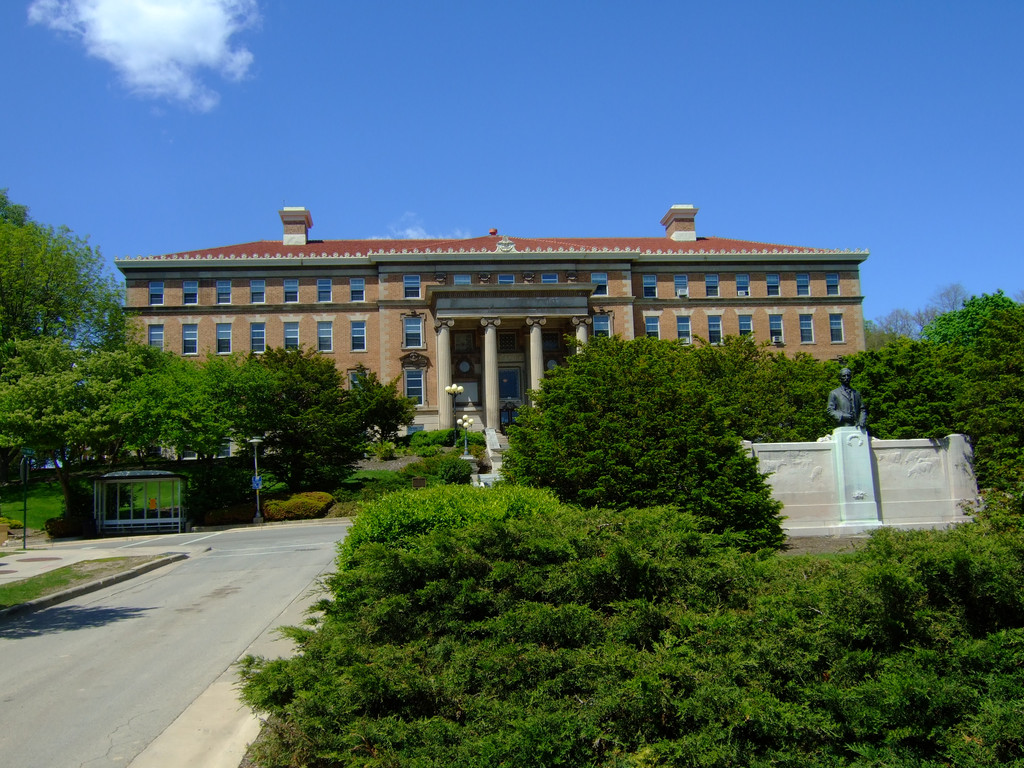
Agriculture Hall, University of Wisconsin–Madison, photographed by James Steakley in 2009. University setting; this is not a view of Curry’s studio.
Image source
.
CC BY-SA 3.0
. Proportionally resized; original appearance retained.
Federal commissions and the Kansas dispute
Curry’s public commissions involved several institutions and programmes. The federal Section of Painting and Sculpture commissioned work for the Department of Justice and Department of the Interior buildings in Washington. These projects gave him large architectural settings while bringing his proposed subjects before officials with expectations about the history and civic values the paintings should represent. [17]
At the Department of Justice, Justice of the Plains: The Movement Westward and Law Versus Mob Rule addressed the relationship between settlement, violence and authority. The GSA’s current accounts explain how proposed compositions changed through the commission process. The discarded emancipation design later developed into a mural for Wisconsin’s Law Library, showing how an idea rejected in one setting could acquire another institutional home. [21]
The Kansas programme arose from a 1937 campaign to secure Curry’s work for the State Capitol. He completed the principal corridor panels in 1940. The proposed rotunda scenes, which included the consequences of poor soil management, required changes to the marble panelling. Public opposition and a legislative resolution preventing removal of that marble obstructed the wider scheme. The completed paintings and the unexecuted proposals therefore belong to different stages of the project. [22]
Tragic Prelude became the most recognizable part of that undertaking. Its John Brown imagery, storm, fire and gathered figures made the past a powerful presence within the building. Curry ended work on the larger programme in 1942 and left the paintings unsigned. The dispute concerned both the image of Kansas offered to the public and the artist’s ability to complete his intended relationship between the different walls. [13] [22]
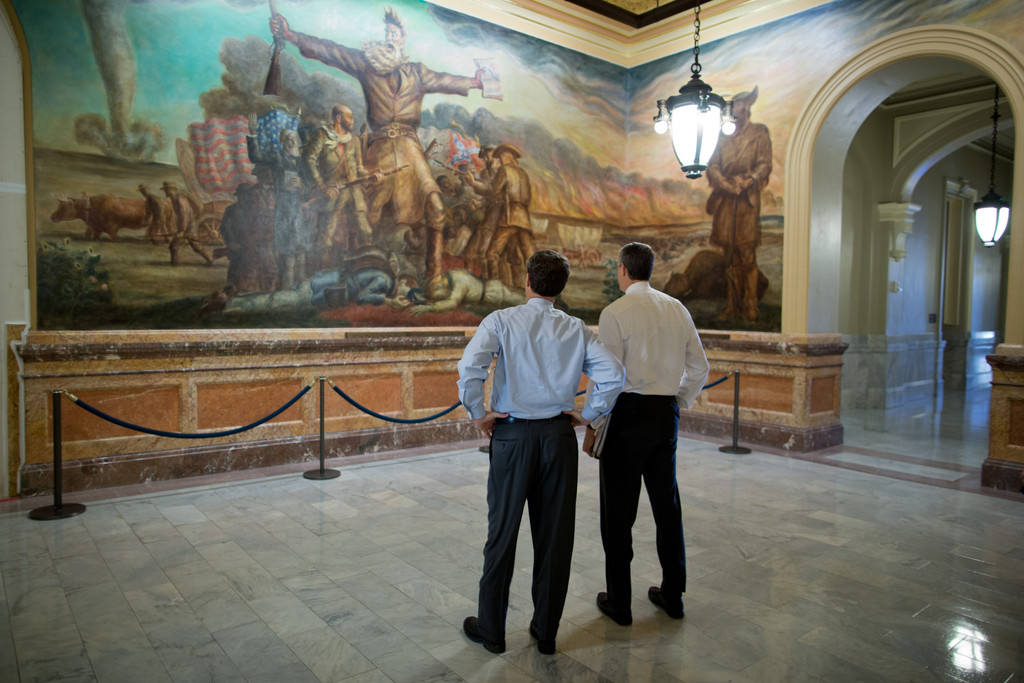
Sam Brownback and Arne Duncan viewing Tragic Prelude at the Kansas State Capitol, 18 September 2012. Photograph by Chuck Kennedy. This installation view includes people and architectural surroundings.
Image source
.
CC BY 2.0
. Proportionally resized; original appearance retained.
The final Wisconsin years
During his Wisconsin residency, Curry continued to paint, exhibit, illustrate books and develop public work. The university setting provided a base for these activities while his reputation and commissions connected him with institutions elsewhere. His career in the 1940s included agricultural imagery, the completion of campus murals and continuing attention to the making of pictures. [2]
The biochemistry murals, painted in 1941–43, addressed a different institutional audience from the State Capitol programme. The Social Benefits of Biochemical Research connected the university’s scientific activity with the wider world beyond the building. The Freeing of the Slaves , installed in the Law Library in 1942, gave a new setting to the emancipation design developed during the earlier federal commission. Together, these works show how the Wisconsin years included large public statements as well as encounters with individual rural artists. The university’s later conservation of the murals also became part of their continuing institutional history. [20] [21]
Conservation research adds another perspective on that work. Lance Mayer and Gay Myers describe Curry’s exchanges about grounds, tempera, oil layers and varnishing with artists, suppliers and dealers. Their account shows experimentation extending across different pictures. It also makes clear why a technical description belongs to a particular object and stage of work: Curry’s materials varied, and the condition of one painting cannot stand for the whole career. [4]
His correspondence with Grant Wood and other artists formed part of this practical exchange. Questions about materials joined the public subjects and regional associations through which these painters are more commonly considered. The style and technique study follows the relationship between the appearance of the works and the evidence for how they were made, including the limits of conclusions drawn from later examination.
The conservation study identifies January 1938 correspondence concerning materials used by Grant Wood and discusses exchanges with Reginald Marsh. It also examines Curry’s dealings with suppliers and the expectations of dealers over varnishing. These were questions about the practical life of a painted object: what lay beneath the image, how the layers behaved and when a surface might be treated. They bring another dimension to the friendships and professional relationships behind the public idea of Regionalism. [4]
Curry died in Madison on 29 August 1946, aged forty-eight, and was buried in Winchester, Kansas. The dates place his death at the end of a decade in Wisconsin. The pictures and public programmes of that period remain essential to an account of his life alongside the Kansas scenes that first brought him widespread recognition. [13]
Reputation, collections and renewed study
Curry’s reputation rests on both individual images and the larger questions they raise about rural America. A farmyard baptism, a tornado and the figure of John Brown became widely recognizable, but their visibility can narrow the view of a varied career. The quieter domestic paintings, circus subjects, drawings and prints provide other ways to consider the artist’s interests and decisions.
Kathleen’s preservation of his work and papers was important to later study. Material held by the Archives of American Art documents family life, commissions, correspondence and professional activity. Worcester received a substantial collection of sketchbooks and drawings in 1999. These different collections allow a career to be approached through working material and documentary history as well as through paintings on museum walls. [2] [14]
Later exhibitions have reconsidered the relationship between the familiar pictures and that broader body of work. Worcester’s 2002 sketchbook exhibition concentrated on drawing and the development of ideas. A 2014 exhibition at the Museum of Wisconsin Art focused on Curry’s Wisconsin decade, while Muskegon’s 2024 Weathering the Storm brought major paintings together with archival material in collaboration with art historian Patricia Junker. [14] [20] [23]
Those different emphases offer useful routes into the work. The painting studies follow particular subjects and objects; drawings and prints consider the development and circulation of images. The murals connect Curry’s artistic choices with the institutions and audiences for which some of his largest works were made.
Artworks and versions directory
Browse 84 selected object, version, edition and reproduction records. Several concern related images or different impressions; this is not a complete lifetime catalogue or a count of unique compositions. Search also finds prints, photographs and reproductions; the medium filter groups paintings and drawings.
Frequently Asked Questions
He was born on his family’s farm near Dunavant, Kansas, on 14 November 1897. [13]
He studied in Paris in 1926–27 with Basil Schoukhaieff and looked at European painting. [2]
He married Clara Derrick in 1923. After her death in 1932, he married Kathleen Gould in 1934. [2]
His College of Agriculture residency ran from 1936 until his death in Madison in 1946. [2]
Discussion
Look again at the images and ideas explored in John Steuart Curry: Life and Career. These editorial prompts invite your observations.
Reader Insights
Consider a Kansas painting made in Westport. How might familiarity with a place and distance from it each contribute to the finished scene?
Compare Curry’s work with rural artists in Wisconsin and his official mural commissions. What different expectations might these audiences bring?
Look at a working drawing beside a finished painting or print. Which decisions become more visible when the two are considered together?
Join the Conversation
Share a detail, comparison or question about John Steuart Curry: Life and Career below.
References
- Smithsonian American Art Museum , John Steuart Curry, artist biographies and training chronology. View source
- Archives of American Art , Smithsonian Institution, John Steuart Curry and Curry family papers: finding aid, printed pp.1–4, overview, biography and scope. For the Marsh connection, also consulted printed p.14 (PDF p.16), Box 2, Folder 61: the correspondence listing and its note about technical notes and illustrated letters. View source
- Smithsonian American Art Museum, Oh Freedom! John Steuart Curry | Smithsonian American Art Museum. View source
- Lance Mayer and Gay Myers , Old Master Recipes in the 1920s, 1930s, and 1940s: Curry, Marsh, Doerner, and Maroger, JAIC 41, no.1 (2002): 21–42, Curry section. View source
- Whitney Museum of American Art, John Steuart Curry | Baptism in Kansas | Whitney Museum of American Art. View source
- Muskegon Museum of Art , Tornado Over Kansas, object essay and reception history. View source
- National Gallery of Art, Circus Elephants: collection object record. View source
- Saint Louis Art Museum, The Mississippi,1935,7:1937: collection record and provenance. View source
- Smithsonian American Art Museum, Ajax. View source
- Kansas Historical Society, Kansas State Capitol - Online tour - Tragic Prelude - Kansas Historical Society. View source
- Metropolitan Museum of Art, Wisconsin Landscape. View source
- Chazen Museum of Art, Our Good Earth | 1873 |Chazen Museum of Art. View source
- Kansas Historical Society , John Steuart Curry, biographical entry. View source
- Worcester Art Museum , Collective Images: The Sketchbooks of John Steuart Curry, 2002 exhibition. View source
- Jeffrey Richmond-Moll , Holy Rollers: Religion and Modern Mobility in the Art of John Steuart Curry, Panorama 9, no.2 (Fall 2023), complete article. View source
- Whitney Museum of American Art , Breaking Ground: The Whitney’s Founding Collection, Curry and Baptism in Kansas section. View source
- U.S. General Services Administration , John Steuart Curry, biography and federal collection overview. View source
- Steven Trout , The Western Front Comes to Kansas: John Steuart Curry’s The Return of Private Davis from the Argonne, Kansas History 31 (Autumn 2008): 194–211. View source
- Robert Torchia , National Gallery of Art, American Paintings, 1900–1945: Circus Elephants, 1932, 2018, circus tour and biographical context. View source
- Käri Knutson , University of Wisconsin–Madison, Museum featuring works of UW’s John Steuart Curry, 8 September 2014. View source
- U.S. General Services Administration , Law Versus Mob Rule, commission changes and the emancipation design. View source
- Kansas Historical Society , Kansas State Capitol: Curry murals, commission, corridor panels and rotunda dispute. View source
- Muskegon Museum of Art , Summer 2024 journal, p.4, John Steuart Curry: Weathering the Storm . View source
- Splash image source.
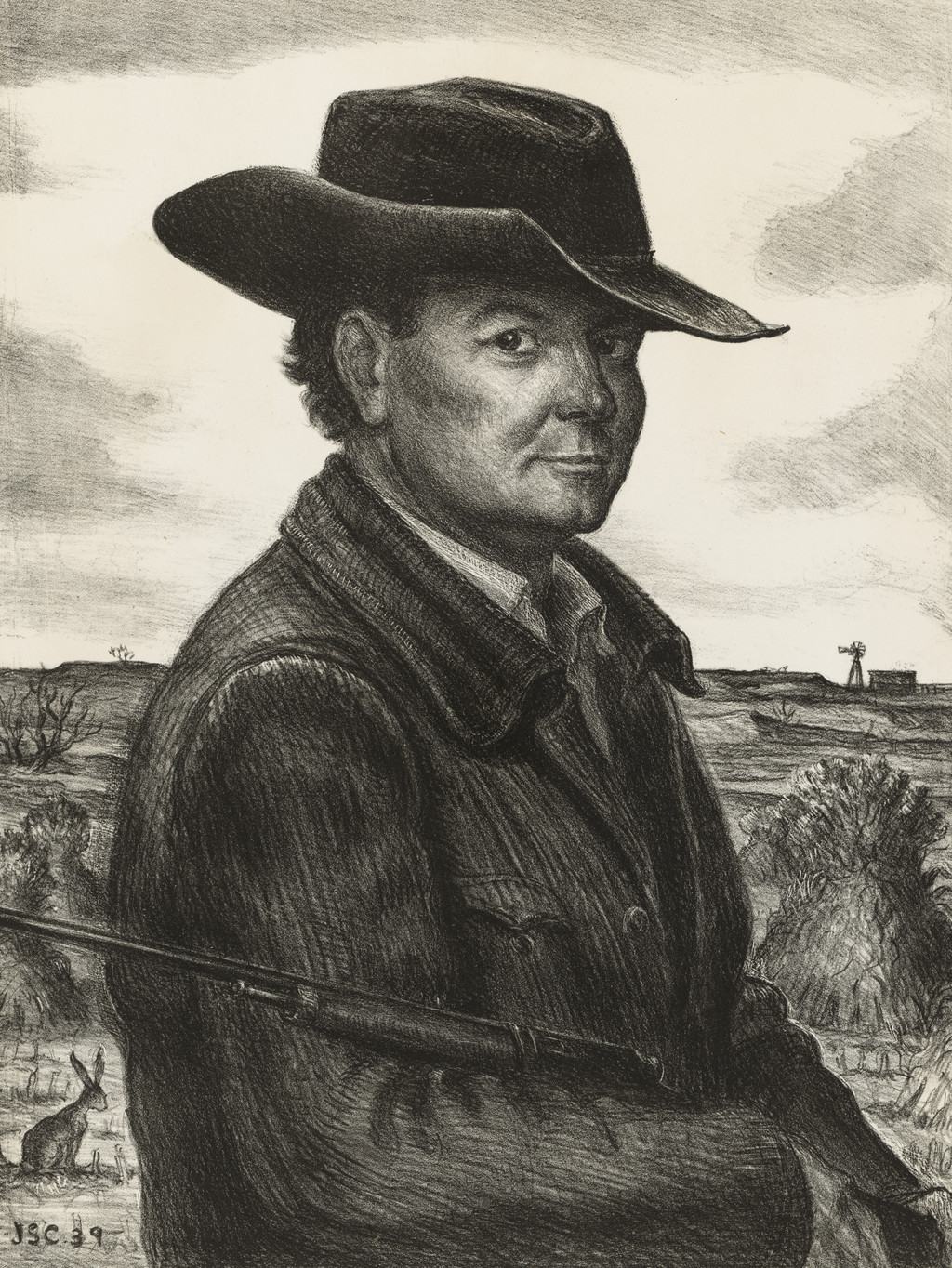
John Steuart Curry, Self-Portrait, 1939, lithograph. National Portrait Gallery, Smithsonian Institution, NPG.85.33. CC0 / public domain; US copyright not renewed . Proportionally resized; original appearance retained.
View source - Smarthistory, Social Realism period guide: c. 1930–1945. View source
- Tacoma Art Museum, “Departures and Divisions”: Regionalism and Social Realism in the 1930s and 1940s. Range rounded to c. 1930–1950 for comparison. View source
- Spencer Museum of Art, The American Scene: Graphics of the 1930s and 1940s (1985). Range rounded to c. 1930–1950 for comparison. View source
- National Museum of American History, Harvey Dunn: 1884–1952. Artist life dates. View source
- National Gallery of Art, Thomas Hart Benton: 1889–1975. Artist life dates. View source
- National Gallery of Art, Grant Wood: 1891–1942. Artist life dates. View source
- National Gallery of Art, John Steuart Curry: 1897–1946. Artist life dates. View source
- National Gallery of Art, Reginald Marsh: 1898–1954. Artist life dates. View source
More CURRY Paintings
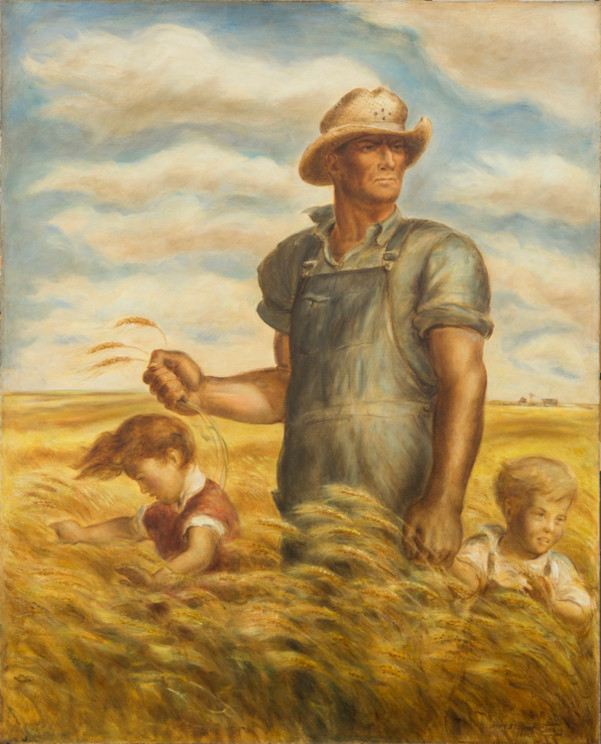
Our Good Earth
1942 painting and its related prints and wartime imagery.
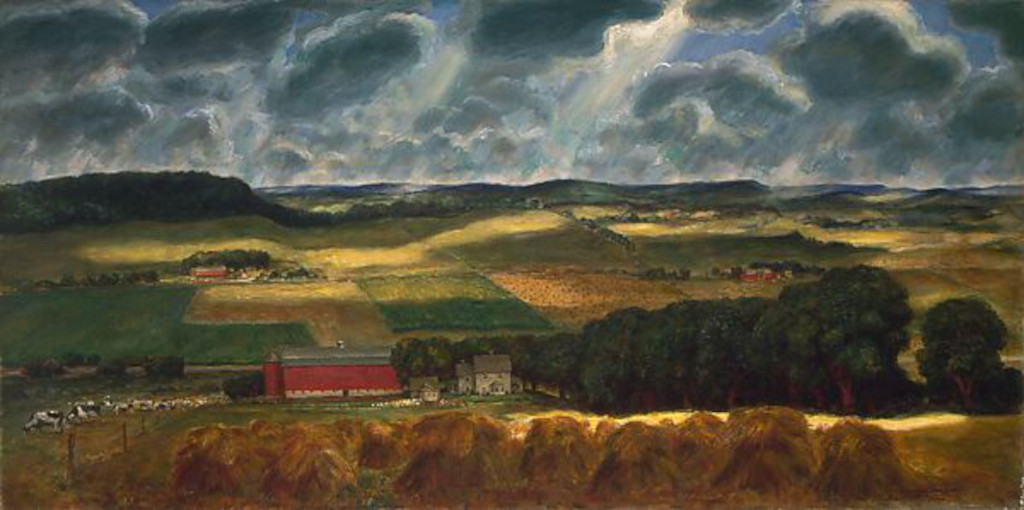
Wisconsin Landscape
1938–39 panorama of working farmland, held by The Met.


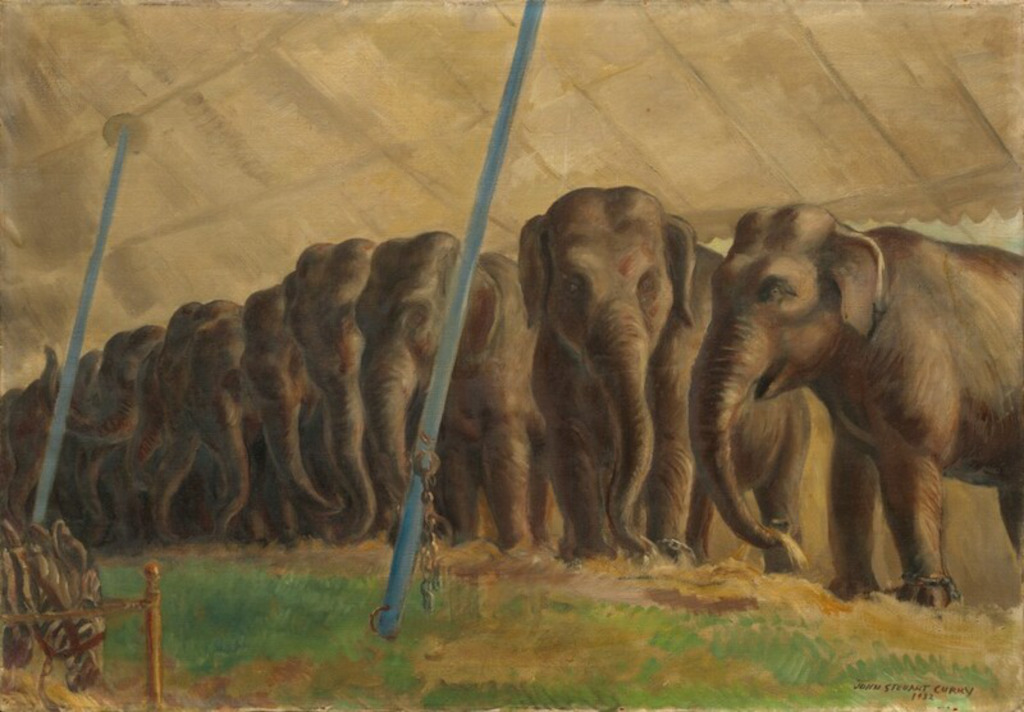
Circus Elephants
1932 painting of elephants, handlers and the work behind the circus.