 by
Tom Gurney
Tom Gurney BSc (Hons) is an art history expert with over 20 years experience
Email:
tomgurney1@gmail.com
/ Phone:
+44 7429 011000
John Steuart Curry Paintings: Introduction
John Steuart Curry’s paintings range from concentrated farmyard scenes to panoramic landscapes and large public murals. Weather, religious gatherings, animals, performers and historical figures give him subjects through which to explore action and physical presence. Looking across those groups reveals how much variety lies behind the familiar image of a family facing a Kansas tornado.
The individual studies follow particular pictures in greater depth. This overview introduces their relationships: how a household occupies a landscape, how a figure becomes monumental, and how a subject changes as it moves between a small study, an independent painting and a public wall. The biography supplies the career’s chronology, while drawings and prints follows other forms in which his images developed.
Explore individual paintings
At a Glance
- Artist John Steuart Curry, 1897–1946.
- Associated movement American Regionalism and the American Scene.
- Principal subjects Farm life, weather, religion, animals, performance and public history.
- Materials Oil, tempera and combinations of media; supports include canvas, composition board and hardboard.
- Important distinction A painting, study, mural and lithograph with related imagery are separate objects.
- Starting works Tornado Over Kansas , Baptism in Kansas , Ajax and Tragic Prelude .
- Public settings Kansas State Capitol, federal buildings in Washington and university buildings in Wisconsin.
- Collection scope Selected documented works and versions, rather than a complete lifetime catalogue.
Contents
- Reading Curry beyond the tornado
- Farmyard, field and weather
- Religion and the domestic interior
- Animals, circus and bodily movement
- War memory and racial violence
- History and the public wall
- Studies, revisions and repeated subjects
- Finding an individual painting
Reading Curry beyond the tornado
Begin with the relationship between a figure and the space around it. Curry can make a body seem heavy, exposed, protected or active through its scale and position. A bull occupies the foreground with exceptional solidity; a person entering a storm cellar becomes part of a sequence of urgent movements. The difference between those arrangements is more revealing than a single description of his art as dramatic.
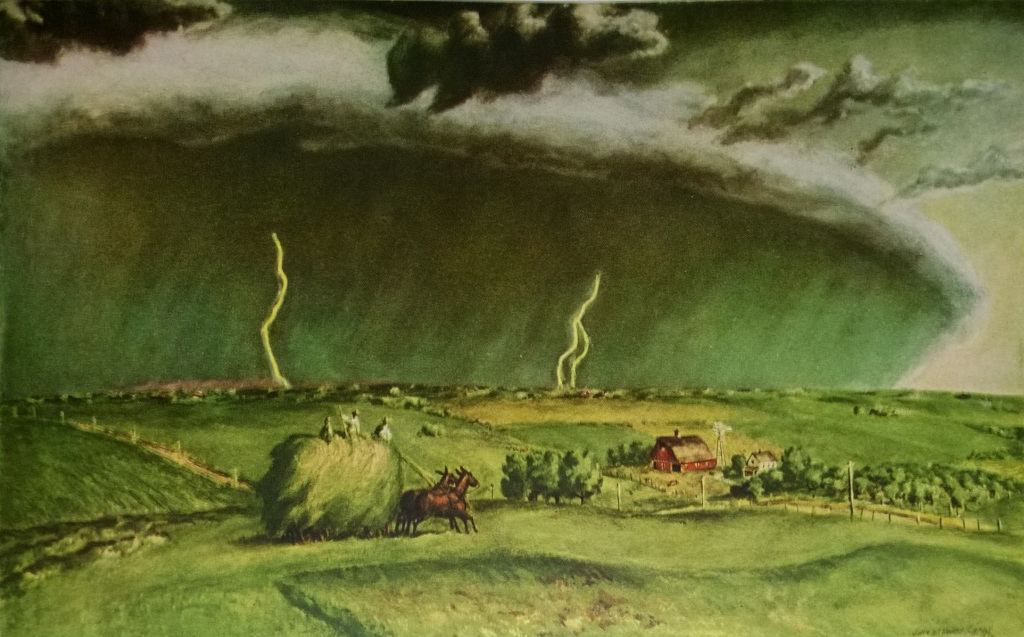
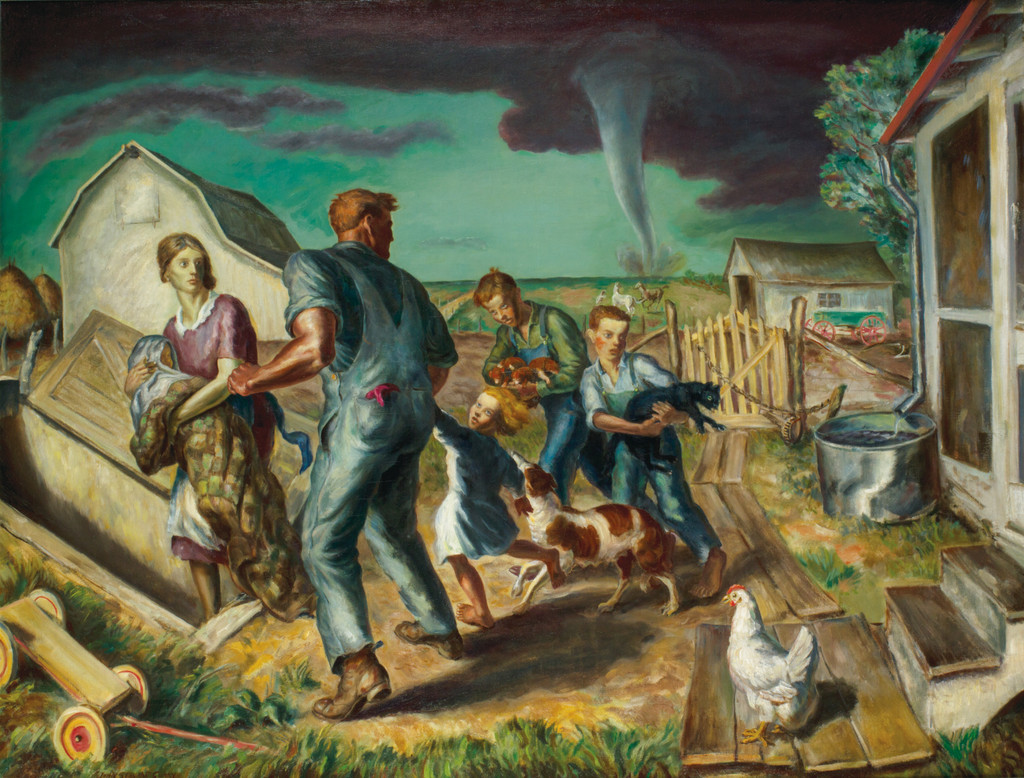
Tornado Over Kansas is a useful opening example because the picture offers several kinds of action at once. The distant funnel establishes the danger, while the family’s gestures make it immediate. The house, fence and cellar entrance define places of movement and shelter. The farm setting becomes legible through the way the people and animals occupy it.
The work was painted in Westport, Connecticut, in 1929. Muskegon Museum of Art explains its relationship to Curry’s childhood memories and traces the painting’s exhibition, reproduction and acquisition history. The Kansas subject reached its public through a studio picture made elsewhere, then through different institutions and printed reproductions. A recognizable place could become the basis for a widely circulated image. [1]
Other pictures reward a change in pace. An interior portrait, a quiet pasture or a carefully organized row of elephants asks the viewer to attend to different relationships. Following those differences keeps the paintings’ individual purposes in view while making it possible to recognize recurring concerns.
Farmyard, field and weather
The farm in The Tornado contains more than the principal figures. Household objects, animals and the edges of buildings bring ordinary activity into the scene. Their presence makes the approaching danger consequential: it interrupts a place already inhabited and used. The picture’s force grows from the close relation between that familiar setting and the event beyond it.
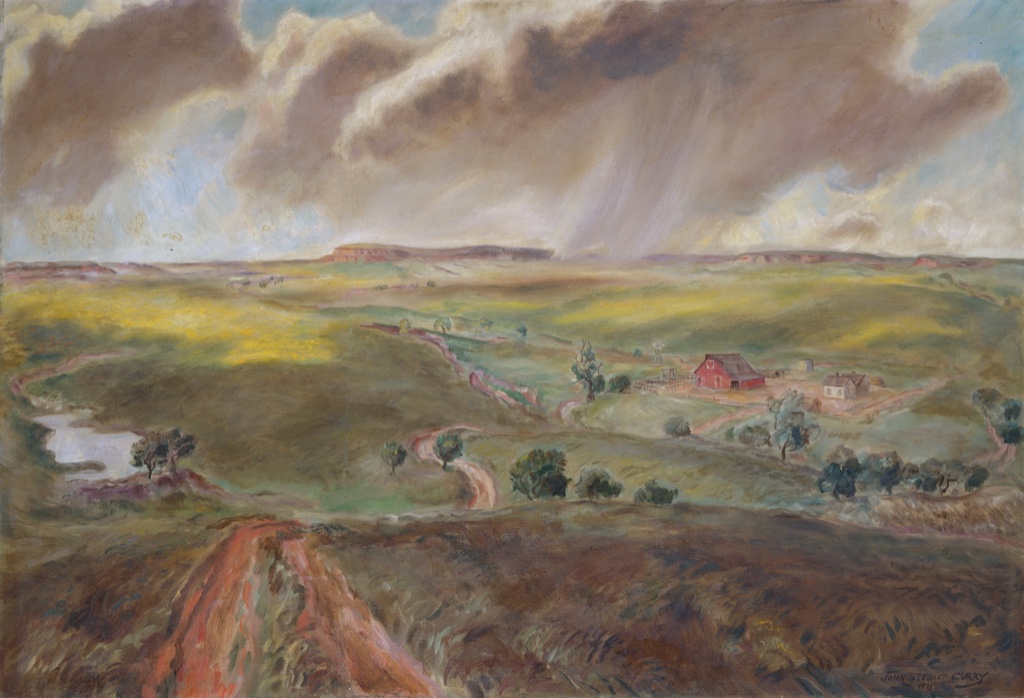
Wisconsin Landscape opens the view across a much wider area. The Met dates it to 1938–39 and describes an idealized composite rather than a record of one particular farm. Fields, buildings, cattle and changing light become parts of an extensive arrangement. Its breadth offers a different account of agricultural life from the concentrated farmyard emergency. [2]
Our Good Earth brings the scale back toward a central figure. The farmer and two children stand among wheat beneath a large sky. Chazen’s painting is a 1942 oil on hardboard; the museum’s record also traces its gift from the Treasury Department to the university and its later museum loan. The image’s agricultural subject therefore belongs to a particular object and public history. [3]
These works offer several ways to consider the countryside. A family acts within danger, a panorama gathers different kinds of cultivated ground, and a monumental farmer stands for a continuity between work and children. Weather remains important, but its role changes with the composition and the kind of encounter Curry constructs.
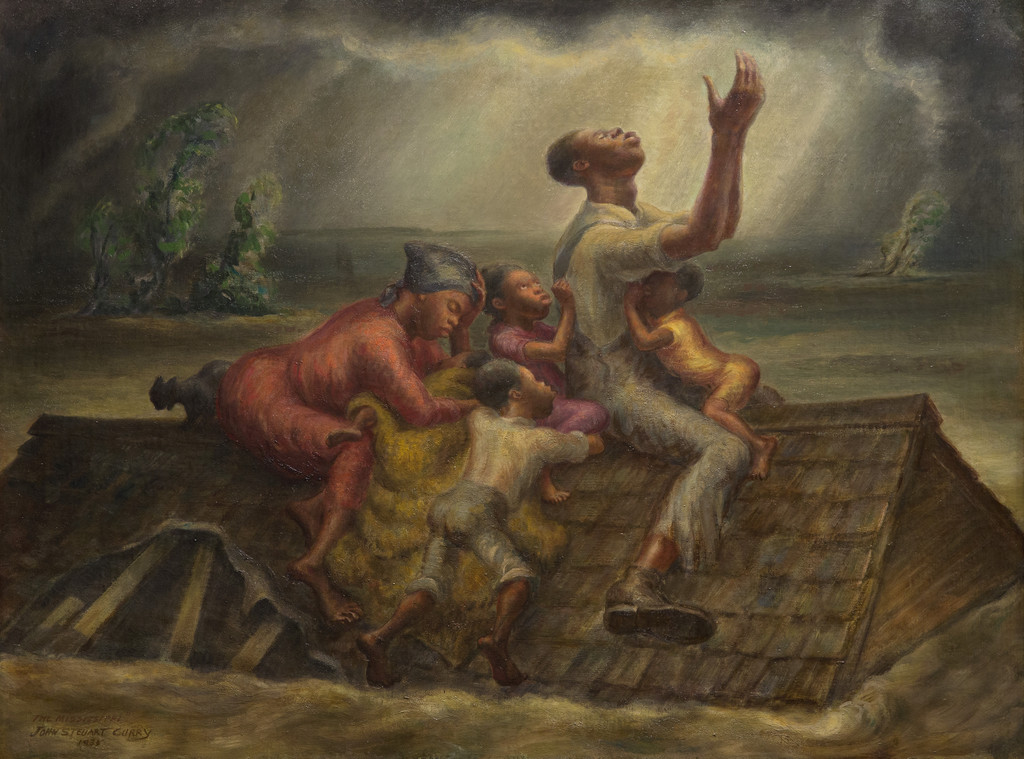
The Mississippi makes the household’s vulnerability still more immediate. A family and its cat occupy the sloping roof of a building surrounded by water. The father raises his arms toward a break in the clouds, while the children gather close around the adults. Considered beside The Tornado , the painting changes the relationship between action and refuge. The storm-cellar scene offers a destination toward which the family can move; the flood picture concentrates attention on the precarious place they already occupy. The arrangement makes the household’s shared dependence visible through bodies, gestures and a narrow supporting surface. [4]
Religion and the domestic interior
Baptism in Kansas , painted in 1928, recalls a ceremony Curry witnessed in 1915. The central act of immersion takes place in a farm water tank, surrounded by people, vehicles and buildings. The Whitney’s account connects the scene with a period when dried-up creeks made the tank a practical alternative for the ceremony. [5]
The arrangement joins ritual and everyday infrastructure. The tank, windmill and cars establish a farm community with particular means of gathering and obtaining water. The people’s varied positions give the viewer several routes toward the central figures. A religious subject becomes a scene of collective attention, with individual faces and bodies participating in different ways.
In The Gospel Train , movement spreads across an interior. Raised hands, dancing children, musicians and the banner organize the gathering. Jeffrey Richmond-Moll considers both works through religion and modern mobility, connecting the movement of communities with the roads, vehicles and other networks of rural life. His interpretation gives the visible details a wider social setting while allowing different responses to Curry’s religious imagery. [6]
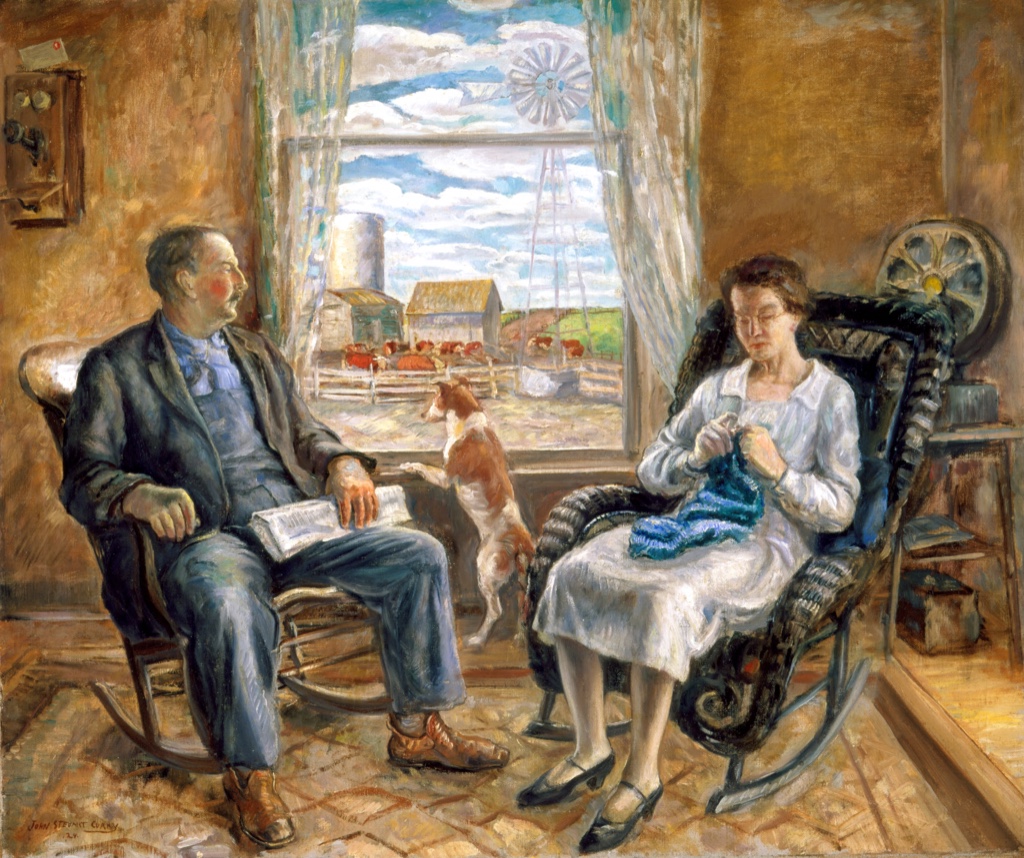
The Old Folks presents the artist’s parents within a quieter room. Cincinnati dates the oil to 1929. Its domestic setting can be considered beside the larger gatherings: a household is another place in which rural experience becomes visible. The newspaper, radio and view outside, discussed in Richmond-Moll’s study, connect the interior with a world beyond its walls. [7] [6]
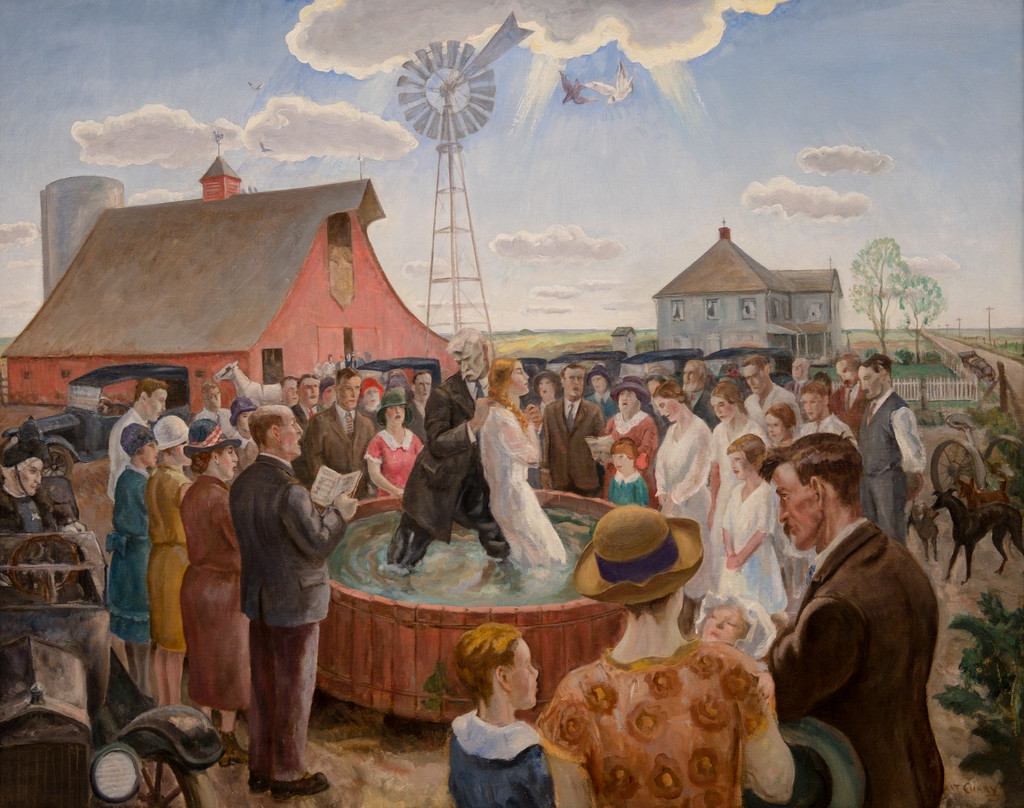
John Steuart Curry, Baptism in Kansas, 1928, oil on canvas, Whitney Museum of American Art. Photograph by Mollerus, 2018; the painting is seen at an angle.
Image source
.
CC BY 2.0 photograph; underlying painting public domain
. Proportionally resized; original appearance retained.
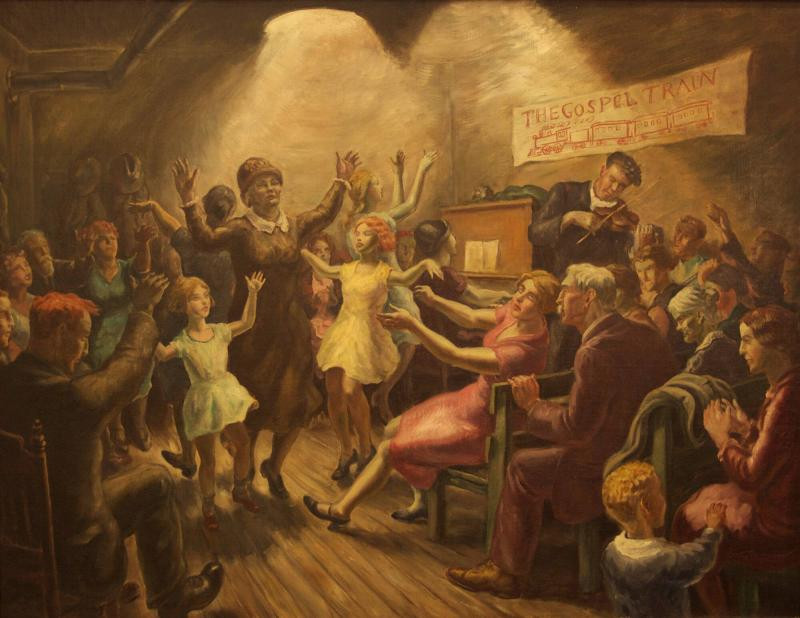
John Steuart Curry, The Gospel Train, 1929, oil on canvas. Syracuse University Art Museum, Gift of Dr. Henry H’57 and Mrs. Gladys Kay Crown, 1957.001.
Image source
.
Public domain
. Proportionally resized; original appearance retained.
Animals, circus and bodily movement
Ajax , 1936–37, makes an animal’s presence its principal event. The bull’s large body stands close to the viewer, while small birds and distant cattle establish other scales. The Smithsonian’s interpretation relates the fertile pasture and substantial animal to a desire for reassurance during the Dust Bowl years. The painting’s quiet action remains important to that reading. [8]
Curry’s circus subjects present other problems of weight and movement. The 1932 Circus Elephants gathers large animals beneath a tent, using their sequence to carry attention into space. The National Gallery’s study considers both the circumstances of Curry’s circus tour and the painting’s technical handling. The animals’ scale becomes part of a carefully organized pictorial rhythm. [9]
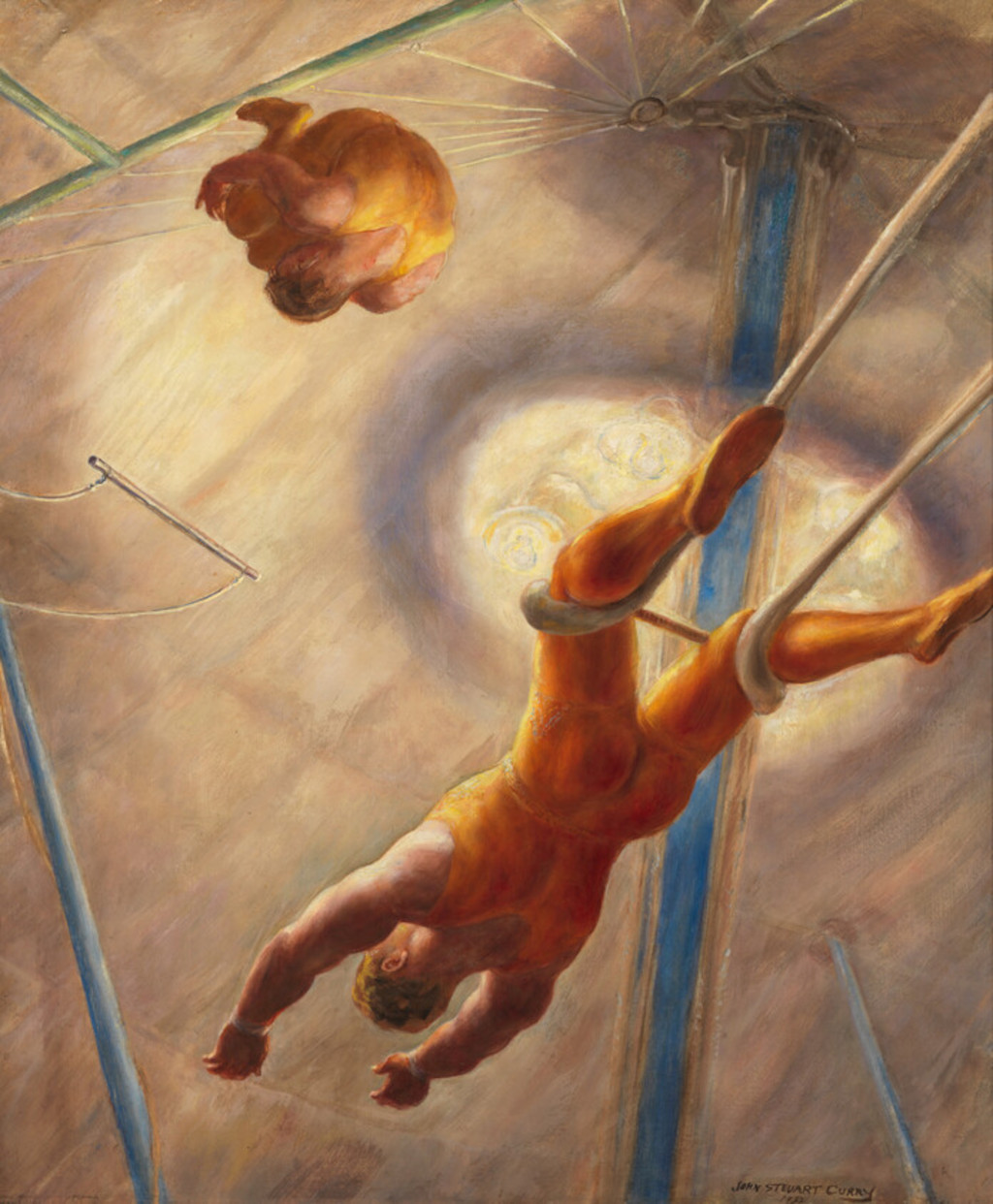
The Flying Codonas turns toward aerial performance. The Whitney identifies the 1932 painting’s medium as tempera and oil on composition board. That information matters when comparing it with other circus works: a shared subject does not mean a shared support, material or method. [10]
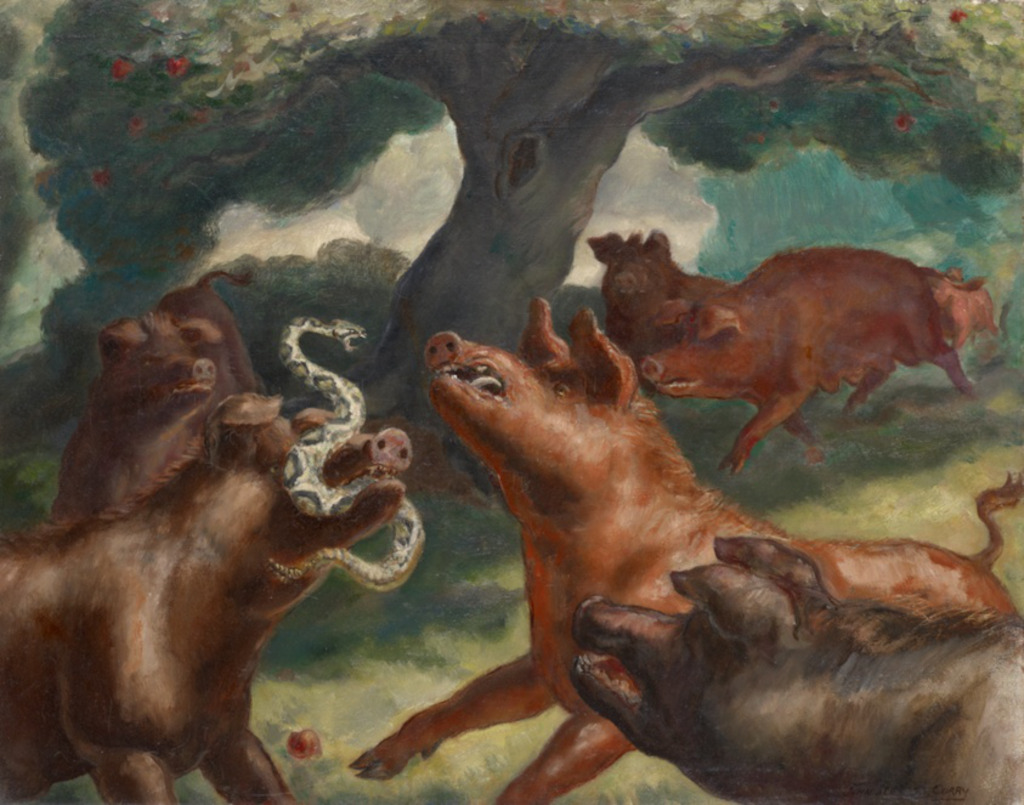
The more concentrated encounter in Hogs Killing a Snake gives another kind of animal subject. The Art Institute’s record identifies the oil as about 1930 and discusses the scratched paint used to suggest bristles. Subject and surface can be examined together here, connecting the force of the scene with a specific way of making an animal’s texture visible. [11]
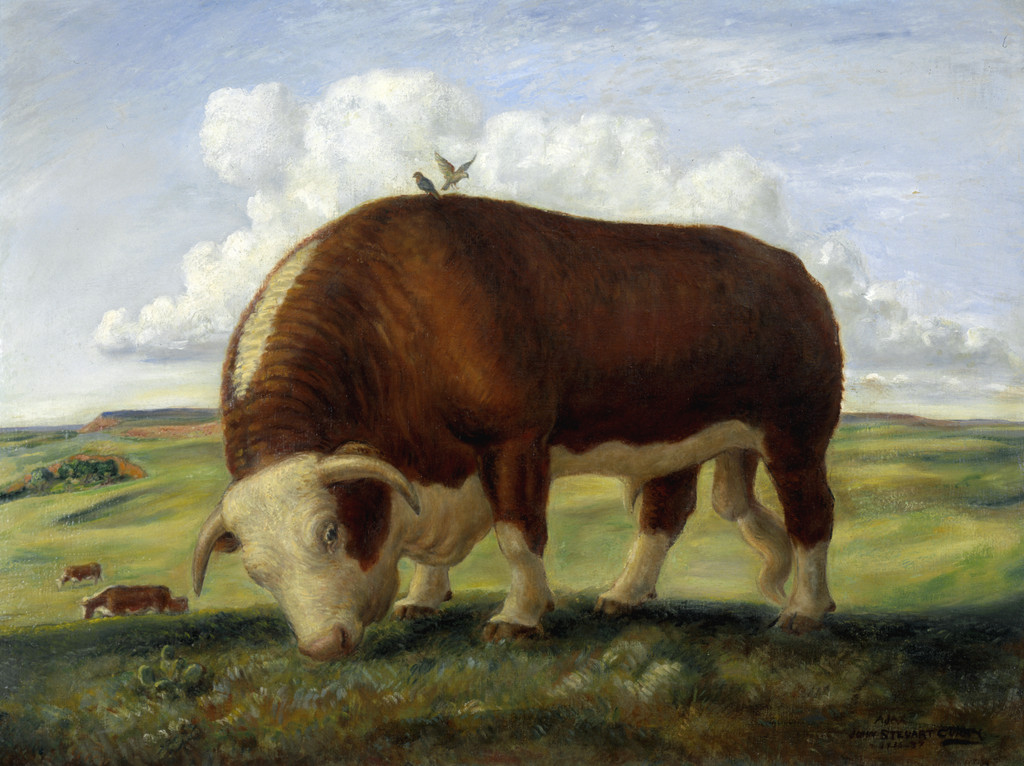
John Steuart Curry, Ajax, 1936–37, oil on canvas. Smithsonian American Art Museum, 2001.95.
Image source
.
CC0 / public domain
. Proportionally resized; original appearance retained.
Watch: John Steuart Curry
Choose a film to explore the artist’s work, its interpretation and its wider setting.
Look at This: John Steuart Curry at MOWA
An exhibition interview with Graeme Reid considers Curry’s work and life in Wisconsin.
Watch on YouTubeWar memory and racial violence
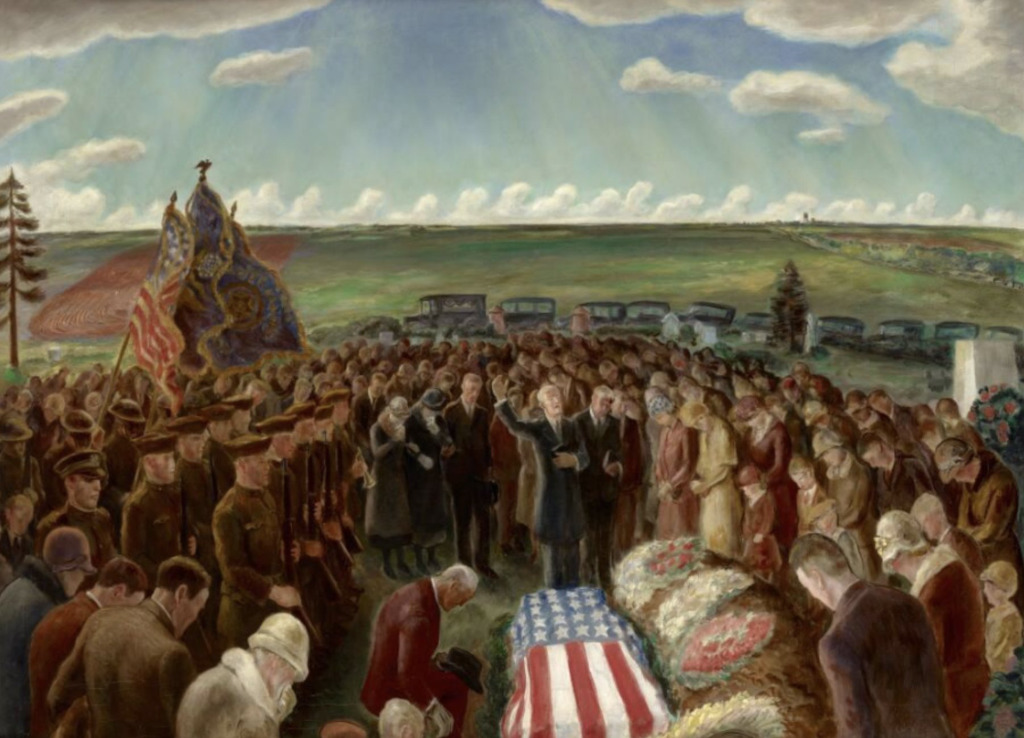
The Return of Private Davis from the Argonne extends Curry’s treatment of communal gatherings into military remembrance. Developed from 1928 to 1940, the painting takes a Kansas soldier’s reburial as its subject. Steven Trout’s study considers the work’s changing circumstances and the different attitudes toward war and mourning that its funeral scene could accommodate. [12]
The painting’s long development is important to that interpretation. An event remembered from the early 1920s could acquire another significance as the political setting changed. The assembled community and constructed landscape belong to the work’s pictorial argument. They should be approached with attention to the painting’s development rather than treated as a straightforward record of a single view.
Curry’s anti-lynching subjects connect painting with printmaking and public argument. The Smithsonian discusses The Fugitive in relation to the NAACP’s 1935 exhibition, which included work in both painted and printed forms. The Smithsonian object is a lithograph. Keeping that distinction clear allows the subject to be followed across Curry’s work without merging separate versions. [13]
History and the public wall
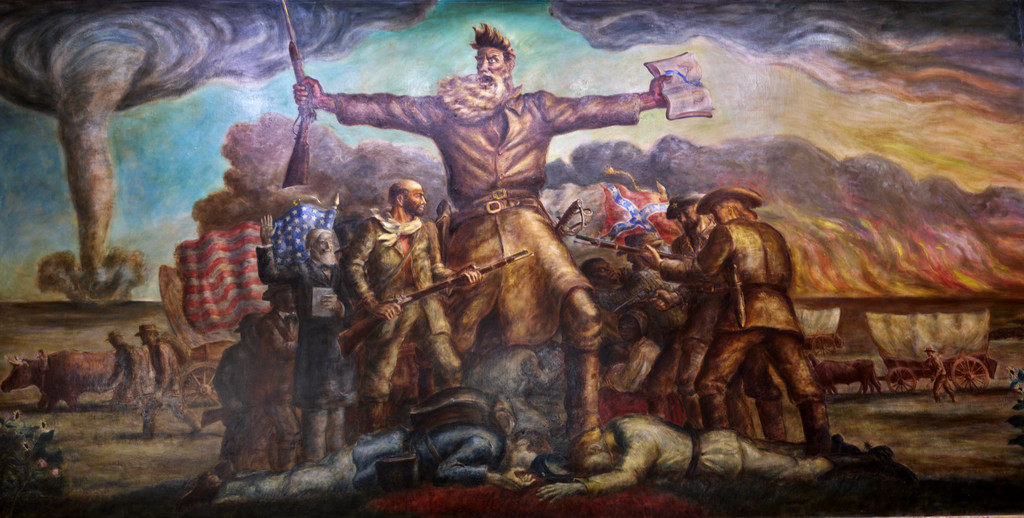
Public murals changed the scale and circumstances of Curry’s painting. At the Kansas State Capitol, Tragic Prelude places John Brown amid armed conflict, bodies and symbols of historical and natural upheaval. The completed corridor paintings belonged to a wider programme whose rotunda scenes remained unexecuted. The setting and the unfinished scheme are both part of the work’s history. [14]
Federal commissions brought different expectations. In Law Versus Mob Rule , a white fugitive seeks protection from a robed figure of justice. The GSA’s account explains the changes made during the commission and the relationship to a rejected emancipation design. The subject differs from the Black fugitive in Curry’s anti-lynching images, even as both address threats posed by collective violence. [15]
The Homesteading and the Building of Barbed Wire Fences , 1939, places agricultural work within the history of settlement. The GSA interprets the mural through land privatization, cultivation and the environmental crisis that followed. Considering it beside the Kansas scenes widens the question of what a farm picture can represent: a particular household, a public ideal or a historical account of changes to the land. [16]
Studies, revisions and repeated subjects
A title can connect several works without making them interchangeable. Our Good Earth appears as an oil painting, a watercolor study and a lithograph. Circus Elephants has a 1932 painting and a separate 1936 print. A comparison begins by identifying the object’s medium, date and collection, then asking what remains consistent and what changes between the versions.
The Met’s John Brown , a 1939 oil on canvas, is a substantial study connected with the Kansas mural. Its vertical format concentrates attention on Brown’s head and torso, with the outstretched arms continuing beyond the edges. The finished mural gives the figure a much wider surrounding field of opposing groups, historical imagery and landscape. Comparing the two allows scale and format to become part of the interpretation. The study is a painting with its own dimensions and collection history, alongside its place in the development of a larger public composition. [17]
Curry’s use of materials was equally varied. Conservators Lance Mayer and Gay Myers examine tempera and oil layers, different grounds and questions of varnishing in particular paintings. Their research supports a close connection between the visible image and the practical decisions behind it. It also encourages care when extending a description of one painting to another. [18]
The style and technique article follows those material questions. The murals study considers architectural settings and commissions, while the individual artwork articles bring a particular composition, object and history into focus. These routes make it possible to move between the breadth of Curry’s painting and the detail through which each work becomes distinctive.
Finding an individual painting
For an introduction to Curry’s arrangement of people, begin with Baptism in Kansas and The Tornado . Compare the central actions, the paths through the group and the relation between figures and surroundings. Then turn to The Gospel Train or The Old Folks to see how those concerns change within an interior.
For landscape and agricultural subjects, compare Wisconsin Landscape , Our Good Earth and Ajax . Their different scales offer a panorama, a monumental human figure and a close encounter with an animal. Circus and mural subjects then widen the comparison into other forms of bodily movement and public storytelling.
The directory distinguishes documented works and versions by their recorded titles, dates, media and collections. Those details provide a practical way to follow a subject across different objects and to recognize the particular painting considered in each study.
Books and further reading
These resources place Curry’s prints within the wider history of Associated American Artists.
Art for Every Home: Associated American Artists, 1934–2000. Edited by Elizabeth G. Seaton, Jane Myers and Gail Windisch. Marianna Kistler Beach Museum of Art, 2015; distributed by Yale University Press. ISBN 9780300215793.
A wider account of the publisher that brought Curry’s prints into American homes, useful for understanding the relationship between art, commerce and domestic display. Museum publication details.
Art for Every Home: An Illustrated Index of Associated American Artists Prints, Ceramics, and Textile Designs. Gail Windisch, Sylvan Cole and Karen J. Herbaugh. Marianna Kistler Beach Museum of Art, 2016.
A free reference index for AAA publications, useful for separating publication dates, editions and printing records. The repository links to a large PDF of about 399 MB. Open the university repository record.
Artworks and versions directory
Browse 84 selected object, version, edition and reproduction records. Several concern related images or different impressions; this is not a complete lifetime catalogue or a count of unique compositions. Search also finds prints, photographs and reproductions; the medium filter groups paintings and drawings.
Frequently Asked Questions
Tornado Over Kansas , Baptism in Kansas , Ajax and Wisconsin Landscape offer contrasting introductions to Curry’s figures, settings and agricultural subjects.
No. A painting, study and lithograph can share a subject while having different dates, supports and collection histories. Those identities are kept separate in the individual studies.
Murals were an important part of Curry’s painting practice. Their architectural setting and commissioning history introduce questions that differ from those surrounding an independent easel picture.
Discussion
Look again at the images and ideas explored in John Steuart Curry Paintings. These editorial prompts invite your observations.
Reader Insights
Compare the scale of the bull in Ajax with the people in Wisconsin Landscape . How does scale change the way each picture presents farm life?
Look at a farmyard gathering and an interior scene. Which details establish the activity and the relationships between the people?
Consider a painted composition alongside a related print. What changes in the relationship between line, tone and space?
Join the Conversation
Share a detail, comparison or question about John Steuart Curry Paintings below.
References
- Muskegon Museum of Art , Tornado Over Kansas, object essay, studio origin and reception. View source
- Metropolitan Museum of Art , Wisconsin Landscape, 1938–39, 42.154. View source
- Chazen Museum of Art , Our Good Earth, 1942, 3.1999.1. View source
- Hiart , Photograph of The Mississippi at the Saint Louis Art Museum, visual record of the painting. View source
- Whitney Museum of American Art , Baptism in Kansas, 1928, 31.159. View source
- Jeffrey Richmond-Moll , Holy Rollers: Religion and Modern Mobility in the Art of John Steuart Curry, Panorama 9, no.2 (Fall 2023). View source
- Cincinnati Art Museum , The Old Folks (Mother and Father), 1929, 2002.46. View source
- Smithsonian American Art Museum , Ajax, 1936–37, 2001.95. View source
- Robert Torchia , National Gallery of Art, American Paintings, 1900–1945: Circus Elephants, 1932, 2018. View source
- Whitney Museum of American Art , The Flying Codonas, 1932, 33.10. View source
- Art Institute of Chicago , Hogs Killing a Snake: object API, about 1930, 1947.392, description and collection history. View source
- Steven Trout , The Western Front Comes to Kansas: John Steuart Curry’s The Return of Private Davis from the Argonne, Kansas History 31 (Autumn 2008): 194–211. View source
- Smithsonian American Art Museum , Oh Freedom! John Steuart Curry, The Fugitive and the anti-lynching context. View source
- Kansas Historical Society , Kansas State Capitol: Curry murals, completed corridor paintings and the wider programme. View source
- U.S. General Services Administration , Law Versus Mob Rule, 1936, commission history. View source
- U.S. General Services Administration , The Homesteading and the Building of Barbed Wire Fences, 1939. View source
- Metropolitan Museum of Art , John Brown, 1939, oil on canvas, 50.94.1. View source
- Lance Mayer and Gay Myers , Old Master Recipes in the 1920s, 1930s, and 1940s: Curry, Marsh, Doerner, and Maroger, JAIC 41, no.1 (2002): 21–42, Curry section. View source
- Splash image source.
John Steuart Curry, The Tornado (Tornado Over Kansas), 1929, oil on canvas. Muskegon Museum of Art. Public domain . Proportionally resized; original appearance retained.
View source
More CURRY Paintings
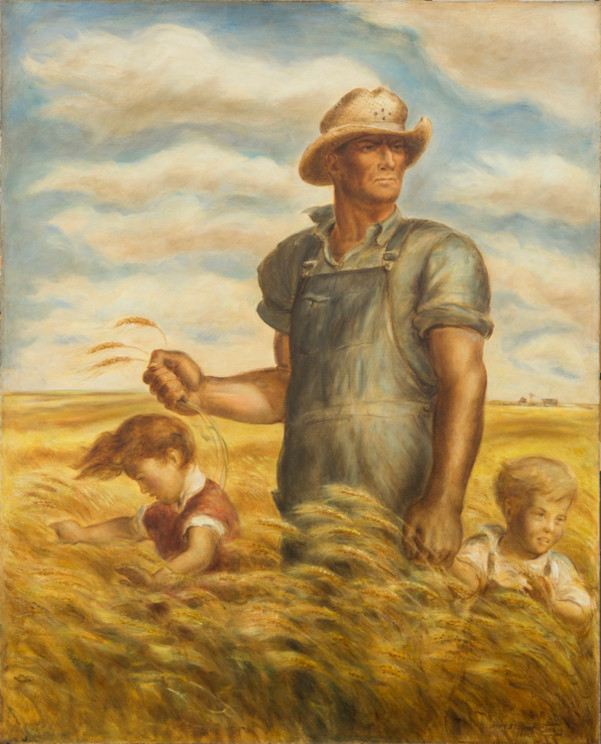
Our Good Earth
1942 painting and its related prints and wartime imagery.
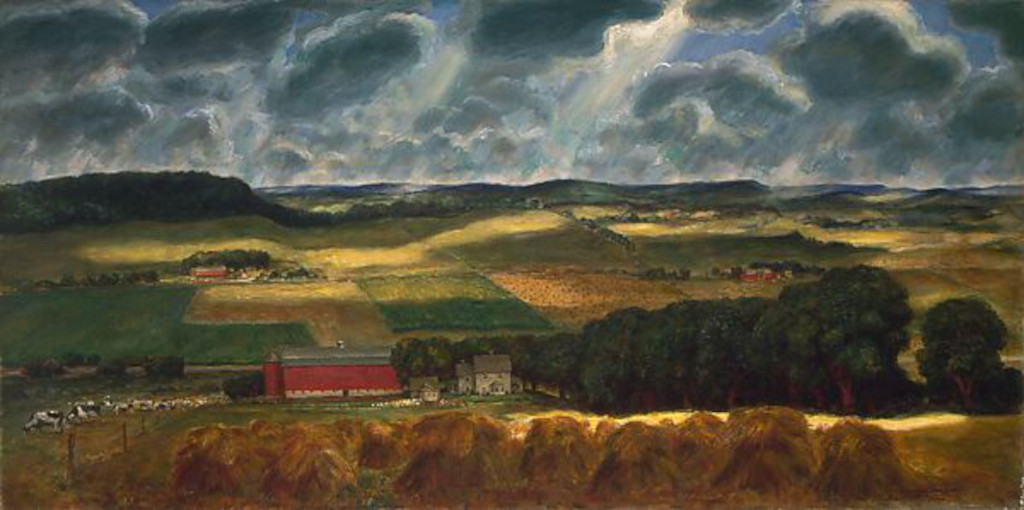
Wisconsin Landscape
1938–39 panorama of working farmland, held by The Met.
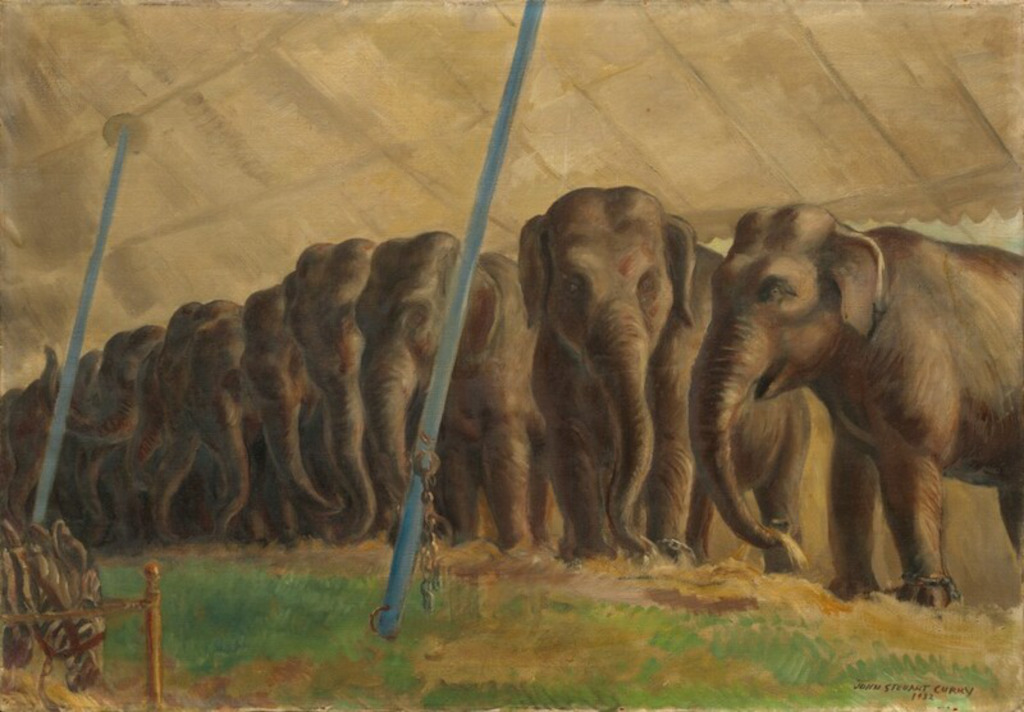
Circus Elephants
1932 painting of elephants, handlers and the work behind the circus.