


 by
Tom Gurney
Tom Gurney BSc (Hons) is an art history expert with over 20 years experience
Email:
tomgurney1@gmail.com
/ Phone:
+44 7429 011000
The Old Folks (Mother and Father) by John Steuart Curry: Introduction
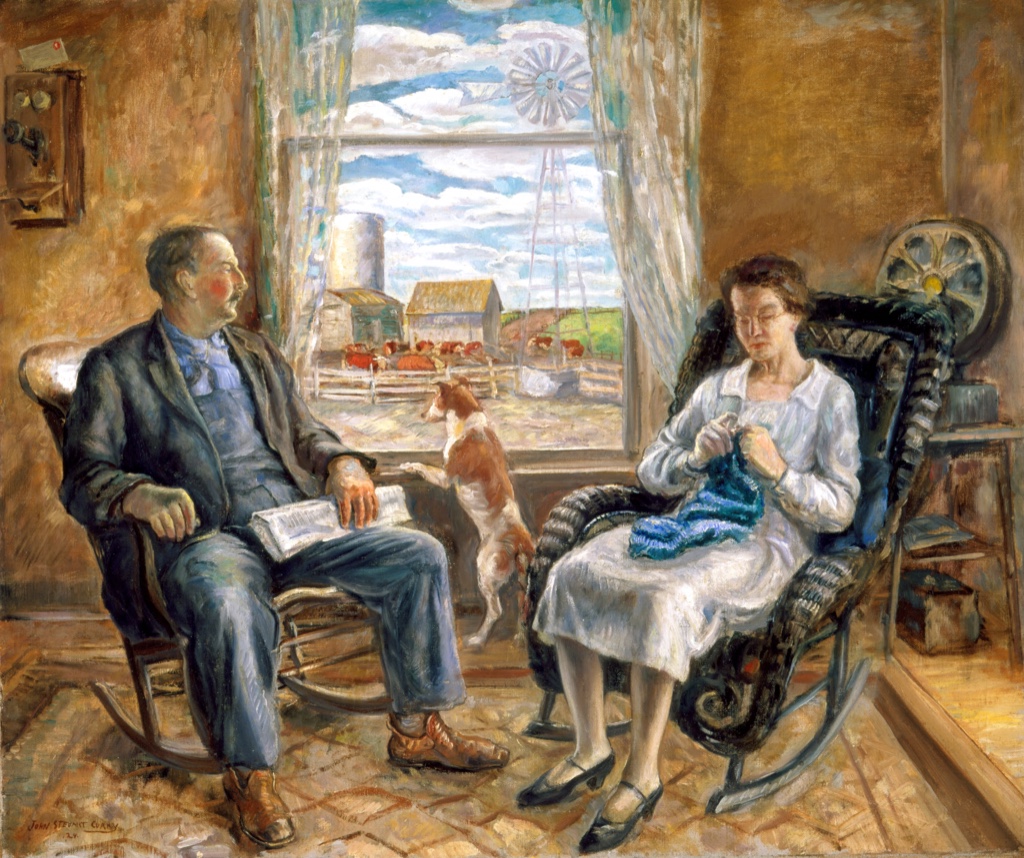
Two people sit on opposite sides of a window, sharing a room while attending to different things. Between them, a small dog stands upright to look outside. In The Old Folks (Mother and Father) , John Steuart Curry gives an ordinary household the sustained attention that he also brought to storms, religious gatherings and public history.
Cincinnati Art Museum identifies the painting as a 1929 oil on canvas, measuring 30 by 36 inches, and records it under accession number 2002.46, with the credit The Edwin and Virginia Irwin Memorial. [1] Its modest domestic subject opens onto a larger world: the farm beyond the glass and the means by which news and voices enter the home.
At a Glance
- Artist John Steuart Curry, 1897–1946.
- Title The Old Folks (Mother and Father) .
- Date 1929.
- Medium Oil on canvas.
- Dimensions 30 × 36 inches (76.2 × 91.4 cm).
- Collection Cincinnati Art Museum.
- Credit The Edwin and Virginia Irwin Memorial.
- Object number 2002.46.
- Subject The artist's parents in their Kansas farmhouse.
This work across John Steuart Curry’s career
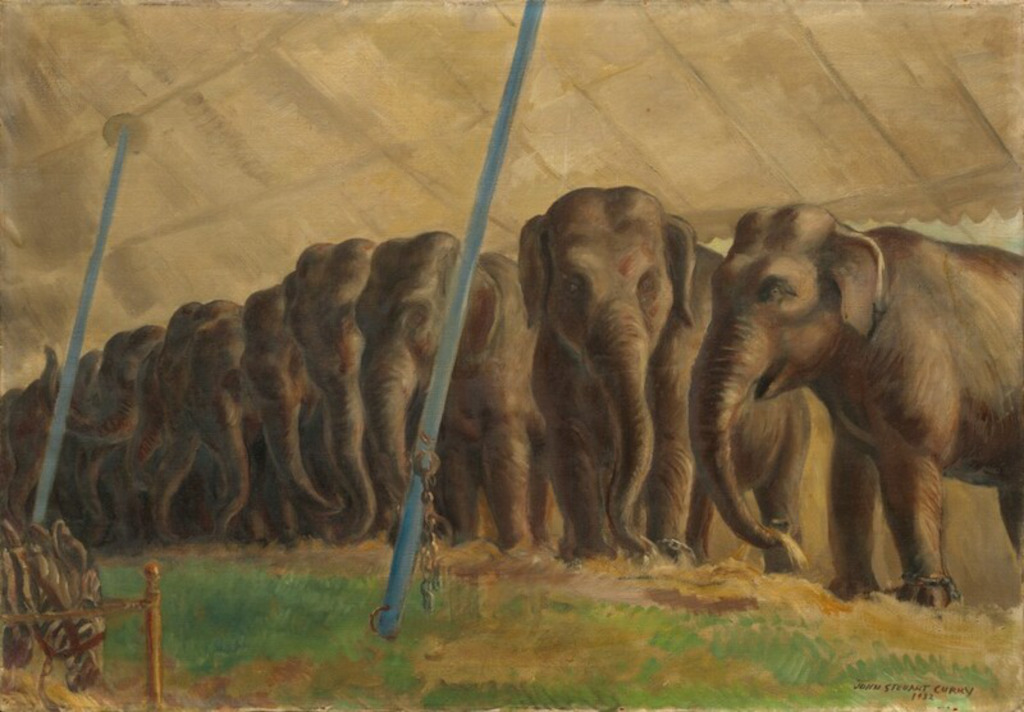
Circus Elephants
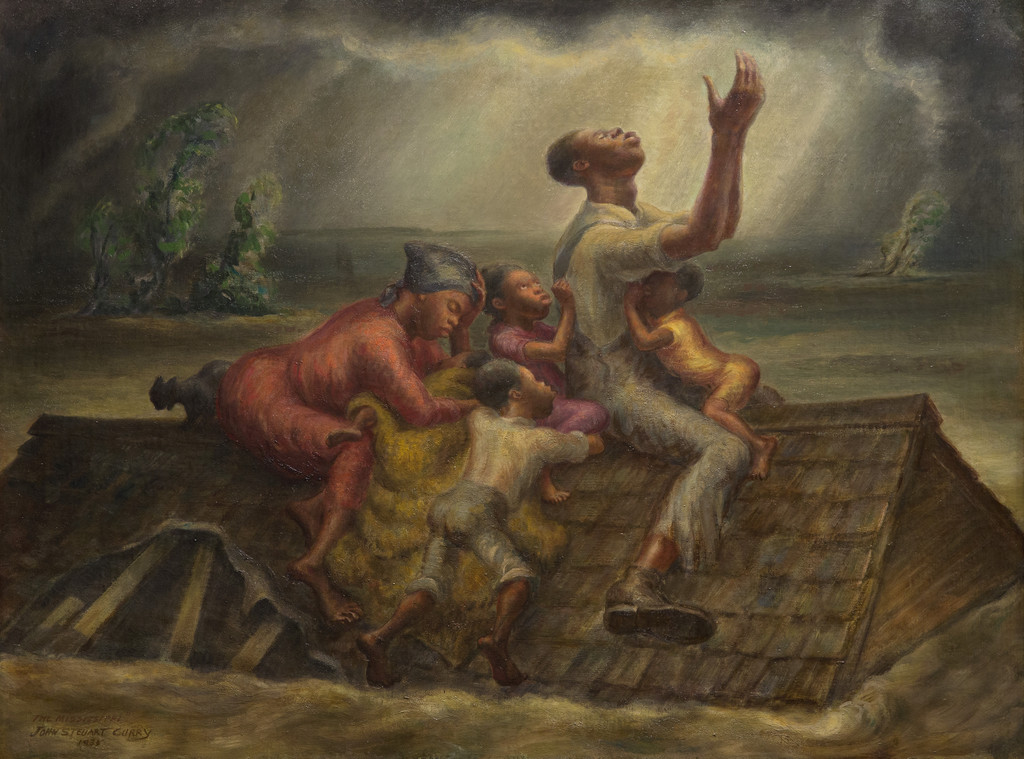
1932 paintingThe Mississippi
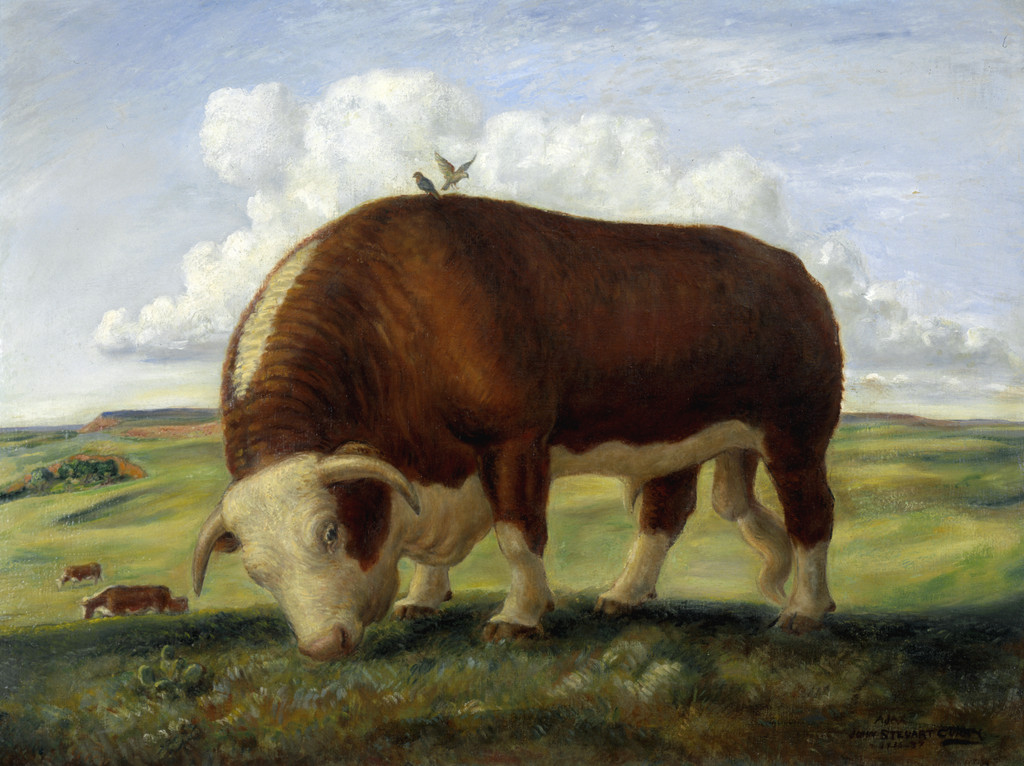
1935 paintingAjax
1936–37 oil paintingTragic Prelude
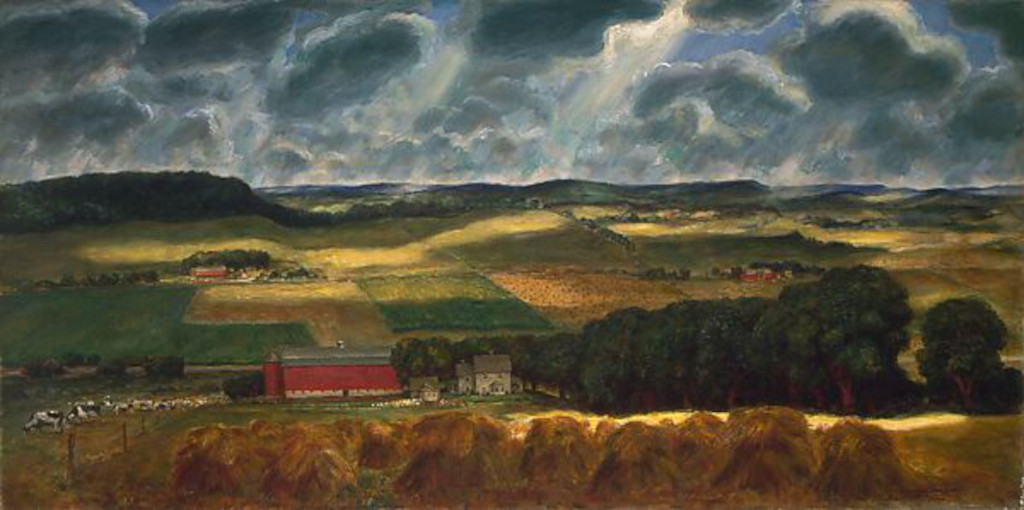
1938–40; project 1937–42Wisconsin Landscape
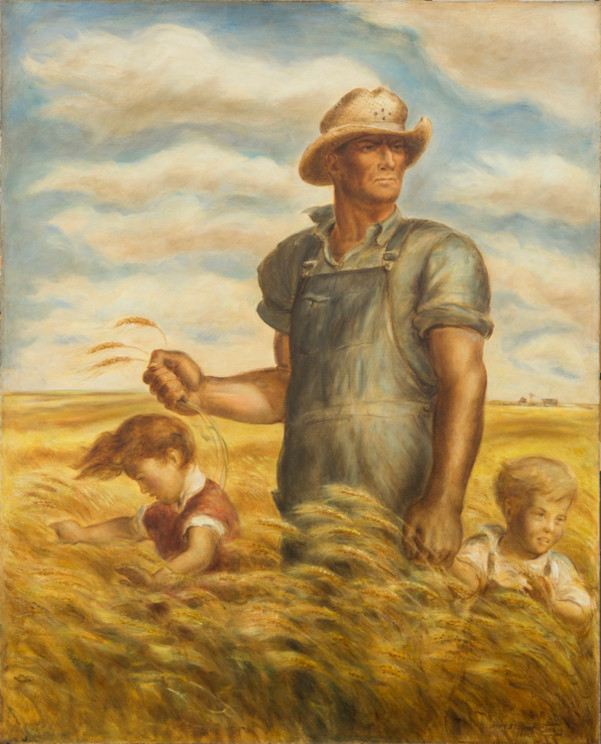
1938–39Our Good Earth
1942 oil paintingNotes and sources
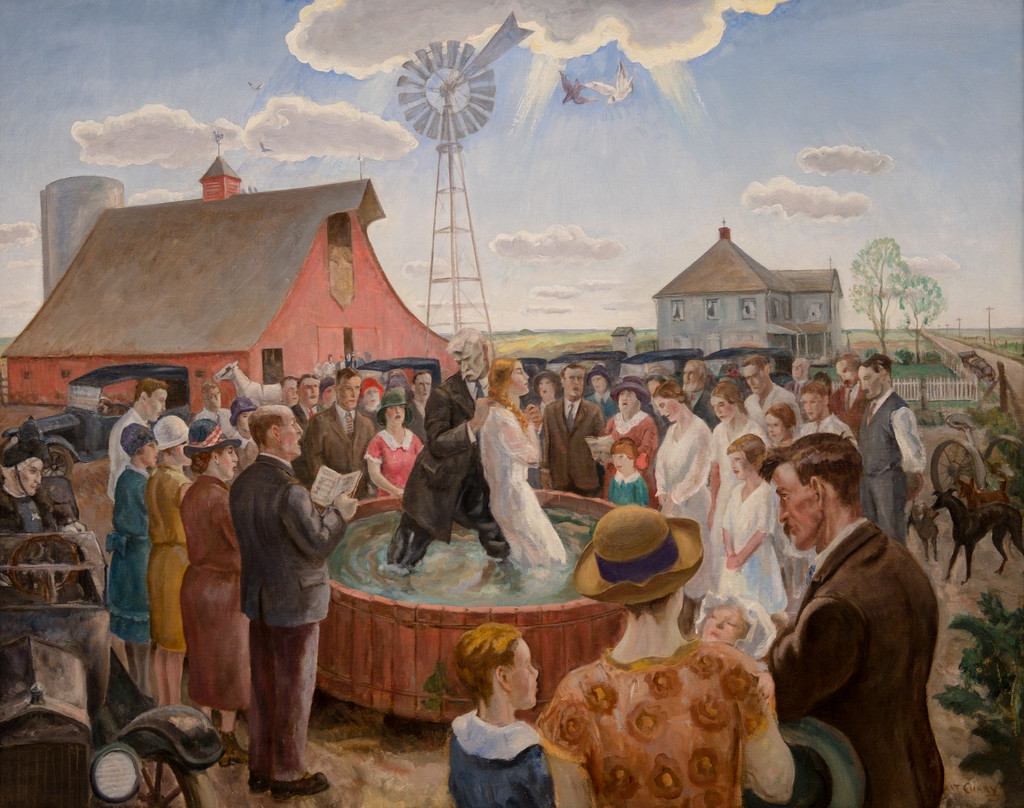
Baptism in Kansas. A remembered Kansas ceremony is staged within a working farmyard. [2]
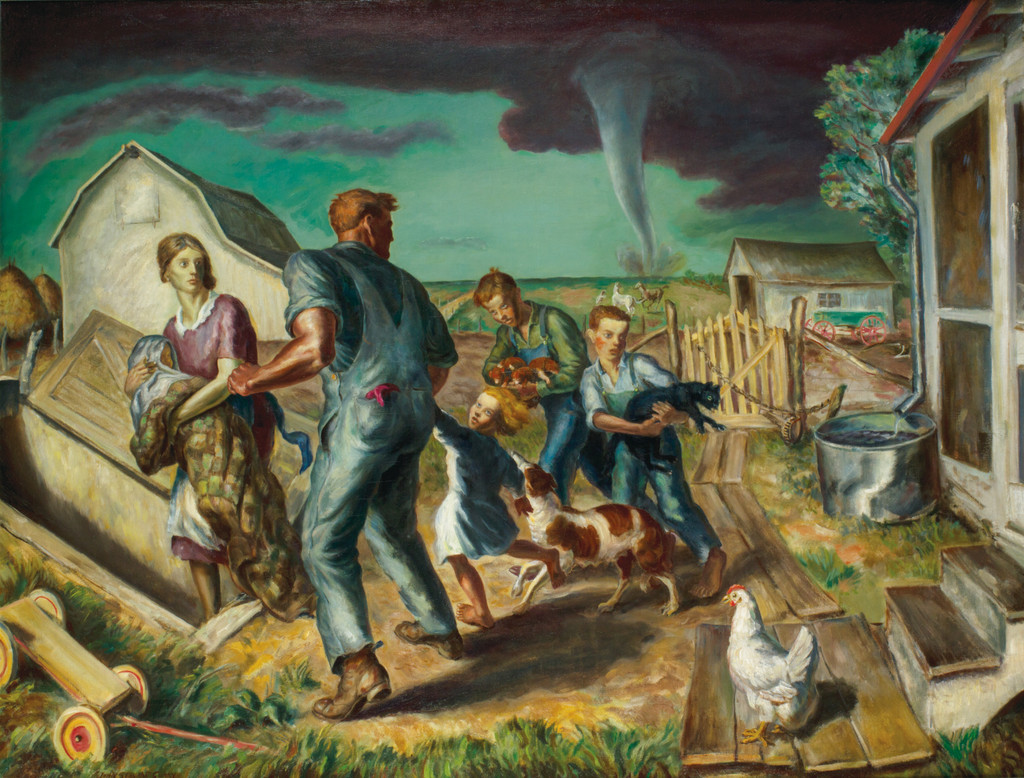
Tornado Over Kansas. A Kansas storm and a family seeking shelter, painted in Curry’s Westport studio. [3]
The Old Folks (Mother and Father) (current article). The artist’s parents sit beside a farm window, with a dog between them. [1]
Circus Elephants. Elephants and handlers occupy the working space beneath a circus tent. [4]
The Mississippi. A family occupies a roof amid floodwater; the painting is tempera on canvas mounted on panel. [5]
Ajax. The monumental bull in the Smithsonian oil differs from the earlier lithograph. [6]
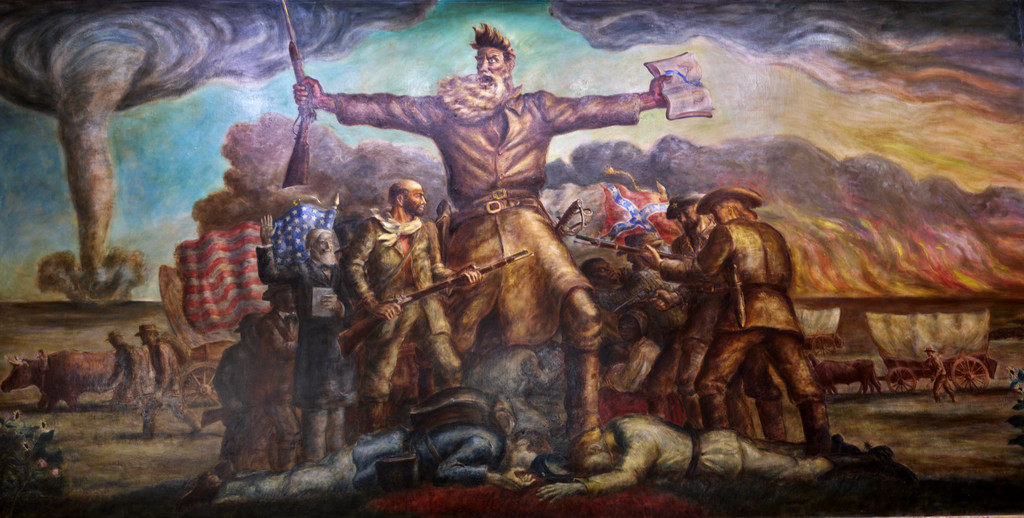
Tragic Prelude. John Brown stands at the centre of a Kansas State Capitol mural continuing across adjoining walls. [7]
Wisconsin Landscape. An extensive farm panorama, distinct from the separately catalogued preparatory study. [8]
Our Good Earth. The Chazen painting is distinct from the watercolour study, lithographs and wartime posters. [9]
Contents
- A quiet room and a working farm
- The two seated parents
- The dog and the view through the window
- Newspaper, radio and rural connections
- The 1929 portrait beside Curry's other subjects
- The museum record and later readings
A quiet room and a working farm
The museum's account identifies the sitters as Curry's parents inside their Kansas farmhouse. [10] Their relationship to the room is expressed through use. Clothes, chairs, a newspaper and handwork establish familiar occupations without the ceremonial setting of a formal society portrait. Each person seems accommodated by a particular chair and a habitual place beside the window.
The room fills almost the entire canvas, yet the window prevents it from becoming a closed compartment. Its upright frame occupies the centre of the composition, with curtains falling down either side. Through it, buildings, cattle, fences and a windmill establish the surrounding farm. Domestic rest and agricultural work belong to the same small field of vision.
Outside, the sky forms broad bands of white cloud and blue. Inside, brown walls and wooden floorboards give the figures a warmer enclosure. The difference makes the window immediately legible as an opening, but the view remains close enough to connect with the occupants. Curry does not detach this interior from the land around it.
The two seated parents
The father occupies the left side in blue work clothes, a darker jacket and brown shoes. His feet are planted apart, and his arms rest on the chair and across the newspaper on his lap. His turned head directs attention towards the window rather than straight out at the viewer. The paper remains present even when reading appears to have paused.
On the right, the mother bends her head towards blue-green handwork. Her pale dress, white collar and stockings create a lighter figure against the dark woven chair. Her hands meet above her lap, concentrating attention on a small task. The contrast between her lowered gaze and the father's outward look gives the portrait two different centres of awareness.
Their poses do not explain what either parent thinks or feels. Instead, Curry provides the visible conditions for interpreting their companionship: shared space, separate occupations and an interval between the chairs. The viewer can recognize familiarity without having to invent a conversation or a particular incident in family history.
The chairs contribute to the distinction between the sitters. On the left, the wooden rocking chair has a comparatively open frame. On the right, the mother's darker chair surrounds her body with thicker woven curves. Both sets of runners rest on the patterned rug, bringing these different shapes into the same domestic ground.
Their shoes and the curved runners approach the bottom edge of the canvas. This placement brings the seated bodies close to the viewer, while the window opens a much deeper space behind them.
The dog and the view through the window
The dog occupies the narrow space between the parents, with its front paws raised to the sill. Its upright body repeats the window's vertical direction, while its head turns towards the farm. The animal gives the central gap a living occupant and draws the eye from the foreground towards the exterior.
Franck Mercurio, writing for Cincinnati Art Museum, describes the terrier as a third member of the household. His suggestion that it might be watching a small animal remains a possibility rather than an identified event. [10] Nothing in the painting requires a precise explanation for the dog's attention: the posture itself supplies the sense of alertness.
The three occupants therefore relate differently to the same surroundings. The mother's activity stays close to her body, the father's gaze extends sideways, and the dog reaches towards the window. Curry turns an apparently still room into a network of small directions. The scene has movement without the sweeping gestures found in his more dramatic compositions.
Beyond the glass, the windmill rises above the lower farm buildings. Its narrow structure and circular top echo the contrast between straight architectural lines and rounded furniture inside. This visual correspondence helps join the two spaces, while the window frame keeps their different distances clear.
Watch: John Steuart Curry
Choose a film to explore the artist’s work, its interpretation and its wider setting.
Look at This: John Steuart Curry at MOWA
An exhibition interview with Graeme Reid considers Curry’s work and life in Wisconsin.
Watch on YouTubeNewspaper, radio and rural connections
Art historian Jeffrey Richmond-Moll identifies the newspaper on the father's lap as the Kansas City Star and the radio behind the mother as an Atwater Kent. He also identifies Old Highway 59 towards Kansas City beyond the cattle yard and windmill. In his interpretation, these details connect the farm household with wider networks of transport and communication. [11]
That reading gives the furnishings a significance beyond period decoration. The newspaper is something brought into the room from elsewhere; the radio makes distant speech and music available within the home. Neither object needs to dominate the picture to suggest a relationship between private daily life and events beyond the immediate landscape.
The radio's circular speaker is visible behind the mother's chair, close to the right edge. Its position makes it part of the room's equipment rather than a separate technological exhibit. A wall telephone at the upper left supplies another recognizable household object. These forms sit among curtains, furniture and floorboards, integrated into the setting's ordinary appearance.
The portrait does not specify which programme might be playing, whether the radio is switched on, or what article the father has been reading. Its interest lies in the presence of these connections. A farm interior can be rooted in a particular place while receiving information from well beyond its boundaries.
The 1929 portrait beside Curry's other subjects
The quietness of The Old Folks becomes especially striking beside The Gospel Train , another painting dated 1929. In that crowded interior, raised arms, dancers and instruments suggest collective sound and movement. Here, two seated figures and a watching dog give the room a slower rhythm, with attention passing between small household actions.
The contrast concerns how people occupy space. The congregation fills its room through overlapping bodies, while the parents remain distinctly separated by the window. Curry can make an interior active through either arrangement: a crowd gathers energy in one picture, and a few diverging gazes organize the other.
There is also a useful connection with Baptism in Kansas . Its outdoor gathering places human activity within a farm setting. The Old Folks approaches that relationship from inside the house. Together, the works invite attention to the many uses of rural space, from shared ceremony to the intimate routines of a family room.
The museum record and later readings
The title's parenthetical words, Mother and Father , keep the sitters' relationship to the artist in view. The more familiar phrase The Old Folks might suggest a general scene of older people at home; the fuller title makes this a portrait with a particular family connection. That specificity matters when interpreting its quieter gestures and possessions.
The painting's date and collection history should also remain distinct. Cincinnati records a work painted in 1929 under object number 2002.46; the accession identifier is not an alternative date for the image. The listed memorial credit identifies the museum's acquisition credit without explaining every earlier stage of ownership. [1]
The household continues to reward more than one kind of looking. Following the dog leads towards the window and farm; following the newspaper and radio leads towards wider communication; comparing the parents brings attention back to their separate gestures. These routes meet within a single room, giving the portrait its combination of domestic intimacy and a world extending beyond the frame.
Artworks and versions directory
Browse 84 selected object, version, edition and reproduction records. Several concern related images or different impressions; this is not a complete lifetime catalogue or a count of unique compositions. Search also finds prints, photographs and reproductions; the medium filter groups paintings and drawings.
Frequently Asked Questions
They are John Steuart Curry's parents, shown inside their Kansas farmhouse. Cincinnati Art Museum uses the fuller title The Old Folks (Mother and Father) .
The museum dates it to 1929. It is an oil on canvas measuring 30 by 36 inches.
It belongs to Cincinnati Art Museum, accession 2002.46, with the credit The Edwin and Virginia Irwin Memorial. Check the museum's current record when planning a visit.
Jeffrey Richmond-Moll interprets them as connections between the farm household and a wider urban and national world. The painting does not identify a particular broadcast or newspaper story.
Discussion
Look again at the images and ideas explored in The Old Folks (Mother and Father) by John Steuart Curry. These editorial prompts invite your observations.
Reader Insights
How does the central window connect the two seated figures while keeping their occupations distinct?
Does your attention move first towards the dog, the parents or the farm outside?
How do the newspaper and radio affect your understanding of this rural interior?
Join the Conversation
Share a detail, comparison or question about The Old Folks (Mother and Father) by John Steuart Curry below.
References
- Cincinnati Art Museum , The Old Folks (Mother and Father), 2002.46. Current object record: title, 1929 date, oil on canvas, dimensions and memorial credit. View source
- Whitney Museum of American Art, John Steuart Curry | Baptism in Kansas | Whitney Museum of American Art. View source
- Muskegon Museum of Art, Tornado Over Kansas - Muskegon Museum of Art. View source
- National Gallery of Art, Circus Elephants: collection object record. View source
- Saint Louis Art Museum, The Mississippi,1935,7:1937: collection record and provenance. View source
- Smithsonian American Art Museum, Ajax. View source
- Kansas Historical Society, Kansas State Capitol - Online tour - Tragic Prelude - Kansas Historical Society. View source
- Metropolitan Museum of Art, Wisconsin Landscape. View source
- Chazen Museum of Art, Our Good Earth | 1873 |Chazen Museum of Art. View source
- Franck Mercurio , Canids of Eden Park, Cincinnati Art Museum, 11 March 2026. Curry section and caption only: parents, Kansas farmhouse and family terrier; the proposed object of the dog's attention is speculative. View source
- Jeffrey Richmond-Moll , Holy Rollers: Religion and Modern Mobility in the Art of John Steuart Curry, Panorama 9, no. 2 (Fall 2023). Physical page 11 and figure 12: newspaper, radio, road and the farm's wider connections. Original archival sources cited by the author were not separately consulted. View source
More CURRY Paintings
Our Good Earth
1942 painting and its related prints and wartime imagery.
Wisconsin Landscape
1938–39 panorama of working farmland, held by The Met.


Circus Elephants
1932 painting of elephants, handlers and the work behind the circus.