


 by
Tom Gurney
Tom Gurney BSc (Hons) is an art history expert with over 20 years experience
Email:
tomgurney1@gmail.com
/ Phone:
+44 7429 011000
John Steuart Curry: Introduction
John Steuart Curry (1897–1946) was an American painter, printmaker and muralist whose subjects brought the experiences of the rural Midwest into a national public arena. A family moving toward a storm cellar, a baptism in a farmyard and the towering figure of John Brown are among his best-known images. Their force comes from the relationships between people, places and the events that interrupt ordinary life. [1]
Curry is closely associated with American Regionalism , alongside Grant Wood and Thomas Hart Benton. His career also reached across commercial illustration, circus drawing, experiments with painting materials and work at the University of Wisconsin. Following those different activities reveals an artist concerned with how pictures could speak to audiences beyond the studio. [2]
The paintings , prints and murals offer several ways into that achievement. The biography follows his life between Kansas, the East Coast, Paris and Wisconsin; the individual artwork studies examine the subjects and histories behind particular pictures.
At a Glance
- Artist John Steuart Curry.
- Lived 14 November 1897–29 August 1946.
- Nationality American.
- Born Near Dunavant, Kansas.
- Died Madison, Wisconsin.
- Associated movement American Regionalism and the broader American Scene.
- Media Painting, drawing, lithography and murals.
- Recurring subjects Rural families, weather, religion, animals, performance and public history.
- University appointment Artist in residence at Wisconsin’s College of Agriculture, 1936–46.
- Major works Tornado Over Kansas , Baptism in Kansas and Tragic Prelude .
Curry’s artistic connections
Illustration, shared public subjects and practical questions about painting brought different kinds of artistic connection.
- Harvey Dunn: The Archives of American Art places Curry’s early freelance work in Leonia under Dunn’s influence. [2]
- Grant Wood: Mayer and Myers document Curry’s interest in Wood’s grounds and painting materials, adding a practical exchange to their Regionalist association. [3]
- Thomas Hart Benton: The Smithsonian groups the artists within the American Scene. The conservation study also records Benton’s advice to Curry about a wax varnish. [1] [3]
- Reginald Marsh: The Curry finding aid lists Marsh correspondence with technical notes and illustrated letters. This documents a professional connection without making Marsh Curry’s teacher. [2]
John Steuart Curry in context
Bars show approximate historical periods. c. means circa (about).
Social Realism
c. 1930–1945 [21]American Regionalism
c. 1930–1950 [22]The American Scene
c. 1930–1950 [23]Notes and sources
Social Realism. A connection through particular subjects. The anti-lynching subject of The Fugitive connects part of Curry’s work with art addressing racial violence; it does not define every rural picture. [4]
American Regionalism. A historical association. Curry is closely associated with Grant Wood and Thomas Hart Benton in accounts of American Regionalism. [2]
The American Scene. American subjects in the 1930s. The Smithsonian places Curry among major American Scene painters, drawing subjects from American life and history. [1]
Each bar runs from the artist’s birth to their death.
Harvey Dunn
1884–1952 · Birth–death [24]Thomas Hart Benton
1889–1975 · Birth–death [25]Grant Wood
1891–1942 · Birth–death [26]John Steuart Curry
1897–1946 · Birth–death [27]Reginald Marsh
1898–1954 · Birth–death [28]Notes and sources
Harvey Dunn. Early illustration career. The Archives of American Art describes Dunn’s influence on Curry’s early freelance illustration in Leonia. [2]
Thomas Hart Benton. American Scene and mural materials. The Smithsonian groups the artists within the American Scene; Mayer and Myers discuss Benton’s advice about mural varnish. [1] [3]
Grant Wood. Regionalism and technical exchange. Alongside their Regionalist association, the conservation study documents Curry’s interest in Wood’s materials and grounds. [3]
John Steuart Curry. Explore selected object dates in the Key works view. [1]
Reginald Marsh. Correspondence and technical interests. The Curry finding aid lists Marsh correspondence from 1938, 1940–42 and undated material, including technical notes and illustrated letters. [2]
Circus Elephants
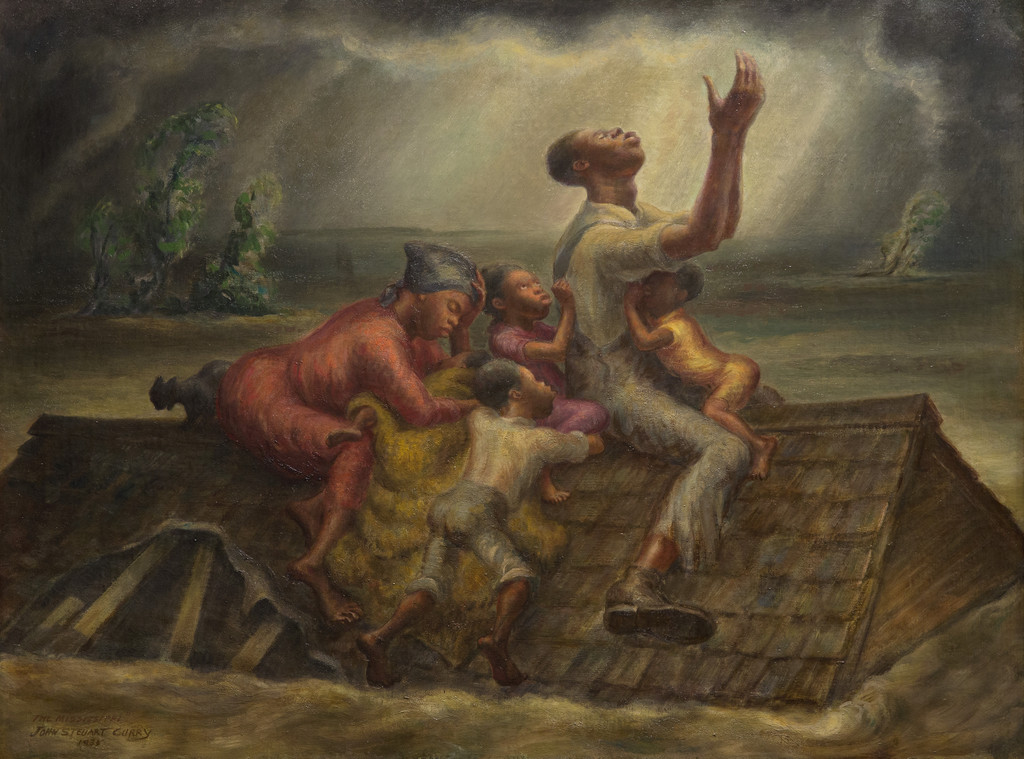
1932 paintingThe Mississippi
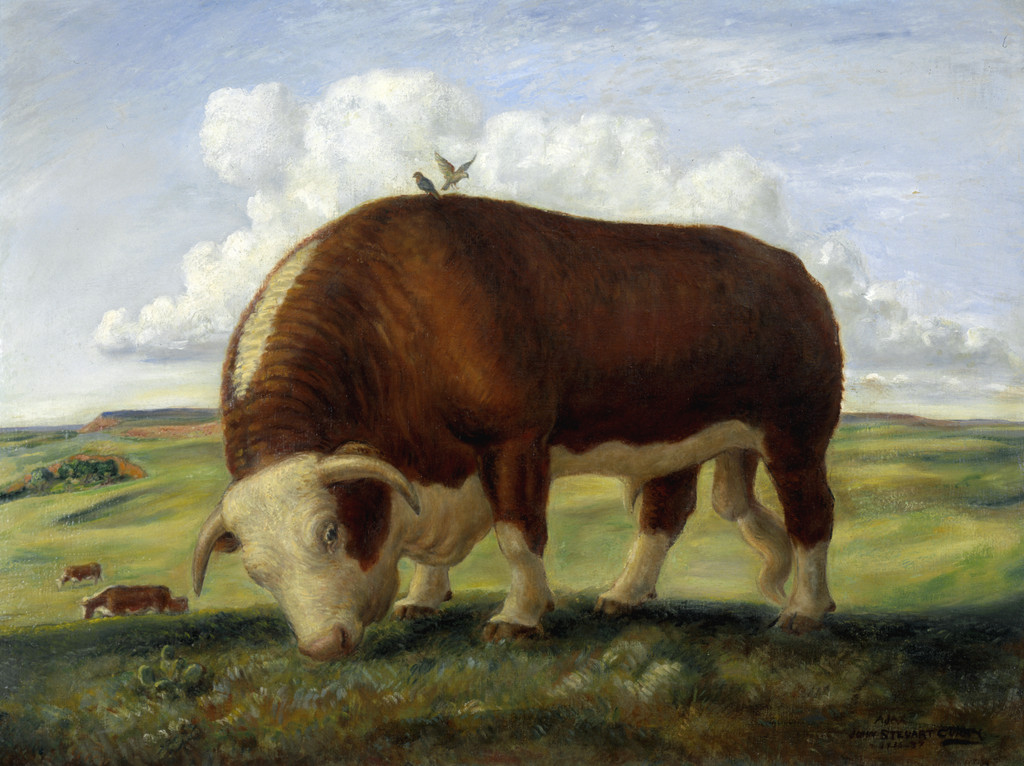
1935 paintingAjax
1936–37 oil paintingTragic Prelude
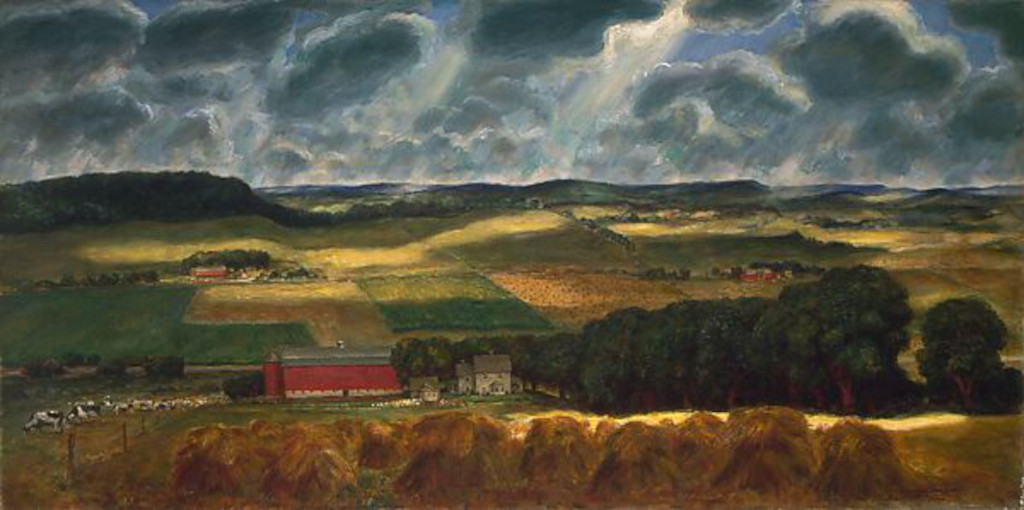
1938–40; project 1937–42Wisconsin Landscape
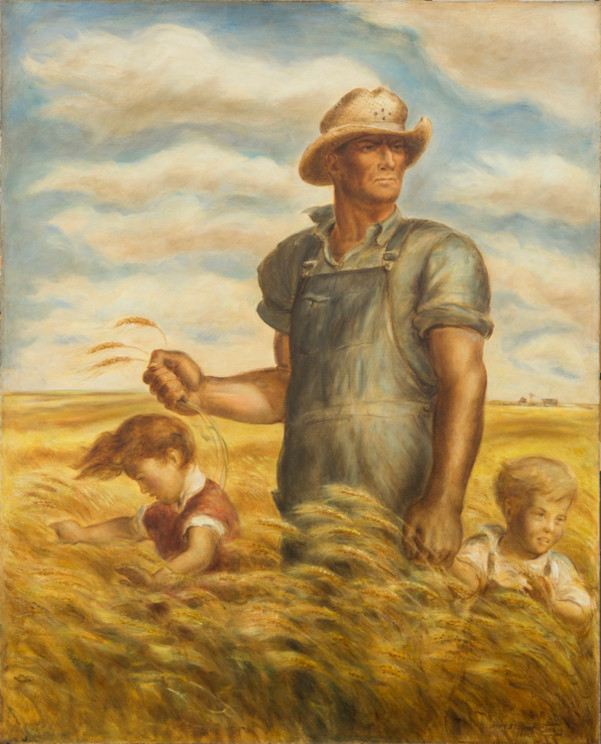
1938–39Our Good Earth
1942 oil paintingNotes and sources
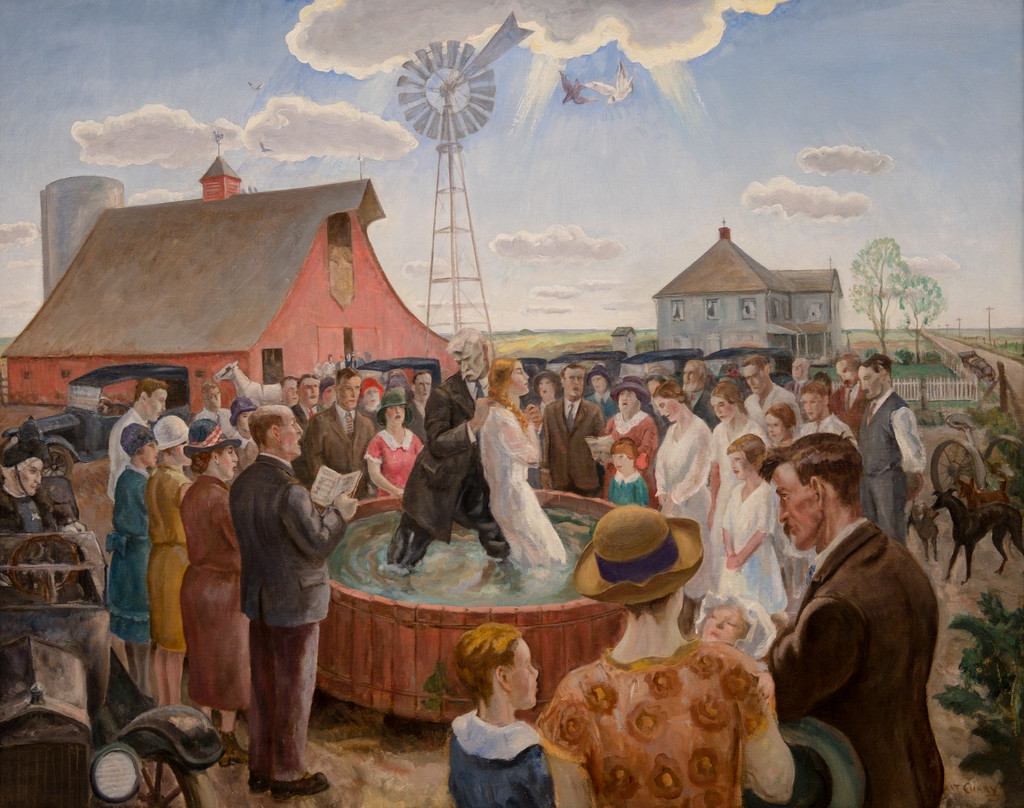
Baptism in Kansas. A remembered Kansas ceremony is staged within a working farmyard. [5]
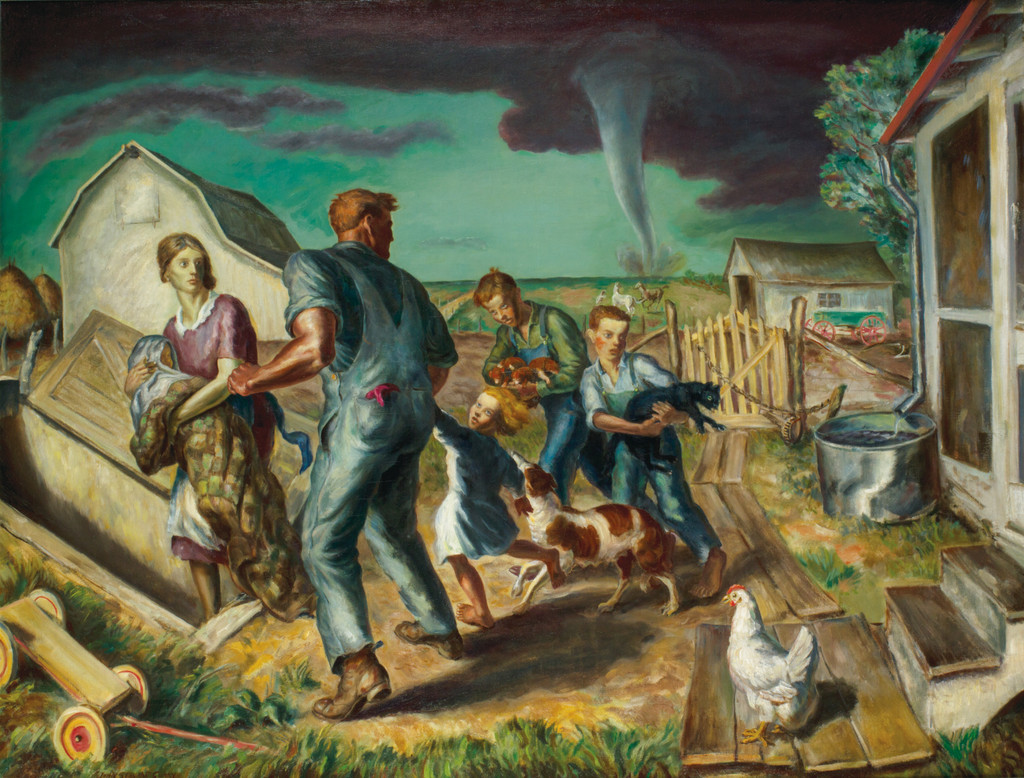
Tornado Over Kansas. A Kansas storm and a family seeking shelter, painted in Curry’s Westport studio. [6]
Circus Elephants. Elephants and handlers occupy the working space beneath a circus tent. [7]
The Mississippi. A family occupies a roof amid floodwater; the painting is tempera on canvas mounted on panel. [8]
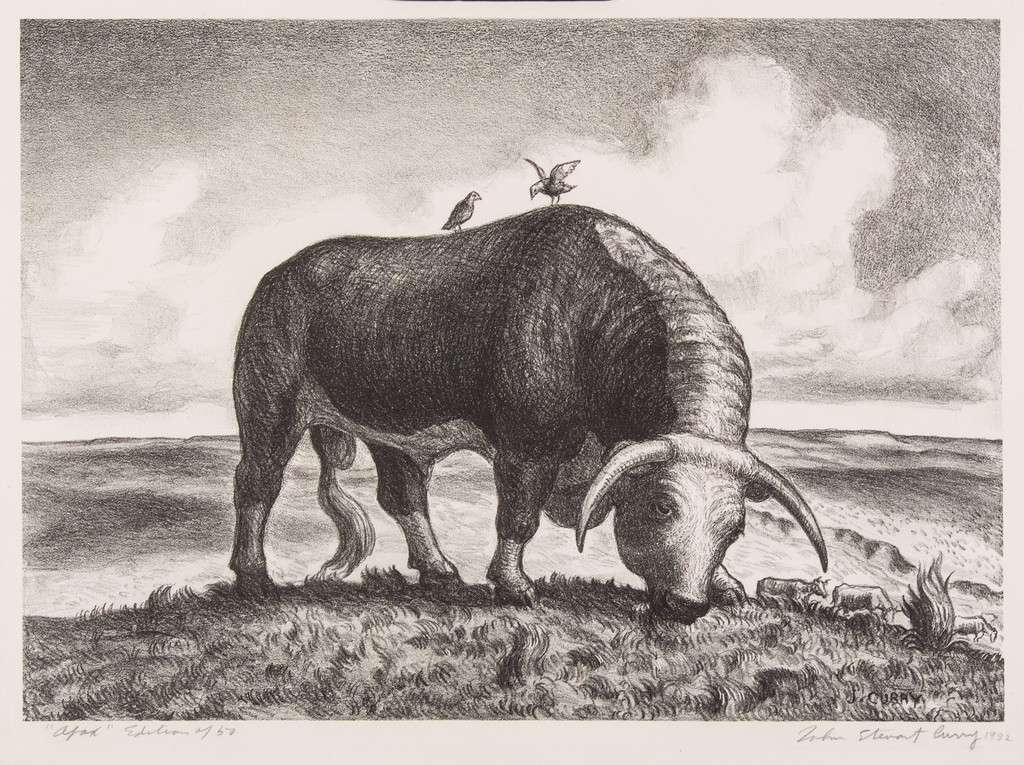
Ajax. The monumental bull in the Smithsonian oil differs from the earlier lithograph. [9]
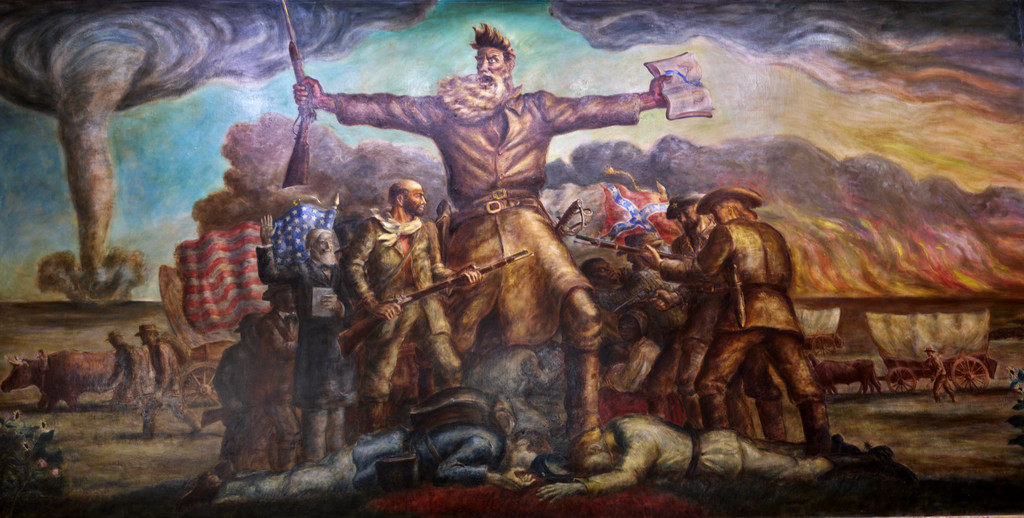
Tragic Prelude. John Brown stands at the centre of a Kansas State Capitol mural continuing across adjoining walls. [10]
Wisconsin Landscape. An extensive farm panorama, distinct from the separately catalogued preparatory study. [11]
Our Good Earth. The Chazen painting is distinct from the watercolour study, lithographs and wartime posters. [12]
Contents
- A painter of the American Midwest
- Kansas remembered from the East Coast
- Weather and the drama of ordinary life
- Religion, performance and the family
- The circus and disciplined work
- Public history on a monumental scale
- Wisconsin and the place of the working artist
- Eight works and routes through the collection
A painter of the American Midwest
Curry grew up on a farm near Dunavant in northeastern Kansas. His parents, Smith and Margaret Curry, encouraged an interest in art, and his subsequent education took him through institutions in Kansas City, Chicago and Pennsylvania. The childhood farm remained an important point of reference as his working life carried him elsewhere. Familiar subjects supplied a store of relationships: people caring for children and animals, the dependence of farming on weather, and the gatherings through which a community recognized itself. [13]
Calling this a regional art identifies an attachment to place while opening a larger question about representation. A picture made from a remembered Kansas experience could be exhibited in New York, collected in Michigan or seen in reproduction across the country. Its audience brought different memories and expectations to it. The same storm that suggested a recognizable childhood danger to one viewer could trouble another as a public image of Kansas.
The Regionalist association with Grant Wood and Benton gave Curry a prominent position among American artists . It also encouraged viewers to consider the three together. Their shared attention to American subjects leaves room for considerable differences in composition, materials and the meaning assigned to rural life. Curry’s large figures, agitated weather and concentrated physical actions provide a useful starting point for recognizing his particular contribution. [14]
His range becomes clearer when a tranquil grazing bull is considered beside a threatened household or a crowd caught up in religious performance. Rural experience contains work, pleasure, danger, belief and conflict. Curry made pictures from that variety, allowing a familiar setting to carry questions about security, belonging and public responsibility.
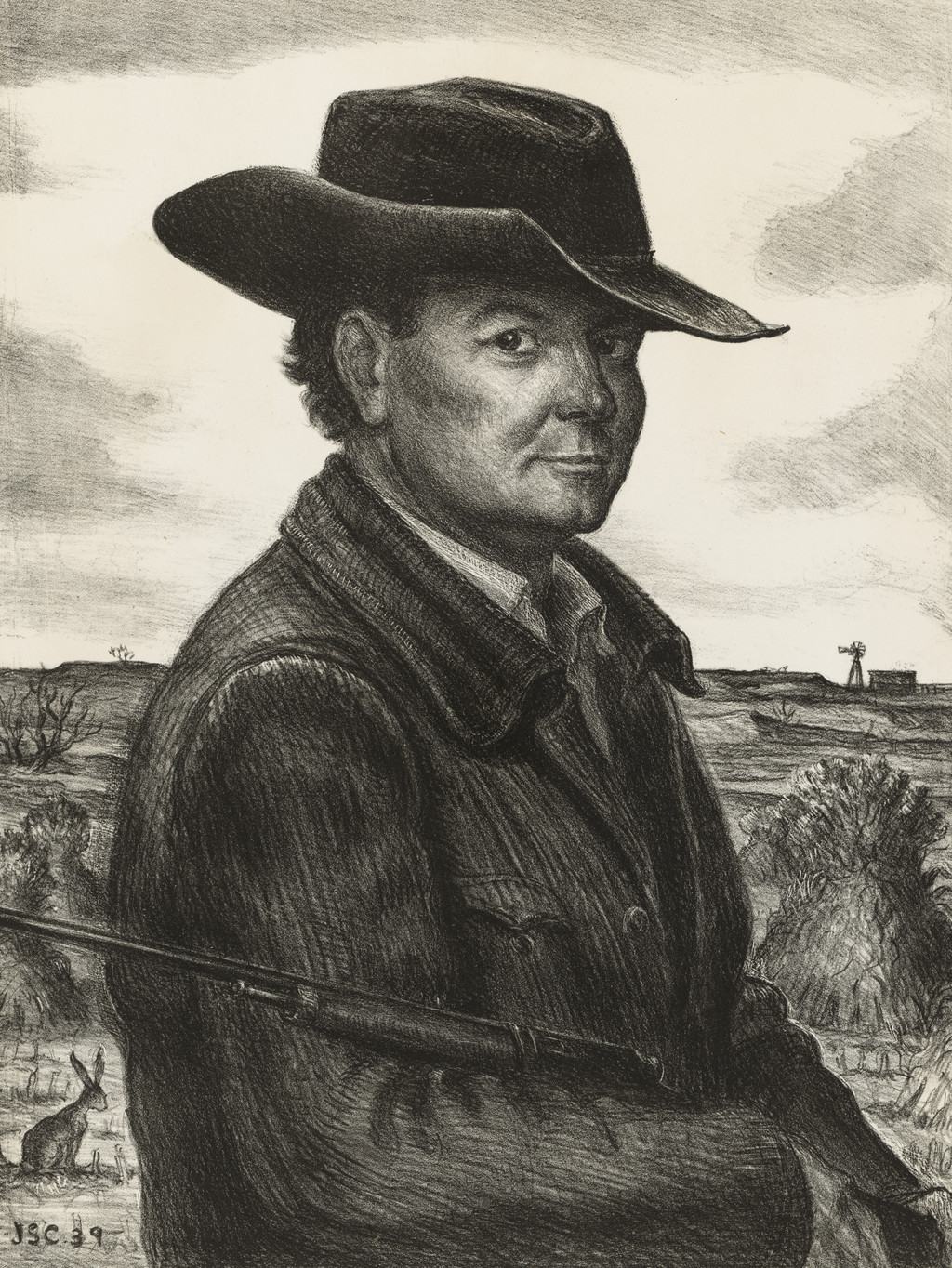
John Steuart Curry, Self-Portrait, 1939, lithograph. National Portrait Gallery, Smithsonian Institution, NPG.85.33.
Image source
.
CC0 / public domain; US copyright not renewed
. Proportionally resized; original appearance retained.
Four stages of John Steuart Curry’s career
These periods group related developments; painting, travel and local work overlap across their boundaries.
Learning to make pictures for an audience
A Kansas farm childhood was followed by art-school training and freelance magazine illustration. Harvey Dunn’s influence in Leonia belongs to this early professional development. [2]
From illustration towards painting
Study in Paris in 1926–27 was followed by growing recognition for paintings of American subjects. Curry held a solo exhibition at the Whitney Studio Club in 1930. [2]
Ideas moving across media
Circus drawings and other sketchbook subjects reveal Curry’s continuing attention to bodies, movement and materials. Finished drawings, experiments and notes coexist in books that record the development of ideas. [15]
An artist working with a wider community
The Wisconsin residency combined Curry’s own painting with guidance for rural artists, lectures and exhibitions. Mural projects in Washington, Kansas and Wisconsin brought further public settings to his work. [2]
Kansas remembered from the East Coast
One revealing fact about Tornado Over Kansas is where Curry painted it. The 1929 canvas was made in his Westport, Connecticut, studio. Its farmyard and threatening funnel draw on a Kansas subject developed at a distance. The finished painting therefore joins knowledge of a place to the deliberate work of constructing a scene. [6]
The composition makes that construction visible. The father turns across the path of the family’s movement; children, animals, the cellar entrance and the house crowd the foreground. Beyond the fence, the tornado occupies an open interval of land and sky. The difference between the close household activity and the distant storm gives the viewer two scales of attention at once. Small domestic decisions take place within a much larger danger.
Memory mattered in Baptism in Kansas as well. The 1928 painting recalls a ceremony at Will McBride’s farm in 1915, when drought made a farm water tank an alternative place for immersion. Its remembered event becomes a carefully arranged gathering of faces, bodies, vehicles and farm buildings. The painting invites attention both to the ritual at its centre and to the community surrounding it. [16]
Distance also helps explain the reach of these pictures. Their subjects could remain locally specific while becoming recognizable to people who had lived elsewhere. Muskegon’s account of The Tornado records a prospective buyer responding to memories of his own Michigan childhood. The painting’s later exhibition and publication history carried that recognition further, connecting a particular farm scene with a widely circulated image of the Midwest. [6]
Weather and the drama of ordinary life
Weather gives many Curry compositions their largest moving forms. A tornado narrows into a funnel, clouds advance across farmland, and wind appears through the direction of a figure or a tree. These elements organize the image as well as establishing its subject. Their scale can make the people seem vulnerable while sharpening the importance of an immediate action.
In The Tornado , the household’s movement supplies that action. The storm is still beyond the farmyard, but its approach changes the meaning of everything nearby. A toy, a bucket or an animal belongs to the ordinary life of the place; the urgency of the figures draws those objects into a moment of interruption. The painting’s tension depends on the time between seeing danger and reaching shelter.
Other subjects offer different relationships between people and their surroundings. The family in The Mississippi occupies a precarious roof above floodwater. The expansive farm panorama of Wisconsin Landscape gathers buildings, fields and distant hills beneath a changing sky. Looking between such pictures makes room for different degrees of threat, work and continuity within Curry’s countryside.
Ajax provides a particularly strong change of pace. The bull’s body fills much of the image, while small birds and distant cattle establish other scales. Its lowered head and grazing stance give weight to the animal without requiring a violent action. The Smithsonian interprets the fertile pasture and substantial cattle in relation to a desire for reassurance during the Dust Bowl years. That reading adds historical context to the image’s visible contrast of bulk and delicacy. [9]
Religion, performance and the family
Curry’s religious subjects bring belief into recognizable social settings. Baptism in Kansas places immersion within a working farmyard. The windmill, water tank and parked cars connect the gathering to the practical arrangements of rural life. The white-clothed candidate and dark-clothed minister stand among people whose different positions allow the viewer to move between the central ritual and its witnesses.
Art historian Jeffrey Richmond-Moll has examined these details through the relationship between religion and modern mobility. His account considers the movement of congregations, the importance of water and the ways rural communities were connected by roads and vehicles. It also brings together differing responses to Curry’s image: a viewer might find sincerity, satire, unease or several of those qualities at once. The painting’s expressive faces sustain that complexity. [16]
The Gospel Train shifts the emphasis toward bodily movement and collective performance. Figures raise their hands, children dance and musicians occupy one side of the room. The banner’s train image gives the gathering another point of focus. The floor and the surrounding group hold the scene together while individual gestures pull attention in different directions.
The quieter domestic setting of The Old Folks extends the account of rural community into a household. Richmond-Moll discusses the newspaper and radio in the portrait of Curry’s parents as connections between the farm and a larger world. Read alongside the religious scenes, the picture complicates any idea of a countryside wholly isolated from modern life. Gathering, reading, listening and travelling all become part of the experience Curry chose to depict. [16]
The circus and disciplined work
The circus opened another field of subjects for Curry. Animals, aerial performers and the practical work surrounding a travelling show offered opportunities to study bodies in motion and bodies at rest. His circus pictures belong within a career already attentive to the relation between physical weight, balance and the space around a figure.
Worcester Art Museum’s account of his sketchbooks emphasizes drawing as a continuing activity throughout that career. The books bring together studies, notes, experiments and more resolved images. Their sequence allows an idea to develop across pages rather than appearing only in the final form of a painting. Circus drawings sit within this wider practice of looking, recording and reconsidering. [15]
Circus Elephants and The Flying Codonas offer contrasting ways to pursue the subject. One concentrates on large animals occupying the space beneath a tent; the other turns toward aerial performance. Their different demands make the circus a useful place to examine Curry’s interests in movement, mass and the arrangement of a scene.
His working methods were varied too. Conservators Lance Mayer and Gay Myers document experiments with tempera and oil, changing grounds and the treatment of painted surfaces. Their study makes clear the value of considering particular pictures individually. An account of style and technique can therefore connect the force of Curry’s images to specific working decisions, while preserving the distinction between observed material evidence and a proposed explanation. [3]
Public history on a monumental scale
Murals gave Curry architectural settings in which to address a public audience. Federal commissions brought him into the Department of Justice and Department of the Interior buildings in Washington. The institution commissioning a work, the shape of the available wall and expectations about its subject became part of the painting’s circumstances. [14]
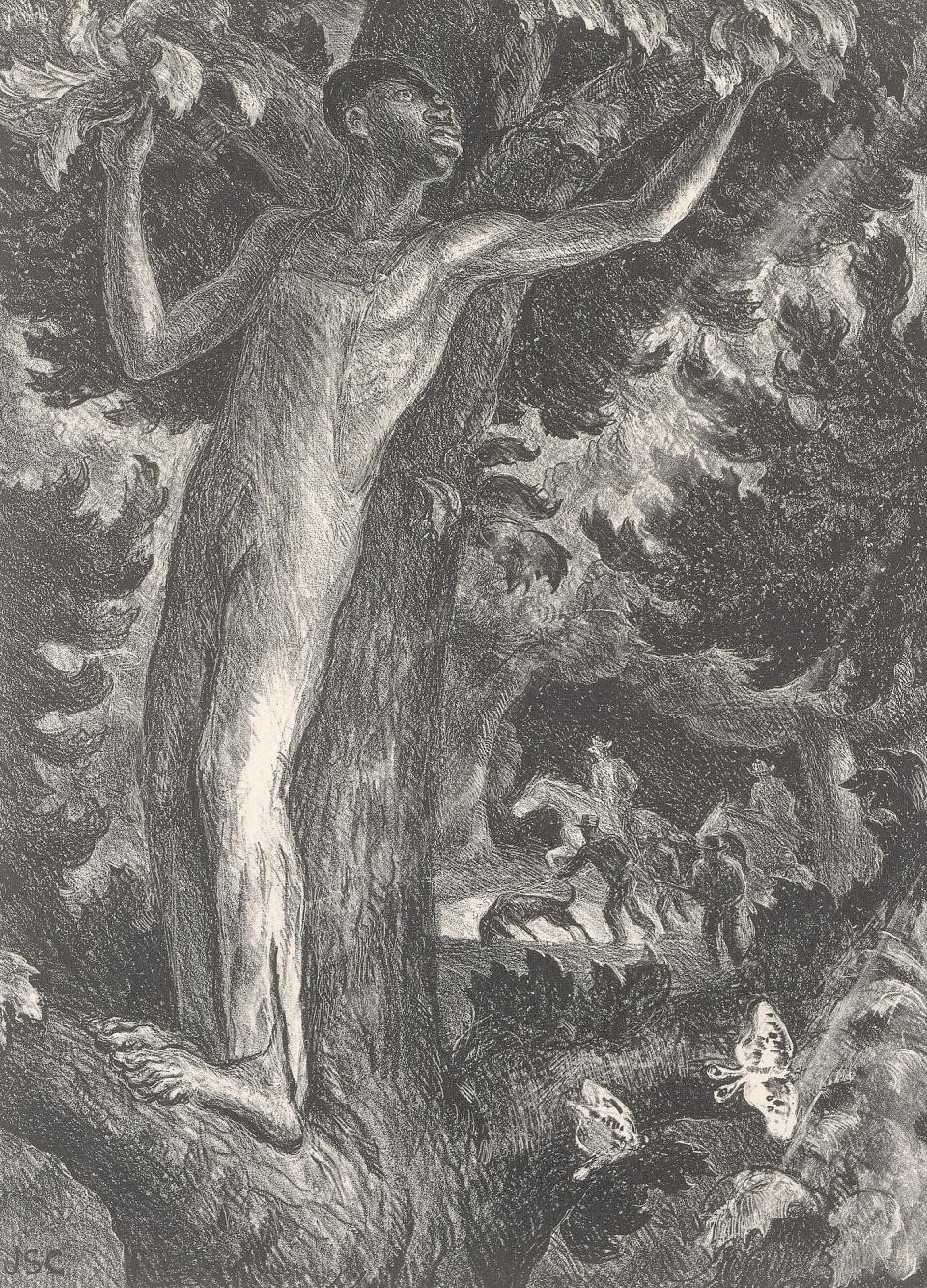
His public subjects also reached viewers through prints. In The Fugitive , a Black man clings high among the branches of a tree while men and dogs appear below. The raised arms and exposed body make the threatened figure the centre of a tightly compressed setting. The Smithsonian places the 1935 lithograph within the period’s anti-lynching art and the NAACP’s exhibition activity. Its relation to Social Realism emerges through the attention it asks viewers to give to racial violence and the individual facing it. The image widens an account of Curry’s public concerns beyond the history represented on official walls. [4]
War and communal memory provide another strand. The Return of Private Davis from the Argonne developed over the years from 1928 to 1940, taking a Kansas soldier’s reburial as its subject. Historian Steven Trout examines how a military funeral could carry differing attitudes toward patriotic service, loss and the place of war in a community’s memory. The prolonged development of the painting is revealing beside Curry’s remembered farm scenes: an earlier event could remain available for reconsideration as the artist’s circumstances and the wider political setting changed. [17]
The Kansas State Capitol programme made that relationship especially visible. A campaign by newspaper editors helped bring the commission into being in 1937. Curry’s chosen subjects and their treatment then became matters of public dispute. The completed corridor paintings belonged to a wider programme whose proposed rotunda scenes remained unfinished. The history requires attention to both the paintings that exist and the ambitions that were abandoned. [18]
In Tragic Prelude , John Brown’s outstretched arms establish the central figure’s extraordinary scale. Armed groups, flags, bodies, wagons, fire and the tornado gather different kinds of historical and natural force around him. The work continues onto an adjoining wall, so a photograph of the familiar Brown-centred panel supplies only part of its architectural setting. [10]
The murals remained unsigned when Curry ended work on the larger project in 1942. Their controversy is one part of their history; their capacity to organize a public encounter with the past is another. The murals article considers the different federal, Kansas and Wisconsin commissions together, including the changes that institutional expectations could bring to a proposed image. [13]
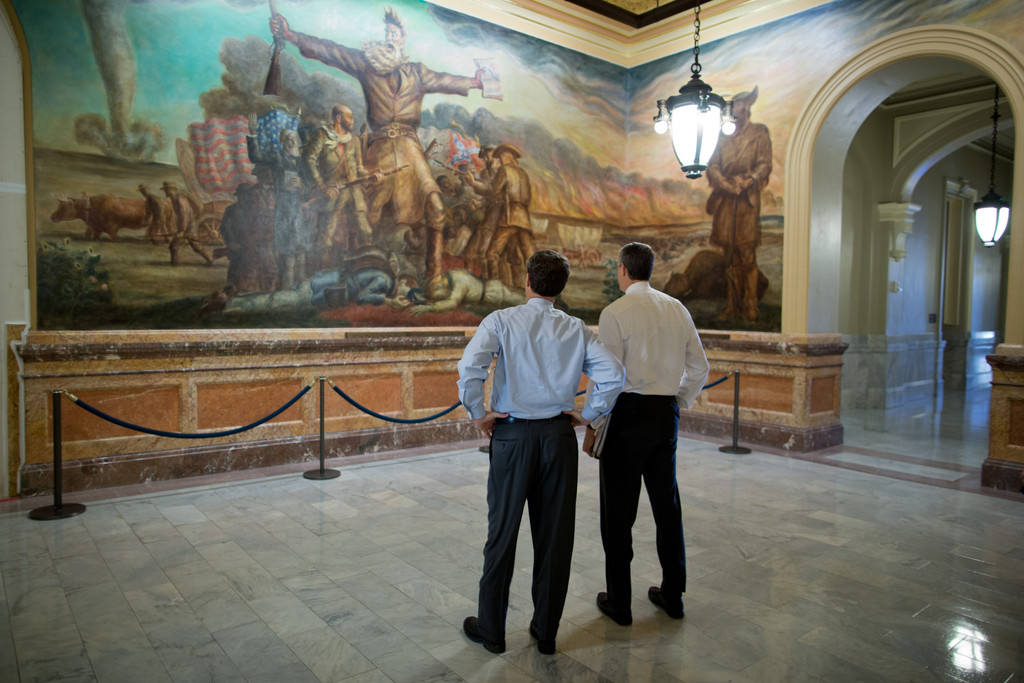
Sam Brownback and Arne Duncan viewing Tragic Prelude at the Kansas State Capitol, 18 September 2012. Photograph by Chuck Kennedy. This installation view includes people and architectural surroundings.
Image source
.
CC BY 2.0
. Proportionally resized; original appearance retained.
Wisconsin and the place of the working artist
In 1936 Curry became artist in residence at the University of Wisconsin’s College of Agriculture. He remained in Madison until his death in 1946. The appointment brought his artistic work into a setting concerned with farming, education and a public extending beyond professional artists and established collectors. [2]
The university’s account of his Wisconsin years emphasizes his engagement with rural residents and encouragement of their artistic ambitions. It also places his paintings beside the drawings through which subjects developed. Agriculture could provide a subject for a finished picture while offering a setting for conversations about who might make art and what experiences deserved representation. [19]
Our Good Earth , with its farmer and children in a wheat field, belongs within this broader relationship between rural experience and public imagery. The composition exists in different media, making it important to distinguish the painting, the watercolor study, the lithograph and wartime reproductions. Each has its own material form and history even when the central motif is familiar.
Curry’s Wisconsin work also included murals for university buildings. These extend the account of his public art beyond the Kansas controversy. The dedicated Wisconsin study follows the residency, the agricultural setting and the continuing importance of Kansas within a career established elsewhere.
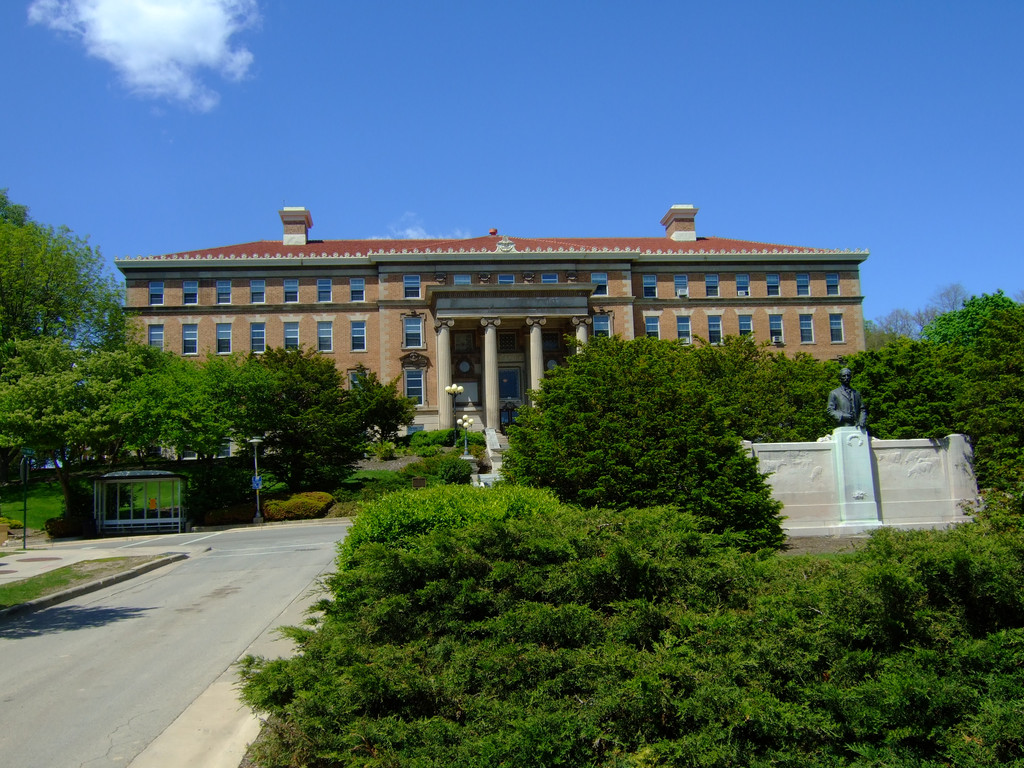
Agriculture Hall, University of Wisconsin–Madison, photographed by James Steakley in 2009. University setting; this is not a view of Curry’s studio.
Image source
.
CC BY-SA 3.0
. Proportionally resized; original appearance retained.
Eight works and routes through the collection
The Tornado , Tragic Prelude and Baptism in Kansas form a particularly useful opening group. Compare their arrangements of people before concentrating on individual symbols. In each, a central action directs attention across a larger setting, while gestures and changes of scale connect the figures to the surrounding world.
Then consider Our Good Earth , Wisconsin Landscape and Ajax . The relationship between people, animals and productive land takes different forms across these works. The monumental farmer, the extensive panorama and the close view of the bull offer contrasting ways to organize an agricultural subject. Their differences help widen an account of Curry beyond his most dramatic storm images.
The Mississippi and Circus Elephants open further comparisons. The threatened household and the animals beneath the tent place bodies within sharply different circumstances. A reader interested in the development and circulation of such compositions can continue through drawings and prints , while the painting studies follow individual subjects, objects and histories in greater detail.
Essential John Steuart Curry works
Tornado Over Kansas
1929 · A Kansas storm and a family seeking shelter, painted in Curry’s Westport studio.
Tragic Prelude
1938–40; project 1937–42 · John Brown stands at the centre of a Kansas State Capitol mural continuing across adjoining walls.
Baptism in Kansas
1928 · A remembered Kansas ceremony is staged within a working farmyard.
Our Good Earth
1942 oil painting · The Chazen painting is distinct from the watercolour study, lithographs and wartime posters.
Wisconsin Landscape
1938–39 · An extensive farm panorama, distinct from the separately catalogued preparatory study.
Ajax
1936–37 oil painting · The monumental bull in the Smithsonian oil differs from the earlier lithograph.
The Mississippi
1935 painting · A family occupies a roof amid floodwater; the painting is tempera on canvas mounted on panel.
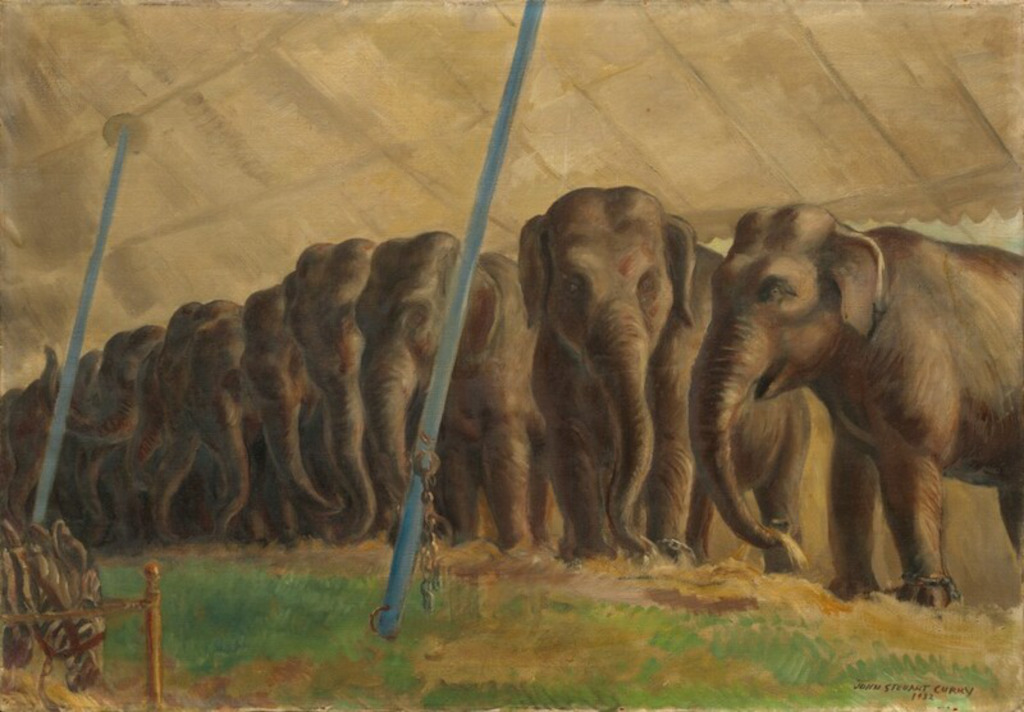
Circus Elephants
1932 painting · Elephants and handlers occupy the working space beneath a circus tent.
Books and further reading
These resources place Curry’s prints within the wider history of Associated American Artists.
Art for Every Home: Associated American Artists, 1934–2000. Edited by Elizabeth G. Seaton, Jane Myers and Gail Windisch. Marianna Kistler Beach Museum of Art, 2015; distributed by Yale University Press. ISBN 9780300215793.
A wider account of the publisher that brought Curry’s prints into American homes, useful for understanding the relationship between art, commerce and domestic display. Museum publication details.
Art for Every Home: An Illustrated Index of Associated American Artists Prints, Ceramics, and Textile Designs. Gail Windisch, Sylvan Cole and Karen J. Herbaugh. Marianna Kistler Beach Museum of Art, 2016.
A free reference index for AAA publications, useful for separating publication dates, editions and printing records. The repository links to a large PDF of about 399 MB. Open the university repository record.
Watch: Curry at the Museum of Wisconsin Art
An exhibition interview offers another route into Curry’s Wisconsin subjects and career.
Look at This: John Steuart Curry at MOWA
Kat Murrell interviews Graeme Reid about John Steuart Curry: At Home in Wisconsin at the Museum of Wisconsin Art.
Watch on YouTubeArtworks and versions directory
Browse 84 selected object, version, edition and reproduction records. Several concern related images or different impressions; this is not a complete lifetime catalogue or a count of unique compositions. Search also finds prints, photographs and reproductions; the medium filter groups paintings and drawings.


Frequently Asked Questions
He is especially associated with Tornado Over Kansas , Baptism in Kansas and the Kansas State Capitol mural Tragic Prelude , alongside a wider body of paintings, drawings, prints and public commissions. [1]
Curry is a major figure in American Regionalism and the broader American Scene, commonly considered alongside Grant Wood and Thomas Hart Benton. [14]
Tornado Over Kansas was painted in his Westport, Connecticut, studio. Familiar places and remembered experiences could continue to supply subjects while he worked elsewhere. [6]
Curry developed subjects through drawings, paintings and prints. Similar imagery can belong to distinct objects, so dates, media and collection records are important when comparing versions. Worcester’s sketchbook exhibition explains the continuing role of drawing in that process. [15]
Discussion
Look again at the images and ideas explored in John Steuart Curry. These editorial prompts invite your observations.
Reader Insights
Compare the positions of the people in Baptism in Kansas and Tornado Over Kansas . How does each group direct attention toward its central event?
Look at the bull in Ajax beside the family in The Mississippi . How does the relationship between bodies and surrounding space change the mood?
Consider a Capitol installation photograph alongside the central panel of Tragic Prelude . What does the building add to the experience of the painting?
Join the Conversation
Share a detail, comparison or question about John Steuart Curry below.
References
- Smithsonian American Art Museum , John Steuart Curry: artist biographies, accounts published by Joan Stahl and the National Museum of American Art. View source
- Archives of American Art , Smithsonian Institution, John Steuart Curry and Curry family papers: finding aid, printed pp.1–4, overview, biography and scope. For the Marsh connection, also consulted printed p.14 (PDF p.16), Box 2, Folder 61: the correspondence listing and its note about technical notes and illustrated letters. View source
- Lance Mayer and Gay Myers , Old Master Recipes in the 1920s, 1930s, and 1940s: Curry, Marsh, Doerner, and Maroger, Journal of the American Institute for Conservation 41, no.1 (2002): 21–42, section 2 on Curry. View source
- Smithsonian American Art Museum , Oh Freedom! John Steuart Curry, The Fugitive and the anti-lynching context. View source
- Whitney Museum of American Art, John Steuart Curry | Baptism in Kansas | Whitney Museum of American Art. View source
- Muskegon Museum of Art , Tornado Over Kansas, object essay, acquisition and exhibition history. View source
- National Gallery of Art, Circus Elephants: collection object record. View source
- Saint Louis Art Museum, The Mississippi,1935,7:1937: collection record and provenance. View source
- Smithsonian American Art Museum , Ajax, 1936–37, 2001.95, object record and interpretation. View source
- Kansas Historical Society , Kansas State Capitol online tour: Tragic Prelude, architectural location and mural interpretation. View source
- Metropolitan Museum of Art, Wisconsin Landscape. View source
- Chazen Museum of Art, Our Good Earth | 1873 |Chazen Museum of Art. View source
- Kansas Historical Society , John Steuart Curry, biographical entry. View source
- U.S. General Services Administration , John Steuart Curry, artist biography and federal collection overview. View source
- Worcester Art Museum , Collective Images: The Sketchbooks of John Steuart Curry, exhibition of 23 February–5 May 2002. View source
- Jeffrey Richmond-Moll , Holy Rollers: Religion and Modern Mobility in the Art of John Steuart Curry, Panorama 9, no.2 (Fall 2023), complete article. View source
- Steven Trout , The Western Front Comes to Kansas: John Steuart Curry’s The Return of Private Davis from the Argonne, Kansas History 31 (Autumn 2008): 194–211. View source
- Kansas Historical Society , Kansas State Capitol: Curry murals, commission and controversy. View source
- Käri Knutson , University of Wisconsin–Madison, Museum featuring works of UW’s John Steuart Curry, 8 September 2014. View source
- Splash image source.
John Steuart Curry, The Tornado (Tornado Over Kansas), 1929, oil on canvas. Muskegon Museum of Art. Public domain . Proportionally resized; original appearance retained.
View source - Smarthistory, Social Realism period guide: c. 1930–1945. View source
- Tacoma Art Museum, “Departures and Divisions”: Regionalism and Social Realism in the 1930s and 1940s. Range rounded to c. 1930–1950 for comparison. View source
- Spencer Museum of Art, The American Scene: Graphics of the 1930s and 1940s (1985). Range rounded to c. 1930–1950 for comparison. View source
- National Museum of American History, Harvey Dunn: 1884–1952. Artist life dates. View source
- National Gallery of Art, Thomas Hart Benton: 1889–1975. Artist life dates. View source
- National Gallery of Art, Grant Wood: 1891–1942. Artist life dates. View source
- National Gallery of Art, John Steuart Curry: 1897–1946. Artist life dates. View source
- National Gallery of Art, Reginald Marsh: 1898–1954. Artist life dates. View source
More CURRY Paintings
Our Good Earth
1942 painting and its related prints and wartime imagery.
Wisconsin Landscape
1938–39 panorama of working farmland, held by The Met.
Circus Elephants
1932 painting of elephants, handlers and the work behind the circus.