


 by
Tom Gurney
Tom Gurney BSc (Hons) is an art history expert with over 20 years experience
Email:
tomgurney1@gmail.com
/ Phone:
+44 7429 011000
The Gospel Train by John Steuart Curry: Introduction
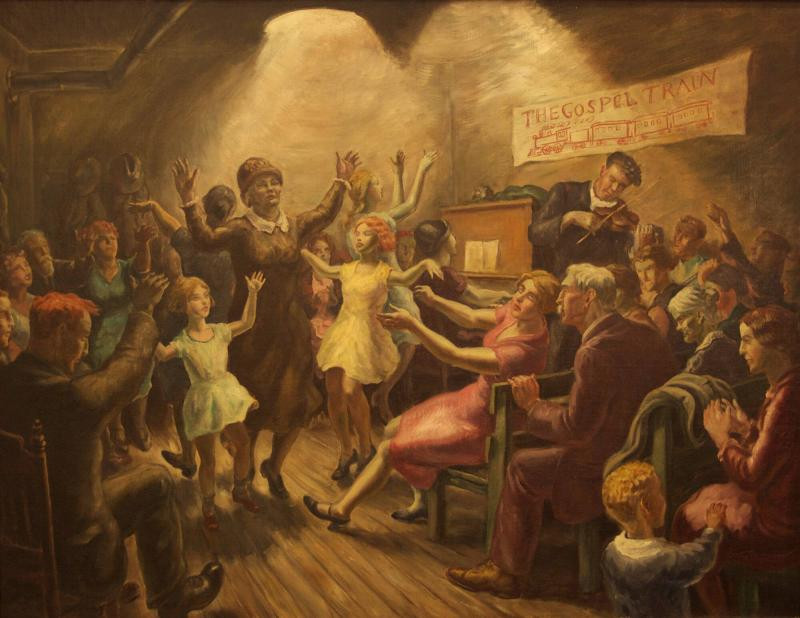
Raised hands, dancing figures and musical instruments fill a crowded room in The Gospel Train . A banner on the wall supplies the title and a small drawing of a locomotive, while the people below turn religious gathering into visible movement. John Steuart Curry makes the congregation's physical activity the centre of the picture.
Syracuse University Art Museum dates the painting to 1929 and identifies it as an oil, accession 1957.001, measuring 40 by 52 inches. [1] The scene combines adults and children, seated participants and dancers, with music connecting the different parts of the room. Its energy depends on their relationships rather than a single isolated performer.
At a Glance
- Artist John Steuart Curry, 1897–1946.
- Title The Gospel Train .
- Date 1929.
- Medium Oil; canvas support documented in the 1975 Syracuse catalogue.
- Dimensions 40 × 52 inches.
- Collection Syracuse University Art Museum.
- Credit Gift of Dr. Henry H’57 and Mrs. Gladys Kay Crown.
- Object number 1957.001.
- Related print Holy Rollers—St. Joseph, Missouri (Gospel Train) , 1930, lithograph; a separate impression is held by Chazen Museum of Art.
This work across John Steuart Curry’s career
The Gospel Train (current article)
1929 oil paintingCircus Elephants
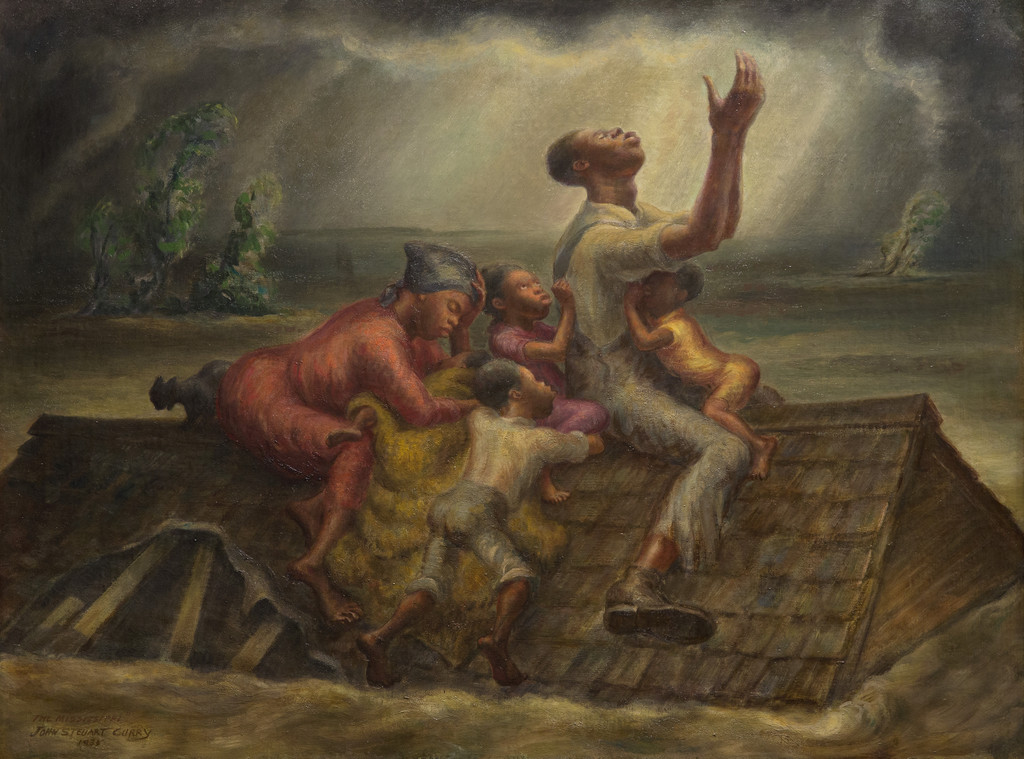
1932 paintingThe Mississippi
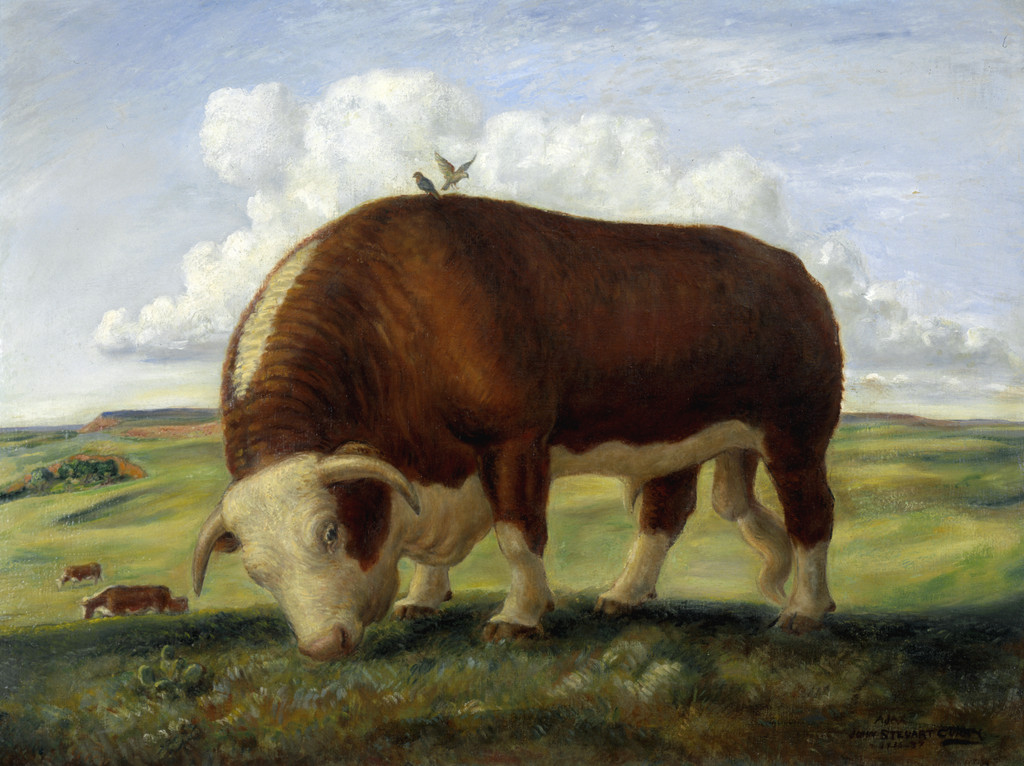
1935 paintingAjax
1936–37 oil paintingTragic Prelude
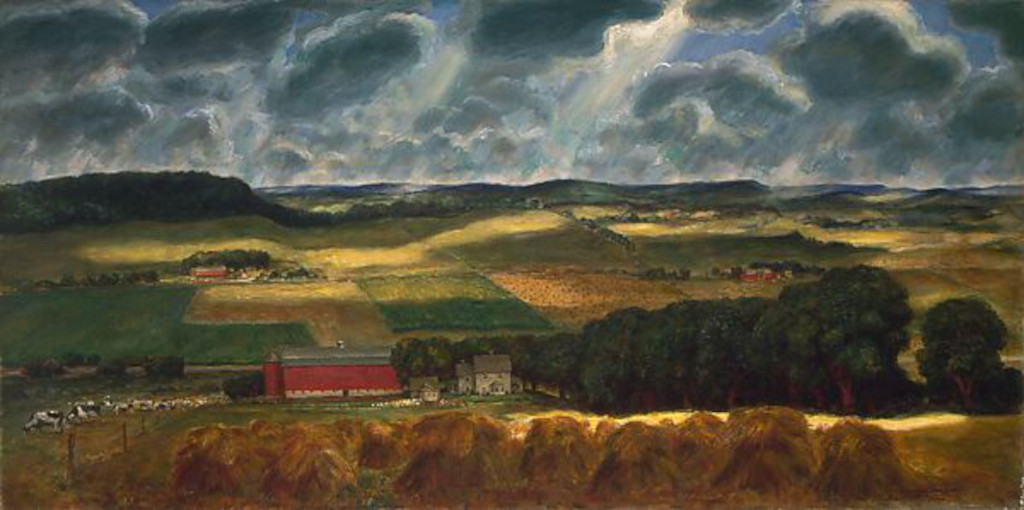
1938–40; project 1937–42Wisconsin Landscape
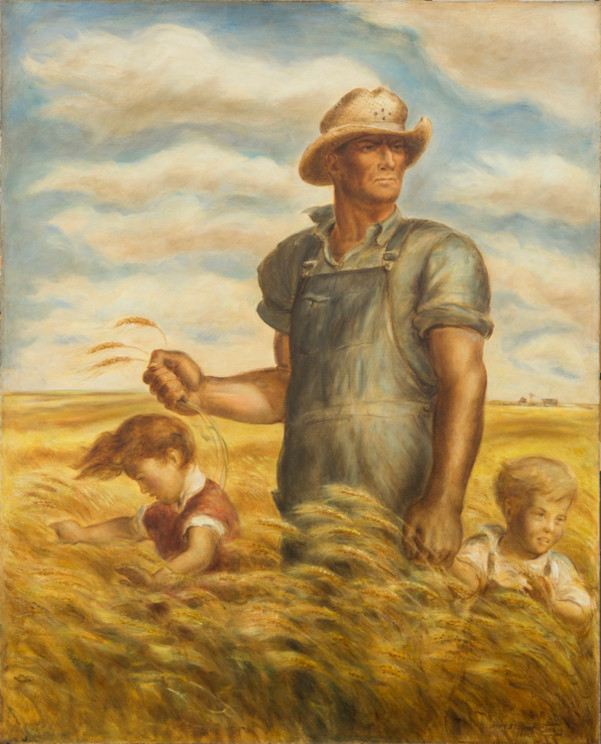
1938–39Our Good Earth
1942 oil paintingNotes and sources
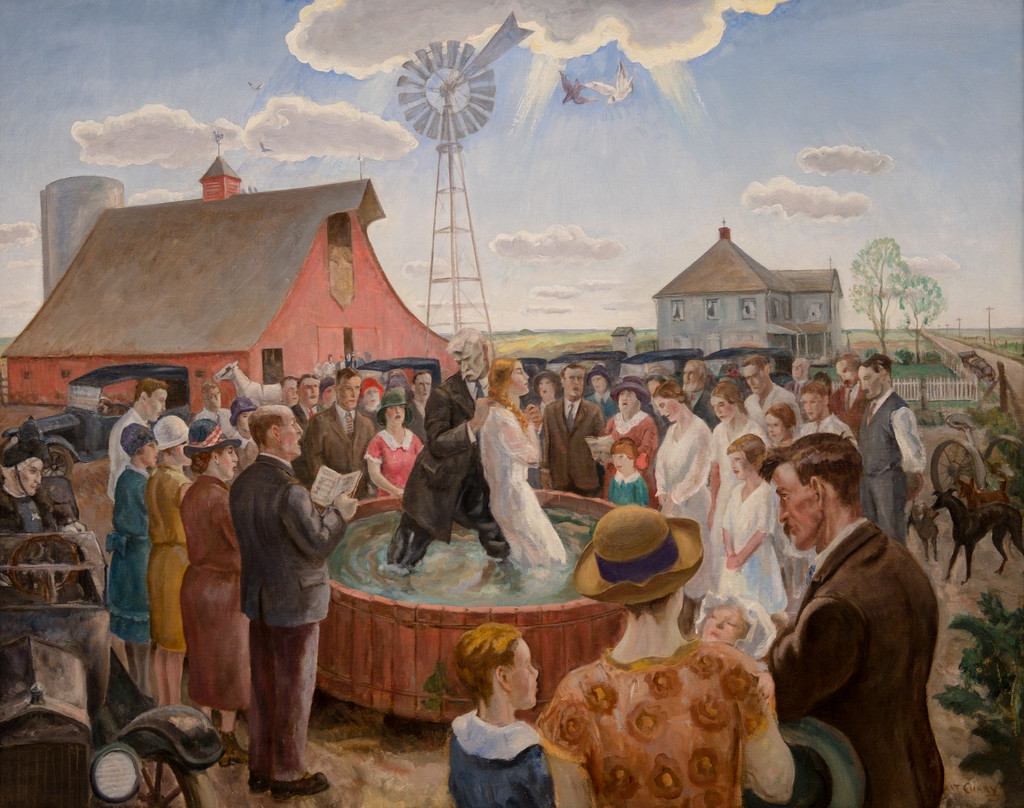
Baptism in Kansas. A remembered Kansas ceremony is staged within a working farmyard. [2]
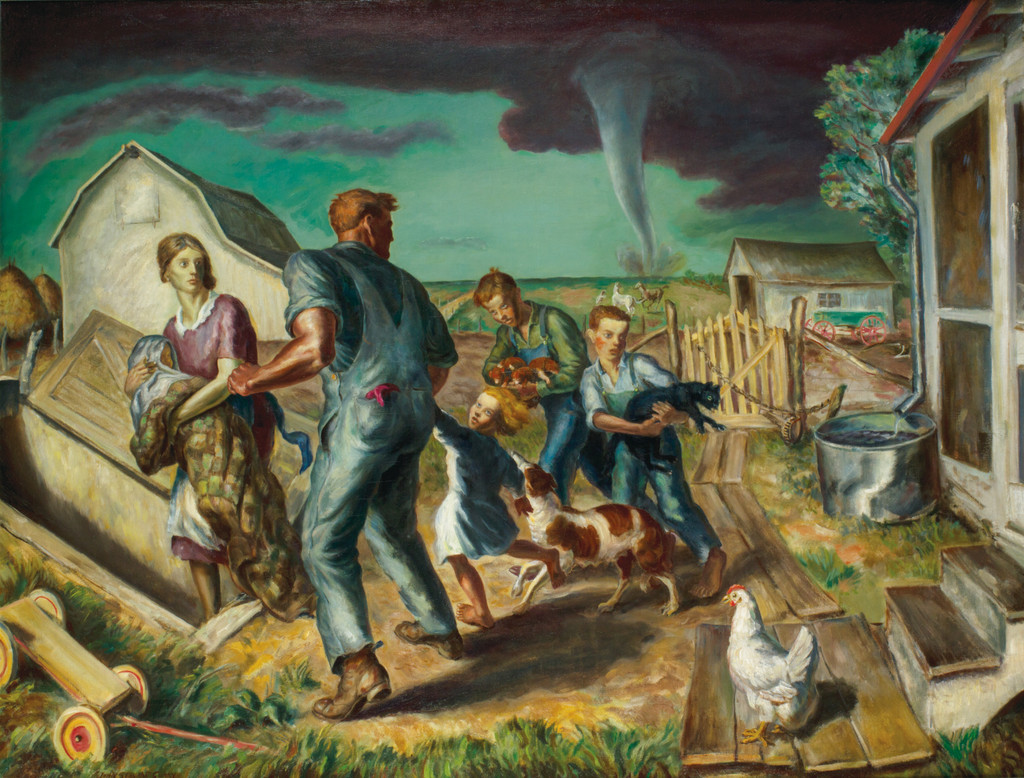
Tornado Over Kansas. A Kansas storm and a family seeking shelter, painted in Curry’s Westport studio. [3]
The Gospel Train (current article). An animated religious gathering, with musicians, dancers and a locomotive banner. [1]
Circus Elephants. Elephants and handlers occupy the working space beneath a circus tent. [4]
The Mississippi. A family occupies a roof amid floodwater; the painting is tempera on canvas mounted on panel. [5]
Ajax. The monumental bull in the Smithsonian oil differs from the earlier lithograph. [6]
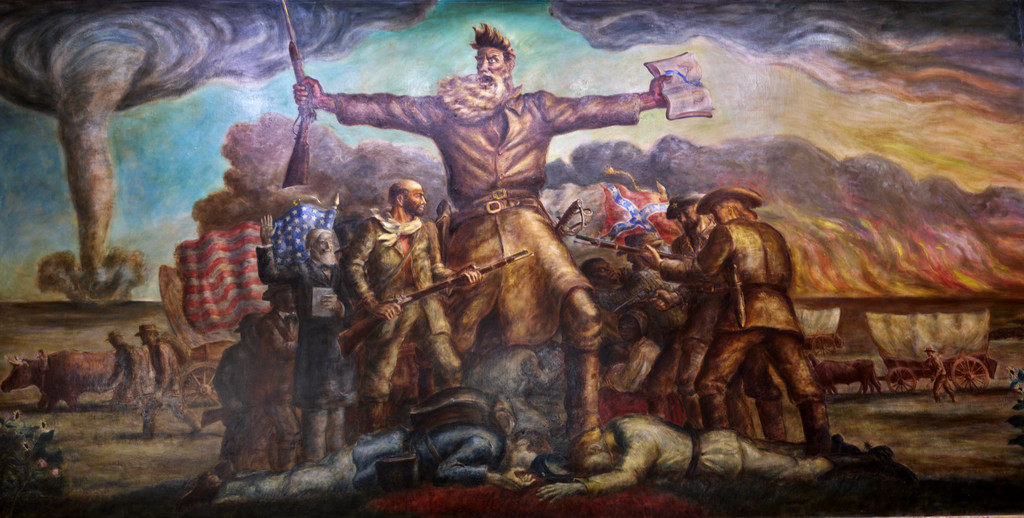
Tragic Prelude. John Brown stands at the centre of a Kansas State Capitol mural continuing across adjoining walls. [7]
Wisconsin Landscape. An extensive farm panorama, distinct from the separately catalogued preparatory study. [8]
Our Good Earth. The Chazen painting is distinct from the watercolour study, lithographs and wartime posters. [9]
Contents
- A room in motion
- Dancers, witnesses and musicians
- Light, colour and the congregation
- The banner and the idea of a train
- Religious performance and the question of satire
- Comparing Baptism in Kansas
- The 1929 oil and the 1930 lithographs
- The Syracuse collection record
- Annotated details
A room in motion
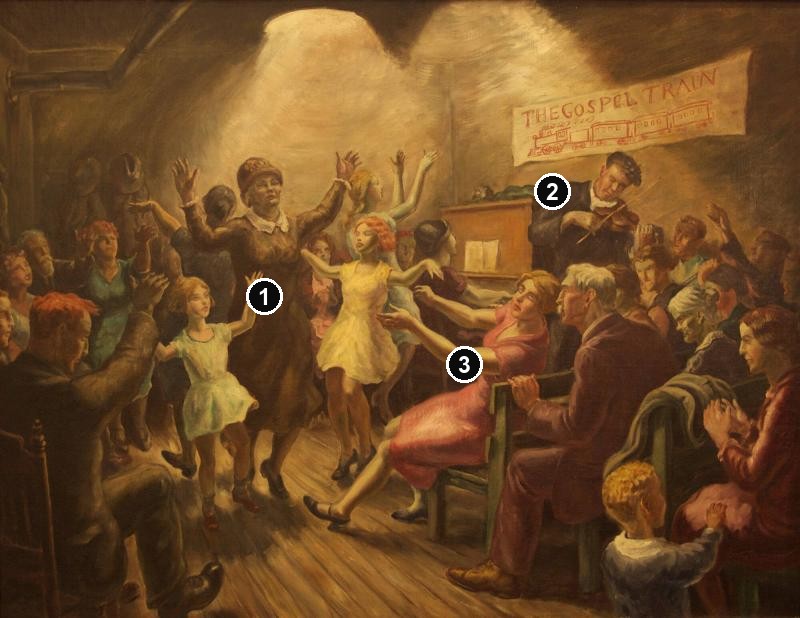
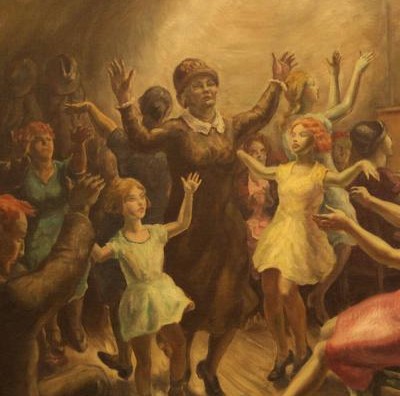
A standing woman near the centre raises both arms, while two girls occupy the open floor in front of her. One child steps forward with a bent knee; the other extends her arms and lifts her heels. Their different poses prevent the central group from settling into a single repeated gesture. The gathering has rhythm, but it is made from varied movements.
To the right, a woman in a warm pink dress leans back from her chair, reaching towards the open space. Her extended leg creates a low diagonal across the floor. That line introduces another direction beneath the standing figures and connects the seated group with the dancers. Even a person who has not left a chair can contribute strongly to the picture's sense of motion.
Curry uses overlap to keep the room crowded without making it unreadable. Hands appear beside faces, bodies meet the outlines of chairs, and more participants emerge behind the central figures. The viewer encounters a continuous gathering, but changes in pose, light and clothing help distinguish individual people within it.
The floorboards provide a quieter structure beneath the activity. Their receding lines establish the space in which the dancers move and keep the foreground open enough for their legs and feet to register. The room's depth is therefore organized through both architecture and the placement of bodies.
Annotated Details from The Gospel Train
The numbered points identify visible features discussed in this article. Return from each detail to the whole composition. John Steuart Curry, The Gospel Train, 1929, oil on canvas. Syracuse University Art Museum, Gift of Dr. Henry H’57 and Mrs. Gladys Kay Crown, 1957.001. Image source. Public domain. Editorial numbers added to the overview; detail crops retain the source image’s appearance.
Details from THE GOSPEL TRAIN
Compare the cropped details with the complete images above. Notice how their colours, shapes and positions contribute to the larger compositions.
Raised arms and dancing children
Raised hands and the children’s different steps give the central group varied directions of movement. The gathering’s energy comes from these distinct gestures occupying the same small room.
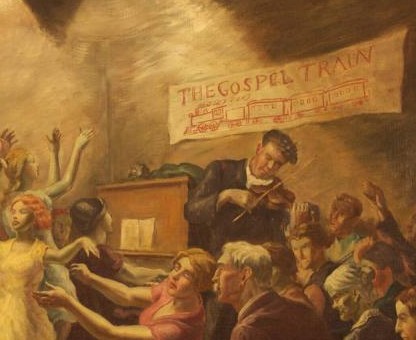
Musicians beneath the train banner
The piano and violinist provide a visible source for the implied music. Above them, the locomotive banner joins the title’s train image to the activity in the room.
The seated woman reaches into the room
The seated woman’s extended arms and leg carry movement out from her chair. Her pose connects seated participants with the figures occupying the open floor.
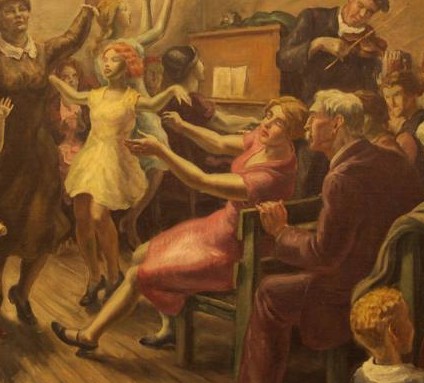
Dancers, witnesses and musicians
The people at the edges make the central action a shared event. Seated figures turn inward or lift their hands; others watch from behind. These differences matter because they show participation occurring in more than one form. The image includes stillness and attention alongside movement, without requiring every person to respond identically.
Children make this range particularly visible. The girls on the floor take part in the activity, while another child near the lower right stands beside the seated adults. Their smaller bodies introduce a second scale into the gathering. Curry brings different generations into the same room rather than presenting religious expression as an exclusively adult performance.
Music occupies a distinct area at the back. A piano stands against the wall, with an open sheet above its keyboard, and a violinist bends towards his instrument nearby. These details give the scene a visible source for its implied sound. The dancers' movements can be understood in relation to music being made within the room.
The violinist's inclined head contrasts with the more expansive raised arms elsewhere. His attention appears concentrated on the instrument rather than directed towards the viewer. That contrast creates a useful balance: the gathering's larger gestures coexist with a smaller action requiring focus and control.
The picture cannot reproduce the music itself. Instead, it suggests sound through the relationship between instruments, open mouths, lifted hands and moving feet. Looking from one of these details to another allows the viewer to reconstruct a sense of collective activity without being given a literal soundtrack or a fully specified hymn.
Light, colour and the congregation
Broad areas of light fall from above, bringing the central figures forward against the darker room. The illumination gives their faces and lifted hands particular prominence. At the edges, less clearly lit figures remain part of the gathering while allowing attention to return towards the middle.
Warm browns and golden tones hold the room together. Within that overall atmosphere, the girls' lighter dresses and the pink clothing of the seated woman create more distinct areas of colour. The changes help organize the crowd, separating important movements without turning every participant into a sharply isolated unit.
The banner and piano form a comparatively stable backdrop. Their rectangular shapes sit behind the curves of arms and bodies, providing another contrast between the room's furnishings and its occupants. Curry uses that difference to make movement legible: the human gestures are most active where they meet the steadier lines of the interior.
The lighting also gives the scene a theatrical intensity, but that effect does not establish the congregation's beliefs or the artist's judgement of them. It is possible to describe the visible concentration of light and movement without treating either enthusiasm or ridicule as a fact about Curry's intentions.
The banner and the idea of a train
The words “The Gospel Train” appear above a drawn locomotive and its carriages. The train is a picture within the painting, displayed on the wall rather than physically entering the room. Its presence joins a familiar machine to the religious subject, giving the title a visible counterpart.
Art historian Jeffrey Richmond-Moll interprets the painting through the relationship between religious experience and modern mobility. He identifies the gathering as Pentecostal and discusses the locomotive language used to describe conversion, spiritual power and bodily excitement. [10] In this reading, a train supplies a metaphor through which worshippers could express an experience that was difficult to describe in ordinary terms.
The metaphor also helps connect the title with the composition. The banner remains still, while the people beneath it supply movement. Raised arms, turning bodies and the different directions of the dancers make the gathering feel driven by a shared energy. The mechanical image and the human action reinforce one another without becoming the same thing.
Richmond-Moll extends this interpretation to the movement of religious communities across the region and the country. That broader argument gives the room a connection with histories beyond its walls. It should remain an attributed interpretation, however, rather than a claim that every figure represents a particular journey or that the painting records a named congregation's itinerary.
Watch: John Steuart Curry
Choose a film to explore the artist’s work, its interpretation and its wider setting.
Look at This: John Steuart Curry at MOWA
An exhibition interview with Graeme Reid considers Curry’s work and life in Wisconsin.
Watch on YouTubeReligious performance and the question of satire
The related print's historical title uses “Holy Rollers,” a label associated with exuberant forms of worship. It is a title to be explained in context, rather than a neutral description of all Pentecostals. The visible scene itself offers a more varied account of participation than a single collective label can convey.
Curry's emphatic gestures can seem unusual to viewers unfamiliar with the practices represented. Yet their intensity alone does not prove mockery. The painter gives the people substantial bodies, individual positions and relationships with one another. They occupy a shared social space rather than appearing only as a collection of disconnected eccentricities.
Equally, the picture does not provide direct access to anyone's inner religious experience. A lifted hand or closed eye can suggest concentration, excitement or supplication, but the viewer cannot verify belief from a painted pose. Keeping that limit in view makes room for interpretation without reducing the people to illustrations of either unquestioning faith or foolishness.
Richmond-Moll's approach is useful because it connects religious practice with the contemporary world. The locomotive on the banner is a modern reference within the service, not a sign that religion and technological change occupy entirely separate histories. The painting can therefore be understood as an image of adaptation and communal expression as well as an arresting spectacle.
Comparing Baptism in Kansas
The previous year's Baptism in Kansas also organizes a religious event around a gathering of adults and children. Its open farmyard and surrounding landscape differ markedly from this enclosed room. Where the baptism draws attention to a particular ritual at the centre, The Gospel Train distributes activity among several participants.
Both pictures depend on the relationship between active figures and those around them. The observers help define the event, providing an audience within the picture and giving the viewer several possible points of identification. The differences between their responses make each congregation more complex than a uniform crowd.
Richmond-Moll discusses the two works together as images in which religious life intersects with movement and modern technology. His argument shifts attention away from treating rural belief as simply a survival from an earlier age. The train banner and the automobiles in Baptism bring modern references into the settings of devotional practice. [10]
The 1929 oil and the 1930 lithographs
Chazen Museum of Art catalogues Holy Rollers—St. Joseph, Missouri (Gospel Train) as a 1930 lithograph, inventory 1991.552. Its image measures 9 by 12⅞ inches. The museum records it as a gift from Daniel B. Schuster in memory of Ellen Curry Schuster. [11]
Syracuse also owns a 1930 lithograph titled Holy Rollers , accession 1966.324, given by Mr. Harry and Maria Wickey. [12] These print records are distinct from the university's 1929 oil painting. Different titles, media and accessions should not be combined into a single object history.
The place name in Chazen's print title belongs to that record. It does not by itself establish the exact building depicted in the oil or prove that Curry painted the scene while attending the service. The related works demonstrate his return to the subject across media without supplying a complete account of the event's circumstances.
The Syracuse collection record
The university's 1975 Varieties of American Realism catalogue lists The Gospel Train as entry 16: a 1929 oil on canvas, 40 by 52 inches, with the historical number SU 57.01 and a gift credit to Henry Crown. [13] Its title, date and measurements connect that entry with the current record, 1957.001.
The museum now gives the fuller credit to Dr. Henry H’57 and Mrs. Gladys Kay Crown. [1] The older catalogue provides useful collecting history, while the current record identifies the painting as held today. Neither should be confused with the Wickey gift of the separate lithograph.
The painting's lasting interest lies in the coordination of many kinds of activity. Its music, watchers, dancers and wall banner make a religious gathering intelligible through bodies and objects. Curry holds them together in a room whose energy is collective, while allowing its individual participants to remain visibly different.
Artworks and versions directory
Browse 84 selected object, version, edition and reproduction records. Several concern related images or different impressions; this is not a complete lifetime catalogue or a count of unique compositions. Search also finds prints, photographs and reproductions; the medium filter groups paintings and drawings.
Frequently Asked Questions
Syracuse dates the oil painting to 1929. The related lithographs discussed here are dated 1930.
A locomotive appears on the wall banner. The title also supports a metaphorical relationship between trains and religious experience.
Syracuse University Art Museum owns it, accession 1957.001, as a gift of Dr. Henry H’57 and Mrs. Gladys Kay Crown.
No. Museums catalogue related lithographs under that title; they have separate dates, media, accessions and gift histories.
Discussion
Look again at the images and ideas explored in The Gospel Train by John Steuart Curry. These editorial prompts invite your observations.
Reader Insights
Which gesture most strongly connects the seated figures with the dancers?
How does the train banner affect your reading of the room below it?
What changes when you compare this interior with the open setting of Baptism in Kansas?
Join the Conversation
Share a detail, comparison or question about The Gospel Train by John Steuart Curry below.
References
- Syracuse University Art Museum , The Gospel Train, 1929, oil, 1957.001: current object record and credit. View source
- Whitney Museum of American Art, John Steuart Curry | Baptism in Kansas | Whitney Museum of American Art. View source
- Muskegon Museum of Art, Tornado Over Kansas - Muskegon Museum of Art. View source
- National Gallery of Art, Circus Elephants: collection object record. View source
- Saint Louis Art Museum, The Mississippi,1935,7:1937: collection record and provenance. View source
- Smithsonian American Art Museum, Ajax. View source
- Kansas Historical Society, Kansas State Capitol - Online tour - Tragic Prelude - Kansas Historical Society. View source
- Metropolitan Museum of Art, Wisconsin Landscape. View source
- Chazen Museum of Art, Our Good Earth | 1873 |Chazen Museum of Art. View source
- Jeffrey Richmond-Moll , Holy Rollers: Religion and Modern Mobility in the Art of John Steuart Curry, Panorama 9, no. 2, Fall 2023, especially physical PDF pages 9–10. View source
- Chazen Museum of Art , Holy Rollers—St. Joseph, Missouri (Gospel Train), 1930, lithograph, 1991.552. View source
- Syracuse University Art Museum , Holy Rollers, 1930, lithograph, 1966.324. View source
- Syracuse University Art Galleries , Varieties of American Realism, 1975, physical PDF page 4, entry 16. View source
- Splash image source.
John Steuart Curry, The Gospel Train, 1929, oil on canvas. Syracuse University Art Museum, Gift of Dr. Henry H’57 and Mrs. Gladys Kay Crown, 1957.001. Public domain . Proportionally resized; original appearance retained.
View source
More CURRY Paintings
Our Good Earth
1942 painting and its related prints and wartime imagery.
Wisconsin Landscape
1938–39 panorama of working farmland, held by The Met.


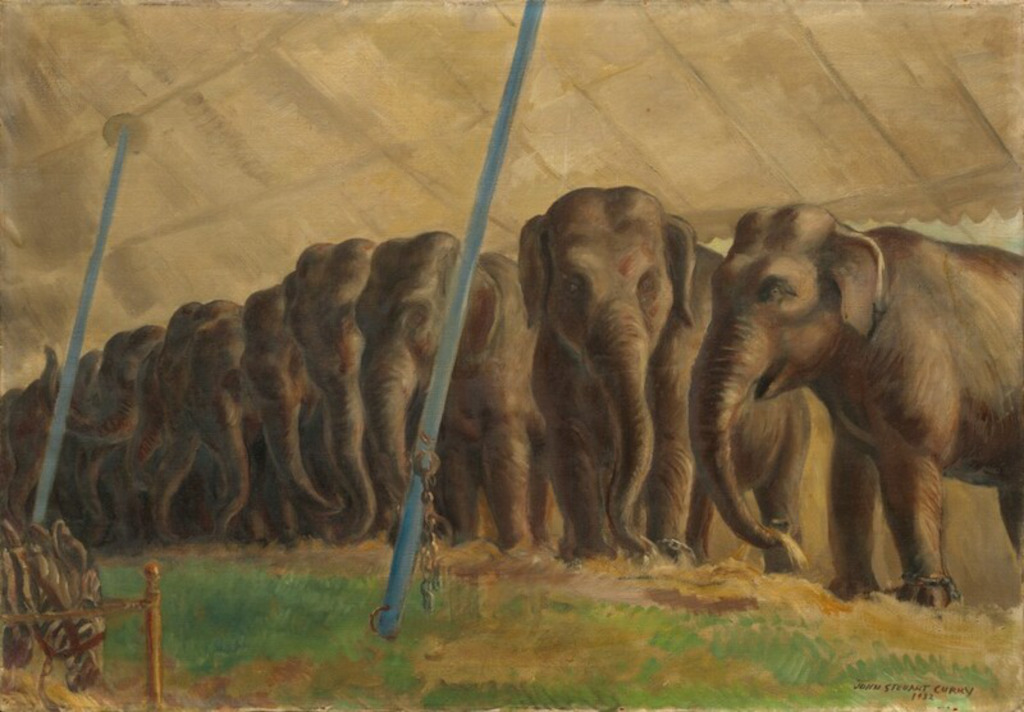
Circus Elephants
1932 painting of elephants, handlers and the work behind the circus.