


 by
Tom Gurney
Tom Gurney BSc (Hons) is an art history expert with over 20 years experience
Email:
tomgurney1@gmail.com
/ Phone:
+44 7429 011000
Kansas Cornfield by John Steuart Curry: Introduction
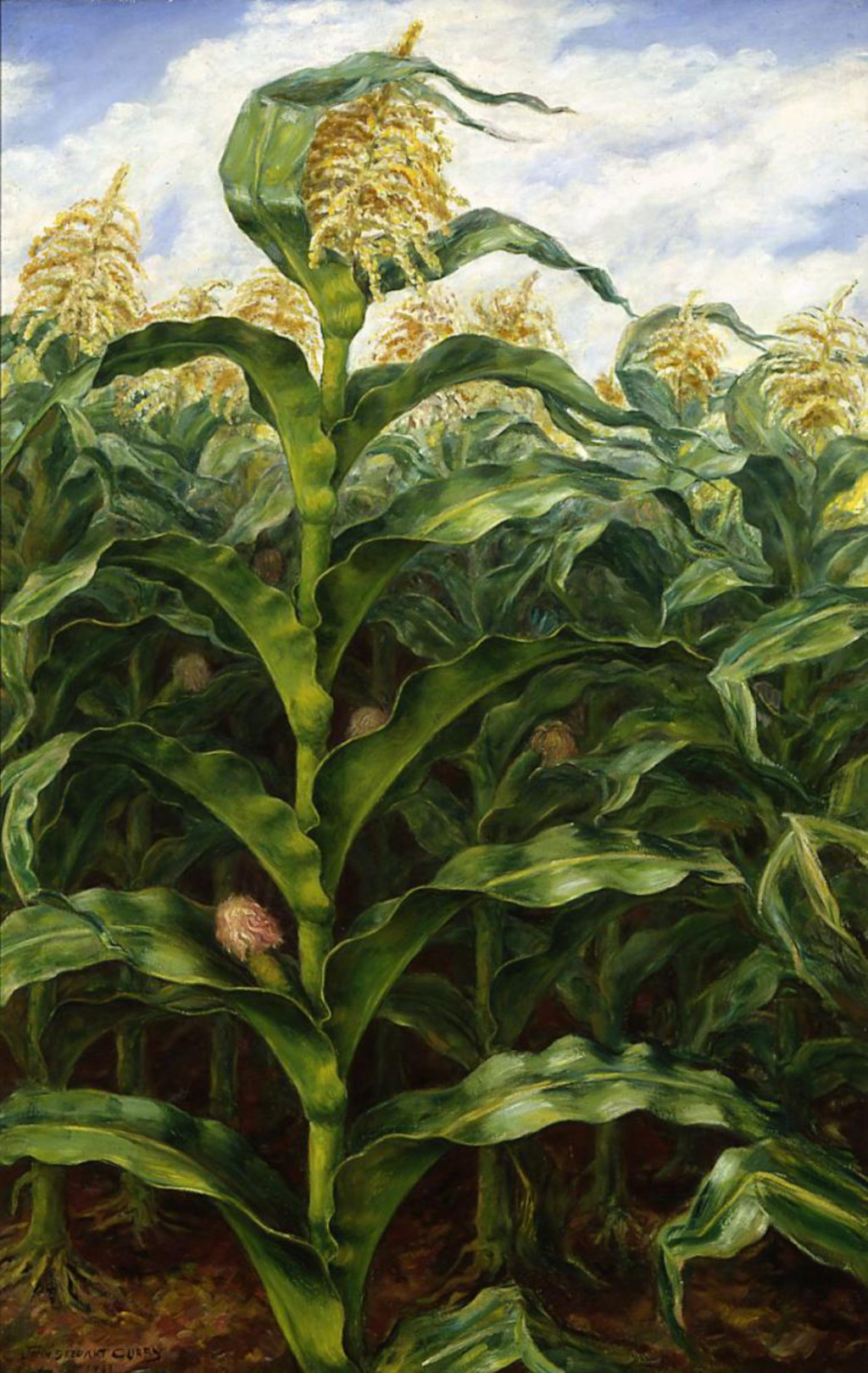
A single corn stalk rises almost the full height of Kansas Cornfield . Its broad leaves spread across a crowded field, while golden tassels stand against pale clouds. John Steuart Curry brings the viewer close enough for the crop to fill the picture. The landscape is experienced from among the plants rather than from a distant lookout.
Wichita Art Museum identifies the work as a 1933 oil on canvas, accession M1.39, in the Roland P. Murdock Collection. [1] The tall canvas gives an ordinary agricultural subject the presence of a much larger environment. Its main drama lies in the relationship between one conspicuous stalk and the dense growth surrounding it.
At a Glance
- Artist John Steuart Curry, 1897–1946.
- Title Kansas Cornfield .
- Date 1933.
- Medium Oil on canvas.
- Dimensions 60⅜ × 38⅜ inches, approximately 153.4 × 97.5 centimetres.
- Collection Wichita Art Museum.
- Credit Wichita Art Museum, Roland P. Murdock Collection.
- Object number M1.39.
- Acquisition First purchase for the Murdock Collection, made by Elizabeth S. Navas in 1939.
This work across John Steuart Curry’s career
Circus Elephants
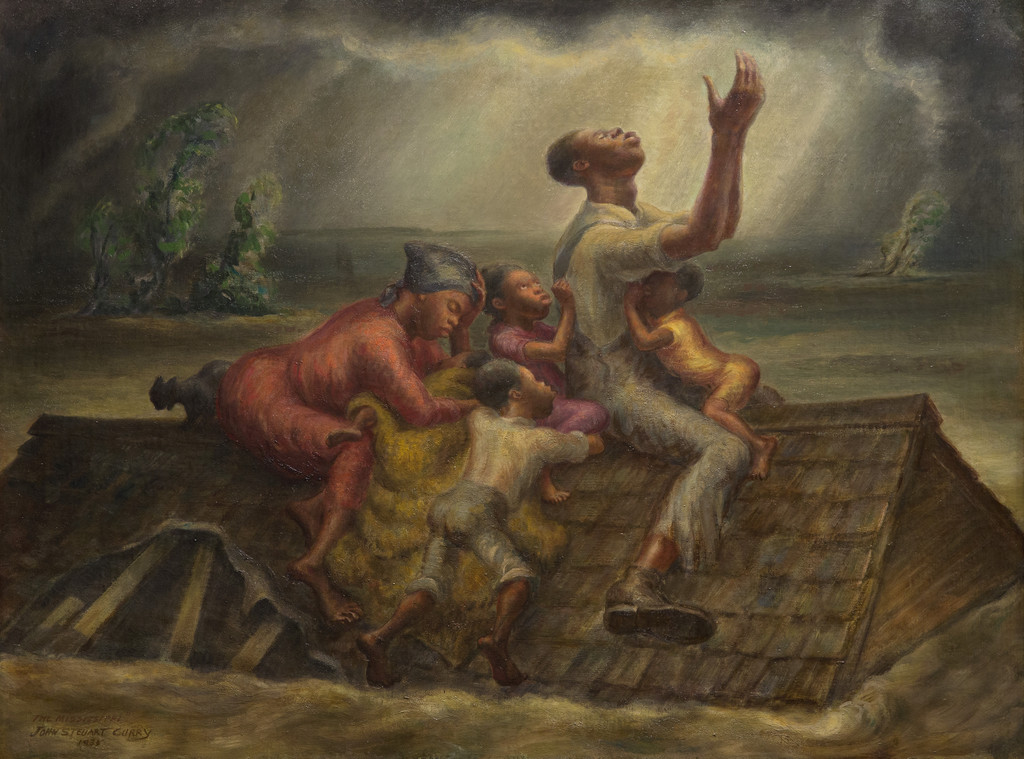
1932 paintingThe Mississippi
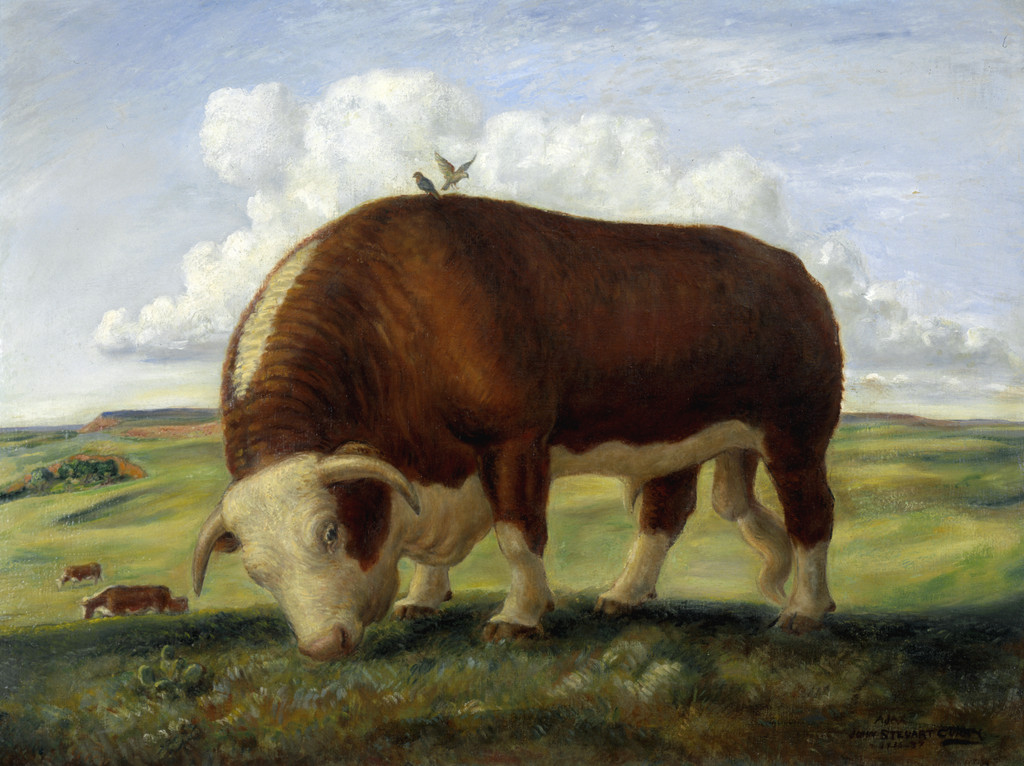
1935 paintingAjax
1936–37 oil paintingTragic Prelude
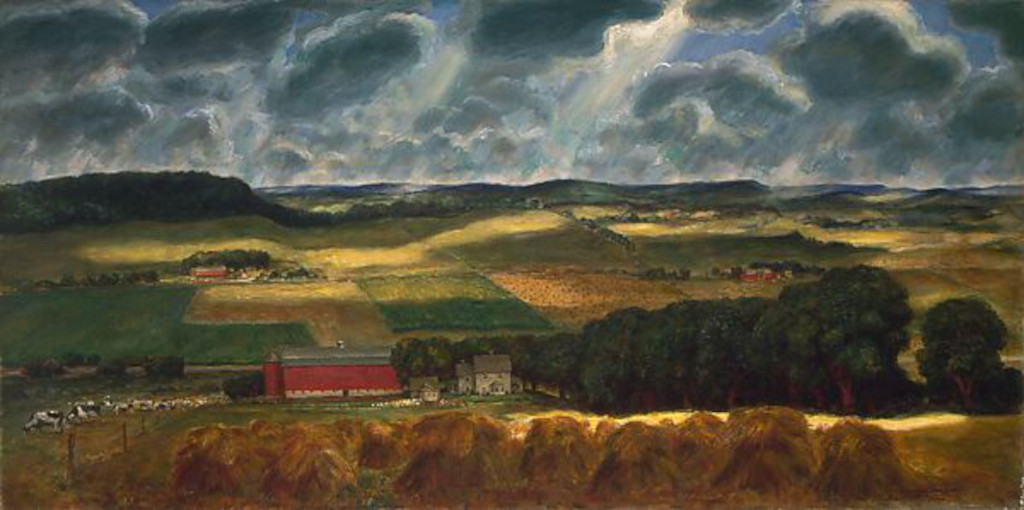
1938–40; project 1937–42Wisconsin Landscape
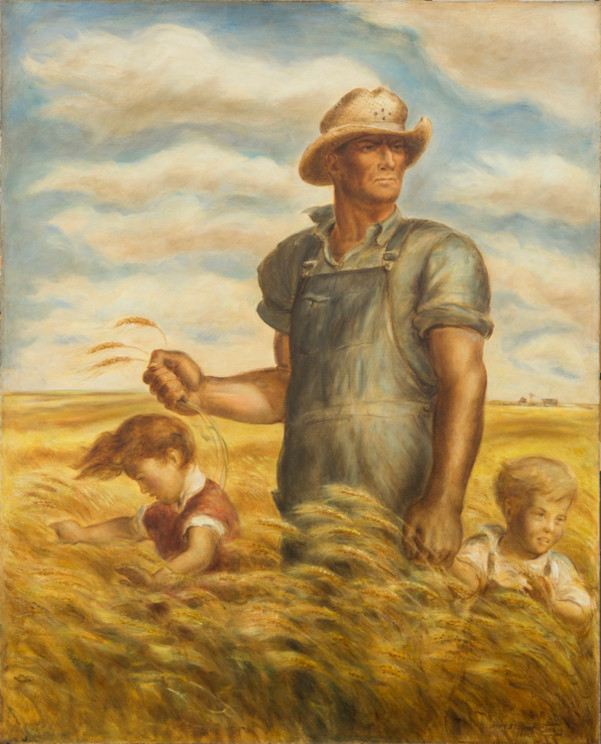
1938–39Our Good Earth
1942 oil paintingNotes and sources
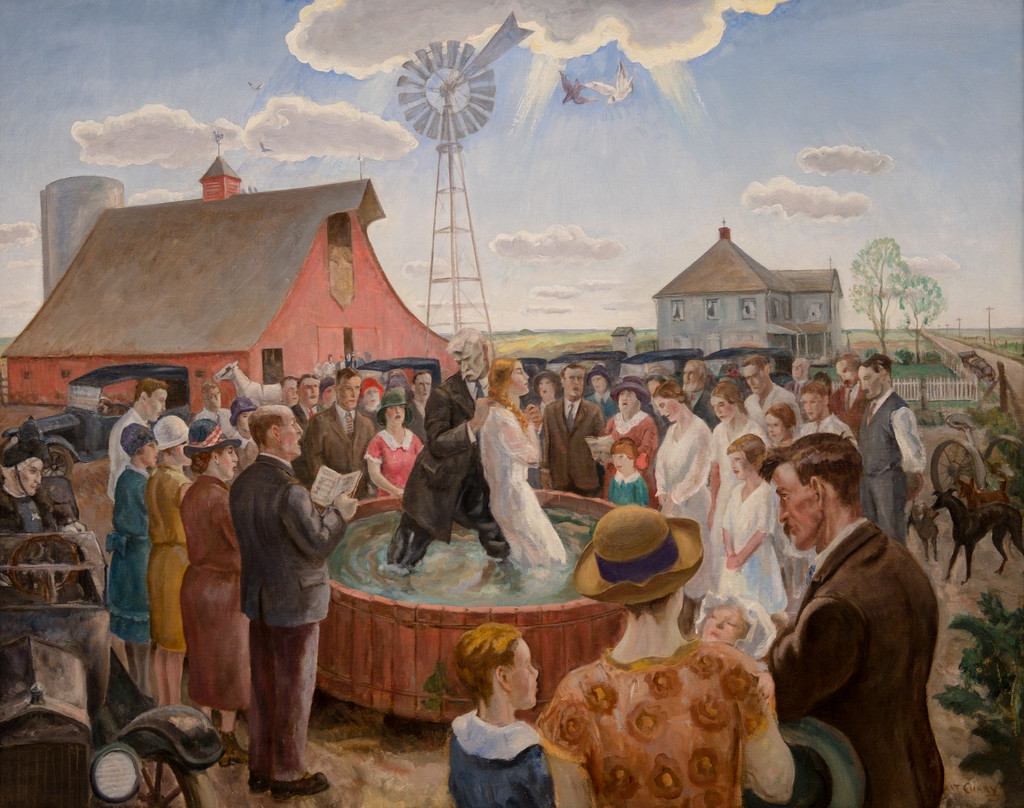
Baptism in Kansas. A remembered Kansas ceremony is staged within a working farmyard. [2]
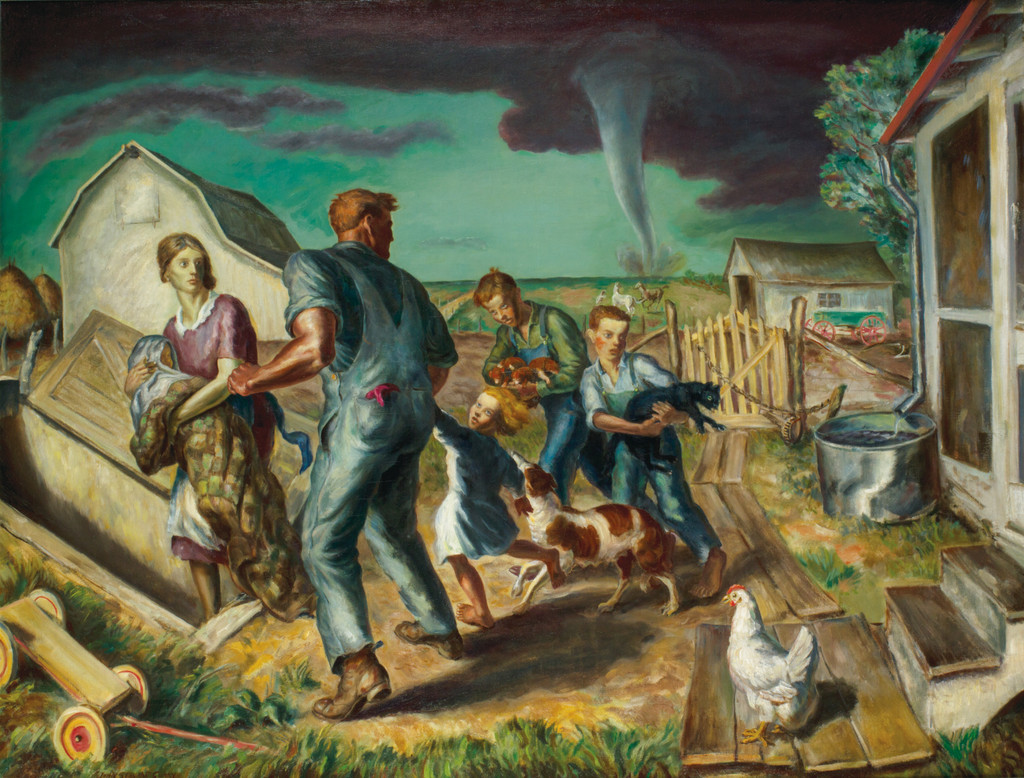
Tornado Over Kansas. A Kansas storm and a family seeking shelter, painted in Curry’s Westport studio. [3]
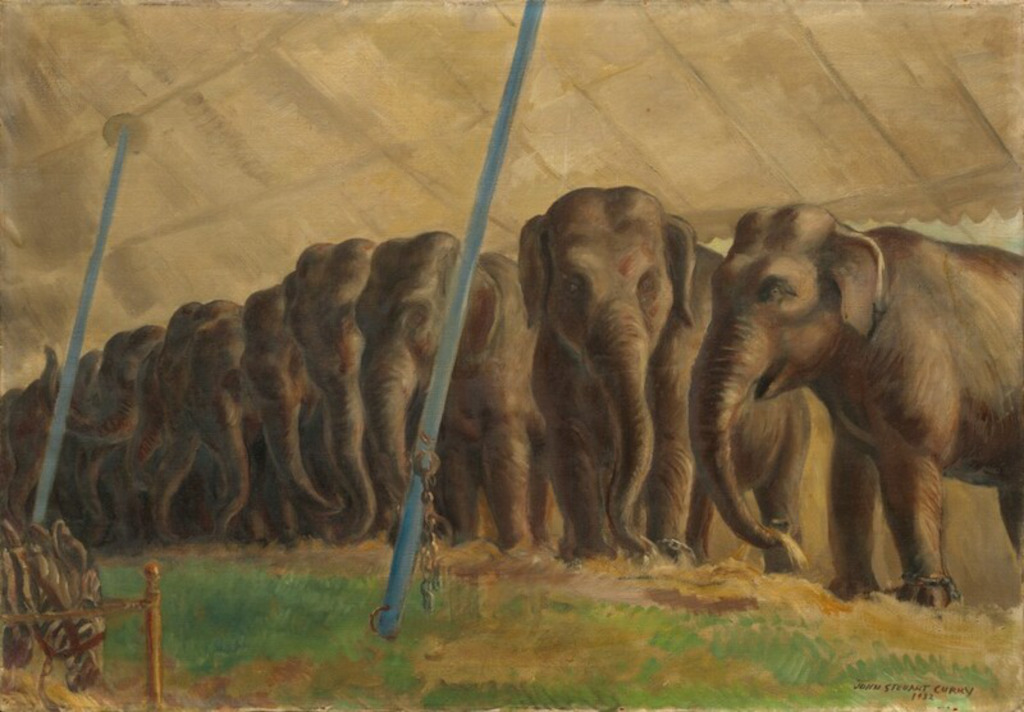
Circus Elephants. Elephants and handlers occupy the working space beneath a circus tent. [4]
Kansas Cornfield (current article). The tall Wichita canvas encloses the viewer within a dense cornfield. [1]
The Mississippi. A family occupies a roof amid floodwater; the painting is tempera on canvas mounted on panel. [5]
Ajax. The monumental bull in the Smithsonian oil differs from the earlier lithograph. [6]
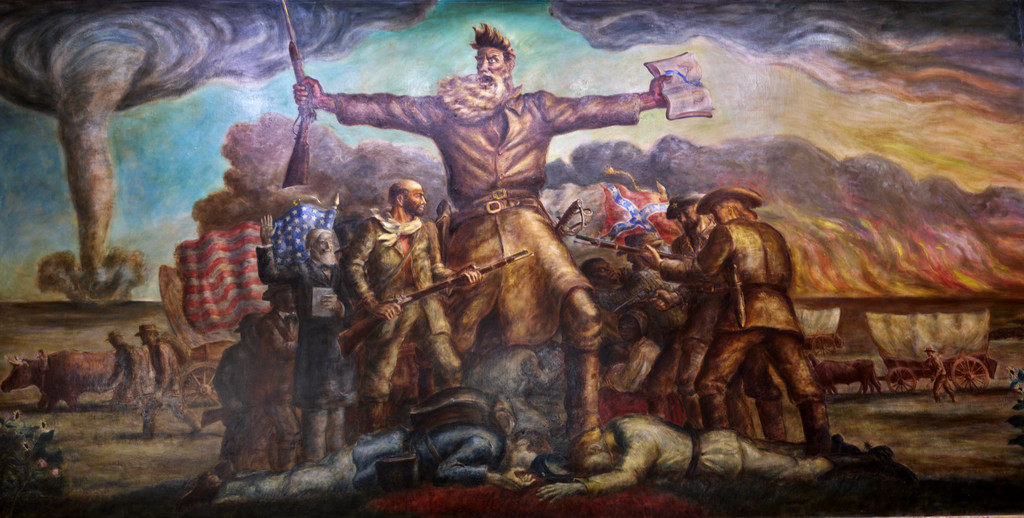
Tragic Prelude. John Brown stands at the centre of a Kansas State Capitol mural continuing across adjoining walls. [7]
Wisconsin Landscape. An extensive farm panorama, distinct from the separately catalogued preparatory study. [8]
Our Good Earth. The Chazen painting is distinct from the watercolour study, lithographs and wartime posters. [9]
Contents
- The cornfield as a vertical picture
- Leaves, light and the sense of movement
- Kansas and the remembered farm
- The 1933 painting and a later mural proposal
- Navas and the beginning of the Murdock Collection
- Looking closely at an agricultural subject
The cornfield as a vertical picture
The strongest upright stands just left of centre. It begins near the lower edge and carries the eye towards a tassel close to the top. This continuous stem supplies a clear route through a picture otherwise filled with crossing leaves. The viewer can follow an individual plant while remaining aware of many others behind it.
The proportions matter. A wide view might have emphasized the field's spread across the countryside; this narrow, tall arrangement emphasizes growth above the ground. Leaves repeatedly reach towards the sides, where the frame cuts off their continuation. The crop therefore seems to occupy more space than the canvas can contain, extending sideways as well as upwards.
At the top, the plants open against the sky. Pale clouds provide a light background for the tassels and upper leaves, making their silhouettes readily visible. Lower down, stems and foliage overlap against darker greens and reddish earth. Curry moves from this enclosed lower zone towards a brighter, more open upper one without allowing the field to lose its density.
Leaves, light and the sense of movement
The leaves give the composition its changing rhythm. Some arch outward before turning down; others twist so that a narrow edge becomes a broad surface. Their shapes interrupt the central stem at different heights. These repeated turns prevent the strong vertical structure from becoming rigid, introducing movement across the picture.
Colour makes those turns easier to follow. Yellow-green passages run alongside cooler, darker areas, suggesting surfaces catching light beside folds turned away from it. The large foreground leaves have enough breadth for these changes to register clearly. Farther back, smaller patches merge into a thicker network of stems and foliage, providing a contrast between the principal plant and its surroundings.
Golden tassels form another repeated pattern. They punctuate the upper field at different heights, linking the foreground stalk with the plants behind it. Their warm colour also connects with the reddish-brown ground glimpsed below. Between these warm accents, green remains dominant, but it is varied through changes of light, overlap and direction.
There are no workers to provide an obvious human scale. Instead, proximity supplies the measure: the viewer looks past large nearby leaves into less distinct growth. The absence of a figure lets the crop itself command attention. Its stems, folds and tassels offer enough variation to sustain a close view without an accompanying episode of farm labour.
The sky provides a second kind of movement. Its cloud bands run across the upper picture, crossing the direction of the dominant stem. This meeting of horizontal and vertical forms gives the plant a setting larger than its immediate patch of earth, while preserving the close viewpoint established below.
Kansas and the remembered farm
Wichita's account says that Curry worked from studies of his father's fields. It also reproduces a passage from his letter to Navas of 30 June 1939. In that passage, he connected Kansas cornfields with childhood fascination and the fear of losing his way among the plants. [1] His recollection combines attraction with unease.
That combination offers a useful way of looking at the composition. Its bright upper reaches invite attention, while the crowded lower growth makes access less straightforward. Openings between the stalks suggest depth without providing a clear path through it. The viewer can appreciate the crop's abundance and still feel the enclosing effect of its leaves.
The letter helps explain Curry's attachment to the subject; it does not turn the canvas into a measured record of a particular childhood excursion. The composition remains selective. One stalk is brought forward, other plants support it, and the sky is given just enough room to make the upper forms distinct. Memory and observation meet in that arrangement.
Watch: John Steuart Curry
Choose a film to explore the artist’s work, its interpretation and its wider setting.
Look at This: John Steuart Curry at MOWA
An exhibition interview with Graeme Reid considers Curry’s work and life in Wisconsin.
Watch on YouTubeThe 1933 painting and a later mural proposal
The museum's date is 1933. The work's later acquisition in 1939 belongs to its collecting history, six years after its creation. Keeping those dates separate helps place the painting among Curry's earlier agricultural subjects rather than treating it as a new commission made for Wichita at the time of purchase.
The museum also links the cornfield subject with a proposed mural for the Kansas Capitol rotunda that was never completed. [1] The Wichita canvas is an independent easel painting, distinct from that unexecuted project. Its tall format can suggest monumentality without making it a surviving section of a wall decoration.
For the wider story of the Capitol commission, see Curry's murals . Here, the important distinction is between a completed, portable picture and the later possibility of treating a related subject on an architectural scale. The history of one should not obscure the identity of the other.
Navas and the beginning of the Murdock Collection
In 1939, Navas made Kansas Cornfield the first purchase for the Roland P. Murdock Collection. [1] That position gives the painting significance beyond Curry's own career: it stands at the beginning of a major Wichita collecting programme.
A museum statement published for the 1997–98 exhibition Toward an American Identity explains that Louise Caldwell Murdock's 1915 trust provided funds to acquire American art, with the city responsible for a museum to house it. Navas, the collection's first trustee, assembled work across a broad range of American painting, receiving advice from figures including Edith Halpert and Lloyd Goodrich. [10]
The exhibition placed Kansas Cornfield within its discussion of American landscape and regional identity. This later setting shows how a close view of a crop could participate in a much wider account of national art. The painting's local associations remained important even as it entered a collection containing many different subjects and styles.
Looking closely at an agricultural subject
The picture rewards attention to the way an apparently simple subject is organized. Follow the central stalk, then trace the leaves outward into the field. The movement changes from a clear upward line to a series of overlapping curves. Light and colour keep those competing directions readable.
Curry makes the field both particular and encompassing. The foreground plant has a distinct structure, yet its surrounding growth prevents it from becoming an isolated specimen. That balance gives Kansas Cornfield its lasting force: the familiar crop becomes an environment large enough to absorb the viewer's attention.
Artworks and versions directory
Browse 84 selected object, version, edition and reproduction records. Several concern related images or different impressions; this is not a complete lifetime catalogue or a count of unique compositions. Search also finds prints, photographs and reproductions; the medium filter groups paintings and drawings.
Frequently Asked Questions
Wichita Art Museum dates it to 1933. The 1939 date refers to its acquisition for the Murdock Collection.
It belongs to Wichita Art Museum, Roland P. Murdock Collection, object M1.39. Check the museum's current information before planning a visit to see it.
In a 1939 letter quoted by the museum, he recalled the fascination and fear he experienced in cornfields as a child.
No. This is an oil on canvas. The museum discusses a separate, uncompleted cornfield mural proposal for the Capitol rotunda.
Discussion
Look again at the images and ideas explored in Kansas Cornfield by John Steuart Curry. These editorial prompts invite your observations.
Reader Insights
How does the tall format change your sense of the corn's scale?
Which leaves most strongly guide your eye away from the central stem?
Does the crowded field seem inviting, enclosing, or both?
Join the Conversation
Share a detail, comparison or question about Kansas Cornfield by John Steuart Curry below.
References
- Wichita Art Museum , Kansas Cornfield, 1933, M1.39: current collection record and label, including the museum's quotation from Curry's letter to Elizabeth S. Navas, 30 June 1939. View source
- Whitney Museum of American Art, John Steuart Curry | Baptism in Kansas | Whitney Museum of American Art. View source
- Muskegon Museum of Art, Tornado Over Kansas - Muskegon Museum of Art. View source
- National Gallery of Art, Circus Elephants: collection object record. View source
- Saint Louis Art Museum, The Mississippi,1935,7:1937: collection record and provenance. View source
- Smithsonian American Art Museum, Ajax. View source
- Kansas Historical Society, Kansas State Capitol - Online tour - Tragic Prelude - Kansas Historical Society. View source
- Metropolitan Museum of Art, Wisconsin Landscape. View source
- Chazen Museum of Art, Our Good Earth | 1873 |Chazen Museum of Art. View source
- Wichita Art Museum , Toward an American Identity: Selections from the Wichita Art Museum, 1997 exhibition statement reproduced by Traditional Fine Arts Organization. View source
More CURRY Paintings
Our Good Earth
1942 painting and its related prints and wartime imagery.
Wisconsin Landscape
1938–39 panorama of working farmland, held by The Met.


Circus Elephants
1932 painting of elephants, handlers and the work behind the circus.