


 by
Tom Gurney
Tom Gurney BSc (Hons) is an art history expert with over 20 years experience
Email:
tomgurney1@gmail.com
/ Phone:
+44 7429 011000
John Steuart Curry in Wisconsin: Introduction
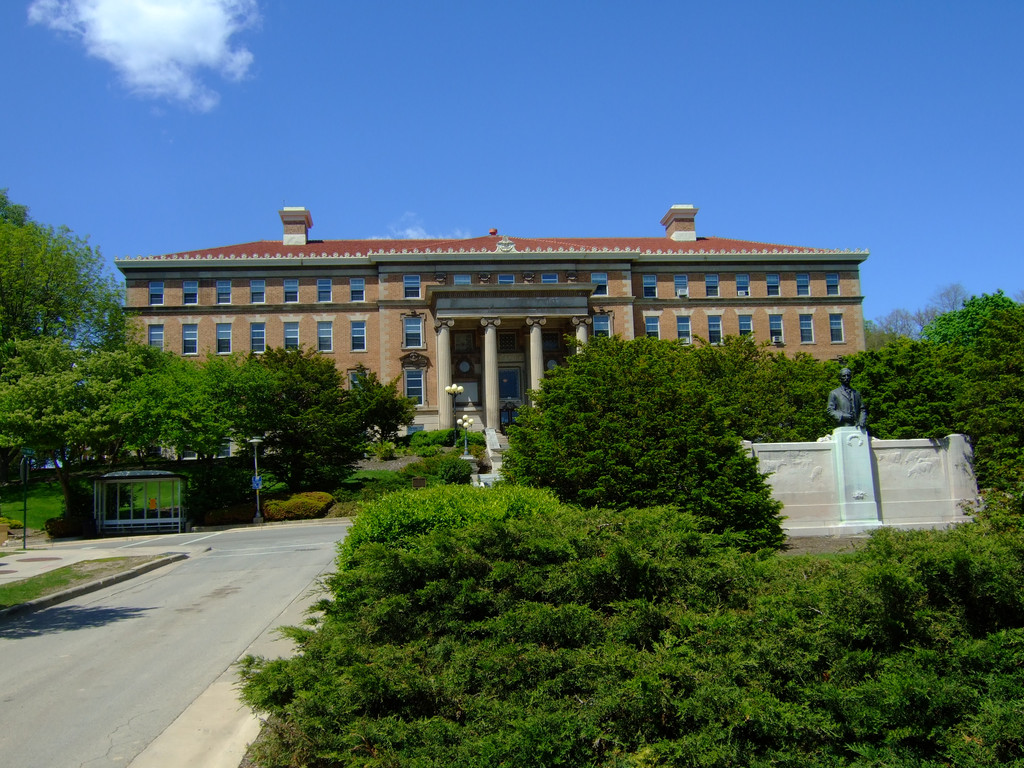
Wisconsin gave John Steuart Curry a university base, an audience of rural artists and a setting for some of his most ambitious public paintings. From 1936 until his death in 1946, he served as artist-in-residence at the University of Wisconsin’s College of Agriculture. The appointment connected his own work with a wider experiment in cultural education. [1]
His Wisconsin years include landscapes, campus murals, wartime imagery and pictures connected with university life. They also include visits, conversations and exhibitions through which other people developed their art. Following those activities together reveals a role that extended beyond producing paintings for an institution.
At a Glance
- Wisconsin years 1936–1946.
- University role Artist-in-residence, College of Agriculture, University of Wisconsin–Madison.
- Educational purpose Encourage artistic activity among people beyond the university classroom.
- Important milestone First Rural Art Exhibit at the Memorial Union during Farm and Home Week in 1940.
- Campus murals Law Library and Biochemistry Building.
- Related paintings Wisconsin Landscape , Our Good Earth and An All-American .
- Historical distinction The rural art programme predates the artists’ association founded in 1954.
- Continuing connection University collections, surviving murals and the history of rural arts education.
Contents
- An artist at the College of Agriculture
- The university and a wider rural audience
- Wisconsin farmland as a pictorial subject
- The biochemistry murals
- The Law Library and emancipation
- Our Good Earth and wartime public imagery
- A working life between Wisconsin and Kansas
- Collections and the continuing university connection
An artist at the College of Agriculture
Curry arrived at the university with a national reputation and extensive experience beyond Kansas. The Wisconsin position gave him a salary and studio while allowing him to pursue his own work. According to the Archives of American Art’s finding aid, he also made himself available through correspondence, studio guidance, lectures and visits to groups around the state. Those activities were part of the appointment’s educational purpose. [1]
The setting within agriculture was significant. In Helen Klebesadel’s history of the rural art programme, sociologist John Rector Barton and Dean C. L. Christensen envisioned an expanded cultural role for the college. Its relationship with rural communities could include opportunities for artistic expression alongside technical knowledge about farming. Curry’s experience and public reputation offered a means of pursuing that ambition. [2]
The appointment belonged to the wider Wisconsin Idea: university knowledge should influence life beyond the campus. In this instance, artistic practice formed part of that exchange. The people approached as potential artists already possessed knowledge of places, occupations and experiences that could become subjects for their work.
Curry’s own career made that approach especially relevant. Farm life had supplied major subjects for his pictures, even when he worked far from his birthplace. In Wisconsin he could encourage others to take their surroundings seriously while continuing to develop his own response to rural experience. His role joined professional practice with sustained contact outside the art world’s principal institutions.
The university and a wider rural audience
The programme’s first Rural Art Exhibit took place at the Memorial Union during Farm and Home Week in 1940. The Association of Wisconsin Artists’ history records thirty artists from seventeen counties in that opening exhibition. The gathering gave work made in different communities a shared public setting, creating an audience beyond each artist’s immediate surroundings. [3]
The same history describes participants whose working lives included teaching, farming, postal work, blacksmithing and household responsibilities. Artistic activity took place alongside those occupations. Informal visits, supportive criticism and opportunities to exhibit could help sustain work that might otherwise remain private or difficult to fit around everyday demands. [3]
The distinction between professional and nonprofessional artists therefore involved more than a judgement of quality. It concerned access to training, time, recognition and an audience. Curry’s position offered a bridge between an established artist’s experience and people developing their abilities through other kinds of working life. The emphasis on familiar subjects allowed local knowledge to become an artistic resource.
Lois Ireland offers a concrete example of that encouragement. The programme’s history describes Curry encountering the young artist’s paintings in a local restaurant and supporting her work. She exhibited through the rural programme during the 1940s before pursuing further training. The example helps explain the value of a professional artist’s attention: work made outside established exhibition channels could gain recognition, enter a wider conversation and become part of a developing career. [3]
Klebesadel also describes Curry teaching lithography to Clarence Boyce Monegar, a Ho-Chunk artist known as Red Arrow. His case connects the outreach programme with practical instruction in a printmaking medium. Alongside criticism and opportunities to exhibit, the exchange could involve learning another way to make images. Such individual relationships give the programme’s educational ambitions a more concrete history and connect them with Curry’s own experience of drawing and prints . [2]
The programme continued after Curry’s death. The later artists’ association, now known as the Association of Wisconsin Artists, began in 1954. Its own history distinguishes that organization from the older rural art programme it supported. Keeping the two histories separate gives Curry appropriate credit for the earlier work while recognizing the participants who organized its later support network. [4]
Wisconsin farmland as a pictorial subject
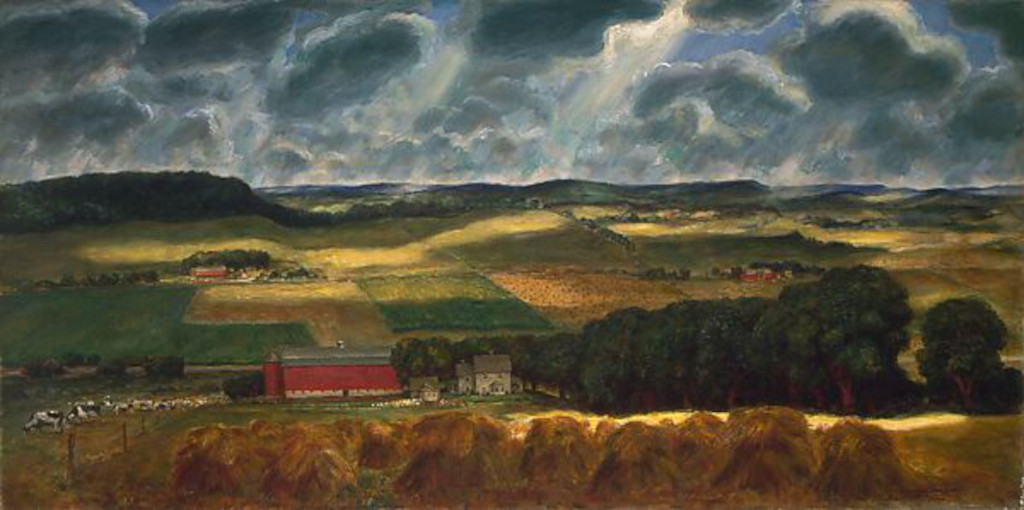
Wisconsin Landscape , dated 1938–39, provides a major example of Curry’s response to the region. The Met describes it as an idealized composite of farms seen while travelling through the Midwest. It brings agricultural land, buildings, cattle and a dramatic sky into an extensive arrangement. Its breadth belongs to a constructed view rather than a record of one identifiable farm. [5]
That distinction helps connect observation with artistic invention. A landscape can draw on repeated encounters while organizing them into an image with a particular emphasis. The Met reads Curry’s painting through agricultural calm and abundance, a selective vision made during a period of continuing difficulty for farming communities. The image’s reassurance is part of its historical character. [5]
Wisconsin thus offered more than new scenery. It provided a setting in which Curry’s interest in land, work and weather could develop through travel and institutional relationships. Looking at the landscape beside his educational activities reveals two ways of responding to the countryside: representing it in a painting and encouraging the people who lived there to make images of their own.
The biochemistry murals
Curry’s Biochemistry Building murals connect agriculture with another part of the university’s work. The group, dated 1941–43 in a university conservation account, presents relationships between scientific research, healthier crops and animals, and household well-being. Farm life becomes part of a public account of what research can contribute to society. [6]
The architectural setting gives the programme different forms. The stairwell foyer surrounds the visitor with an extensive sequence; the Seminar Room carries painted scenes across its walls, including a rainbow over a productive farmstead. The report distinguishes the heavier canvas in the foyer from the thinner muslin and direct handling of the Seminar Room paintings. These were related works with material differences. [6]
The setting within a science building also changes the agricultural imagery’s purpose. Crops, animals, laboratory activity and family life are brought into relation with the institution around them. The paintings can be read as an account of public benefit, linking specialized work with experiences recognizable beyond the laboratory. The murals overview places them alongside Curry’s other public commissions.
The Law Library and emancipation
The Law Library’s Freeing of the Slaves , painted in 1942, developed from a design rejected for the Department of Justice in Washington. The library’s institutional history identifies Dean Lloyd Garrison as the supporter who found a place for the subject in Wisconsin. The painting occupied the north wall of the reading room, becoming part of a space used for legal study. [7]
Its subject extends the Wisconsin work beyond agriculture. In a university discussion published in 2012, historian Steve Kantrowitz emphasizes the agency of the Black figures at the centre of the composition. He reads them as participants in their own liberation, giving the mural an argument about emancipation rather than treating it solely as a record of an event. This is a historian’s interpretation of the painting’s organization and meaning. [8]
The move from rejected Washington design to Wisconsin mural shows how patronage could redirect a subject’s public life. A composition needed an advocate and an appropriate setting as well as an artist. In the Law Library it became part of the institution’s surroundings, offering successive generations of viewers an image through which to consider freedom and citizenship.
Our Good Earth and wartime public imagery
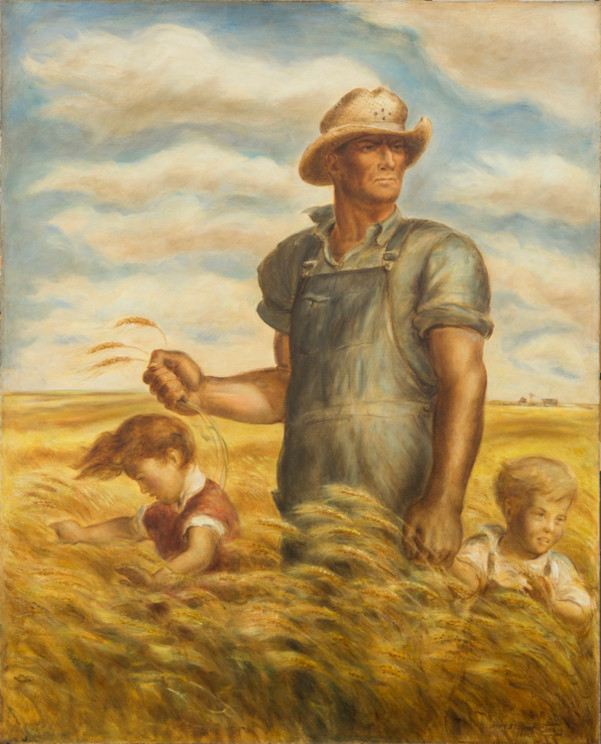
Our Good Earth joins the university connection with Curry’s wider public work. Chazen Museum of Art records the large painting as a 1942 oil on hardboard. Its provenance traces a 1943 gift from the Treasury Department to the College of Agriculture and a later long-term museum loan in 1999. The work’s history links a national commission with a university collection. [9]
The Smithsonian holds a related 1942 watercolour on illustration board. Its account explains that the study led toward the painting reproduced for a war-bond poster. A monumental farmer and children in a wheat field carried agricultural imagery into wartime communication, connecting food production and the household with a national purpose. The study, painting and poster remain separate objects within that project. [10]
The image also shows why Curry’s Wisconsin period should not be confined to literal views of Wisconsin locations. His established agricultural subjects could serve several audiences and purposes. The university supplied a working base and became part of the painting’s later history, while the familiar rural figure reached viewers through a different form of public circulation.
A working life between Wisconsin and Kansas
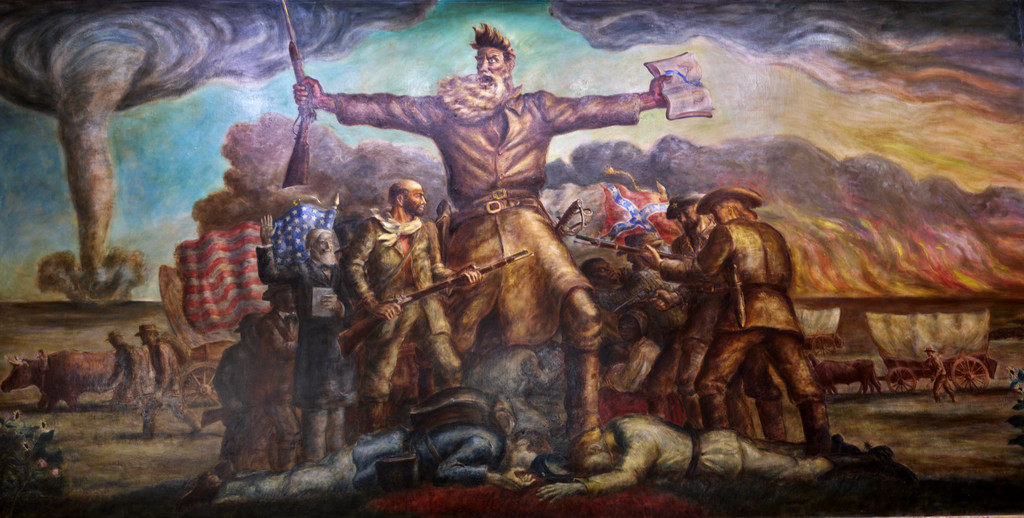
The Wisconsin appointment overlapped with the Kansas State Capitol commission begun in 1937. Curry’s commitments extended across places: his university role continued while he developed a major historical programme in his home state. The Kansas Historical Society distinguishes the completed corridor panels from the rotunda sequence that legislative opposition prevented. [11]
The two settings brought different expectations. In Wisconsin, his public role included encouragement of rural artists and work linked to the university. In Kansas, arguments arose over how a state should represent itself through history, agriculture and the figure of John Brown. The comparison reveals several kinds of public audience within the same period of Curry’s career.
It also keeps his regional identity open to more than one place. Kansas supplied formative memories and subjects; Wisconsin offered a decade of work, relationships and institutional support. The biography follows that larger chronology, while Tragic Prelude considers the best-known Kansas mural in detail.
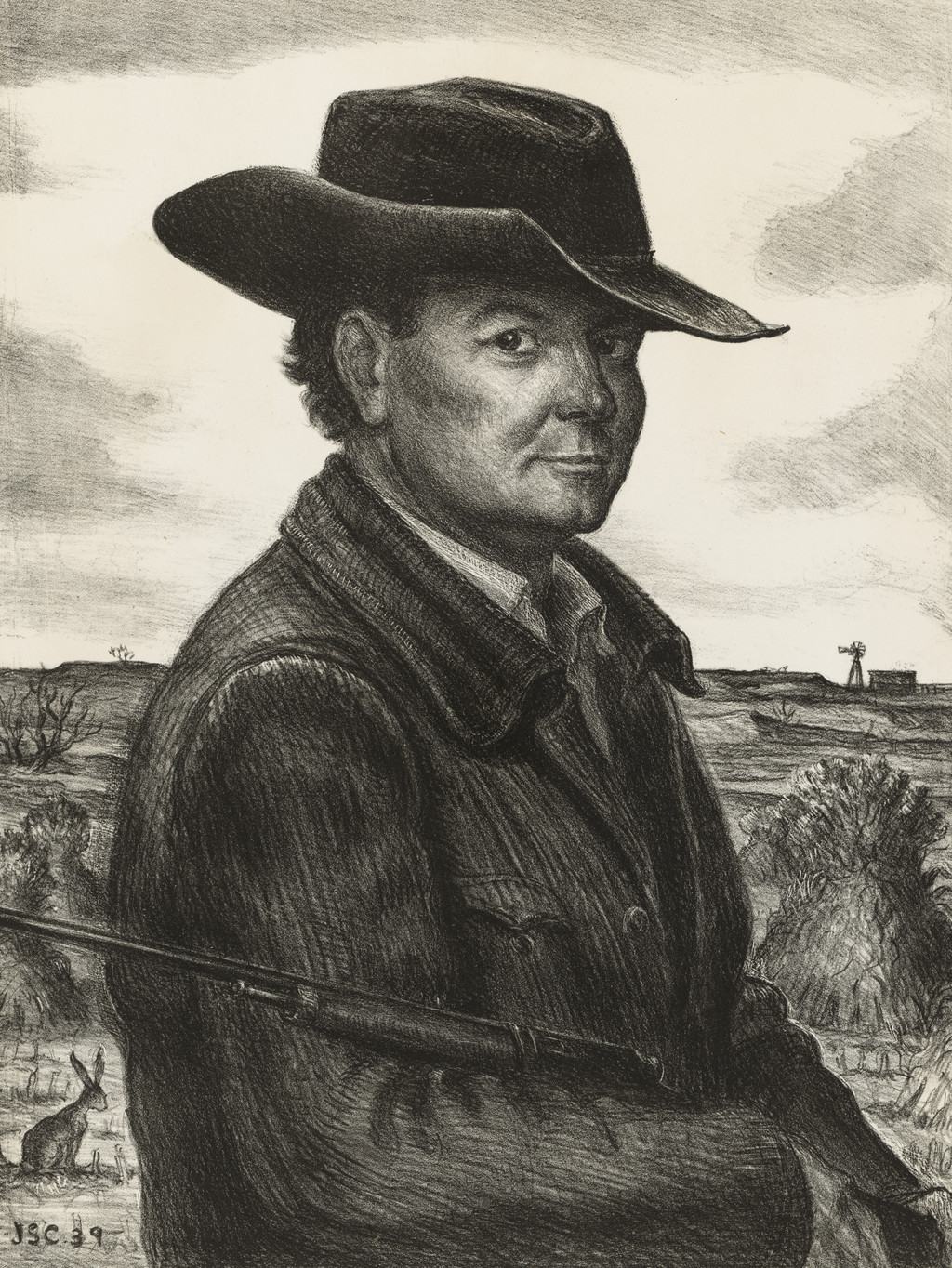
John Steuart Curry, Self-Portrait, 1939, lithograph. National Portrait Gallery, Smithsonian Institution, NPG.85.33.
Image source
.
CC0 / public domain; US copyright not renewed
. Proportionally resized; original appearance retained.
Collections and the continuing university connection
The Wisconsin pictures also include university athletics. Chazen curator Janine Yorimoto Boldt explains that Forward Pass , painted in 1941 for an Abbott Laboratories magazine cover, used football player David Schreiner as its model. Following his death in 1945, the work was renamed An All-American in his honour. The museum identifies it as mixed media on canvas mounted to hardboard, preserving a material distinction from the oil paintings. [12]
The painting’s later history moved through the university’s athletics collection before its transfer to Chazen in 2013. Alongside Our Good Earth and the campus murals, it demonstrates the different routes through which Curry’s work became connected with university life. Agriculture, science, legal study and sport all supplied institutional relationships for his art.
Later exhibitions have revisited this period. A 2014 university account of John Steuart Curry: At Home in Wisconsin describes an exhibition bringing paintings and preparatory drawings together to consider the decade. The same account reports curator Graeme Reid’s emphasis on Curry’s seriousness toward people developing their artistic abilities outside professional careers. [13]
That educational connection gives the Wisconsin years a lasting significance alongside the individual works. Curry’s place among American artists and within American Regionalism involved making pictures from ordinary experience and helping other people recognize the artistic possibilities of their own. The surviving paintings and the rural programme’s history preserve both parts of that work.
Watch: Curry at the Museum of Wisconsin Art
An exhibition interview offers another route into Curry’s Wisconsin subjects and career.
Look at This: John Steuart Curry at MOWA
Kat Murrell interviews Graeme Reid about John Steuart Curry: At Home in Wisconsin at the Museum of Wisconsin Art.
Watch on YouTubeArtworks and versions directory
Browse 84 selected object, version, edition and reproduction records. Several concern related images or different impressions; this is not a complete lifetime catalogue or a count of unique compositions. Search also finds prints, photographs and reproductions; the medium filter groups paintings and drawings.
Frequently Asked Questions
He became artist-in-residence at the College of Agriculture in 1936 and remained in that role until his death in 1946. [1]
The association began in 1954, after Curry’s death. His contribution belongs to the earlier rural art programme and its exhibitions. [4]
The Met describes it as an idealized composite of farm scenes. [5]
Discussion
Look again at the images and ideas explored in John Steuart Curry in Wisconsin. These editorial prompts invite your observations.
Reader Insights
How does knowing about Curry’s work with rural artists change your understanding of his agricultural paintings?
What different purposes do the Law Library and Biochemistry murals serve within their university settings?
Compare the university histories of Our Good Earth and An All-American . How can a painting’s public meaning change through its later ownership and naming?
Join the Conversation
Share a detail, comparison or question about John Steuart Curry in Wisconsin below.
References
- Megan McShea , A Finding Aid to the John Steuart Curry and Curry Family Papers, Archives of American Art, printed pp. 1–4. View source
- Helen Klebesadel , Looking Back to Look Forward: 75 Years of the Wisconsin Regional Arts Program, 1940–2015, Wisconsin Academy. View source
- Association of Wisconsin Artists , Wisconsin Regional Art Program: History. View source
- Association of Wisconsin Artists , About AWA: organizational history. View source
- The Metropolitan Museum of Art , Wisconsin Landscape, 1938–39, 42.154. View source
- Dennis Chaptman , Treasured campus murals conserved for future generations, UW–Madison, 25 October 2011. View source
- UW–Madison Law Library , 75th Anniversary of John Steuart Curry’s Freeing of the Slaves. View source
- Mary Ellen Gabriel , UW Curry mural tells forgotten emancipation story, 1 November 2012. View source
- Chazen Museum of Art , Our Good Earth, 1942, 3.1999.1. View source
- Smithsonian American Art Museum , Our Good Earth, 1942, watercolour on illustration board, 2001.4. View source
- Kansas Historical Society , Kansas State Capitol: Curry murals. View source
- Janine Yorimoto Boldt , All-American Schreiner was model for Curry’s Forward Pass, Chazen Museum of Art. View source
- Käri Knutson , Museum featuring works of UW’s John Steuart Curry, UW–Madison, 8 September 2014. View source
- Splash image source.
Agriculture Hall, University of Wisconsin–Madison, photographed by James Steakley in 2009. University setting; this is not a view of Curry’s studio. CC BY-SA 3.0 . Proportionally resized; original appearance retained.
View source
More CURRY Paintings
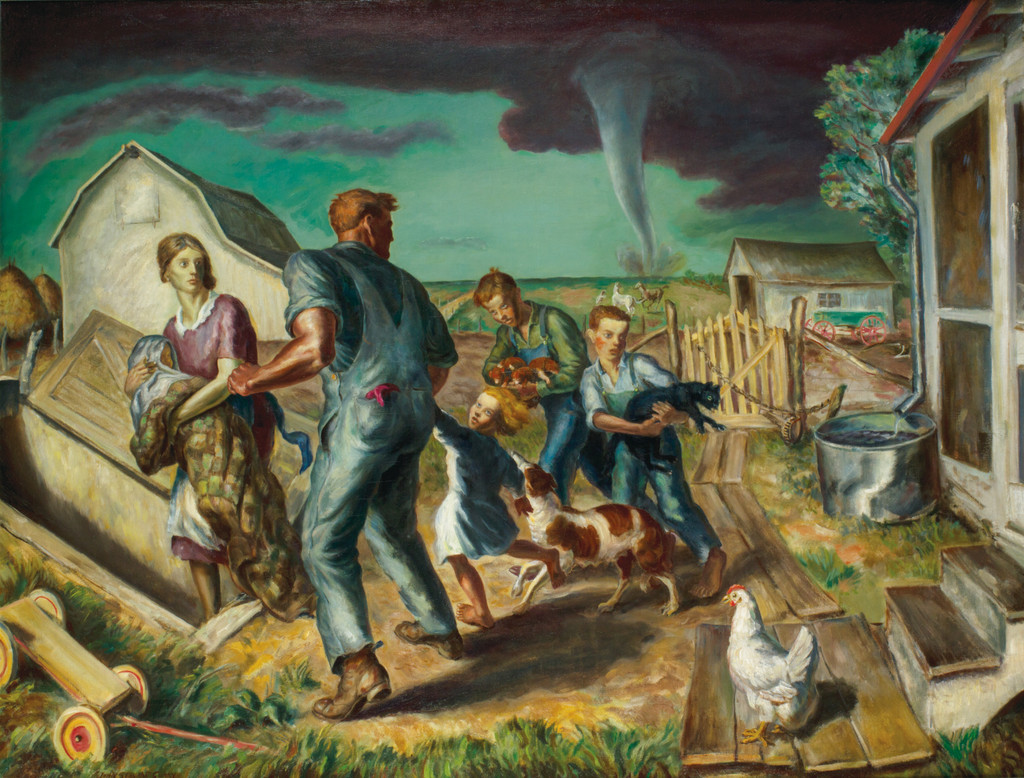
Our Good Earth
1942 painting and its related prints and wartime imagery.
Wisconsin Landscape
1938–39 panorama of working farmland, held by The Met.


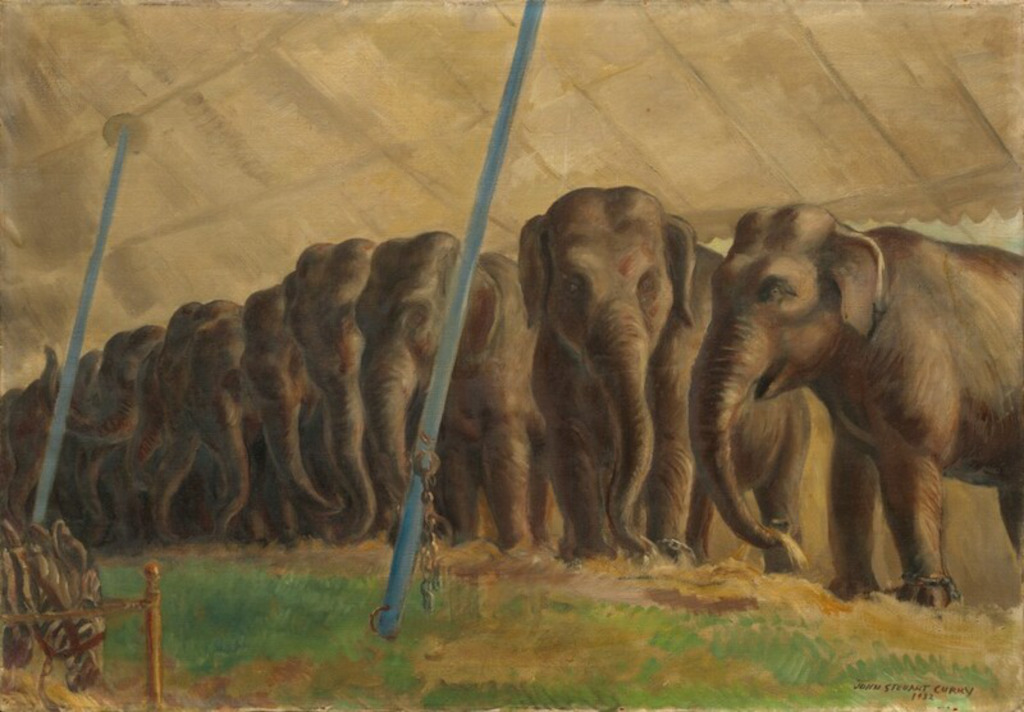
Circus Elephants
1932 painting of elephants, handlers and the work behind the circus.