



 by Tom Gurney
Tom Gurney BSc (Hons) is an art history expert with over 20 years experience
Published on June 19, 2020 / Updated on November 2, 2026
Email: tomgurney1@gmail.com / Phone: +44 7429 011000
The Bezique Game: Introduction
Six men gather around a green card table in Gustave Caillebotte’s The Bezique Game. The hands, cards and inclined heads make a small centre of activity within a much larger arrangement of dark clothes and upholstered furniture. Painted about 1880–81, the picture belongs to Louvre Abu Dhabi. The museum dates it to 1880; the Musée d’Orsay’s 2024 exhibition used “about 1881”. [1] [2]
The setting is the Boulevard Haussmann apartment that Caillebotte shared with his younger brother Martial. Friends have drawn together to play and watch, while one man reclines behind them. The six figures fill a room whose main activity occupies only a small patch of canvas. It brings the habits of a particular household into the exhibition room without making its inhabitants perform for the visitor. [3]
At a Glance
- ArtistGustave Caillebotte.
- French titleLa Partie de bésigue, also written Partie de bézigue.
- DateAbout 1880–81; Louvre Abu Dhabi gives 1880, while the 2024 Orsay exhibition gave about 1881.
- MediumOil on canvas.
- SizeBerhaut’s 1994 catalogue records 121 × 161 cm; the owner publishes 125.3 × 165.6 × 3.4 cm, a different measurement set including depth.
- CollectionLouvre Abu Dhabi, inventory LAD 2009.036.
- Catalogue numberBerhaut 183.
- First exhibitionSeventh Impressionist exhibition, Paris, 1882, catalogue no. 1. [1] [2] [3]
This work across Gustave Caillebotte’s career
The Orange Trees
1878 [4]The Bezique Game (current article)
about 1880–81Man at His Bath
1884 [4]Contents
- A table that gathers the picture together
- Looking into a private room
- Friends, clothes and familiar furniture
- Leisure treated seriously
- A private gathering at the 1882 exhibition
- The painting’s later history
A table that gathers the picture together
Begin with the cards. Their little white rectangles stand out against the green baize, providing some of the sharpest light accents in the lower centre. They sit between the two principal players, whose bodies approach the table from opposite sides. The man on the left bends forward, his hands close together; the man in the brown jacket on the right holds his cards above the surface. Across the gap between them, Caillebotte creates a sequence of cuffs, fingers, cards and pale faces. The game becomes visible through several small actions rather than a single decisive gesture. [3]
We see enough of the tabletop to understand what binds the company. We cannot survey every card or reconstruct the next move. Its near edge establishes a firm horizontal, interrupted by bodies, and the supporting legs descend into a compressed tangle of knees and dark cloth. The table is simultaneously an accessible patch of colour and a space largely enclosed by its users. The viewer can follow the activity without assuming the position of another player.
The figures vary the experience of watching. At the front left, a seated man turns towards the action in profile. His back and the curved arm of his red chair partly close the foreground. Behind the left player, the standing man bends his head down; his upright body gives the composition its highest human point. On the opposite side, another man leans over the right player’s shoulder. These different heights make a loose arch around the cards. The figures are close enough for their coats to merge into connected areas of darkness, but the pale faces remain distinct. [3]
Behind them, the reclining man introduces a different tempo. His head is tipped back against the upholstered furniture, and his face lies beyond the immediate exchange of hands. He complicates the idea that everyone present shares exactly the same degree of absorption. The picture accommodates both the close attention of the players and the looser participation of someone who occupies the same room without leaning into the game.
That variation gives the gathering its credibility. Nothing requires every guest to display an equal interest or a matching expression. The scene depends on the coexistence of active players, attentive spectators and a more withdrawn presence. Caillebotte has made a group portrait in which the activity, rather than a collective pose, supplies the organising principle.
Looking into a private room
Discussing the 1882 exhibition, Joris-Karl Huysmans imagined a window opening in the wall: through it the visitor sees smokers absorbed in their cards, unaware of being observed. In L’Art moderne, he contrasted their truthfulness with the sidelong acknowledgement of the viewer he found in older Flemish card-playing scenes, especially Teniers. His comparison concerns the figures’ relationship to an audience. [5]
The imagined window helps explain the edges. The red chair enters from the lower left, while the brown-jacketed player presses against the right boundary. There is no broad, empty floor across which we might approach the table. The company occupies the available width, and furniture blocks the easiest route into its space. Yet the faces and cards remain sufficiently exposed for us to understand the gathering. We look into a scene whose inhabitants have a reason to continue without us.
Paul Perrin, curator of the 2024 Orsay exhibition, describes Caillebotte’s apparent immediacy as the result of strongly considered compositions. In his account, cropping, contrasts, scale and forceful diagonals help the painter involve the spectator and unsettle habitual ways of looking. That is a useful way to approach this interior. Its convincing informality does not require us to imagine an unplanned snapshot. The arrangement of bodies gives each part of the gathering a distinct place in the whole. [6]
The walls steady that arrangement. Tall, narrow panels and their gold mouldings rise behind the company, creating a measured framework against which the heads tilt and overlap. A fragment of a framed picture at the upper left suggests a room extending beyond the canvas. The decorative wall fitting between the figures is small but conspicuous against the pale surface. Such details establish the apartment’s character while leaving the card table as the principal focus. The household is recognisable through its furnishings without becoming a catalogue of possessions. [3]
Watch: Gustave Caillebotte
Explore a museum overview and two discussions of Paris Street; Rainy Day. This shared selection offers wider context for the artist’s work.
"Who Is Gustave Caillebotte?" - HD version
An introduction to Caillebotte from the Kimbell Art Museum.
Watch on YouTubeFriends, clothes and familiar furniture
Martial Caillebotte is identified by Louvre Abu Dhabi as the player on the right, smoking a pipe. The other names require more care. Marie Berhaut’s catalogue associates the gathering with Dessommes, Maurice Brault, Richard Gallo and Cassabois, identifying Brault as Martial’s opponent and Gallo as the standing man. [1] [3]
Olmsted also identifies the reclining man as Paul Hugot. The inconsistent transmission of these names makes a complete seating plan a qualified scholarly reconstruction. [7]
What the canvas makes immediately available is the variety within the group. Dark suits provide a common register, but their shapes differ considerably. The central player’s bent sleeve gathers close to the tabletop; the standing man’s coat forms a long vertical; the foreground spectator’s rounded shoulder creates a dense, nearly uninterrupted shape. Martial’s brown jacket opens up the right side with warmer colour. Caillebotte allows clothing to describe both social likeness and individual posture.
Perrin draws attention to the importance of the black bourgeois suit in Caillebotte’s work: the clothing can conceal much of the body, making gestures especially consequential. Here wrists, necks and inclinations of heads carry information that exposed limbs supply in his pictures of rowers or workers. A modest change in the angle of a hand becomes visible because so much of the surrounding figure remains dark and still. [6]
The red foreground chair curves around its occupant; the divan behind the group offers space to recline. Megan Seiler’s Nelson-Atkins essay identifies that familiar divan in several interiors, including The Bezique Game and Nude on a Couch. She proposes that the more assertively patterned sofa in the 1881 Portrait of Richard Gallo may be the same furnishing covered with another fabric. The recurring furniture suggests an adaptable household environment; the proposed covering remains hypothetical. [8]
The Gallo portrait offers a contrast. Its single sitter competes for attention with the sofa’s pattern. In The Bezique Game, furniture distributes the company around a shared activity. The reclining man occupies the divan’s softer, less directed space, while the players use a firm surface for their immediate purpose. Similar furnishings support different pictures of being together. [3] [8]
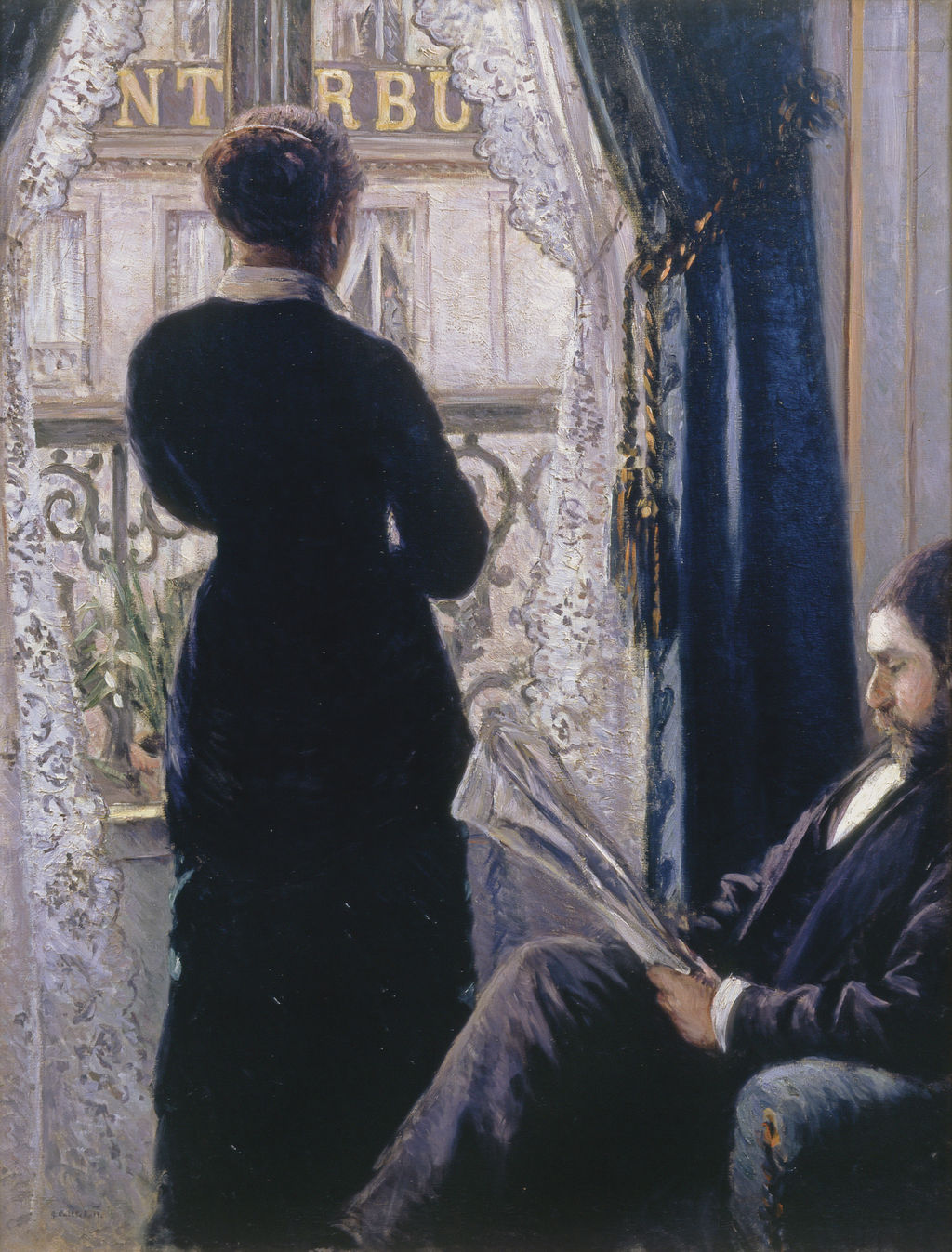
Interior, Woman at the Window, 1880; a separate example of shared domestic space and divided attention.
Leisure treated seriously
Samuel Raybone’s 2018 study connects the hands of Caillebotte’s card players with those of his pianists and manual workers. He reads their disciplined attention across the divide between earning a living and enjoying leisure. Drawing on Hannah Arendt, he proposes that painting, yachting and stamp collecting offered Caillebotte related forms of serious activity and sociability. The card table, with its shared objects and conventions, becomes a setting for companionship sustained through concentration. [9]
Philately gives Raybone a particularly suggestive comparison: stamps and cards acquire significance through handling, grouping and comparison. He connects the brothers’ shared stamp collecting with the social possibilities of the game. His argument allows silence to express involvement rather than automatically signify isolation. This is a scholarly reading of Caillebotte’s practices and their pictorial relationships; it does not establish what any individual sitter felt. [9]
Looking across the paintings reveals different arrangements of the active hands. In Young Man Playing the Piano, the keyboard makes a continuous pale strip extending diagonally away from the seated figure. An open score rises above it, offering a second light rectangle within the dark mass of the instrument. In The Bezique Game, the small, separate cards lie low between several people. The pianist’s hands meet an uninterrupted row of keys; the card players’ hands approach a scattered display from opposing sides. The difference is visible even before either activity is explained. [3]
The setting of The Floor Scrapers makes a stronger spatial contrast. Long strips of flooring stretch towards the foreground, opening a broad area between the workers and the viewer. Bent arms and lowered heads recur across that exposed surface. Here, coats and furniture largely conceal the lower room, keeping attention near tabletop height. Floor and card table both organise the bodies around them, but they give the spectator very different access: an extended field to look across in one picture, a narrow, partly enclosed patch in the other.
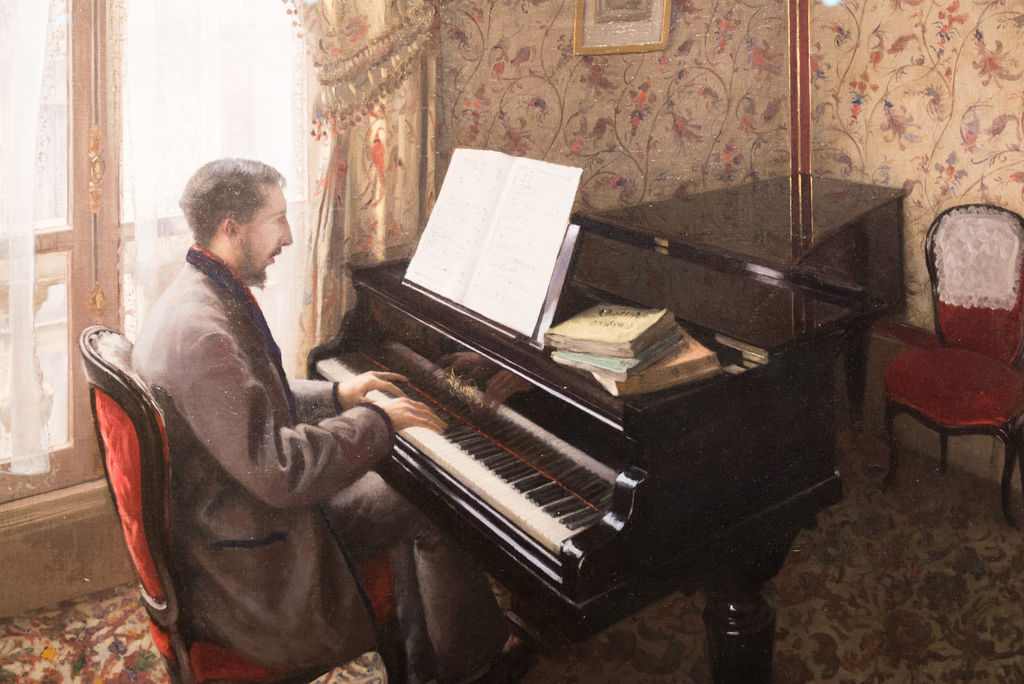
Young Man Playing the Piano, 1876; a separate arrangement of hands at work in a domestic interior. Photograph: xiquinhosilva. Image source. CC BY 2.0. Photograph by xiquinhosilva, CC BY 2.0. Resized only; source appearance preserved.
A private gathering at the 1882 exhibition
Olmsted places The Bezique Game within Caillebotte’s varied 1882 submission of sixteen paintings and one pastel. She compares its gathering with Renoir’s Luncheon of the Boating Party: tables organise both companies, but Renoir’s bright terrace encourages conversation and drinking, while Caillebotte’s interior concentrates attention on cards. She argues that Caillebotte selected works that connected with those of Renoir, Monet and Sisley, helping the exhibition cohere. This reconstruction of his strategy restores a public dimension to the domestic subject: the private gathering participated in a collective presentation of modern painting. [7]
Huysmans’s opening remarks lament the exhibition’s narrowed range and the dominance of landscape. Against that background, he praises Caillebotte’s versatility and attention to contemporary life. The absorbed card players supplied something of the intimate human world he found insufficiently represented elsewhere. [5]
Louvre Abu Dhabi emphasises the ambition of treating a familiar genre subject on the scale of history painting. The tiny cards and substantial bodies make that transformation tangible: an ordinary pastime provides the subject for a major figure composition. [1]
The painting’s later history
Berhaut’s 1994 catalogue records family and French private ownership, the 1894 retrospective, the 1921 Salon d’Automne, and later exhibitions in Houston–New York, Washington–San Francisco and Paris–Chicago. Periodic exhibitions allowed public reassessment during its years in private hands. The current collection record identifies it with Louvre Abu Dhabi under inventory LAD 2009.036. [3] [1]
Its published measurements need to be read with equal attention to context. Berhaut gives the canvas as 121 × 161 cm. Louvre Abu Dhabi publishes 125.3 × 165.6 × 3.4 cm, while the Orsay exhibition caption repeats the larger height and width. Since the owner’s set includes depth without identifying precisely what each measurement encompasses, the two sets should not be treated as interchangeable canvas dimensions. Neither establishes that the painting itself was enlarged. [3] [1] [2]
Its most compelling invitation remains the one Huysmans recognised: to stand close enough to follow the company’s attention while remaining outside its immediate concerns. Caillebotte gives the viewer a generous view of a gathering whose reason for existing lies in the shared activity at its centre.
Catalogue and documented works
This directory brings together 578 entries in the revised 1994 catalogue, 11 further documented records and three groups of study descriptions. It is a directory of records, not a total of authenticated individual works. Albums, print states and surviving decorative panels are grouped. English labels retain the French titles as searchable aliases; dates are supplied only where checked. Numbered entries link to the relevant article or the historical catalogue. Pastels appear under the Drawing filter; original prints remain searchable under All media.
Frequently Asked Questions
The owner identifies Martial Caillebotte as the player on the right with a pipe. The complete seating plan remains uncertain; the main discussion distinguishes the names proposed in the scholarship. [1]
It belongs to Louvre Abu Dhabi, inventory LAD 2009.036. [1]
He admired the absorbed figures and compared looking at them to seeing through a newly opened window. His account stresses their apparent independence from the spectator. [5]
Discussion
Look again at the images and ideas explored in The Bezique Game. These editorial prompts invite your observations.
Reader Insights
The table gathers six men into a compact arrangement.
The contrast between players and observers gives attention several directions.
Which figure most helps you understand the social space around the game?
Join the Conversation
Share a detail, comparison or question about The Bezique Game below.
References
- Louvre Abu Dhabi, “The Bezique Game”, collection record, LAD 2009.036; object details and interpretation. View source.
- Musée d’Orsay, Caillebotte: Painting Men, institutional exhibition presentation (2024), displayed caption for Partie de bézigue. View source. (in en/fr).
- Marie Berhaut, with Sophie Pietri, Gustave Caillebotte: Catalogue raisonné des peintures et pastels (1994), no. 183, p. 144; illustrated entry, sitter identifications, dimensions, exhibition history and provenance; no. 36, p. 78, illustrated piano comparison. Digitised by the Wildenstein Plattner Institute. View source. (in French).
- Marie Berhaut with Sophie Pietri; Wildenstein Plattner Institute, Gustave Caillebotte Catalogue raisonné des peintures et pastels, 1994. View source. (in French).
- Joris-Karl Huysmans, L’Art moderne (1883), Appendice I, opening discussion of the 1882 exhibition and “M. Caillebotte”; original French text in public transcription. View source. (in French).
- Paul Perrin, Musée d’Orsay, Transcription de l’entretien commissaire Caillebotte (2024), pp. 4–6, on masculine dress, the apartment and deliberate composition. View source. (in French).
- Galina Olmsted, Making and Exhibiting Modernism: Gustave Caillebotte in Paris, New York, and Brussels (PhD dissertation, University of Delaware, 2019), pp. 221–225, on the 1882 selection, sitter identifications and the comparison with Renoir. View source.
- Megan Seiler, Nelson-Atkins Museum of Art, “Portrait of Richard Gallo” (2024), catalogue essay, discussion of recurring domestic furniture and the proposed covering of the divan, notes 6–9. View source.
- Samuel Raybone, “Gustave Caillebotte’s Interiors: Working Between Leisure and Labor”, nonsite.org, no. 26 (2018), repository PDF pp. 2–8 and 21–29, on hands, the card players, work, yachting and philately. View source.
- Art Institute of Chicago, Caillebotte Paintings and Drawings at the Art Institute of Chicago, 2015. View source.
- Petit Palais / Paris Musées, Portrait de Paul Hugot, original print, PPG2319, current. View source. (in French).
- Paul Perrin, Musée d’Orsay, Transcription de l’entretien commissaire Caillebotte, 2024. View source. (in French).
- Cleveland Museum of Art, Caillebotte collection records: 2020.260, 2009.157 and 2020.105, current. View source.
- Splash image, The Bezique Game, about 1880–81.


