


 by Tom Gurney
Tom Gurney BSc (Hons) is an art history expert with over 20 years experience
Email: tomgurney1@gmail.com / Phone: +44 7429 011000
Caillebotte’s Paris: Introduction
Gustave Caillebotte’s Paris is a city experienced at different heights. On a pavement, an umbrella and an approaching stranger can fill the field of vision. From an upper window, people become small moving marks between immense buildings. A balcony connects these experiences while keeping their inhabitants apart. His urban paintings explore the streets and domestic spaces of a capital transformed by the renovations directed by Baron Haussmann from the 1850s. [1]
These views have a surprisingly local geography. Curator Paul Perrin emphasises Caillebotte’s familiarity with the streets between his home and the cafés where he met other artists. This was a Paris close to his daily life, rather than a collection of distant sights discovered on aimless walks. [2] Following the paintings through that neighbourhood reveals how much could change when an artist crossed a road, entered a room or leaned over a railing.
At a Glance
- Family homethe Caillebottes moved to 77 rue de Miromesnil in 1868. [3]
- Later Paris addressthe 1879 Impressionist exhibition catalogue lists Caillebotte at 31 boulevard Haussmann. [3]
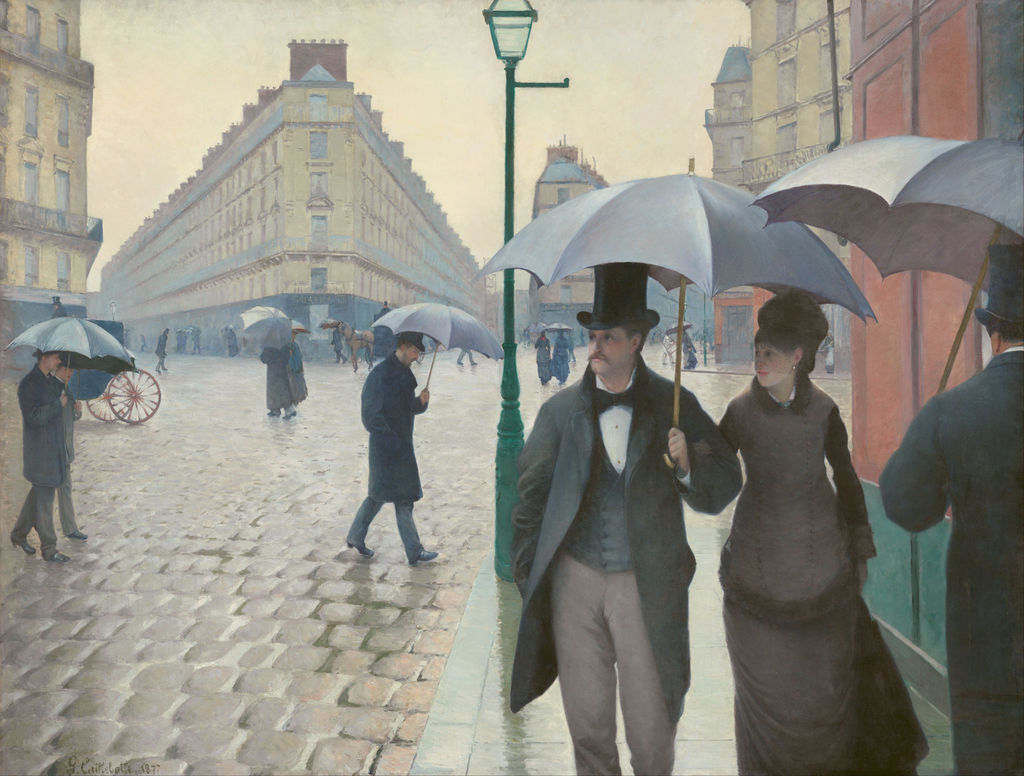
- Street-level landmarkParis Street, Rainy Day depicts the junction around rue de Turin, rue de Moscou and rue de Saint-Pétersbourg. [4]
- Principal urban viewpointspavement, railway bridge, window and balcony.
Contents
- A city seen from home
- The work behind the polished apartment
- Walking into Paris Street, Rainy Day
- The bridge: moving across, looking down
- Rue Halévy from the sixth floor
- When the balcony takes over the picture
- Looking almost straight down
- Public streets, private spectators
- A familiar city made unfamiliar
A city seen from home
The family’s rue de Miromesnil residence places Caillebotte’s early interiors inside the same urban world as his street pictures. In Young Man at His Window, dated 1875 in Berhaut’s catalogue, the city opens beyond a standing figure seen from behind. [3] His dark suit occupies much of the right side. The pale masonry opposite seems almost within reach, while the street slips away below the stone balustrade. The window offers several distances at once: the man beside us, the nearest building across the gap, and the diminutive figures beneath it.
Look at the boundary between inside and outside. The open glazed door on the right catches a pale reflection of the figure; its frame extends the room into the picture while partially screening the view. A red upholstered chair presses into the lower corner. These furnishings give the observer a place to stand, but their warmth and proximity also make the exterior seem cooler and more exposed. The young man has turned his back on that comfortable seat. His position directs our attention outward without allowing us to see precisely where his eyes have settled.
The opposite apartments matter as much as the roadway. Their windows, balconies, shutters and storeys divide the façade into repeated compartments. To look from one house is to look towards the private interiors of others. Even where no neighbouring occupant is visible, the buildings establish the possibility of reciprocal observation. Caillebotte makes the city feel inhabited through the arrangement of its openings, rather than through a packed crowd.
The work behind the polished apartment
The bourgeois home also contained labour. In his study of Caillebotte’s interiors, Samuel Raybone locates The Floor Scrapers in the rue de Miromesnil house and reads its renovation as an encounter between inherited property and manual work. His argument connects the workers’ treatment of the floor with the painter’s transformation of a surface. This is Raybone’s interpretation of the relationship between leisure, ownership and labour. [5]
The painting makes that relationship tangible. Long bands of flooring run from the foreground towards the window. Some are dark and glossy; others have been cut back to a lighter colour. Wood shavings interrupt the lines, accumulating around hands and tools. The workers occupy the floor at close range, their bent backs catching the same light that travels across its surface. The room’s decoration remains above them: moulded wall panels, a pale skirting board and the ornamental metalwork beyond the glass.
The contrast does not require an invented conversation between painter and workers. A furnished apartment can conceal the effort that prepared it; this room exposes that effort. The floor is both an architectural surface and an unfinished task. Seen beside the window picture, it complicates the idea of a private refuge sealed off from the working city. The apartment belongs to Paris through its construction, maintenance and materials, as well as through the view it commands.
Walking into Paris Street, Rainy Day
The intersection in Paris Street, Rainy Day has no single monumental centre. The Art Institute of Chicago identifies the viewpoint on rue de Turin and explains how Caillebotte adjusted the complicated site through preparatory drawing. Its research on the surviving architectural study distinguishes initial observation from later changes to the perspective. [4] A real junction provided the subject, but the painting gives that junction an unusually persuasive order.
The first obstacle is the couple coming towards us. The man’s pale trousers and open coat descend beyond the lower edge; the woman’s skirt fills the adjoining space. Their shared umbrella spreads over both heads and overlaps the building behind. At the far right, another pedestrian enters with his back turned, his umbrella cut by the frame. There is barely enough pavement for the approaching bodies. To imagine walking forward is immediately to imagine adjusting one’s course.
Across the road, however, there is abundant room. The open area on the left stretches towards small figures and a carriage, and the cobbles form a broad, gently glittering field. The lamppost divides this expanse from the close encounter. Its straight shaft is unusually firm among umbrella curves, bent elbows and the changing directions of pedestrians. It stabilises the picture without giving anyone a destination.
The wedge-shaped building across the junction supplies another strong vertical. Its two façades draw apart into separate streets, making a solid object appear to split the view. Repeated windows diminish into the distance; the figures shrink much faster than those architectural rhythms. This difference in scale lets us feel how long the streets are even though their ends are obscured.
Rain changes the neighbourhood’s visibility. The distant masonry becomes pale and soft, while the foreground clothes remain dark and distinct. Reflections in the pavement turn the ground into a broken mixture of grey, cream, green and pink. The weather binds the spaces together, yet the umbrellas create small individual enclosures within it. A shared condition produces separate shelters. That is a visible feature of the encounter, rather than evidence that every passer-by is lonely.
The bridge: moving across, looking down
The railway district offered a different kind of crossing. Le Pont de l’Europe, the large 1876 Geneva composition, places pedestrians alongside the iron structure above the Saint-Lazare railway approaches. Lynn Kellmanson Matheny’s National Gallery of Art brochure discusses it with Rainy Day as a response to the reconstructed city. [1]
The bridge creates a corridor with a much stronger direction than the open junction. Its girders run from the immense diagonal at the upper right towards a distant point near the centre-left. The pavement follows them. A dog enters this channel in the foreground, a walking couple approaches along it, and a man at the railing interrupts its flow by turning sideways. He faces the railway space beyond the ironwork. We encounter both ways of occupying the bridge: passing over it and stopping to look through it.
The immense scale of the nearest girder is crucial. Its diagonal crosses a large part of the sky, making a structural member dominate the scene more strongly than any individual. At a distance, the same members become a quick succession of narrow openings. The bridge therefore offers its own lesson in perspective, visible through ordinary construction. Repetition converts the weight of iron into an accelerating rhythm.
Its shadows duplicate that rhythm on the pavement. Dark angled shapes pass across the route of the pedestrians and the dog. A person can walk through these bars of shade while the solid structure remains to one side. This doubling links the bridge’s engineering to the movement of bodies. Farther away, pale steam softens a space that the foreground metalwork divides sharply.
Galina Olmsted reconstructs the 1877 exhibition in which the Geneva bridge painting, Rainy Day and The House Painters appeared among Caillebotte’s six submissions. She argues that their display alongside Monet’s railway paintings helped establish a deliberate artistic dialogue. The close-cropped bridge canvas now at the Kimbell was absent from that exhibition; explanations for its omission remain scholarly proposals. [6] The exhibition brought several experiences of a connected neighbourhood into the same viewing space.
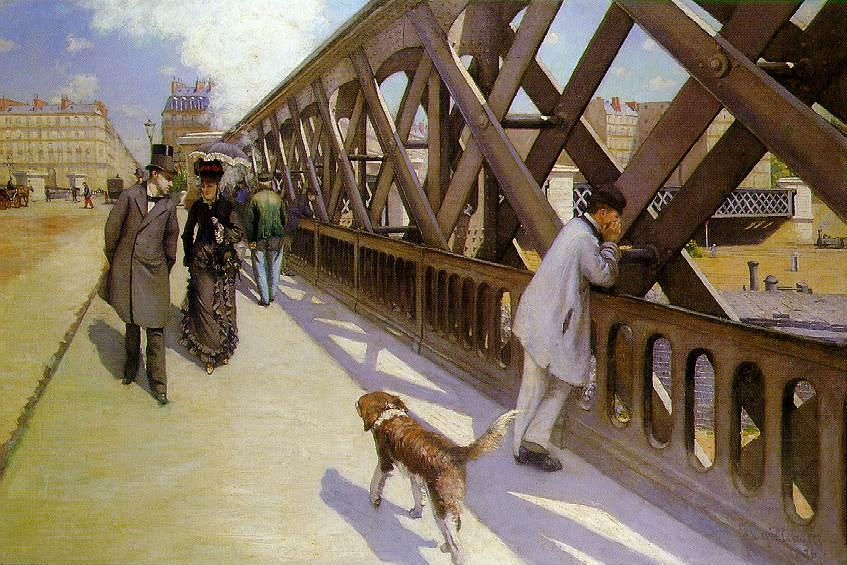
Le Pont de l’Europe, 1876; the finished Geneva composition, Berhaut 49, with its foreground dog.
Rue Halévy from the sixth floor
Height changes the relationship between architecture and people. The Museum Barberini’s Rue Halévy, View from the Sixth Floor is dated 1878 and measures 59.5 × 73 cm. Daniel Zamani identifies its viewpoint in a building on rue La Fayette and the gilded rooftop sculpture of the Opéra Garnier in the distance. The painting appeared at the 1879 Impressionist exhibition. It is catalogue number 100, distinct from the related Rue Halévy, View from a Balcony. [7]
The broad street rises through the centre of the canvas. Its light surface seems to lift towards the distant architecture, held between the rounded building at the left and the long façade on the right. The road is plentiful; the people are sparse strokes. Carriages are more legible as compact blocks with dark wheels, yet they too become part of the street’s changing pattern rather than the centre of a story.
One strip of the nearby building cuts steeply down the left edge. It is darker and more immediate than the panorama, giving a bodily reminder of the observer’s elevated position. Without it, the street could be read as a broad channel laid out beneath an all-seeing eye. With it, we remain at an opening in a particular building. The view has a location even when the person looking is absent.
The roofs strengthen this sense of being high in the city. Chimneys, dormers and blue-grey slopes become prominent forms, almost level with the distant opera sculpture. Their colours repeat across the street and tie separate buildings together. Sunlit stone and violet-blue shadows give the broad façades a more varied surface than their repeated windows initially suggest. The city’s regularity becomes an opportunity for differences of light and touch.
Zamani compares the painting’s hazy distance and high viewpoint with Monet’s Boulevard des Capucines. [7] For this view, the comparison is especially useful because Caillebotte’s street can be read both as deep space and as a pale painted shape. The eye follows its traffic towards the opera, then returns to the visibly worked surface in front of us.
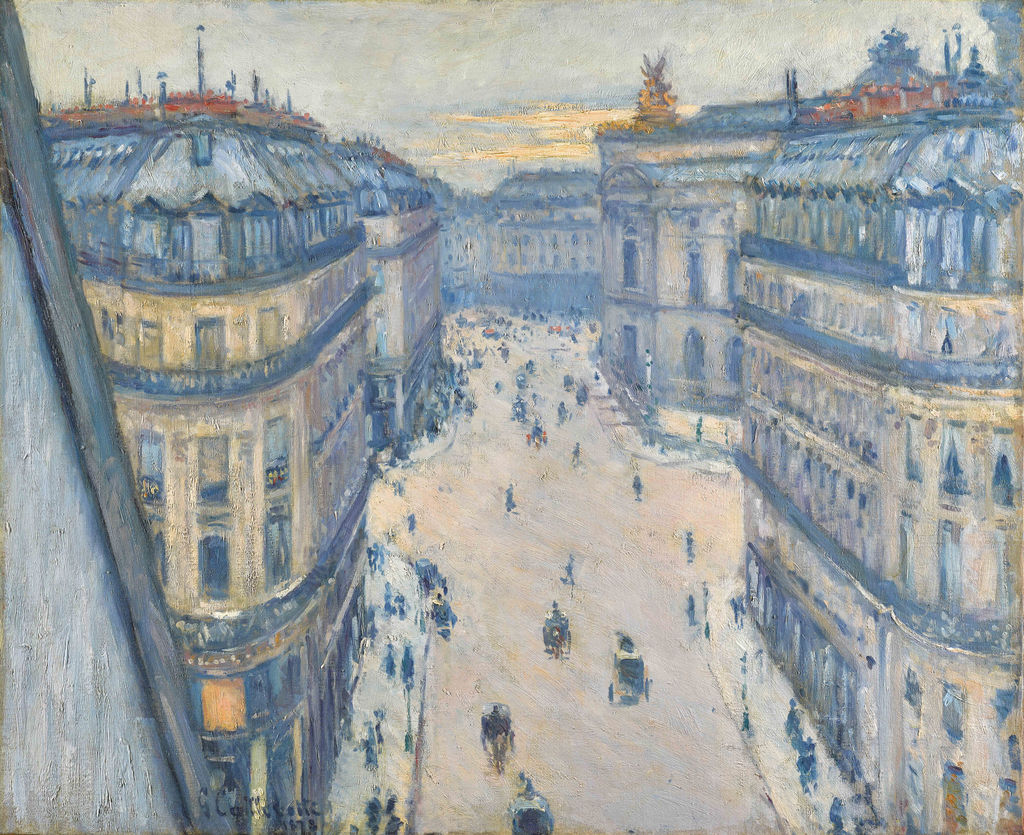
Rue Halévy, View from the Sixth Floor, 1878; Hasso Plattner Collection, Museum Barberini, MB-Cai-02. sammlung.museum-barberini.de. Image source. Public domain. Resized only; source appearance preserved.
Watch: Gustave Caillebotte
Explore a museum overview and two discussions of Paris Street; Rainy Day. This shared selection offers wider context for the artist’s work.
"Who Is Gustave Caillebotte?" - HD version
An introduction to Caillebotte from the Kimbell Art Museum.
Watch on YouTubeWhen the balcony takes over the picture
A balcony can offer a panorama, include the person enjoying it, or become the subject itself. These possibilities should be kept distinct. The empty Balcony in Paris, catalogued as Un balcon, boulevard Haussmann, is Berhaut 148, a 55 × 38 cm canvas of 1880. It differs from the Van Gogh Museum’s close view through ironwork, number 147, and from the figure paintings numbered 145 and 149. [3]
In the empty balcony painting, the horizontal handrail spans almost the entire width. Below it, repeated scrolls curl around pale intervals of street and light. Above it, the city opens out into trees and a long run of façades. The railing is near enough for its dark paint to dominate, while the buildings remain legible beyond a soft veil of foliage. Two different rhythms compete: the emphatic curves in front and the receding horizontal lines across the boulevard.
There is no figure to act as an intermediary. We occupy the position that a depicted spectator might otherwise claim. The rail indicates the limit of bodily movement while allowing the eye to cross it. Its ornamental circles also encourage small, local acts of looking: through a curl, around an upright, between the leaves. The panorama is available in pieces.
The Van Gogh Museum picture pushes that fragmentation further. Sjraar van Heugten’s acquisition study explains that its ironwork was established before pale background colours were applied after drying. He treats this deliberate sequence as evidence for an independent finished painting. His account concerns number 147; the proposed identification with an 1880 exhibition entry is uncertain. [8]
Compared with the more open number 148, the larger scrolls in 147 nearly overwhelm the street. The openings are irregular windows onto small areas of ground and traffic. What conventionally serves as decoration at the edge of an urban view becomes an insistent structure across it. The same city can thus appear broad and navigable from one position, then difficult to assemble from another a short distance away.
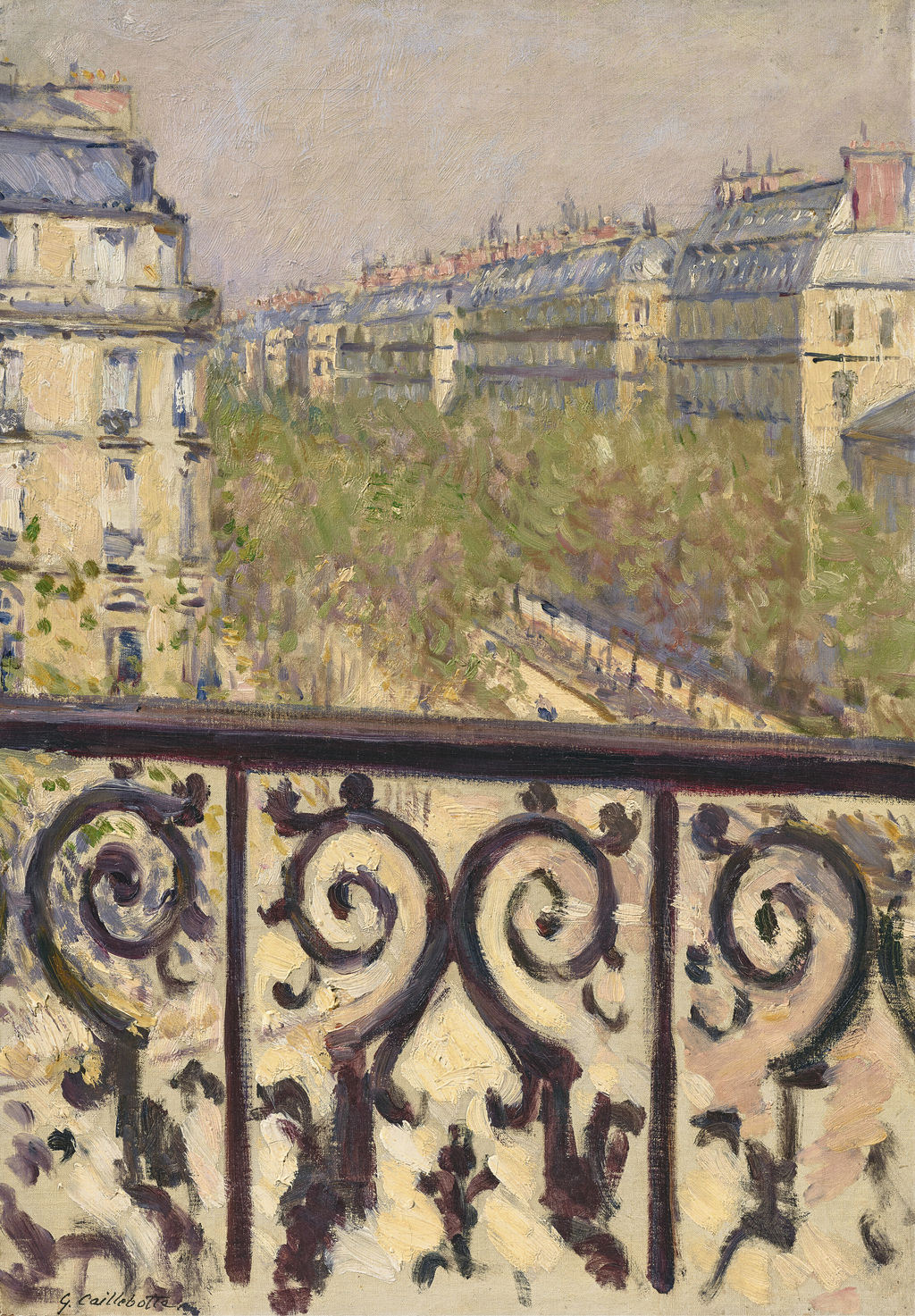
A Balcony in Paris, 1880; the empty balcony and city view, Berhaut 148. Image source. Public domain. Whole supplied image retained; resized only.
Looking almost straight down
A still steeper angle can remove the horizon altogether. The Musée des impressionnismes Giverny discusses The Boulevard Seen from Above of 1880 as an example: foreshortened pedestrians and diagonal divisions replace the usual arrangement of ground beneath sky. Its teaching dossier places these city views alongside Caillebotte’s work at Yerres, on the Normandy coast and at Petit-Gennevilliers. [9]
This viewpoint asks a different question from the distant view towards the opera. A tree trunk and its circular pavement grate stand at the right; branches cross towards the left, screening the road behind. A long bench cuts diagonally through the middle. Its empty seat and the dark hats of the passing men identify familiar objects seen at an unfamiliar angle. The grate’s concentric pattern is more completely visible than any face. The ground directly beneath the observer becomes the setting for an intricate arrangement of circles, diagonals and interrupted silhouettes. Even without entering an apartment, a viewer has to imagine the building that makes such an angle possible.
The change also alters the viewer’s relationship with strangers. At street level, the painted pedestrian appears capable of meeting us. From above, we can watch without sharing the same immediate space. Yet the gain in overview comes with a loss of facial information. Elevation brings spatial knowledge and personal distance together. Caillebotte’s different viewpoints make that exchange visible without resolving it into a single judgement on urban life.
Public streets, private spectators
The Musée d’Orsay’s Peindre les hommes exhibition frames Caillebotte’s streets and balconies through the social freedoms and conventions surrounding men. Its account connects public movement with the more private act of watching from an apartment. This curatorial perspective draws attention to who occupies each space and how their bodies are presented. [10]
A window does not simply end the street picture. In Interior, Woman at the Window, the standing woman faces the building opposite, while a seated man looks down at a newspaper. Lace curtains overlap the exterior architecture. The deep blue hanging on the right creates a heavy division beside the window, and the newspaper extends into the space between the two people.
Their activities establish different fields of attention. One looks outward, the other at a printed page. The woman’s back prevents us from following her expression, just as the folded newspaper conceals much of what the man reads. We can see their physical nearness more easily than we can reconstruct any shared thought. Across the gap, the opposite building appears unusually close. Private life and public frontage become adjacent layers of the same picture.
The domestic setting was also available for rearrangement. In her Nelson-Atkins study of Richard Gallo, Megan Seiler proposes that its striking sofa may be a familiar divan covered with patterned fabric. She presents this as a hypothesis based on visible folds and cushions. [11] Such a proposal reminds us to treat a painted room as a selected arrangement. The apartment offered Caillebotte a setting to compose, as the junction and bridge did outside.
The street also entered the home through consumption and display. Matheny links Caillebotte’s still lifes with the visual appeal of Parisian shops and markets. [1] In Fruit Displayed on a Stand, white paper separates rounded heaps of fruit into compartments. The brightest oranges and yellow pears crowd the outer parts of the composition, while smaller purple and green fruit gather towards the centre. Pale folds create steps between the groups, directing attention across their different sizes and colours. Seen beside the balcony pictures, the arrangement offers another kind of selective view: a crowded surface organised into inviting sections. A city painting can describe the experience of looking in Paris even when no street is visible.
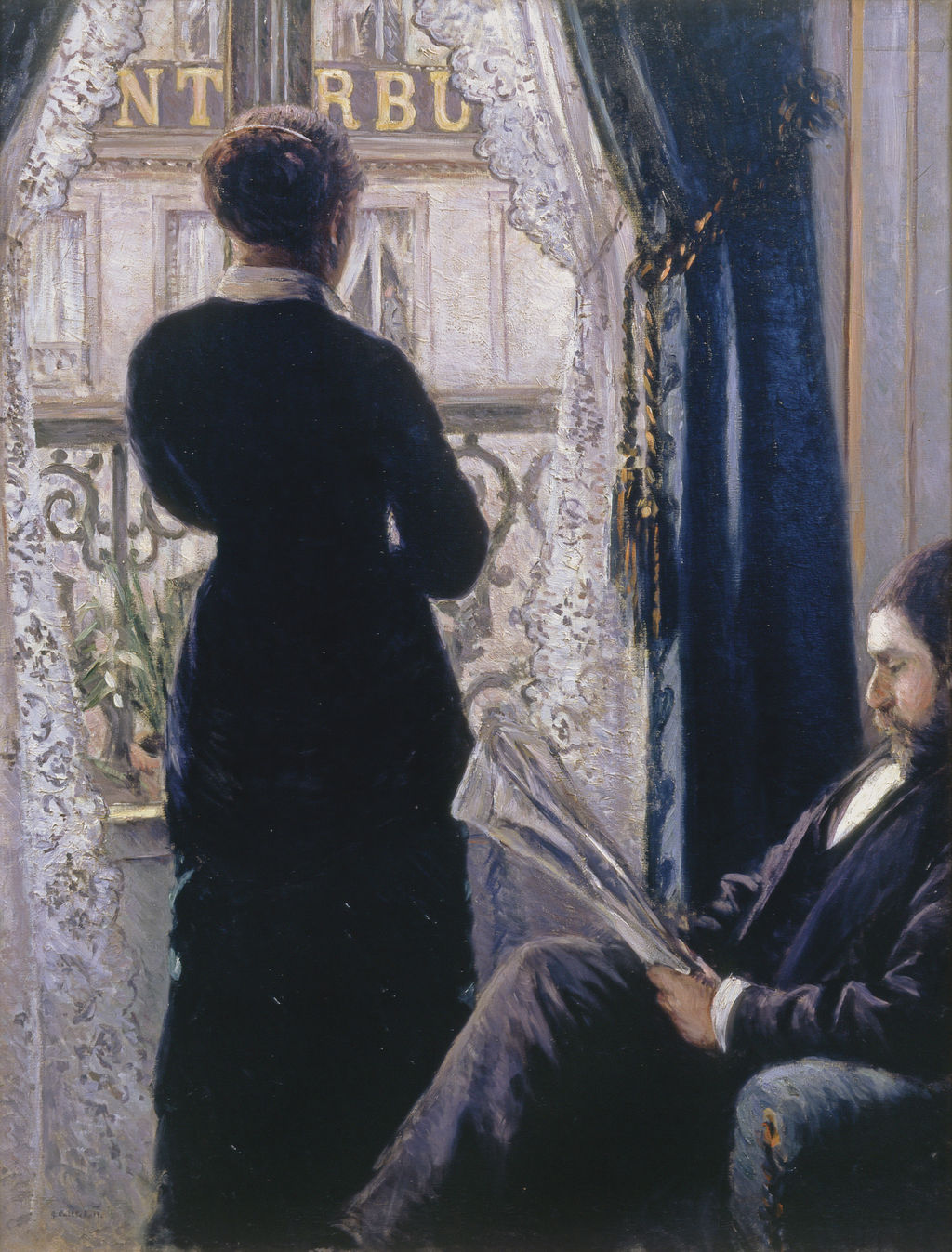
Interior, Woman at the Window, 1880; separate fields of attention in a shared Parisian room.
A familiar city made unfamiliar
The abrupt crops and elevated viewpoints have encouraged comparisons with photography. The SCHIRN Kunsthalle’s 2012 exhibition set Caillebotte’s paintings beside both nineteenth-century photographs and later examples of the New Vision. Its comparison of unusual angles and fragmented views is illuminating as a curatorial argument; it does not establish a source photograph for an individual canvas or a direct line of influence on a later photographer. [12]
The paintings themselves make the most immediate case. A cut-off umbrella can imply a body continuing beyond the frame. A railing can make a distant boulevard intermittently disappear. A high window can turn a street into an expanse of colour while retaining enough carriages and pedestrians for us to recognise its use. These effects derive their force from a recognisable environment being seen under specific conditions.
Perrin describes Caillebotte’s apparent immediacy as the product of deliberate compositional choices, including cropping, changes of scale and emphatic diagonals. [2] Those choices give the neighbourhood more than one character. Its spaciousness feels different to someone negotiating a crowded strip of pavement, someone following the bridge’s rail, and someone looking over a handrail from home.
A useful way to move between these pictures is therefore to ask where the viewer stands and what remains inaccessible from that position. The junction in Rainy Day leaves the railway outside our view; the bridge painting offers glimpses of the space below. The balcony spectator can survey traffic but cannot read a distant face. The person in a room can look across at another building while remaining hidden behind curtains. Caillebotte’s Paris takes shape through those precise opportunities and limits: a city shared by many people, each with a different piece of it in view.
Catalogue and documented works
This directory brings together 578 entries in the revised 1994 catalogue, 11 further documented records and three groups of study descriptions. It is a directory of records, not a total of authenticated individual works. Albums, print states and surviving decorative panels are grouped. English labels retain the French titles as searchable aliases; dates are supplied only where checked. Numbered entries link to the relevant article or the historical catalogue. Pastels appear under the Drawing filter; original prints remain searchable under All media.
Frequently Asked Questions
Perrin emphasises the streets near Caillebotte’s home and on his routes to cafés where he met fellow artists. [2]
The painting looks from rue de Turin towards the junction involving rue de Moscou and rue de Saint-Pétersbourg. The Art Institute’s study explains Caillebotte’s adjustments to its perspective. [4]
It is the 1878 canvas in the Hasso Plattner Collection at the Museum Barberini, inventory MB-Cai-02, catalogue number 100. The museum distinguishes it from the related balcony view. [7]
Comparisons of their cropping and viewpoints with photography do not establish a photographic source. The SCHIRN exhibition used such comparisons to explore Caillebotte’s ways of seeing. [12]
Discussion
Look again at the images and ideas explored in Caillebotte’s Paris. These editorial prompts invite your observations.
Reader Insights
A pavement, a window and a bridge each give the viewer a different position in the city.
The high views can be compared with the close encounters on the street.
Which viewpoint makes familiar urban space feel most unfamiliar?
Join the Conversation
Share a detail, comparison or question about Caillebotte’s Paris below.
References
- Lynn Kellmanson Matheny, National Gallery of Art, Gustave Caillebotte: The Painter’s Eye (2015), brochure, pp. 3–5. View source.
- Paul Perrin, Musée d’Orsay, Transcription de l’entretien commissaire Caillebotte (2024), pp. 3–6. View source. (in French).
- Marie Berhaut with Sophie Pietri, Gustave Caillebotte: Catalogue raisonné des peintures et pastels (1994), biography, reproduced 1879 catalogue, entries 32, 145, 147–149; Wildenstein Plattner Institute edition. View source. (in French).
- Art Institute of Chicago, Caillebotte Paintings and Drawings at the Art Institute of Chicago (2015), catalogue entries 1 and 2, Study for “Paris Street; Rainy Day” and Paris Street; Rainy Day, curatorial discussions. View source.
- Samuel Raybone, “Gustave Caillebotte’s Interiors: Working Between Leisure and Labor,” nonsite.org 26 (2018), opening discussion of The Floor Scrapers, repository PDF pp. 4–5. View source.
- Galina Olmsted, Making and Exhibiting Modernism: Gustave Caillebotte in Paris, New York, and Brussels (2019), pp. 98–112. View source.
- Daniel Zamani, Museum Barberini, “Rue Halévy, View from the Sixth Floor,” collection entry MB-Cai-02, description and exhibition history. View source.
- Sjraar van Heugten, Van Gogh Museum, “View from a balcony,” Van Gogh Museum Journal 2003 (2003), pp. 121–122, notes 1–5. View source.
- Musée des impressionnismes Giverny, Caillebotte, peintre et jardinier: Dossier pédagogique (2016), PDF pp. 4–5, 9. View source. (in French).
- Musée d’Orsay, Gustave Caillebotte: Peindre les hommes (2024), exhibition presentation, “La ville est à nous” and “Hommes au balcon.” View source. (in French).
- Megan Seiler, Nelson-Atkins Museum of Art, “Gustave Caillebotte, Portrait of Richard Gallo, 1881” (2024), catalogue essay, discussion of the divan. View source.
- SCHIRN Kunsthalle Frankfurt, Gustave Caillebotte: Ein Impressionist und die Fotografie (2012), exhibition wall texts, pp. 1–3. View source. (in German).
- Marie Berhaut with Sophie Pietri; Wildenstein Plattner Institute, Gustave Caillebotte Catalogue raisonné des peintures et pastels, 1994. View source. (in French).
- Art Institute of Chicago, Caillebotte Paintings and Drawings at the Art Institute of Chicago, 2015. View source.
- Petit Palais / Paris Musées, Portrait de Paul Hugot, original print, PPG2319, current. View source. (in French).
- Paul Perrin, Musée d’Orsay, Transcription de l’entretien commissaire Caillebotte, 2024. View source. (in French).
- Cleveland Museum of Art, Caillebotte collection records: 2020.260, 2009.157 and 2020.105, current. View source.
- Splash image, Paris Street; Rainy Day, 1877; an encounter with the reconstructed city from the pavement. 5wEUCOlEf-EaVQ at Google Cultural Institute maximum zoom level. Image source. Public domain. Resized only; source appearance preserved.


