


 by Tom Gurney
Tom Gurney BSc (Hons) is an art history expert with over 20 years experience
Email: tomgurney1@gmail.com / Phone: +44 7429 011000
Luncheon: Introduction
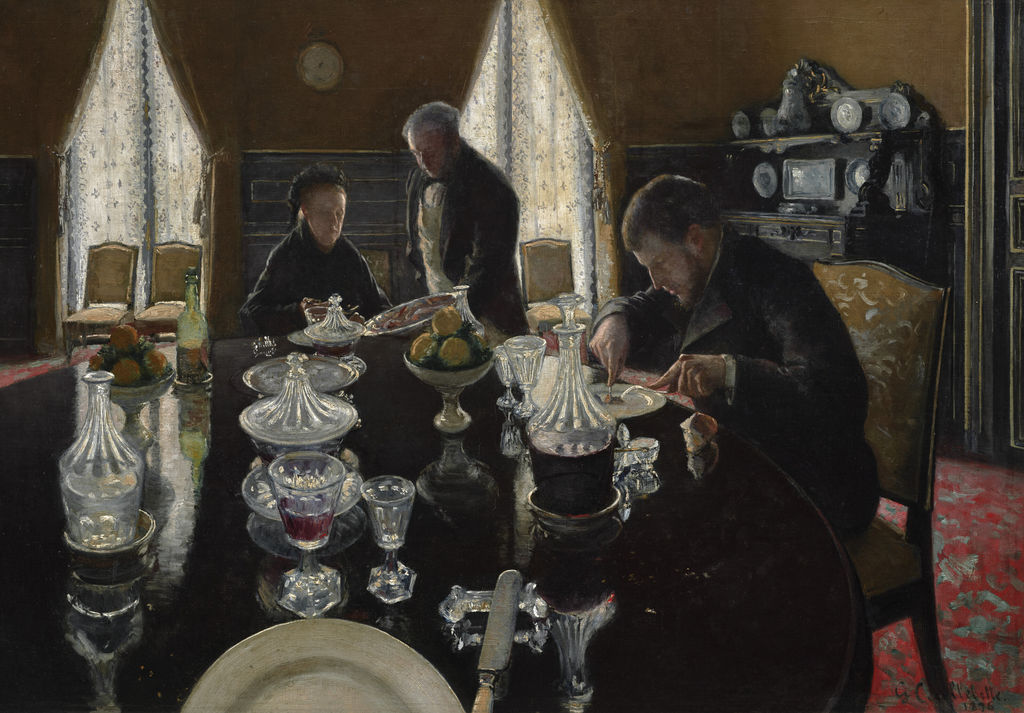
A plate cut in half by the lower edge of the picture places us unusually close to Gustave Caillebotte’s Luncheon. Beyond it, glass stems and decanters rise from a dark, shining table; the people seem much further away. Painted in 1876, this oil on canvas measures just 52 × 75 cm. Its dining room belongs to the Caillebotte family home on the rue de Miromesnil in Paris. [1]
The meal brings together the painter’s mother, Céleste, his brother René and a servant. The Getty places the painting beside Young Man Playing the Piano and Young Man at His Window as a trio of family interiors shown at Caillebotte’s Impressionist debut in 1876. [2] Here, an everyday activity becomes an exacting experiment in how much a table can occupy a picture, and how differently daylight can describe a human face, a cut-glass vessel and polished wood.
At a Glance
- ArtistGustave Caillebotte.
- French titleLe Déjeuner.
- Date and medium1876; oil on canvas.
- Dimensions52 × 75 cm, confirmed in the National Gallery of Art’s 2015 checklist. [3]
- CatalogueBerhaut 1994, no. 37. [1]
- CollectionPrivate collection in the Getty’s 2021 account. [2]
This work across Gustave Caillebotte’s career
Contents
- Taking a place at the table
- A still life within a family scene
- Hands, sleeves and the making of a gesture
- Family interiors at the 1876 exhibition
- Perspective before the public
- Reading work and leisure
- A privately held painting in public view
- Annotated details
Taking a place at the table
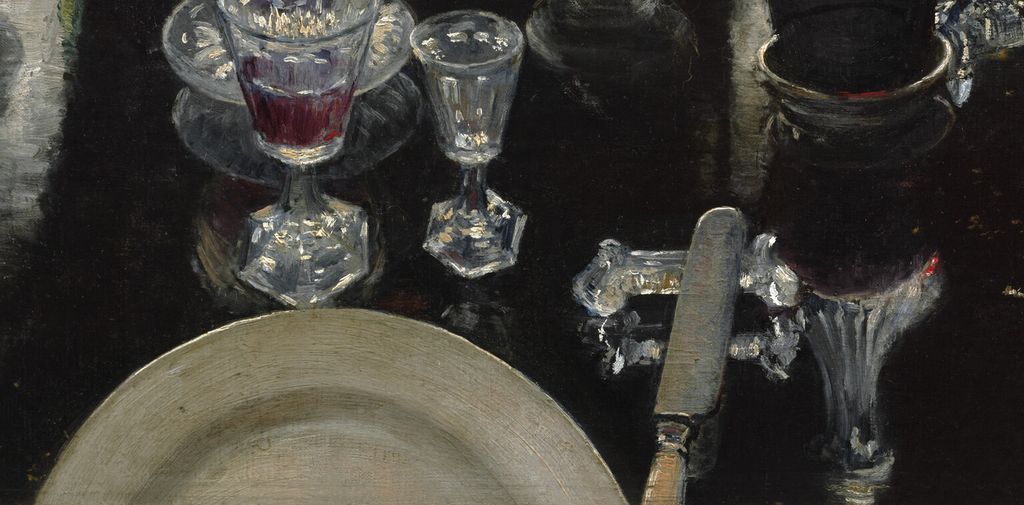
The nearest plate is almost large enough to rest our eyes inside it. Its broad cream rim enters from below, while a knife on a small rest points into the composition just to its right. We cannot see the chair or the person who would use this setting. Yet the plate gives the foreground a practical human scale: this is the distance from which a diner might look across the table. The objects nearest us are therefore more than accessories. They establish a position from which everything else becomes visible.
The table’s right-hand edge describes a long curve. It begins near René’s elbow, sweeps out beside his knees and disappears below the frame. To the left, the tabletop continues beyond the picture. These uneven boundaries deny us a neat, complete shape. We understand that the table curves, but experience it chiefly as a dark expanse that swells towards us. The space is organised around an object whose whole outline we never receive.
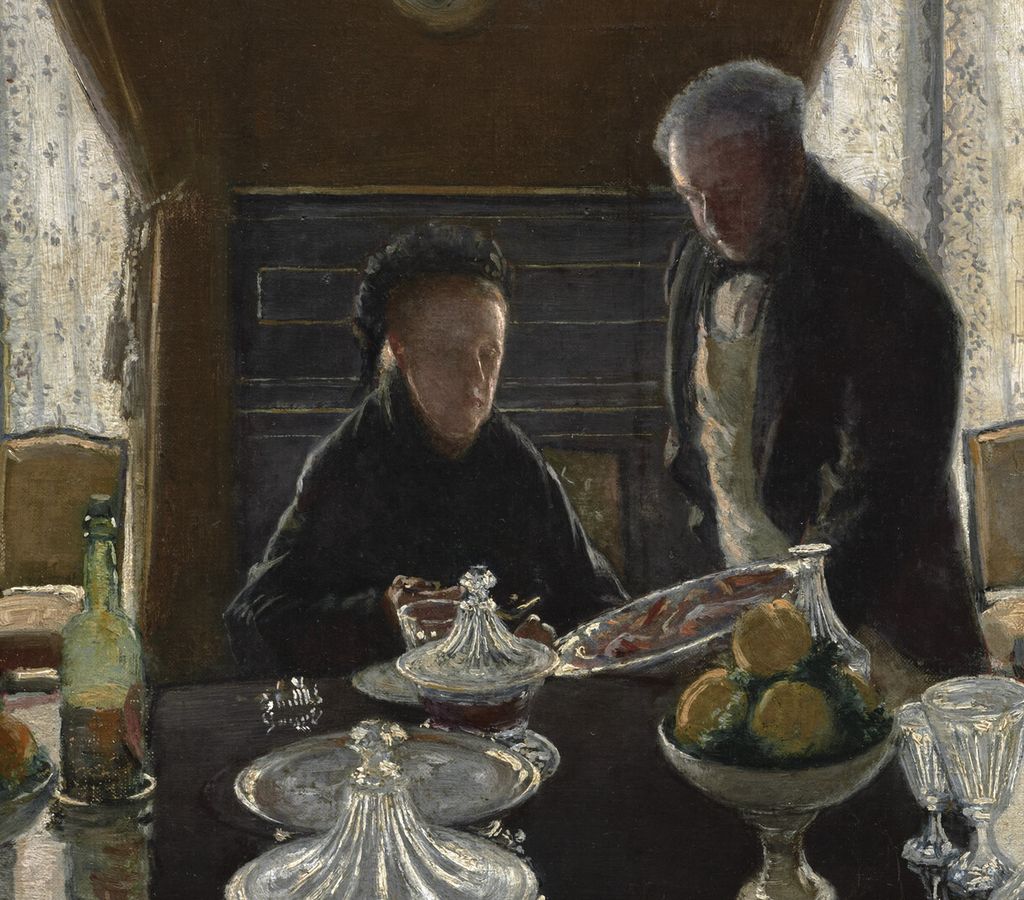
René occupies the right side, bending over his plate with a knife and fork. Across from us, Céleste sits behind a smaller cluster of dishes. Berhaut’s catalogue identifies the standing attendant as Jean Daurelle, citing the Martial Caillebotte family archive. [1] He leans forward between the seated figures, holding a platter at a slant. His body makes a vertical connection between the bright window and the serving vessels, while the tilted platter carries an oblique line towards Céleste.
There is a notable difference between being close to a person and being close to their belongings here. René’s hands and plate are within easy visual reach, but his face turns down into shadow. Céleste’s face is visible beyond the crowded table, with its features softened by the surrounding darkness. The bright objects are much easier to inspect. We can follow the shape of a decanter more readily than we can read either sitter’s expression.
The background remains remarkably legible despite that darkness. Two tall windows punctuate the wall. Pale chair backs stand before them, and a clock hangs high between them. On the right, a substantial cabinet carries plates and decorative objects. The repeated upright forms steady the room behind the table’s spreading curves. Even the servant, whose movement interrupts the meal, belongs to this rear pattern of verticals.
A still life within a family scene
The clearest colours gather in the tabletop objects. Orange and yellow fruit rise above the sombre surface in two raised dishes, with green leaves lodged between their rounded forms. A green bottle catches the light near the left window. Red wine colours the glass near our place setting and the decanter further right. These patches of colour give the eye stopping points among the many clear and silver-grey shapes.
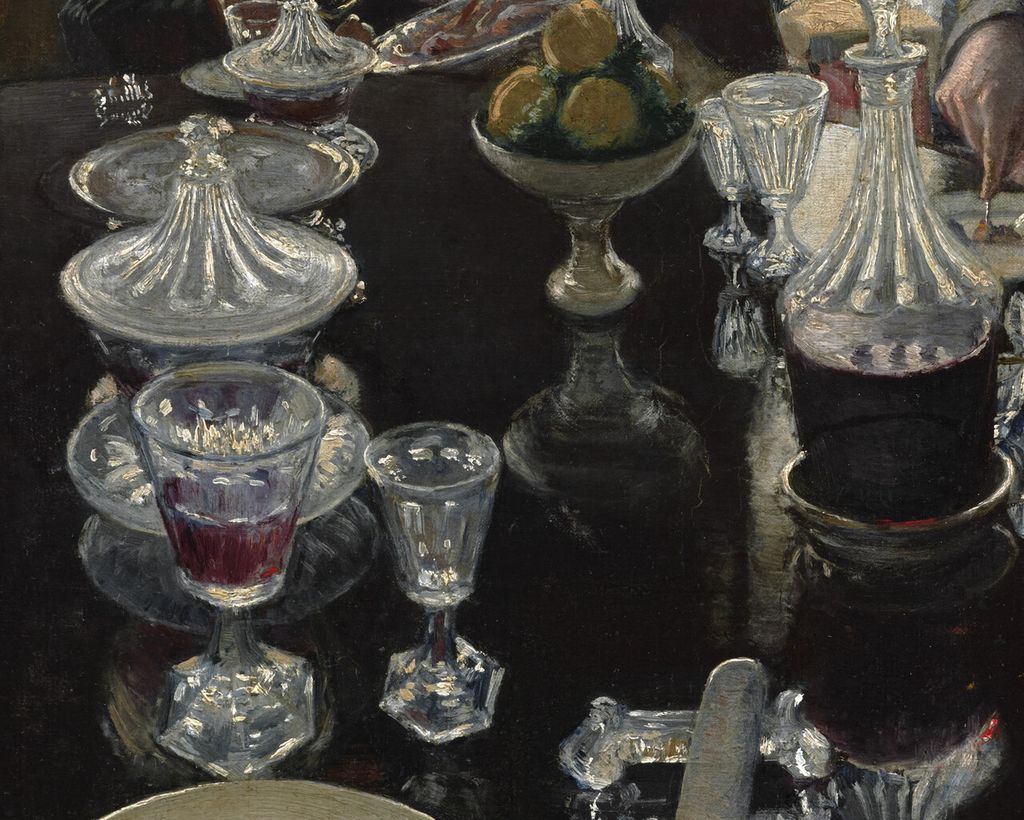
Each kind of vessel has a different relationship with light. The decanters have broad lower bodies that gather reflections into pale pools, then narrowing necks drawn with bright strokes. The glasses break into smaller facets and abrupt flashes. Covered dishes introduce low, fluted cones, their lids spreading outwards towards shallow rims. The table reflects all of them, but those reflections are less tidy than the objects above. They broaden, darken and dissolve into the wood.
Look particularly at the decanter of red wine in front of René. Its lower half reads as a dark mass, while its neck is a sequence of white and grey ridges. Beneath it, the reflection extends the dark shape almost to the bottom edge. Nearby glasses create little interruptions: sharp handles, stems and rims against the larger vessel. Caillebotte makes transparent objects substantial through their outlines, neighbouring shadows and repeated forms.
The clear decanter at the left performs a different task. Its pale body opens a pocket of light in a relatively empty part of the foreground. Behind it, the reflection of the window forms a long, broken band. This strip directs us towards the left side of the room, providing a route through the arrangement that does not lead immediately to a face. We can travel across the picture through reflected light alone.
The tabletop is uncovered. Its dark finish makes the glass conspicuous and lets reflections become part of the setting. It also separates the bright dishes into distinct islands. A white tablecloth would visually connect the places; here, dark intervals remain visible between them. The raised fruit dishes are especially effective against those intervals because their stems lift the coloured fruit away from the surface, leaving room for another inverted shape below.
Behind this display, the cabinet contains a second arrangement of objects. Pale plates stand out against dark shelves, echoing the circular dishes on the table. They are more remote and more compressed, recognisable chiefly as a pattern. The foreground offers objects for close inspection; the cabinet gives similar objects the quieter role of furnishing a room. Caillebotte makes the distance between those two registers unusually tangible.
Berhaut identifies pieces of this service in the 1879 Still Life: Glasses, Decanters and Fruit Dishes (no. 133), set in the boulevard Haussmann dining room. [1] In that later picture, the diners have disappeared and the upright decanters frame raised dishes of fruit. The objects crowd together in a much narrower field, with glasses cut by the lower edge. Seen beside this arrangement, Luncheon makes clear how fully its tableware already commands attention: the vessels form a substantial subject within the family scene, capable of sustaining a painting on their own.
The curtains offer a useful contrast to these hard surfaces. Their pale fabric is worked with small, irregular marks that suggest a repeating pattern without making every motif equally distinct. Against the wall, the dark panelling is described by a few thin, lighter lines. At the far right, the carpet supplies a strip of red with cooler patterning. These different densities of description prevent the interior from becoming uniformly sharp: the glass attracts sustained scrutiny, while the room can be understood through broader shapes and selected accents.
Annotated Details from Luncheon
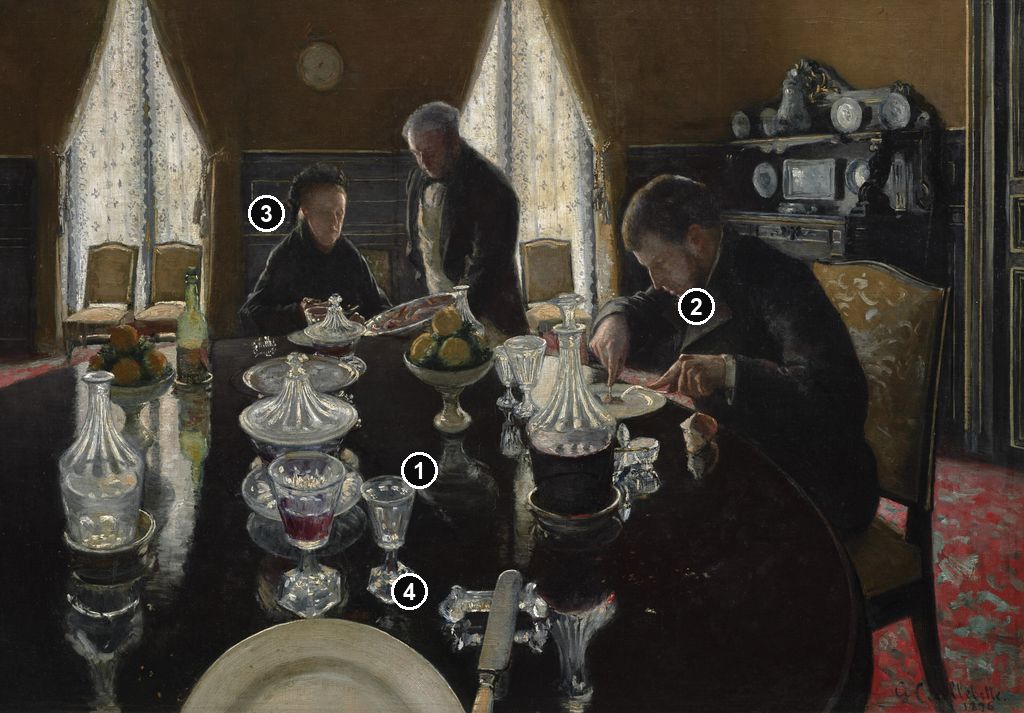
The numbered points identify visible features discussed in this article. Return from each detail to the whole composition. Luncheon, 1876; the Caillebotte family dining room on the rue de Miromesnil, Berhaut 37. Gustave Caillebotte; public-domain reproduction via Wikimedia Commons. Image source. Public domain. Resized only; source appearance preserved.
Details from LUNCHEON
Compare the cropped details with the complete images above. Notice how their colours, shapes and positions contribute to the larger compositions.
Glassware on the dark table
Cut glass catches the light in small white facets. Repeated stems, rims and reflections animate the broad dark surface of the table.
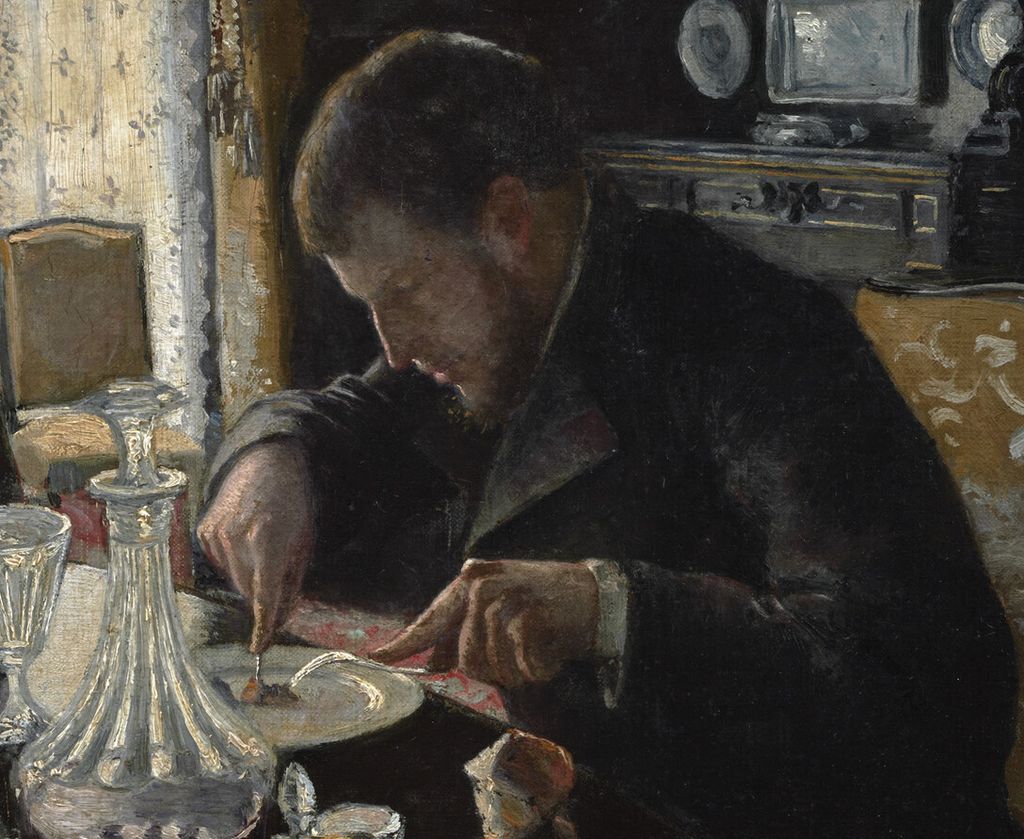
The diner’s hands and plate
The diner bends towards his plate with a utensil in each hand. The elbows and lowered head gather attention around this small activity.
Two figures at the far side
A seated figure and a standing attendant occupy the far side of the table. Their different heights interrupt the bright window openings behind them.
The near place setting
A pale plate enters from the lower edge beside a long knife and a small glass. This cropped setting brings the table close to the viewer.
Watch: Gustave Caillebotte
Explore a museum overview and two discussions of Paris Street; Rainy Day. This shared selection offers wider context for the artist’s work.
"Who Is Gustave Caillebotte?" - HD version
An introduction to Caillebotte from the Kimbell Art Museum.
Watch on YouTubeHands, sleeves and the making of a gesture
René’s two hands are separated across his plate, with the utensils converging on a small area of food. One forearm descends towards the table; the other lies more nearly across it. The white cuffs interrupt his dark clothes and help us find the hands quickly. Their exposed fingers, the cutlery and the light plate form a small, concentrated piece of action beside the expansive still life.
The movement has a firm structure. His bent head repeats the downward direction of the knife, while the near shoulder and elbow make a rounded enclosure around the plate. The chair’s upholstered back remains visible behind him, but the seated body is drawn towards the tabletop. This arrangement makes his action easy to recognise even though his face is partly obscured. We learn what he is doing before learning much about his appearance.
A preparatory drawing reproduced by Samuel Raybone isolates this pose; its caption dates it to 1875 and identifies pencil and charcoal. [5] In the drawing, the table is largely an empty curve. René’s jacket is built from repeated diagonal strokes, and the hands are among the darkest passages. With the crystal and furnishings absent, the relation between bent head, sleeves and utensils becomes particularly clear.
Comparing that study with the painting reveals how much the finished setting changes the action’s prominence. The gesture remains readily identifiable, but now has to compete with the largest decanter, the bright fruit and the nearby reflections. The painting allows us to move away from René’s activity and return to it through a succession of other shapes. Its richness depends on that competition between a small movement and an elaborate surrounding world.
The servant’s hands have a different visual function. They help support a platter whose pale edge and coloured contents run almost horizontally across the background. His work connects the two diners, while René’s utensils bring attention back to one place. The distinction between serving and eating is therefore present in the lines and directions of the painting as well as in the figures’ positions.
Family interiors at the 1876 exhibition
The Getty identifies Martial as the brother playing the piano in the companion interior, and René as the model in Young Man at His Window. It describes the three pictures as successive parts of an early domestic group. [2] Keeping the brothers distinct matters: these are related views of family life, with different people and different forms of attention.
In Young Man Playing the Piano, the instrument occupies much of the space beside Martial. Its black case and the bright keyboard make an emphatic diagonal. The open score supplies a broad pale rectangle above his hands. Beside Luncheon, the painting shows how readily Caillebotte can allow a piece of furniture and its working surface to direct a portrait. A piano and a dining table both place objects between the viewer and the person depicted.
The comparison also draws attention to differences in the light. The pianist is seen from the side, with his pale jacket clearly separated from the instrument. In Luncheon, René’s dark clothing merges with much of the surrounding shadow. The dining picture makes its objects exceptionally bright while keeping its people comparatively subdued. That distribution gives the meal its particular visual weight.
The Floor Scrapers offers another revealing comparison. There, the long bands of the floor rush towards the foreground; here, the tabletop spreads towards us. Both surfaces are interrupted by hands, implements and reflections. The dining room’s small, restrained action and the workers’ extended bodies require different kinds of movement, but Caillebotte gives both a setting that can be followed almost as attentively as the figures themselves.
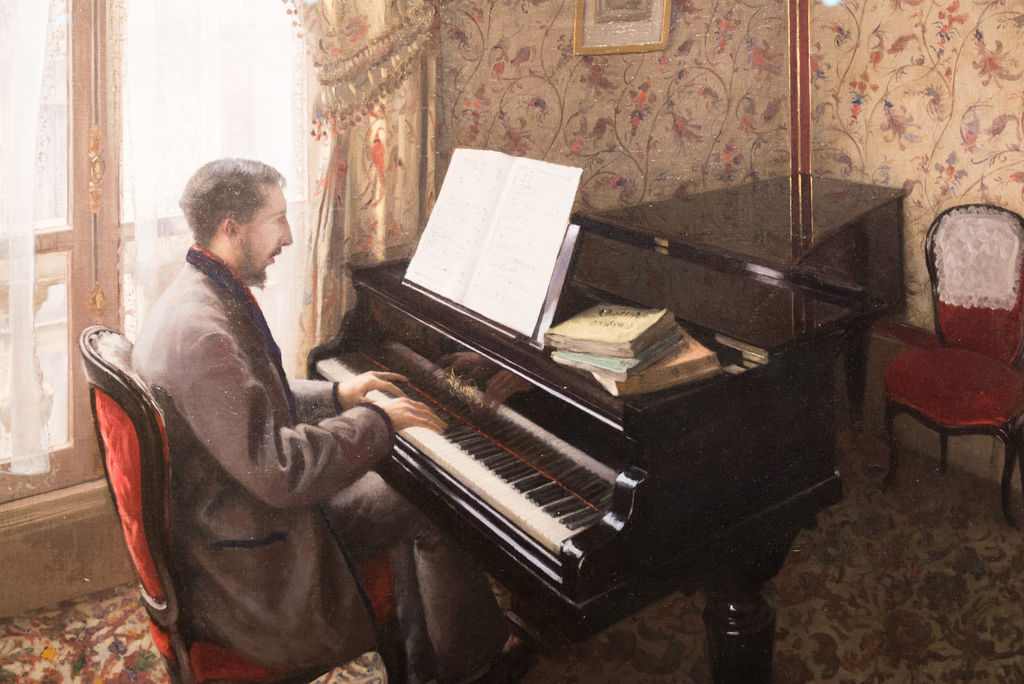
Young Man Playing the Piano, 1876; Martial Caillebotte in a separate family interior, Artizon Museum, Tokyo. Photograph: xiquinhosilva. Image source. CC BY 2.0. Photograph by xiquinhosilva, CC BY 2.0. Resized only; source appearance preserved.
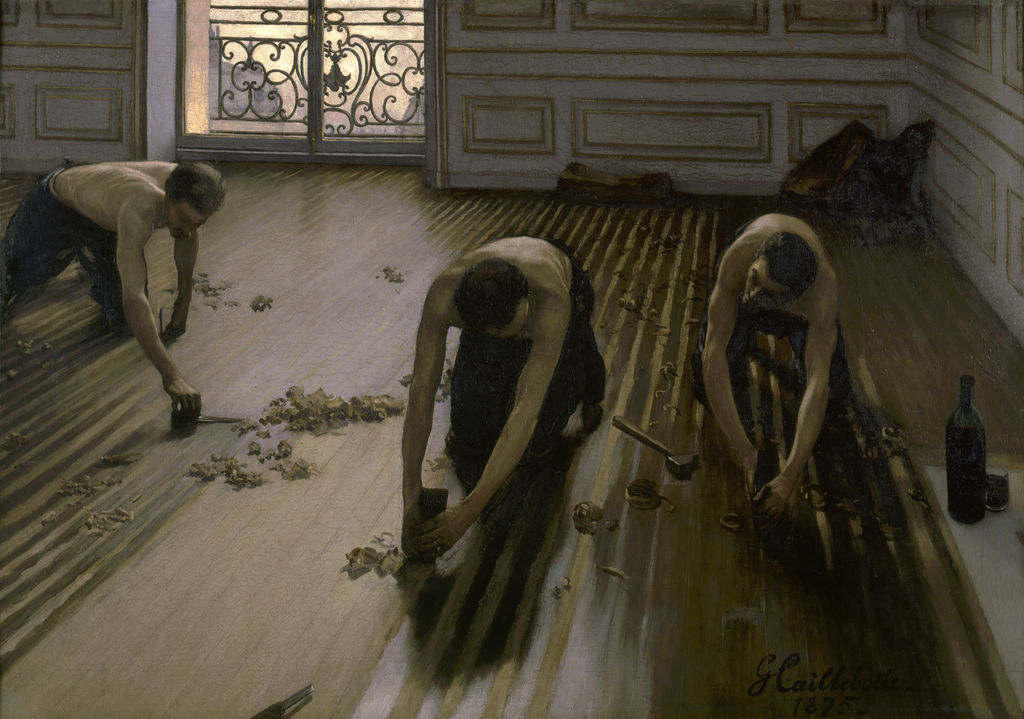
The Floor Scrapers, 1875; a contrasting arrangement of hands, implements and a broad reflective surface. Google Arts & Culture — 0wHXxVpb7UjLNA. Image source. Public domain. Resized only; source appearance preserved.
Perspective before the public
The second Impressionist exhibition opened on 30 March 1876. As Galina Olmsted explains, the invitation had originally announced 20 March and a five-work limit; Caillebotte ultimately had eight catalogue entries. [6] Luncheon was no. 21. [1]
The table’s scale already troubled contemporary viewers. Olmsted cites Émile Porcheron’s complaint that it appeared at least twelve metres long. She compares its foreground setting and reflected objects with Monet’s earlier indoor Luncheon, now at the Städel Museum. Her argument that Caillebotte sought to repeat Monet’s critical success is an interpretation of his exhibition choices. [6]
Porcheron’s response directs attention to a real visual pressure. The table seems enormous because we see so much of its surface and so little space before it. The nearest plate is sharply cut off, while the rear dishes appear much smaller. René’s large figure at the right then interrupts the recession. Our eye has to negotiate several distances at once, moving from the immense foreground setting to the far diner, then back to the near figure’s hands.
The front of the picture consequently feels more open than a conventional portrait, yet less easy to enter than an empty room. Objects fill the route. The place setting invites us to imagine sitting down, while the dense arrangement requires us to look around obstacles. That combination of invitation and obstruction accounts for much of the painting’s force, without requiring us to reconstruct a conversation or assign a fixed meaning to the diners’ silence.
Reading work and leisure
Raybone treats these interiors through the relationship between work, leisure and sociability. Drawing on Hannah Arendt, he links painting with Caillebotte’s yachting and philately as sustained forms of productive activity. His reading shifts attention from ownership alone towards the things people do with their hands and with one another. In Luncheon, he interprets the crowded table and separated figures as an image of impaired sociability; the later card players suggest another possibility for shared activity. These are scholarly readings, rather than statements by Caillebotte about this meal. [5]
The painting gives that discussion concrete points of purchase. A meal is visibly being served and eaten. Different people perform different tasks. Some objects hold food, others hold drink, and others cover dishes or support utensils. The setting displays wealth through abundance, but it also describes a sequence of ordinary uses. Looking only for luxury would overlook the practical relationships between hands, plates, platter and cutlery.
Equally, a single painted moment cannot tell us how these people ordinarily behaved together. René’s lowered head shows his attention to his plate. Céleste’s downward glance and the servant’s inclination can be described with similar precision. Their feelings require another kind of evidence. The painting’s spatial arrangement remains compelling even when we leave those feelings open: its table can connect a household through shared objects while keeping its members visibly apart.
A privately held painting in public view
Berhaut records the painting’s passage from the artist’s family into a private collection and lists its appearance in the 1994–95 Paris–Chicago retrospective. The National Gallery of Art included it in the illustrated checklist for The Painter’s Eye in 2015. [1] [3] These public appearances have allowed a privately held interior to take its place in accounts of Caillebotte’s career.
In his 2024 Musée d’Orsay exhibition interview, curator Paul Perrin places Luncheon among the intimate family scenes associated with the rue de Miromesnil home. The accompanying captions also label it a private collection work. [7] Its furnishings and gestures anchor the scene in daily life, while the long table and brilliant reflections keep redirecting our attention through the room.
Catalogue and documented works
This directory brings together 578 entries in the revised 1994 catalogue, 11 further documented records and three groups of study descriptions. It is a directory of records, not a total of authenticated individual works. Albums, print states and surviving decorative panels are grouped. English labels retain the French titles as searchable aliases; dates are supplied only where checked. Numbered entries link to the relevant article or the historical catalogue. Pastels appear under the Drawing filter; original prints remain searchable under All media.
Frequently Asked Questions
René and his mother Céleste. Berhaut identifies their attendant as Jean Daurelle through the family archive. [1]
It is privately held; the Musée d’Orsay’s 2024 exhibition documentation gives “collection particulière”. [7]
Its surface occupies most of the foreground, with large, cropped objects close to us and much smaller dishes at the rear. The near place setting makes that change of scale especially conspicuous.
No. Monet’s indoor Luncheon at the Städel is dated 1868–69, inventory SG 170. It is a separate painting from Caillebotte’s 1876 canvas. [8]
Discussion
Look again at the images and ideas explored in Luncheon. These editorial prompts invite your observations.
Reader Insights
Hands, plates and glasses make separate centres of activity around the table.
The strong perspective places the viewer close to a particular seat.
Which object most strongly connects the still life to the family scene?
Join the Conversation
Share a detail, comparison or question about Luncheon below.
References
- Marie Berhaut, with Sophie Pietri. Gustave Caillebotte: Catalogue raisonné des peintures et pastels (1994), nos. 37 and 133, pp. 79 and 124; public digital edition, Wildenstein Plattner Institute. View source. (in French).
- Getty Museum. “Getty Museum Acquires Gustave Caillebotte’s Iconic Young Man at His Window” (2021), account of the three family interiors. View source.
- National Gallery of Art. Gustave Caillebotte: The Painter’s Eye, illustrated checklist (2015), cat. 15. View source.
- Marie Berhaut with Sophie Pietri; Wildenstein Plattner Institute, Gustave Caillebotte Catalogue raisonné des peintures et pastels, 1994. View source. (in French).
- Samuel Raybone. “Gustave Caillebotte’s Interiors: Working Between Leisure and Labor”, nonsite.org 26 (2018), repository PDF pp. 6–8, 15–17 and 28–29; fig. 5. View source.
- Galina Olmsted. Making and Exhibiting Modernism: Gustave Caillebotte in Paris, New York, and Brussels (2019), pp. 70–72 and 79–81, including Porcheron as cited on p. 80. View source.
- Paul Perrin, Musée d’Orsay. “Transcription de l’entretien commissaire Caillebotte” (2024), p. 2 and accompanying work captions. View source. (in French).
- Städel Museum. Claude Monet, The Luncheon, 1868–69, SG 170, digital collection record, object metadata. View source. (in en/de).
- Art Institute of Chicago, Caillebotte Paintings and Drawings at the Art Institute of Chicago, 2015. View source.
- Petit Palais / Paris Musées, Portrait de Paul Hugot, original print, PPG2319, current. View source. (in French).
- Paul Perrin, Musée d’Orsay, Transcription de l’entretien commissaire Caillebotte, 2024. View source. (in French).
- Cleveland Museum of Art, Caillebotte collection records: 2020.260, 2009.157 and 2020.105, current. View source.
- Splash image, Luncheon, 1876; the Caillebotte family dining room on the rue de Miromesnil, Berhaut 37. Gustave Caillebotte; public-domain reproduction via Wikimedia Commons. Image source. Public domain. Resized only; source appearance preserved.


