


 by Tom Gurney
Tom Gurney BSc (Hons) is an art history expert with over 20 years experience
Email: tomgurney1@gmail.com / Phone: +44 7429 011000
Young Man Playing the Piano: Introduction
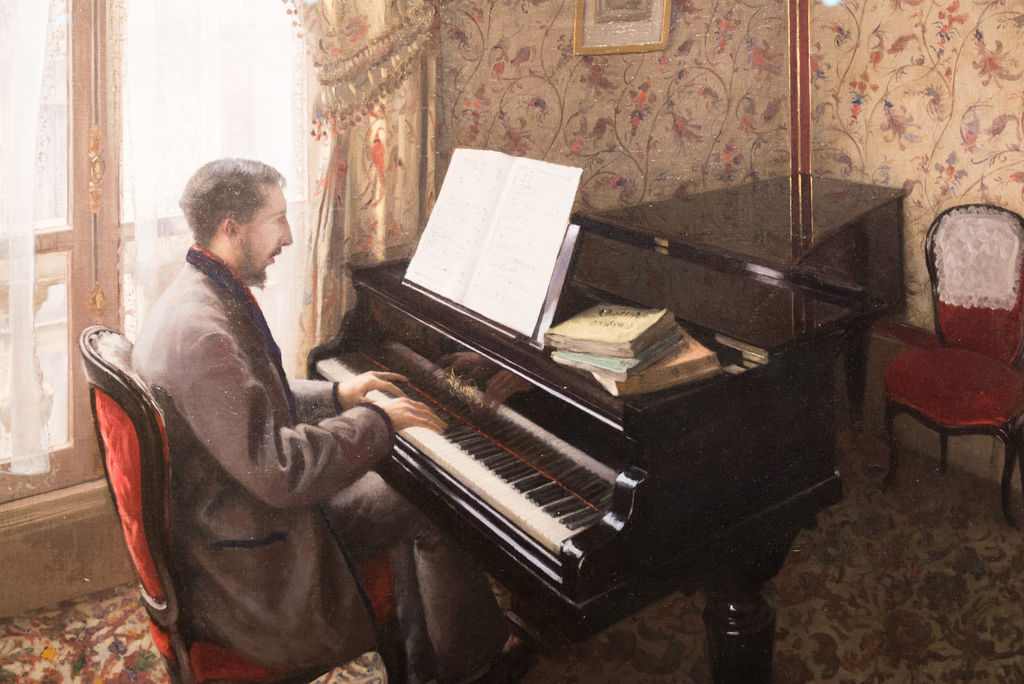
The hands are small, the piano enormous. In Gustave Caillebotte’s Young Man Playing the Piano, a seated musician occupies the bright left side of the room while his instrument spreads across the canvas towards us. The player is the artist’s younger brother Martial, shown in the family home on the rue de Miromesnil in Paris. Painted in 1876, the picture belongs to the Artizon Museum, Ishibashi Foundation, in Tokyo. [1]
Everything seems ready for music: an open score, books within reach, fingers poised along the keys. Yet our experience of the painting depends on looking beyond this familiar arrangement. A dark surface produces a second keyboard; a wall decoration appears to descend into the piano lid. Caillebotte makes an ordinary domestic occupation hold our attention through the changing relationships between a body, a complicated object and the light that joins them.
At a Glance
- ArtistGustave Caillebotte.
- Date1876.
- MediumOil on canvas.
- Dimensions81 × 116 cm, as recorded in the Ishibashi Foundation’s 2012 research report. [2]
- SubjectMartial Caillebotte at the piano in the family’s Paris home.
- CollectionArtizon Museum, Ishibashi Foundation, Tokyo. [1]
This work across Gustave Caillebotte’s career
Contents
- A Room Organised Around Playing
- Where the Light Changes Its Character
- The Second Pair of Hands
- Music as a Serious Occupation
- Three Views of Family Life
- A Carefully Made Impressionist Debut
- From the Family Circle to Tokyo
- Annotated details
A Room Organised Around Playing
The viewpoint gives us a place close beside the musician, slightly above the keyboard. We can see the upper surface of the instrument and look down onto his hands without confronting his face directly. His profile is clear against the window, but his attention continues past us towards the score. This is a portrait in which the sitter has something else to do. The viewer must find an approach through the activity rather than through an exchanged glance.
The painting’s horizontal format allows the piano to claim almost as much importance as the person. Its nearest corner projects towards the bottom of the picture, while its long body reaches into the right background. There is no convenient frontal view of a familiar piece of furniture. One part is seen from above, another obliquely, another almost as a black silhouette. The whole has to be assembled from these separate surfaces. The keyboard offers the clearest route through them, a strip of alternating pale and dark shapes travelling diagonally into the room.
Martial’s chair creates a second diagonal at the left. Its red upholstery curves around his back, while his coat descends in broader, quieter folds. The instrument’s hard angles and the chair’s rounded edge meet in the musician’s bent arms. The elbows, wrists and fingers bridge the gap between sitting and playing. Each arm has a different contour, and each hand meets the keys differently. That small asymmetry gives the action its specificity: we seem to have encountered one position within a continuing sequence.
Marie Berhaut’s catalogue identifies the canvas as number 36 and records its signed date, 1876. It also identifies Martial, born in 1854, and locates the scene in a salon of the family house. The personal identification is secure even though the painting’s customary title describes an occupation. [4] The distinction affects how we look. Knowing the sitter’s name brings the brothers’ relationship into view; following the title directs us towards what his body is doing.
The empty chair at the far right gives this activity room to unfold. Its pale antimacassar catches the light above a deep red seat, repeating the colours of the occupied chair without repeating its function. Placed behind the piano, it is available yet unoccupied. The two chairs do not establish a conversation across the room. One has been drawn into the practical act of playing; the other remains part of the furnishing. Their separation makes the musician’s concentration especially apparent without telling us how he feels.
Where the Light Changes Its Character
Begin at the window and follow the light across the picture. The broadest brightness is filtered through a pale curtain. Against it, Martial’s head has a definite outline, although the transition from hair to surrounding light remains softer than the crisp edges of the piano. His face turns towards the darker centre of the composition. The light makes his presence legible while his pose carries our gaze away from its source.
The same brightness becomes much narrower on the instrument. Along the keyboard it is divided into small rectangular intervals. At the projecting corner it turns into a few abrupt white accents. Against the black piano case these highlights appear sharper than the window itself. The room consequently contains several kinds of brightness at once: diffused, interrupted, reflected and concentrated at an edge. Caillebotte gives each a different visual weight.
There is a similar difference between the open music and the window. Both are pale areas, but the score is a tilted object with a central fold and a lower edge. It stands against dark wood rather than dissolving into the atmosphere. The pages catch the eye before their notation becomes legible. Their brightness helps describe the position at which a player would read, and their slant carries the viewer from Martial’s face down towards his hands.
The walls and curtains are more active than they first appear. On their warm ground, thin stems, leaves and flowers spread across the room in a dispersed pattern. They offer no single point on which the eye can settle. Near them, the piano’s largely undecorated surfaces become unusually powerful. Ornament fills the background while the black instrument interrupts it with expanses of relative quiet. Small reds in the furnishings and patterns keep the two halves of the room connected.
Artizon’s collection essay draws attention to the reflections of fingers and keys in the fallboard, and of wall moulding in the lid. It also places the picture’s measured handling within Impressionism’s varied approaches to light. [1] These observations invite a slower inspection of the instrument. Its blackness is full of information. Looking into it reveals parts of the surrounding room that its bulk initially seemed to exclude.
Annotated Details from Young Man Playing the Piano
The numbered points identify visible features discussed in this article. Return from each detail to the whole composition. Young Man Playing the Piano, 1876; Martial Caillebotte in the family’s Paris home, Artizon Museum, Ishibashi Foundation, Tokyo. Photograph: xiquinhosilva. Image source. CC BY 2.0. Photograph by xiquinhosilva, CC BY 2.0. Numbers added to a resized overview; separate detail crops made from the photograph. Overview and crops remain CC BY 2.0.
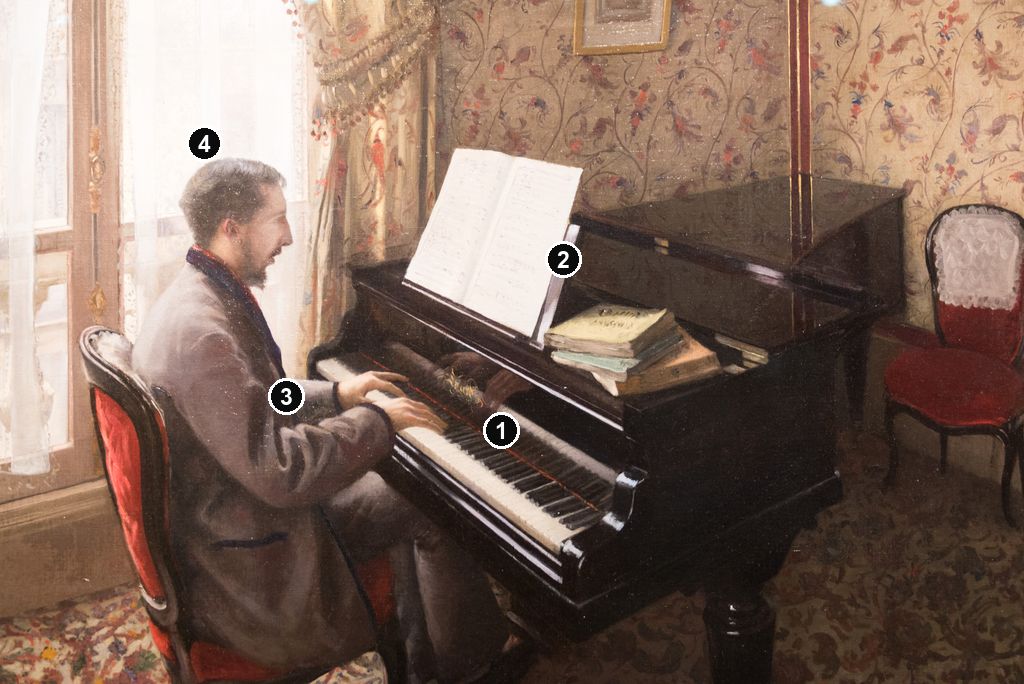
Details from YOUNG MAN PLAYING THE PIANO
Compare the cropped details with the complete images above. Notice how their colours, shapes and positions contribute to the larger compositions.
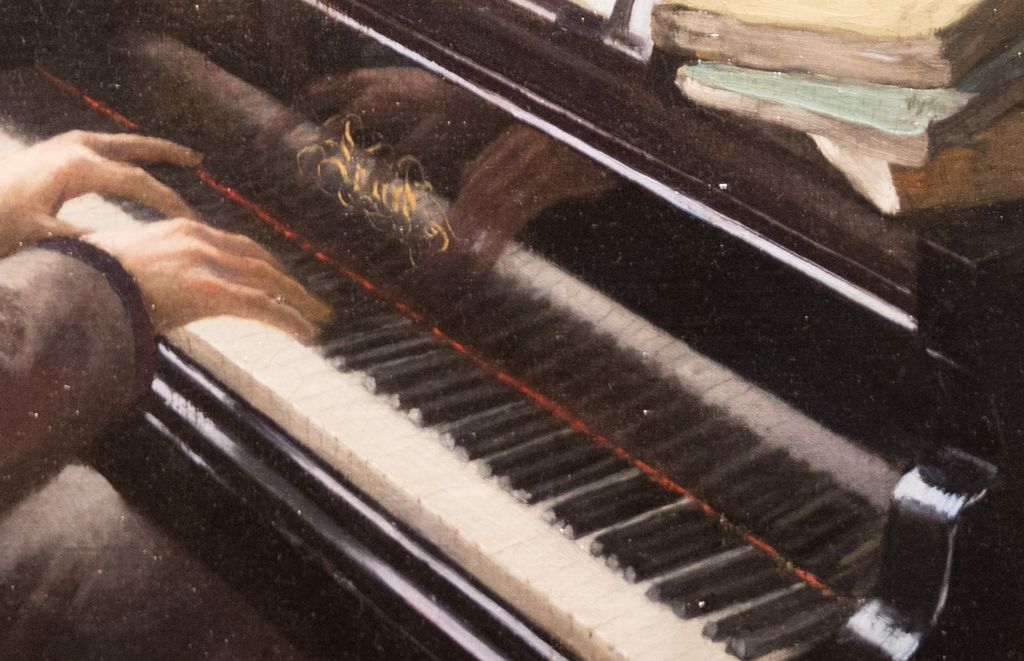
Hands across the keyboard
The hands meet the pale keys near the middle of the instrument. The long diagonal of the keyboard gives their small movements a clear place within the room.
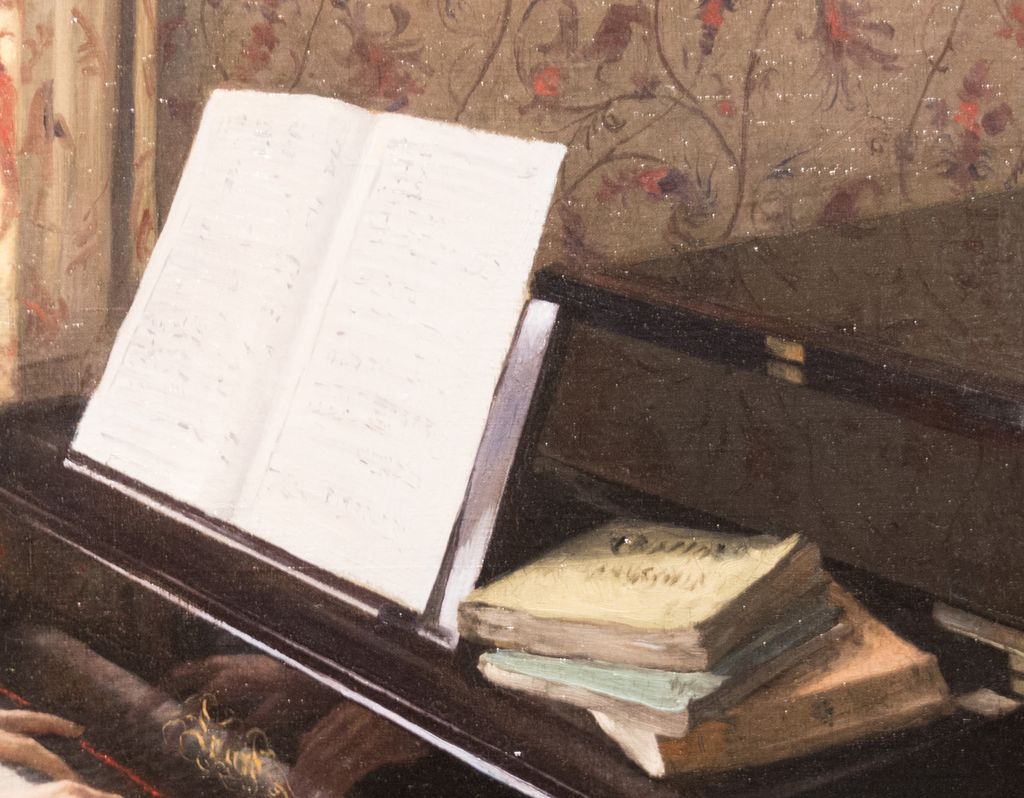
The open score and stacked music
A bright open score rises above the keys, with further music resting nearby. Pale paper interrupts the dark polished surfaces of the instrument.
The seated player and red chair
The player sits in profile on a red upholstered chair. Bent arms and the angle of the torso connect the seated body with the keyboard.
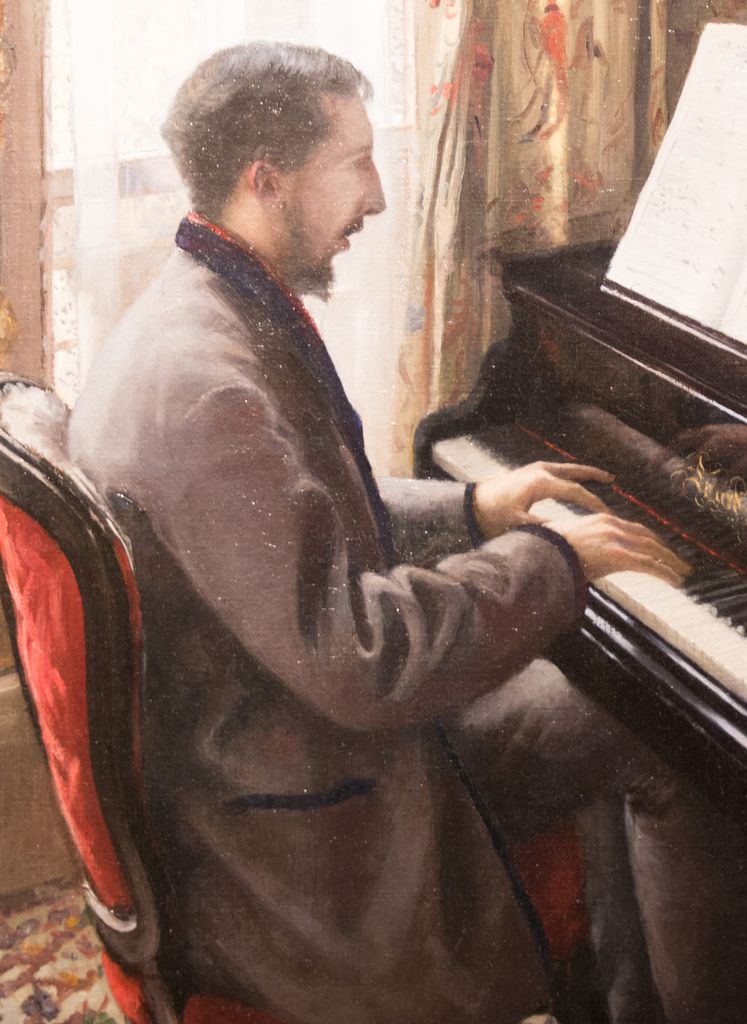
Window light and patterned wall
The pale window and curtain meet the patterned wall behind the player. Their contrasting surfaces locate the instrument within a furnished domestic room.
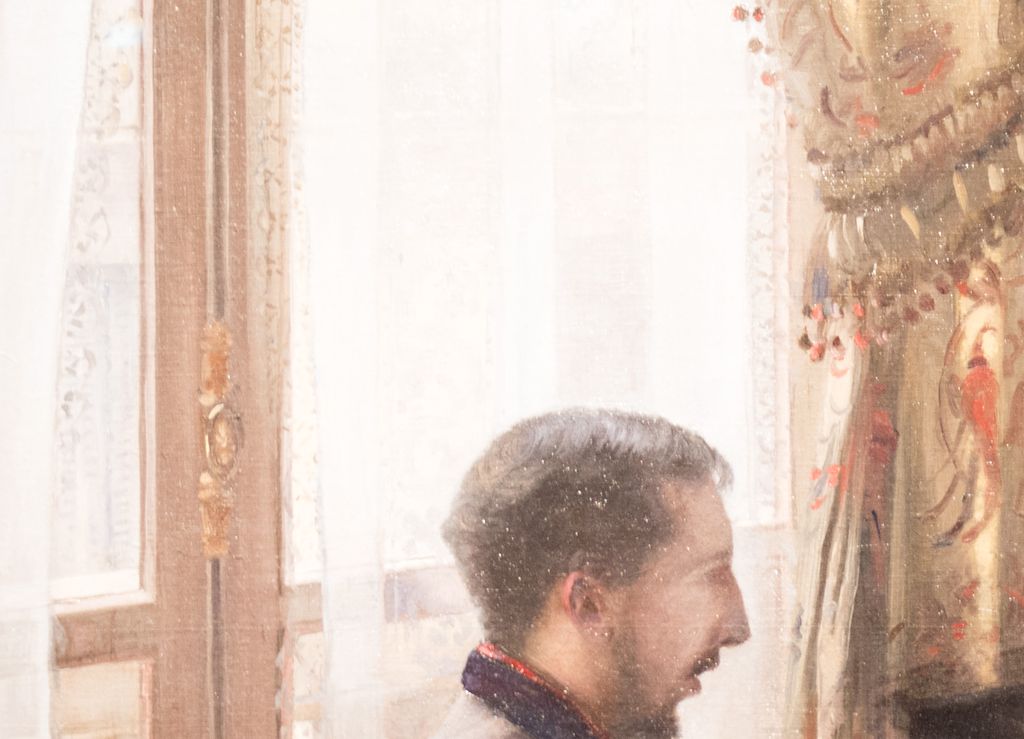
The Second Pair of Hands
The reflected hands sit close to the actual ones, but their relation to the keys is less immediately clear. Their warm brown forms emerge from the dark polished wood above the keyboard. For a moment the surface seems to contain another set of fingers. Then the correspondence becomes apparent: the instrument is returning an altered view of the player’s own action.
This is an especially effective place for a reflection because playing already divides attention between several locations. The eyes follow the score; the fingers work below; the pianist must coordinate both. The painting adds another level by showing the hands twice. We can inspect their position from a viewpoint unavailable to the player without a change of focus. The visual doubling makes a short stretch of keyboard feel dense with activity.
Look higher and a different reflection establishes the lid’s position. The vertical gold line of the wall decoration continues down towards the dark top of the piano, where an answering form changes direction. A rigid feature of the room becomes evidence of a reflective plane. This junction is easy to overlook because the colours remain subdued. It helps the eye distinguish the piano’s surface from the patterned wall behind it.
Neither reflection operates like a separate picture placed inside this one. Each depends on its attachment to an object that we understand as substantial and usable. The fallboard holds an image of the very fingers operating the keys beneath it; the lid gathers a fragment of the room in which the instrument stands. Their interest comes from this proximity. Looking and doing occupy almost the same small area of painted wood.
The books add another kind of doubling: music already represented as marks on paper will become sound through the player’s actions. The open pages and the closed volumes present different stages of access to that stored material. Their uneven pile offsets the score’s upright display. Worn-looking edges, coloured covers and irregular angles give the shelf the appearance of use. The painting does not need us to decipher the printed music for us to recognise the relationship between a reader, a manual skill and a written instruction.
Watch: Gustave Caillebotte
Explore a museum overview and two discussions of Paris Street; Rainy Day. This shared selection offers wider context for the artist’s work.
"Who Is Gustave Caillebotte?" - HD version
An introduction to Caillebotte from the Kimbell Art Museum.
Watch on YouTubeMusic as a Serious Occupation
The instrument is an Érard grand piano. Yasuhide Shimbata compares this affluent domestic scene with female pianists painted by Degas, Manet and Renoir, including Renoir’s Woman at the Piano, also exhibited in 1876. [2]
Shimbata notes that Martial studied at the Conservatoire with Marmontel and later composed music, including the published Airs de Ballets of 1887. [2]
Here the musician’s clothing belongs to the same furnished world as the chairs and curtains, but the pose makes a different demand on it. The jacket sleeve bends and gathers at the elbow, the hands project beyond its cuffs, and the shoulders incline towards the keyboard. These are useful details for understanding the body’s engagement. Formal dress has not prevented the figure from becoming physically absorbed in a task.
Samuel Raybone makes that absorption central to his reading. His 2018 essay links Martial’s manual attention with the working bodies in The Floor Scrapers and the concentrated gestures of Luncheon. Drawing on Hannah Arendt, he considers painting, yachting and philately as related forms of purposeful work and social participation. In this account, leisure activities can require discipline and dexterity; wealth alone cannot explain everything a figure does within a domestic interior. [5]
Raybone’s argument is useful here because the hands are visibly active while so much of the room remains still. It does not supply a statement of Caillebotte’s intention or a diagnosis of Martial’s state of mind. Instead, it opens a question that the painting can sustain: how does an interior full of possessions become a place of sustained activity? The books and instrument are part of the answer. They are arranged within reach, and the player’s posture gives them a common purpose.
Shimbata leaves the score unidentified; its proposed connection with the pianist and teacher Antoine-François Marmontel remains hypothetical. [2]
The uncertainty matters because the picture gives us the outward conditions of music more readily than its specific content. We can follow the organisation of playing without knowing which piece is being played. Naming a composition would add a narrative that the visible notation has not securely supplied.
Three Views of Family Life
The Getty’s account of Young Man at His Window brings this painting together with that work and Luncheon as an early trio of family interiors. Martial is the pianist; René appears at the window and at lunch, where the artist’s mother and a servant are also present. All three were included in Caillebotte’s debut at the second Impressionist exhibition in 1876. [6]
Seen together, their different occupations become revealing. At the window, the figure’s standing body directs attention outwards. At the piano, the seated body turns towards an object within the room. A window remains beside him, but the score interrupts the route from his face towards the interior. His world is immediately close: a distance measured by the extension of arms and the placing of fingers.
The comparison with Luncheon makes another distinction possible. A meal distributes action among people and objects; the piano concentrates it around one seated figure. Here the instrument’s oblique keyboard gives the hands a shared working edge. The white score gathers the upper part of the composition while the alternating keys gather its lower part. Both are organised sequences, yet the spaces around them are irregular, crowded with the curves of chairs and the looseness of botanical ornament.
These comparisons do not require the three paintings to have been designed as a formally prescribed set. Their value is that each gives a different shape to attention within an affluent home. The family setting provides continuity, while the activity changes the relation between figure, furnishings and viewer. In Young Man Playing the Piano, the spectator is brought near enough to observe an action in detail and kept just outside the player’s line of sight.
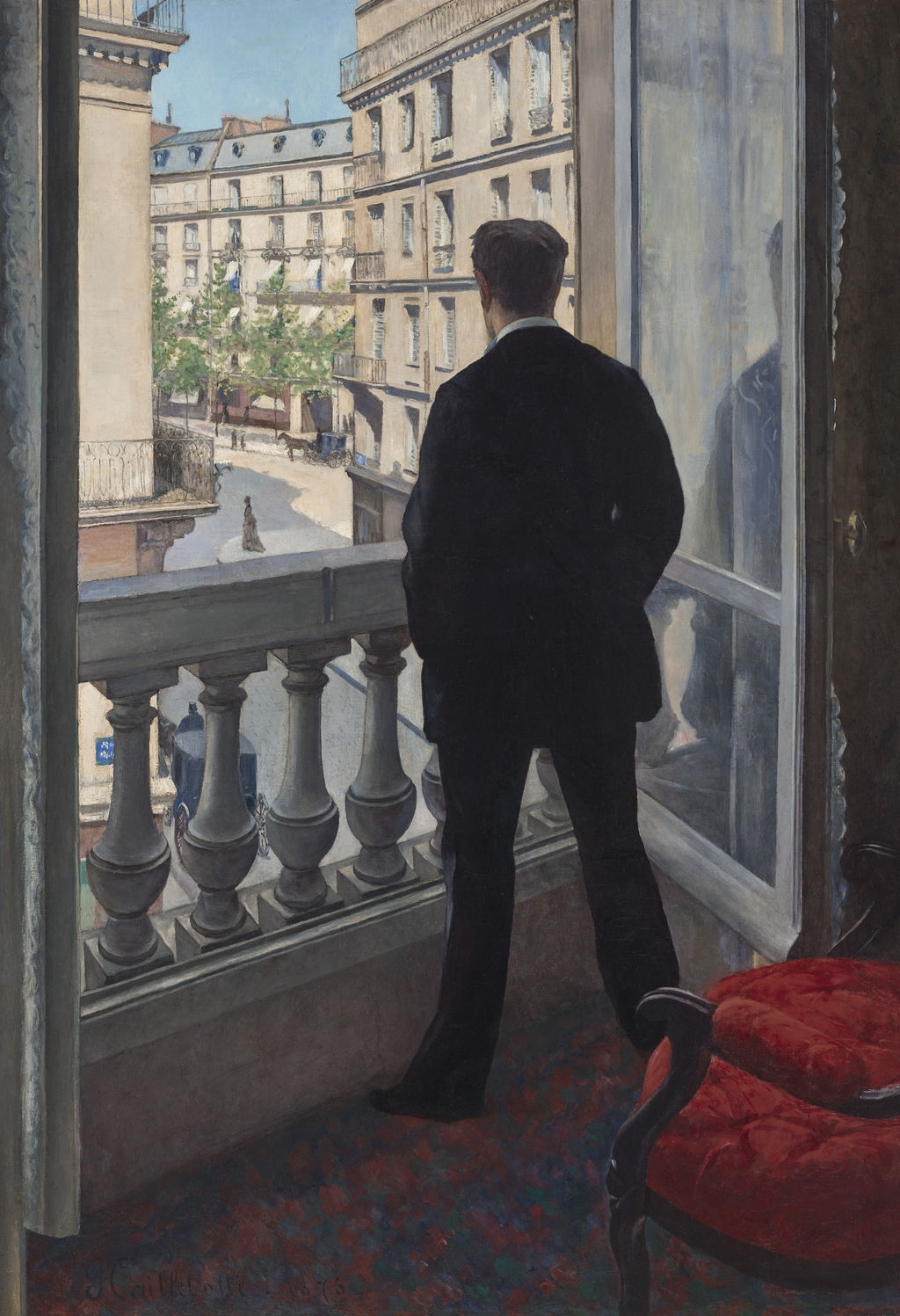
Young Man at His Window, 1876; René Caillebotte in a separate family interior. www.christies.com. Image source. Public domain. Resized only; source appearance preserved.
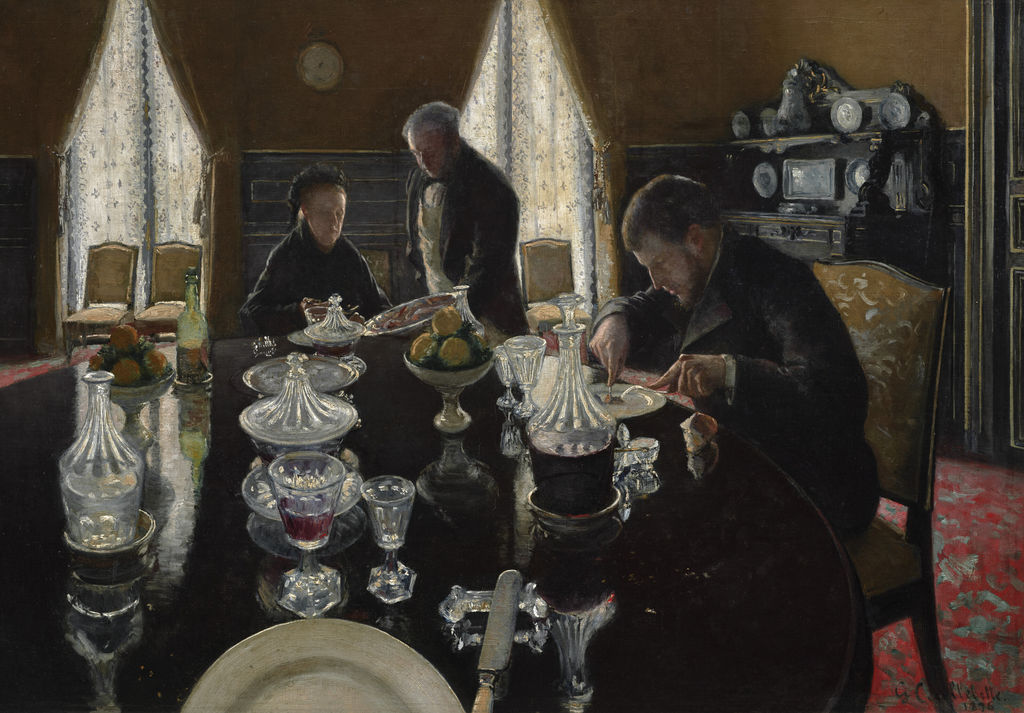
Luncheon, 1876; another of the early family interiors, with René, Céleste and their attendant. Gustave Caillebotte; public-domain reproduction via Wikimedia Commons. Image source. Public domain. Resized only; source appearance preserved.
A Carefully Made Impressionist Debut
The exhibition was a public undertaking with practical conditions. Galina Olmsted reproduces the invitation signed by Renoir and Henri Rouart on 5 February 1876: an exhibitor’s fee of 120 francs, an initial allowance of five works, and an opening planned for 20 March. The show actually opened on 30 March, and its catalogue listed eight Caillebotte entries. Olmsted also records his purchases of three Monets in February. His participation involved both presenting pictures and supporting fellow painters. [7]
Berhaut records Young Man Playing the Piano as number 19 in that exhibition and later as number 28 in the 1886 New York exhibition of French Impressionists. [4] The familiar room thus became a subject for audiences far beyond the family. Its intimate scale of activity should not obscure its role in Caillebotte’s public identity as an exhibiting artist.
Shimbata’s study includes preparatory drawings and argues for the compatibility of conventional finish with modern subjects and light. He also reports Louis Énault’s and Émile Porcheron’s objections to the piano’s perspective. [2]
Their response identifies a feature that still makes the picture arresting: the instrument feels exceptionally large in relation to its player.
That effect is strongest when we compare the piano’s projecting front corner with the small area occupied by Martial’s hands. The corner seems close enough to impede our approach. The hands lie farther back, where the keyboard narrows. To reach the figure visually, we must move past a substantial object whose depth the oblique view insists upon. The difficulty is productive: the room does not offer itself as an evenly spaced display of belongings.
The finish also varies according to what needs to be seen. The face, cuffs and key edges are more readily distinguished than many of the flowers behind them. The latter form a continuous setting without demanding that every stem be counted. Dark passages merge beneath the keyboard, while a few pale accents separate neighbouring surfaces. The effect of precision comes partly from selecting where a distinct edge matters most.
Berhaut also points out that Edmond Duranty proposed the pianist as a subject for depicting the modern individual in his 1876 essay La Nouvelle Peinture. [4] The choice directs attention towards the connection between a person and an occupation. In this canvas, the recognisable face and the precisely arranged activity give each other substance.
From the Family Circle to Tokyo
Berhaut’s provenance places the painting with Eugène Daufresne and then, around 1896, with Martial Caillebotte before its later private ownership. [4]
Artizon’s official history records the museum’s acquisition in 2011. [8] The National Gallery of Art’s illustrated checklist subsequently included it in Gustave Caillebotte: The Painter’s Eye in 2015, under the then-used museum name, Bridgestone Museum of Art. [9]
The passage into a museum changes the circumstances of looking while leaving the scene’s central invitation intact. We can spend time with details a passing visitor to the painted room might scarcely notice: the red line behind the keys, the slight unevenness of the books, the pale patch on the empty chair, the point at which the wall seems to enter the lid. Each sends the eye back towards the player through a different route.
His concentration finally gives those routes their centre. The picture contains an abundance of ornament and several competing surfaces, yet the action remains small and exact. Two hands meet the keys beneath a bright open score. Around that contact, Caillebotte has built a room in which possession, skilled activity and close observation become inseparable parts of the experience of looking.
Catalogue and documented works
This directory brings together 578 entries in the revised 1994 catalogue, 11 further documented records and three groups of study descriptions. It is a directory of records, not a total of authenticated individual works. Albums, print states and surviving decorative panels are grouped. English labels retain the French titles as searchable aliases; dates are supplied only where checked. Numbered entries link to the relevant article or the historical catalogue. Pastels appear under the Drawing filter; original prints remain searchable under All media.
Frequently Asked Questions
He is Martial Caillebotte, the painter’s younger brother, in the family’s Paris home. [1]
It remains unidentified; Shimbata reports a hypothetical connection with Marmontel. [2]
Its polished fallboard reflects the pianist’s fingers and the keyboard. [1]
Discussion
Look again at the images and ideas explored in Young Man Playing the Piano. These editorial prompts invite your observations.
Reader Insights
The hands at the keyboard give the seated pose an active centre.
The reflection makes a second pair of hands part of the room.
Does comparing the piano player with Young Man at His Window change your sense of attention?
Join the Conversation
Share a detail, comparison or question about Young Man Playing the Piano below.
References
- Artizon Museum, Ishibashi Foundation. Young Man Playing the Piano, collection essay, undated; object and interior description. View source.
- Yasuhide Shimbata / Ishibashi Foundation. “ギュスターヴ・カイユボット《ピアノを弾く若い男》” [Gustave Caillebotte, Young Man Playing the Piano], 2012, pp. 99–105, figs. 1, 9, 11–13 and object apparatus, pp. 107–108. View source. (in Japanese).
- Marie Berhaut with Sophie Pietri; Wildenstein Plattner Institute, Gustave Caillebotte Catalogue raisonné des peintures et pastels, 1994. View source. (in French).
- Marie Berhaut, with Sophie Pietri. Gustave Caillebotte: Catalogue raisonné des peintures et pastels, 1994, no. 36, pp. 78–79, public digital edition hosted by the Wildenstein Plattner Institute. View source. (in French).
- Samuel Raybone. “Gustave Caillebotte’s Interiors: Working Between Leisure and Labor”, nonsite.org 26, 2018; repository PDF, pp. 2–8, 11–17 and 27–29. View source.
- Getty Museum. “Getty Museum Acquires Gustave Caillebotte’s Iconic Young Man at His Window”, 11 November 2021; account of the three domestic interiors and their sitters. View source.
- Galina Olmsted. Making and Exhibiting Modernism: Gustave Caillebotte in Paris, New York, and Brussels, dissertation, 2019, pp. 69–82, especially pp. 70–72 and notes 132–134. View source.
- Artizon Museum, Ishibashi Foundation. History, undated; entry for 2011. View source.
- National Gallery of Art. Gustave Caillebotte: The Painter’s Eye, illustrated exhibition checklist, 2015, p. 3, cat. 17. View source.
- Art Institute of Chicago, Caillebotte Paintings and Drawings at the Art Institute of Chicago, 2015. View source.
- Petit Palais / Paris Musées, Portrait de Paul Hugot, original print, PPG2319, current. View source. (in French).
- Paul Perrin, Musée d’Orsay, Transcription de l’entretien commissaire Caillebotte, 2024. View source. (in French).
- Cleveland Museum of Art, Caillebotte collection records: 2020.260, 2009.157 and 2020.105, current. View source.
- Splash image, Young Man Playing the Piano, 1876; Martial Caillebotte in the family’s Paris home, Artizon Museum, Ishibashi Foundation, Tokyo. Photograph: xiquinhosilva. Image source. CC BY 2.0. Photograph by xiquinhosilva, CC BY 2.0. Resized only; source appearance preserved.


