



 by Tom Gurney
Tom Gurney BSc (Hons) is an art history expert with over 20 years experience
Published on June 19, 2020 / Updated on November 2, 2026
Email: tomgurney1@gmail.com / Phone: +44 7429 011000
Man Drying His Leg: Introduction
A naked man sits on a narrow chair, lifting one foot towards the rim of a bath while he dries his leg. His head tips down towards the work of his hands. Gustave Caillebotte makes this small adjustment of the body fill an entire painting: the rounded back, raised knee and stretched towel become the organising forces of a spare interior.
Man Drying His Leg, or Homme s’essuyant la jambe, is an oil on canvas dated about 1884. The Musée d’Orsay’s 2024 exhibition presentation records its dimensions as 100 × 125 cm and its ownership as a private collection. It is a separate work from the standing figure in Man at His Bath, now in Boston. [1]
The seated figure offers a particularly concentrated encounter with Caillebotte’s art. Almost everything here has a practical role, yet the relationships between body, furniture and room are arresting. The man attends to his leg; the viewer must work out how the whole precarious arrangement holds together.
At a Glance
- ArtistGustave Caillebotte.
- French titleHomme s’essuyant la jambe.
- DateAbout 1884.
- MediumOil on canvas.
- Dimensions100 × 125 cm.
- CollectionPrivate collection, as recorded in the Musée d’Orsay’s 2024 presentation. [1]
- CatalogueNo. 285 in Marie Berhaut’s 1994 catalogue raisonné. [2]
This work across Gustave Caillebotte’s career
The Orange Trees
1878 [3]Man at His Bath
1884 [3]Man Drying His Leg (current article)
about 1884Contents
- A body organised by an ordinary task
- The room gives the gesture its shape
- Movement held in a single image
- The visible surface and the question of finish
- Two bathers, two encounters
- A related exhibition history
A body organised by an ordinary task
The first thing to follow is the path between the man’s head and his raised foot. His gaze, forearms and towel converge on the extended leg. The head inclines towards the hands, bringing the upper body into the same small circuit of attention. Although the picture presents the figure from the side, his posture turns the action inwards. He gives the spectator no answering look.
His two legs do very different things. One drops from the edge of the chair to the floor, ending in a long bare foot angled across the foreground. The other rises through the centre of the composition, its foot reaching towards the dark rim of the bath. The lowered leg anchors the body; the lifted leg extends it into the room. Their divergence gives the seated pose a surprising breadth. The man occupies both the left side of the canvas and the passage across its middle.
The white towel is crucial to the legibility of this arrangement. It passes over and around the raised limb, with a loose length hanging down. Against the warm skin and dark floor, it catches the eye immediately. Its folds interrupt the leg’s contour, so that we reconstruct the action through alternating glimpses of flesh and fabric. We can see the task without seeing every contact between hand, cloth and skin.
Notice how little space separates the downward-facing head from the raised knee. The posture folds the figure into a compact shape at the top of the painting, then opens out below through the chair legs and the foot on the floor. The result is neither a relaxed sprawl nor a rigid seated pose. It is a body making temporary arrangements to reach a particular place.
The title directs us to that practical purpose. Once the action has been recognised, however, the picture keeps offering other things to follow: the curve of the back, the angular elbows, the small dark shapes beneath the chair. A gesture that might take seconds in daily life becomes something the eye can explore at length.
The room gives the gesture its shape
The chair is an unexpectedly important participant. Its dark upright back rises behind the man’s shoulder, while the thin supports descend beneath his thigh. His body is broad and pale beside this wiry structure. The seat provides a narrow platform for a pose that reaches far beyond it, and the small visible area beneath his weight makes the balance especially tangible.
Behind the figure hangs a pale curtain marked by long blue, grey and creamy strokes. Its vertical folds establish a background against which the bending torso becomes easy to read. The curtain also creates a shallow enclosure. There is no open doorway or distant room to draw the gaze away from the bather, and no view outside to change the scale of the scene.
On the right, the bath introduces a second large form. Its warm reddish exterior bows out towards the edge of the canvas, while its upper rim recedes obliquely. The raised foot comes close to this rim. The bath therefore helps explain the position of the leg, while its curved side answers the rounded shoulder and back on the opposite side of the picture. Hard furniture and living body share some of the same broad shapes.
Between them lies a dark wedge of space. Below the lifted leg, the floor remains visible across a substantial area, giving the outstretched limb room to register. This interval matters as much as the things themselves. If the bath pressed directly against the chair, the pose would look cramped; if it stood far away, the foot would lose its immediate relationship with the rim.
The floor’s diagonal marks carry the eye into this gap. They do not offer the strongly articulated, long perspective lines familiar from some of Caillebotte’s interiors. Instead, the darker surface spreads beneath the chair and bath as a continuous field. Against it, the man’s lowered foot is unusually exposed. We feel the contact of a bare sole with the room through its clear separation from the surrounding paint.
The upper wall has a simpler division between pale surface and dark lower band. That horizontal boundary steadies the composition behind the sloping arm and leg. Across the picture, the room supplies verticals and horizontals against which the bather’s temporary angles become more noticeable. The action feels casual because it belongs to an ordinary routine; its placement within the rectangle is remarkably exact.
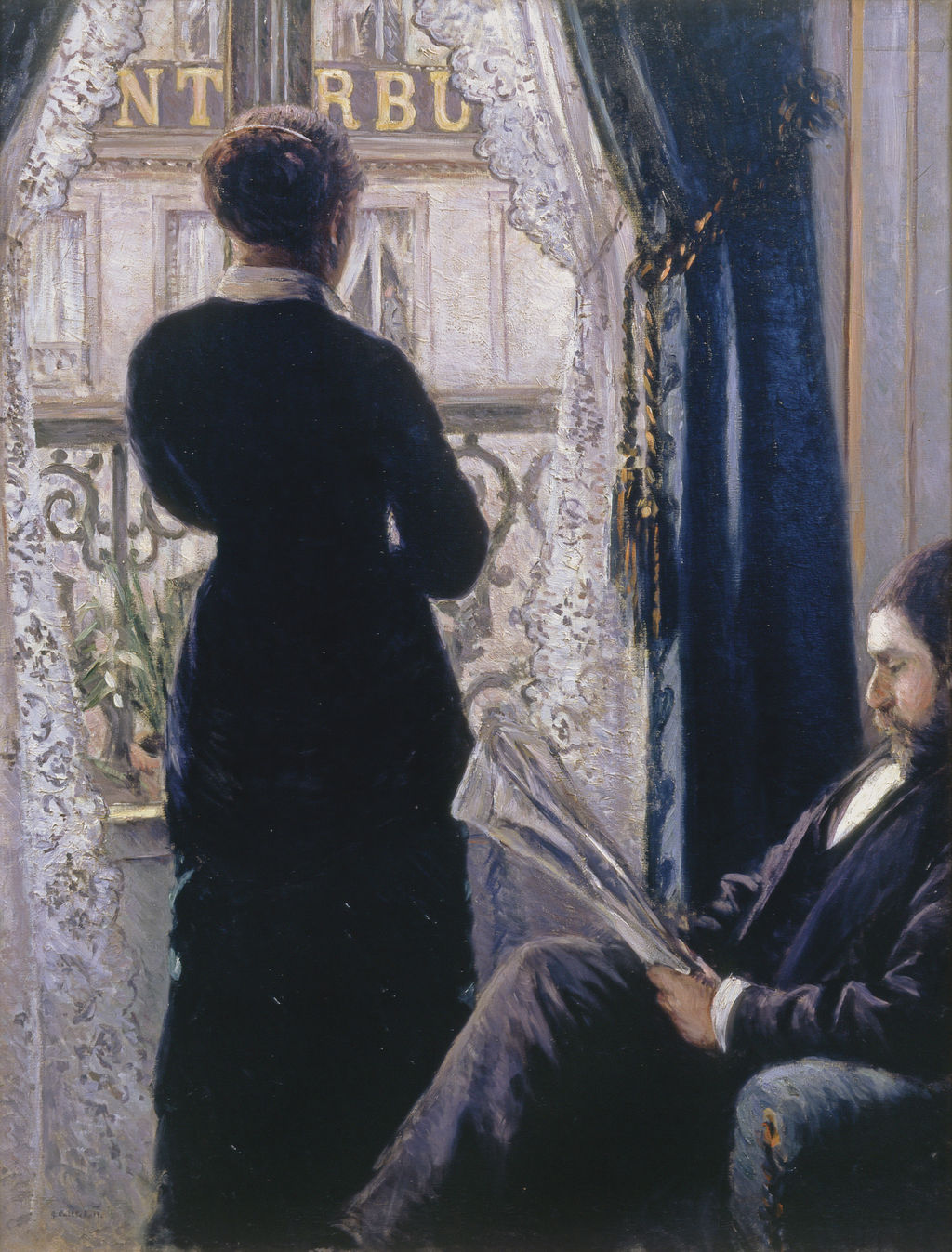
Interior, Woman at the Window, 1880; a contrasting view of clothed figures in a furnished Parisian room.
Movement held in a single image
The SCHIRN’s 2012 exhibition texts connect Caillebotte’s interest in gestures to the analysis of movement, explicitly including this seated bather among his images of men drying themselves. The curators place such works in a wider dialogue with movement photography. Their comparison concerns ways of seeing bodily action; it does not establish a photographic model for this painting. [4]
Here, a single pose contains several implied stages. To reach this position, the man has had to sit down, lift the leg and gather the towel. To leave it, he will need to release the cloth and lower the foot. These are ordinary deductions from the visible arrangement, rather than a story supplied by objects elsewhere in the room. The painting needs very little narrative furniture because the gesture already suggests a before and after.
The hanging end of the towel makes that suspended movement especially clear. The raised leg travels across the composition while the cloth falls towards the floor. One direction implies effort; the other follows gravity. The hands bring the two together. Even in a still reproduction, this opposition helps the action remain intelligible.
There is also a difference between the apparent speed of the task and the time it takes to look. We register “drying a leg” almost at once. Following the bent arm past the knee, or distinguishing the chair from the dark area behind it, takes longer. The painting rewards both kinds of attention: recognition of an ordinary act and a slower tracing of its construction.
This is why the lowered foot deserves a second look. It contributes little to the title’s named action, yet it completes the body’s organisation. The long diagonal from knee to toes spreads the figure towards the bottom of the canvas. Without it, the raised leg and reaching arms would seem to carry the composition bodily to the right. The lowered limb balances the reaching one.
Watch: Gustave Caillebotte
Explore a museum overview and two discussions of Paris Street; Rainy Day. This shared selection offers wider context for the artist’s work.
"Who Is Gustave Caillebotte?" - HD version
An introduction to Caillebotte from the Kimbell Art Museum.
Watch on YouTubeThe visible surface and the question of finish
The reproduction shows a surface of conspicuous, separate strokes. On the skin, short pale and darker marks follow the flank and thigh. Across the curtain, longer vertical strokes describe folds. On the bath, broader warm passages hold together a comparatively simple mass. The treatment changes with the thing being described, allowing us to distinguish surfaces without an abundance of small accessories.
The strongest contrasts are concentrated around the figure’s upper body and the white cloth. Elsewhere, boundaries sometimes soften into neighbouring colours. The chair’s dark forms partly merge with the background; the bath’s edge is less insistently defined than the bright towel. These differences distribute attention unevenly across the picture. We keep returning to the hands and raised leg even though the room occupies so much of the canvas.
Galina Olmsted describes this painting as an unfinished study of a model in the standing bather’s room. Her characterisation does not establish a preparatory relationship between the canvases. [5]
The distinction matters when looking at the picture. Its open handling can remain part of our experience without becoming evidence for a particular sequence of production. Nor does a designation as a study make this a small sketch: its recorded width is 125 cm. [1] The image gives the bent body substantial room, and the broad curtain, bath and floor remain forceful parts of its design.
Paul Perrin, discussing Caillebotte’s practice more generally, argues that a carefully conceived composition often precedes the appearance of immediacy. His account emphasises planning, contrasts and strategies that draw the spectator into the image. This is a useful curatorial perspective on the apparent informality of the seated pose, without supplying an undocumented preparatory history for this canvas. [6]
Two bathers, two encounters
Looking at the two male nudes together clarifies the seated painting’s particular demands. In Man at His Bath, the man stands with his back towards us, the towel drawn across his middle. In Man Drying His Leg, he sits in profile and directs his activity towards an elevated foot. The first arrangement stretches the figure upwards; the second folds and extends it across a horizontal canvas. Berhaut catalogues them separately as nos. 286 and 285. [2]
The chair changes its role between them. Behind the standing figure, it helps furnish the room. Beneath the seated figure, it becomes indispensable to the action. Likewise, the bath’s rim moves into a direct relationship with the raised foot. Familiar objects do more than establish that both scenes concern bathing: their positions determine what each body can do.
Our access to the figure changes too. The standing bather presents the broad surface of his back. The seated man’s profile makes the downward direction of his attention easier to follow, though the bent posture still keeps much of his face from view. In both cases, looking is a one-sided encounter. The spectator can attend closely to the figure without being acknowledged by him.
The Getty’s 2025 exhibition texts frame Caillebotte’s major nudes as a transfer of the academic nude into modern, sparsely furnished interiors, without the usual historical, mythological or exotic explanations. Their discussion centres on Man at His Bath and Nude on a Couch. [7] The seated painting makes that curatorial argument particularly easy to test visually: chair, cloth and bath explain the naked body’s presence through use.
Its concentration on a practical act also complicates our position. We are close enough to examine the man’s skin and posture, yet the task absorbs him completely. The room offers no other person to mediate the encounter. The intimacy arises from this combination of access and inattention, which the painting maintains without a dramatic incident or an exchange of glances.
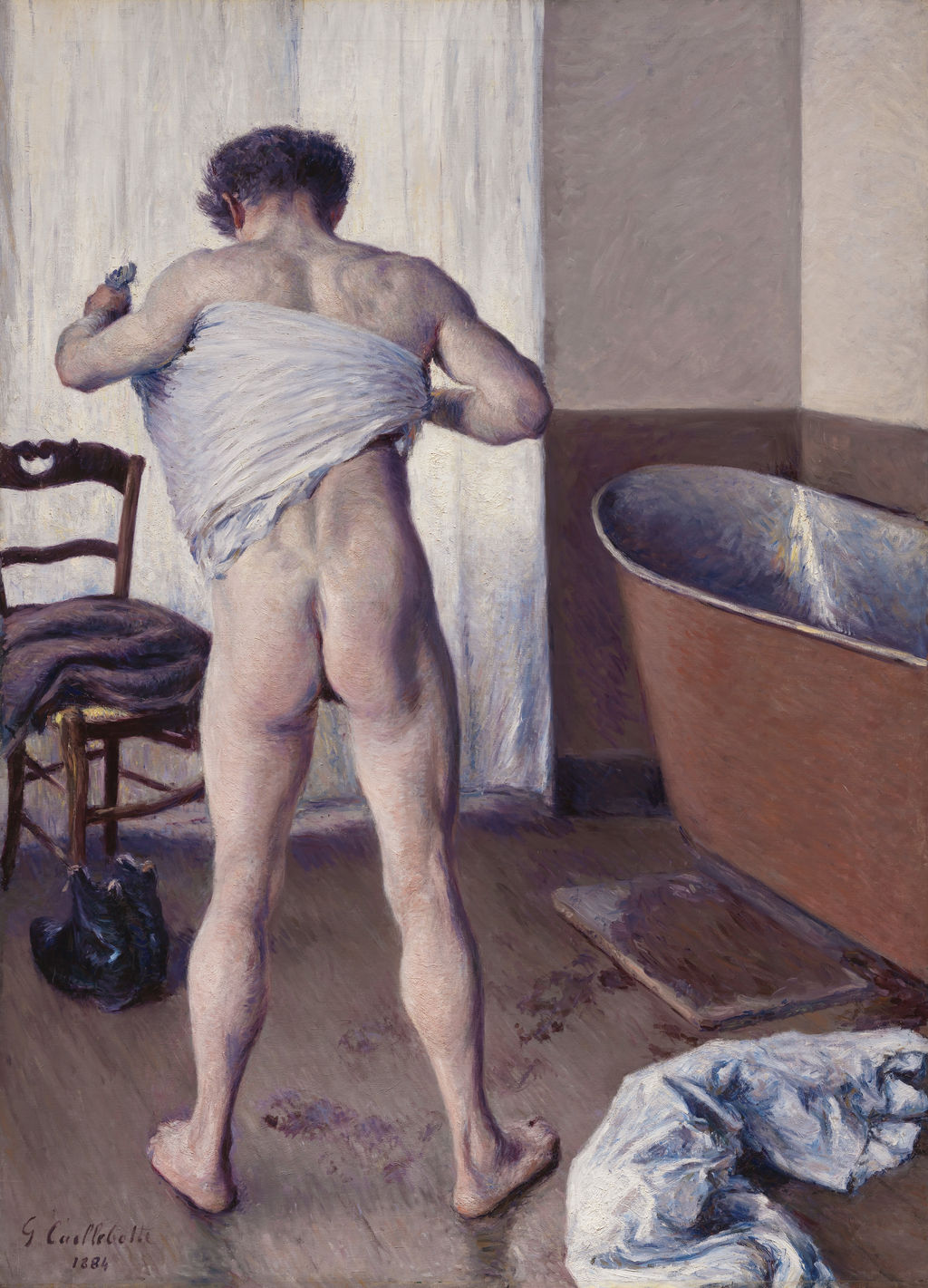
Man at His Bath, 1884; the separate standing nude, Berhaut 286, Museum of Fine Arts, Boston. https://www.google.com/culturalinstitute/asset-viewer/man-at-his-bath/igG6jTDcTNW5fw?projectId=art-project. Image source. Public domain. Resized only; source appearance preserved.
A related exhibition history
The Brussels episode concerns the standing Man at His Bath. Olmsted examines four letters to Octave Maus about Les XX in 1888: four proposed pictures became eight, and Caillebotte asked about installation. His attendance remains uncertain. La Chronique reported on 10 February that the nude and an Anquetin were placed apart from the main display. The organisers’ reason and artist’s reaction remain undocumented. Olmsted reads sexual insinuations in reviews; these do not establish his private life. [5]
Keeping that episode attached to the correct picture lets the seated canvas retain its own history. The comparison shows the public difficulties surrounding one ambitious bathing scene, while the seated painting offers another way of bringing the same private activity into view. Its folded silhouette and workmanlike adjustment of the towel deserve attention in their own right.
Berhaut’s 1994 provenance records the seated painting with the artist’s family, then Stephen Hahn in New York and the Harold Schwartz Trust in Evanston, with a loan to the Art Institute of Chicago from 1989. This is a historical record of ownership and deposit. The later Orsay presentation labels it a private collection. [2] [1]
The painting’s appeal survives those changes of setting. A simple room becomes an exact arrangement of distances, supports and obstructions. The naked body is immediately recognisable, yet its position takes time to unravel. Looking closely returns us to the smallest practical fact in the picture: to dry a leg, this man must balance himself, reach and bend.
Catalogue and documented works
This directory brings together 578 entries in the revised 1994 catalogue, 11 further documented records and three groups of study descriptions. It is a directory of records, not a total of authenticated individual works. Albums, print states and surviving decorative panels are grouped. English labels retain the French titles as searchable aliases; dates are supplied only where checked. Numbered entries link to the relevant article or the historical catalogue. Pastels appear under the Drawing filter; original prints remain searchable under All media.
Frequently Asked Questions
The Musée d’Orsay’s 2024 presentation dates it to about 1884. [1]
No. Man Drying His Leg shows a seated figure and is Berhaut no. 285; the standing Man at His Bath is no. 286. [2]
It was listed in a private collection in the Musée d’Orsay’s 2024 exhibition presentation. [1]
Discussion
Look again at the images and ideas explored in Man Drying His Leg. These editorial prompts invite your observations.
Reader Insights
The drying action folds the body into a compact shape.
Furniture and cloth help make the gesture understandable.
What changes when the standing bather is compared with this seated figure?
Join the Conversation
Share a detail, comparison or question about Man Drying His Leg below.
References
- Musée d’Orsay; Paul Perrin, Scott Allan and Gloria Groom, Caillebotte: Painting Men (2024), institutional presentation, object captions for Homme s’essuyant la jambe and Homme au bain. View source. (in en/fr).
- Marie Berhaut, with Sophie Pietri, Gustave Caillebotte: Catalogue raisonné des peintures et pastels (1994), p. 180, nos. 285–286; public digital edition, Wildenstein Plattner Institute. View source. (in French).
- Marie Berhaut with Sophie Pietri; Wildenstein Plattner Institute, Gustave Caillebotte Catalogue raisonné des peintures et pastels, 1994. View source. (in French).
- SCHIRN Kunsthalle Frankfurt, Gustave Caillebotte: Ein Impressionist und die Fotografie — Wandtexte (2012), pp. 4–5, “Wandel der Wahrnehmung durch Bewegung”. View source. (in German).
- Galina Olmsted, Making and Exhibiting Modernism: Gustave Caillebotte in Paris, New York, and Brussels (2019), pp. 287–297, especially p. 290, note 630. View source.
- Paul Perrin, Musée d’Orsay, Transcription de l’entretien commissaire Caillebotte (2024), pp. 5–6, composition and immediacy. View source. (in French).
- J. Paul Getty Museum, Gustave Caillebotte: Painting Men — Gallery Text (2025), p. 9, “The Nude”. View source. (in en/es).
- Art Institute of Chicago, Caillebotte Paintings and Drawings at the Art Institute of Chicago, 2015. View source.
- Petit Palais / Paris Musées, Portrait de Paul Hugot, original print, PPG2319, current. View source. (in French).
- Paul Perrin, Musée d’Orsay, Transcription de l’entretien commissaire Caillebotte, 2024. View source. (in French).
- Cleveland Museum of Art, Caillebotte collection records: 2020.260, 2009.157 and 2020.105, current. View source.
- Splash image, Man Drying His Leg, about 1884.


