



 by Tom Gurney
Tom Gurney BSc (Hons) is an art history expert with over 20 years experience
Published on June 19, 2020 / Updated on November 2, 2026
Email: tomgurney1@gmail.com / Phone: +44 7429 011000
Man on a Balcony: Introduction
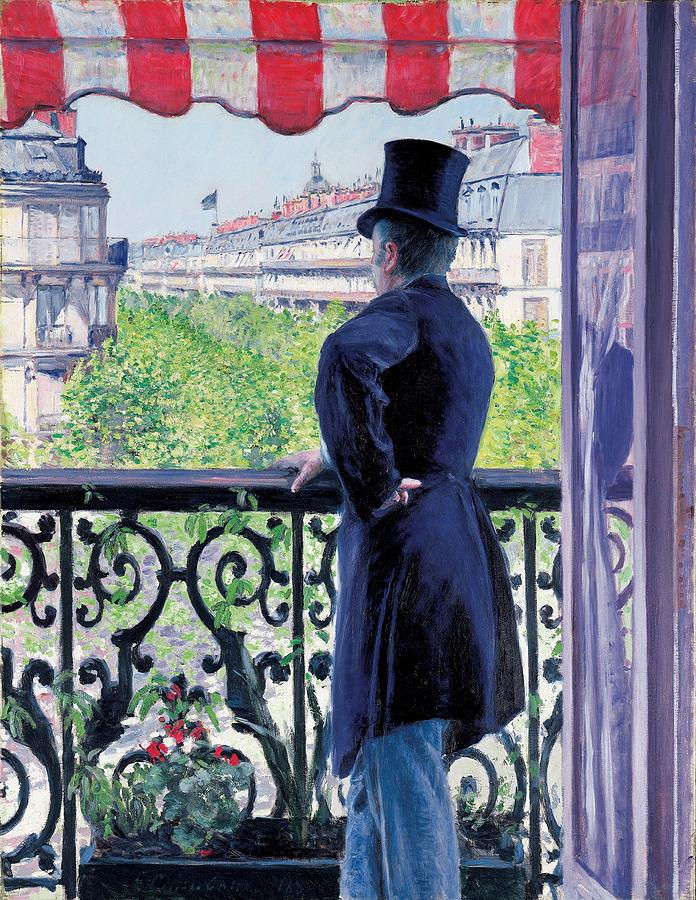
A man in a top hat stands above Paris, one hand resting on a balcony rail and the other drawn behind his waist. Beyond his dark coat, trees and pale stone buildings glow in the daylight. Gustave Caillebotte’s Man on a Balcony, signed and dated 1880, makes the act of looking at the city its central subject. The canvas is catalogued more fully as Homme au balcon, boulevard Haussmann. [1]
We see the man almost from behind, from a position close to the open balcony door. His face offers little explanation of what occupies him. Instead, the painting gives us his stance, his clothes and the architecture around him: an ornamental railing, a striped awning and a glazed door that catches a second, fragmentary image of his figure. Caillebotte brings an imposing human presence into a sunlit city view while keeping the relation between the two open to scrutiny.
At a Glance
- ArtistGustave Caillebotte.
- Date1880, signed and dated at lower left.
- MediumOil on canvas.
- Dimensions117 × 90 cm in Marie Berhaut’s 1994 catalogue.
- Catalogue numberBerhaut 149.
- SubjectA single man at the balcony of the artist’s Boulevard Haussmann apartment; probably Albert Courtier, a notary and family friend.
- CollectionRecorded in a private collection in the historical catalogue. [1]
This work across Gustave Caillebotte’s career
Contents
- Standing between the room and the city
- A top hat against the daylight
- Boulevard Haussmann as a lived environment
- Light, colour and the broken surface
- Small details that alter the view
- Who is the man?
- A private view shown in public
- Annotated details
Standing between the room and the city
The composition begins with an unequal division. The man fills much of the right half, while the opening to his left gives a broad view across the treetops. His body interrupts the panorama, but it also measures it. The buildings would seem much smaller and further away without his substantial figure in front of them. As it is, Caillebotte makes us conscious of two distances at once: the few steps separating us from the man and the much greater space beyond the rail.
The balcony is a shallow place with several boundaries. Across the bottom, the dark ironwork marks the edge above the street. At the right, the open door defines the way back indoors. Overhead, the scalloped awning cuts across the sky. These elements enclose the view without turning it into an ordinary room. The man can occupy the outside air while remaining attached to the apartment behind him. We, too, look out from a protected position.
His stance makes that arrangement tangible. The hand on the rail connects his body to the balcony’s horizontal line; the other hand, tucked behind him, introduces a small, tight curve at his waist. The long coat widens below it, with the grey trousers emerging beneath. There is little sense of a passing action. Attention settles on the duration of standing and looking, and on the physical ease with which this man occupies his narrow platform.
Berhaut’s catalogue describes him as standing before a window of Caillebotte’s apartment. The threshold matters because it gives the urban scene a particular observer, rather than offering Paris as an unqualified panorama. The view belongs to an inhabited building, with its own doors, furnishings and vantage points. [1]
Man on a Balcony,1880; catalogue149. Image source. Public domain. Whole supplied image retained; resized only.
Young Man at His Window,1876; J.Paul Getty Museum. www.christies.com. Image source. Public domain. Resized only; source appearance preserved.
A top hat against the daylight
The top hat is one of the painting’s strongest shapes. Its high, dark crown rises against the pale buildings, making the head instantly legible even though the face is turned away. The brim interrupts the profile and keeps the expression difficult to read. Below it, the coat creates a second, larger dark form, modelling the shoulders and back through blue and grey variations rather than a single continuous black.
These clothes make the figure socially specific. Berhaut identifies a frock coat and top hat, formal dress brought into the apartment’s sheltered outdoor space. The painting preserves that outward appearance while withholding the direct facial encounter expected from a conventional portrait. Dress supplies information that the face does not: this is a carefully turned-out urban man, seen at leisure above the boulevard. [1]
The Getty Museum’s 2025 exhibition text places Caillebotte’s balcony pictures within the privileges of his wealthy male world. Its curators connect his elevated viewpoints to the position of a property-holder whose family had benefited from the redevelopment of Paris. That reading sharpens what is visible here. The man’s commanding scale, his formal clothes and the apartment’s outlook become parts of the same social arrangement. It need not mean that he consciously surveys the city as his possession; the picture makes his access to such a view evident. [3]
Looking at the figure also changes the spectator’s role. We can inspect the contour of his back and the set of his arms while he looks elsewhere. His absorbed stance permits a close encounter without a reciprocal glance. Caillebotte gives this ordinary pause the weight of a substantial figure painting, even as the sitter’s attention directs us away from him.
Boulevard Haussmann as a lived environment
The apartment belongs to a specific phase in Caillebotte’s life. After their mother’s death in 1878, Gustave and his brother Martial moved to Boulevard Haussmann. The Getty’s account places the address in the fashionable centre of the renovated city and relates the ensuing balcony views to Caillebotte’s earlier street scenes. Broad streets, uniform apartment blocks and long perspectives had already become important features of his modern Paris. [3]
Here those apartment blocks are encountered above a thick band of foliage. Trees occupy much of the middle distance, screening the lower part of the boulevard. The eye passes over them to the pale façades, rooflines and upper-storey windows. Paris appears as an environment of inhabited heights, with another balcony’s view potentially facing this one across the gap.
The painting therefore offers a useful change of level from Paris Street, Rainy Day. In the Getty curators’ account, both the street scenes and the later balcony pictures register Caillebotte’s relationship to Haussmann’s rebuilt city. The balcony makes that relationship especially concrete: the observer has withdrawn from street circulation while retaining visual access to the urban world. [3]
The setting also complicates a familiar reading of the solitary city-dweller. A figure turned away can suggest distance or isolation to a modern viewer, but his posture cannot establish his feelings. The Getty text itself holds together possible social alienation and the power conferred by wealth. In this painting, the visible evidence of comfort, access and shelter deserves as much attention as the absence of conversation. [3]
A Balcony in Paris,1880; separate empty-balcony composition,catalogue148. Image source. Public domain. Whole supplied image retained; resized only.
Watch: Gustave Caillebotte
Explore a museum overview and two discussions of Paris Street; Rainy Day. This shared selection offers wider context for the artist’s work.
"Who Is Gustave Caillebotte?" - HD version
An introduction to Caillebotte from the Kimbell Art Museum.
Watch on YouTubeLight, colour and the broken surface
The image depends on strong illumination beyond the apartment. Against the yellowish light of the city, the man’s coat becomes a dense blue-dark silhouette. Yet its outline is neither equally sharp nor equally opaque throughout. At the shoulders and sleeves, changes of tone turn the figure in space; lower down, the coat’s edge meets the busier marks of the ironwork and foliage. The solidity of the body emerges from its relation to these lighter, more fragmented surroundings.
The awning adds a different kind of pattern. Its broad red and muted grey stripes stretch across the top, with rounded hanging edges that echo the curves of the railing below. Between them lies the open prospect. The building’s fittings give the picture a decorative rhythm before we have begun to count the windows or follow the distant roofs.
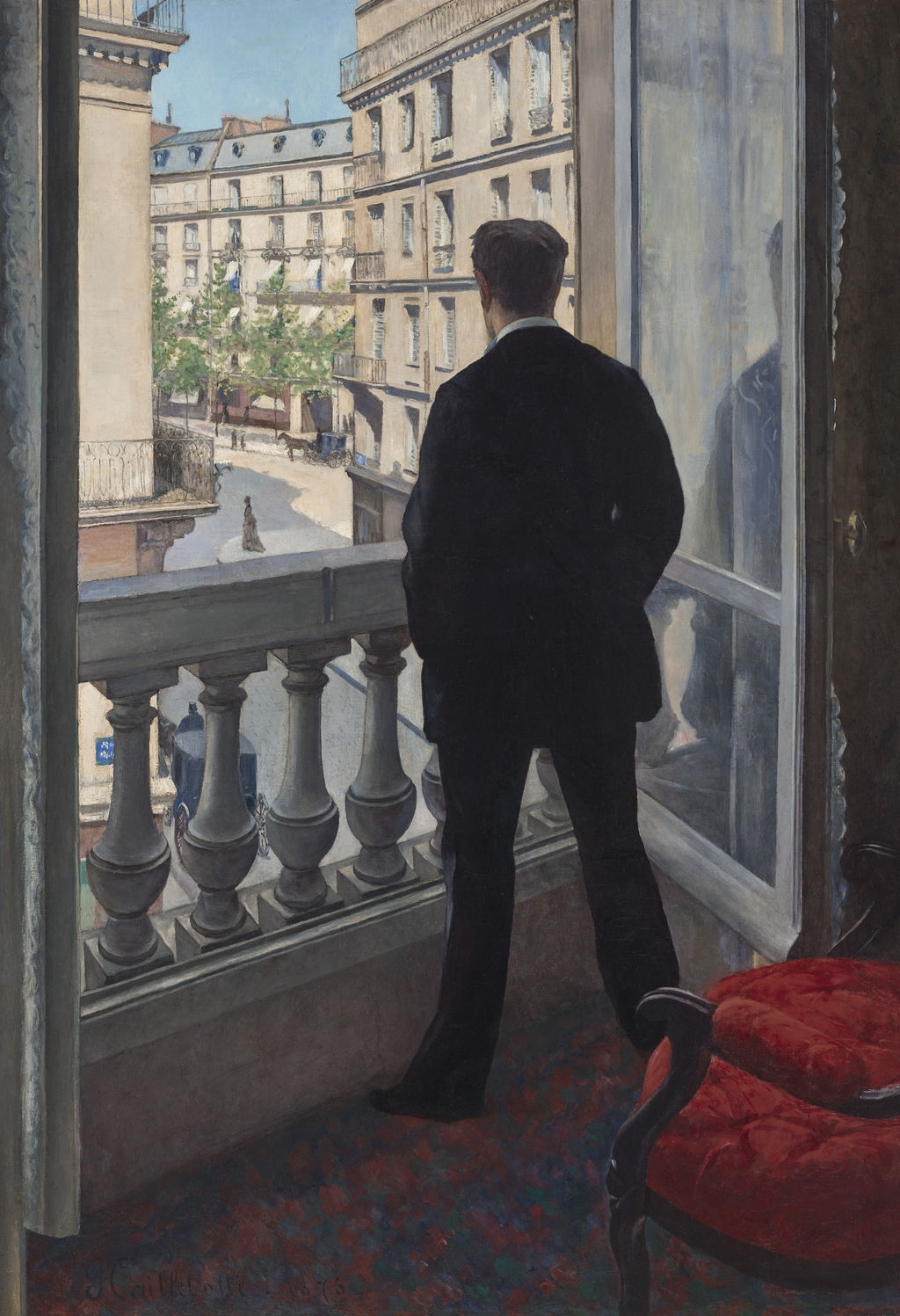
Berhaut specifically compares this canvas with Caillebotte’s earlier Young Man at His Window. She contrasts the earlier work’s dark tonality, blended handling and precise forms with the lighter palette, visible touches and slight impasto of Man on a Balcony. Her comparison makes this an especially useful work for seeing how a repeated subject could accommodate a changing painted surface. [1]
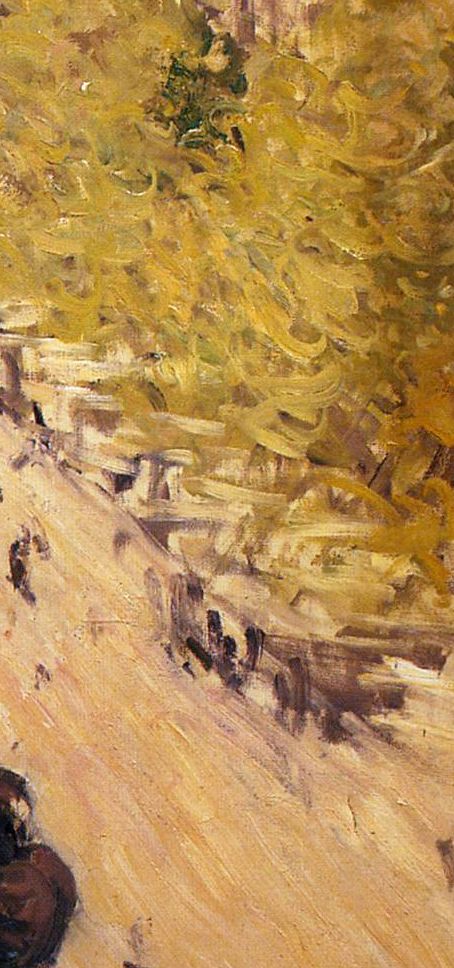
That argument is borne out by the reproduction’s different textures. The trees flicker with numerous short touches; the buildings hold together through broader pale areas and small accents; the coat is more continuous, though still visibly worked. These differences keep foreground figure and distant city distinct. They also prevent the man from becoming a cut-out pasted over a landscape: coloured light and broken marks connect his clothing to the scene around him.
Small details that alter the view
The glazed door at the right deserves a second look. Its narrow panes catch a partial reflection of the figure and balcony, bringing a pale, broken counterpart to the man into the composition. This secondary image occupies very little space, but it extends the act of looking. We see the man directly from behind and encounter a further trace of him in the apartment’s glass.
At the opposite lower corner, a flowering plant stands close to the railing. Its clustered leaves and blossoms overlap the iron scrolls, making the boundary less clean than it first appears. Living growth and manufactured ornament share the same foreground space. Across the rail, the trees produce a much larger field of foliage, so the small plant also connects the apartment’s immediate surroundings with the green mass outside.
The railing itself alternately opens and obstructs. Its heavy scrolls stand in front of light and leaves, and the repeated dark curves pull the eye sideways. Caillebotte has given the view a conspicuous physical barrier. We can see through it, but cannot forget it, because its pattern occupies so much of the lower picture.
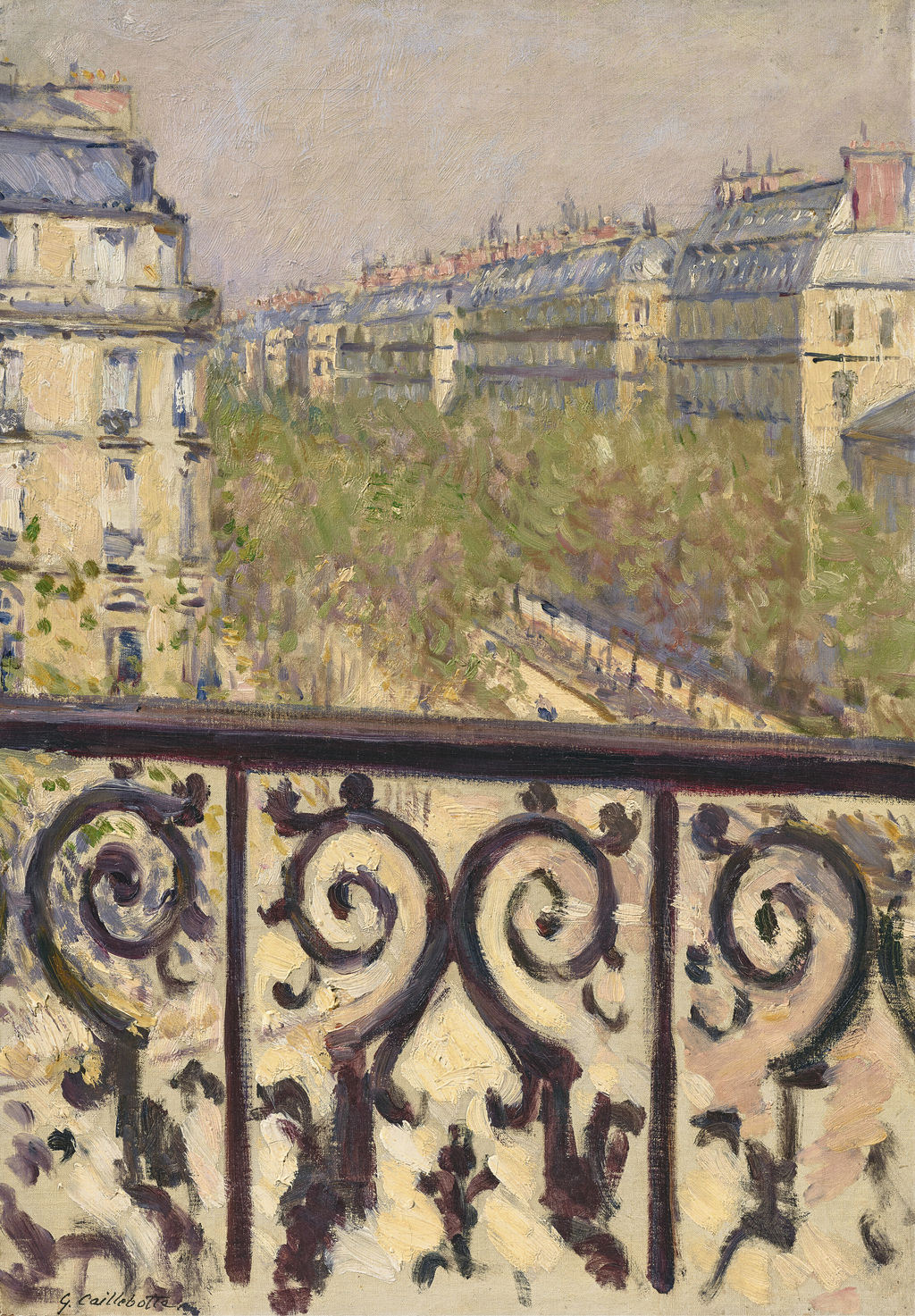
This helps distinguish Man on a Balcony from the related Balcony in Paris, catalogued as number 148. There, the empty balcony’s ironwork and the city beyond supply the principal relationship. In number 149, the man stands between those two elements and transforms the view into a scene of someone viewing. Berhaut groups both works within Caillebotte’s variations on the open window, alongside the more closely obstructed View Through a Balcony, number 147. [1]
Who is the man?
Berhaut proposes Albert Courtier, a notary and friend of the family, as the probable sitter. Her wording is qualified, and the identification should remain so. The turned head, shaded features and formal costume offer less facial information than an ordinary portrait; the picture cannot by itself turn a proposed name into a certainty. [1]
There is nevertheless a documented connection between Courtier and this canvas. The catalogue records that Caillebotte gave it to him at Meaux around 1880. That gift establishes a place for the work within a relationship of friendship, even while the identity of its figure remains probable. The distinction is useful: ownership history can strengthen our understanding of the painting’s social setting without proving who posed. [1]
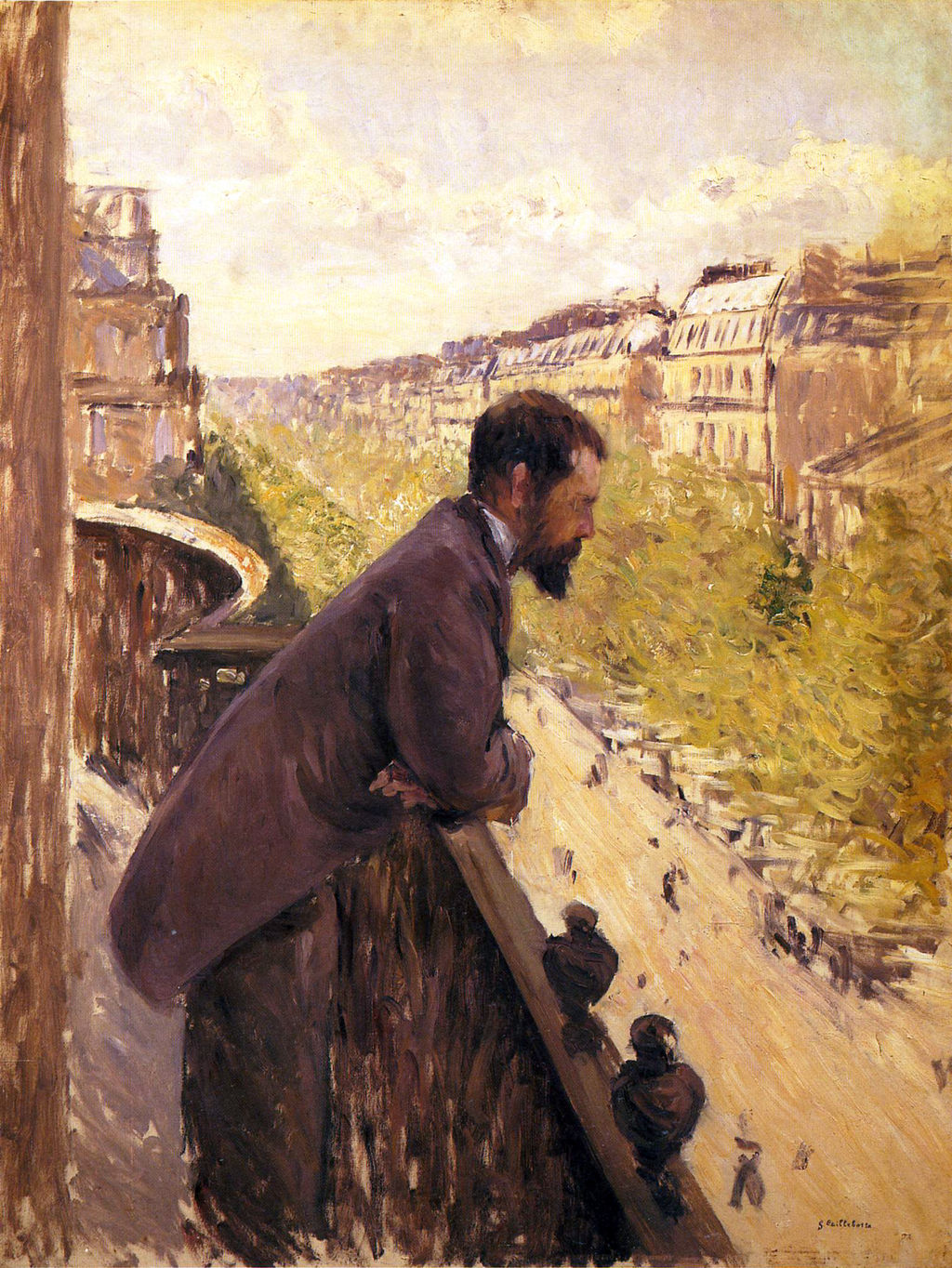
Caillebotte painted other men on balconies, so the title alone does not identify this composition. Berhaut’s number 145 depicts Maurice Brault and has a different view along Boulevard Haussmann; number 146 contains two men. The present work is the single top-hatted figure beneath the striped awning, number 149, with the open glazed door at the right. Keeping these canvases distinct allows the particulars of each encounter with Paris to emerge. [1]
Man on a Balcony,1880; Maurice Brault, separate composition,catalogue145. Image source. Public domain. Whole supplied image retained; resized only.
Annotated Details from the separate balcony portrait of Maurice Brault
The numbered points identify visible features discussed in this article. Return from each detail to the whole composition. Man on a Balcony,1880; Maurice Brault, separate composition,catalogue145. Image source. Public domain. Whole supplied image retained; resized only.
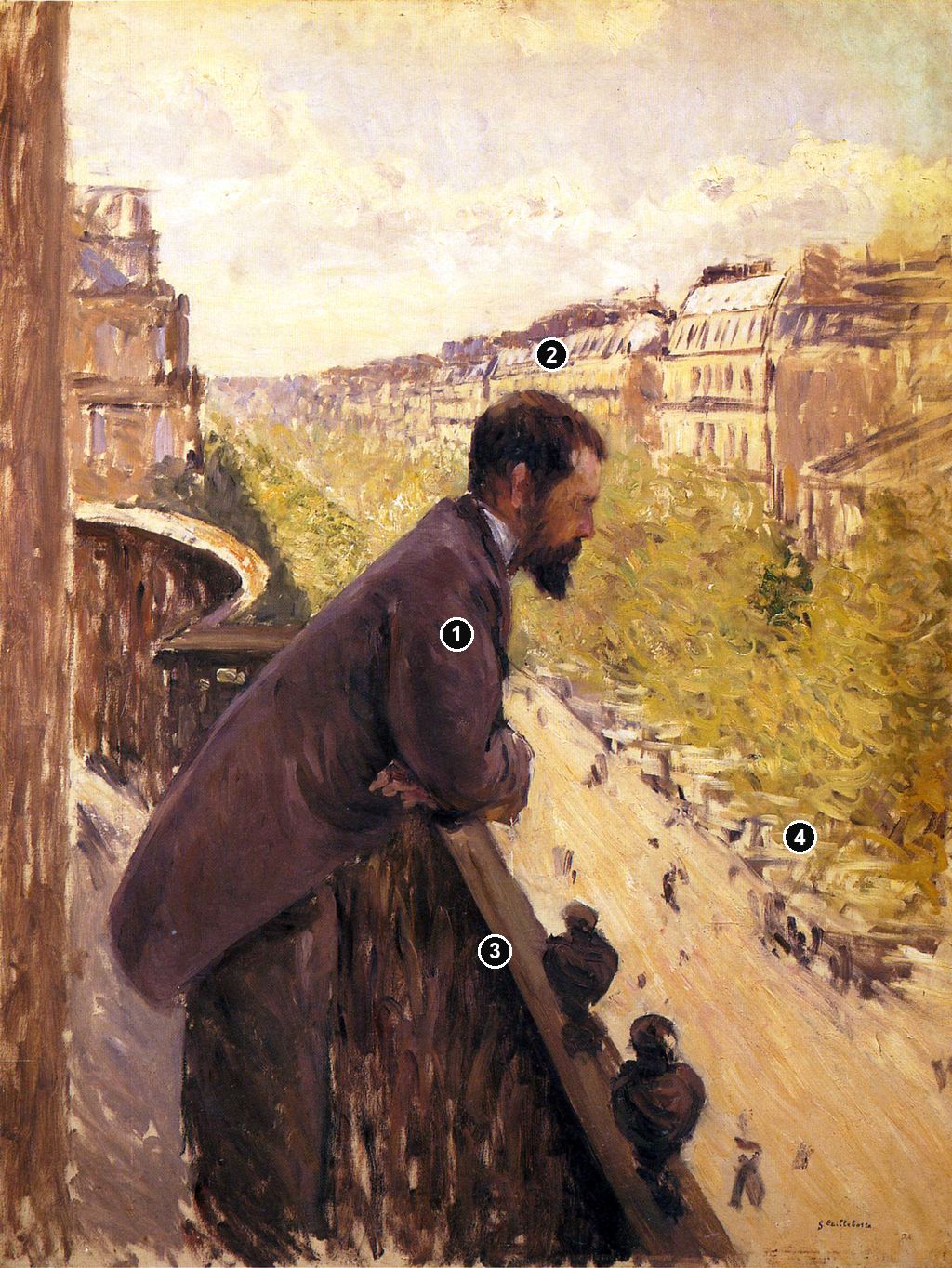
Details from THE SEPARATE BALCONY PORTRAIT OF MAURICE BRAULT
The cropped details show Maurice Brault without a top hat, Berhaut 145. They do not show the top-hatted man in the article’s main image, Berhaut 149.
Head and folded arms at the rail
The bareheaded man bends forward with his arms resting along the balcony. His angled torso places a large dark shape before the sunlit boulevard.
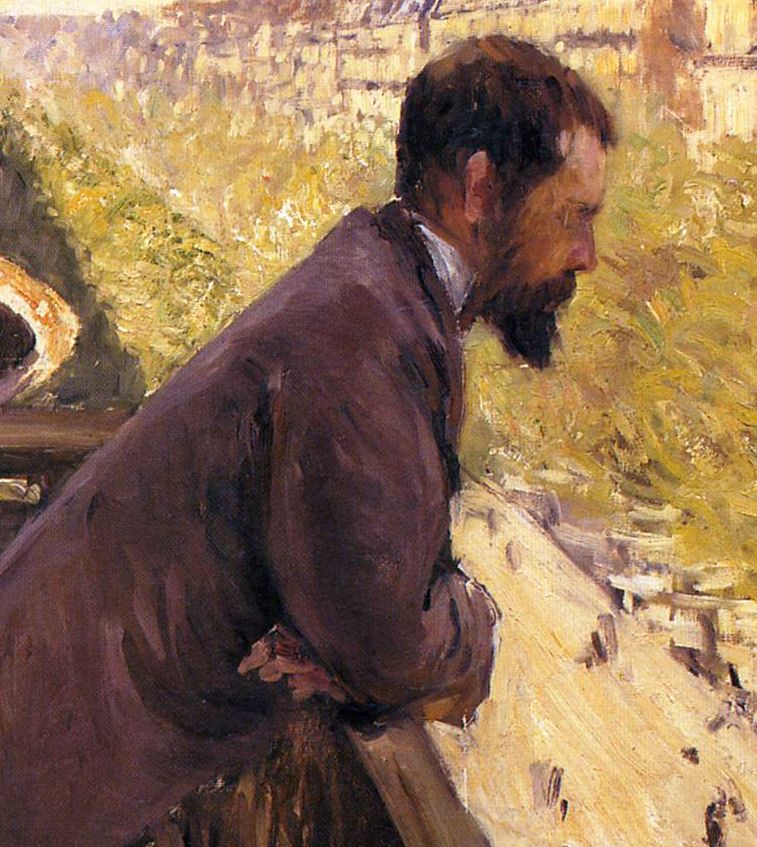
Roofs beyond the balcony
Repeated windows, chimneys and pale roofs stretch into the distance. Their smaller divisions contrast with the nearby figure.
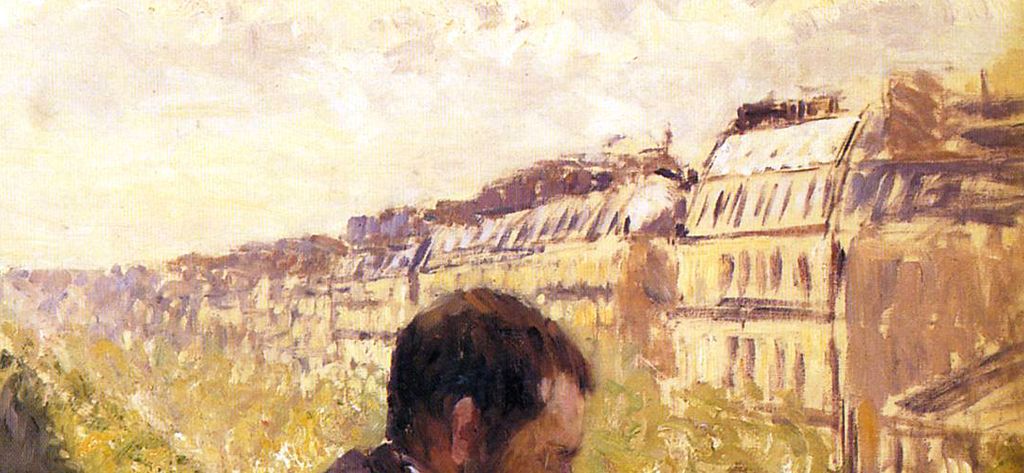
The ornate railing in the foreground
Dark ornamental ironwork fills the lower foreground. Its repeated curves continue below the man’s arms and the long straight handrail.
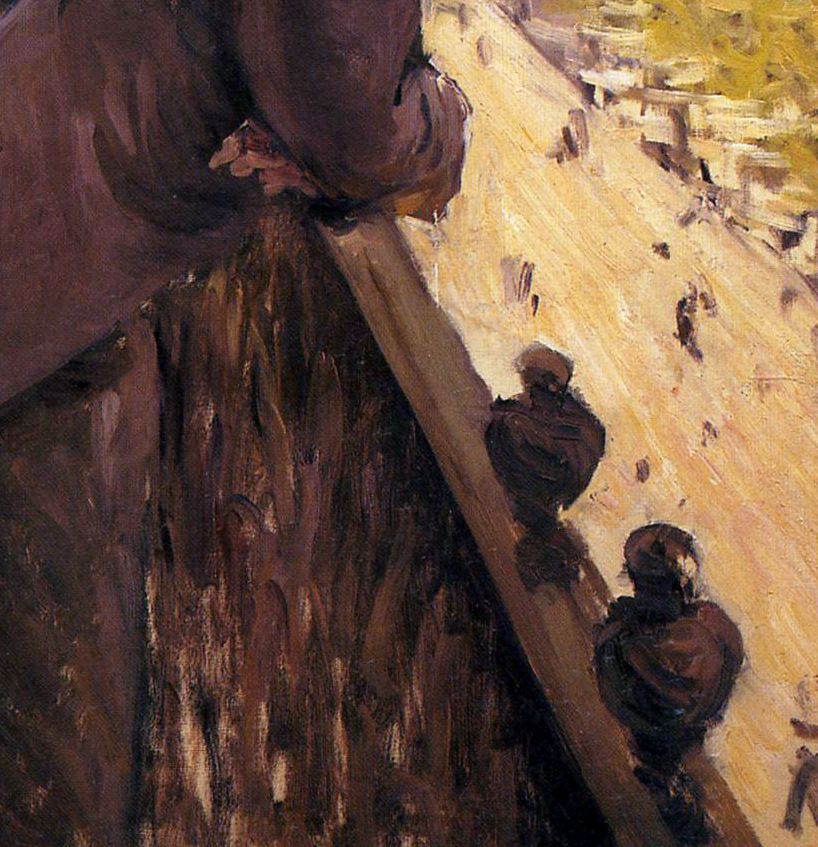
Small figures on the boulevard
Small figures and vehicles occupy the street beneath the trees. Their reduced scale makes the balcony’s height visible within the composition.
A private view shown in public
The painting’s domestic viewpoint did not keep it out of public exhibition. Berhaut records it as number 2 in the seventh Impressionist exhibition of 1882 and number 56 in Caillebotte’s posthumous retrospective in Paris in 1894. The 1882 list also includes the separate two-man balcony composition, number 146. Visitors could therefore encounter more than one solution to the relationship between an apartment, its occupants and the boulevard. [1]
The later history recorded in the catalogue runs from Courtier through the Paris dealer Metthey to a sale at Drouot on 10 October 1946, and then to a private collection in Switzerland. These are historical provenance entries, ending with the catalogue’s published record rather than a named present owner. Berhaut also lists appearances in the 1983 Lausanne exhibition of Impressionism in French-speaking Swiss collections and the 1994–95 Paris–Chicago Caillebotte exhibition. [1]
The National Gallery of Art’s illustrated checklist for Gustave Caillebotte: The Painter’s Eye in 2015 lists the painting as catalogue number 9, again in a private collection. It gives dimensions of 116.5 × 89.5 cm, slightly different from Berhaut’s rounded 117 × 90 cm. Both records concern the same signed and dated composition; the difference should be understood as a difference between published measurements. [4]
Across these changing settings, the painting continues to make its spectator occupy a very particular place. We stand just behind a man whose city view is partly ours and partly withheld by his body. The sunny distance invites our attention, while the coat, rail, awning and reflected figure keep returning us to the apartment’s edge. Caillebotte makes the position from which Paris is seen as absorbing as Paris itself.
Catalogue and documented works
This directory brings together 578 entries in the revised 1994 catalogue, 11 further documented records and three groups of study descriptions. It is a directory of records, not a total of authenticated individual works. Albums, print states and surviving decorative panels are grouped. English labels retain the French titles as searchable aliases; dates are supplied only where checked. Numbered entries link to the relevant article or the historical catalogue. Pastels appear under the Drawing filter; original prints remain searchable under All media.
Frequently Asked Questions
The painting is signed and dated 1880 at the lower left. Berhaut catalogues it as number 149. [1]
Marie Berhaut identifies him as probably Albert Courtier, a notary and family friend. The identification remains probable rather than certain. Caillebotte gave the painting to Courtier around 1880. [1]
No. This canvas shows one man beneath a striped awning. Berhaut separately catalogues the two-man Un balcon, boulevard Haussmann as number 146. [1]
Discussion
Look again at the images and ideas explored in Man on a Balcony. These editorial prompts invite your observations.
Reader Insights
The top hat makes a dark shape against the open daylight.
The railing marks a boundary between the man’s position and the boulevard below.
How does an occupied balcony change the way you read an empty one?
Join the Conversation
Share a detail, comparison or question about Man on a Balcony below.
References
- Marie Berhaut, revised and augmented by Sophie Pietri. Gustave Caillebotte: Catalogue raisonné des peintures et pastels (1994), introduction pp. 20, 35–36; catalogue entries 145–150, especially no. 149, p. 132; exhibition list for the seventh Impressionist exhibition, 1882. Digital edition, Wildenstein Plattner Institute. View source.
- Marie Berhaut with Sophie Pietri; Wildenstein Plattner Institute, Gustave Caillebotte Catalogue raisonné des peintures et pastels, 1994. View source. (in French).
- J. Paul Getty Museum. Gustave Caillebotte: Painting Men, gallery text (2025), especially PDF p. 4, on modern Paris, property and the Boulevard Haussmann apartment. View source. (in en/es).
- National Gallery of Art. Gustave Caillebotte: The Painter’s Eye, illustrated exhibition checklist (2015), PDF p. 2, cat. no. 9, Man on a Balcony, Boulevard Haussmann. View source.
- Art Institute of Chicago, Caillebotte Paintings and Drawings at the Art Institute of Chicago, 2015. View source.
- Petit Palais / Paris Musées, Portrait de Paul Hugot, original print, PPG2319, current. View source. (in French).
- Paul Perrin, Musée d’Orsay, Transcription de l’entretien commissaire Caillebotte, 2024. View source. (in French).
- Cleveland Museum of Art, Caillebotte collection records: 2020.260, 2009.157 and 2020.105, current. View source.
- Splash image, Man on a Balcony, 1880.


