


 by Tom Gurney
Tom Gurney BSc (Hons) is an art history expert with over 20 years experience
Email: tomgurney1@gmail.com / Phone: +44 7429 011000
Style and Technique: Introduction
Gustave Caillebotte made looking feel physical. A pavement opens under our feet; a boat seems about to strike the picture’s edge; an iron railing stands between us and the city. His paintings give these experiences a compelling clarity, even when the space they describe feels awkward. Kirk Varnedoe identified a central tension in this achievement: modern subjects emerge through patient, traditional construction, including ruled perspective and separately studied figures. [1]
Caillebotte’s surfaces vary as much as his viewpoints. The long, pale floorboards of The Floor Scrapers invite a different kind of attention from the restless yellow marks of his fields or the congested petals of his chrysanthemums. Paul Perrin reads his forceful compositions as deliberate inventions, developed through the studies needed to realise them. That interpretation helps explain their apparent immediacy, although individual works preserve very different evidence of planning and revision. [2]
At a Glance
- Compositional strengthspronounced diagonals, abrupt changes of scale, close foregrounds and cropped forms. [2]
- Drawinga means of constructing space and studying figures as well as recording observations. [1]
- Recurring visual questionwhere the spectator stands in relation to the scene. [2]
- Rangeurban streets, interiors, workers, river sports, landscapes, still lifes and gardens. [2]
Contents
- Constructing a convincing encounter
- Drawing, measuring and changing
- What a photographic appearance can tell us
- Finish, light and the occupied interior
- Still life: colour organised for looking
- River painting: movement in the brushwork
- Landscape methods: eight paintings, different evidence
- Flowers and the expansion of the painted surface
- Annotated details
Constructing a convincing encounter
Caillebotte’s academic education was brief. Marie Berhaut records his admission to the École des Beaux-Arts on 18 March 1873, after preparation in Léon Bonnat’s studio. It is safer to connect his art with the procedures visible in surviving works than to imagine an extensive, fully documented school career. [3]
In The Floor Scrapers, the floor supplies an exceptionally strong framework. Its seams run past the kneeling men towards the back wall, while the upright window and horizontal panelling steady the room. The spectator looks down across a large expanse of wood. The workers’ backs occupy different angles within that space: the nearest man bends into a compact arch, while the man at the left extends more horizontally. Their arms make smaller diagonals across the much longer lines of the boards.
The bodies feel substantial because their rounded shoulders and bent elbows interrupt an environment dominated by straight lines. Brightness also changes its function across the picture. It describes flesh on a shoulder, the broad exposed area of the floor and the window at the back. The most luminous patch of wood is almost empty, giving the eye room to travel between the men. Empty space becomes an active part of the composition.
The Musée d’Orsay explains that Caillebotte prepared individual elements in drawings and transferred them using a grid. The museum connects this disciplined preparation with his ability to give contemporary workers the physical presence traditionally reserved for elevated subjects. [4] The equipment also makes the gestures specific. Galina Olmsted distinguishes the heavy plane, finer scraper and sharpening file within the working sequence; the familiar English title can conceal the variety of operations represented. Her proposal that the two floor-worker canvases originated in 1875 remains a scholarly argument, rather than a reason to erase the date 1876 carried by the smaller variant. [5]
This matters for an understanding of technique. Caillebotte could make a recognisable action legible by isolating its posture, placing it within a coherent room and varying it against another action. The effect depends on relationships among bodies, tools and perspective. It does not require every surface to receive equal emphasis. The elaborate railing seen through the rear window, for example, remains a relatively small, dark pattern beside the broad light floor.
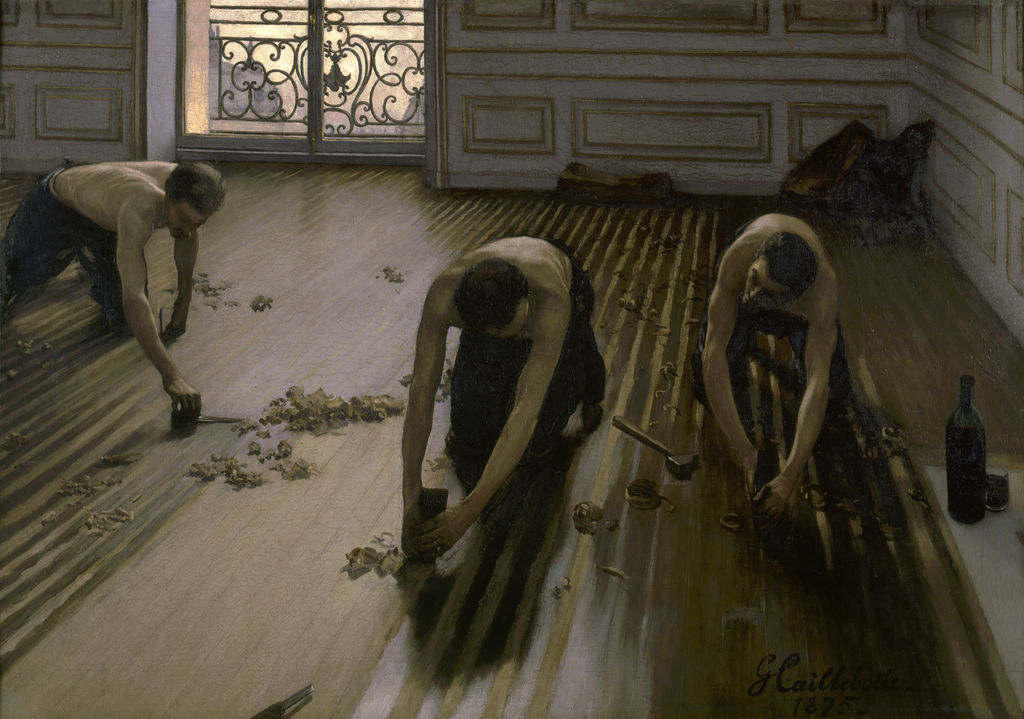
The Floor Scrapers, 1875; bodies and tools organised within a room of strong perspective. Google Arts & Culture — 0wHXxVpb7UjLNA. Image source. Public domain. Resized only; source appearance preserved.
Drawing, measuring and changing
The Chicago study for Paris Street; Rainy Day combines freehand graphite with ruled lines and tool indentations associated with measurement. The finished oil contains pinholes, underdrawing and substantial revisions. Groom and Keegan propose possible camera-lucida assistance, without documentary confirmation. They describe measured enlargement of roughly seven times. Cleaning in 2013–14 removed discoloured varnish and overpaint, changing the oil’s appearance. Chicago’s sketchbook combines graphite, watercolour and grey wash; its colour notes and varied subjects broaden the purposes of drawing. In Calf’s Head and Ox Tongue, Keegan documents grey-beige preparation, dark preliminary layout, altered colours and a later second head. [6]
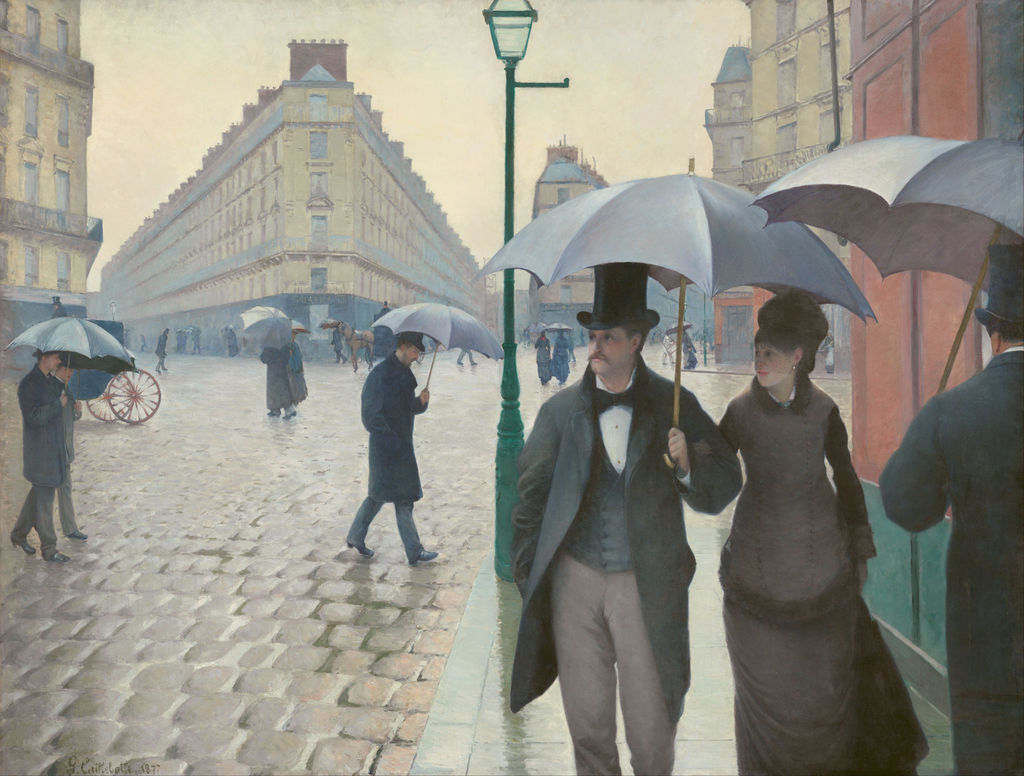
The final Paris Street; Rainy Day makes those decisions seem effortless. Its lamppost is an unusually clear vertical division, but the space on either side behaves differently. To the left, a broad triangular building and a long sweep of cobbles open the view. To the right, the foreground couple and the man entering at the edge restrict it. Their umbrellas overlap into a roof of curved shapes, quite unlike the straight building lines above them.
Look at the relationship between the couple and the smaller man crossing near the lamppost. The difference in their scale is large, yet the open pavement allows the eye to connect them. The buildings do not simply frame a collection of portraits. They create distances through which the figures can approach and depart. At the right edge, the cropped man makes that distance feel temporarily obstructed: our imagined route through the scene has to negotiate another pedestrian.
Caillebotte’s figures are therefore both descriptions of people and instruments of scale. Their hats, shoulders and umbrellas make intervals visible. The couple’s relatively large faces hold attention near the surface; the small figures below the distant façades draw it away again. This repeated movement between proximity and distance creates much of the picture’s peculiar tension.
A late drawing offers a useful counterweight to the architecture. Cleveland’s Study of a Man with Hands in His Pockets, dated 1893, is black chalk on laid paper and prepares the figure of Eugène Lamy for a winter riverbank painting. [7] The man stands with his back largely towards us. A firm outer contour encloses loosely worked shading, while small, searching lines around the jacket refuse to settle into a completely smooth boundary. The legs are long and lightly articulated compared with the dark concentration at the waist.
The sheet demonstrates how much a posture can convey without a face. The hands disappear into the pockets; the shoulders and turned head carry the action. Broad hatching registers the jacket as a surface stretched over a body. Beside the ruled logic of a street, this is another kind of precision: the recognition of a weight shift and a silhouette. The unfinished surroundings leave that problem exposed.
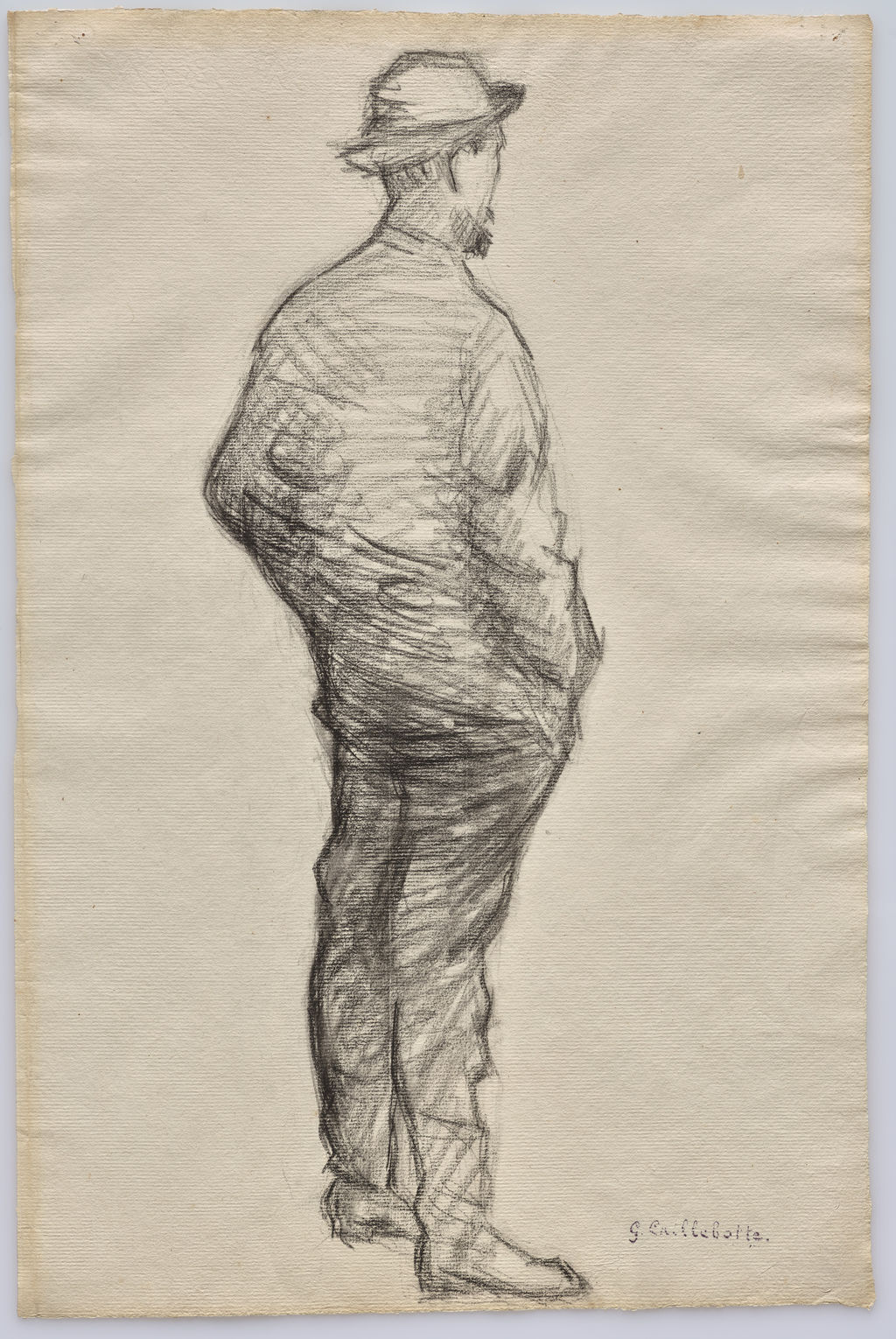
Study of a Man with Hands in His Pockets, 1893; black chalk study of Eugène Lamy, Cleveland Museum of Art. John L. Severance Fund. Image source. CC0 / Public domain. Resized only; source appearance preserved.
What a photographic appearance can tell us
The comparison with photography is useful when it makes us look harder at cropping, scale and viewpoint. The SCHIRN’s 2012 exhibition placed Caillebotte’s close views and steep perspectives beside photographic practices, including the later New Vision. Those parallels are curatorial comparisons; resemblance alone cannot identify a source photograph or establish a chain of influence. [8]
The distinction becomes clear in two balcony pictures. In the Van Gogh Museum’s View from a Balcony, the iron scrolls occupy almost the entire field. Their black curves are broad enough to become shapes in their own right. Between them, the city appears in pale fragments: a façade, a slanting pavement, the small form of a horse. Looking through the railing is difficult because looking at it is so absorbing.
Sjraar van Heugten reports that the ironwork was painted first and the pale background added after drying. He argues that this considered sequence supports understanding the work as an independent painting. [9] The loose handling is therefore compatible with an interval of waiting and a carefully maintained relationship between layers.
The Balcony in Paris represented by Un balcon, Boulevard Haussmann is a different canvas, catalogued by Berhaut as number 148; the Van Gogh Museum picture is number 147. [3] In the former, the railing occupies the lower portion and the city remains visible above it. The horizontal rail divides a distant urban prospect from a close, irregular arrangement of dark curls and pale gaps. The tree foliage, buildings and ironwork have distinct rhythms: dabs, short architectural strokes and sweeping curves.
These views show how a small change in framing changes the subject. One makes the barrier almost overwhelming; the other permits a more continuous journey from railing to boulevard and rooftops. Neither needs a figure to suggest a spectator. The obstruction itself establishes our position. A photograph might offer a comparable arrangement, but the material sequence documented for the Van Gogh Museum painting answers a different question: how that particular painted surface was built.
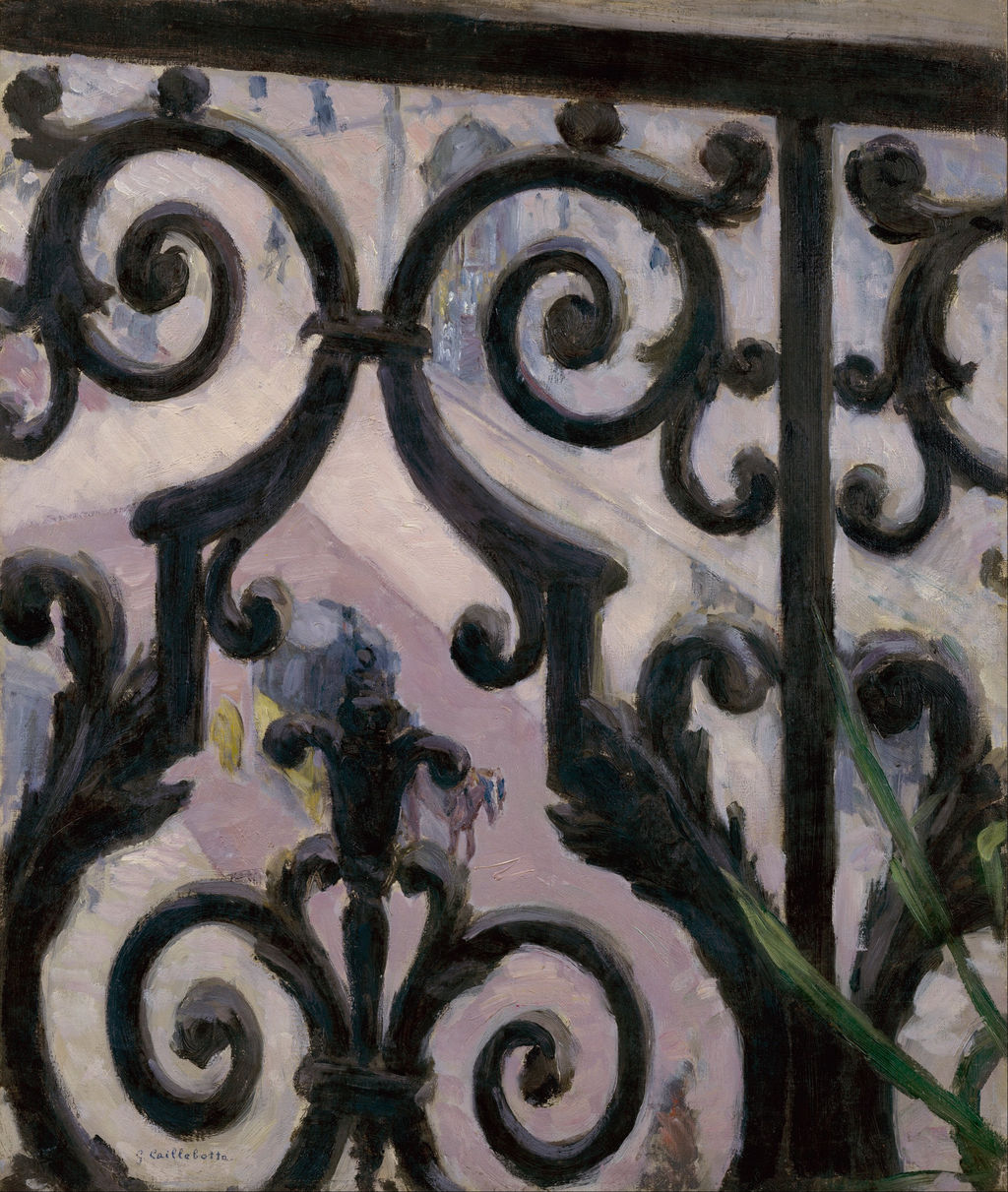
View Through a Balcony, 1880; Berhaut 147, the separate Van Gogh Museum canvas. 8gHrHH2Xl-O5cw at Google Cultural Institute maximum zoom level. Image source. Public domain. Resized only; source appearance preserved.
Finish, light and the occupied interior
In Young Man Playing the Piano, the keyboard projects diagonally towards us, while the seated man, chair and window balance its dark mass. The instrument’s polished surfaces repeat pieces of the room in dim reflections. Its blackness is interrupted by the keys, pale music and narrow highlights. The man’s hands sit at the meeting point of these contrasts.
Yasuhide Shimbata identifies the Érard instrument and places the scene in dialogue with keyboard subjects by Degas, Manet and Renoir. His study treats its careful finish as compatible with a modern domestic subject and a subtle investigation of light. [10] That combination helps explain why a smooth passage of paint should not automatically be read as conservative. The piano’s sloping edges organise a decidedly immediate view of somebody engaged in an activity.
Compare Henri Cordier. Here the body is much closer, the lower figure cut by the edge, and the books press against the sitter’s back. The Musée d’Orsay relates this compressed arrangement to Caillebotte’s experiments and to Degas. [11] The bent forearm makes a wide curve across the lower left. Above it, small strokes in the beard and hair surround the more continuous modelling of cheek and forehead. The coat contains a range of greys and muted purples rather than a single flat tone.
The desk presents another register of touch. Fine pale streaks cross its dark reddish surface, while the book spines are divided into vertical strips, broken by small highlights. These different marks remain subordinate to the large movement of the man leaning into his work. It is possible to read the activity immediately while continuing to discover the surface that produces it.
Mary Schafer’s technical study of Portrait of Richard Gallo provides a material counterpart. She records dry-media traces probably related to planning, purple initial washes in the suit, magenta and blue within its apparent blackness, extensive work over dried paint and the artist’s reduction of the composition at three edges. Painting continued after the canvas had been restretched. Its original frame survives, but a fingerprint associated with the frame has no established maker. [12]
Such evidence complicates any equation of casual pose with casual execution. It also makes the format part of the technique: changing the edges changes how tightly a sitter occupies a room. Perrin’s emphasis on the calculated encounter between picture and spectator is especially productive here, provided it remains a reading of the art rather than a claim that every composition followed an identical sequence. [2]
Watch: Gustave Caillebotte
Explore a museum overview and two discussions of Paris Street; Rainy Day. This shared selection offers wider context for the artist’s work.
"Who Is Gustave Caillebotte?" - HD version
An introduction to Caillebotte from the Kimbell Art Museum.
Watch on YouTubeStill life: colour organised for looking
In Fruit Displayed on a Stand, the surface is crowded yet divided. White paper and containers separate clusters of oranges, pears, grapes and other produce. These pale intervals carry the eye diagonally into the arrangement, while a dark band of leaves closes the top. Lynn Kellmanson Matheny connects Caillebotte’s still lifes with the visual appeal of commercial display. [13]
The handling varies within that order. Rounded fruits are built from curved strokes and short highlights; grapes accumulate as small dots and dabs; the papers spread into broader folds of white, grey and blue. A bunch of dark grapes near the centre appears especially concentrated because its small marks sit within a pale rectangular compartment. Shape and colour cooperate: the light wrapper defines a space in which the dark fruit can become dense.
This elevated view allows us to survey a great deal at once, yet the nearest fruit presses towards the bottom edge. The picture holds abundance between two effects, the organised overview and the almost tactile encounter. Its structure is as consequential as the perspective of a street. Straight divisions establish the display; rounded produce continually fills and softens them.
The alterations in Chicago’s meat still life show that an arrangement could develop during painting. They do not establish the fruit painting’s pigments or preliminary medium. [6]
River painting: movement in the brushwork
Skiffs offers a striking change of surface. The nearest boat points down towards the edge, and a double-bladed paddle stretches across the water on a contrasting diagonal. Further back, another paddle swings almost horizontally; a small distant boat continues the movement towards the centre. The National Gallery of Art identifies this as a painting of 1877 and draws attention to its elevated view and zigzag rhythm. It distinguishes the dated upper-right signature from the lower-left imitation of an atelier stamp, probably applied by someone else. [14]
The river is made from marks of markedly different lengths. Blue and green strokes spread laterally across the middle distance. Beside the foreground boat, pale dragged strokes bend into the wake. Yellow reflections repeat the paddles’ colour but break their solid shapes into fragments. The dark foliage above the river contains smaller, less regular touches, keeping the bank visually separate from the water even where their colours overlap.
The nearest paddler’s white shirt is far from blank. Blue and violet strokes turn its sleeves and shade its front. The hat’s pale yellow broadens into a brighter shape above the darker face. These concentrated lights stop the figure from dissolving into the surrounding green. At the right edge, another paddle and a sliver of boat intrude without their occupant, extending the activity beyond the visible scene.
There is continuity with the city pictures in this cropping and use of bodies as measures of depth. The distinction lies partly in the distribution of marks. The river’s surface participates directly in the movement: we see painted strokes as ripples and reflections. Close inspection does not cancel the subject; it gives the subject a second life as the action of the brush.
Landscape methods: eight paintings, different evidence
The breadth of Caillebotte’s landscape technique becomes clearer through the Wallraf-Richartz-Museum’s examinations. Their reports distinguish the ground—the prepared surface beneath the image—from preliminary drawing, underpainting and later applications. These stages can leave different traces even where the finished pictures share a bright, loose appearance.
The Cologne Gennevilliers Plain, Yellow Fields, dated 1884, has an off-white preparation, sparse evidence suggesting charcoal followed by brush planning, and paint applied both into wet passages and over dried ones. Examination identified cobalt blue and viridian among its pigments; some yellow identifications remain qualified. A small unpainted area at the bottom suggests a field-easel fastening. The report estimates two or three sessions. This is the Cologne canvas, Berhaut 293, distinct from Melbourne’s similarly titled painting. [15]
In the Melbourne Plain of Gennevilliers, Yellow Fields, the low strip of distant houses sits above an immense expanse of yellow vegetation. Ted Gott discusses the work’s combination of simplified structure and exuberant paint. His suggestion that colour may have been squeezed directly from the tube is a visual interpretation. [16] In the image, short yellow strokes cross pink, green and blue passages. At a distance they merge into a field; nearby they become an uneven fabric of marks. The pale sky occupies a quieter zone, making the foreground appear more densely worked.
For The Hillside at Colombes, the Cologne researchers found no detailed preliminary drawing. Broad coloured underpainting dried before subsequent work; differences between those early layers and the visible fields indicate corrections. The probable easel mark again supports an outdoor setting, while dirt below a later varnish suggests a period without that coating. The handwritten signature cannot securely be identified as the artist’s own. [17]
Garden in Trouville began with a sparse painted lay-in on a commercially prepared canvas. Its fine touches followed an initial drying interval, with much subsequent work performed into wet paint. Corner holes and circular depressions may derive from spacers used to transport fresh pictures face-to-face. Its blue signature stamp was probably added after Caillebotte’s death. [18] Here the possible transport evidence concerns what happened to a portable painting while its surface remained vulnerable. It adds a practical dimension to the more familiar discussion of an outdoor viewpoint.
In Arm of the Seine, Autumnal Mood, no compositional underdrawing was discerned. Broad thin colour preceded more textured foliage and reflections. Two signatures were added after the paint had aged; one was subsequently covered. The researchers consider them probably posthumous, and the current stretching is also later. [19] An inscription can therefore belong to the history of a picture without recording the artist’s last touch.
Boats and Shed on the Banks of the Seine offers a particularly vivid revision. Blue-crayon outlines in the sky belong to an abandoned arrangement of boats. Caillebotte turned the support through 180 degrees and began again. The report also records later lining, a tear, retouching and a non-original glossy varnish. [20] The present image conceals an earlier decision about scale. The support itself became a means of starting over.
For The Banks of the Seine, the researchers describe a relatively open-weave canvas, dark brush outlines and thin local colours followed, after drying, by broader paint. Later lining flattened raised strokes, while removal of the original turnover edges slightly reduced the picture. [21] This is a reminder that the texture seen today is partly a result of subsequent treatment. A comparatively smooth surface need not preserve the exact relief left by the brush.
The large Laundry Drying on the Banks of the Seine was prepared on pale-grey ground and laid out in charcoal and paint. Embedded material includes a poplar bud, unusually direct evidence supporting outdoor work. The report dates the picture about 1892 and regards its open handling as probably incomplete. This canvas, Berhaut 368, must be distinguished from the smaller Laundry Drying, Petit Gennevilliers, Berhaut 370. [22] Size alone is thus a poor guide to whether a painting was made outside.
Finally, Sailing Boat on the Seine at Argenteuil uses a fine, dense, commercially prepared canvas. Charcoal and painted planning preceded coloured layers, with some scratching into wet paint. A probable easel fastening survives at the lower edge. The Dubus supplier’s mark was stencilled, and remnants of paper backing remain on the reverse; their protective purpose is a possibility. Its signature may be posthumous. The report concerns Berhaut 470, rather than the earlier Orsay sailing picture. [23]
Taken together, these objects replace a single recipe with choices. Drawing could be sparse, painted, made with crayon or undetected. A light ground might remain exposed or disappear under repeated applications. Drying intervals could coexist with brisk finishing. Their differences are as informative as their similarities, because they reveal how many practical routes can lead to an image that seems immediately seen.
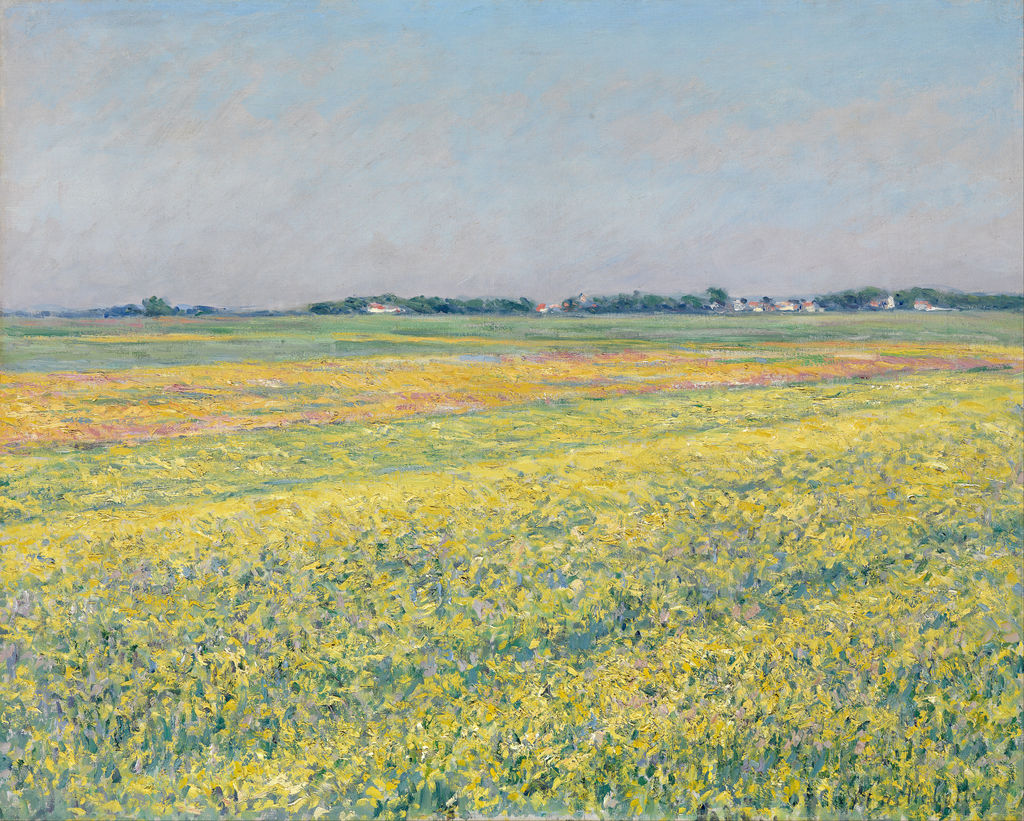
The Plain of Gennevilliers, Yellow Fields, 1884; the Melbourne canvas, Berhaut 289, distinct from Cologne’s technical-study subject. National Gallery of Victoria, Melbourne. Felton Bequest,2011. Source reproduction via Google Art Project and exact Commons file. Image source. Public domain. Resized only; source appearance preserved.
Annotated Details from Villas at Trouville
The numbered points identify visible features discussed in this article. Return from each detail to the whole composition. Villas at Trouville, 1884; Cleveland Museum of Art. A different work from Garden in Trouville in the Cologne technical report. Nancy F. and Joseph P. Keithley Collection Gift. Image source. CC0 / Public domain. Resized only; source appearance preserved.
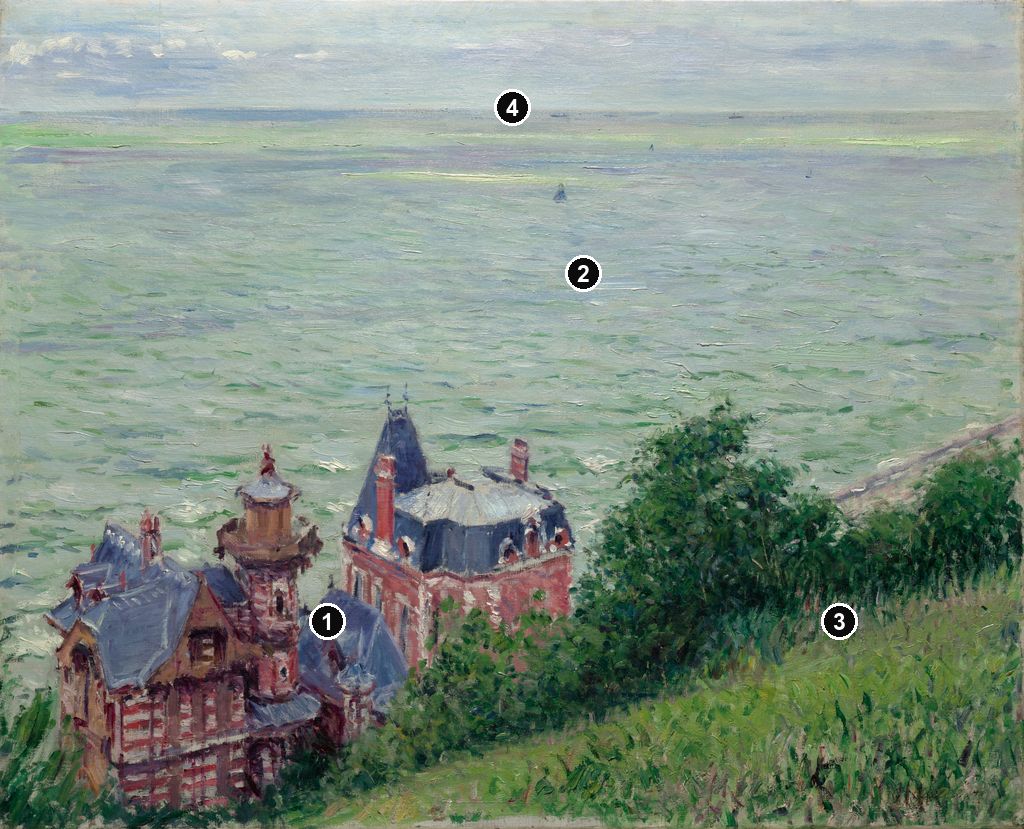
Details from VILLAS AT TROUVILLE
Villas at Trouville, 1884, is a separate Cleveland painting. These are observations of its visible composition; the technical findings for Garden in Trouville do not apply to it.
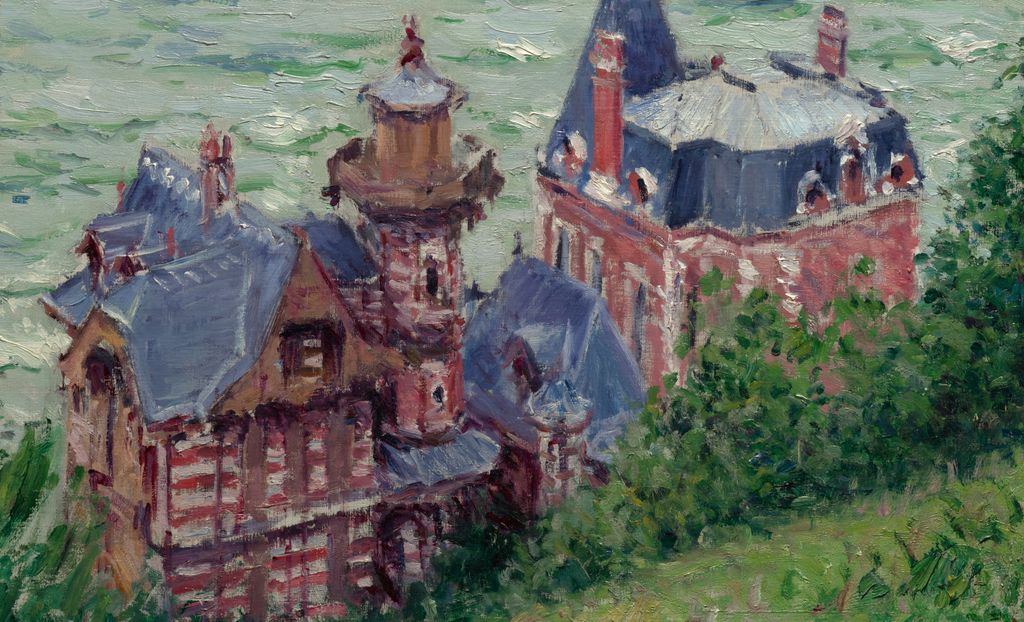
Villas beneath the high viewpoint
Red walls, pale windows and pointed roofs gather below the viewer. The dense architecture occupies only a small part of a much broader coastal view.
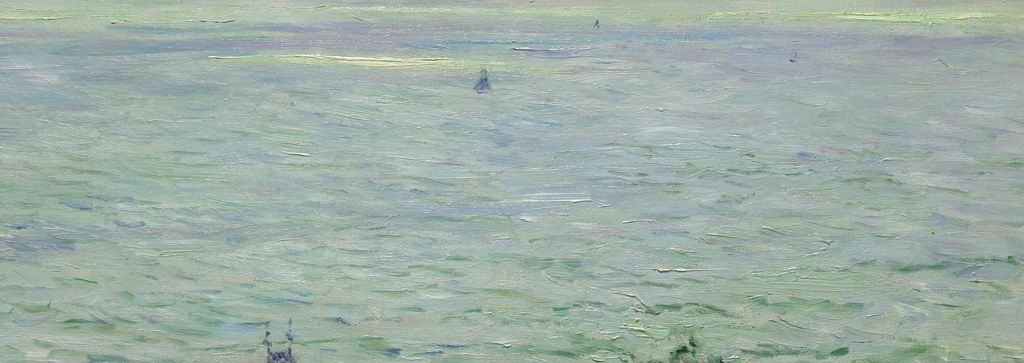
Broken marks across the sea
Short blue-green and pale strokes spread across the water. Their repeated horizontal movement connects widely separated parts of the open sea.
The green slope in the foreground
Green strokes and shrubs cover the slope beside the villas. The irregular pattern contrasts with the sharply divided surfaces of the buildings.
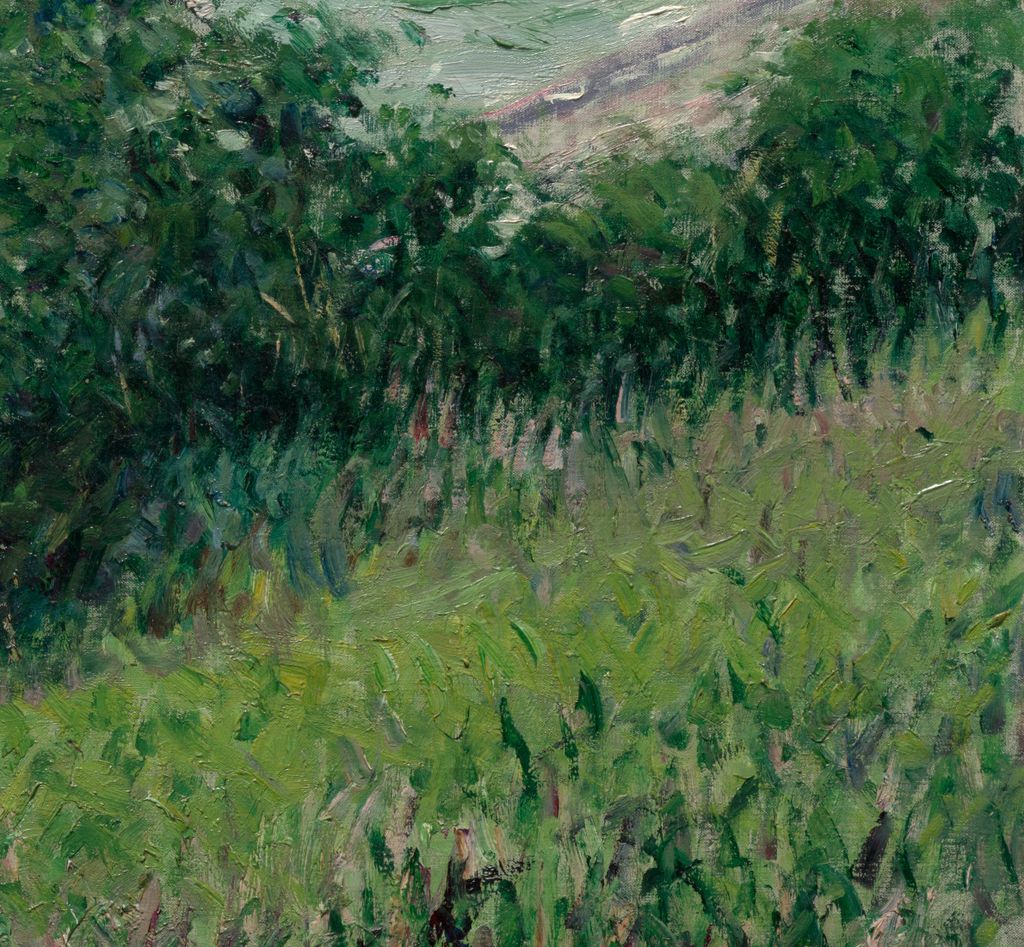
The distant horizon
A thin pale band separates sea and sky. Broad soft passages above it contrast with the more broken marks across the water below.

Flowers and the expansion of the painted surface
Caillebotte’s garden work extends the relationship between near vision and surface. The Giverny museum’s account follows his subjects across Paris, Yerres, Normandy and Petit Gennevilliers. At the latter property, acquired jointly with Martial in 1881, cultivation and painting developed together. Gustave bought his brother’s share in 1887; settlement was a process, rather than a single moment that explains an abrupt change of style. The museum also describes the surviving four-panel presentation of Parterre de marguerites as portions cut from an unfinished decoration after it had been folded and stored, rather than an intact room installation. [24]
Giverny explains that unfinished passages in Parterre reveal an uneven painted green background and reserved flower positions, keeping whites and yellows clean. Repeated motifs create what the dossier likens to a moving vegetal tapestry. [24]
The Met’s Chrysanthemums in the Garden at Petit Gennevilliers, painted in 1893, is a tall canvas measuring 99.4 by 61.6 centimetres. [25] The upper flowers form a congested mass of pale, yellow, rust-red and pink heads, while the lower portion is darker and more openly stalked. Some blooms overlap so closely that their limits become difficult to trace. Others have spiky outer petals that carry individual brush marks beyond the body of the flower.
The change from flower heads to stems gives the composition its vertical movement. Small coloured hooks and radiating strokes gather above; longer brown and green lines descend through the lower half. Unlike the boulevard, there is no clear avenue into the distance. The eye moves around and between nearby plants, repeatedly meeting the surface. Beside Giverny’s account of Parterre, this close view shows how shallow space can emerge through the distribution of flowers and stems.
Jane Becker connects this picture and the Marmottan’s White and Yellow Chrysanthemums with the possibility of decorative panels. Her proposed door or wall setting for the Met painting remains a hypothesis. [26] It is a productive suggestion because it asks how an image might meet a moving viewer within a room. The same question animates the railing, the fruit stand and the cropped pedestrian: how close can the visible world come, and what happens when it exceeds the frame?
Caillebotte’s technique gives that question many answers. A ruled line can make distance convincing; a revised edge can tighten an interior; a stroke of yellow can register both paint and reflected light. His style becomes most distinctive where these material decisions organise an encounter—where the viewer feels a place through the particular way it has been drawn and painted.
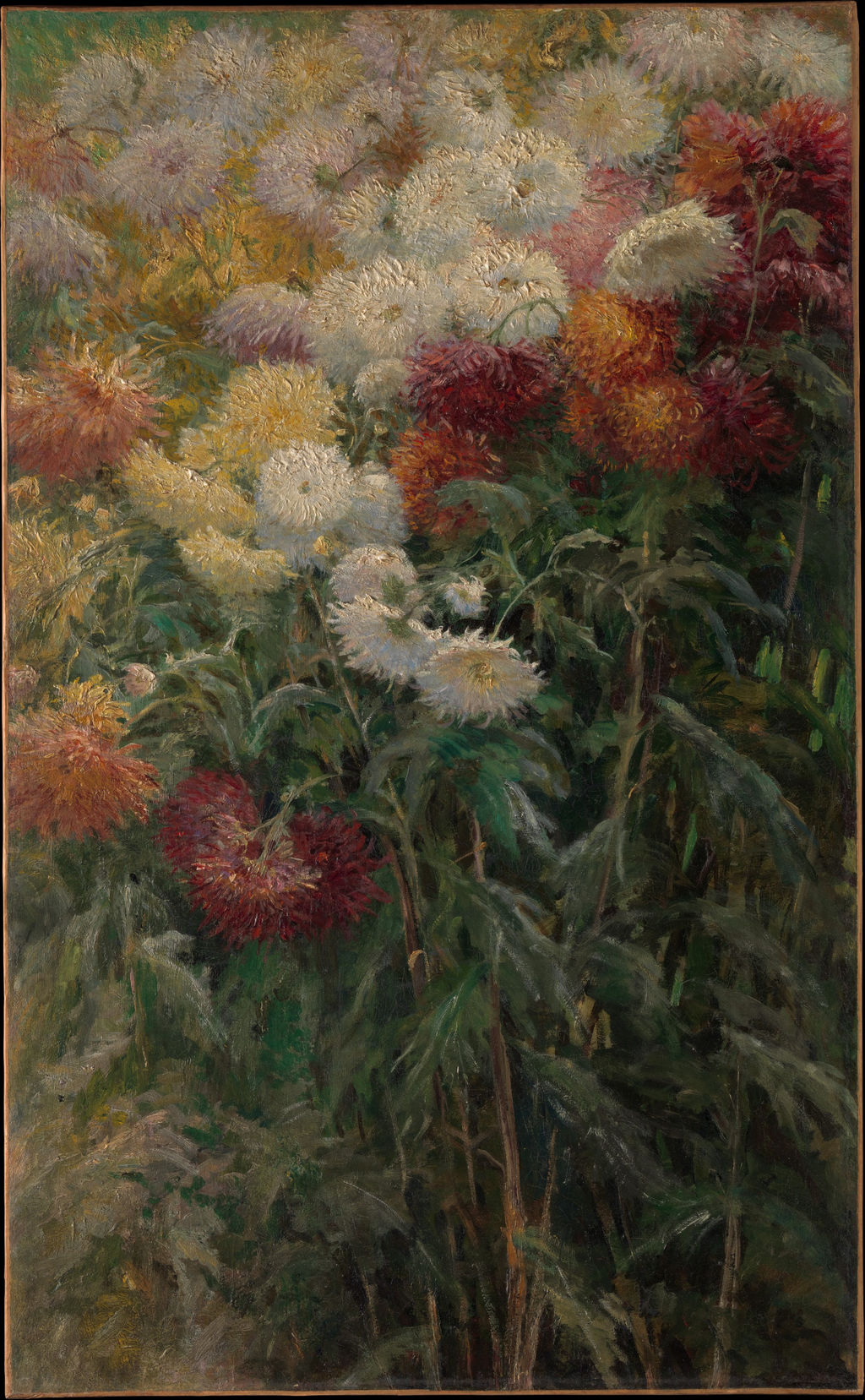
Chrysanthemums in the Garden at Petit-Gennevilliers, 1893; the Metropolitan Museum canvas, 2014.736. Gift of the Honorable John C. Whitehead, 2014. Image source. CC0 / Public domain. Resized only; source appearance preserved.
Catalogue and documented works
This directory brings together 578 entries in the revised 1994 catalogue, 11 further documented records and three groups of study descriptions. It is a directory of records, not a total of authenticated individual works. Albums, print states and surviving decorative panels are grouped. English labels retain the French titles as searchable aliases; dates are supplied only where checked. Numbered entries link to the relevant article or the historical catalogue. Pastels appear under the Drawing filter; original prints remain searchable under All media.
Frequently Asked Questions
No single location describes his practice. Technical evidence supports outdoor work for particular landscapes, including the poplar bud embedded in Cologne’s large laundry painting. That finding belongs to that canvas. [22]
A signature must be examined in context. Several landscapes carry marks probably added after Caillebotte’s death; some unsigned pictures were exhibited during his lifetime. [22]
Discussion
Look again at the images and ideas explored in Style and Technique. These editorial prompts invite your observations.
Reader Insights
An apparent instant can contain a carefully constructed spatial framework.
Comparing a river surface with an interior makes changes in handling easier to see.
Which work most challenges the idea of a single Caillebotte technique?
Join the Conversation
Share a detail, comparison or question about Style and Technique below.
References
- Kirk Varnedoe. Foreword to Jean Chardeau, Les dessins de Caillebotte (1989), p. 7; publisher excerpt, physical PDF p. 9. View source. (in French).
- Paul Perrin, Musée d’Orsay. Entretien commissaire Caillebotte (2024), pp. 1–7, especially 5–6. View source. (in French).
- Marie Berhaut, with Sophie Pietri. Gustave Caillebotte: Catalogue raisonné des peintures et pastels (1994), pp. 4–5 and entries 147–148. Public WPI reader. View source. (in French).
- Musée d’Orsay. Raboteurs de parquets, RF 2718, collection essay. View source. (in French).
- Galina Olmsted. Making and Exhibiting Modernism: Gustave Caillebotte in Paris, New York, and Brussels (2019), pp. 61–69. View source.
- Art Institute of Chicago. Caillebotte Paintings and Drawings (2015), Study (465), Rainy Day (574), Sketchbook (468) and Calf’s Head (467), curatorial and technical reports. View source.
- Cleveland Museum of Art. Study of a Man with Hands in His Pockets, 2020.260, collection record. View source.
- SCHIRN Kunsthalle Frankfurt. Gustave Caillebotte: Ein Impressionist und die Fotografie, wall texts (2012), pp. 1–5. View source. (in German).
- Sjraar van Heugten. View from a Balcony, Van Gogh Museum Journal (2003), pp. 121–122 and notes 1–5. View source.
- Yasuhide Shimbata, Ishibashi Foundation. Research report on Young Man Playing the Piano (2012), pp. 101–105. View source. (in Japanese).
- Musée d’Orsay. Henri Cordier, RF 2729, collection essay. View source.
- Mary Schafer, Nelson-Atkins Museum of Art. Portrait of Richard Gallo, technical entry (2026), construction, paint layers, reformatting and frame. View source.
- Lynn Kellmanson Matheny, National Gallery of Art. Gustave Caillebotte: The Painter’s Eye, brochure (2015), pp. 3–6. View source.
- National Gallery of Art. Skiffs, 1985.64.6, collection essay. View source.
- Caroline von Saint-George and Katja Lewerentz. Gennevilliers Plain, Yellow Fields, technology report (2008), pp. 1–6. View source.
- Ted Gott, National Gallery of Victoria. Gustave Caillebotte: The Plain of Gennevilliers, Yellow Fields (2013). View source.
- Caroline von Saint-George and Katja Lewerentz. The Hillside at Colombes, technology report (2008), pp. 1–6. View source.
- Caroline von Saint-George and Katja Lewerentz. Garden in Trouville, technology report (2008), pp. 1–5. View source.
- Caroline von Saint-George and Katja Lewerentz. Arm of the Seine, Autumnal Mood, technology report (2008), pp. 1–6. View source.
- Caroline von Saint-George and Katja Lewerentz. Boats and Shed on the Banks of the Seine, technology report (2008), pp. 1–6. View source.
- Caroline von Saint-George and Katja Lewerentz. The Banks of the Seine, technology report (2008), pp. 1–6. View source.
- Caroline von Saint-George and Katja Lewerentz. Laundry Drying on the Banks of the Seine, technology report (2008), pp. 1–8. View source.
- Caroline von Saint-George and Katja Lewerentz. Sailing Boat on the Seine at Argenteuil, technology report (2008), pp. 1–7. View source.
- Musée des impressionnismes Giverny. Caillebotte, peintre et jardinier, teaching dossier (2016), pp. 3–14. View source. (in French).
- Metropolitan Museum of Art. Chrysanthemums in the Garden at Petit Gennevilliers, 2014.736, collection record. View source.
- Jane R. Becker, Metropolitan Museum of Art. Caillebotte’s Chrysanthemums; or, Unexpected Encounters with Impressionist Interior Design (2015). View source.
- Marie Berhaut with Sophie Pietri; Wildenstein Plattner Institute, Gustave Caillebotte Catalogue raisonné des peintures et pastels, 1994. View source. (in French).
- Art Institute of Chicago, Caillebotte Paintings and Drawings at the Art Institute of Chicago, 2015. View source.
- Petit Palais / Paris Musées, Portrait de Paul Hugot, original print, PPG2319, current. View source. (in French).
- Paul Perrin, Musée d’Orsay, Transcription de l’entretien commissaire Caillebotte, 2024. View source. (in French).
- Cleveland Museum of Art, Caillebotte collection records: 2020.260, 2009.157 and 2020.105, current. View source.
- Splash image, Paris Street; Rainy Day, 1877; measured space and a close encounter with pedestrians. 5wEUCOlEf-EaVQ at Google Cultural Institute maximum zoom level. Image source. Public domain. Resized only; source appearance preserved.


