


 by Tom Gurney
Tom Gurney BSc (Hons) is an art history expert with over 20 years experience
Email: tomgurney1@gmail.com / Phone: +44 7429 011000
Collector and Bequest: Introduction
Gustave Caillebotte imagined a public future for his collection while he was still a young painter. His will of 3 November 1876 offered the pictures he owned to the French State, with conditions about where they should be seen. The destination mattered as much as the transfer of ownership: the Luxembourg first, the Louvre later. [1]
His work for other artists also took place in rented rooms, exhibition accounts, loans and deliveries. The Getty Museum describes a participant who selected exhibitors, supervised displays, bought pictures and helped meet the costs of publicity. Collecting belonged to this larger involvement in making contemporary painting visible. [2]
The resulting bequest needs to be understood through both pictures and paperwork. A painting bought from a friend, money advanced to help him work, a canvas borrowed for an exhibition and an object eventually accepted by a museum each had a different history. Caillebotte's letters and testament allow us to follow those differences without reducing his contribution to the size of his fortune. [1]
At a Glance
- First testament3 November 1876; further testamentary provisions in 1883 and 1889. [1]
- ExecutorAuguste Renoir. [1]
- Intended museum sequenceMusée du Luxembourg, then Musée du Louvre. [1]
- Final selection38 works for the Luxembourg and two Millet drawings for the Louvre. [3]
- Public opening of the Caillebotte room9 February 1897. [4]
Contents
- Four ways of supporting painting
- Paying for an exhibition, making an exhibition
- Help with a particular purpose
- Looking across the collection
- A testament about being seen
- From the will to the museum
- The painter beside his bequest
Four ways of supporting painting
A collector chooses objects to live with and preserve. A patron supplies resources that allow an artist or enterprise to continue. An organiser assembles people, premises and pictures so that an exhibition can happen. Caillebotte worked in all three capacities while remaining a painter exhibiting his own work. The distinctions help explain why a single purchase cannot stand for everything he did.
His inheritance following his father's death in 1874 gave him considerable freedom to support fellow artists, including Monet and Pissarro. He also lent pictures from his growing collection to the Impressionist exhibitions. In such a loan, a private possession became part of a temporary public argument: viewers could encounter works together, while the owner retained the canvas. [2]
Money entering an artist's household through a sale has a different status from a loan that must eventually be repaid. Similarly, promising to guarantee an enterprise is different from buying a finished picture. These distinctions become especially important when we read the testament. Its cancellation of Renoir's debt records an obligation that still existed; its gift of collected pictures records property Caillebotte could dispose of. Neither provision is adequately described by saying simply that he was generous. [1]
Nor does financial independence mean that his own pictures never entered a sale. Berhaut records four Caillebotte works in the Drouot auction of 28 May 1877: two versions of The Floor Scrapers, House Painters and a view of the Parc Monceau. Their later retention within the family does not establish successful sales to independent buyers. [5] The distinction matters for his paintings: the history of putting a work before buyers is not necessarily the history of finding a new owner.
Paying for an exhibition, making an exhibition
The invitation sent to Caillebotte by Renoir and Henri Rouart on 5 February 1876 specified a contribution of 120 francs per exhibitor. It proposed five works each and an opening on 20 March. Galina Olmsted distinguishes these initial terms from the exhibition that actually opened on 30 March, with eight Caillebotte catalogue entries. She also records three Monet purchases entered in his accounts on 23–26 February, totalling 1,000 francs. [6]
This gives collecting a useful proximity to exhibiting without making the two identical. Buying another painter's work and paying to show one's own work were separate commitments. Together they placed Caillebotte inside the practical arrangements of the independent exhibition. The invitation's fee makes especially clear that independence required an agreed means of paying expenses; it did not remove those expenses.
His correspondence offers a more intimate view of the work afterwards. In a letter to Monet editorially dated late May 1879, he apologised for replying slowly because the exhibition had needed moving. He reported a profit of 439.50 francs per participant, enclosed 400 francs and dealt with the return of pictures, frames and lenders' addresses. The letter moves between financial reckoning and the physical whereabouts of objects with no sense that these were separate concerns. [7]
Caillebotte's own verdict was measured through attendance as well as receipts. In the same letter he wrote, in translation from the printed French transcription: “We had a little over 15,400 admissions. All in all, it is progress.” He acknowledged hostile journalism while maintaining that the exhibition had achieved something for painters and public alike. [7] An admission count cannot tell us whether visitors approved. It does show what he considered worth reporting: people had come, the accounts produced a surplus, and the pictures had reached an audience.
This is a revealing counterpart to the will's future museum. A temporary exhibition required crates, money and decisions about the placement of pictures. A lasting public collection would require an institution willing to receive them and give them space. In both cases, ownership alone left the central question unanswered: who would actually see the art?
Help with a particular purpose
Some interventions answered a narrowly defined obstacle. In 1878, Berhaut records Caillebotte guaranteeing Monet's debt of 800 francs and paying bailiff's expenses. She also describes his willingness to provide backing for Degas's proposed print journal in 1879, an undertaking that remained unrealised. Neither episode should be converted into a purchase of a painting. [5]
A letter from Monet dated 6 July, assigned to 1884 in the catalogue, makes another request quite tangible. His former Argenteuil landlord, the carpenter Flament, still had the large Déjeuner sur l'herbe. Monet asked whether Caillebotte could arrange its return by boat; if that proved possible, he would send the 300 francs still owing. [7] This is a request for intervention, including transport and communication, rather than evidence that Caillebotte bought the canvas. The picture's recovery and its ownership are different questions.
The same care is needed with Manet's Olympia. Berhaut places Caillebotte among the subscribers to the campaign begun in 1889. Monet's letter of 18 February 1890 asks him to forward his subscription so that the outstanding balance can be paid and the picture collected. [5] [7] Caillebotte's part in that collective effort was a contribution towards public acquisition. Olympia was therefore not a picture conveyed to the State through his own collection bequest.
Other letters show the social connections that sustained such practical help. Writing to Durand-Ruel on 1 November 1891, Caillebotte announced the resumption of their customary dinners and gave a precise appointment: Thursday, seven o'clock, Café Riche. A later note to Bellio, dated 24 November 1893, rearranged a dinner at Monet's request. [7] The business is modest, but the repeated effort is visible. Someone had to notify the others, make the date workable and maintain the occasion for meeting.
Samuel Raybone's study of Caillebotte's interiors offers a useful framework for considering this activity. Drawing on Hannah Arendt's distinction between labour and work, he reads painting, yachting and philately as serious productive practices bound to sociability. His argument challenges the assumption that inherited wealth made everything Caillebotte undertook an idle diversion. It remains a scholarly interpretation rather than a statement of the artist's private motives. [8] For the collector, its value is the attention it directs towards what he did with objects and people, alongside what he paid for them.
The friendship also accommodated disagreement about art. Writing to Monet from Trouville on 18 July 1884, Caillebotte reflected at length on Flaubert's letters. He admired the writer's extraordinary application while questioning an art so absorbed by the stupidity of others. Delacroix and Millet supplied different points of comparison; Degas, despite his talent, did not satisfy the ideal of composure Caillebotte was describing. [7] This was a particular critical exchange, not a programme explaining every acquisition. It nevertheless shows the collector making distinctions inside admiration. Loyalty to a person did not require agreement with every quality of that person's work or conduct.
Watch: Gustave Caillebotte
Explore a museum overview and two discussions of Paris Street; Rainy Day. This shared selection offers wider context for the artist’s work.
"Who Is Gustave Caillebotte?" - HD version
An introduction to Caillebotte from the Kimbell Art Museum.
Watch on YouTubeLooking across the collection
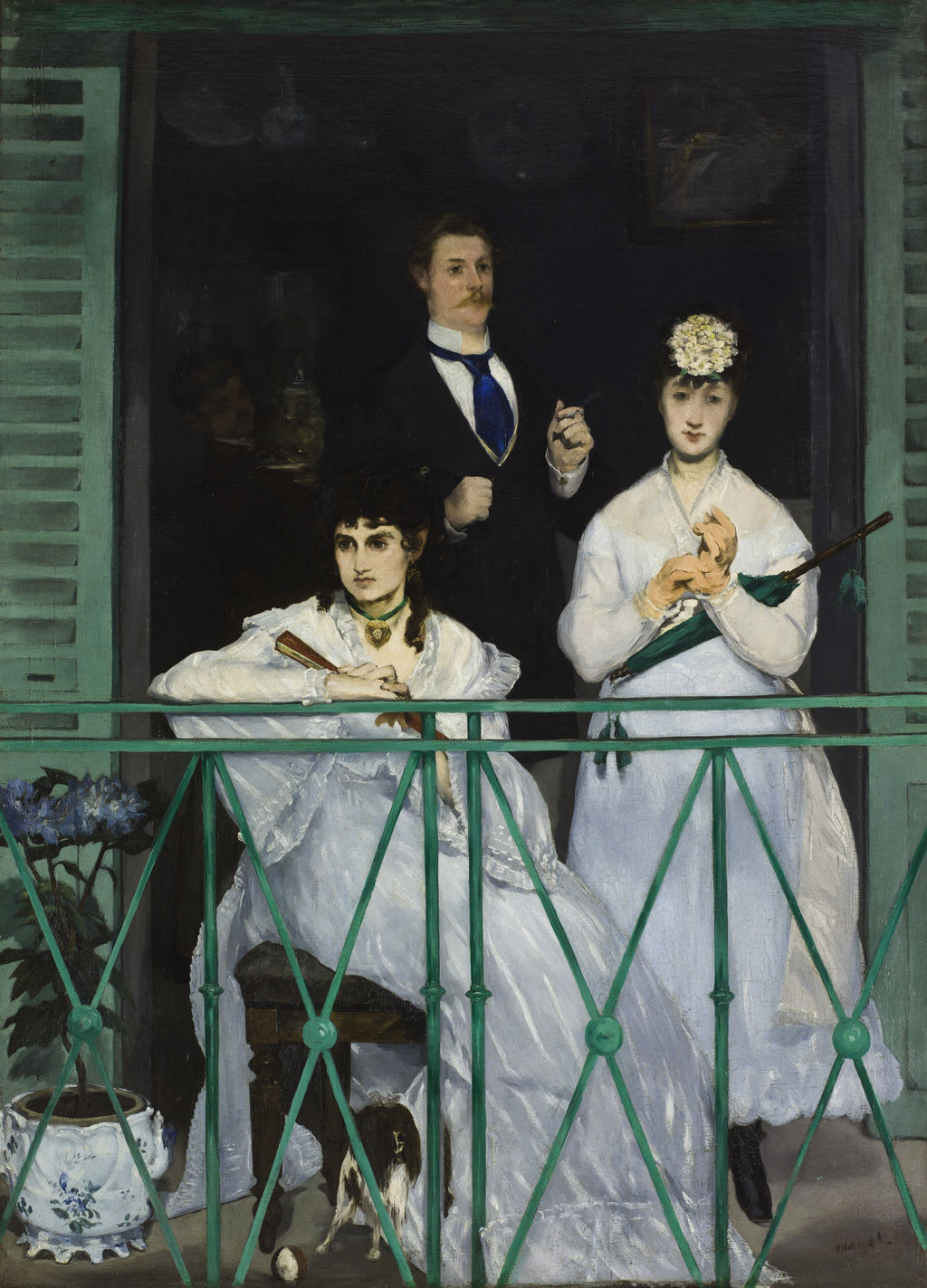
Three pictures that entered the bequest make its visual range immediately apparent: Manet's The Balcony of 1868–69, Renoir's Bal du moulin de la Galette of 1876 and Monet's The Gare Saint-Lazare of 1877. [3]
In Manet's picture, a green railing spreads a firm horizontal across the foreground. Its diagonal bars cut through the white dresses behind it. Open shutters provide further green uprights, turning the opening into a conspicuous frame. Against this structure, the people appear strangely separate. The seated woman looks towards the left, the standing woman faces forward, and the man occupies the darker interval behind them. Their proximity does not make a conversation. The black interior remains deep enough for a further figure to emerge only gradually.
Renoir's dance scene creates a different kind of density. Faces, hats, shoulders, glasses and chairs compete for attention, while pale patches scatter over clothing and ground. At the front, the curving back of the bench and the yellow chair guide the eye into a group gathered around a table. Beyond them the crowd thickens beneath the trees. The repeated light touches make it difficult to isolate a single still figure: an arm, a cheek and the space beside a dress can all participate in the same flickering pattern.
Monet's station also contains a crowd, yet the people are small within the structure. Dark roof beams converge overhead. Below them, steam interrupts the outlines of engines and the buildings outside. The largest pale cloud both conceals the machinery and gives it a visible effect on the surrounding air. The space can be read through its framework, then lost in the shifting paint that fills it. Looking moves between recognition of the station and attention to blue, grey, yellow and violet passages.
The three pictures ask for different habits of attention. Manet's railing holds the figures behind a sharp foreground division. Renoir lets one grouping overlap another until looking becomes a passage through company. Monet provides a geometric enclosure whose contents repeatedly dissolve. Seen together, they make a collection of modern painting more varied than any account based solely on bright colour or rapid brushwork.
They also complicate the relationship between collecting and painting. Admiring a picture need not mean adopting its handling, composition or subject. A collector can preserve a difference. The value of this group for a public museum lies partly in the opportunity to compare those differences directly: a balcony threshold, a crowded dance and a railway shed offer distinct solutions to the problem of bringing contemporary experience onto canvas.
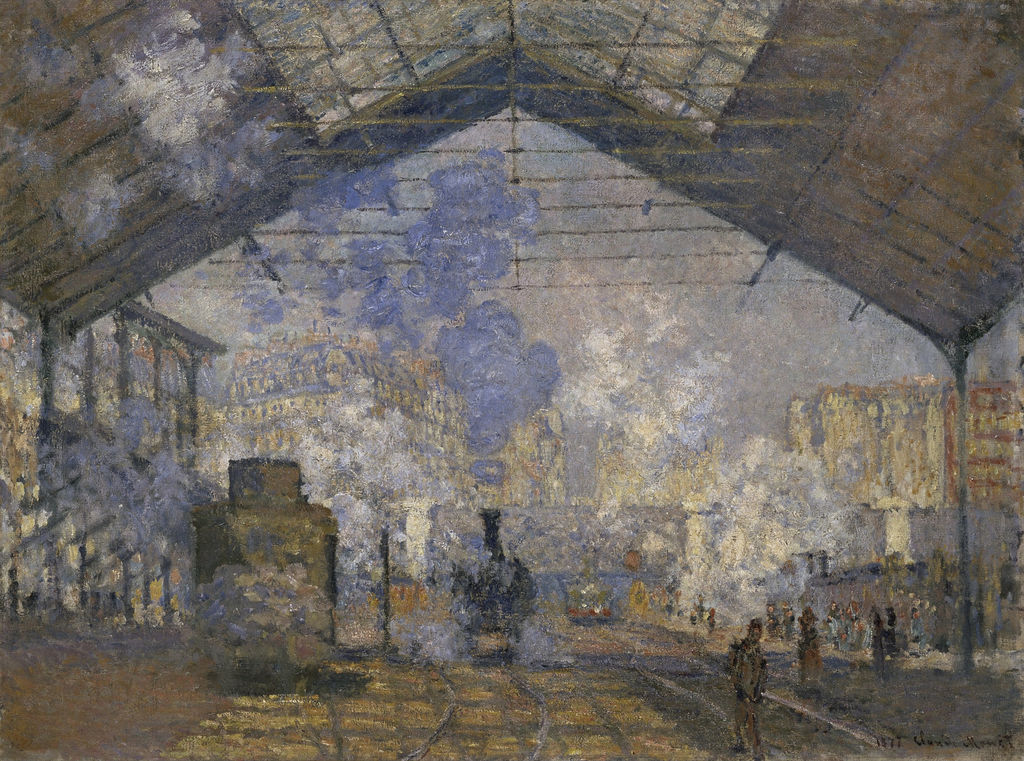
Claude Monet, The Saint-Lazare Station, 1877; the Musée d’Orsay canvas from Caillebotte’s bequest. wAHOCsl09dhUPw at Google Cultural Institute maximum zoom level. Image source. Public domain. Resized only; source appearance preserved.
A testament about being seen
Caillebotte's first will began with an exhibition rather than a museum. He wanted the estate to provide the money necessary for an exhibition in 1878 under the best possible conditions. He estimated that this might require thirty or forty thousand francs, or more. The named painters included Degas, Monet, Pissarro, Renoir, Cézanne, Sisley and Berthe Morisot, followed by an explicit qualification that these names did not exclude others. [1]
The form of the provision is striking. He declined to turn his estimate into a ceiling. The estate should provide what the undertaking required, within the purpose he had defined. Nor did his named list become a closed membership rule. Read literally, it proposed both resources and a degree of flexibility. It was a practical instruction for people who would have to organise something after his death.
The gift of his pictures then widened the horizon. In translation from the French will, he directed that they should go “neither into an attic nor into a provincial museum, but to the Luxembourg and later to the Louvre”. He allowed a delay until the public would accept this painting, specifying that the interval might be twenty years or more. Martial, or another heir if necessary, would keep the pictures in the meantime. [1]
These clauses combine confidence in the pictures with patience about their reception. Twenty years was a possible interval, not a deadline by which the State had to act. The temporary custodian was named so that waiting would have a practical arrangement behind it. Meanwhile the insistence on particular museums made the future destination unusually demanding. The works were to obtain a recognised public place; simply surrendering legal title would not fulfil everything the document sought.
His distinction between public understanding and public acceptance also deserves attention. He did not require a future audience to agree on what every painting meant. The threshold he named was more basic: the art had to be admitted. That wording allows a collection to become public before its reception becomes unanimous. It is especially apt for pictures whose abrupt framing, divided attention or shifting surfaces continue to invite competing responses.
Renoir was asked to act as executor and to choose a picture for himself, with the heirs urged to ensure that he took an important one. The supplement of 20 November 1883 preserved the gift of painting by other artists and recognised that the projected 1878 exhibition provision had become unnecessary. It also cancelled Renoir's debt completely. [1] The update is valuable evidence of how precisely Caillebotte distinguished continuing obligations from an expired plan.
The same supplement provided an annuity for Charlotte Berthier, a gift to Jenny Courtier and additional property for Martial. An addition dated 5 November 1889 left Charlotte a small house at Petit Gennevilliers. [1] The art provisions belonged inside a wider arrangement for particular people. Their specificity makes it unnecessary to invent a single motive explaining every clause.
From the will to the museum
Fanny Matz's archival reassessment shows an initial acceptance on 20 March 1894, followed by disagreement over display obligations. A proposed use of national museum annexes did not settle the heirs' concerns. The eventual compromise allowed a selection, leaving the remainder to the family. Her count is 38 Luxembourg works, plus two Millet drawings for the Louvre: forty objects, including seven Degas pastels. Earlier inventories and changing proposals do not describe an identical group. [3]
The outcome separated preservation within public ownership from preservation of the whole collection as Caillebotte had assembled it. A selected group could enter the museum and be shown; the remainder could stay with the heirs. This involved a real reduction of the proposed gift. It also secured a substantial public presence for the artists. Calling the episode a total refusal loses both sides of the decision.
The Luxembourg selection comprised two Manets, two Cézannes, six Renoirs, six Sisleys, seven Pissarros, eight Monets and seven Degas pastels. [4]
The administrative stages had distinct dates. Presidential authorisation followed on 25 February 1896; Martial delivered the works on 23 November. The new Caillebotte room opened on 9 February 1897. His own The Floor Scrapers and View of Rooftops (Effect of Snow) had been given separately in 1894. The two Millet drawings are associated with Orsay's collections but kept by the Louvre's Department of Graphic Arts. [4]
Matz also traces the retained pictures beyond the settlement: some were later offered again, and sales followed the death of Martial's widow in 1931. The accepted paintings moved to the Louvre between 1929 and 1933. [3] The settlement had a long afterlife.
The painter beside his bequest
The National Gallery of Art's 2015 exhibition brochure observes that the collection's importance helped overshadow Caillebotte's own artistic reputation. [9] That is a consequential afterlife for a gift explicitly concerned with painting by others. A museum could preserve his name through works he had chosen while visitors remained less familiar with works he had made.
His exchanges with Monet nevertheless include the practical frustrations of a working painter. In the June 1883 letter discussed by Nancy Ireson at the Art Institute of Chicago, Caillebotte described working as much as he could, finding his results unsatisfactory and struggling to paint trees before their blossom disappeared. Her sketchbook essay supplies the French transcription and its context. [10] Here the recipient of financial and organisational help was also someone to whom Caillebotte could explain a difficulty in his own art.
The biography and style and technique of that painter deserve their own attention. For the bequest, the essential connection is already present in the documents: making a picture, keeping another artist at work, finding an audience and imagining a museum were activities that could sustain one another. His will gave the last of these an unusually concrete form. It asked future custodians to make looking possible.
Catalogue and documented works
This directory brings together 578 entries in the revised 1994 catalogue, 11 further documented records and three groups of study descriptions. It is a directory of records, not a total of authenticated individual works. Albums, print states and surviving decorative panels are grouped. English labels retain the French titles as searchable aliases; dates are supplied only where checked. Numbered entries link to the relevant article or the historical catalogue. Pastels appear under the Drawing filter; original prints remain searchable under All media.
Frequently Asked Questions
It initially accepted the proposed gift in 1894. Negotiation over its display led to a smaller final selection. [4]
Forty: 38 for the Luxembourg and two Millet drawings for the Louvre. [4]
Yes. Caillebotte asked him to administer the will and choose an important picture; the 1883 supplement also forgave his debt. [1]
Discussion
Look again at the images and ideas explored in Collector and Bequest. These editorial prompts invite your observations.
Reader Insights
The collection brings Caillebotte’s looking into dialogue with his own painting.
Practical support and the wish for public display raise different questions about artistic friendship.
Which painting would you place beside one of Caillebotte’s own works, and why?
Join the Conversation
Share a detail, comparison or question about Collector and Bequest below.
References
- Gustave Caillebotte / Archives départementales de Seine-et-Marne. Testaments of 3 November 1876 and 20 November 1883; addition of 5 November 1889, AD77 112E623-1. Will facsimiles and archival transcriptions. View source. (in French).
- Getty Museum. “Getty Museum Acquires Gustave Caillebotte's Iconic Young Man at His Window” (2021), biographical account of collecting, lending and exhibition organisation. View source.
- Fanny Matz / Musée d'Orsay. “Le legs Caillebotte : une « affaire délicate »” (2024), negotiation, illustrated works and later history; notes 1–26. View source. (in French).
- Archives départementales de Seine-et-Marne. “Le testament de Gustave Caillebotte,” sections on settlement, the 1897 room and separate gifts; artist-by-artist table. View source. (in French).
- Marie Berhaut, with Sophie Pietri. Gustave Caillebotte: Catalogue raisonné des peintures et pastels (1994), pp. 6–7, 10–11 and notes, pp. 13–14. View source. (in French).
- Galina Olmsted. Making and Exhibiting Modernism: Gustave Caillebotte in Paris, New York, and Brussels (2019), pp. 69–72, especially notes 132–134. View source.
- Gustave Caillebotte, Claude Monet and correspondents. Letters transcribed in Berhaut (1994), nos. 20, 31–32, 40, 48 and 51, pp. 275, 277–279. Translations from the printed French; editorial dates retained. View source. (in French).
- Samuel Raybone. “Gustave Caillebotte's Interiors: Working Between Leisure and Labor,” nonsite.org 26 (2018), repository PDF pp. 3–4, 13–16, 25–27. View source.
- Lynn Kellmanson Matheny / National Gallery of Art. Gustave Caillebotte: The Painter's Eye, exhibition brochure (2015), p. 7. View source.
- Nancy Ireson / Art Institute of Chicago. “Sketchbook,” in Caillebotte Paintings and Drawings at the Art Institute of Chicago (2015), curatorial entry and note 10. View source.
- Marie Berhaut with Sophie Pietri; Wildenstein Plattner Institute, Gustave Caillebotte Catalogue raisonné des peintures et pastels, 1994. View source. (in French).
- Art Institute of Chicago, Caillebotte Paintings and Drawings at the Art Institute of Chicago, 2015. View source.
- Petit Palais / Paris Musées, Portrait de Paul Hugot, original print, PPG2319, current. View source. (in French).
- Paul Perrin, Musée d’Orsay, Transcription de l’entretien commissaire Caillebotte, 2024. View source. (in French).
- Cleveland Museum of Art, Caillebotte collection records: 2020.260, 2009.157 and 2020.105, current. View source.
- Splash image, Édouard Manet, The Balcony, 1868–69; a painting in Caillebotte’s bequest, Musée d’Orsay. ggFK0UgXAd7OCA at Google Cultural Institute maximum zoom level. Image source. Public domain. Resized only; source appearance preserved.


