



 by Tom Gurney
Tom Gurney BSc (Hons) is an art history expert with over 20 years experience
Published on June 19, 2020 / Updated on November 2, 2026
Email: tomgurney1@gmail.com / Phone: +44 7429 011000
Nude on a Couch: Introduction
A woman lies diagonally across a floral couch, one leg extended, the other bent, her raised arm obscuring her face. The crowded upholstery seems almost to surround her. Gustave Caillebotte’s Nude on a Couch, painted about 1880, brings an unclothed body into a recognisably furnished modern interior on a canvas nearly two metres wide. The painting belongs to the Minneapolis Institute of Art. [1]
The subject is intimate, but its arrangement gives the viewer no easy social encounter. We can inspect the woman’s body while seeing little of her expression. Clothes gather at the head of the couch; dark footwear stands below it. These ordinary things give the scene its particular character, while the absence of an explanatory story leaves the relationship between model, painter and spectator unresolved.
In their 2025 exhibition text, the Getty Museum’s curators discuss this painting with Man at His Bath as challenging transformations of the traditional nude into modern realism. [2]
That comparison asks how painting makes private life available to strangers, and what changes when the body being watched is female or male.
At a Glance
- ArtistGustave Caillebotte.
- TitleNude on a Couch, also known as Nu au divan.
- DateAbout 1880.
- MediumOil on canvas.
- Dimensions129.5 × 195.6 cm.
- CollectionMinneapolis Institute of Art, The John R. Van Derlip Fund.
- Accession number67.67. [1]
- Catalogue number201 in Marie Berhaut’s 1994 catalogue raisonné. [3]
This work across Gustave Caillebotte’s career
The Orange Trees
1878 [4]Nude on a Couch (current article)
about 1880Man at His Bath
1884 [4]Contents
- A pose that withholds a face
- The couch occupies the room
- Clothing, light and the limits of a story
- The earlier pastel is a separate work
- Looking at the female and male nude together
- From a private interior to museum display
A pose that withholds a face
The first strong movement is from the outstretched foot at the lower left towards the woman’s head at the upper right. The long foreground leg, hips and torso form a pale diagonal across the couch. The other knee rises sharply, introducing a second direction into a pose that might otherwise seem simply horizontal. Her body occupies the furniture unevenly: stretched along the seat below, gathered into a more complicated arrangement of arms, hair and cushions above.
The raised arm is essential. Its elbow creates a conspicuous angle, while the forearm interrupts our view of the head. The face is partly absorbed into shadow and partly hidden by the pose. The other hand lies against the torso. The gestures make the figure more specific than an evenly displayed anatomical study, yet they do not explain themselves. A raised arm could accompany rest or a deliberate pose; the picture alone cannot establish whether the woman is sleeping, avoiding the light or responding to being observed.
This uncertainty affects how we look. The extended leg is open to view, and the broad illuminated surface of the body attracts attention. At the head, however, recognition becomes difficult. The painting grants visual access without supplying the reciprocity of a clearly visible gaze. It is possible to spend a long time examining the figure while learning very little about the person represented.
At nearly two metres across, the canvas also makes this relationship physical. Its subject does not retreat into a small, comfortably distant scene. The couch stretches through much of the field, and its front edge approaches the bottom of the painting. There is little intervening floor to establish a polite distance between the spectator and the woman. The documented dimensions help explain why the composition can feel imposing even though its action is minimal. [1]
The couch occupies the room
The floral couch is almost as insistent as the body. Its pale ground carries small red and green forms, while darker bands divide the surface into repeated vertical sections. The pattern extends across the upright cushions, the seat and the hanging front. It is interrupted by seams and folds, but it remains visually active over a large area of the canvas. The woman’s relatively unbroken skin stands out against this constant small-scale movement.
Two broad cushions rise behind the bent leg. At the opposite end, a cushion supports the head and upper body. The furniture therefore does more than identify a domestic setting: its separate padded parts help produce the pose. The horizontal seat accommodates the extended leg; the support at the right raises the shoulders; the back cushions make a patterned barrier behind the body. Against the comparatively plain wall, these arrangements become especially legible.
Megan Seiler, writing for the Nelson-Atkins Museum of Art, identifies this divan in Woman Reading, Bezique Game and a self-portrait. Its loose cushions and bed-like base, she explains, allowed it to be rearranged. [5]
The couch becomes a practical component of an artist’s working environment as well as a conspicuous object within the finished painting.
Seiler proposes that the sofa in Portrait of Richard Gallo may be this divan under another fabric, pointing to folds and missing cushion divisions. This remains a hypothesis about that portrait. [5]
The comparison draws attention to how upholstery, cushions and the sitter’s placement can change an interior’s entire visual character.
In Nude on a Couch, the result is an unusually close association between furnishing and flesh. The textile supplies neither a neutral backdrop nor a decorative border. It takes up enough space to compete for attention, and its repeated divisions make the body’s irregular bends more noticeable. Looking back from the pattern to the woman, we become more aware of how little in her pose follows the couch’s regular structure.
Clothing, light and the limits of a story
The garments at the right introduce a different kind of surface. Dark cloth gathers behind the woman’s head and arm, while a pale garment hangs over the support beside her. Below, near the lower right, dark boots stand against the couch and the strip of floor. These objects connect the unclothed figure with the ordinary acts of dressing and undressing. They also make a powerful contrast of scale: a small area of footwear anchors the much larger expanse of pale upholstery above it.
The light separates these materials without making the scene uniformly bright. The leg and torso are readily visible, but the head remains difficult to read. The pale garment catches the light in broken folds; the darker fabric behind the arm produces a much denser patch. These contrasts concentrate attention on the point where the body ends and clothing begins. They also keep the head from becoming the clear centre of a portrait.
The Getty’s curators suggest Caillebotte’s Boulevard Haussmann apartment-studio as a possible setting for both nudes. They emphasise the absence of mythological, historical or exotic justification, interpreting the intimate encounters as voyeuristic. [2]
That reading grows from particular decisions visible here. The couch belongs to furnished daily life. No attribute identifies the woman as a goddess or a historical heroine. The scattered clothing offers a practical context for nudity, yet no other person appears to clarify what has happened or what will follow. The painting is precise about bodily position and material surroundings while remaining reticent about the event.
The model’s identity is not securely established. [3] Neither the obscured face nor the intimacy of the setting licenses a personal biography. The useful distinction is between the closeness produced by the composition and a documented relationship outside it. We can describe the former in detail without pretending that it supplies the latter.
Watch: Gustave Caillebotte
Explore a museum overview and two discussions of Paris Street; Rainy Day. This shared selection offers wider context for the artist’s work.
"Who Is Gustave Caillebotte?" - HD version
An introduction to Caillebotte from the Kimbell Art Museum.
Watch on YouTubeThe earlier pastel is a separate work
Caillebotte had already made a substantial reclining female nude in 1873. Berhaut catalogues that earlier work as Femme nue étendue sur un divan, number 8: a signed and dated pastel measuring 87 × 113 cm. Nude on a Couch is number 201 and is an oil painting. Similar subjects and overlapping translations of their titles can obscure this basic distinction. The 1873 pastel is neither another name for the Minneapolis canvas nor evidence that its medium is pastel. [3]
The catalogue’s illustrations make the difference plain. In the earlier composition, the woman reclines amid extensive drapery, with her body, hands and legs arranged quite differently. The Minneapolis painting stretches the body along a much broader floral couch, gives the bent knee a sharper prominence and places everyday clothing at the head. They share a reclining subject and an interest in the arm’s relationship to the head, but they are distinct compositions.
Berhaut connects the pastel with Caillebotte’s admission to the École des Beaux-Arts in 1873 and characterises it as unusually academic within his known work. She suggests that its scale and careful signature may indicate an intention to submit it to the Salon. That is the catalogue author’s proposal, rather than a documented submission. It nevertheless provides a useful account of how the early nude could belong to the artist’s training and professional ambitions. [3]
The later oil gives the reclining figure a markedly different material environment. Instead of allowing drapery to organise most of the surrounding space, it makes the repeated pattern and construction of a household couch unavoidable. The distinction is therefore more illuminating than a simple change of medium. It shows how the same broad subject could be reconsidered through the relationship between a body and its immediate furnishings.
Dating also requires care. The 1994 catalogue places number 201 in its 1881–1882 sequence, whereas the Musée d’Orsay’s 2024 caption dates the Minneapolis painting to about 1880. The approximate date used here follows that recent institutional identification. The change does not alter which canvas is under discussion: the dimensions, collection and accession number identify the same oil painting. [3] [1]
Looking at the female and male nude together
Paul Perrin’s account of the Musée d’Orsay exhibition explains how its domestic interiors led into a more intimate space where this woman on a couch confronted a man attending to his body in a bathroom. The arrangement made the contrast between their poses and settings part of the exhibition’s argument. [6]
Their differences matter. Here the body reclines along a strongly horizontal piece of furniture, and one leg extends towards the edge. In Man at His Bath, the standing figure turns his back towards the spectator and is engaged in drying himself. One arrangement offers a comparatively extended body; the other concentrates on an ordinary bodily action. Both prevent the face from providing the encounter’s principal explanation.
The historical expectations were unequal. In her study of Caillebotte’s exhibitions, Galina Olmsted points out that female nudes in domestic settings had appeared in Impressionist exhibitions, while male nudes were much rarer outside history painting. She discusses the difficult reception of Man at His Bath at Les XX in Brussels in 1888. An anonymous review in La Chronique, which she transcribes, reported that it and a work by Louis Anquetin had been relegated to a secondary space. No surviving document explains the organisers’ reason or records Caillebotte’s reaction. [7]
Olmsted interprets sexual insinuations in the Brussels reviews as evidence of the difficulty a sexualised male body could present to contemporary viewers. Her interpretation concerns a reception shaped by assumptions about gender; it cannot establish the artist’s sexuality. [7] Beside the woman on the couch, the standing bather invites a more searching examination of how pose and setting organise a spectator’s access to another person’s body.
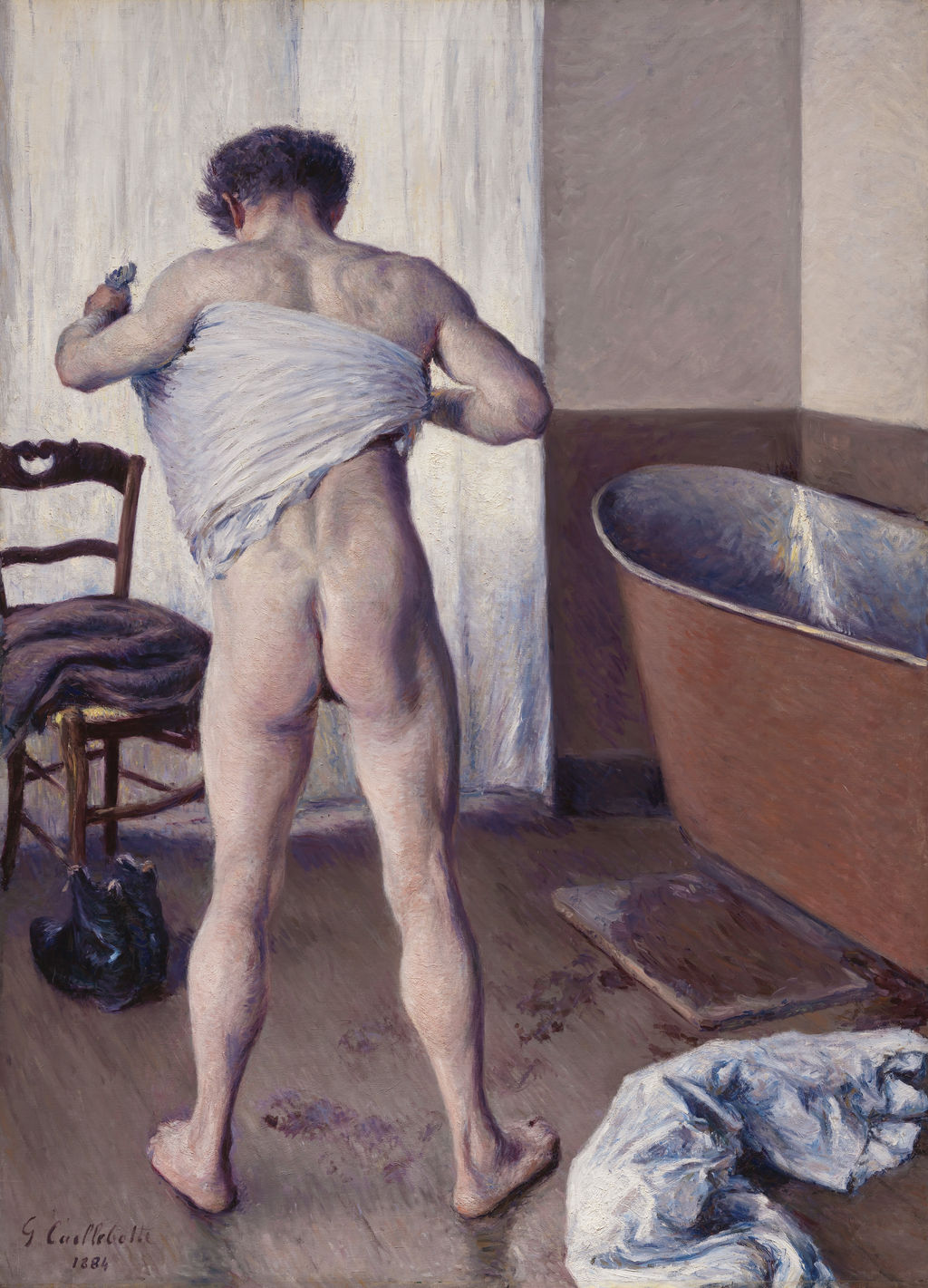
Man at His Bath, 1884; the separate male nude paired with the couch painting in recent exhibitions. https://www.google.com/culturalinstitute/asset-viewer/man-at-his-bath/igG6jTDcTNW5fw?projectId=art-project. Image source. Public domain. Resized only; source appearance preserved.
From a private interior to museum display
Berhaut’s provenance for Nude on a Couch traces it from the artist’s family through Lorenceau in Paris and Stephen Hahn in New York to Minneapolis. Her exhibition list records the canvas in Hahn’s Le Nu, Manet to Matisse in 1967, a Caillebotte exhibition in New York in 1968, the Houston and New York exhibition of 1976–1977, and the Paris–Chicago retrospective of 1994–1995. These documented appearances show the painting entering both broader histories of the nude and exhibitions devoted to the artist. [3]
The later Painting Men exhibition gave the female figure a different setting for interpretation. The Musée d’Orsay presentation explains that female figures throughout its itinerary helped clarify the unusual character of an artist so persistently concerned with men. Perrin’s discussion places the couch painting within the transition from sociable apartment interiors to the more exposed privacy of the nude. This context makes the woman central to the exhibition’s questions about gender and looking, even within a project focused on male subjects. [1] [6]
Seiler’s identification of the recurring divan connects the nude with Bezique Game and other interiors. [5]
That continuity is suggestive. Clothed friends read, sit or gather in furnished rooms; here the body lies exposed. The significance changes when clothing is removed, but the modern domestic setting remains.
Returning to the painting after these comparisons, the small decisions become more forceful: the hand resting on the torso, the arm across the face, the foot close to the left edge, the pale garment dropping beside the head. Caillebotte gives each a definite place without joining them into a definite story. The couch is solid, patterned and familiar; the woman remains partially inaccessible. That combination sustains the painting’s intimacy and the spectator’s uncertainty about what such intimacy permits us to know.
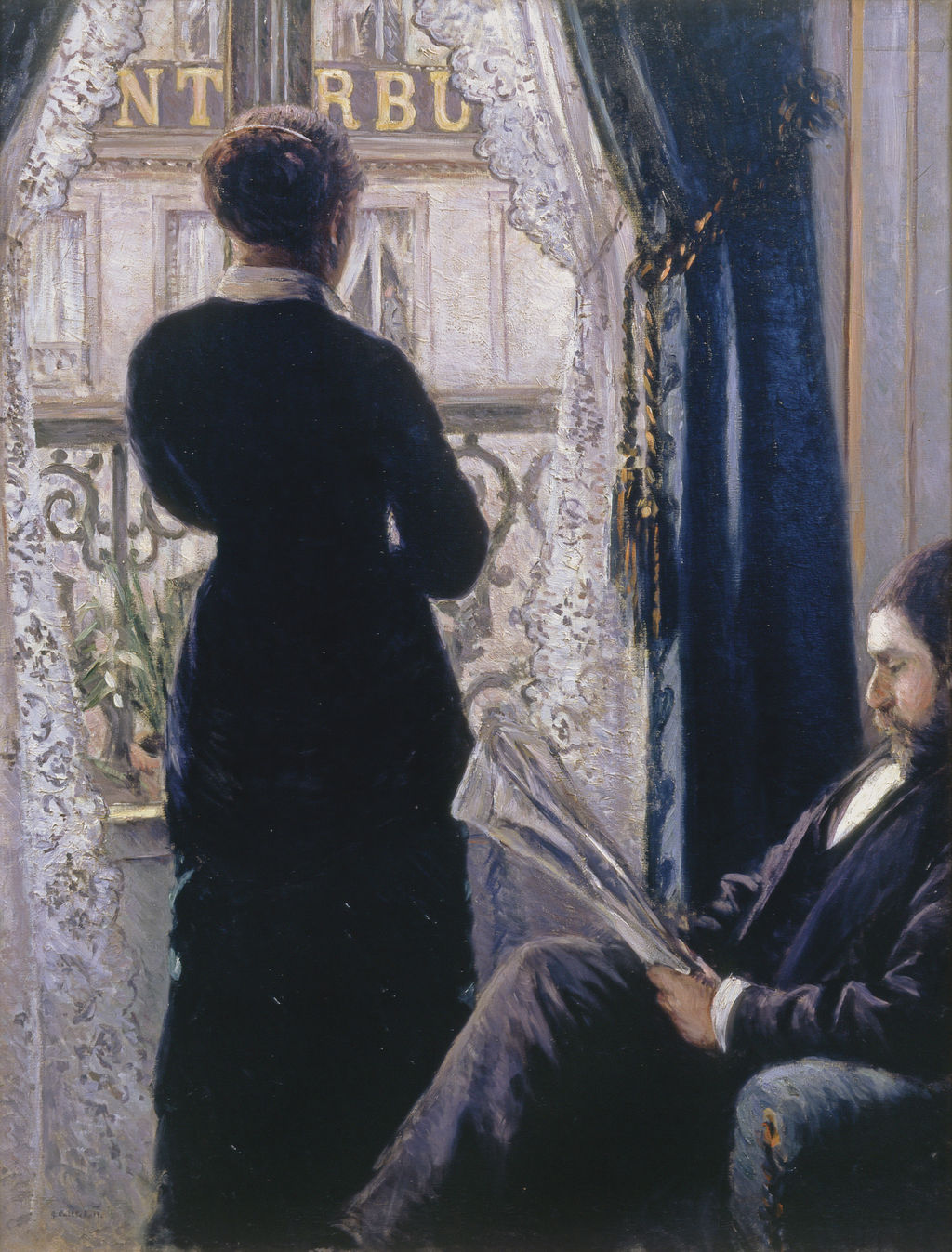
Interior, Woman at the Window, 1880; a contrasting furnished domestic setting with clothed figures.
Catalogue and documented works
This directory brings together 578 entries in the revised 1994 catalogue, 11 further documented records and three groups of study descriptions. It is a directory of records, not a total of authenticated individual works. Albums, print states and surviving decorative panels are grouped. English labels retain the French titles as searchable aliases; dates are supplied only where checked. Numbered entries link to the relevant article or the historical catalogue. Pastels appear under the Drawing filter; original prints remain searchable under All media.
Frequently Asked Questions
It belongs to the Minneapolis Institute of Art, accession 67.67, with the credit line The John R. Van Derlip Fund. [1]
The Minneapolis work is oil on canvas. Caillebotte’s 1873 Femme nue étendue sur un divan is a separate pastel, number 8 in Berhaut’s catalogue; the oil is number 201. [3]
The Getty’s curators connect their modern settings, unexplained nudity and unsettling spectator relationships. Their different poses make the comparison especially revealing. [2]
Discussion
Look again at the images and ideas explored in Nude on a Couch. These editorial prompts invite your observations.
Reader Insights
The pose withholds a full view of the face.
The couch gives the body a large and uneven field of support.
How does comparing this figure with Man at His Bath change your attention?
Join the Conversation
Share a detail, comparison or question about Nude on a Couch below.
References
- Musée d’Orsay; Paul Perrin, Scott Allan and Gloria Groom. Caillebotte: Painting Men, institutional exhibition presentation and selected work captions (2024), curatorial presentation and caption for Nu au divan, about 1880, Minneapolis, 67.67. View source. (in en/fr).
- J. Paul Getty Museum. Gustave Caillebotte: Painting Men: Gallery Text (2025), PDF p. 9, “The Nude”. View source. (in en/es).
- Marie Berhaut, with Sophie Pietri. Gustave Caillebotte: Catalogue raisonné des peintures et pastels (1994), pp. 62–63, no. 8; pp. 150–151, no. 201 and illustration; available through the Wildenstein Plattner Institute. View source. (in French).
- Marie Berhaut with Sophie Pietri; Wildenstein Plattner Institute, Gustave Caillebotte Catalogue raisonné des peintures et pastels, 1994. View source. (in French).
- Megan Seiler, Nelson-Atkins Museum of Art. “Gustave Caillebotte, Portrait of Richard Gallo”, in French Paintings and Pastels, 1600–1945 (2024), catalogue essay, discussion of the divan and fig. 1, notes 6–9. View source.
- Paul Perrin, Musée d’Orsay. Transcription de l’entretien commissaire Caillebotte (2024), PDF p. 5, apartment interiors and the juxtaposition of female and male nudes. View source. (in French).
- Galina Olmsted. Making and Exhibiting Modernism: Gustave Caillebotte in Paris, New York, and Brussels (PhD dissertation, University of Delaware, 2019), pp. 291–297, especially pp. 294–295, discussion and transcription of “Chez les XX”, La Chronique, 10 February 1888. View source.
- Art Institute of Chicago, Caillebotte Paintings and Drawings at the Art Institute of Chicago, 2015. View source.
- Petit Palais / Paris Musées, Portrait de Paul Hugot, original print, PPG2319, current. View source. (in French).
- Paul Perrin, Musée d’Orsay, Transcription de l’entretien commissaire Caillebotte, 2024. View source. (in French).
- Cleveland Museum of Art, Caillebotte collection records: 2020.260, 2009.157 and 2020.105, current. View source.
- Splash image, Nude on a Couch, about 1880.


