 by Tom Gurney
Tom Gurney BSc (Hons) is an art history expert with over 20 years experience
Published on June 19, 2020 / Updated on October 2, 2026
Email: tomgurney1@gmail.com / Phone: +44 7429 011000
The Annunciation
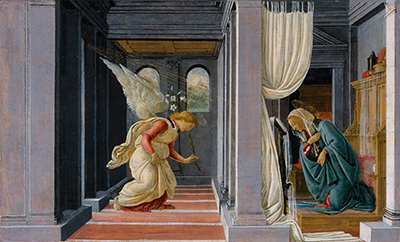
Gabriel enters from the left and lowers himself towards Mary. She kneels beyond a curtain, inside a room with a bed and cupboards. Between them, a row of pale columns divides the painted space without cutting off their exchange. The panel is small enough to hold in two hands, yet Botticelli gives its meeting a deep architectural setting. The eye follows the tiled floor towards the figures and then passes between them along the angel's arm and Mary's lowered head.[1]
This Annunciation belongs to the Metropolitan Museum of Art's Robert Lehman Collection in New York, inventory 1975.1.74. The Met's current English record dates it to about 1490 and identifies tempera and gold on wood. It is a separate painting from Botticelli's larger Cestello panel and San Martino fresco in the Uffizi. Their shared subject should not make their dates, settings or patrons interchangeable.[1][4]
At a glance
- ArtistSandro Botticelli
- TitleThe Annunciation
- Dateabout 1490 in the current Met record; an older Met audio account suggests the mid-1480s
- Mediumtempera and gold on wood
- Dimensions19.1 × 31.4 cm
- Current collectionThe Metropolitan Museum of Art, Robert Lehman Collection, New York
- Object number1975.1.74
- First patronnot known
Where this work sits in Botticelli’s career
Fortitude
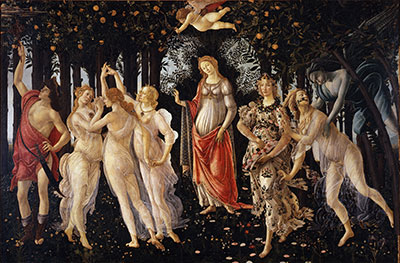
1470Primavera
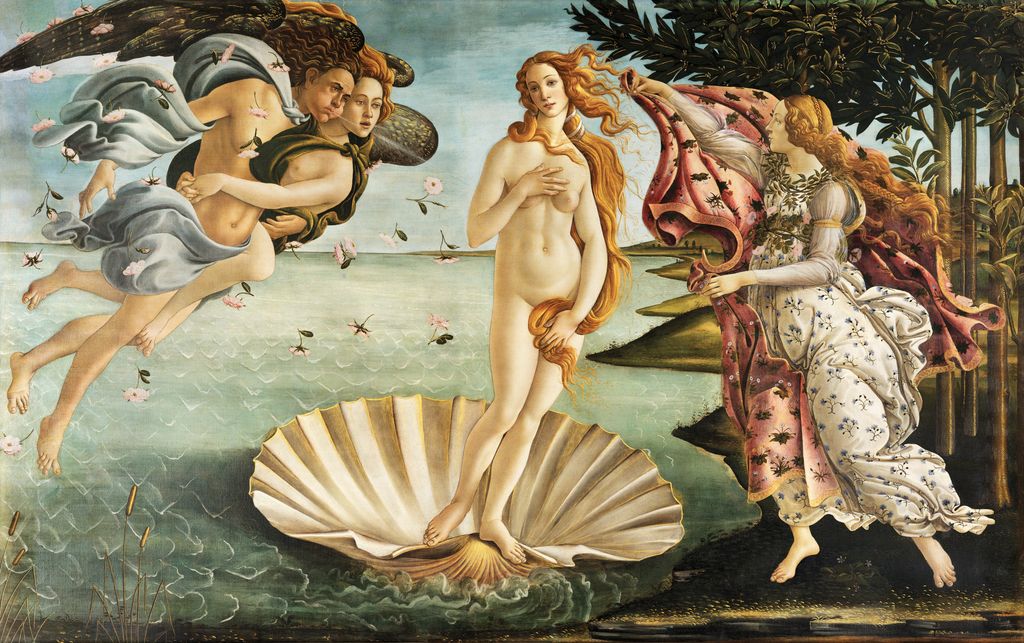
c. 1480The Birth of Venus
c. 1485The Met Lehman Annunciation
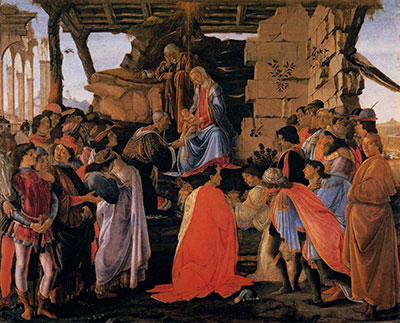
ca. 1490The Mystical Nativity
c. 1500Contents
- A Meeting Across the Columns
- Mary's Room
- A Small Painting Built with Care
- This Panel's Later History
- A Separate Annunciation from the Uffizi Works
The current date deserves notice because estimates have changed. The Met's present object page and Open Access record say ca. 1490, while a curator's earlier audio account says probably mid-1480s. These are different estimates for the same panel, not evidence that two Met Annunciations have been combined. The current catalogue date leads here.[1][2]
A Meeting Across the Columns
The angel's large pale wings carry him into the left part of the room. He bends and begins to kneel, holding a slender lily. Mary responds on the other side of the central columns, her body folding forward in a compact gesture. Their poses are related but not identical. Gabriel is still arriving; Mary has drawn herself inward. The difference gives the meeting a moment of movement within the measured architecture.[1][2]
The floor's horizontal bands pull the eye into the painting. Tall posts and columns then break the space into nearer and farther areas. The Met describes this as one-point perspective: a way of organising the architecture to make depth appear on a flat surface. The device is clear even in a reproduction. It gives Gabriel a route towards Mary and makes her chamber seem both connected to and set apart from the space in which he appears.[1]
The central structure is especially important. A row of pillars stands between the angel and the bedchamber, but the figures are not confined to separate stories. Light crosses the space and their gestures answer each other. A Met essay on paintings of Christ's birth and infancy treats this panel as a balanced encounter in a classical interior. The balance is not stillness: Gabriel's entry and Mary's response remain visible as actions.[1][3]
At the upper left, an opening shows a small patch of landscape. This view makes the house seem part of a wider world, yet Botticelli gives most of the panel to the interior. The setting is not a measured plan of a particular Florentine home. It is an imagined, carefully ordered place in which the announcement can be seen and contemplated.[1][2]
Mary's Room
The curtain is pulled aside, exposing Mary kneeling near her bed. The Met's audio description draws attention to the bed and storage furniture and suggests she had been reading, probably a book of hours. That last detail is an interpretation of what may be on or near her reading stand, not a surviving record of the exact text before her. The curtain's visible movement is enough to show an intimate part of the room opened to the viewer.[2]
Mary's blue-green mantle makes a broad shape against the warm floor. Her bowed head, hands and covered body contrast with the angel's wings and forward motion. Botticelli has made the encounter quiet without emptying it of surprise. The columns permit a measured pause between the two figures, while the open curtain allows us to see the private room in which Mary receives the message.[1][2]
The setting matters for the painting's likely use. The Met says this small panel was almost certainly commissioned as a private devotional image rather than as one part of a larger altarpiece. Its modest dimensions support the idea of close viewing, although the institution does not name the first owner or an original room. A viewer could attend to the figures and then return to the bed, curtain and floor while thinking through the sacred episode.[1]
A Small Painting Built with Care
The Met notes incised lines on the panel's surface as evidence of Botticelli's method for constructing the complicated design. Such marks are more than accidental scratches in the picture: they show planning for the architecture and perspective beneath the finished paint. The panel's size makes that care striking. A scene barely wider than thirty centimetres contains a sequence of spaces that stays legible when the painting is seen as a whole.[1]
The wooden surround visible in the Met photograph also draws attention to the panel's small scale. The current online record does not establish that the surround is the original frame, so its appearance should not be used to reconstruct how Botticelli first presented the work. The painted architecture itself supplies the strong border around the scene.[1]
John Pope-Hennessy's detailed Lehman catalogue adds an important physical qualification. He reports that the horizontal-grain wood panel was thinned and set into a second panel, and that a lip of original gesso survives around its edges. From that surviving ground he judged the painted face had not been cut down. This is a more precise statement than saying the small painting has simply remained untouched: its support has been altered, while the evidence at the edge speaks to the original painted extent. The catalogue also notes that the gilding had been reinforced and that parts of Gabriel, including his head, suffered paint loss and later reconstruction. A viewer can still study the design, but should not assume every bright or sharply defined detail is in its first state.[5]
Tempera and gold are the materials listed by the Met. They do not mean the whole image shines uniformly. Much of the room is restrained in colour, allowing the angel's pale wings, Mary's blue-green clothing and the warm floor to stand out. The arrangement gives the scene a sense of order while preserving the differences between the messenger and the person addressed.[1]
This Panel's Later History
The Met records the picture in the Barberini collection in Rome in the seventeenth century. That is a later provenance milestone, not evidence for the original patron. The first commission remains unknown in the museum's public account. The painting entered the Met as part of the Robert Lehman Collection in 1975, where its small size is now encountered within a much larger museum setting.[1]
Pope-Hennessy traced a fuller later route: Barberini inventories of 1648–49 and 1679, a nineteenth-century Palazzo Barberini listing, export from Italy in 1905, a period with Oscar Huldschinsky in Berlin, and Robert Lehman's acquisition in 1928. The catalogue records a cleaning shortly before 1931 and earlier photographs showing a partly overpainted state. These dates document movement and changes in appearance after Botticelli; they do not fill the much earlier gap between the artist and the first securely listed owner.[5]
The same study tested an older suggestion that the picture once belonged to the San Barnaba altarpiece's predella. It rejected that idea because the main altarpiece already included an Annunciation in its roundels and surviving predella scenes tell episodes from the Virgin's life rather than this proposed setting. Pope-Hennessy concluded that the small panel seems to have been independent, while expressly saying there is no direct indication of its first purpose. The Met's current “almost certainly” private-devotional description is a plausible reading of its scale and self-contained design, with the first household and commission still unknown.[5][1]
Older Met materials call the picture about 1485 or mid-1480s. The current Met object record and its updated Open Access data use about 1490. An approximate date should remain approximate; the difference is a reminder that dating can be revised without changing the panel's identity.[1][2]
A Separate Annunciation from the Uffizi Works
The Uffizi holds two other Botticelli Annunciations: the San Martino fresco dated 1481 and the Cestello panel dated 1489–90. The Met painting is much smaller than either and shows Gabriel and Mary in a closely divided interior with a drawn curtain. The Cestello work had a documented Guardi family chapel commission, while the Met says the Lehman panel's first patron is unknown. Facts about one should not be transferred to another merely because all three show the same biblical moment.[1][4]
Look again at the narrow space between Gabriel's gesture and Mary's bowed figure. The pillars, curtain and floor make that interval feel deep, but the two figures still belong to one encounter. Botticelli turns a small wooden panel into a place for sustained looking: the divine message arrives through an imagined house, and Mary's response holds the viewer at its centre.[1]
Botticelli and related artworks
Discussion
Look again at the details and evidence discussed above. Which part of the painting changes most when you know its history?
These prompts invite close looking and source-led questions rather than a single settled interpretation.
Reader Insights
How do the columns divide Gabriel and Mary while keeping them in one scene?
Which details make the room feel deep despite the panel’s small size?
What can the Met’s description support about private devotional use, and what remains unknown?
Join the Conversation
Share an observation or question about the painting below.
References
- The Metropolitan Museum of Art, “The Annunciation,” Robert Lehman Collection, 1975.1.74, current object record, accessed 29 September 2026 View source.
- The Metropolitan Museum of Art, curator Laurence Kanter's audio transcript on the object page, “The Annunciation,” accessed 29 September 2026. The transcript gives an earlier mid-1480s estimate View source.
- The Metropolitan Museum of Art, “The Birth and Infancy of Christ in Italian Painting,” essay identifying object 1975.1.74, accessed 29 September 2026 View source.
- Uffizi Galleries, “Botticelli's Annunciations” and “Annunciation (Cestello),” accessed 29 September 2026 View source View source.
- John Pope-Hennessy, assisted by Laurence B. Kanter, The Robert Lehman Collection, vol. 1: Italian Paintings, Metropolitan Museum of Art, 1987, pp. 188–91, object 80, on construction, condition, attribution, rejected predella association and provenance; consulted 1 October 2026 View source.
- Image credit. Sandro Botticelli, The Annunciation, ca. 1490. Robert Lehman Collection, The Metropolitan Museum of Art, New York, 1975.1.74. Public Domain / Open Access View source.