 by Tom Gurney
Tom Gurney BSc (Hons) is an art history expert with over 20 years experience
Published on June 19, 2020 / Updated on October 2, 2026
Email: tomgurney1@gmail.com / Phone: +44 7429 011000
A closer look
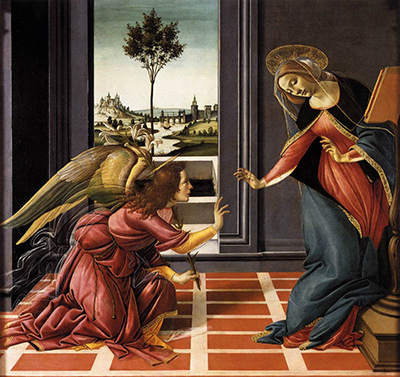
Gabriel kneels at the left of a nearly empty room, his hand reaching toward Mary. She draws back at the right, yet extends a hand of her own into the space between them. A tiled floor leads to an opening beyond the room, where a walled garden and distant landscape appear. Botticelli gives the meeting few objects to distract from those opposing gestures. The moment is held between announcement and response.[1]
This is the Annunciation painted for the Cestello church in Florence, now in the Uffizi. Benedetto di ser Francesco Guardi, a moneychanger, commissioned it for his family chapel in 1489; the museum dates the finished tempera panel to 1489–90. Its original frame survives with his emblems, a pietà image of the suffering Christ and two inscriptions from Luke's Gospel. The frame is part of the work's evidence, even though many reproductions show only the painted scene.[1][2]
At a glance
- TitleAnnunciation, commonly called the Cestello Annunciation
- ArtistSandro Botticelli
- Date1489–90; commission recorded in 1489
- Mediumtempera on wood
- Dimensions150 × 156 cm
- CollectionUffizi Galleries, Florence
- Inventory1890 no. 1608
- Original settingGuardi family chapel, church of Santa Maria Maddalena in borgo Pinti, Florence
The commission sets this panel apart from other Annunciations associated with Botticelli. Its patron and chapel are known, and its frame preserves words and signs that connect the image with that setting. The visual story is still direct: Gabriel brings a message to Mary, and her body registers both surprise and acceptance.[1][2]
This work in Botticelli’s career
Fortitude
1470Cestello Annunciation
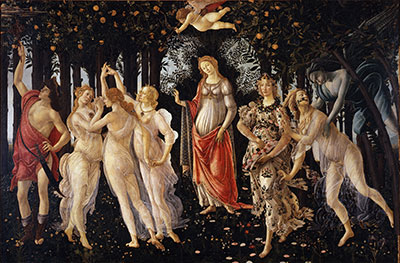
1489–90Primavera
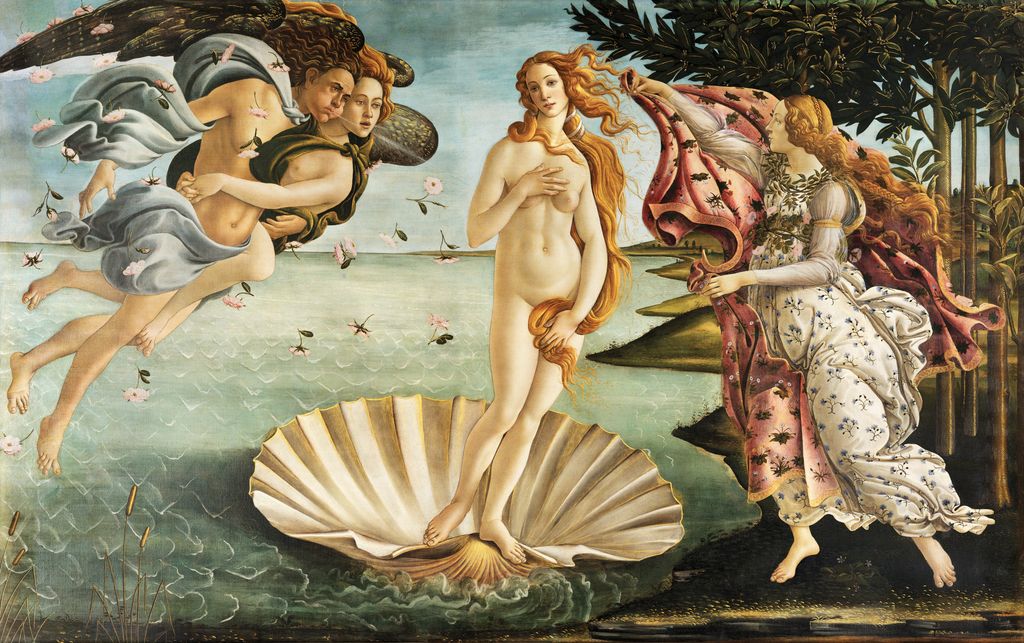
c. 1480Birth of Venus
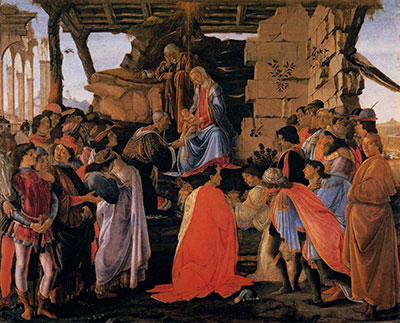
c. 1485Mystic Nativity
1500Contents
- At a Glance
- The Space Between Gabriel and Mary
- The Message on the Frame
- Simplicity and a Changed Florence
- Which Botticelli Annunciation?
The Space Between Gabriel and Mary
Gabriel is low to the ground, leaning forward from the left. His robe spreads across the floor, and his wings create a dark, sweeping shape behind him. Mary stands at the right, turning away from the approaching angel. Their hands nearly meet across the centre, but they do not touch. The empty strip of air between them makes the spoken message seem present without painting words inside the room.[1]
Mary's pose is especially complex. Her upper body bends away, and one hand rises as though to pause the encounter. The other reaches toward Gabriel. Botticelli sets hesitation and response within a single figure rather than separating them into successive scenes. Her robe falls in long folds, while the angel's low posture gives his approach urgency. Neither figure needs a crowd of witnesses to make the event dramatic.[1]
The floor's large red and pale tiles establish a measured distance. Their lines draw the eye from the picture's lower edge into the room, then across to the two hands. The room itself has few furnishings; a book is near Mary, but broad surfaces of wall and floor remain open. The Uffizi emphasizes that spareness and the restrained clothing in its interpretation of the painting. The composition directs attention to gesture instead of household detail.[1]
Behind the pair, an opening frames trees, buildings, water and enclosed ground. The walled garden is a familiar emblem of Mary's virginity in Christian art, as the Uffizi explains. It also changes the rhythm of looking. The eye first moves between Gabriel and Mary, then passes out through the architecture to a quieter distance. Botticelli lets an event inside a room connect with a world beyond it.[1]
The Message on the Frame
The Uffizi states that the painting retains its original frame. At the bottom are Guardi emblems and a figure of Christ in pietà. Those features anchor the panel to a patron and to the later suffering of the child whose conception the Annunciation foretells. They are not visible in every cropped photograph of the painted field; the panel and its frame need to be considered together.[1]
Two Latin inscriptions on the frame come from Luke's account. One refers to the Holy Spirit coming upon Mary and the power of the Most High overshadowing her; the other records Mary's acceptance of God's word. The first gives the angel's announcement, the second her reply. The painted hands hold the pause between those utterances. In the original framed work, the viewer could move from gesture to text and back again.[1]
The Guardi emblems are unusually useful evidence because the Uffizi also names Benedetto di ser Francesco Guardi as the commissioner. The Italian national cultural-property record cites a Cestello monastery benefactors' book for the order placed with Botticelli in 1489. The frame and document support one another. They do not need an invented story about what Benedetto personally said to the artist.[1][2]
Herbert Horne transcribed the benefactors' book in 1908. Its entry places the Guardi chapel second on the right as one entered the church and records 50 ducats spent on its building, including a glazed window, plus 30 ducats for the altarpiece “by the hand of Sandro Botticello.” This separates the cost of the painting from the cost of its architectural setting. The same record notes the altar's consecration on 26 June 1490, a white damask altar cloth and iron candlesticks. The painting was therefore one part of a furnished place of worship, not an isolated image made for a gallery wall.[5]
There is a discrepancy in the patron's recorded name: Horne's transcription reads “Benedetto di ser Giovanni Guardi,” whereas the present Uffizi and national catalogue identify him as “Benedetto di ser Francesco Guardi.” The sources agree on the Guardi chapel and Botticelli commission; the father's name should not be silently treated as settled. Horne also prints the book's date as 19 March 1488 in Florentine dating, equivalent to 1489 in modern year reckoning, while the national catalogue describes the order as around 14 May 1489. These records support a commission in 1489 and an altar consecrated in 1490, not an exact day when Botticelli finished painting.[1][2][5]
The painting's church setting matters to scale. At 150 by 156 centimetres, it is a large panel made for a family chapel, not a tiny image for a private cabinet. Gabriel and Mary could be read from across the space, while the inscriptions and emblems invited closer attention. The composition works at both distances: the broad exchange of figures first, then the textual and heraldic details.[1]
The chapel was not the painting's last home. The national record says it was still noted on its altar in 1754, then moved later in that century to a villa belonging to the Cestello monastery. It was found there in 1870 and transferred to the gallery two years later. That documented route explains how a painting named for its first church arrived in a public collection; it does not turn the villa into part of Botticelli's original plan.[2]
Simplicity and a Changed Florence
The Uffizi relates the severe room, limited decoration and heightened gestures to a late fifteenth-century search for religious simplicity, alongside the fervour that grew around Girolamo Savonarola's preaching. That is a curatorial reading of style and setting. The record does not say that Savonarola directed Botticelli's design or that a sermon can be matched to one gesture in the panel.[1]
The picture's quiet surfaces make the movement more conspicuous. Gabriel's approach, Mary's withdrawal and their reaching hands occupy most of the drama. The landscape and garden carry established Marian associations, but the viewer is not asked to solve a crowded collection of objects. Botticelli uses restraint in the room so that the human exchange can hold the painting's large scale.[1]
The commissioning date also positions this panel among Botticelli's later Florentine religious works. It was made after his visit to Rome for the Sistine Chapel frescoes and before the more openly visionary paintings of his final decades. That broad chronology may help orient the viewer, but this work should be understood through its own evidence: a documented Guardi commission, a surviving frame and an Annunciation composed around two responding bodies.[1][2]
Which Botticelli Annunciation?
Botticelli treated the subject more than once. The Uffizi also holds the detached San Martino alla Scala fresco, an earlier work from a different setting. The Metropolitan Museum of Art in New York holds a much smaller panel, usually dated about 1490 in its current record. Neither is this Guardi commission. The Cestello panel is identified by the 1489 chapel order, its near-square 150 × 156 cm format, the open garden beyond the sparse room and its original inscribed frame.[1][3][4]
Keeping those objects distinct helps explain what is special here. The scene is not just a generic example of Botticelli's Annunciation iconography. Its first location and commissioner are recorded, and the frame preserves the Gospel exchange that the painted figures enact. The viewer can look at Mary's two hands and then at the two inscriptions, moving between the visible pause and the words that give it meaning.[1][2]
At the centre of the panel, no object fills the gap between angel and Virgin. Botticelli leaves room for a message and a decision. The surviving frame shows how the original setting gave that gap a voice: Gabriel's promise and Mary's assent accompany two figures who remain poised just before contact.[1]
Botticelli and related artworks
Discussion
Which detail changes how you read Cestello Annunciation?
Reader Insights
How does the empty space between Gabriel and Mary work?
What does the surviving Guardi commission establish?
How does the original chapel change your reading of the panel?
Join the Conversation
Share a source-led observation or question below.
References
- Uffizi Galleries, Daniela Parenti, “Annunciation,” inventory 1890 no. 1608, current object record; accessed 29 September 2026 View source.
- Italian Ministry of Culture, “Annunciazione,” national cultural-property linked record, citing the Cestello benefactors' book; accessed 29 September 2026 View source.
- Uffizi Galleries, “Annunciation (San Martino alla Scala fresco),” distinct object record; accessed 29 September 2026 View source.
- Metropolitan Museum of Art, “The Annunciation,” Robert Lehman Collection 1975.1.74, distinct small panel; accessed 29 September 2026 View source.
- Herbert P. Horne, Alessandro Filipepi, Commonly Called Sandro Botticelli, Painter of Florence (1908), pp. 163–65 and appendix, document XXXII, p. 355, transcribing the Cestello Libro de' Benefattori, fol. 7r; accessed 1 October 2026 View source.