 by Tom Gurney
Tom Gurney BSc (Hons) is an art history expert with over 20 years experience
Published on June 19, 2020 / Updated on October 2, 2026
Email: tomgurney1@gmail.com / Phone: +44 7429 011000
A closer look
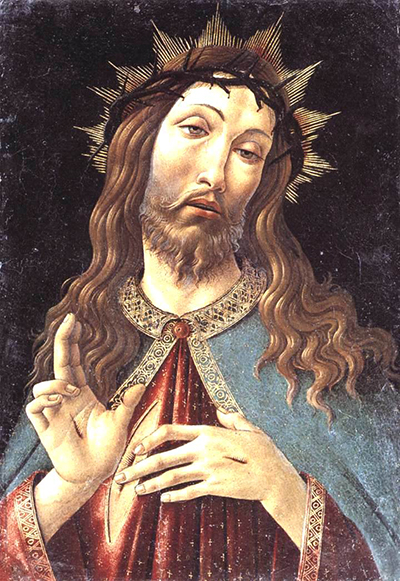
The crown of thorns is the first sign of suffering. Then the hand rises in blessing. In the small Christ the Redeemer Blessing panel at Bergamo's Accademia Carrara, the two gestures belong to the same figure: Christ bears the marks of the Passion while facing the viewer as a source of grace. His dark eyes turn slightly downward, and gold rays break out behind the thorny ring against a nearly black ground. This is a devotional image that invites sustained looking rather than a painted moment from one continuous Gospel scene.[1][3]
The legacy page calls the work Christ Crowned with Thorns, a useful description of what is visible. The Italian national catalogue's title is Cristo redentore benedicente—Christ the Redeemer Blessing. It currently assigns the panel to Botticelli's workshop, as does Fondazione Zeri. The Accademia Carrara's 2012 conservation catalogue argues for Botticelli's own hand, as did an Australian exhibition and a Victoria and Albert Museum loan list. These are conflicting judgements about one panel, not separate paintings: the dimensions, inventory number and Morelli collecting history identify the same Carrara object. The restored painting should be discussed with both the present workshop classifications and the owner publication's contrary argument in view.[1][2][3][4][7][8]
At a glance
- Current national-catalogue titleChrist the Redeemer Blessing (Cristo redentore benedicente)
- ArtistWorkshop of Sandro Botticelli in the Italian national catalogue and Fondazione Zeri; argued to be Botticelli himself in the Carrara’s 2012 conservation catalogue
- DateAfter 1500 and before 1515 in the national catalogue; about 1495–1500 in the Carrara catalogue and about 1495–1505 in the Australian and V&A exhibition records
- MediumTempera and gold on wood panel
- Size47.6 × 32.3 cm
- CollectionAccademia Carrara, Bergamo
- Inventory58MR00005; also 928-1891 in the V&A loan list
- SubjectA half-length Christ with a thorn crown and Passion wounds, raising his right hand in blessing
The date ranges overlap around 1500–05 but do not say exactly the same thing. The national catalogue's later outer limit also extends beyond Botticelli's death in 1510, consistent with its workshop label. It does not prove that the picture was painted after his death. The documents available here do not name an original patron, place of display or securely identifiable painter of each passage.[1][2][3][4]
This work in Botticelli’s career
Fortitude
1470Christ the Redeemer
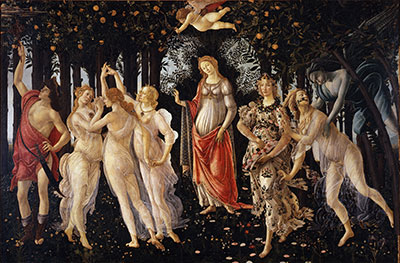
after 1500Primavera
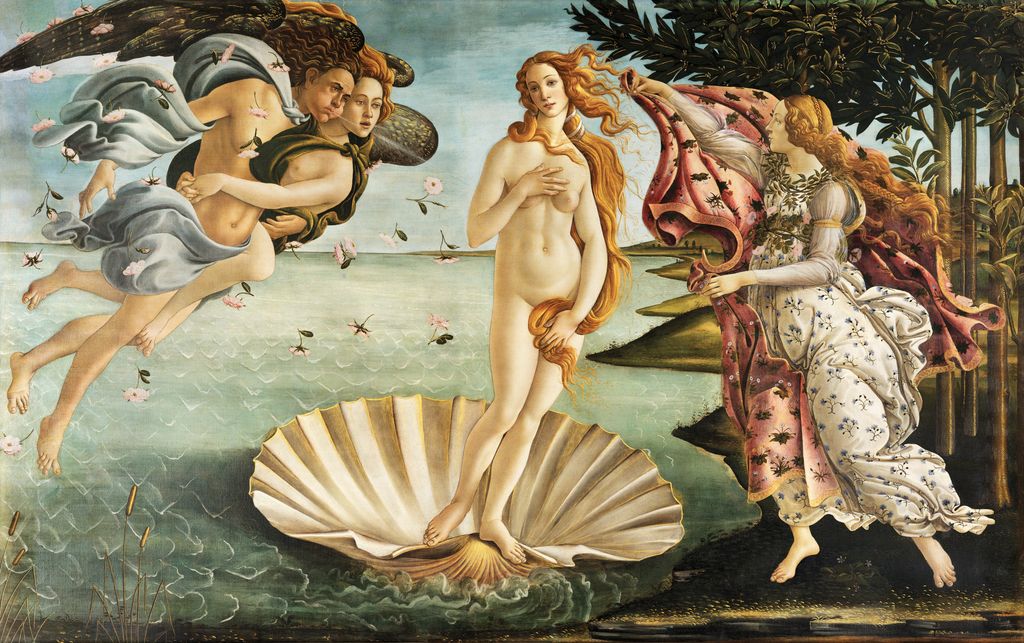
c. 1480Birth of Venus
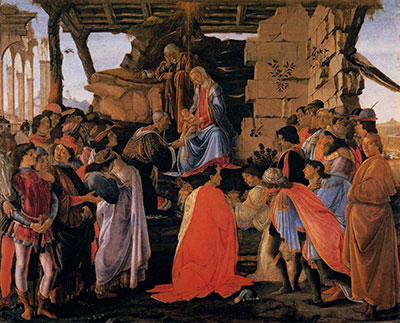
c. 1485Mystic Nativity
1500Contents
- At a Glance
- The Crown and the Blessing
- Several Moments in One Image
- Botticelli, Workshop and Repeated Designs
- What the 2010 Conservation Study Revealed
- A Possible Pair and a Known Collector
The Crown and the Blessing
Christ is shown from about the waist upward. His long hair falls in waves over a blue mantle, and a red robe opens beneath it. Embroidered gold borders follow the neckline and the front edges of the mantle. Those carefully patterned surfaces surround a face that is quieter than the ornament: half-lowered lids, parted lips and a slightly inclined head make the expression contemplative rather than triumphant. The National Gallery of Australia describes tears and wounds as part of the panel's appeal to devotion.[3]
The thorn crown cuts across the top of Christ's forehead. Behind it, sharply pointed gold rays form an aureole. They are separate signs with different meanings: the thorns recall human mockery and injury, while the radiance asserts sacred status. The black background gives neither a palace nor a hill to locate the figure in a historical episode. It concentrates attention on the face, the crown and the hands.[1][3]
His right hand is lifted near the left edge of the panel, with two fingers extended in a blessing sign. The other hand rests across his chest, touching the red fabric. The national catalogue lists the stigmata among the Passion symbols. In a larger narrative painting, the wound might be one event among many; here it is brought close to the viewer beside the blessing hand. The panel holds together suffering, survival and an active address to the person before it.[1][3]
The format matters. At less than half a metre high, this was never a life-size figure. A person approaching it would meet a face and hands at an intimate scale. That observation does not identify its original room or owner. The painting's small size and direct presentation support a devotional reading, while the specific setting in which it was first used remains undocumented in these records.[1][3]
Several Moments in One Image
John's Gospel describes soldiers placing a thorn crown on Jesus before the Crucifixion. The raised blessing hand does not belong to that moment of mockery. Luke describes the risen Jesus showing his hands to the disciples and later blessing them. The panel draws on both kinds of sign, but it illustrates neither passage as a full event. No soldiers, disciples, cross or landscape appear.[5][6]
This combination explains why its titles differ. Christ Crowned with Thorns draws attention to the painful attribute. Christ the Redeemer Blessing names the action directed toward the viewer. The Australian exhibition used Christ the Redeemer and also called it a Man of Sorrows. Each points to part of the picture; none requires us to flatten it into a single episode. A viewer is asked to consider the wounded Christ as a blessing presence.[1][3][5][6]
The Australian curator Jaynie Anderson compares the expressive face and emphasis on wounds and tears with Flemish devotional art, and mentions Hans Memling in that context. This is a stylistic comparison, not a documented journey by the painter or a proven copy from a specific northern panel. She also raises Savonarola's preaching on Christ's Passion as a possible context for Florentine devotion. That hypothesis may explain why such an image could resonate, but it does not establish a Savonarolan commission or the individual workshop painter's beliefs.[3]
Botticelli, Workshop and Repeated Designs
Attribution is especially consequential when a familiar composition exists in versions. The national catalogue records the Carrara panel as the work of Botticelli's workshop, while noting Botticelli as an earlier attribution. Fondazione Zeri makes the same primary workshop classification and records a handwritten photographic note supporting the Botticelli alternative. By contrast, the National Gallery of Australia's Renaissance entry and the V&A's 2016 loan list used Botticelli without workshop qualification.[1][2][3][4]
The 2012 Carrara catalogue presents the opposite conclusion from today's national and Zeri headings. Andrea Di Lorenzo recounts the long sequence of autograph and workshop judgements, and follows Everett Fahy in attributing the restored panel to Botticelli. Conservator Carlotta Beccaria describes surviving original paint, design changes and later retouching; those material findings help readers judge the surface but do not sign it. Neither the conservation report nor the current database labels can name a particular assistant or prove the hand behind every passage. The page therefore keeps the current workshop label visible alongside the owner catalogue's argued autograph attribution.[1][2][7][8]
Anderson notes that other versions of this Christ composition survive. She reports that the Harvard Art Museums' Fogg version seems to have used the same preparatory design or cartoon despite differences around the outer edges. That comparison helps explain how a successful devotional type could be repeated. It does not by itself prove that the Carrara and Harvard panels were painted by the same hand, made in a particular order or commissioned together.[3]
The panel's ornament and expression also deserve to be read on their own terms, whatever the precise painter. The gold patterned trim sets a ceremonial border around the red and blue clothing. The face softens that splendour. The hands then link it back to an action directed toward the viewer. Workshop classification changes how we discuss authorship; it does not make these visible choices disappear.[1][3]
What the 2010 Conservation Study Revealed
Beccaria examined a single poplar board, its grain running vertically, still about 3.3 centimetres thick. She saw tool marks from preparing the back and small holes associated with a lost frame. The support had not been thinned or replaced. Those observations make this a notably intact wooden object, but the holes cannot identify the missing frame as the original one or establish a hinge to the lost Virgin. A picture can preserve its board while its frame and pair have separate, less secure histories.[8]
The paint preserves details that are easy to miss in a reproduction. Beccaria reports fine hatched strokes shaping Christ's face and gold leaf applied with mordant in the ornament. Infrared reflectography showed two adjustments during design: the outline of the raised right hand was first broader, and the blue mantle over that arm was drawn with folds different from the finished painting. These are changes in this panel itself, evidence of a working process rather than automatic proof of which workshop member made it. They also matter to the viewer: the blessing hand and the fall of the mantle were considered, not merely copied mechanically into their final shapes.[8]
Her non-destructive imaging and X-ray fluorescence study distinguishes firmer identifications from a genuine uncertainty. The report assigns lead white, earth pigments and vermilion to flesh passages; ochres and earths help form the hair and beard; and red lake with lead white colours the robe. The blue-green mantle is harder to resolve. Its infrared response suggests one possibility, while copper found by XRF could indicate azurite, malachite or verdigris in a lower layer. Beccaria considers a lapis-lazuli upper layer but explicitly leaves that reconstruction uncertain. The result is more informative than calling every blue passage “ultramarine” on sight.[8]
The face visible now has also passed through two documented restorations. A 25 October 1865 letter places the newly acquired painting with Giuseppe Molteni, and Beccaria found old paint laid over original colour to soften Christ's facial outline and hide some beard hair. In the 2010 treatment, she removed those altered retouches selectively and cleaned surface dirt, while preserving an older varnish rather than stripping the whole panel. The restored lines make the expression more sharply defined than Molteni's softened version. They do not turn today's view into an untouched fifteenth-century surface: old varnish, small losses and modern retouching remain part of the object's visible history.[7][8]
A Possible Pair and a Known Collector
The national catalogue records a proposal that the Redeemer once formed a diptych with a sorrowing Virgin. Anderson says the Mater Dolorosa panel was paired with it when Giovanni Morelli acquired the Christ. Di Lorenzo identifies the other collector as Maria Nikolaevna Romanova, notes that the Virgin appeared in a 1913 Hermitage exhibition after her death, and reproduces a photograph from that exhibition's catalogue. The companion is therefore not wholly without a visual record, although its present location is unknown. The nineteenth-century pairing and old photograph make comparison possible; they do not, by themselves, prove original hinges, exact first dimensions or a documented fifteenth-century patron.[1][3][7]
The documented modern history begins in Florence. Anderson reports that Morelli bought the Christ before 25 October 1865, when a letter records it in conservation with Giuseppe Molteni in Milan. The V&A loan list also places the acquisition in Florence and says Morelli bequeathed it to the Accademia Carrara in 1891. This gives a clear route into Bergamo, while leaving several earlier centuries unaccounted for. Morelli's ownership cannot be used to infer a Renaissance patron or a Florentine church.[3][4]
The panel now has a twentieth-century frame according to the national record. That matters because a modern frame cannot settle whether the original object was paired, hung alone or fitted into another structure. The proposed Virgin companion and the repetition of the Christ design remain valuable clues, but neither supplies a complete reconstruction. The surviving Carrara image can still be read directly: the wound and crown register suffering, while the raised fingers continue to bless.[1][3]
Look again at the narrow gap between thorn crown and gold rays. The image does not let pain erase sanctity, or radiance erase the wound. That tension helps explain its devotional power and why several titles have followed it. Its precise hand and first use remain questions; the panel itself keeps the viewer close to a face that is both marked and attentive.[1][2][3]
Botticelli and related artworks
Discussion
Which detail changes how you read Christ the Redeemer?
Reader Insights
How do the crown and blessing coexist in one figure?
Why does the image combine moments of suffering and triumph?
How does the workshop attribution affect its interpretation?
Join the Conversation
Share a source-led observation or question below.
References
- Italian Ministry of Culture, “Cristo redentore benedicente,” national catalogue record 0300644312, compiled by Regione Lombardia, accessed via current indexed text 29 September 2026 (direct request failed) View source.
- Fondazione Federico Zeri, “Filipepi Alessandro, bottega, Cristo Redentore benedicente,” work entry 14416, accessed 29 September 2026 View source.
- Jaynie Anderson, “Christ the Redeemer,” National Gallery of Australia, Renaissance exhibition entry, accessed 29 September 2026 View source.
- Victoria and Albert Museum, “Botticelli Reimagined: immunity from seizure object list,” 2016, p. 5, accessed 29 September 2026 View source.
- United States Conference of Catholic Bishops, “John 19,” verses 1–5, accessed 29 September 2026 View source.
- United States Conference of Catholic Bishops, “Luke 24,” verses 39–51, accessed 29 September 2026 View source.
- Andrea Di Lorenzo, “Vir dolorum,” in M. Cristina Rodeschini, ed., Sandro Botticelli: Persona sofistica. I dipinti dell’Accademia Carrara (Bergamo: Lubrina Editore, 2012), printed pp. 25–29, PDF pp. 26–29; direct catalogue reading 1 October 2026. Includes the 1865 Molteni letter's archival location, the 1913 Mater dolorosa photograph and the owner publication's autograph attribution; the original letter and 1913 catalogue were not independently read View source.
- Carlotta Beccaria, “Vir dolorum,” conservation report in Sandro Botticelli: Persona sofistica (Accademia Carrara, 2012), printed pp. 75–81, PDF pp. 75–81; original treating conservator's report directly consulted 1 October 2026. Support, surface, imaging, pigment limits and selective 2010 treatment are attributed to this panel alone View source.