by Tom Gurney
Tom Gurney BSc (Hons) is an art history expert with over 20 years experience
Published on June 19, 2020 / Updated on October 2, 2026
Email: tomgurney1@gmail.com / Phone: +44 7429 011000
The Last Miracle and Death of Saint Zenobius
A cart wheel, a grieving mother, a child carried through a doorway and an old bishop blessing people from his bed: Botticelli fits these episodes into one long painted panel. The Dresden painting is usually called The Last Miracle and the Death of Saint Zenobius. It closes a four-panel story of Florence's revered bishop. The same painted streets and buildings let us watch time move from a sudden accident to recovery and, finally, to the saint's own death.[1][2][3]
The title can make the picture sound like two separate scenes. In fact, the first part is a miracle told across several moments. At the left a child has been struck by a cart. His mother seeks help; near the centre he appears again after being restored to life. At the right, Zenobius lies dying and blesses those gathered around him. The saint is not shown performing the resurrection in person. Botticelli makes the result visible through the change in the child and his mother's response.[1][4]
At a glance
- Current titleLast Miracle and the Death of St. Zenobius
- ArtistSandro Botticelli in the Dresden-hosted and Zeri records
- Datearound 1500 in the Dresden-hosted record
- Mediumtempera on panel, according to the Fondazione Zeri catalogue
- Dimensions66 × 182 cm, according to Zeri
- Current collectionGemäldegalerie Alte Meister, Staatliche Kunstsammlungen Dresden
- Inventory number9 in the Zeri catalogue
- Seriesfourth of four panels depicting episodes from the life of Saint Zenobius
Where this work sits in Botticelli’s career
Fortitude
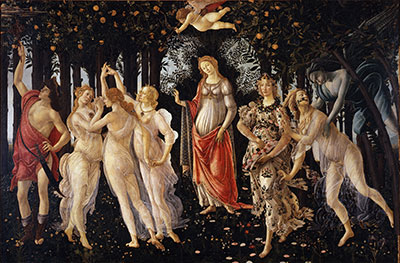
1470Primavera
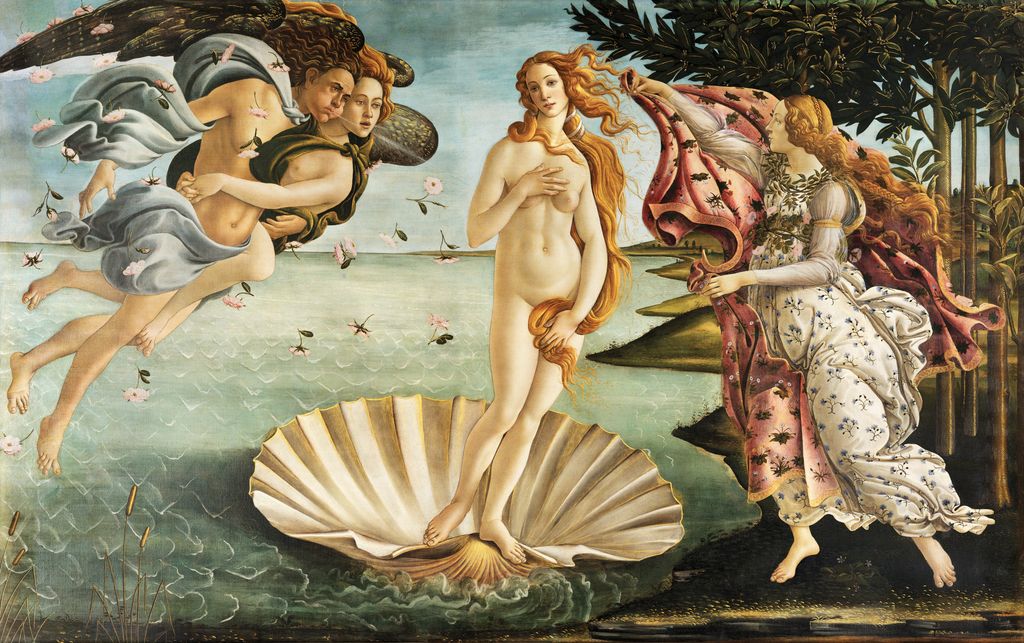
c. 1480The Birth of Venus
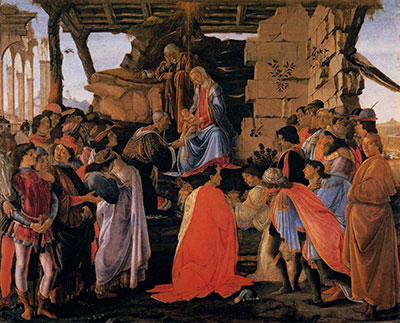
c. 1485The Mystical Nativity
c. 1500Contents
- Reading the Long Panel
- A Story Set in a Painted City
- The Fourth Panel of a Cycle
- From Florence to Dresden
- Looking Again
The Dresden-hosted online description gives the subject, date and collection. Its displayed dimensions contain a typographical error, so the size above follows the independent Zeri catalogue. Zeri gives a wider dating range, 1495–1510; “around 1500” is the museum-hosted public date rather than an exact year of completion.[1][2]
Reading the Long Panel
The painting is far wider than it is high. Architecture divides it into spaces without enclosing each moment in a separate frame. A street opens at the left; an ornamented doorway and broad steps fill the middle; the raised deathbed occupies the right. People in bright pink, green, white and red garments rush or bend between these settings. Their gestures provide the story's rhythm.[1][5]
Start beside the cartwheel at the far left. The small child lies on the ground while adults throw themselves toward him. The wheel is partly cut by the edge of the panel, making the accident feel sudden, as though it has just entered the scene from outside. The child's scale and position make him vulnerable amid the adults' sweeping garments.[1][4]
The story continues at the steps. A woman carries or supports the child toward the doorway, where white-robed attendants meet her. These are stages of the same crisis rather than new accidents. The figure in red and the pale child draw the eye from the street into the architectural centre. Botticelli's repeated figures compress a sequence that would unfold over time into one continuous view.[1][4]
Near the middle-right, the mother bends close to the living boy. One attendant steadies him while others witness the reunion. The change from a limp body to an upright child supplies the evidence of the miracle. The prayer that restores him happens offstage. This omission keeps the painted emphasis on the human passage through danger, grief and relief.[1][4]
The rightmost scene changes pace. Zenobius, older and wearing a bishop's mitre, is propped up in bed beneath arches. Clergy and others kneel around him as he raises a hand in blessing. This is his deathbed, not the child's funeral or a later procession. The high bed and surrounding figures give the final episode a still, ceremonial focus after the hurried movement at the left.[1][4]
A Story Set in a Painted City
The cityscape is more than background. Doors, steps, painted pilasters and open archways help separate the moments and carry the eye from one to the next. The left street points inward; the central entrance gathers people; the right arcade frames the dying bishop. The painted geometry organizes an event that otherwise might be hard to follow across such a long surface.[1][3]
The National Gallery's study of the related Zenobius panels describes how Botticelli used a spalliera format: long paintings associated with domestic wooden wall decoration. It notes that the four works share a visual rhythm and architectural settings, making an idealized Florence through which the saint's story moves. The Dresden panel's broad paved foreground and decorated buildings fit that account. We should picture a connected sequence of panels, not an isolated altar painting.[3]
Zenobius was a bishop of Florence, and his miracles became part of the city's identity. The National Gallery connects the four-panel sequence to Clemente Mazza's vernacular life of the saint, written in 1475 and printed in 1487. Botticelli places the legend in a city that has the recognizably Florentine concern with streets, civic buildings and public witness, even though its architecture is an idealized stage rather than a documentary street map.[3]
The book itself gives the proposed Girolami setting a firmer context. Paolo Morelli's biographical study identifies Mazza's 1475 Life as an adaptation of an earlier hagiography with memories of the transfer of Zenobius's relics added by Mazza. It says the work was dedicated to Filippo Girolami, whose family claimed descent from the bishop and helped guard his cult. A catalogue of the 1487 first edition locates that dedication on leaf a1r and another address to the dedicatee before its second part. The printed book shows an established bond between the family and the saint's story before Botticelli made the panels. It does not say that Filippo or another Girolami ordered these paintings.[7][8]
The miracle also had a much older life in Florentine art. The Opera del Duomo catalogues a Zenobius altar panel dated about 1240–50, now in its museum, with small scenes beside the enthroned bishop. Its account identifies a child killed by an ox cart and later restored to life in two of those scenes. Botticelli's much later Dresden panel expands an accident, urgent carrying and reunion across an inhabited street, while giving the dying saint a separate final episode. The earlier object shows that viewers in Florence could recognise cart injury and resurrection within the saint's visual tradition; it does not prove that Botticelli copied this particular panel or that both works follow an identical version of every detail.[10][1][3]
Notice how the edges resist being a neat beginning and end. At the left, the cart is already moving out of view; at the right, mourners crowd toward a bed that nearly fills the corner. The eye can move across the panel like a reader crossing lines of a story. Botticelli creates continuity through repeated people, shared paving and adjacent buildings, without making every action simultaneous.[1][3]
The Fourth Panel of a Cycle
This is the last of four surviving Zenobius panels. Two earlier works are in the National Gallery, London, and the third is in the Metropolitan Museum of Art, New York. The National Gallery's research identifies the Dresden painting as the fourth and notes that the panels maintain related scale, colour and settings. The Met's third panel also tells multiple miracles across one painted cityscape, preparing the viewer for Dresden's final movement from resurrection to death.[3][5]
The works were probably made for a room or institutional interior, but their first setting is debated. The Dresden-hosted description suggests a Girolami family wedding around 1497 or 1500. The National Gallery presents that marriage-chamber theory alongside a possible commission for a confraternity devoted to Zenobius. It also points out that the panels do not show clear Girolami emblems or specific surroundings of their residences. The patron cannot be named with certainty from the evidence now available.[1][3]
The dedication sharpens that uncertainty rather than resolving it. A family that sponsored or cherished a saint's written life might also have valued a painted cycle, but the surviving dedication is evidence for the book's audience, not a payment or contract for Botticelli's work. The marriage proposal must also account for the first panel's scene in which Zenobius rejects a fiancée to pursue religious life, a narrative choice the National Gallery cites when questioning a wedding-chamber purpose. The subject and the family's devotion make the hypothesis intelligible; neither documents the lost room.[3][7][8][9]
That uncertainty does not weaken the painting's subject. Both proposed settings would have allowed an audience to follow a Florence-based saint through scenes of loss, rescue and communal care. The processional groups, white-robed attendants and shared city spaces suit a story meant to be read in company. Whether the original room belonged to a family or confraternity, the image connects private grief with public witness.[1][3]
From Florence to Dresden
An early catalogue of Dresden's Royal Picture Gallery traces this panel through the possession of the Marchese Rondinelli and then the Metzger collection in Florence. It records that the gallery acquired the painting from the von Quandt collection in 1868. This is more specific than the current short public object description, although the old catalogue does not supply dates or transaction documents for the earlier Florentine steps. Its account establishes a nineteenth-century collecting route; it does not identify the original patron around 1500.[6]
The same catalogue proposed a commission for the Compagnia di San Zanobi in 1503–04 and described the saint himself as leading the revived boy back to his mother. Those are historical catalogue interpretations, not findings that settle the picture's first setting or the identity of the white-robed figure at the centre. The National Gallery's later study presents the confraternity as one possibility among others. Separating the gallery's acquisition record from its older interpretive claims helps preserve what each source can establish.[3][6]
Looking Again
Return to the child at the far left and find him again near the centre. His repeated appearance is the hinge of the story. Botticelli does not paint the saint's unseen prayer as a separate scene; instead, the movement through the doorway and the changed posture of the child let the viewer understand what has happened. The final blessing at the right then closes not only this panel but a longer four-part account of Zenobius's life.[1][3][4]
The painting's colour helps hold these moments together. Pink and red garments pull attention across the steps, while white robes mark the attendants at the centre and right. The long horizontal format gives each group room to act, but the shared paving prevents the scenes from becoming unrelated pictures. It is a carefully staged progression from shock to consolation and farewell.[1][3]
Seen in full, the panel offers a particular kind of miracle image. The most important transformation is not given a theatrical flash or a visible saintly gesture. It appears in people carrying, receiving and embracing a child. Botticelli lets the human reactions tell us how a city's holy story could be experienced at street level.[1][4]
Botticelli and related artworks
Discussion
Look again at the details and evidence discussed above. Which part of the painting changes most when you know its history?
These prompts invite close looking and source-led questions rather than a single settled interpretation.
Reader Insights
How can you tell the child appears at more than one moment?
Which architectural features help you move between the episodes?
How does the quiet deathbed scene change the pace of the panel?
Join the Conversation
Share an observation or question about the painting below.
References
- Gemäldegalerie Alte Meister, Staatliche Kunstsammlungen Dresden, “Last Miracle and the Death of St. Zenobius,” institution-hosted Google Arts & Culture record, accessed 29 September 2026 View source.
- Fondazione Federico Zeri, “San Zanobi resuscita un bambino, San Zanobi annuncia la propria morte,” catalogue entry 12539, accessed 29 September 2026 View source.
- Amanda Lillie, “Sandro Botticelli, Three Miracles of Saint Zenobius,” National Gallery, London, 2014, accessed 29 September 2026 View source.
- Web Gallery of Art, “Last Miracle and the Death of St Zenobius,” object description, accessed 29 September 2026 View source.
- Metropolitan Museum of Art, “Three Miracles of Saint Zenobius,” collection record for the third panel, accessed 29 September 2026 View source.
- Royal Picture Gallery, Dresden, Catalogue of the Pictures in the Royal Gallery at Dresden, 1912, entry 9; nineteenth-century provenance and the catalogue's historical commission and scene readings, checked through indexed text 1 October 2026 View source.
- Paolo Morelli, “Mazza, Clemente”, Dizionario Biografico degli Italiani 72 (2008), on the 1475 vernacular Life, its 1487 edition, the author's memories of the 1439 relic translation and the dedication to Filippo Girolami; consulted 1 October 2026 View source.
- Christie's, catalogue of the 1487 first edition of Mazza's Vita di San Zenobio, bibliographic collation locating the Filippo Zenobio Girolami dedication at a1r and a second address at d4r; consulted 1 October 2026. A rare-book description establishes features of the printed text, not a commission for Botticelli's panels View source.
- National Gallery, London, Three Miracles of Saint Zenobius collection record, “About the series”, on the first panel's rejected marriage, the domestic and confraternity proposals, and its account of Filippo Girolami's ordering of Mazza's biography; consulted 1 October 2026. This present-day curatorial interpretation does not document a patron for the paintings View source.
- Opera di Santa Maria del Fiore, San Zanobi, santi Eugenio e Crescenzio e storie della sua vita, museum catalogue for the earlier altar panel, dated c.1240–50, describing the child crushed by an ox cart and his revival; consulted 1 October 2026. This is evidence for a local pictorial tradition, not a documented direct model for Botticelli's Dresden painting View source.
- Image credit. Sandro Botticelli, Last Miracle and the Death of St. Zenobius, around 1500, Gemäldegalerie Alte Meister, Staatliche Kunstsammlungen Dresden, inv. 9. Photograph credited by the museum-hosted record to Hans Peter Klut / Elke Estel. This full-frame Google Art Project reproduction is marked Public Domain Mark 1.0 on Wikimedia Commons. View the full-size image on Wikimedia Commons View source · View source · View source.