 by Tom Gurney
Tom Gurney BSc (Hons) is an art history expert with over 20 years experience
Published on June 19, 2020 / Updated on October 2, 2026
Email: tomgurney1@gmail.com / Phone: +44 7429 011000
A closer look
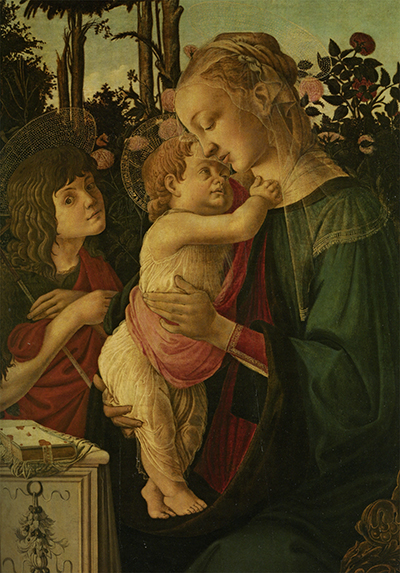
The Christ Child reaches up toward Mary's neckline while she steadies him with both hands. At the left, the young John the Baptist turns outward, holding his slender reed cross. A closed book lies on a folded cloth over a carved support in front of him. Behind the group, dark trees and a rosebush mark a garden rather than an interior. These details identify the Louvre's La Vierge et l'Enfant avec le jeune saint Jean Baptiste, INV 286 / L 3936. The Louvre lists Sandro Botticelli as artist, while allowing that a workshop member may have painted John and the pillar.[1]
This qualification is part of the painting's identity. Botticelli's Madonna-and-John subjects exist in several collections, often with changing workshop labels. The Louvre object is a poplar panel, 90.7 × 67 cm without its accessory, not the large Pitti canvas or the round workshop scenes elsewhere. Its three faces make a clear route through the composition: John looks toward the viewer, the Child turns up to Mary, and Mary lowers her face to him. The painting stages a family encounter while quietly inviting someone outside the pictured group to look in.[1][2]
At a glance
- TitleLa Vierge et l'Enfant avec le jeune saint Jean Baptiste (Virgin and Child with the Young Saint John the Baptist)
- ArtistSandro Botticelli in the Louvre catalogue; the museum says John and the pillar may be workshop execution
- DateBroadly 1450–75, the third quarter of the fifteenth century in the Louvre record
- MaterialTempera (?) on poplar wood, with the question mark retained from the museum record
- Panel dimensions90.7 × 67 cm; 126 × 102.5 cm with accessory in the Louvre's separate measurements
- CollectionMusée du Louvre, Department of Paintings, INV 286 / L 3936
- AcquisitionPurchased from the dealer Mauco in 1824; an earlier Durand ownership is recorded with a question mark[1]
This work in Botticelli’s career
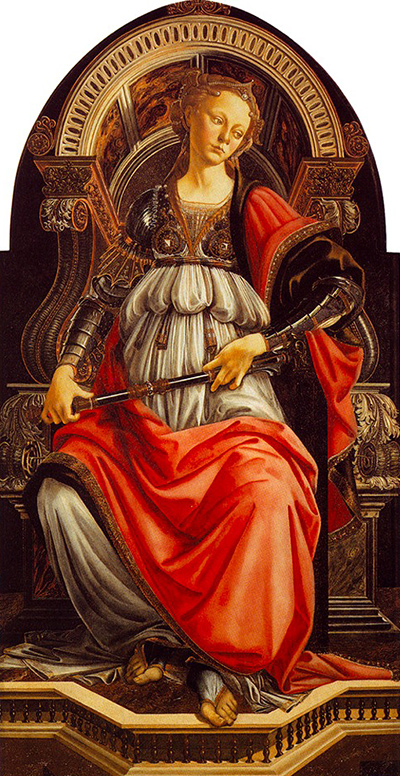
Fortitude
1470Louvre Madonna and John
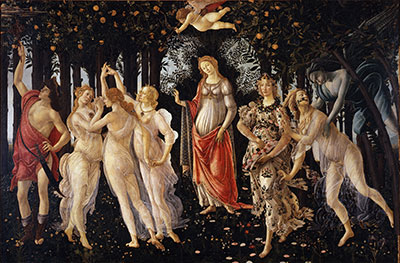
1450–75 broad rangePrimavera
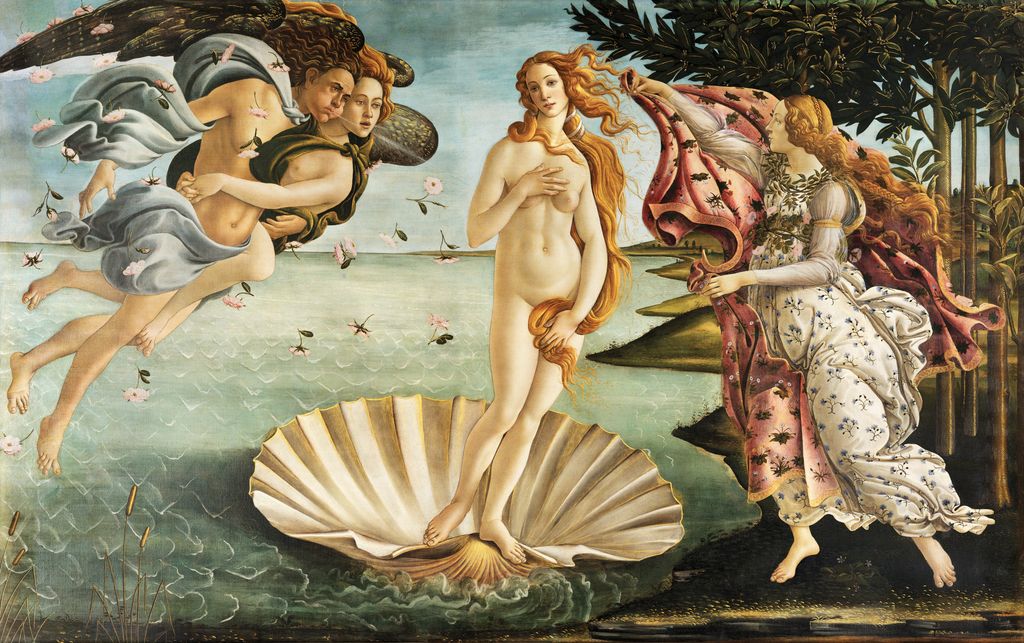
c. 1480Birth of Venus
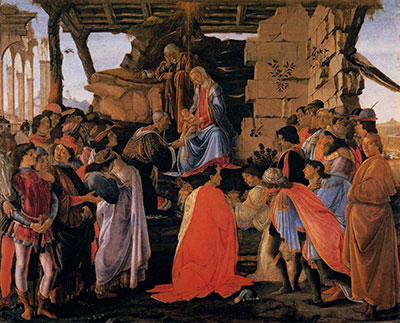
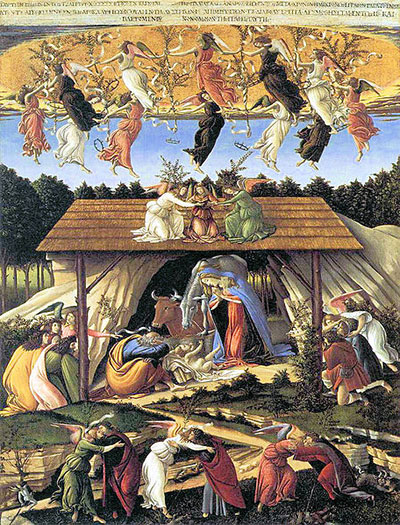
c. 1485Mystic Nativity
1500Contents
- At a Glance
- Three Figures and Three Directions of Looking
- Book, Pillar and Garden
- Date, Material and the Making of a Botticelli Madonna
- What the Provenance Tells Us
Three Figures and Three Directions of Looking
Mary takes up the right side. Her head inclines over the Child and her pale veil softens the edge of her hair and face. The Child's body is held upright but not standing on a surface: his feet hang free over the dark sweep of her mantle. One hand rises toward her neck while the other arm extends across her chest. The exchange keeps mother and son close without freezing them in a rigid devotional pose. Her hands provide the support that makes his movement possible.[1]
John occupies a different position. His face is turned toward the viewer rather than absorbed entirely in the mother-child exchange. A thin cross runs diagonally beside him; the rough garment and red drapery help distinguish him from the pale-clothed Christ. He is present in the same garden, yet his gaze opens the scene outward. A viewer following that gaze reaches the Child, whose attention in turn leads back to Mary. The three faces therefore do more than identify the figures. They set the pace at which the eye moves through the picture.[1]
The Louvre's note about workshop labour is unusually specific: the young John and the pillar may have been entrusted to a member of the studio. It does not state that those passages definitely are by an assistant, nor that the rest can be assigned stroke by stroke to Botticelli. The difference matters when looking at John. His outward stare and sharply edged place at the left may seem distinct from Mary's inward expression, but style alone cannot turn the museum's “may” into a documented fact about who held the brush.[1]
Book, Pillar and Garden
The foreground support gives John a place in the composition. A pale cloth spreads over its top, with a closed, bound book laid on it. The object is clearly a book; neither its title nor its exact liturgical use is specified in the Louvre record. The cloth and carved face of the support add textures against the soft human forms. They also make a small still life at the picture's lower edge, where a viewer might pause before moving upward into the figures.[1]
The support is part of the workshop question. The Louvre names the pillar alongside John as a passage that might have been delegated. That makes it more than a piece of furniture to describe and forget. Its precise carving and squared edge give the left side a firm base, while Mary's mantle supplies a rounded mass on the right. Whether one painter or two finished these passages, the difference in shapes is visible. The uncertain division of labour belongs in the factual account, while the visual relation between support and figures can be read directly.[1]
Behind the heads, slender trunks rise into a dark mass of foliage, and flowers show at the upper right. They place the encounter in an idealised outdoor setting. The roses are easy to notice, but the museum's short catalogue entry does not assign them a single fixed meaning or identify every plant. They can be read as part of the painting's garden language without pretending to have a lost programme of flower symbols. The dark background also helps the light faces, veil and infant body stand out.[1]
The garden gives the children room without offering an extensive landscape view. The figures press near the front edge; the trees are a close backdrop rather than a destination for the eye. That closeness suits the gestures. The Child reaches toward Mary at a distance measured in inches, and John stands near enough to be included but far enough to meet the viewer's gaze. The painting asks for attention to these small relationships rather than to a distant biblical setting.[1]
Date, Material and the Making of a Botticelli Madonna
The Louvre dates the work broadly to the third quarter of the fifteenth century, 1450–75. That span is a catalogue field, not a claim that Botticelli painted it at the beginning of his life. Likewise, the medium is written as tempera (?) on poplar. Poplar is the named support; the question mark makes the exact paint identification provisional. Giving a narrower year or dropping the punctuation would make the evidence seem firmer than the museum has made it.[1]
The panel's unframed height and width are 90.7 × 67 cm. The Louvre separately publishes 126 × 102.5 cm with accessory, without using those figures as the painting surface's dimensions. An image cropped tightly to the picture can hide this distinction. The bare panel size helps place the work among upright Marian paintings, while the larger measurement belongs to its present physical presentation. Neither number should be silently substituted for the other.[1]
Botticelli's workshop produced many Madonna images, but that general practice is not a licence to merge this picture with others. The National Gallery in London holds a different, round Virgin and Child with Saint John the Baptist under a workshop of Botticelli label. Its account explains why John, Florence's patron saint, could make such a subject appealing to Florentine viewers. That context is useful for understanding the Louvre trio, but the London painting's ruins, river and inscribed scroll are its own details. They are absent from the Louvre panel.[1][2]
Even the name “Rose Garden Madonna” can mislead. It has been used in discussion of the Louvre work, while the Uffizi also owns a distinct Botticelli Madonna of the Rose Garden. The sure way to identify the painting discussed here is its collection and number, Louvre INV 286, together with the outward-looking young John, the book on cloth and the Child touching Mary's neckline. Titles often describe a motif; an inventory number points to one physical object.[1][3]
What the Provenance Tells Us
The Louvre records a possible earlier owner named Durand, associated with Castile, and then the Paris art dealer Mauco. The first part is marked as uncertain. The secure acquisition event in the museum entry is the purchase from Mauco on 4 July 1824, entering the collection of Louis XVIII. This history explains how the panel came to the French national collection, not where Botticelli first intended it to hang.[1]
No original commissioner or first setting is named in the catalogue record. The gentle exchange between the children may suggest close devotional viewing, but it does not prove a particular household, chapel or patron. The painting's presence in the Louvre today is the end of a documented collecting path, not evidence that all earlier steps can be reconstructed. Keeping the gap visible is especially important for a subject so frequently repeated in Florence.[1][2]
The work continues to be studied alongside Botticelli's drawings. A report on the 2023–24 Botticelli Drawings exhibition says a newly attributed preparatory sketch was reunited there with the Louvre painting; the Louvre's record confirms that the panel travelled for that exhibition. The exhibition relation is worth noting, but the object entry consulted here does not identify the sheet or settle its attribution. It should not be used to override the Louvre's cautious note about possible workshop work in John and the pillar.[1][4]
In the painting itself, the mother's lowered head, the Child's raised arm and John's outward look remain the strongest guides. The book and carved support anchor the left corner, while trees and roses close the garden behind them. The Louvre's description allows a Botticelli design with a possible assistant's contribution in specific parts, and its broad date and questioned medium keep the technical record honest. Read as INV 286, the panel is a distinct encounter between three figures rather than another interchangeable “Botticelli Madonna.”[1]
Botticelli and related artworks
Discussion
Which detail changes how you read Louvre Madonna and John?
Reader Insights
How do the three figures direct one another’s gaze?
What role do the book, pillar and garden play?
Why does the Louvre give a broad date and questioned medium?
Join the Conversation
Share a source-led observation or question below.
References
- Musée du Louvre, “La Vierge et l'Enfant avec le jeune saint Jean Baptiste,” INV 286 / L 3936, museum artist and workshop note, date, material, two dimension sets, provenance and exhibition history; page updated 24 March 2026, accessed 1 October 2026 View source.
- The National Gallery, London, “Workshop of Sandro Botticelli, The Virgin and Child with Saint John the Baptist,” a separate painting, used only for Florentine Baptist and workshop Madonna context; accessed 1 October 2026 View source.
- Gallerie degli Uffizi, “Madonna of the Rose Garden,” a separate Uffizi painting, used for title disambiguation only; accessed 1 October 2026 View source.
- Christie's, “Botticelli Drawings: A landmark show,” report of a newly attributed sketch reunited with the Louvre painting in the 2023–24 exhibition; drawing attribution not independently established in the Louvre record, accessed 1 October 2026 View source.