 by Tom Gurney
Tom Gurney BSc (Hons) is an art history expert with over 20 years experience
Published on June 19, 2020 / Updated on October 2, 2026
Email: tomgurney1@gmail.com / Phone: +44 7429 011000
A closer look
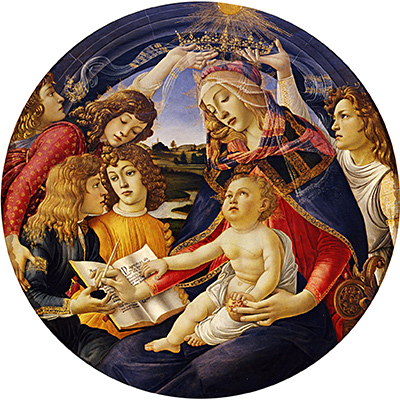
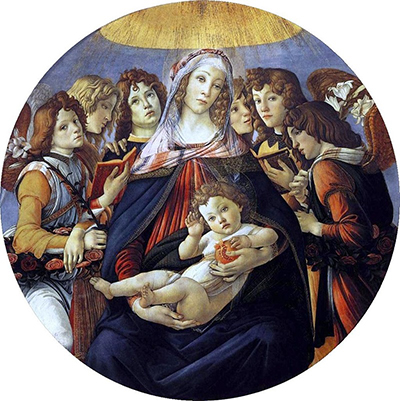
The child reaches for a pomegranate as Mary holds it close to his chest. Around them, six angels crowd into a circle, their heads and hands almost closing the space behind the pair. Some look towards Mary; others turn in different directions. Botticelli makes the fruit the centre of a gentle physical exchange, yet the faces are strikingly serious. This is the Uffizi's Madonna of the Pomegranate, a large, round painting in which a familiar image of mother and child takes on a ceremonial weight.[1]
The Uffizi records the work as Virgin and Child with Angels, painted by Sandro Botticelli about 1487 in tempera on wood. Its diameter is 143.5 centimetres, and its inventory number is 1890/1607. Those details help distinguish the painting from other Botticelli Madonnas that also contain a pomegranate. Its original carved and gilded frame survives, although many modern reproductions, including the older image used on this site, show only the painted circle.[1]
At a glance
- ArtistSandro Botticelli, according to the Uffizi Galleries
- TitleVirgin and Child with Angels ('Madonna of the Pomegranate')
- Datec. 1487
- Mediumtempera on wood
- Dimensions143.5 cm in diameter
- CollectionUffizi Galleries, Florence
- Inventory1890/1607
The date is an art-historical estimate rather than a date written on the panel. A payment recorded in 1487 for a Marian tondo by Botticelli has often been connected with this picture. The Uffizi presents that link as a proposal, not an established identification. The payment, the painting and their possible relationship need to be considered separately.[1][2]
This work in Botticelli’s career
Fortitude
1470Madonna of the Pomegranate
about 1487Primavera
c. 1480Birth of Venus
c. 1485Mystic Nativity
1500Contents
- At a Glance
- A Circle of Faces and Hands
- Why a Pomegranate?
- Flowers, Prayer and Mary's Place
- The Round Painting and Its Original Frame
- A 1487 Payment and an Uncertain First Setting
- Three Madonnas with a Pomegranate
A Circle of Faces and Hands
Mary sits almost on the painting's central axis. Her head tilts slightly, and the dark blue of her mantle forms a broad shape around the child on her lap. Christ is not isolated in an open landscape. He lies across her arms with one hand near the pomegranate; Mary's hands hold him and offer the fruit. These small gestures are surrounded by a dense arrangement of shoulders, sleeves and faces. The angels leave little empty space, even at the edge of the tondo.[1]
Botticelli gives the figures different tasks within this close group. Angels at either side hold flowers; others stand behind Mary's head. One figure near the right lowers a face towards a prayerful gesture, while another looks out from beside Mary. The viewer can move around their expressions before returning to the fruit. The composition feels balanced without making all six attendants identical. Their varied glances animate what might otherwise be a rigidly symmetrical devotional image.[1]
Above Mary's head is a luminous golden zone. It gives the central figure visual emphasis even though the angels press close to her. Botticelli's bright, detailed faces and the broad areas of red and blue clothing work at different distances: a viewer can first recognise the monumental central group, then look more slowly at the hands, flowers and embroidered fabric. The diameter matters here. This is a substantial panel, not a small miniature for private handling.[1]
The Uffizi draws attention to a tension in the work. Circular sacred pictures were often made for secular settings and could have an intimate tone, but this one has strict symmetry, monumentality and solemnity. Mary and her attendants do not simply celebrate a healthy child. Their thoughtful expressions invite a viewer to consider the future suffering signalled by the fruit. That is the museum's interpretive reading, grounded in the picture's visible mood and traditional Christian symbolism; it does not tell us exactly what any first owner thought.[1]
Why a Pomegranate?
Mary presents the fruit and Christ takes hold of it. Its vivid interior and many red seeds made the pomegranate a familiar Christian sign of the Passion: the Uffizi identifies the red kernels with the blood Christ would shed. In this painting, the meaning is carried by an action rather than placed at the margin as a decorative emblem. The child is still held safely on Mary's lap, yet the fruit points beyond his infancy.[1]
That contrast gives the picture much of its emotional force. Mary's lowered face and the angels' pensive expressions can be read alongside the fruit's Passion meaning. The image does not illustrate the Crucifixion, nor does it turn the child into a mere forecast of it. It joins a present bond between mother and son to a devotional awareness of what Christian viewers believed would come. The round format keeps those ideas close to the people who contemplate them.[1]
The pomegranate is not a unique identifier for this work. Botticelli placed one in the Uffizi's earlier Madonna of the Magnificat, where the child touches the fruit while Mary writes. It also appears in his much earlier Madonna of the Rose Garden, where Mary offers it under a stone loggia. Recognising the symbol is a useful first step; the figures' actions, format, dimensions and inventory tell us which painting we are seeing.[1][3][4]
Flowers, Prayer and Mary's Place
The angels carry lilies and roses, flowers associated in the Uffizi's interpretation with Mary and her virginity. Their presence reinforces her central place in the group. These flowers are held by living figures rather than scattered across a background. The attendants frame Mary through their bodies and through what they bring to her.[1]
One angel to the left wears an embroidered stole bearing AVE MARIA GRATIA PLENA, the opening words of a prayer to Mary. The lettering belongs to the painted scene. It turns clothing into a devotional text and gives the viewer a phrase to associate with the Virgin at the centre. We can identify the words from the Uffizi's transcription without assuming that every viewer in Botticelli's Florence read them at the same distance, or that an original commissioner dictated their placement.[1]
Flowers, prayer and fruit point in related directions, but they do different work. The lilies and roses direct attention to Mary's identity; the inscription voices an address to her; the pomegranate links the child to the Passion. Botticelli gathers these elements around a very human exchange of hands. The symbols matter because they help explain the picture's decisions, not because they replace looking at its figures.[1]
The Round Painting and Its Original Frame
A tondo is a round picture. Its shape helps gather the angels closely about Mary and Christ, while its wide diameter gives the gathering room to feel imposing. Botticelli uses the circle as more than a convenient border. Faces follow its upper arc, and the figures at the sides seem to turn inward towards the mother and child. The arrangement makes the central fruit visible from within a ring of people.[1]
Unusually, the painting retains its original frame. The Uffizi describes carved, gilded and painted wood with golden lilies against a blue ground along the circumference. That physical surround changes how the work is experienced: the painted gathering sits within another ring of ornament. A cropped image of the painted disk does not show the whole historical object. The frame deserves attention in its own right, even when a reproduction cannot include it.[1]
The frame is the product of skilled Florentine woodwork. Its maker has been proposed as Giuliano da Maiano or Giuliano da Sangallo, but the Uffizi does not settle between them. We should not attach the frame to either workshop as a documented commission. Its survival is secure; a precise maker is not. The golden lilies may invite wider associations, but the frame alone cannot identify the painting's first room or patron.[1]
Large sacred tondi could belong in civic and domestic surroundings as well as within religious life. The Uffizi notes that the round format was used for sacred images intended for secular settings. That general practice helps explain why a solemn Madonna might have been made for an audience hall. It cannot, by itself, locate this panel. The shape offers context; a specific original destination depends on stronger evidence.[1]
A 1487 Payment and an Uncertain First Setting
There is a recorded payment to Botticelli in 1487 for a tondo showing the Virgin, destined for the audience hall of the Massai di Camera, a financial office of the Florentine Republic. The Uffizi's account cites Roberta J. M. Olson's study of the payment document and says that scholars tend to relate this large surviving panel to it. That wording matters. A record of a Marian tondo does not by itself prove that the Uffizi Madonna of the Pomegranate is the picture paid for.[1][2]
Even the location of the administrative body's audience hall is not fixed in the Uffizi record. It may have been in the Palazzo della Signoria, now Palazzo Vecchio, or in the Palazzo del Podestà, now the Bargello. The latter building was used by the office when it was suppressed in 1533, but that later fact does not settle the situation in 1487. A precise account of the panel hanging in a named room would go beyond the evidence available here.[1]
The proposed commission is still significant. It suggests a possible civic function for a picture whose size and solemnity can feel more public than intimate. If the identification is correct, the tondo would have greeted people undertaking the business of the republic. Yet that reading should remain conditional. We can describe Botticelli's visible composition and the documented payment without making them two halves of a proven story.[1][2]
The history of that identification explains the caution. A Christie's catalogue reviewing the tondo's scholarship says Gaetano Milanesi argued in 1878 that its decorated frame pointed to a Florentine public office and proposed the Massai di Camera. Herbert Horne and Ronald Lightbown could not locate the underlying commissioning document, even though they considered the civic link plausible. The Uffizi now cites Olson's 1995 study of the payment and still describes the connection to this surviving panel as a tendency rather than a certainty. The frame, a reported document and the panel are three kinds of evidence; the chain between them has been argued over time, not preserved as an unbroken object history.[6][1][2]
The first secure ownership milestone supplied by the Uffizi is later. In the seventeenth century, the painting entered the collection of Cardinal Leopoldo de' Medici. It has been at the Uffizi since 1780. Those records tell us something about how the work was preserved and displayed after Botticelli's lifetime. They do not fill the gap between its creation and its Medici collection history.[1]
The later records can be dated more closely. Christie's cites a posthumous inventory of Cardinal Leopoldo from October 1675 that describes the tondo and its frame. It also cites a document of 19 October 1780 ordering its transfer from the Pitti Palace to the Uffizi under Grand Duke Pietro Leopoldo. These references support a passage through a Medici collection and a specific later move, but the auction catalogue is reporting those documents, not reproducing them in full. Neither record identifies the first patron of the picture or verifies the proposed 1487 audience-hall setting.[6][1]
Three Madonnas with a Pomegranate
The Madonna of the Rose Garden is an upright panel of about 1470, 124 × 64 centimetres, Uffizi inventory 1601. Mary and Christ sit beneath a loggia; a rose bush grows behind them. The fruit is part of a close meeting between two figures in an architectural niche. It is neither the same panel nor a detail cut from the later round Pomegranate.[3]
The Madonna of the Magnificat is also a tondo, but the Uffizi dates it to about 1483 and records a smaller diameter of 118 centimetres, inventory 1609. Mary writes the opening of the Magnificat with the child's guidance; angels crown her, and the child touches a pomegranate. Writing and a view into a landscape give that painting a different visual rhythm. The Uffizi does not know its original destination.[4]
In the Madonna of the Pomegranate, dated about 1487, the mother and child are encircled by six angels, and the fruit occupies their shared gesture at the centre of a solemn composition. The three works show Botticelli returning to a symbol while changing the setting, scale and action around it. Similar subject matter does not mean that one image is a copy of another or that their early histories can be combined.[1][3][4]
The design also circulated within Botticelli's wider studio. Christie's catalogued a separate, smaller tondo from the Wernher collection as a studio reduction of this Uffizi painting. At 97 centimetres in diameter, it omits the two angels nearest the Uffizi panel's outer edges and the lily held by one angel; even the exposed part of the pomegranate is simplified. Those concrete differences make the later object useful for seeing how a monumental composition could be adapted, not merely repeated at a new size. Horne had suggested a relation to a preparatory cartoon, while the catalogue notes that the difference in scale rules out a precise one-to-one transfer from such a cartoon. The Wernher panel's studio attribution and its English collecting history belong to that separate painting, not to the Uffizi original.[6]
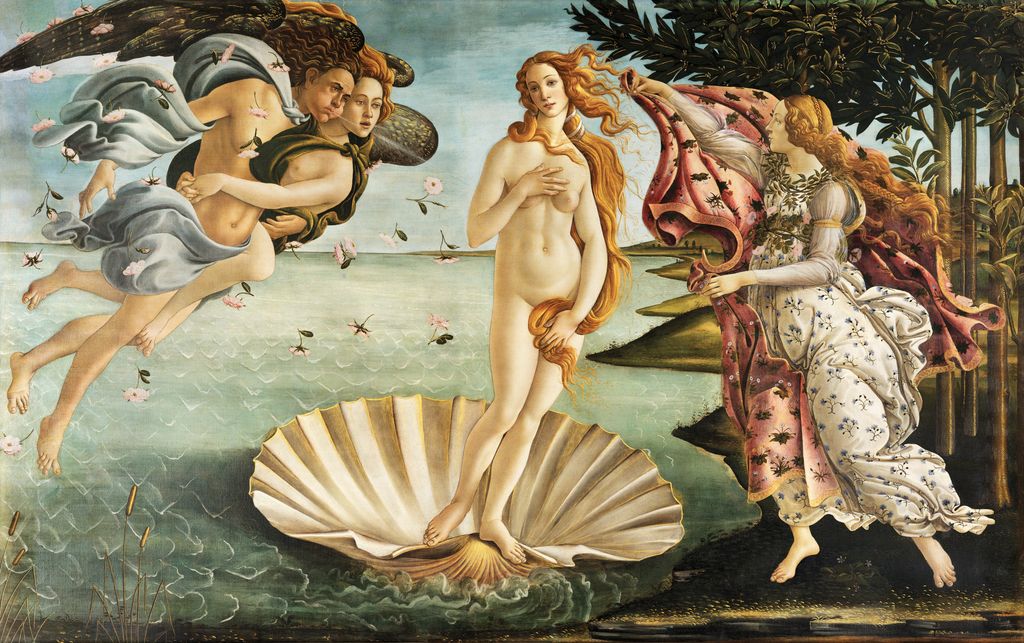
The Uffizi's 2026 installation now places the Pomegranate and Magnificat tondi on either side of the Birth of Venus. The museum proposes a dialogue between the faces of Mary and Venus. This is a modern curatorial arrangement that can help a visitor compare Botticelli's forms; it is not evidence that the paintings originally hung together or that Botticelli planned that comparison for their first viewers.[5]
Look again at Christ's hand and the fruit Mary gives him. The ring of angels, the flowers and the surviving frame all expand this small action into a large sacred image. Its origin may eventually be tied more firmly to the 1487 civic payment. For now, the painting itself offers a clearer starting point: Botticelli makes tenderness and foreknowledge occupy the same close circle.[1]
Botticelli and related artworks
Discussion
Which detail changes how you read Madonna of the Pomegranate?
Reader Insights
How do the angels’ faces and hands close the circle?
What can the pomegranate mean in this devotional scene?
How much is known about where this tondo first hung?
Join the Conversation
Share a source-led observation or question below.
References
- Uffizi Galleries, “Virgin and Child with Angels ('Madonna of the Pomegranate'),” inventory 1890/1607, current collection record by Daniela Parenti; accessed 29 September 2026 View source.
- Roberta J. M. Olson, “An old mystery solved: the 1487 payment document to Botticelli for a tondo,” Mitteilungen des Kunsthistorischen Institutes in Florenz 39 (1995), 393–396. Bibliographic identification from the journal listing and Uffizi record; full paper was not accessible in this research pass View source.
- Uffizi Galleries, “Madonna and Child, known as the Madonna of the Rose Garden,” inventory 1890 no. 1601, current collection record; accessed 29 September 2026 View source.
- Uffizi Galleries, “Virgin and Child, and Angels (Madonna of the Magnificat),” inventory 1890 no. 1609, current collection record by Daniela Parenti; accessed 29 September 2026 View source.
- Uffizi Galleries, “The new permanent installation of the Botticelli Rooms,” announcement, 16 June 2026; accessed 29 September 2026 View source.
- Christie's, “The Madonna and Child with Four Angels,” studio of Sandro Botticelli, Wernher collection sale catalogue, lot essay and provenance, consulted 1 October 2026. Its comparisons with Uffizi inventory 1607, account of Milanesi/Horne/Lightbown, and references to the 1675 and 1780 documents were read directly; the two historical documents and Olson's full 1995 article were not independently inspected View source.