 by Tom Gurney
Tom Gurney BSc (Hons) is an art history expert with over 20 years experience
Published on June 19, 2020 / Updated on October 2, 2026
Email: tomgurney1@gmail.com / Phone: +44 7429 011000
A closer look
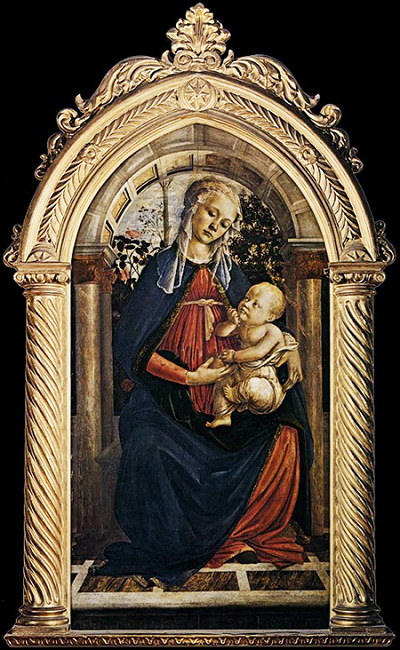
Mary lowers her face towards the child seated on her lap, while a rose bush crowds the opening behind them. Between their hands is a pomegranate. Botticelli places these living forms inside a narrow, carefully ordered stone setting: columns rise on either side, and a coffered vault arches over their heads. The picture joins a close exchange between mother and son to a larger devotional language of flowers, fruit and architecture.[1][2]
The Uffizi Galleries call the painting Madonna and Child, known as the Madonna of the Rose Garden. They date it to about 1470 and record tempera on wood, 124 × 64 centimetres, inventory 1890 no. 1601. Its tall, arched shape is one way to recognise the work. Another is the small rose bush, partly visible in the dark space behind Mary. The pomegranate does not turn it into Botticelli's much later round Madonna of the Pomegranate; the two panels have different sizes, dates and compositions.[1][3]
At a glance
- ArtistSandro Botticelli, according to the Uffizi's current attribution
- TitleMadonna and Child, known as the Madonna of the Rose Garden (Madonna del Roseto)
- Datec. 1470
- Mediumtempera on wood
- Dimensions124 × 64 cm
- CollectionUffizi Galleries, Florence
- Inventory1890 no. 1601
The Italian national catalogue gives a slightly narrower 1469–70 dating. That range and the Uffizi's “about 1470” are compatible estimates, not competing records of a dated commission. The catalogue also preserves an older attribution to Botticelli's workshop, while assigning the work to Botticelli in its principal field. The current holding museum names Botticelli. The original patron and first display site are less securely established than these object facts.[1][2]
This work in Botticelli’s career
Fortitude
1470Madonna of the Rose Garden
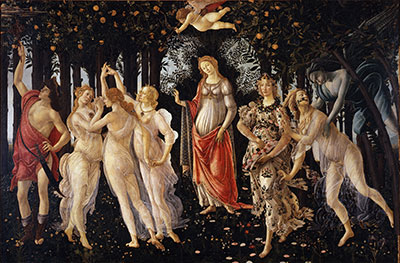
about 1470Primavera
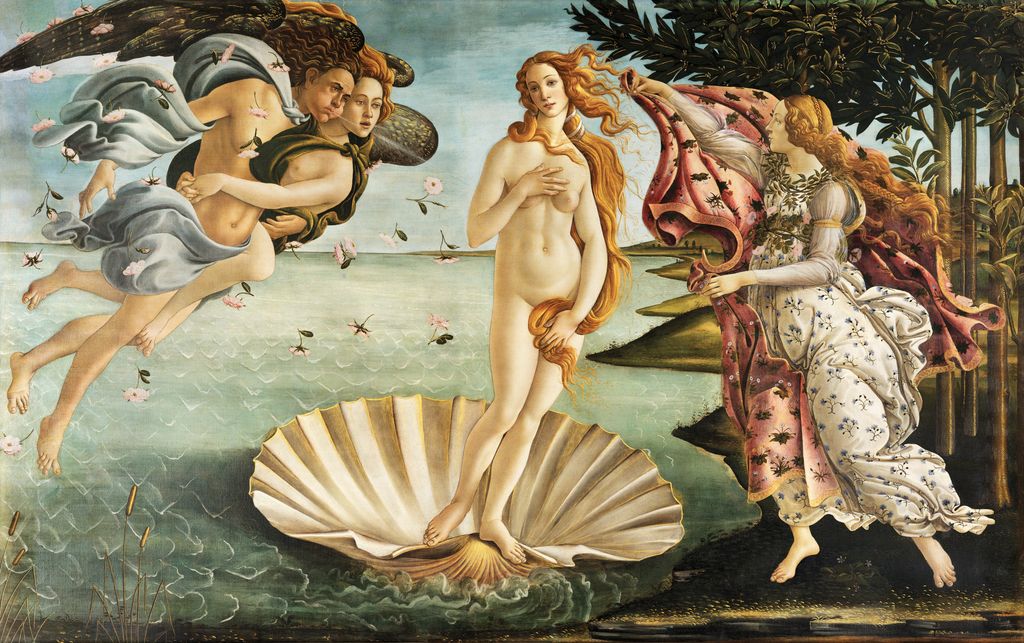
c. 1480Birth of Venus
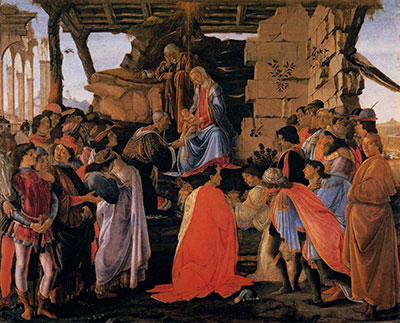
c. 1485Mystic Nativity
1500Contents
- At a Glance
- Mother and Child Beneath the Arch
- Why a Rose Garden and a Pomegranate?
- An Early Work and a Proposed Commission
- At the Uffizi Today
- This Panel and the Other Pomegranate Madonna
Mother and Child Beneath the Arch
Mary's dark blue mantle falls in broad folds over the seat and towards the floor. A red dress appears within it, and a pale veil frames her face. Her head inclines towards Christ, but her expression is quiet rather than animated. The child sits across her lap with his bare legs angled outward. He turns towards her and reaches into the space where she presents the fruit. Their faces and hands occupy a small zone near the centre of a much taller picture.[1]
That contrast in scale makes the panel more than an enlarged close-up. The arch rises above Mary, and the stone floor extends beneath her robe. Botticelli gives the pair an architectural place. Yet the child's reaching hand and Mary's offer keep drawing our attention back from the columns to the simple movement between them. The painting can be read from a distance as a seated Madonna beneath a vault, then at closer range as an exchange made through fingers and a piece of fruit.[1][2]
The coffered ceiling curves with the painted top. Its repeated square recesses recede behind Mary's head, while the columns on either side hold the scene upright. The national catalogue identifies Corinthian capitals and an architectural throne. The dark opening between the supports gives the rose bush room to appear. Built order frames natural growth, and both frame the figures. Botticelli uses that tension to make the setting active without adding other people or a wide narrative landscape.[1][2]
The marble or stone pattern at the bottom gives the robe a clear edge. Mary's blue drapery reaches down towards it, while red fabric brightens the interior. Christ's pale skin stands against those deeper colours. The vertical support and patterned floor keep the composition stable; the inclining heads, curved arms and bush interrupt its symmetry. These visible relationships matter even before a viewer knows what the rose and pomegranate have been taken to mean.[1]
Why a Rose Garden and a Pomegranate?
The Uffizi explains the rose bush behind Mary as an allusion to the Rosa Mystica, a traditional image of her purity. Its account describes her as a rose without thorns, free from original sin. The flowers are therefore not merely an attractive background. They place Mary within a devotional vocabulary that a contemporary viewer could connect with her religious role. At the same time, the plant is small and partly shadowed; Botticelli does not turn the whole panel into a literal garden scene.[1]
The pomegranate carries a different reference. The museum relates it to the Passion and Resurrection of Christ. Mary holds it before the infant, so the fruit binds a present, tender action to a future Christian story. The child reaches towards what she offers without a dramatic gesture. That restraint leaves the symbol open to sustained attention. The panel presents a mother and child now, while the Uffizi's interpretation asks the viewer to think ahead to suffering and renewal.[1]
These readings come from the owning museum's account of the painting. They do not identify its first patron or prove that every visitor would have understood the symbols in exactly the same way. The rose's association with Mary and the fruit's association with Christ are strong iconographic guides, but neither removes the visual importance of the actual exchange: Mary's hand, the child's body and the small object between them. The painting works by holding a devotional sign inside a human gesture.[1]
An Early Work and a Proposed Commission
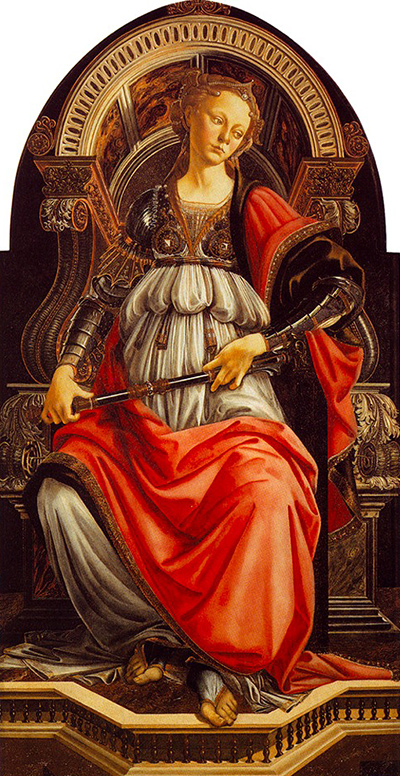
Both the Uffizi and the Italian national catalogue place the panel around 1470. The catalogue reports that scholars have associated its style with Botticelli's period of contact with Verrocchio's art and noted affinities with his Fortitude, also dated 1470. The comparison concerns the formation of the young artist's style; it is not proof that these two paintings were commissioned together or made for the same building.[1][2]
The panel's later recorded history offers a more specific clue than its style. The national catalogue says it came from Florence's Camera di Commercio, or Chamber of Commerce. It also records a partly legible inscription on the back referring to that institution and a June date in the eighteenth century. The damaged date does not give a precise year in the catalogue's transcription. It shows a historical connection with the building or organisation, not a surviving fifteenth-century order from a patron.[2]
Ronald Lightbown proposed that the painting might have been commissioned for either the Mercanzia, Florence's merchant court, or the Arte della Lana, the wool guild, because those bodies had earlier occupied the building connected with the later provenance. The national catalogue presents this as a hypothesis. A later location can suggest an earlier institutional use, but it cannot by itself identify who paid Botticelli, on which date, or where the panel first stood. That distinction is especially important for a devotional painting, because its architecture in the image should not be mistaken for a record of the architecture around it.[2]
The older workshop attribution recorded by the national catalogue is another reason to keep levels of certainty separate. The Uffizi currently credits Botticelli, and the national catalogue does so in its primary attribution. Neither source gives a contract that would settle all questions about the panel's early making. The painting's place in the artist's early career is well supported; a named commissioner remains unproved.[1][2]
At the Uffizi Today
The Uffizi's object page locates the Madonna of the Rose Garden in its Botticelli display. A 16 June 2026 announcement of the reinstalled rooms describes it more precisely: the panel now flanks Primavera in the room facing The Birth of Venus, alongside the Madonna of the Cherubim. This is a modern curatorial arrangement. It brings an early religious image into dialogue with better-known mythological works, but it does not reconstruct the panel's original Florentine position.[1][4]
Seeing the painting among other Botticelli works can sharpen its distinctive choices. It is tall where many later Marian panels are round. The figures occupy a recessed architectural niche rather than a broad landscape or circle of angels. The pomegranate appears here in a quiet pair, not in a more populous composition. Those differences are visible without assuming that Botticelli meant each Madonna to answer another in a fixed sequence.[1][3][4]
The current photograph of the panel also calls for care about its ornate frame. A gilded surround can alter how we perceive the arch and columns, but the sources used here do not establish when that frame was made or whether it belonged to the original presentation. The painted niche, rose bush and figures can be described securely; an original-frame history would require separate evidence.[1][2]
This Panel and the Other Pomegranate Madonna
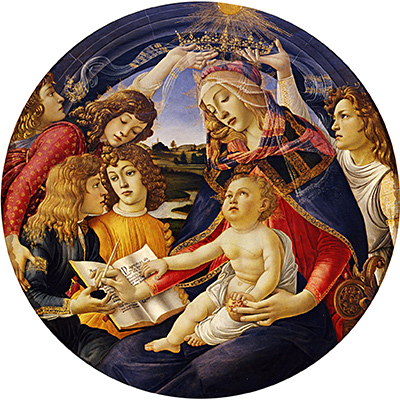
Botticelli's Madonna of the Pomegranate at the Uffizi dates to about 1487. It is a large tondo, 143.5 centimetres in diameter, inventory 1890/1607. Mary and the child are accompanied by angels, and the fruit is held at the centre of a round, more symmetrical composition. The Rose Garden is the tall panel of about 1470, inventory 1890 no. 1601, with Mary and the child beneath a vaulted loggia and roses behind them. The same fruit signifies related religious ideas in both, but the object records and visual forms keep the works apart.[1][3]
An older web route called “Madonna of the Roses” shows a crop of this Rose Garden panel. It is another reproduction of the same Uffizi object, not a third Botticelli painting to be interpreted separately. The retained Rose Garden page gathers that search phrase under the museum's recognised title. Its more important distinction remains the later pomegranate tondo: a shared symbol is not a shared physical painting.[1][3]
Look again at the small fruit between Mary and Christ. The rose bush behind them and the stone vault around them expand the moment into a sacred image, yet the gesture remains compact. Botticelli's early painting draws its force from that balance: a monumental seat for two figures whose attention is concentrated on one another and on what Mary offers her child.[1][2]
Botticelli and related artworks
Discussion
Which detail changes how you read Madonna of the Rose Garden?
Reader Insights
How does the arched setting frame Mary and the Child?
What do the rose and pomegranate suggest?
What does the later Chamber of Commerce history establish?
Join the Conversation
Share a source-led observation or question below.
References
- Uffizi Galleries, “Madonna and Child, known as the Madonna of the Rose Garden,” inventory 1890 no. 1601, current object record, accessed 29 September 2026 View source.
- Italian Ministry of Culture / Uffizi Galleries, “Madonna del Roseto,” national catalogue 0900188557, compiled 1985 and updated through 2006, accessed 29 September 2026 View source.
- Uffizi Galleries, “Virgin and Child with Angels ('Madonna of the Pomegranate'),” inventory 1890/1607, current object record, accessed 29 September 2026 View source.
- Uffizi Galleries, “The new permanent installation of the Botticelli Rooms,” announcement, 16 June 2026, accessed 29 September 2026 View source.