 by Tom Gurney
Tom Gurney BSc (Hons) is an art history expert with over 20 years experience
Published on June 19, 2020 / Updated on October 2, 2026
Email: tomgurney1@gmail.com / Phone: +44 7429 011000
A closer look
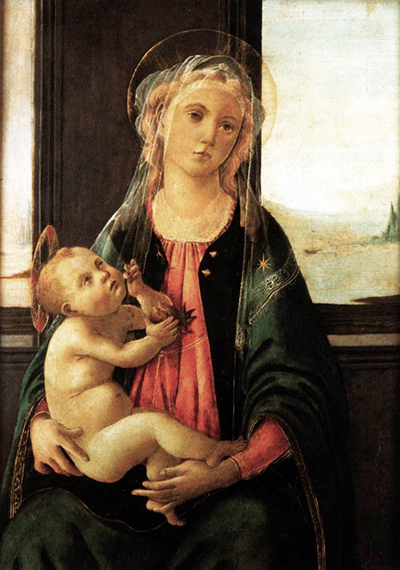
Mary sits with the Christ Child on her lap, close to a dark window frame. Beyond it, a pale strip of sea opens the room to a distant landscape. That small view gives the painting its familiar name, Madonna del Mare, or Madonna of the Sea. The Galleria dell'Accademia in Florence dates the panel to about 1475–80 and labels it attributed to Sandro Botticelli. The attribution is deliberately qualified. This page follows the Accademia object, inventory 1890 no. 8456, while keeping the debate over Botticelli and Filippino Lippi visible.[1][2][3]
The picture is sometimes reproduced as though it were an unproblematic early Botticelli Madonna. Its object records are more complicated. The Accademia's restoration list describes tempera on panel, while an older Italian national catalogue says oil on panel. Published size figures also disagree substantially. These are catalogue differences, not details a reader can settle by looking at a small photograph. What can be seen is a quiet exchange between mother and child, set against a window that makes the distant sea part of the painting's mood.[2][3][4]
At a glance
- TitleMadonna del Mare (Madonna of the Sea), also Madonna and Child
- Artist labelAttributed to Sandro Botticelli in the Accademia's 2025 visitor map and Italian national catalogue; Filippino Lippi is a historical alternative
- DateAround 1475–80 in the museum map and national catalogue
- ObjectPainting on wood panel, not a fresco
- Paint mediumTempera on panel in the Accademia's restoration report and a V&A lender list; oil on panel in the older national catalogue
- SizeV&A loan documentation reports 403 × 284 mm (40.3 × 28.4 cm); a widespread 60.5 × 49.5 cm figure remains unreconciled
- CollectionGalleria dell'Accademia, Florence, inventory 1890 no. 8456
- Recorded later provenanceSanta Felicita convent, Florence; Accademia, Uffizi, then Accademia again according to a V&A loan listing[1][2][3][4]
This work in Botticelli’s career
Fortitude
1470Madonna of the Sea
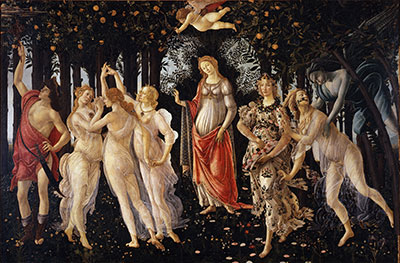
about 1475–80Primavera
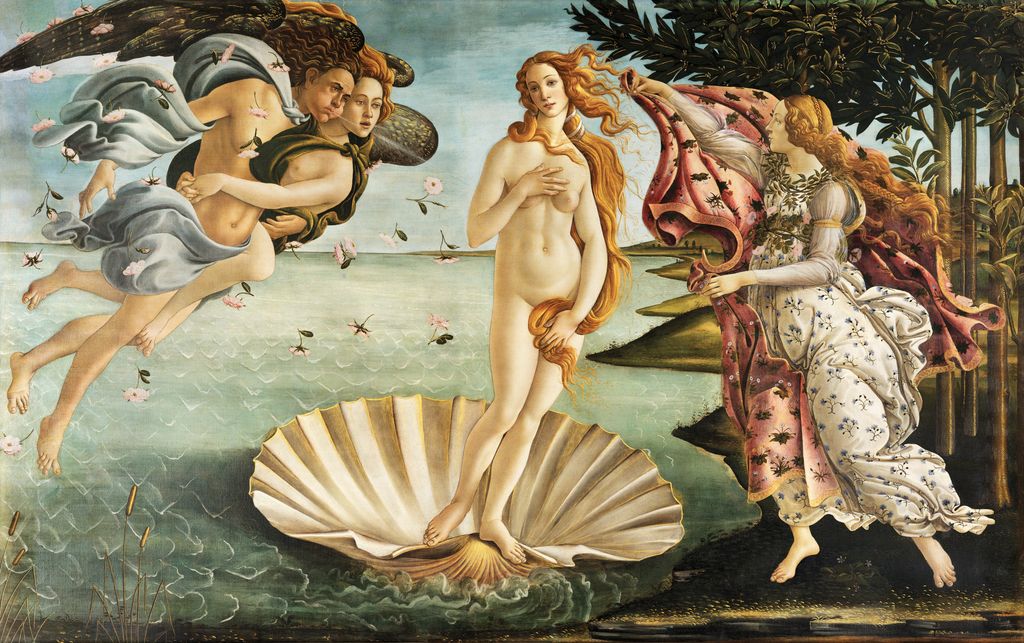
c. 1480Birth of Venus
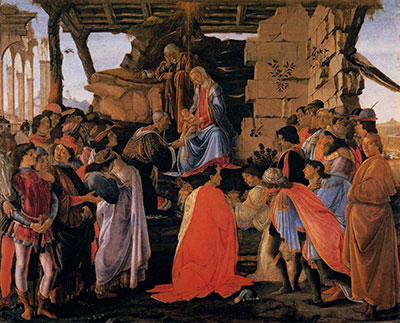
c. 1485Mystic Nativity
1500Contents
- At a Glance
- The Mother, Child and Window
- What the Fruit and Star Can Mean
- Why the Artist's Name Is Qualified
- A Small Panel with Disputed Measurements
The Mother, Child and Window
Mary takes up most of the narrow image. Her face tilts slightly toward the child, but her gaze is lowered and distant rather than fixed on his every movement. A sheer veil falls around her hair; a dark mantle surrounds a warm red garment. The mantle carries a small star. The V&A's loan description specifically notes it, a useful detail because it is easy to miss in a reduced reproduction. Her quiet, nearly upright pose gives the composition its centre.[4]
The Child's body creates a different rhythm. He sits across her lap, bare against the heavy folds of Mary's clothing, turning his face upward and moving his hands. The national catalogue and the V&A list identify the fruit he holds as a pomegranate. In the image, the small red form is less commanding than the bodies around it, but its placement between Mary's stillness and the child's activity rewards close inspection. The contrast gives a familiar Madonna and Child subject a particular tension: a mother supports a moving infant while seeming to look beyond the present moment.[3][4]
The sea is not spread behind the whole group. A dark vertical jamb divides the interior from a pale landscape opening at the right. Light sky, distant water and small forms on the shore or water are compressed into a narrow area. The Italian catalogue names boats among the depicted objects. That distant detail is enough to explain the conventional title Madonna of the Sea. It does not identify a real harbour, a named coastline or the place where the painting was first displayed.[3]
The division between dark interior and bright outside also makes the painting feel deeper than its small panel would suggest. Mary's veil and face are set against shadow; the sea seems further away because it is framed by architecture. The viewer first meets the figures, then looks past them. This is a compositional observation, not proof that the artist intended the distant view as a map or narrative setting.[3][4]
What the Fruit and Star Can Mean
The pomegranate is a common Marian-picture fruit, and its red seeds have been read as a reference to Christ's future suffering and resurrection. The Uffizi's account of its different Madonna of the Rose Garden gives those traditional Christian meanings explicitly. The fruit in Madonna del Mare can be understood within that shared visual language. It is not evidence that the Accademia panel belonged to the Uffizi work or was made for the same patron.[3][4][5]
The small star on Mary's mantle also fits a long tradition of identifying her through a celestial sign. The older page on this site links it to Stella Maris, “Star of the Sea.” That is a possible devotional association for a Madonna whose background contains water. None of the object records cited here documents a commission built around that title, however, so the safer reading is to distinguish two visible things: an embroidered star and a seascape. Their combination invites reflection without supplying a lost contract or proven original title.[1][3][4]
This restraint matters because the panel is already full of meaningful detail. Mary's veil, the exposed Child, fruit, window and sea work together to suggest both intimacy and distance. The familiar symbols can deepen a viewer's reading, but they should not erase the painting's simple human structure. The child pushes outward; the mother holds him. Her face remains calm even as his small hands and body create motion.[3][4]
Why the Artist's Name Is Qualified
The Accademia's 2025 map says “Sandro Botticelli (attr.)” beside Madonna del mare, dating it to approximately 1475–80. The museum's own collection overview uses the phrase traditionally attributed to Botticelli. Its restoration report files the panel under his full name, Alessandro Filipepi, but that administrative heading does not remove the map's qualification. The Italian national catalogue likewise says Botticelli attributed, and records Filippino Lippi and the old “Amico di Sandro” label as other assignments.[1][2][3]
The national catalogue's historical note explains the problem in brief. Ulmann in 1893 described the work as close to Botticelli. Over time it has been given to both Botticelli and Filippino, Botticelli's pupil. The catalogue reports Ronald Lightbown's preference for Filippino. Those judgements are not the same as a new technical verdict by the current museum. They show why a definite headline “by Botticelli” would conceal a live attribution question. A reader should encounter the object's physical and visual identity first, with the name given at the museum's level of confidence.[3]
The painting's medium raises a separate question. The Accademia's modern report calls it tempera on panel; the V&A loan listing repeats tempera on wood. The national catalogue says oil on panel. All three agree that the support is wood, so the old description of this work as a fresco is wrong. The consulted records do not include a technical analysis that resolves the binding medium. It is better to give the two catalogue terms than to turn one unexamined field into a confident laboratory result.[2][3][4]
A Small Panel with Disputed Measurements
The V&A's lender entry for the Accademia painting gives 403 × 284 millimetres. A historical photo-archive entry appears to give the same numbers as 40.3 × 28.4, although its stated unit field is inconsistent. Many image listings instead say 60.5 × 49.5 centimetres. The two pairs are too far apart to smooth into a rounding difference. The consulted evidence does not establish whether one measures a frame, a formerly larger state, or a different cataloguing convention. The safe fact is that the V&A loan list explicitly reports the smaller size for inventory 8456; the alternative figure remains unresolved.[4][6]
What is clear from the reproduced composition is its vertical shape. The mother and child occupy a close, narrow space, with only a slim view past the window. The painting was suited to intimate looking in a way a great church altarpiece would not be, but the records consulted here do not prove a household commission. The documented Santa Felicita convent provenance identifies a later place where it was held, not necessarily the room or purpose for which the first painter made it.[4]
The V&A loan listing traces the panel from Santa Felicita to the Accademia in 1809, then to the Uffizi in 1934, and back to the Accademia in 1936. Its current collection is thus clear even if its earliest patron is not. The Accademia's 2025 map placed it in the Sala del Colosso at that time; room displays can change. Inventory 8456 is the stable way to locate the exact work in catalogues.[1][4]
This painting's value as a subject for close looking does not depend on settling every catalogue disagreement. The dark jamb gives way to a distant sea. Mary appears still as the Child stirs across her lap, the pomegranate between them. The star is small enough to be missed, then difficult to ignore once seen. Calling the object Madonna del Mare draws attention to the background; calling it attributed to Botticelli keeps the museum's present caution intact. Both parts of that description help the viewer see the panel as it survives today.[1][3][4]
Botticelli and related artworks
Discussion
Which detail changes how you read Madonna of the Sea?
Reader Insights
Where does the sea appear in this small panel?
What roles might the fruit and star play?
Why is the attribution to Botticelli qualified?
Join the Conversation
Share a source-led observation or question below.
References
- Galleria dell'Accademia di Firenze, “Mappa Cantico delle creature,” 2025 visitor map: Madonna del mare, Botticelli (attributed), c. 1475–80, Sala del Colosso; and Accademia collection overview describing the painting as traditionally attributed, accessed 1 October 2026 View source View source.
- Galleria dell'Accademia di Firenze, “Restoration report,” records Madonna del mare, inv. 1890 no. 8456, as tempera on panel and a 2020 gilded-frame restoration, accessed 1 October 2026 View source.
- Italian General Catalogue of Cultural Heritage, “Madonna del mare. Madonna con Bambino,” national record 0900191210, Botticelli (attributed), alternative Filippino and Amico di Sandro attributions, oil-on-panel field and depicted objects, compiled 1986 with updates through 2006, accessed 1 October 2026 View source.
- Victoria and Albert Museum, “Botticelli Reimagined loan listing,” official indexed entry for Accademia no. 8456: 403 × 284 mm, tempera on wood, Child's pomegranate, mantle star, seascape and collection movement. The listing was available in search indexing, while direct PDF retrieval was unavailable in this pass; accessed 1 October 2026 View source.
- Gallerie degli Uffizi, “Madonna of the Rose Garden,” separate painting's record explaining traditional Passion and Resurrection meanings of the pomegranate, used for iconographic comparison only, accessed 1 October 2026 View source.
- Istituto Nazionale di Studi sul Rinascimento, “Madonna con Bambino,” historical photo archive entry with 40.3 × 28.4 measurement and inconsistent unit field, Santa Felicita provenance; used only as corroboration with the V&A lender record, accessed 1 October 2026 View source.