 by Tom Gurney
Tom Gurney BSc (Hons) is an art history expert with over 20 years experience
Published on June 19, 2020 / Updated on October 2, 2026
Email: tomgurney1@gmail.com / Phone: +44 7429 011000
The Virgin and Child with Singing Angels (Raczyński Tondo)
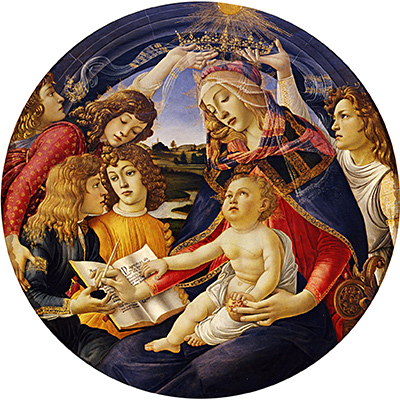
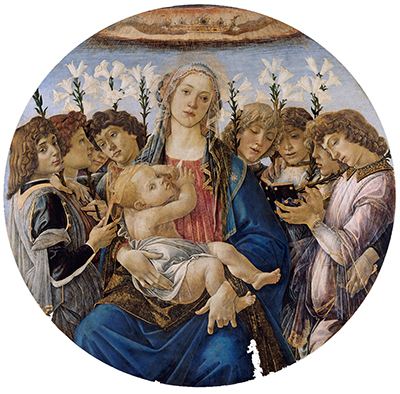
The infant Christ turns towards Mary and reaches for her breast. Around them, eight angels crowd into the round painting, some carrying white lilies and others attending to a small book. A crown hangs high above Mary’s head. Botticelli gives this familiar mother and child a gathering of faces, flowers and voices, yet the centre of the image remains the contact between the two figures.[1]
Berlin’s Gemäldegalerie calls the work The Virgin and Child with Singing Angels (Raczyński Tondo) and dates it to about 1478. At 136.5 centimetres across, the poplar panel is large enough for the angels to be seen as individual participants rather than a decorative border. Its round shape, known as a tondo, does more than contain the figures: their heads, stems and garments continually lead the eye back around the circle.[1]
At a glance
- ArtistSandro Botticelli
- TitleThe Virgin and Child with Singing Angels (Raczyński Tondo)
- Dateabout 1478; Fondazione Zeri gives a broader 1475–80 range
- Mediumtempera on poplar panel, according to the Walters Art Museum journal; Berlin specifies the poplar support
- Dimensions136.5 cm diameter
- Current collectionGemäldegalerie, Staatliche Museen zu Berlin
- Inventory number102A
Where this work sits in Botticelli’s career
Fortitude
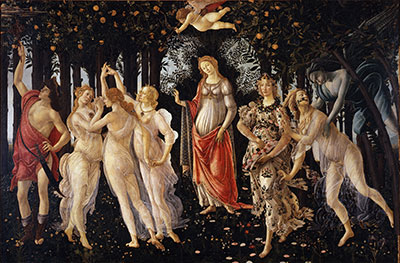
1470Primavera
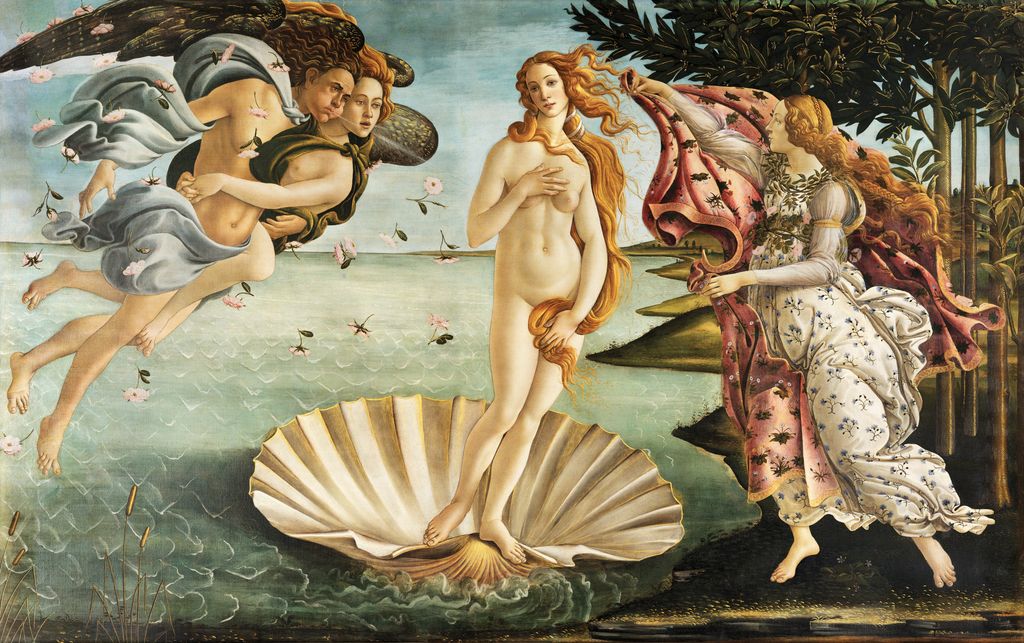
c. 1480The Birth of Venus
c. 1485The Virgin and Child with Singing Angels
about 1478The Mystical Nativity
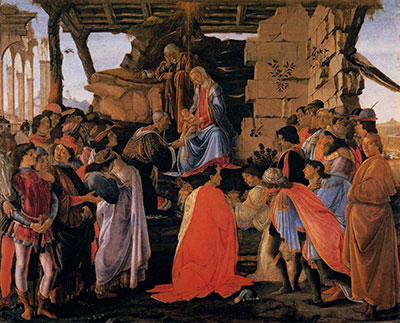
c. 1500Contents
- Mother, Child and Crown
- The Eight Angels
- What the Round Format Does
- A Possible Florentine Church Setting
- The Raczyński Name and Berlin
The picture is also called Madonna and Child with Eight Angels. Both titles refer to this Berlin painting, not to Botticelli’s other round Madonnas. The museum’s inventory number, size and date help keep it distinct from works with similar names. Fondazione Zeri identifies the same object but allows the date to run from 1475 to 1480, a reasonable reminder that “about 1478” is an art-historical estimate rather than a date written on the panel.[1][2][3]
Mother, Child and Crown
Mary sits directly beneath a suspended crown. Berlin interprets it as a sign that she is Queen of Heaven. Her red dress and dark blue mantle give her a strong central shape, while the fine veil around her hair softens the transition to the sky behind. She looks down and slightly away from the viewer. Her still expression differs from the quick movement of the child across her lap.[1]
Christ lies across her arms rather than sitting upright. He turns his face outwards, bends one leg and stretches a hand to Mary’s breast. Berlin’s account connects this gesture to Mary as a nourishing mother and to a theological idea of salvation. The action is bodily and immediate, but the crown above it gives the pair a sacred dignity. Botticelli holds these two registers together without separating them into different scenes.[1]
Mary’s hands carry much of the weight of the painting. One supports the child beneath his body; the other rests near the cloth around him. His small feet project across the blue folds of her mantle. The overlap makes his movement feel close to the viewer even though he is surrounded by angels. It also makes the relation between mother and child more active than a symmetrical pose would allow.[1]
The crown is almost at the edge of the tondo, beyond the ring of lilies and heads. Its place above Mary establishes a vertical line through her face to the child. From there the eye can travel outward again, following his arm towards the angels at the left or the sweep of blue cloth towards those at the right. The composition continually alternates between its centre and its crowded circumference.[1]
The Eight Angels
Four angels gather at each side of Mary. Their faces are close together, yet Botticelli varies their attention. One at the left looks towards us; another turns in profile; a face peeks out from behind the others. At the right, two focus on an open dark book while neighbouring faces lean towards them. The museum describes the group as singing in praise of Mary. The book supports that description, though its page should not be treated as a readable transcription of a particular hymn.[1]
Tall white lilies rise behind the angels’ heads. Berlin identifies them as emblems of purity. Their stems add upright lines to a composition dominated by curves, while the open flowers create a loose ring around Mary. They are part of the action of the picture, held by the angels, as well as part of its symbolic language.[1]
The angels do not form a flat row. Shoulders overlap, heads turn and hands emerge from gaps between bodies. The nearest figures press against the round boundary, leaving little empty space around them. This closeness gives the painting a sense of gathering: the viewer sees not a distant heavenly choir but a group assembled around Mary and the child.[1]
What the Round Format Does
The tondo’s edge cuts a wide arc over the crown and continues around the angels’ backs and Mary’s blue robe. The round frame encourages an eye movement that can start almost anywhere and return to the central pair. Botticelli does not force all the figures into one rigid ring. The child stretches across it, the lilies rise through it and some angels turn away from its centre. Those interruptions keep the arrangement lively.[1]
An essay in the Journal of the Walters Art Museum notes that round pictures were common in Renaissance Tuscan homes, although religious settings were possible too. This Berlin painting is much larger than many surviving tondi discussed there. Size alone does not establish where it first hung, but it changes how the work might have been encountered. A viewer could recognize the ring of figures from across a room and then approach the child’s hand, the singing book and the different faces.[3]
The same essay captions the Berlin work as tempera on panel and dates it to the late 1470s. Berlin’s own catalogue specifies poplar wood but does not name the paint medium in its short technical field. Keeping those sources distinct matters because the visible surface of a reproduction cannot by itself settle a technical description.[1][3]
A Possible Florentine Church Setting
The Berlin museum says the round picture may once have belonged to the Brothers of San Francesco in Florence. That “may” is important. The museum offers a possible former setting, not a documented commission or a fixed original location.[1]
The Walters essay explains why the association has attracted attention. Vasari described a Botticelli tondo of Mary and angels in San Francesco outside Florence’s Porta San Miniato. Later, Francesco Bocchi described a Madonna and child with singing angels in a chapel there. In 1908 Herbert Horne identified those descriptions with the Berlin painting. The identification is plausible, but the written descriptions postdate its making; the picture could also have arrived at the church after it was painted.[3]
Horne's original argument is more conditional than a simple identification. He observed that Vasari's eight angel heads fit the Berlin picture and that Bocchi's singing angels do not fit the Uffizi Madonna of the Magnificat, which some earlier writers had proposed. But he also questioned whether a number dropped into Vasari's workshop anecdote should be taken literally. More strikingly, Horne judged the Berlin tondo a workshop product rather than a painting executed by Botticelli himself. Berlin's current catalogue names Botticelli directly. These are different judgements about both the written descriptions and the painted hand; neither a matching angel count nor an old opinion settles the present attribution on its own.[1][5]
We therefore cannot use the possible church location to name a patron, an intended altar or the painting’s first viewers. The image could serve devotion in more than one kind of space. Its large scale, songs and lilies make the gathering around Mary intelligible in either a domestic or a religious setting, while the historical documents leave the exact first use open.[1][3]
The Raczyński Name and Berlin
“Raczyński Tondo” preserves an association with a later collection, not the painting’s subject. The secure modern collection milestone in Berlin’s current record is its joint purchase by the German federal government and several states in 1954. The Gemäldegalerie’s acquisition-log overview identifies the painting as entry 5/54, inventory 102A. Those records place the work in its present collection without supplying every link in its earlier ownership history.[1][4]
The name reaches back at least to a Paris purchase in 1824. A receipt reproduced in a Polish study of the Raczyński collection records payment of 2,500 francs for a painting described as by Sandro Botticelli; the study identifies it as this Madonna. This is firmer evidence for the nineteenth-century collection than a story inferred from the modern title alone. The reproduced receipt does not account for the picture's earlier passage from Italy to Paris, nor does it establish where Botticelli's tondo first hung.[6]
An 1864 survey by Joseph Archer Crowe and Giovanni Battista Cavalcaselle gives a further checkpoint between that purchase and the twentieth-century museum record. Under the heading “Berlin. Raczynski gallery,” they describe a large round Virgin and child, an angel indicating a passage in a book, and the other angels leaning together. These identifying details connect their account to this tondo. They also say the painting had been restored, but provide no date, method or extent for that work. Their description records how the picture was presented and perceived in the mid nineteenth century; it cannot fill the earlier gap between its making and the Paris purchase.[7]
The painting rewards a last look at the centre after following its outer ring. The lilies and singing angels announce Mary’s sacred role, and the crown gives it a visible sign. Yet Christ’s hand reaches for her body, and her arms hold his weight. Botticelli makes the circle grand and intimate at once: a crowded image of praise held together by a simple exchange between mother and child.[1]
Botticelli and related artworks
Discussion
Look again at the details and evidence discussed above. Which part of the painting changes most when you know its history?
These prompts invite close looking and source-led questions rather than a single settled interpretation.
Reader Insights
Which of the eight angels draws your attention first, and what leads your eye there?
How do the lilies, book and crown change the way you see Mary and the child?
What can the possible San Francesco link tell us, and what remains unknown about the first setting?
Join the Conversation
Share an observation or question about the painting below.
References
- Staatliche Museen zu Berlin, Gemäldegalerie, “Maria mit dem Kind und singenden Engeln (Raczyński Tondo),” inv. 102A, object record, updated 28 May 2026, accessed 29 September 2026 View source.
- Fondazione Federico Zeri, “Filipepi Alessandro, Madonna con Bambino e angeli,” object catalogue, accessed 29 September 2026 View source.
- “Thinking Through a Tondo by the Master of the Fiesole Epiphany,” Journal of the Walters Art Museum, vol. 77, especially “Part II: The Object,” accessed 29 September 2026 View source.
- Staatliche Museen zu Berlin, Gemäldegalerie, “Acquisition and Accession Logs,” entry for the Raczyński Tondo, accession 5/54, accessed 29 September 2026 View source.
- Herbert P. Horne, Alessandro Filipepi, Commonly Called Sandro Botticelli, Painter of Florence (1908), printed p. 120 (PDF p. 218), comparing Vasari and Bocchi with the Berlin tondo and questioning autograph execution; consulted 1 October 2026 View source.
- Kamila Kłudkiewicz and Michał Mencfel, eds., Miłośnictwo rzeczy: Studia z historii kolekcjonerstwa na ziemiach polskich w XIX wieku, National Institute for Museums and Public Collections, Warsaw, 2014, p. 280, fig. 6 reproducing the 1824 Paris receipt for Raczyński's Madonna among Angels; search-indexed text and figure description consulted 1 October 2026. The original receipt and complete chapter were not directly inspected View source.
- Joseph Archer Crowe and Giovanni Battista Cavalcaselle, A New History of Painting in Italy, from the Second to the Sixteenth Century, vol. 2 (London, 1864), p. 427, “Berlin. Raczynski gallery”; original volume inspected 1 October 2026 View source.
- Image credit. Sandro Botticelli, The Virgin and Child with Singing Angels (Raczyński Tondo), about 1478. Staatliche Museen zu Berlin, Gemäldegalerie, inv. 102A. Photo: Dietmar Gunne. Public Domain Mark 1.0 View source · View source.