 by Tom Gurney
Tom Gurney BSc (Hons) is an art history expert with over 20 years experience
Published on June 19, 2020 / Updated on October 2, 2026
Email: tomgurney1@gmail.com / Phone: +44 7429 011000
A closer look
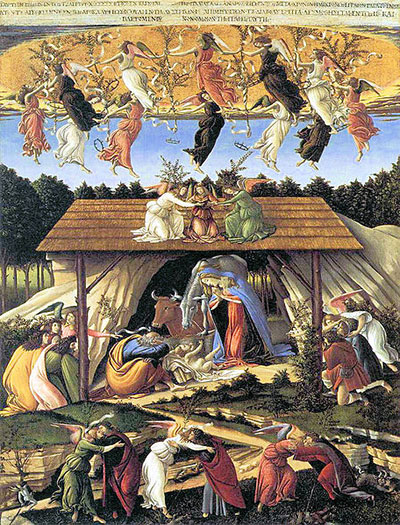
At the centre of Botticelli’s Mystic Nativity, the infant Jesus reaches towards Mary. Above them, angels dance in a golden opening to heaven. Below, angels embrace people while small dark demons flee into cracks in the ground. Joy at a birth and the defeat of evil happen in the same picture. A long Greek inscription across its top asks the viewer to understand that unusual combination in the light of Italy’s troubles and the biblical Book of Revelation.[1][2]
The National Gallery, London, catalogues the painting as made in 1500. It is a rare case in which Botticelli put his name and a date into a painting. A modern study of the Greek wording places the work in the half-year after 1500, or early 1501. Both readings locate it at the turn of the century.[1][2]
At a glance
- ArtistSandro Botticelli
- TitleMystic Nativity
- Datecatalogued 1500; inscription has also been read as pointing to early 1501
- Mediumoil on canvas
- Dimensions108.6 × 74.9 cm
- Current locationNational Gallery, London, Room 60
- Inventory numberNG1034
- Recorded acquisitionbought from William Fuller Maitland in 1878
This is a tall canvas rather than a conventional broad panel of visitors gathered around a manger. Its vertical format lets Botticelli join three levels: an opened heaven, the birth on earth and the small defeated creatures at the bottom. The inscription spans the upper edge as a fourth, verbal part of that design.[1]
The medium is a useful check on assumptions about Botticelli's technique. A National Gallery paint-media study identified walnut oil as the binder in Mystic Nativity and found the green pigment verdigris. The researchers compare it with his oil-painted Bardi altarpiece, but caution that Botticelli's choice of binder does not simply follow a painting's support, scale or date. Here “oil on canvas” is supported by material analysis; it should not be generalized into a rule for all his late pictures.[4]
This work in Botticelli’s career
Fortitude
1470Mystic Nativity
1500Primavera
c. 1480Birth of Venus
c. 1485Contents
- At a Glance
- Heaven Opens Above the Stable
- Embraces and Demons at the Bottom
- What the Greek Inscription Says
- Italy’s Troubles and Revelation
- The Canvas’s Recorded Journey
Heaven Opens Above the Stable
Twelve angels move around a golden dome above the trees. They hold olive branches bearing scrolls and hanging crowns. Their linked movement gives the upper register a sense of celebration that is not confined to the stable below. The National Gallery reads the olive as a sign of peace and the circle as heaven made visible to earth.[1]
Immediately below, three more angels sit together on the roof of a simple shelter. The roof covers the mouth of a rocky cavern. Beneath it Mary kneels near Jesus, who reaches up to her; Joseph rests behind them. The stable is not rendered as an ordinary building in a town. It is pitched between a dense grove, a rough natural opening and the blaze of gold overhead. Botticelli makes the setting feel both earthly and visionary.[1][2]
The visitors arrive from opposite sides. The Magi approach on the left; shepherds come on the right, guided by angels. In the Gospel accounts these visitors belong to different episodes around Christ’s birth, but Botticelli brings them together in one devotional image. Their presence makes the infant the centre of attention even while the activity above and below threatens to draw the eye away.[1]
The figures also change scale across the painting. Mary and Jesus are large relative to several people nearer the foreground. The effect is not a failed attempt at realistic depth: it makes the Holy Family the image’s fixed point while the angelic dance and earthly arrivals unfold around them. The viewer can move from the child upward towards heaven and downward towards the scene of reconciliation.[1]
Embraces and Demons at the Bottom
Three pairs of figures embrace across the foreground. In each pair, an angel meets a human being. The National Gallery sees these meetings as a sign of the joining of divine and human life made possible by Christ’s birth. The repeated poses form a rhythm beneath the stable, echoing the repeated angels circling above it.[1]
At their feet, little winged demons scurry towards holes in the rocks. Some seem to push themselves headfirst into gaps. Their dark, cramped movements oppose the open gestures of the embracing pairs. The demons are easy to miss in a small reproduction, but they are crucial to the painting’s meaning: peace is not only celebrated in heaven; it is shown taking hold on earth as evil retreats.[1][2]
This lower scene is why Mystic Nativity is more than an unusually crowded birth picture. Botticelli joins the Incarnation—God becoming human in the child—to a hoped-for future when conflict is overcome. The painting does not depict only what happened at Bethlehem. It asks what that birth might mean for a troubled world at the moment Botticelli was painting.[1]
What the Greek Inscription Says
The inscription names “Alessandro”, Botticelli’s given name, and refers to the end of 1500 and the “troubles of Italy”. It connects the picture to the eleventh chapter of the Revelation of Saint John, its “second woe”, the devil’s period of release and his eventual restraint. These are not usual instructions for reading a Nativity. Botticelli presents the birth as the beginning of a victory whose full fulfilment belongs to the end of time.[1][2]
The writing has its own limits as evidence. Its final line is damaged, and scholars have proposed different ways to complete a missing word. A familiar English rendering says the devil will be “buried”; Monica Centanni and Paolo B. Cipolla argue for a reading closer to his being driven into the ground or confined. Both attempts respond to the visible demons retreating into crevices. Neither should be presented as a perfectly preserved, unambiguous last sentence written by Botticelli.[2]
The inscription is more than a short label: Centanni and Cipolla count 55 Greek words and note the care with which its capital letters were formed. Its last phrase says that the devil's fate will be seen “as in this painting,” even though the word describing that fate is partly lost. The text thus points the reader back down to the tiny demons. Their awkward descent is a pictorial answer to a sentence that now survives imperfectly.[2]
The date phrase also deserves care. The National Gallery lists the work as 1500. Centanni and Cipolla read the inscription’s reference to the half-year following 1500 as pointing into the first part of 1501. Other scholarship likewise discusses the painting as 1500/1.[1][2][3] Readers do not need to choose a side to see what is secure: the artist placed his work amid Italy’s turmoil at the turn of the century, and he made the apocalyptic interpretation explicit in Greek.
The same text speaks of the devil's release for three and a half years before his restraint, linking the Nativity to the time scheme of Revelation. That is an apocalyptic interval inside the image's interpretation, not a secure calendar key for identifying exactly which three and a half years of Florentine politics Botticelli meant. The distinction matters because the inscription itself dates the making of the work while also using prophetic time to give the present crisis a hoped-for ending.[2]
Whether Botticelli himself composed that Greek without help is a separate question. The inscription is generally treated as his signed statement, while its language has prompted debate about his own command of Greek. It is safer to credit him with making the text part of his painting than to turn it into proof of a particular formal education.[2]
Italy’s Troubles and Revelation
The Gallery relates the inscription’s political language probably to French invasions of Italy and to civil conflict in Florence. French forces took Naples in 1494 and Milan in 1499. Florence, too, had undergone political upheaval after the Medici were expelled. The painting’s promise of peace would have had force in that setting, even though the inscription does not spell out every contemporary event by name.[1]
The Book of Revelation gives the painting a broader horizon. Its visions of conflict, the devil and the eventual triumph of God allowed Christians to think of present suffering as part of a history that would end differently. Botticelli makes that hope visual: the angels’ dance and the human embraces answer the fleeing demons. The infant at the centre belongs to a Nativity, while the world around him already anticipates a final reconciliation.[1][3]
The National Gallery connects the apocalyptic language with the preaching of Girolamo Savonarola, who criticised Florence’s conduct and interpreted political crises as divine warnings. Savonarola was executed in 1498, before this painting was made. His sermons form a relevant background, and scholars have discussed possible links between Botticelli and his followers.[1][3] The inscription does not, by itself, document a personal meeting, a precise commission from a Savonarolan patron or a sudden conversion in the painter’s inner life. Its force lies in the visible union of a Christian birth scene with a contemporary sense of crisis and expectation.
The Canvas’s Recorded Journey
The National Gallery’s published provenance begins at the Villa Aldobrandini in Rome. The painting later belonged to William Young Ottley and appeared in his sales in 1811 and 1837. William Fuller Maitland acquired it by 1847; it was exhibited in Britain during the nineteenth century and bought from him for the National Gallery in 1878. The original patron and first place of display are not documented in that record.[1]
Ottley's own 25 May 1811 sale catalogue, lot 32, already recognised the Greek inscription as containing the painter's name and listed the work as The Nativity of Christ from the Villa Aldobrandini. Yet its description placed the art at “about the year 1480” and called the medium “distemper, on cloth.” These are clues to how an early English collector presented the painting, not reliable substitutes for the inscription's turn-of-the-century date or the Gallery's modern oil-on-canvas identification. Reading the old catalogue alongside the painting's present record separates an early provenance witness from its outdated dating and technical labels.[5][1][4]
The Gallery now records a sixteenth-century Spanish frame around the painting. It belongs to the object's later presentation, not to a documented original Florentine setting. The difference is worth keeping in view: the museum can specify a long, unusually detailed nineteenth-century ownership and exhibition trail, yet the first room and viewer for Botticelli's signed picture remain unknown.[1]
Its present museum setting lets viewers see the full vertical sequence at once, but a small reproduction can hide the figures and words on which the argument depends. The angels, demons and inscription all carry essential parts of the story. Looking from the golden circle at the top to the embraces and fissures at the bottom reveals how Botticelli made a Nativity speak simultaneously of a child’s birth, a city’s unease and a hoped-for peace.[1][2]
Botticelli and related artworks
Discussion
Which detail changes how you read Mystic Nativity?
Reader Insights
How do the upper and lower groups connect?
What can the Greek inscription establish about the work?
Where does historical context help without fixing one meaning?
Join the Conversation
Share a source-led observation or question below.
References
- National Gallery, London, “Sandro Botticelli: Mystic Nativity,” collection record for NG1034, including overview, in-depth text, key facts and provenance, accessed 29 September 2026 View source.
- Monica Centanni and Paolo B. Cipolla, “ΟΥΑΙ ΟΥΑΙ, il secondo grido dell’aquila: Angeli apocalittici e demoni sconfitti nella iscrizione greca (integrata) della Natività mistica di Botticelli,” La Rivista di Engramma 197 (December 2022), pp. 71–82, accessed 29 September 2026 View source.
- Natasha F. H. O’Hear, “The Mystic Nativity: Botticelli and the Book of Revelation,” chapter 4 in Contrasting Images of the Book of Revelation in Late Medieval and Early Modern Art (Oxford University Press, 2011), pp. 105–134; abstract accessed 29 September 2026 View source.
- Catherine Higgitt and Raymond White, “Analyses of Paint Media: New Studies of Italian Paintings of the Fifteenth and Sixteenth Centuries,” National Gallery Technical Bulletin 26 (2005), especially p. 91 on Botticelli's walnut-oil paintings and verdigris; consulted 1 October 2026 View source.
- James Christie, A Catalogue of a Truly Capital & Highly Valuable Assemblage ... the Genuine and Entire Collection of William Young Ottley (London, 25 May 1811), lot 32, scanned PDF pp. 8–9; original auction catalogue consulted 1 October 2026. The lot description establishes how the work was catalogued and its stated Villa Aldobrandini source, not whether the lot sold View source.