 by Tom Gurney
Tom Gurney BSc (Hons) is an art history expert with over 20 years experience
Published on June 19, 2020 / Updated on October 2, 2026
Email: tomgurney1@gmail.com / Phone: +44 7429 011000
A closer look
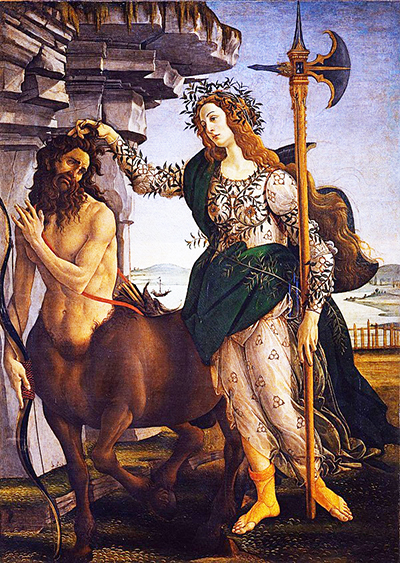
A young woman catches a centaur by the hair beside a broken stone wall. He twists away, one hand lifted as if to ward her off. She holds a tall battle axe upright, yet it is her other hand, rather than the blade, that controls him. Botticelli's Pallas and the Centaur turns restraint into a visible action. The two figures fill a tall canvas, with little narrative before or after this encounter to explain exactly who they are.[1]
The Uffizi dates the painting to about 1480–85 and identifies it as tempera on canvas, measuring 207 by 148 centimetres. Its familiar title names the woman as Pallas Athena, but the museum leaves another possibility open: she may represent Camilla, the virgin warrior of classical literature. The painting's broad meaning, the control of forceful instinct by a virtue, is easier to state than the precise identity of its heroine or the occasion for which it was made.[1]
At a glance
- Current titlePallas and the Centaur
- ArtistSandro Botticelli
- Dateabout 1480–85, Uffizi current record
- Mediumtempera on canvas, Uffizi current record
- Dimensions207 × 148 cm
- CollectionUffizi Galleries, Florence
- InventoryPitti Objects of Art 1911 no. 752; Deposits no. 29
- Identity cautionthe woman may be Pallas/Minerva or Camilla
An older Italian national catalogue record calls the support a panel and gives a date around 1482. The current Uffizi object record instead specifies canvas and a wider date range. Those descriptions should not be collapsed into a new, precise hybrid. For the work's present public facts, the owning museum's current entry is the stronger starting point; the older discrepancy remains visible in the record.[1][2]
This work in Botticelli’s career
Fortitude
1470Pallas and the Centaur
about 1480–85Primavera
c. 1480Birth of Venus
c. 1485Mystic Nativity
1500Contents
- At a Glance
- The Grip at the Centre
- Pallas, Camilla or Another Virtue?
- The Medici Signs
- A Tall Canvas with an Open Background
The Grip at the Centre
The woman's hand closes on the centaur's hair above his forehead. His head turns down and away, pulling the viewer's eye toward their point of contact. Botticelli gives the centaur a human face and torso joined to a horse's body; the mixture makes his physical strength clear even while he yields. His raised hand does not meet her weapon. It seems to answer the immediate grip.[1]
The battle axe rises beside the woman like a second vertical line. She could threaten him with it, but the pictured moment is one of containment. The contrast between the weapon and her chosen gesture gives the painting its tension. The Uffizi describes the centaur as a figure for humanity's wild impulses and reads the encounter as a virtue checking violent or passionate temperament. The visual relationship supports that broad idea without settling every more specific political or moral interpretation.[1]
The centaur's bow and quiver are visible near his body. They mark him as capable of attack, though he is not shooting. The rocky structure behind him hems him in, while the landscape opens behind the woman. Their positions make the scene feel unequal: he occupies the enclosed side, and she stands before open distance. That spatial contrast can be seen directly; its precise allegorical translation is less certain.[1][2]
She is also unlike a simple soldier. Her light dress carries repeated devices, her head is circled by branches, and her face remains composed. Her legs are firmly planted, but her clothing and hair give her a flowing outline. Botticelli joins control with elegance, allowing the figure to seem both armed and ceremonially presented.[1]
Pallas, Camilla or Another Virtue?
The Uffizi says early inventories and literary references have supported more than one name for the woman. Pallas Athena, called Minerva in Roman tradition, is a goddess associated with wisdom. Camilla is a chaste warrior in Virgil's Aeneid. Either name could fit an armed female figure, but neither makes every plant and gesture unambiguous.[1]
Monica Centanni gives the disagreement a documentary timeline. She cites an inventory of the Via Larga Medici house from 1498–99 describing a picture above an antechamber door as Camilla with a satyr; a 1516 inventory calls it a figure with Minerva and a centaur. The old wording also calls the picture “wooden,” whereas the Uffizi now describes the surviving work as canvas, so the identification of the entries with this object should remain a reasoned one. The shifting names show how uncertain even early descriptions of the armed woman and her companion could be. The recorded position above a door, if the identification is right, is a more specific later setting than a broad wedding-image possibility.[5][1]
The greenery around her head might be olive, sacred to Pallas, or myrtle, which the Uffizi links with Camilla. The museum frames both botanical readings as possibilities. The small branches therefore cannot by themselves function as a definitive name tag. The painting invites recognition through attributes while holding back a final label.[1]
The older national catalogue surveys political, moral and Neoplatonic readings offered by scholars. A political interpretation might see wise government overcoming disorder; a moral one might see reason mastering appetite. Those readings share the visible contrast between the standing woman and the restrained centaur, but they differ on what each figure represents in a particular context. The catalogue records the disagreement rather than providing a newly discovered commission document that resolves it.[2]
This uncertainty is part of the painting's appeal. We can describe what Botticelli made with confidence: one hybrid creature controlled by an armed woman, against rock, shore and sky. Interpretation begins when those visible elements are joined to a name, a patron's intention or a political event. The current Uffizi record offers a broad allegory while leaving the heroine's identity open.[1]
The Medici Signs
Repeated rings on the woman's dress are the three-ring emblem of the Medici. The Uffizi links the painting with Lorenzo di Pierfrancesco de' Medici, a cousin of Lorenzo the Magnificent, and says it may have been commissioned for his marriage to Semiramide Appiani in 1482. Ownership belongs to the museum's account; the wedding occasion remains a possibility rather than a securely recorded purpose.[1]
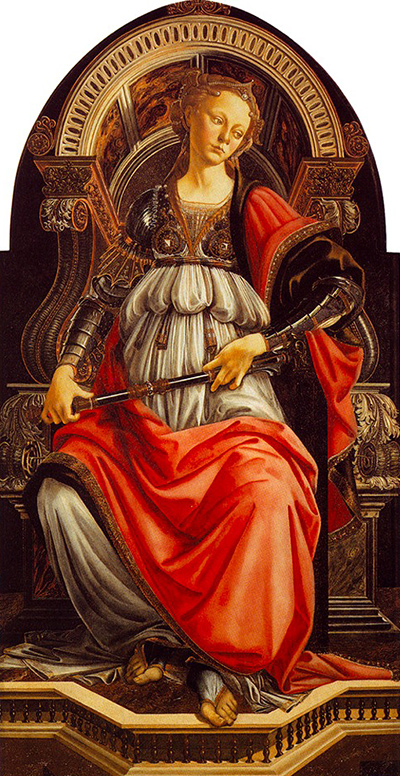
The ornament does more than identify a family connection. In the Uffizi's exhibition Jewels in the Uffizi, pointed diamonds and ring motifs are read as images of strength and resistance. The exhibition points to jewels on the woman's light robe and weapon and compares them with Botticelli's Fortitude. In that reading, a material prized for hardness reinforces the figure's power to withstand the centaur's force. It is a developed curatorial interpretation of painted details, not proof that one political enemy was intended.[3]
The exhibition notes that the pointed stones appear fixed directly to a light fabric in a way that would be impractical for a real garment. Botticelli's ornament is therefore more than a record of jewelry someone wore: it is a painted choice that makes the family's signs conspicuous. The same Uffizi account describes a table-cut stone on the weapon. Those two different placements join dress and defensive force in the curators' reading, while the specific historical occasion for the painting remains unknown.[1][3]
The jewels are small against a canvas more than two metres high, but they reward a second look after the first encounter has been understood. From a distance, the grip and axe organize the picture. Closer in, the rings and bright points tie the figure to Medici imagery. The painting can operate at both scales, as an immediately legible contest and as a work carrying carefully chosen signs for viewers who knew the family.[1][3]
The marriage hypothesis is attractive because a virtuous figure mastering disorder could suit a domestic celebration. It is still a hypothesis. The Uffizi's current wording does not establish that the canvas was ordered for a particular room or ceremony. Other proposed political readings have also been attached to the image. The Medici devices offer firmer evidence of association than any single reconstructed occasion.[1][2]
A Tall Canvas with an Open Background
The material record helps resolve what can be said about this support. Higgitt and White's National Gallery paint-media study groups Pallas and the Centaur with Botticelli's other Uffizi canvas The Birth of Venus as a gesso-grounded canvas painted essentially in egg tempera. The gesso is a prepared surface beneath the paint; it does not turn the work into the poplar panel named by the older national record. That technical comparison backs the present Uffizi description of canvas while giving it more specificity. It does not settle why a large vertical canvas was chosen for this subject, or which figure the armed woman represents.[4][1][2]
The figures nearly reach the painting's top and bottom edges. The centaur's broad animal body fills the lower left; the woman's dress, axe and upright pose rise on the right. Behind them, a shore and distant water open a route for the eye out of the narrow struggle. The ruined masonry creates a harder boundary on the centaur's side. Botticelli's landscape thus gives the contest space without turning it into a fully told myth.[1]
The Uffizi's date places the painting near other ambitious works connected with Lorenzo di Pierfrancesco's circle, but its format and action are its own. It is a vertical encounter between two figures, not a many-person procession. The visible relationship remains strong even if one does not decide between Pallas and Camilla: one figure has the power to harm and chooses control; the other possesses strength yet is held in check.[1]
Return to their hands. The centaur's raised fingers and the woman's grip make a small exchange at the centre of a large, ornate work. The painting does not state whether its first viewers saw a political victory, a moral lesson or a marriage emblem. It gives them a forceful image of restraint, then surrounds it with signs that invite further, less certain readings.[1][2][3]
Botticelli and related artworks
Discussion
Which detail changes how you read Pallas and the Centaur?
Reader Insights
What does the woman’s grip on the centaur show?
Which parts of the female figure’s identity remain debated?
What can the later household record establish?
Join the Conversation
Share a source-led observation or question below.
References
- Uffizi Galleries, Daniela Parenti, “Pallas and the Centaur,” Pitti Objects of Art 1911 no. 752 / Deposits no. 29, current object record; accessed 29 September 2026 View source.
- Italian National Catalogue of Cultural Heritage, “Minerva e il centauro,” national record 0900188558, an earlier catalogue entry with different support/date and a history of interpretations; accessed 29 September 2026 View source.
- Uffizi Galleries, “Jewels in the Uffizi,” online exhibition, sections on Pallas and the Centaur; accessed 29 September 2026 View source.
- Catherine Higgitt and Raymond White, “Analyses of Paint Media: New Studies of Italian Paintings of the Fifteenth and Sixteenth Centuries”, National Gallery Technical Bulletin 26 (2005), p. 89 and note 11, comparing Botticelli's gesso-grounded Uffizi canvases and egg-tempera passages; consulted 1 October 2026 View source.
- Monica Centanni, “26 aprile, giorno di primavera: nozze fatali nel giardino di Venere”, La Rivista di Engramma 105 (2013), section II.2, citing the 1498–99 and 1516 Via Larga inventory labels and antechamber placement; consulted 1 October 2026 View source.