 by Tom Gurney
Tom Gurney BSc (Hons) is an art history expert with over 20 years experience
Published on June 19, 2020 / Updated on October 2, 2026
Email: tomgurney1@gmail.com / Phone: +44 7429 011000
Profile Portrait of a Young Woman
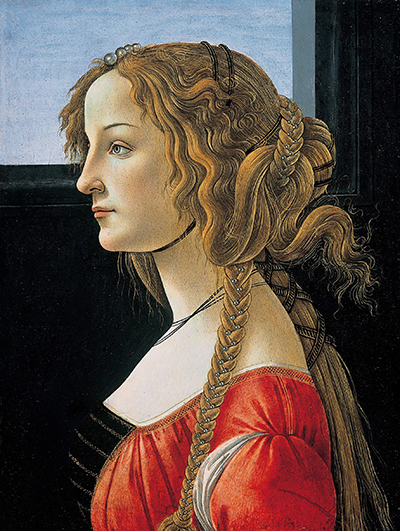
A young woman turns left in a sharply defined profile. Her face is still, but her hair moves in waves, coils and a long pearl-threaded braid. A pale blue opening appears behind her head while the dark wall below sets off her red dress. The Berlin painting has long been called a portrait of Simonetta Vespucci. Its current museum record asks us to look first at the image itself: the elaborate hair points towards an ideal portrait, while the woman's identity remains unproved.[1]
The work belongs to the Gemäldegalerie in Berlin, where it is catalogued as Profile Portrait of a Young Woman, inventory 106A. The museum dates it to 1475–80 and credits Sandro Botticelli. That title tells us what the panel shows without turning an old identification into a fact. The name Simonetta is part of the painting's history of interpretation, but the evidence does not establish that she sat for this image.[1]
At a glance
- Current titleProfile Portrait of a Young Woman (Profilbildnis einer jungen Frau)
- ArtistSandro Botticelli in the current Berlin record; the Fondazione Zeri catalogue files the work under Botticelli's workshop
- Date1475–80 in the Berlin record
- Supportpoplar panel; the Cincinnati Art Museum describes the paint as tempera
- Dimensions55.4 × 43 cm in the current Berlin record
- Current collectionGemäldegalerie, Staatliche Museen zu Berlin
- Inventory number106A
- Recorded acquisitionpurchased from Stefano Bardini, Florence, in 1875
Where this work sits in Botticelli’s career
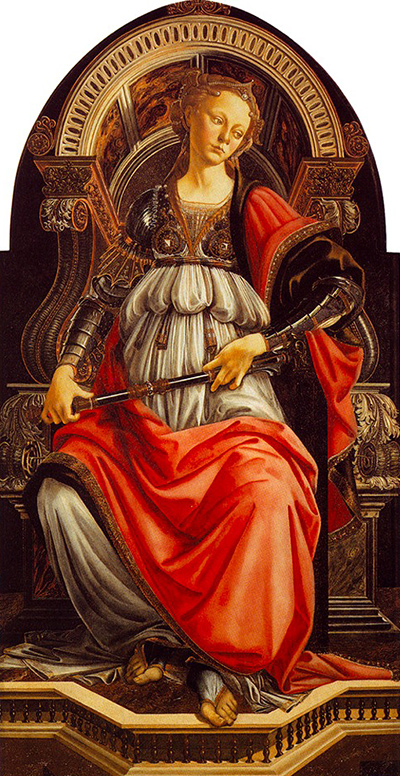
Fortitude
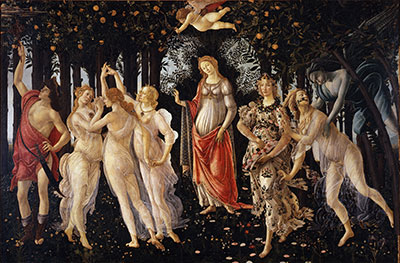
1470Primavera
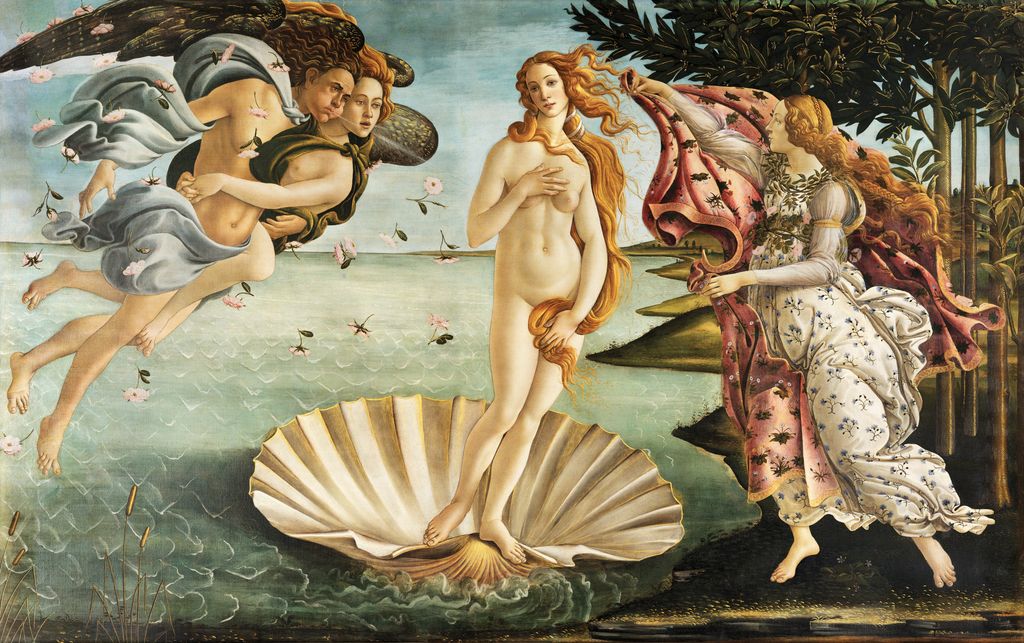
c. 1480The Birth of Venus
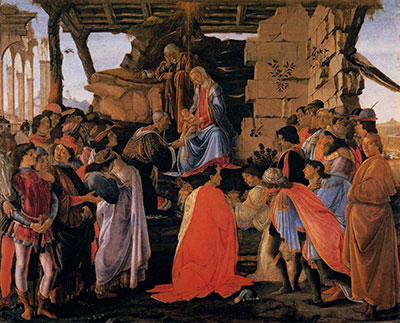
c. 1485The Mystical Nativity
c. 1500Contents
- A Face Drawn in Profile
- Hair, Pearls and Dress
- The Simonetta Vespucci Name
- Botticelli, Workshop and Catalogue Differences
- The Painting's Recorded Travels
- A Separate Ideal Portrait in Frankfurt
Berlin's object record supplies the leading date, support, size and acquisition. A separate Zeri photo-archive entry identifies Berlin 106A but gives a wider date range, smaller measurements and a workshop classification. Those differences matter and are considered below rather than blended into one apparently certain description.[1][3]
A Face Drawn in Profile
The face is turned so fully to the side that one eye, the line of the nose and the contour of the lips carry its expression. The near shoulder and red sleeve broaden the figure beneath that narrow profile. This contrast between the crisp facial outline and the large shape of the dress gives the sitter a strong presence without asking her to meet the viewer's gaze.[1][2]
Behind her, the background is divided. A dark wall fills the lower field. Above it, a light blue opening outlines the top of the head, while a dark vertical edge closes the space at the right. The change in tone makes the forehead, hair and pearls easy to read. It also stops the background from becoming an elaborate room that would compete with the figure.[2]
The Cincinnati Art Museum's description of this Berlin painting notices the pale skin, blue eye and understated colour in the face. Those features are more restrained than the bright red garment. Looking between them, the eye moves from a quiet profile to the highly worked hair and sleeves. The picture's impact depends as much on that shift of attention as on the question of a name.[2]
Hair, Pearls and Dress
The hairstyle refuses to settle into a simple knot. Loose strands frame the forehead; larger waves gather behind the head; a braid curves around a bun and a second long braid falls over the shoulder. Pearls punctuate the parting and the descending braid. Black ribbons bind sections of hair and create thin, dark lines against the gold. The Cincinnati museum's description identifies these separate arrangements, which are easy to lose when the image is reduced to a small portrait thumbnail.[2]
The woman's red dress has sleeves opened to reveal white fabric beneath. A dark panel crosses the front, patterned with small gold shapes. Together with the pearls, the clothing gives the image a carefully fashioned appearance. It shows choices of colour and surface, but it does not document an outfit worn by a known woman on a known occasion.[2]
Berlin draws a conclusion from the hair's imaginative complexity. It resembles the hairstyles of female figures in Botticelli's mythological pictures and supports reading the panel as an Idealbildnis, an ideal portrait. That term does not mean the woman is featureless or interchangeable. It means the image may construct an admired type of beauty rather than record a sitter's appearance with documentary precision.[1]
The long contour from forehead to neck gives the figure the clarity associated with a profile portrait. Against it, the many curls, ribbons and strands supply movement. Botticelli's design can therefore seem both fixed and changeable: the face is held in one view, while the hair seems to keep unfolding around it. We can describe that visual effect without assigning a secret meaning to each pearl or ribbon.[1][2]
The Simonetta Vespucci Name
Simonetta Vespucci was a Florentine woman admired for her beauty who died in 1476. Berlin says this portrait was formerly understood as her likeness and notes her association with Giuliano de' Medici. The museum does not make that old identification its current title. Instead, it points to the fantastic hairstyle as evidence for an ideal image.[1]
The Cincinnati Art Museum, which presented the Berlin panel in an account of its postwar travels, likewise calls Simonetta a possibility and says the work is probably not an objective likeness. That careful wording leaves room for a historical association without turning it into a documented sitting. Neither a profile view nor a fashionable hairstyle can prove the woman's name.[2]
The name remains useful for understanding how the painting has been seen over time. It tells us about a tradition of interpretation, not about the original circumstances of its making. Keeping that distinction in view allows the historical association to be discussed without turning it into evidence of a documented sitter.[1][2]
Botticelli, Workshop and Catalogue Differences
The current Berlin collection record lists Botticelli as the painter. The Fondazione Federico Zeri photo archive identifies the same Berlin inventory number, 106A, yet files the work under Botticelli's workshop. Its entry also records Botticelli himself as a different attribution found in a photograph's caption. These are distinct catalogue judgments, not two separate paintings that happen to share a title.[1][3]
The two sources also disagree on measurements. Berlin gives the image size as 55.4 × 43 centimetres. Zeri gives 47.5 × 35 centimetres and a broader date of 1475–99. The available entries do not explain whether the dimensions refer to different measured fields, old information or an error. For a current object summary, Berlin's owning-museum measurements and 1475–80 date are the clearest basis; the disagreement should remain visible rather than be quietly corrected by guesswork.[1][3]
The Cincinnati museum's account supports the present Berlin attribution and describes the panel as tempera on poplar. Berlin's brief technical field specifies the poplar support but does not name the paint medium. The painting's visible surface in a photograph cannot settle either an attribution to a particular hand or the material formula of the paint. Naming the source for each claim keeps the limits clear.[1][2][3]
The Painting's Recorded Travels
Berlin records a secure nineteenth-century milestone: it purchased the painting in 1875 from the Florentine dealer Stefano Bardini. That acquisition identifies how the panel entered the Gemäldegalerie. It does not provide a continuous history back to the fifteenth century or establish an original patron.[1]
The earlier ownership is more complicated than the shorthand “from the Palazzo Medici Riccardi” sometimes attached to this portrait. A review of Valerie Niemeyer Chini's study of Bardini and Berlin curator Wilhelm Bode, based on their correspondence, reports Bardini's account that he obtained the panel from the Toscanelli sisters of Monopoli. According to that account, they inherited it from an uncle who had served the Riccardi family. Bardini then connected the painting with a “Fiammetta” portrait in a Medici wardrobe record. The reviewer expressly says that this proposed chain needs further archival checking. It is valuable evidence for what Bardini claimed in the 1875 transaction, not proof that this panel belonged to the Medici or depicts a woman called Fiammetta. The review also describes an intermediary named Coppi, which helps explain why older catalogue histories do not always name Bardini directly.[5][1]
The Cincinnati Art Museum documents another chapter. The portrait was among Berlin paintings shown in an American tour in 1948–49 after the Second World War. Its account says this panel was one of only two Botticelli and workshop works that made the full thirteen-city tour. Newspaper photographs of the works being examined and unpacked then made the painting visible in a different context from its museum display. This later history is evidence of the panel's reception, not a clue to the identity of the woman in the picture.[2]
A Separate Ideal Portrait in Frankfurt
Another painting sometimes associated with Simonetta is Botticelli's Idealised Portrait of a Lady in the Städel Museum, Frankfurt. It is a different object, inventory 936, dated about 1480–85. Its larger figure, ornate accessories and mythological guise are not details from the Berlin profile. The Städel calls its painting an ideal portrait rather than a strict likeness as well.[4]
The two works can be compared for Botticelli's interest in elaborate hair and ideal beauty, but one cannot certify the sitter of the other. Their museum numbers, dates, dimensions and compositions keep their identities separate. On this Berlin panel, the strongest evidence is what can be seen and what the current records actually say: a carefully staged young woman's profile, an uncertain traditional name, and an attribution history that deserves to be stated plainly.[1][3][4]
Look once more at the point where the braid crosses the red sleeve. The pearls lead downward from the pale blue space around her head into the colour of the dress, linking the still face to the fuller body. That crafted passage remains engaging even when no sitter's name can be fixed. The painting does not need an authenticated Simonetta to reward close attention.[1][2]
Botticelli and related artworks
Discussion
Look again at the details and evidence discussed above. Which part of the painting changes most when you know its history?
These prompts invite close looking and source-led questions rather than a single settled interpretation.
Reader Insights
Which parts of the hairstyle seem most deliberately constructed, and how do they affect the profile?
How does the old Simonetta name differ from evidence for a documented sitter?
What changes in your reading when Berlin and Zeri classify the painter differently?
Join the Conversation
Share an observation or question about the painting below.
References
- Staatliche Museen zu Berlin, Gemäldegalerie, “Profilbildnis einer jungen Frau,” inv. 106A, current collection record, updated 28 July 2026, accessed 29 September 2026 View source.
- Cincinnati Art Museum, “Ideal Portrait of a Lady,” The Berlin Masterpieces in America audio exhibition, accessed 29 September 2026 View source.
- Fondazione Federico Zeri, “Filipepi Alessandro (Sandro Botticelli), bottega, Ritratto femminile,” Fototeca Zeri entry 14553, Berlin inv. 106a, accessed 29 September 2026 View source.
- Städel Museum, “Idealised Portrait of a Lady (Portrait of Simonetta Vespucci as Nymph),” inv. 936, current digital collection, accessed 29 September 2026 View source.
- Katty Colzi, review of Valerie Niemeyer Chini, Stefano Bardini e Wilhelm Bode, Arte e Arti, 3 November 2009, on the 1875 portrait transaction, Bardini's Toscanelli/Riccardi account and the role of Coppi; consulted 1 October 2026. This is a review reporting the book's archival findings; the correspondence and book were not directly read for this page View source.
- Image credit. Profile Portrait of a Young Woman, catalogued as Sandro Botticelli by Staatliche Museen zu Berlin, Gemäldegalerie, inv. 106A. Photo: Christoph Schmidt. Public Domain Mark 1.0. The Zeri catalogue instead files the same object under Botticelli’s workshop View source · View source.