 by Tom Gurney
Tom Gurney BSc (Hons) is an art history expert with over 20 years experience
Published on June 19, 2020 / Updated on October 2, 2026
Email: tomgurney1@gmail.com / Phone: +44 7429 011000
Prints after Botticelli’s Designs
The print above was made for an illustrated edition of Dante's Comedy published in Florence in 1481. It shows a vision of Beatrice above a journey through the landscape of Inferno II. Dante and Virgil appear more than once, so the eye can follow successive moments across one image. The engraving in the Petit Palais, Paris, is a surviving impression of a design associated with Botticelli; it is not a copperplate cut by Botticelli's hand. Paris Musées names Baccio Baldini as engraver, while the Metropolitan Museum describes another impression of this composition as anonymous Florentine, attributed to Baldini, after Botticelli.[1][2]
This distinction is central to Botticelli's prints. A designer could plan figures and settings, an engraver could incise them into copper, a printer could pull impressions from the plate, and a publisher could place those impressions in copies of a book. The resulting printed picture belongs to a collaborative history. It also survives unevenly: different copies of the 1481 edition contain different numbers of illustrations.[2][3][4]
At a glance
- Subject of this pageEngravings associated with Botticelli's designs for the 1481 Florentine edition of Dante's Comedy
- Illustrated print aboveVignette for the Dante Edition, Inferno, Canto II, Petit Palais, Paris, inv. GDUT233(1)
- Medium and sizeEngraving; image 9.5 × 17.2 cm in the Paris Musées record
- PublicationCommedia with commentary by Cristoforo Landino, printed in Florence by Niccolò di Lorenzo della Magna in 1481
- AttributionAfter Botticelli; the engraver is attributed to Baccio Baldini in some records, but not securely identified
- Date cautionParis Musées gives this impression a broad 1450–1480 date, earlier than the 1481 edition named in its title; 1481 dates the publication, not a proved date for this particular impression
How the 1481 illustrated book came together
Botticelli-associated designs
before/around 1481Early copperplates prepared
by 1481Variable book-copy assembly
1481 and afterContents
- Reading the *Inferno* II Engraving
- An Ambitious Book That Was Never Uniform
- Designer, Engraver, Impression and Copy
- Prints and the Separate Dante Drawings
The illustration is one plate from a planned series, not a sample of all Botticelli's work in print. The 1481 project, its incomplete execution and its relation to a separate sequence of manuscript drawings need to be understood together without treating them as one object.[1][2][3]
Reading the Inferno II Engraving
At the upper left, a woman enclosed by radiating lines interrupts the darker setting below. This is Beatrice, who has come from Heaven to ask Virgil to help Dante. Below her, two small travelers reappear at different points. The repetition turns the wide rectangle into a route: the viewer reads changes of place and action from one pair to the next. At the right, a rocky opening bears the words “PER ME,” the start of the inscription over Hell's gate in the following canto. The image brings the narrative's promise and its dangerous destination into a single field.[1][3]
The plate is small. Its detailed sky, rocks, trees and clothing depend on closely spaced engraved lines. In the darker passages those lines gather into dense hatching; in the brighter ones, the paper remains more open. Their differences guide the eye toward Beatrice's light and then across the travelers' path. The repeated figures are not portraits of several Dantes and Virgils. They are a visual method for showing time on a flat sheet, much like the movement through Botticelli's later Dante drawings.[1][3]
The full Paris impression also shows the marks of its own collection life, including the Dutuit stamp. It should be read as a physical print with an inventory and history, not as a free-standing modern illustration. Paris Musées records its acquisition with the Dutuit bequest in 1902. Its catalogue identifies Baldini as the engraver and assigns a broad date of 1450–1480. That date cannot be silently combined with the 1481 edition specified in the same record's title. The book's documented publication year is secure; the Paris dating field is an unresolved catalogue inconsistency for this impression.[1][2][3]
An Ambitious Book That Was Never Uniform
The 1481 Florentine Comedy joined Dante's poem to Cristoforo Landino's commentary. Niccolò di Lorenzo, also known as della Magna, printed it. An illustration for each canto was the ambition, a much larger programme than the surviving printed sequence fulfils. The plan had to connect text, commentary and image across a substantial book.[3][4]
A contract dated 24 December 1480, discovered in the Florence State Archives and analysed in the Consortium of European Research Libraries' 2021 project, makes the publishing enterprise unusually concrete. Landino, Bernardo degli Alberti and printer Niccolò di Lorenzo formed a company to produce the edition. The terms called for 1,125 copies, a sale price of three florins each, and a recoverable 360-florin loan from Alberti. Landino was to supply the commentary in instalments and help correct proofs; three presses were envisaged for the poem's three canticles. The contract assigns payment for the illustrations to Alberti but gives little detail about their maker. It therefore documents a funded image programme without naming Botticelli as a contractual party or proving who cut each plate.[7]
The completed book is dated 30 August 1481 by its colophon. CERL describes a large folio of 372 leaves on royal-format paper imported from Fabriano. Those physical demands matter: blank areas were reserved for images throughout the cantos, although the eventual engraved sequence reached only the opening nineteen cantos of Inferno. Empty image spaces in a copy are traces of the initial plan, not necessarily evidence that its owner lost prints after purchase.[7]
The images were engravings from copperplates. Type for the text and an inked copperplate could not be impressed by the same printing operation. A sheet set in type went through one process; an intaglio plate, whose incised grooves hold the ink, required another. Oxford's account explains that the first few plates were printed within spaces left in the pages, while further engravings could be printed separately and pasted in. Some planned spaces remained empty. Production difficulty and the timing of plate preparation therefore become visible in surviving volumes.[3]
That is why a count attached to one copy cannot describe every copy. The University of Glasgow's volume has three engravings before the first three cantos; its third is a more heavily inked repeat of the second. A Library of Congress copy is catalogued with nineteen engravings. The contrast is a property of the books as assembled and preserved, not proof that each reader in 1481 held the same illustrated sequence.[3][4][5][7]
CERL's copy census located 180 surviving volumes in 135 libraries in 2021. Their illustrations range from none to a nearly complete set; one Manchester copy has twenty impressions because an image is repeated. The first two or three images could be printed directly in reserved spaces on the text leaves. Later prints were generally pulled on separate sheets, trimmed and pasted into those spaces. This transition helps explain why copy histories differ: an inserted engraving could be supplied later, omitted or moved, and the impressions themselves occur in different states. The census describes surviving copies, not a uniform original package delivered to all 1,125 intended buyers.[7]
Printing an intaglio plate on a page already bearing letterpress text required a second operation and moistened paper. CERL identifies crooked early impressions and an upside-down plate in one Bodleian copy, direct signs of the difficulty. The separate-sheet method avoided that alignment problem but made assembly labour-intensive. The reason the series stopped at nineteen remains unsettled: delayed plates, cost, commercial competition and the printer's circumstances have all been proposed. None is established by the contract alone.[7]
The series also changes in its relationship to Botticelli. Oxford finds that the first three plates closely follow designs associated with him. The dependence of later engravings is less certain. “After Botticelli” is a useful attribution for the printed project, but it should not imply that a full set of exact drawings survives for every plate or that he supervised every impression. The British Museum's record for an Inferno VII print, for example, labels the engraver anonymous but attributed to Baldini and notes similarities to Botticelli's Chart of Hell without an exact surviving drawing for that composition.[3][6]
Designer, Engraver, Impression and Copy
The name Baccio Baldini appears repeatedly in accounts of the Dante engravings. Paris Musées gives it directly for the print above. The Met instead catalogues the maker of another Inferno II impression as an anonymous Florentine engraver, attributed to Baldini, after Botticelli. The same Met record names Niccolò della Magna as publisher. These are meaningful degrees of certainty: the project's connection to Botticelli's designs is stronger than the identification of the person who cut the copper.[1][2]
The disagreement extends beyond the engraver's name. CERL reports that Heinrich Schulze Altcappenberg proposed Baldini worked from assorted preliminary studies rather than a finished, consistent set of Botticelli drawings; Alessandra Baroni has argued for a larger independent role for Baldini and for common Florentine pictorial sources. Other scholars see strong links between the prints and Botticelli's later parchment drawings. These are competing interpretations of visual evidence. Neither the 1480 contract nor the survival of the engravings resolves how closely Botticelli directed every image in the sequence.[7]
A design is a plan for the image, whether preserved as a drawing or reconstructed from the engraving. A copperplate is the worked printing surface. An impression is one sheet pulled from it; the Paris and Met Inferno II records concern separate impressions of the composition. A book copy is the gathered printed text, perhaps with impressions added. These terms keep an engraving's maker and its route to a reader from collapsing into a single “Botticelli print.”[1][2][3]
They also help explain visible variation. Pressure, ink and paper can change the darkness of an impression; an inserted plate can sit differently beside printed text. Glasgow's darker third image, which repeats its second, is a particularly clear reminder that a surviving book copy is an assembled historical object. A digital image of one plate cannot reveal exactly how all other copies were printed, pasted or read.[4]
Prints and the Separate Dante Drawings
Botticelli also developed a much larger cycle of Dante images on parchment. Many surviving sheets are held in Berlin, with others in the Vatican. The drawings survey and the Dante cycle page examine those images as manuscript works. They share a poem, a visual imagination and some narrative methods with the engravings. They are not pages removed from the 1481 printed book.[3]
The difference is more than size. The manuscript sheets leave finely drawn marks on individually prepared parchment surfaces and could explore cantos far beyond the opening Inferno plates. The printed images had to be cut into copper and mechanically transferred to paper, then coordinated with type and commentary. Repeated travelers can appear in both, but their materials and production constraints give that device different effects. The sparse, pale space of a Paradiso VI drawing would not simply be another impression of the compact Inferno II vignette.[1][3]
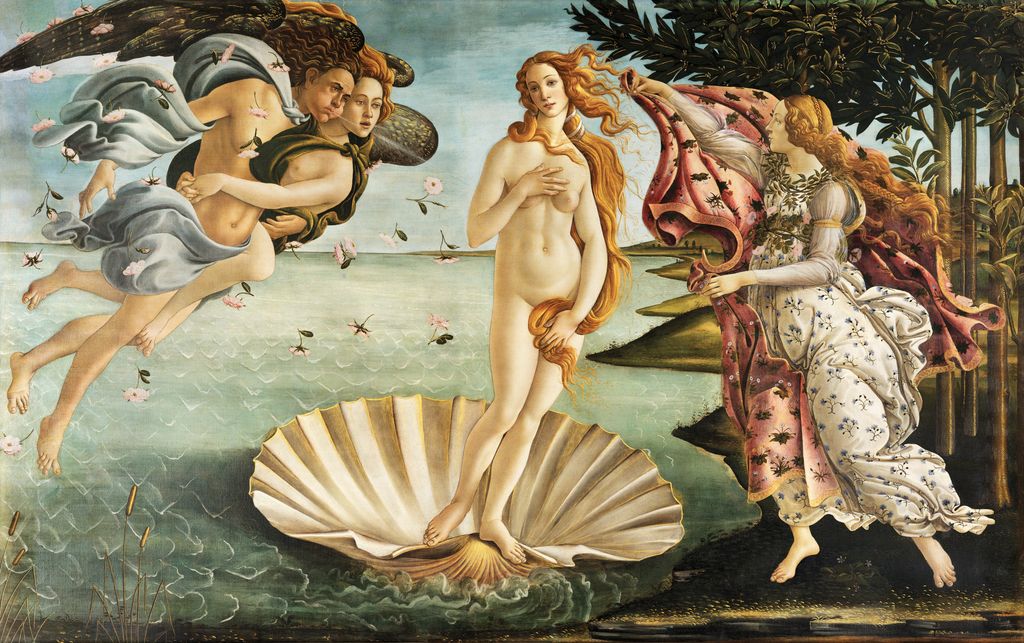
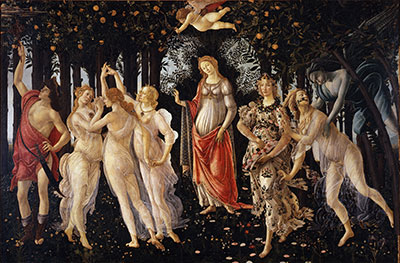
Today “Botticelli print” can also mean a modern photographic reproduction of The Birth of Venus or Primavera. Such posters reproduce paintings. The historical prints discussed here are fifteenth-century engravings designed for a particular book. Looking at their small lines, repeated figures and uneven presence among surviving volumes restores the distinctive story of the 1481 Dante project: a brilliant attempt to make a poem visible in print, whose incomplete state is part of what the surviving evidence tells us.[1][2][3][4]
Botticelli and related artworks
Discussion
Look again at the details and evidence discussed above. Which part of the print changes most when you know its history?
These prompts invite close looking and source-led questions rather than a single settled interpretation.
Reader Insights
How does the repeated pair of travelers show movement through the poem?
What changes when a copperplate impression is pasted into a book copy?
Why might two surviving copies contain different numbers of engravings?
Join the Conversation
Share an observation or question about the print below.
References
- Paris Musées, Petit Palais, “Vignette pour l'édition de Dante. L'Enfer (Chant II),” inv. GDUT233(1), current object and image record; IIIF manifest, accessed 29 September 2026 View source View source.
- Metropolitan Museum of Art, “Inferno II,” accession 62.650.106, current collection record, accessed 29 September 2026 View source.
- Gervase Rosser, “The First Printed and Illustrated Edition of Dante's Comedy,” University of Oxford TORCH, accessed 29 September 2026 View source.
- University of Glasgow, “Dante Alighieri, Commedia with Landino's Commentary, Florence, 1481,” incunable copy record, accessed 29 September 2026 View source.
- Library of Congress, “La Commedia di Dante Alleghieri, 1481,” copy record, accessed via indexed institutional text 29 September 2026 (direct request returned 403) View source.
- British Museum, “Illustration for Inferno VII,” print 1845,0825.449, current record, accessed via indexed institutional text 29 September 2026 (direct request returned 403) View source.
- Consortium of European Research Libraries, “Dante 1481,” Printing Revolution 1450–1500 project, 2021: contract analysis, bibliographical description, print process, attribution debate and illustrated census; consulted 1 October 2026. The project summarises the archival contract and specialist literature; the original contract and cited monographs were not inspected here View source.
- Image credit. Vignette for the Dante Edition, Inferno II, engraving after Botticelli’s design; engraver attributed to Baccio Baldini. Petit Palais, Paris Musées, inv. GDUT233(1). Image: Paris Musées, CC0. Complete impression shown, resized from the museum’s official image. Museum object record View source · View source.