by Tom Gurney
Tom Gurney BSc (Hons) is an art history expert with over 20 years experience
Published on June 19, 2020 / Updated on October 2, 2026
Email: tomgurney1@gmail.com / Phone: +44 7429 011000
Botticelli’s Words and Later Testimony
The portrait above comes from the illustrated 1568 edition of Giorgio Vasari's Lives. It was made decades after Sandro Botticelli died and is best treated as a printed image of how a later writer presented him, not an authenticated likeness. The same distinction governs this page's words. A sentence by Botticelli would need a reliable document connecting its wording to him. A sentence about Botticelli can be valuable while telling us primarily what another person saw, remembered or believed.[1][2]
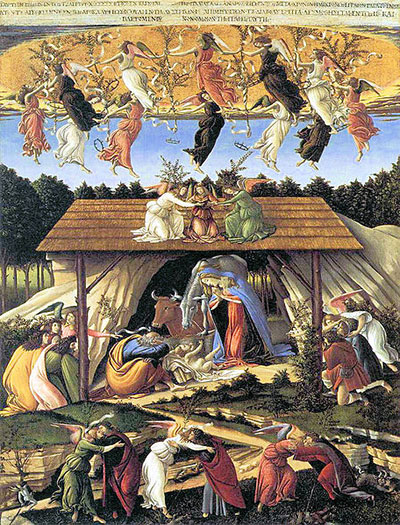
One important first-person text does survive on a painting: the Greek inscription across Botticelli's signed Mystic Nativity. It places the work amid Italy's troubles and speaks as “I, Alexander.” That is a dated statement incorporated into his work, although whether he personally composed its Greek is debated. Leonardo da Vinci also reports a remark attributed to Botticelli about painting landscapes, preserved through Leonardo's later-compiled writing. Neither item is an independently recorded conversation or a store of general aphorisms. Vasari later put speech into Botticelli's mouth in a workshop story without supplying a contemporary transcript. Each source below therefore needs its own label.[2][3][4][5][6][7][8]
At a glance
- Words in a signed workThe first-person Greek inscription on Mystic Nativity; its authorship as Greek prose is a separate question
- Reported remarkLeonardo attributes a comment about landscape painting to Botticelli; the passage survives in a compilation of Leonardo's notes
- Spoken sayingsNo independently authenticated maxim established in the sources checked here
- Sixteenth-century witnessGiorgio Vasari's Life of Botticelli, expanded in the illustrated 1568 Lives
- Later artist responsesBerthe Morisot's 1889 letter about the orange trees in a Botticelli seen in Florence; Paula Modersohn-Becker's Paris letter of 17 January 1900 about a Louvre Madonna
- IllustrationPosthumous portrait woodcut from Vasari's 1568 edition; it is not a verified likeness of Botticelli
- Reading ruleName the speaker, original source, date and translation before treating a line as a quotation
When these words about Botticelli appeared
Contents
- Botticelli's Signed Painting: A Statement, Not a Maxim
- Leonardo Reports a Remark on Landscape
- Giorgio Vasari: Drawings and Memory
- Berthe Morisot: Remembering Botticelli's Trees
- Paula Modersohn-Becker: A Madonna in the Louvre
- How to Check a Botticelli Quotation
The short excerpts below are deliberately limited. They lead to a surviving painting and dated texts that a reader can inspect, rather than collecting attractive but untraceable sayings under Botticelli's name.[2][3][4][5]
Botticelli's Signed Painting: A Statement, Not a Maxim
The National Gallery catalogues Mystic Nativity as signed, dated and inscribed. Across the top, its Greek text names the painter as Alexander and speaks in the first person. It places the making of the image around the end of 1500, during the “troubles of Italy,” then connects its defeated devils with chapters 11 and 12 of Revelation. This is a rare chance to read words that Botticelli chose to place inside a surviving work. They are an explanation bound to one painting and one moment, not a portable aphorism about art or beauty.[5][6]
Even this source needs a distinction. Monica Centanni and Paolo B. Cipolla reproduce and discuss the Greek inscription, noting a damaged passage near its end and differing scholarly readings of the date phrase. They also cite the unresolved question of how much Greek Botticelli himself knew. Calling it his signed painting's inscription is secure; claiming that he personally drafted every Greek word without help would go beyond the evidence. A reader seeking Botticelli's own voice has a more substantial starting point here than in the fabricated quotations often circulated under his name, while the painting's individual account explains the inscription and image together.[5][6]
Leonardo Reports a Remark on Landscape
Leonardo's Book on Painting refers to “our Botticello” in a passage about painters who undervalue landscape. Leonardo says Botticelli regarded studying it as futile because splashing a sponge of mixed colours against a wall could leave a stain resembling a landscape. Leonardo then argues that such accidental marks might suggest shapes but cannot teach a painter how to finish their details. The passage is important precisely because Leonardo disagrees: extracting only the sponge image as Botticelli's creative advice would reverse the force of Leonardo's criticism.[7]
Leonardo attributes the thought to Botticelli, but gives no dated conversation, setting or exact words from Botticelli's mouth. The relevant text comes through the Book on Painting assembled from Leonardo's manuscripts by his pupil Francesco Melzi after Leonardo's death; its shortened treatise version was first printed in 1651. This is a valuable near-contemporary report about Botticelli's view, stronger than a modern unsourced quotation, while still distinct from the signed painting inscription or a letter written by Botticelli. It also tells us about Leonardo's own argument for a painter attending carefully to every part of art, including landscapes.[7][8]
Giorgio Vasari: Drawings and Memory
Vasari admired Botticelli's drawing. In an early English translation of the Life, his assessment begins: “Sandro's drawings were extraordinarily good.” He continues by saying that artists sought the drawings after Botticelli's death and that he held examples in his own collection. This is Vasari's testimony about Botticelli's reputation and the circulation of sheets, not a remark made by Botticelli. A surviving drawing still needs its own attribution and object record; Vasari's general praise cannot certify every sheet later assigned to the artist.[2]
Vasari also tells a lively story about a pupil named Biagio, a painted roundel and a trick played in the workshop. The printed narrative includes dialogue spoken by “Sandro.” Quotation marks around that dialogue do not make it an independently recorded speech. Vasari was writing an artist biography, arranging incidents into a character portrait. The anecdote can be discussed as part of sixteenth-century remembrance of the painter, but it cannot responsibly be turned into a collection of Botticelli's verified one-line sayings.[2]
The publication history matters. Vasari's Lives first appeared in 1550 and was revised and enlarged in 1568. The later edition added portraits of artists, including the woodcut used above. Its picture is not evidence that Vasari watched Botticelli speak or sat for a portrait session with him. The source that transmitted the story and the image is itself a later, edited work. This is why the page names the author and edition beside the image instead of presenting it as a photograph-like likeness.[1][2]
Vasari's account is still worth reading closely. His praise of drawings points toward a practice of collecting and comparing designs, and his reported Biagio episode shows the kind of workshop character he wanted to convey. Those are historically interesting claims. They also have limits: a biographer's statement about what artists wanted after Botticelli's death and a staged conversation have different evidentiary weight from a dated contract, letter or drawing with a secure provenance.[2]
Berthe Morisot: Remembering Botticelli's Trees
In 1889, Berthe Morisot wrote to her sister about the difficulty of painting orange trees. The Nelson-Atkins Museum's catalogue reproduces her comparison with a Botticelli seen in Florence: “as delicate as it is in the Botticelli I saw in Florence.” The remark names neither Botticelli as her correspondent nor a direct lesson he taught. It records what Morisot remembered seeing while she worked on her own landscape and figure paintings.[3]
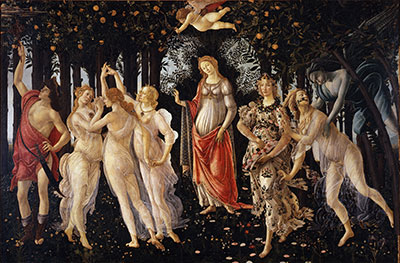
The catalogue connects the remembered work with Primavera, which Morisot had admired on an earlier Florentine visit. It makes the comparison concrete through the orange-bearing trees and her 1889 Under the Orange Tree and Picking Oranges. This is more useful than a free-floating line about “Botticelli's beauty”: we know the speaker, recipient, subject of her immediate work and why the earlier painting came to mind. The catalogue's English is a translated letter excerpt, so a reader should not assume those exact English words were what Morisot wrote in French.[3]
Morisot's comparison does not show that she copied Botticelli's forms wholesale. The museum's analysis distinguishes her modern handling of a garden and figure from the Renaissance allegory. The value of the quotation is narrower and sharper: a nineteenth-century painter looked back to Botticelli for the delicacy of particular trees while trying to solve her own pictorial problem.[3]
Paula Modersohn-Becker: A Madonna in the Louvre
On 17 January 1900, Paula Modersohn-Becker wrote from Paris to Otto Modersohn. In the published German letter she describes the Louvre's hold on her, her growing appreciation of Titian, and “eine süße Botticelli-Madonna” with red roses behind it against a blue-green sky. In English, that brief phrase means a sweet Botticelli Madonna. The date and original German make this a traceable response by a later artist, even though the exact painting she had in mind is not securely identified here.[4]
The distinction protects the artworks as well as the quotation. This letter concerns what she saw in the Louvre. It cannot simply be linked to the Uffizi's Madonna of the Rose Garden because both involve roses. The older version of this page made that connection without establishing that the Louvre picture and the Uffizi panel were the same object. They are not to be conflated. The letter's value lies in Modersohn-Becker's own viewing, not in supplying an undocumented inventory number.[4]
Her mention of Botticelli sits among other artists she sought out in Paris. The context makes the line more personal than a later general judgement about his style: she was reporting a museum visit and specific visual attractions. We can describe that experience without copying a long modern English translation whose wording and publication rights are separate from the early German letter.[4]
How to Check a Botticelli Quotation
First identify the grammatical subject. “Botticelli said” needs evidence for his speech or writing. The Mystic Nativity inscription belongs to a signed work; it is stronger evidence for a statement he publicly associated with his painting than Vasari's later report of a conversation. “Leonardo reported Botticelli's view” has its own textual chain and should retain Leonardo's disagreement. “Morisot remembered a Botticelli” and “Modersohn-Becker saw a Madonna” are later reactions. Keeping these statements separate prevents the most common misattribution on an artist quotes page.[1][2][3][4][5][7][8]
Next check the physical or textual chain: original language, dated letter or edition, translator, and the exact artwork named. A museum catalogue can help identify a likely painting; it should be cited for that identification rather than silently replacing the words in the source. The long remarks once collected on this route under McGraw-Hill, Ronald Lightbown and H. W. Janson have been left out of this selection because their editions and page numbers were not verified here and they are not Botticelli's speech.[2][3][4]
The signed inscription, Leonardo's reported remark and three later voices form a more useful small record than a long unsourced list. Botticelli's painting names him and places its biblical reading amid a dated crisis; Leonardo disputes a view he attributes to Botticelli; Vasari praises his drawing after his death; Morisot recalls delicate orange trees in 1889; Modersohn-Becker singles out a Louvre Madonna in 1900. Together they distinguish what is materially present in his work from what others reported or said about him. His exact private words remain unrecorded in these sources.[2][3][4][5][6][7][8]
Botticelli and related artworks
Discussion
Look again at the details and evidence discussed above. Which part of the source survey changes most when you know its history?
These prompts invite close looking and source-led questions rather than a single settled interpretation.
Reader Insights
What would count as a documented statement by Botticelli himself?
How does a later writer’s memory differ from a recorded artist statement?
Why is the Louvre Madonna in Modersohn-Becker’s letter still unidentified?
Join the Conversation
Share an observation or question about the source survey below.
References
- Uffizi Galleries, “Second edition of the Vite by Giorgio Vasari,” 1568 printed volume, Uffizi Library Rare 5, no. 2189, current record, accessed 29 September 2026; Wikimedia Commons woodcut file, sourced from Cornell University Library, Public Domain Mark, accessed 29 September 2026 View source View source.
- Giorgio Vasari, “The Life of Sandro Botticelli,” English translation of the Lives (expanded 1568 text; this webpage's 1550 label is inconsistent with its mention of a 1564 event), accessed 29 September 2026 View source.
- Danielle Hampton Cullen, “Berthe Morisot, Under the Orange Tree, 1889,” French Paintings and Pastels, 1600–1945, Nelson-Atkins Museum of Art (2021), discussion of Morisot's 1889 letter and Botticelli comparison, accessed 29 September 2026 View source.
- Paula Modersohn-Becker, “Briefe und Tagebuchblätter: Paris,” letter to Otto Modersohn, 17 January 1900, German original published by Kurt Wolff Verlag, accessed 29 September 2026 View source.
- National Gallery, London, Mystic Nativity, NG1034, signed, dated and inscribed painting; owner summary of the Greek inscription and its biblical and Italian historical references, consulted 1 October 2026 View source.
- Monica Centanni and Paolo B. Cipolla, “ΟΥΑΙ ΟΥΑΙ, il secondo grido dell’aquila”, La Rivista di Engramma 197 (2022), pp. 71–82, Greek transcription, translation, damaged ending and questions of date and language; consulted 1 October 2026 View source.
- Leonardo da Vinci, Trattato della pittura, part two, §57, “Precetti del pittore”, Italian text reporting and criticising Botticelli's view of landscape; consulted 1 October 2026. The passage is Leonardo's report, not Botticelli's autograph words View source.
- Institute and Museum of the History of Science, Florence, The Book on Painting, on Melzi's posthumous compilation and 1651 printing; consulted 1 October 2026 View source.
- Image credit. Posthumous, probably imagined portrait of Botticelli in the illustrated 1568 edition of Giorgio Vasari’s Lives. Cornell University Library digitisation, via Wikimedia Commons, Public Domain Mark 1.0. This woodcut is not an authenticated likeness; complete image shown. Image source record View source · View source.