 by Tom Gurney
Tom Gurney BSc (Hons) is an art history expert with over 20 years experience
Published on June 19, 2020 / Updated on October 2, 2026
Email: tomgurney1@gmail.com / Phone: +44 7429 011000
A closer look
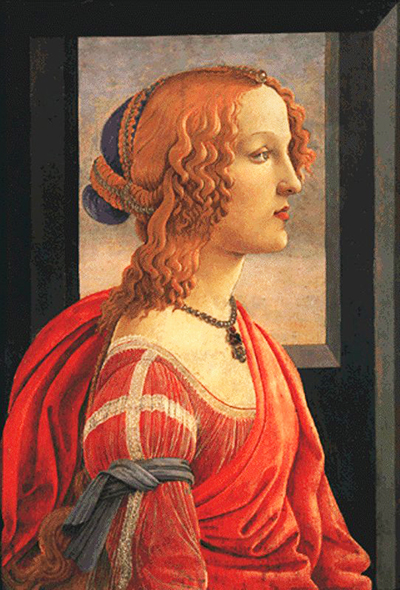
A woman turns in profile against a pale opening. Copper-coloured curls spill from a carefully braided arrangement over her shoulder. Her brilliant red gown, patterned sleeve and small dark pendant make the costume almost as vivid as her face. This is the painting the Marubeni Gallery in Tokyo calls La Bella Simonetta, collection number A186. The gallery attributes the tempera panel to Sandro Botticelli and dates it broadly to the late fifteenth century.[1][2]
The title invites a question the painting cannot settle by itself: is this truly Simonetta Vespucci? Marubeni says she was said to be the model, and its exhibition material explains that the name follows a twentieth-century art historian's book. The portrait is a real, identifiable object with a documented modern collection history. The famous sitter is a more tentative identification.[1][3]
At a glance
- ArtistSandro Botticelli, in the Marubeni Gallery's current catalogue
- WorkLa Bella Simonetta
- DateLate fifteenth century; the gallery does not give a precise year
- MediumTempera on panel
- Size65.1 × 44.3 cm in Marubeni's object database; rounded to 65 × 44 cm on its collection page
- CollectionMarubeni Collection, Tokyo, Japan
- Object numberA186, Marubeni Gallery database record 629
- SitterTraditionally identified as Simonetta Vespucci, without documentary confirmation in the cited records
- Arrival in JapanImported from Britain in 1969[1][2][3]
This work in Botticelli’s career
Fortitude
1470La Bella Simonetta
late 15th centuryPrimavera
c. 1480Birth of Venus
c. 1485Mystic Nativity
1500Contents
- At a Glance
- A Profile Made From Colour and Line
- What the Name “La Bella Simonetta” Means
- A Painting That Travelled to Tokyo
A Profile Made From Colour and Line
The young woman faces right, allowing the artist to draw the forehead, nose, lips and chin as a single contour against the open background. Her eye looks beyond the panel rather than returning our gaze. The profile creates a distance between sitter and viewer, but it also makes each part of the silhouette easy to follow. Her curling hair softens that outline and brings movement into the otherwise still pose.[1]
The hair is one of the picture's most elaborate features. Braids gather it at the back, while shorter ringlets frame the face and longer ones run down the neck. The warm colour against the pale skin draws attention first to the head, then to the pendant below. The jewellery hangs at the centre of the chest, a small dark accent in a portrait dominated by reds and copper tones. These details invite close looking without requiring a named model to explain them.[1][3]
The red gown fills much of the lower panel. Its folds curve across the chest, and a richly worked sleeve adds another pattern of light and dark. A tied band at the arm breaks the sweep of red cloth. The costume is deliberately conspicuous compared with the bare background. It presents the figure as fashionable and visually memorable, although dress alone cannot identify her family, marital status or the occasion for the picture.[1]
The grey framing area behind the woman makes the hair and shoulders stand out. It suggests an opening or a shallow architectural setting without showing a specific street or house. Botticelli's interest, as the image survives, lies in a compact relationship between a pale face, brilliant clothing and a controlled background. The eye travels from the profile through the curls and pendant to the sleeve, then returns to the face.[1]
Marubeni's database measures the panel 65.1 by 44.3 centimetres. Its broader collection page rounds that to 65 by 44 centimetres. Those are two descriptions of the same A186 work, not separate versions. It is large enough for the costume to have a strong presence, yet narrow enough that face and upper body remain the whole subject. A reproduction may magnify the image, but the original is a modest portrait panel.[1][2]
What the Name “La Bella Simonetta” Means
Simonetta Cattaneo Vespucci became a celebrated name in writing about fifteenth-century Florence. Marubeni's collection page says that she was said to be the model for this portrait. Its 2022–23 exhibition text is more precise about the title: the gallery follows Yashiro Yukio's 1929 second edition of a Botticelli study in calling the work La Bella Simonetta. That history explains the modern name; it is not evidence that a sitter's name was written on the panel in Botticelli's lifetime.[1][3]
Marubeni's exhibition considered whether this might be a portrait made during Simonetta's lifetime. It called that a possibility. Simonetta died in 1476, according to the gallery's biography, while the object label gives only late fifteenth century for the painting. That broad date does not decide whether the panel preceded or followed her death. Neither the gallery's online object entry nor its exhibition text presents a commission document or contemporary identification that closes the question.[1][2][3]
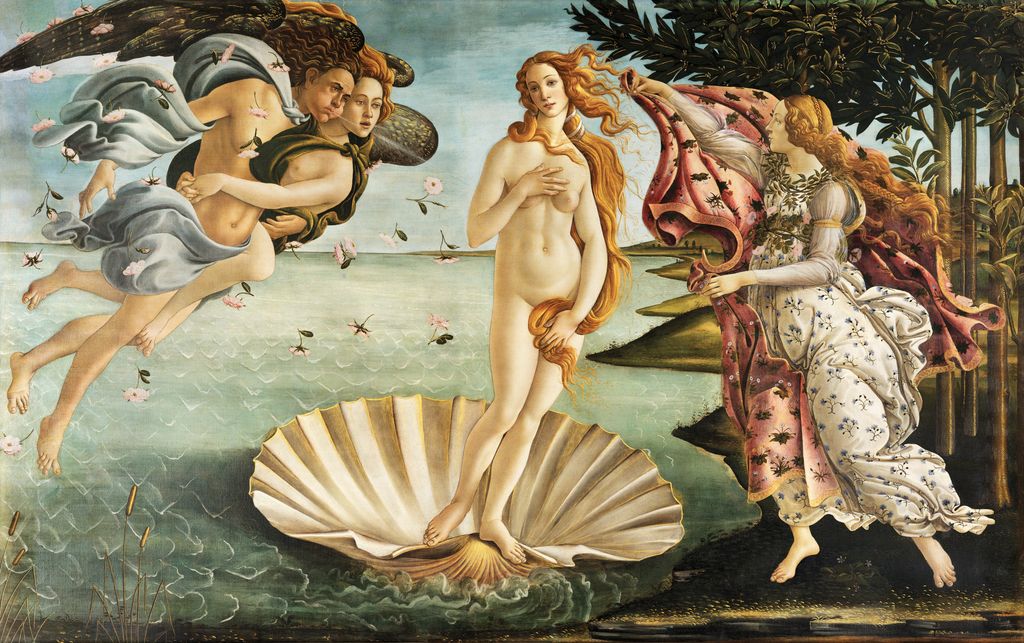
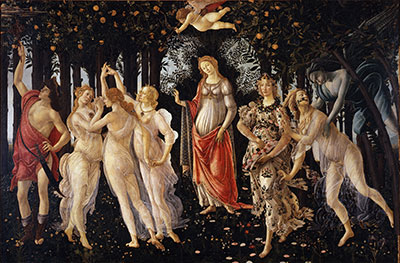
The pendant has attracted comparison with jewellery in other Botticelli images. Marubeni notes a similar design on women it describes as Simonetta-like in other paintings. Repeated motifs can suggest the artist or workshop's visual vocabulary; they do not prove that each woman was the same living person. The gallery also discusses old theories that Simonetta inspired figures in Primavera and The Birth of Venus. Those comparisons belong to the painting's later reception, not to secure records of a sitting for A186.[1][3]
This is why “traditional identification” is useful language. It preserves an important part of the portrait's cultural history without turning an attractive story into a fact. A viewer may see an idealised beauty, a highly specific costume and a face that resembles other Botticelli women. The cited sources do not let us move securely from those observations to the full name of the person represented.[1][3]
There is another portrait often called Bella Simonetta in the Palatine Gallery at Palazzo Pitti, Florence. That painting is Palatina 353, with a white head covering, crimson gown and grey stone jamb. Marubeni's A186 has flowing copper curls, a darker pendant and a different arrangement of red clothing. They are separate objects in separate collections. Sharing a traditional sitter name does not establish that either is a reliable likeness of Simonetta or that they were made for the same patron.[1][2][4]
A Painting That Travelled to Tokyo
Marubeni's 2022–23 exhibition reconstructed a long later journey. It says the painting was rediscovered in Bologna in the early eighteenth century. It subsequently travelled through France, Britain, Germany and Britain again, before Marubeni imported it from the United Kingdom to Japan in 1969. The exhibition summary gives that geographic sequence; Fondazione Zeri's photographic catalogue supplies several names and a sale record within it. Neither account restores the lost fifteenth-century commission.[3][6]
Zeri's catalogue records the picture with J.-B.-P. Lebrun in Paris, A. Seymour in London, and M. Kappel in Berlin before its appearance as lot 34 at Sotheby's London on 5 July 1967. It then lists the London and Tokyo art markets before the Marubeni collection. These are successive recorded locations and owners, not a complete account of every transfer or the date on which each person acquired it. The 1967 lot number is a useful fixed point for tracing the panel backwards through sale catalogues; the online Zeri entry cites that catalogue but does not reproduce its full description.[6]
The same Zeri record offers a narrower 1480–85 date and a measurement of 63.5 × 44.5 cm, whereas Marubeni currently gives the broader late-fifteenth-century date and 65.1 × 44.3 cm. The sources do not explain the measurement difference, so it would be false precision to silently combine them. Zeri's date is a catalogue judgement supported by bibliography, not an inscription or dated commission. The current owner remains the baseline for the panel's public dimensions; Zeri helps show how historical cataloguing has framed it.[1][2][6]
The same exhibition noted the rarity of an early paper trail for a Botticelli painting and displayed documents and an older copperplate reproduction. Those materials are evidence of how the image was known before its Tokyo arrival. They do not supply the lost fifteenth-century commission. Marubeni's modern object number A186 and its published physical measurements give the current collection a stable way to identify this exact work.[2][3]
Marubeni displayed the panel in a dedicated 2022–23 exhibition and again announced a 2025 special exhibition. Its gallery runs temporary shows rather than a permanent display of every collection work. A current visitor should check the gallery's own programme rather than assuming the portrait is always on view. The collection identity, unlike a temporary room placement, remains fixed.[3][5]
In Tokyo, the painting also became a focus for the study of Botticelli's reputation and for the modern appeal of Simonetta's story. Marubeni's exhibition placed it beside discussions of portraits in Frankfurt, Oxford and elsewhere and explained why Yashiro's title mattered. This reception history is important in its own right: the way a painting is named and exhibited shapes what viewers expect to find in its face.[3]
That expectation should not obscure the panel itself. A186 gives us a sharply drawn profile, braided and curling hair, a dark pendant and a saturated red dress. Its modern journey is unusually traceable for such an old painting, while the identity of its sitter remains open. Looking carefully at the object and reading its name as a historically acquired label makes both parts of its story clearer.[1][2][3]
Botticelli and related artworks
Discussion
Which detail changes how you read La Bella Simonetta?
Reader Insights
How do colour and contour shape the profile?
Why is “La Bella Simonetta” a traditional name rather than proof?
What is documented about the painting’s collection history?
Join the Conversation
Share a source-led observation or question below.
References
- Marubeni Gallery, “Collection: La Bella Simonetta,” Botticelli attribution, broad date, technique, rounded dimensions and qualified sitter wording, accessed 1 October 2026 View source.
- Marubeni Gallery, “La Bella Simonetta,” object database record 629 / collection no. A186, precise dimensions and image-use notice, accessed 1 October 2026 View source.
- Marubeni Gallery, “Botticelli Special Exhibition: La Bella Simonetta,” 2022–23 exhibition page, Yashiro title basis, provenance outline and conditional sitter discussion, accessed 1 October 2026 View source.
- Gallerie degli Uffizi, “Portrait of a Lady,” Palazzo Pitti / Palatina 353, distinct traditional “Bella Simonetta” portrait, accessed 1 October 2026 View source.
- Marubeni Corporation, “Special Exhibition: Botticelli—La Bella Simonetta,” 2025 exhibition announcement, accessed 1 October 2026 View source.
- Fondazione Federico Zeri, University of Bologna, Filipepi Alessandro, Ritratto femminile, photo catalogue entry 12596, historic locations, 5 July 1967 Sotheby's lot, catalogue date, size and bibliography; consulted 1 October 2026 View source.