 by Tom Gurney
Tom Gurney BSc (Hons) is an art history expert with over 20 years experience
Published on June 19, 2020 / Updated on October 2, 2026
Email: tomgurney1@gmail.com / Phone: +44 7429 011000
A closer look
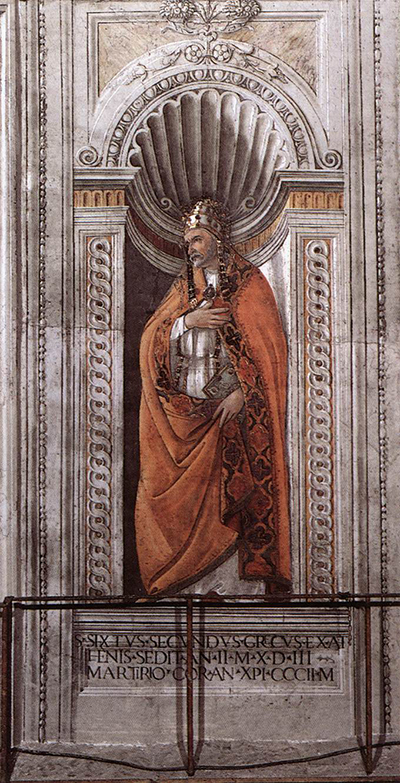
A pope in an orange-red mantle stands beneath a painted shell-shaped niche. One hand rises across his chest while the other gathers his robe. The architectural frame gives him a place of honour even though he is one figure in a much longer row. This is St Sixtus II in the Sistine Chapel's north-wall series of pontiffs. The Vatican Museums describe the individual figure as attributed to Sandro Botticelli.[1][2]
Sixtus II was a pope of the third century. He should not be confused with Sixtus IV, the fifteenth-century pope who commissioned the chapel's wall decoration. The difference matters for both dates and meaning: the fresco presents an early predecessor, while its production belongs to the 1481–82 campaign under a later namesake.[1][3]
At a glance
- SubjectSt Sixtus II, pope in 257–258
- AttributionTo Sandro Botticelli, in the Vatican Museums' qualified wording
- Date of the wall cycle1481–1482, under Pope Sixtus IV
- Medium and settingFresco figure within the Sistine Chapel's painted pontiff series
- LocationNorth wall of the Sistine Chapel, Vatican City
- SizeThe Vatican's consulted object page gives no separate dimensions for this figure
- Original programmePart of the chapel decoration commissioned by Sixtus IV, executed by several painters and workshops[1][2][3]
This work in Botticelli’s career
Fortitude
1470Saint Sixtus II
Sistine campaignPrimavera
c. 1480Birth of Venus
c. 1485Mystic Nativity
1500Contents
- At a Glance
- A Pope Inside a Painted Niche
- Sixtus II and Sixtus IV
- Who Painted This Part of the Chapel?
- An Echo of Saint Augustine
A Pope Inside a Painted Niche
The figure is meant to be read as part of an architectural sequence. Upright strips and a rounded shell form a niche around him. They imitate a setting for a sculpture or ceremonial statue, while the painted pope remains recognisably human in his heavy clothing and small turn of the head. The shell above acts as a visual canopy; the framing columns set limits to his space without making him seem detached from the wall.[1][2]
His warm mantle carries much of the image's colour. Its broad folds cross a lighter garment beneath, and a patterned border gives the drapery definition. The face turns slightly rather than staring straight out. The hands interrupt the long fall of cloth: one rests high near the chest, while the other holds fabric lower down. These restrained gestures give the solitary figure some movement without turning him into a scene of martyrdom.[1]
The name appears in the inscription beneath the niche. In a photograph, that lower section can be difficult to read, especially when a physical barrier crosses the view. The Vatican's own identification fixes the subject without requiring a speculative full transcription of the small Latin letters. The inscription and the pope's costume help viewers read him as a particular member of a larger succession.[1]
The Vatican says this figure stands out for its qualities against a certain overall sameness in the series. That comparison is useful when looking closely: the pope shares the niche format and ceremonial pose with his neighbours, yet the turns of the head, hands and richly articulated mantle invite an individual response. A series needs repeated forms so that its many parts read together. Difference is visible within that repetition.[1][2]
The image is fresco on a chapel wall, not a movable portrait panel. Its photograph may crop away the surrounding programme, but it was designed to be seen beside other popes and above the lower biblical narratives. Treating the crop as an isolated “Botticelli painting” would lose the reason for the painted niche and the repeated format. It also makes the qualified attribution sound more certain than the Vatican states.[1][2][3]
Sixtus II and Sixtus IV
The Vatican's object page says Sixtus II became pope during the persecution ordered by Emperor Valerian and was executed after roughly a year in office, in 258. It also credits him with seeking peace between the churches of Rome and Carthage over whether Christians considered heretics should be baptised again. That historical account explains why he belongs to an early papal succession, but the fresco does not show any of those events as a narrative episode.[1]
The man shown and the patron of the wall cycle are separated by more than twelve centuries. Sixtus IV held the papacy from 1471 to 1484 and oversaw the rebuilding and decoration of the chapel that bears his name. The Vatican dates the fresco campaign to 1481–82. A visitor can therefore see a third-century pope represented through a fifteenth-century pictorial programme. Calling both men simply “Pope Sixtus” obscures the picture's subject and its commissioning history.[1][3]
The series gives the early church a visible line of leaders. It places popes in paired niches at the sides of the windows, with the sequence alternating between opposite walls rather than running along only one side. The figures are commonly shown full length, at a three-quarter angle, and with a book, scroll or blessing gesture. St Sixtus II follows that common design language. His identity makes sense as one point in a chain rather than as a stand-alone likeness from life.[2]
No artist could have observed the third-century Sixtus II. The fresco is an imagined representation of an earlier church leader, not an eyewitness portrait. The human face and ceremonial robes make him present to fifteenth-century worshippers; they do not document his real features. This distinction allows us to appreciate the painterly treatment without searching for a historically accurate physiognomy the image cannot provide.[1][2]
Who Painted This Part of the Chapel?
The Vatican names Perugino, Botticelli, Cosimo Rosselli and Domenico Ghirlandaio as the principal makers of the pontiff series, matching artists involved in the wall cycles of Moses and Christ. Its chapel history also notes their workshops and other close collaborators. This was a coordinated undertaking with many hands. A series-level list should not be turned into a firm individual signature on each papal figure.[2][3]
For St Sixtus II specifically, the Vatican says “attributed to Botticelli.” That wording is narrower than claiming the figure is signed by him or that every stroke can be assigned to his hand. It is nevertheless more informative than leaving the wall anonymous: the owning institution associates this particular figure with his contribution and remarks on its relative quality. A careful title retains both parts of the statement, subject and qualified author.[1]
The attribution has a history. In his sixteenth-century Life of Botticelli, Giorgio Vasari credited him with the direction of the chapel work and with painting “certain Sanctified Popes” above the narrative scenes. Vasari did not identify St Sixtus II by name in that passage. His account therefore witnesses an early association between Botticelli and some papal figures, but cannot settle the authorship of this niche. The Vatican's present figure-specific “attributed to” label is the better guide to how confidently to name its painter today.[5][1][2]
Modern catalogues also phrase the artist's contribution differently. Fondazione Zeri's photographic catalogue files San Sisto II papa under Botticelli, dates it to 1481–82 and identifies bibliography as the basis of its attribution. The Web Gallery of Art proposes that assistants executed the series while Botticelli designed seven of its papal portraits, including this one. These are scholarly catalogue judgements about a collaborative wall campaign, not records of a signed figure or a newly found payment for this niche. The Vatican's more guarded object label remains the most appropriate wording for the individual fresco here.[6][7][1]
The Vatican's own chronology gives the collaborative project a firmer date: 27 October 1481, when Botticelli, Perugino, Ghirlandaio and Cosimo Rosselli were contracted for ten chapel frescoes. It also records a solemn Mass there on 9 August 1483 and inauguration on 15 August. These dates establish a public programme taking shape under Sixtus IV; the chronology does not assign the St Sixtus II niche to Botticelli personally or date the brushwork of this individual pope. The contract for ten frescoes and the museum's qualified attribution answer different questions.[4][1]
The broader chapel setting helps explain the role of the painted popes. The fifteenth-century wall decoration set stories of Moses and Christ opposite one another, while the pontiffs formed a line above. The programme connected sacred history to the church's succession of leaders. St Sixtus II's niche belongs to that visual argument even though its own page gives no detailed iconographic explanation beyond his identity and life.[2][3]
Later additions changed the room but not the age of this fresco. Michelangelo's ceiling was made under Julius II in the early sixteenth century, and his Last Judgement later replaced paintings on the altar wall. The Vatican says four pope figures once at that wall were lost in the change. The north-wall Sixtus II is one of the surviving figures; it should not be dated to Michelangelo's campaigns or confused with the lost altar-wall portraits.[2][3]
The fresco's significance lies partly in its place. Seen closely, it is a warm-coloured pope with expressive drapery and a measured gesture. Seen across the chapel, it joins a repeated procession of predecessors above the biblical stories. The Vatican's cautious Botticelli attribution lets the individual figure be discussed while respecting the collaborative nature of the series.[1][2][3]
An Echo of Saint Augustine
Sixtus II's raised hand and inward-looking face have prompted comparison with Botticelli's Saint Augustine in His Study, the fresco in Florence's Ognissanti church. The Opificio delle Pietre Dure dates the Ognissanti work to about 1480, before the Sistine Chapel campaign. Yet Alessandro Cecchi, in a passage reproduced by a Tuscan regional publication, reports that the similarity of Augustine's inspired face and hand at his chest to Sixtus II has led some to consider whether the Ognissanti fresco might instead have been painted after the Sistine work. The publication also notes that Ghirlandaio's facing Saint Jerome bears the date 1480, a useful point of comparison for the Florentine setting, though not a date inscribed on Botticelli's Augustine.[8][9]
The resemblance is a reason to look from one image to the other; it does not, on its own, tell us which was painted first. Nor does reuse of a pose prove that Botticelli personally painted every part of the papal niche. The proposed later dating of Augustine should therefore be read as a scholarly possibility alongside the Opificio's current approximate date, rather than as a settled revision to the chronology.[8][9][1]
Botticelli and related artworks
Discussion
Which detail changes how you read Saint Sixtus II?
Reader Insights
How does the painted niche frame the pope?
Why must Sixtus II be distinguished from Sixtus IV?
What does the Vatican say about Botticelli’s attribution?
Join the Conversation
Share a source-led observation or question below.
References
- Vatican Museums, “St Sixtus II,” north-wall pontiff page, qualified Botticelli attribution and subject history, accessed 1 October 2026 View source.
- Vatican Museums, “Pontiffs,” chapel series arrangement, artists and losses, accessed 1 October 2026 View source.
- Vatican Museums, “Sistine Chapel,” chapel history and 1481–82 fresco campaign, accessed 1 October 2026 View source.
- Vatican Museums, The Sistine Chapel Twenty Years Later: New Breath, New Light (2014), chronology on PDF p. 36, listing the 27 October 1481 group contract and August 1483 ceremonies; consulted 1 October 2026. This is a museum chronology of the chapel, not the original contract text or a figure-specific attribution View source.
- Giorgio Vasari, “Life of Sandro Botticelli”, in Lives of the Most Eminent Painters, Sculptors, and Architects, translated by Gaston du C. de Vere, vol. III, p. 250; Project Gutenberg transcription consulted 1 October 2026. Vasari names popes collectively, not St Sixtus II individually View source.
- Fondazione Federico Zeri, San Sisto II papa, work catalogue record, dating and bibliography-based attribution, consulted 1 October 2026 View source.
- Web Gallery of Art, St Sixtus II, catalogue note proposing a distinction between assistants' execution and Botticelli's design in the pontiff series, consulted 1 October 2026 View source.
- Opificio delle Pietre Dure, “Sandro Botticelli, Sant’Agostino nello studio, 1480 ca., Basilica di Ognissanti, Firenze”, conservation project page, consulted 1 October 2026 View source.
- Alessandro Cecchi, Botticelli (2005), p. 168, passage reproduced in a Tuscan Regional Council publication, PDF p. 42 (printed p. 41), consulted 1 October 2026. Cecchi's original monograph was not directly inspected; the regional publication is the source read for this passage View source.