 by Tom Gurney
Tom Gurney BSc (Hons) is an art history expert with over 20 years experience
Published on June 19, 2020 / Updated on October 2, 2026
Email: tomgurney1@gmail.com / Phone: +44 7429 011000
The Virgin Adoring the Child
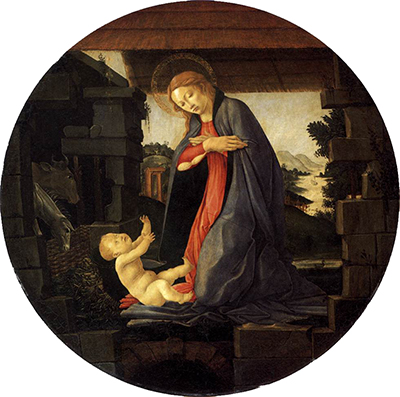
Mary folds her arms across her chest and lowers her eyes towards the infant in front of her. He lies on a pillow and a scatter of hay, but his hands reach up towards her. Their gestures create a quiet exchange: the mother holds back in prayer while the child moves eagerly towards her. Around them, a rough stable, an ox, a donkey and a distant river fill a little circular painting with a scene that feels both intimate and expansive.[1]
The National Gallery of Art in Washington dates The Virgin Adoring the Child to 1480/1490 and attributes it to Sandro Botticelli. The tempera painting is on a round poplar panel, 58.9 centimetres in diameter. It belongs to the Samuel H. Kress Collection at the NGA and is currently on loan to the Flint Institute of Arts as part of the Gallery's Across the Nation programme.[1]
At a glance
- ArtistSandro Botticelli, as catalogued by the National Gallery of Art
- TitleThe Virgin Adoring the Child
- Date1480/1490
- Mediumtempera on poplar panel
- Formatcircular painting, or tondo
- Diameter58.9 cm
- CollectionNational Gallery of Art, Washington, Samuel H. Kress Collection
- Accession number1952.2.4
- Current loanFlint Institute of Arts, Michigan
Where this work sits in Botticelli’s career
Fortitude
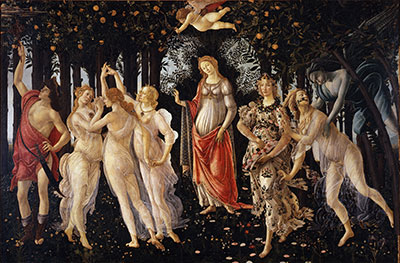
1470Primavera
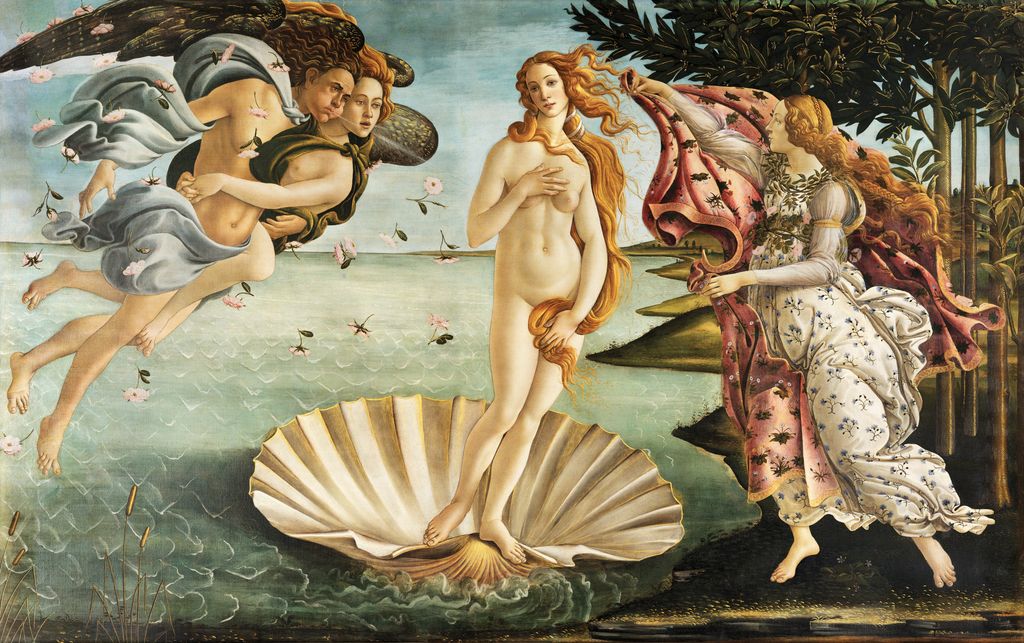
c. 1480The Birth of Venus
c. 1485The Virgin Adoring the Child
1480/1490The Mystical Nativity
c. 1500Contents
- The Round Picture
- A Child in an Open Stable
- When and for Whom Was It Painted?
- How the Attribution Has Changed
- A Distinct Botticelli Madonna
Mary's pose gives the picture its title. She is not holding Jesus on her lap or presenting him to visitors. She kneels close to him, crossing her hands over her heart in adoration. Her almost closed eyes and bowed head direct attention to the child without a theatrical gesture. He looks back at her and lifts both arms, one of them reaching into the space between his face and hers. The painting's emotional centre is that short distance between two bodies.[1]
The Round Picture
The work is a tondo, the Italian name for a circular painting. Its circumference encloses the Virgin's long blue cloak and the curved line of the child's body. Botticelli sets Mary slightly to the right. Her broad mantle occupies much of the lower half, then rises towards her gold halo beneath the wooden roof. The child reclines to the left on her spread clothing. This unequal arrangement is held together by their gazes and the upward movement of his hands.[1]
The roof follows the upper curve of the panel while the stone blocks at each side seem to support it. Below the figures, more masonry describes an arch opening into darkness. Instead of framing Mary and Jesus with a flat decorative border, the painter gives the tondo a small built world. The stable has weight and shadow, yet it is open behind Mary to pale sky and countryside.[1]
Round images of the Virgin and Child were familiar in fifteenth-century Florence. The Uffizi, discussing Botticelli's much larger Madonna of the Pomegranate, notes that sacred tondi could be made for settings outside churches and could encourage a more intimate kind of looking. That general history helps explain the appeal of a round devotional picture; it does not identify the first owner or setting of this particular panel.[3]
The historical Kress catalogue also connects this tondo with Botticelli’s Uffizi drawing 209 E, an Adoration of the Child with Saint Joseph, and with a separate tondo now in Raleigh. That is a design relationship, not proof that the surviving paper was the finished cartoon for this Washington panel. The drawing includes Joseph and survives with an irregular upper edge; the Washington painting leaves Joseph out and gives the mother and child a fully described stable. The comparison shows how a familiar sacred group could be recast across sheets and paintings, while leaving their precise order and workshop use unresolved.[2]
A Child in an Open Stable
The setting is built from contrasts. Mary wears a blue mantle over a warm pink-red dress. The child is almost naked, lying on a pillow near hay. Gold halos mark both figures as holy, but the animal shelter is ordinary and rough. The NGA's visual description identifies an ox and a donkey at left, partly hidden in the shaded interior. Their quiet presence locates the scene in the visual tradition of the Nativity, even though shepherds, Magi and Joseph are absent from this composition.[1]
At the right, the view opens to hills and a winding river. Small trees, buildings and a bird on the water pull the eye far beyond the mother and child. The nearby stable and distant landscape are not two separate stories. The opening lets the compact foreground breathe and places the adoration within a larger world. It also makes Mary's concentration more striking: she looks only at the child, while the viewer can see the country beyond her.[1]
A small bird on the water and the dark opening beneath the figures have attracted symbolic readings. A historical Kress catalogue records proposals that the arch suggests an abyss or death over which Christ triumphs, and that the bird, described there as a duck, may suggest reverence or adoration. These are interpretations offered by earlier scholars, not explanations preserved from Botticelli or the painting's first owner. The objects can also be seen simply as part of a carefully observed landscape and setting.[2]
The gestures require no hidden key. Mary's crossed arms make her worship visible. The child raises his hands and turns his head towards her. Botticelli holds those actions in balance with the shelter's heavier stone and timber. The painting can be looked at first as an encounter between mother and son, then as an image inviting devotion to the child she adores.
When and for Whom Was It Painted?
The NGA gives a decade-wide date of 1480/1490. The historical Kress catalogue notes that scholars had proposed dates near both ends of that range, partly through comparisons with Botticelli's Madonna of the Book in Milan. A narrower date would imply greater certainty than the Gallery's current record provides. The painting's small size and round format make a close-viewing devotional use plausible, but no documented first commission or original room is identified in the NGA's provenance.[1][2]
The difference between an attractive possibility and a documented history is important here. The tondo's shelter may seem to bring a viewer near the Holy Family, yet its recorded ownership begins centuries after Botticelli. The painting belonged to Charles Paravey in Paris by the nineteenth century. It appeared in an 1878 sale and again in a 1929 sale associated with his daughter, Mme Raynaud. Later it passed through Wildenstein & Co. in New York to the Samuel H. Kress Foundation in 1947. The foundation gave it to the National Gallery of Art in 1952.[1]
This sequence explains how the panel reached Washington. It cannot tell us whether a Florentine family once placed it in a home, a chapel or another setting. The scene itself is rich enough to sustain close looking without assigning it an unrecorded patron.
How the Attribution Has Changed
The NGA currently catalogues the tondo as a work by Botticelli. Its own provenance also records that the 1878 and 1929 Paris sale descriptions called it a painting by Filippo Lippi. That was a historical attribution, not the Gallery's present judgement.[1]
The NGA's bibliography shows that opinion continued to vary. It lists a 1974 publication assigning the work to Jacopo del Sellaio, later proposals involving Botticelli's workshop and Sellaio, and a 2020 view accepting Botticelli while suggesting a collaborator close to Sellaio may have helped with the landscape. These entries show why the question cannot be reduced to a single old auction name. They also do not, by themselves, overturn the NGA's current Botticelli attribution.[1]
Such discussion is unsurprising in a Florentine painting made among artists who shared subjects and worked near one another. What is secure for a reader today is the museum's identification of this particular round panel, its documented materials and size, and the visual scene it presents. Specific claims about a collaborator's hand in one part of the landscape remain scholarly proposals rather than visible labels fixed by the painting itself.[1]
A Distinct Botticelli Madonna
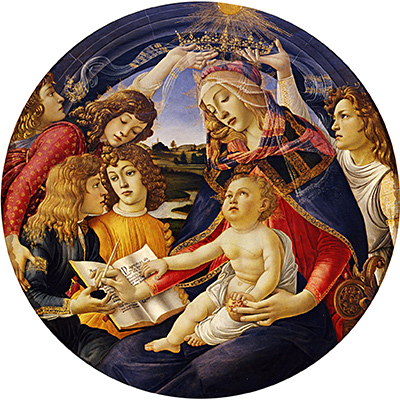
This tondo is easy to confuse with Botticelli's other pictures of the Virgin and Child. The Uffizi's Madonna of the Pomegranate, also circular, shows the child on Mary's lap holding a pomegranate and surrounded by angels. It is much larger, 143.5 centimetres across, and the Uffizi dates it to about 1487. The Washington Virgin Adoring the Child shows Mary kneeling beside an infant on hay in a stable, with an ox and donkey nearby. The shared round format and artist's name do not make them the same painting.[1][3]
The NGA panel is also not an Adoration of the Magi. No visitors have arrived with gifts. Mary and the child are the only people in the foreground; the animals remain in shadow to one side. Botticelli concentrates the subject into the first exchange of attention between them. Mary's folded arms and the baby's raised hands carry the action across the small gap at the centre of a whole circular world.
Botticelli and related artworks
Discussion
Look again at the details and evidence discussed above. Which part of the painting changes most when you know its history?
These prompts invite close looking and source-led questions rather than a single settled interpretation.
Reader Insights
How do Mary’s crossed arms and the child’s raised hands shape their encounter?
What does the circular edge do to the stable and landscape?
Which detail outside the two figures changes your understanding of the scene?
Join the Conversation
Share an observation or question about the painting below.
References
- National Gallery of Art, “The Virgin Adoring the Child,” Samuel H. Kress Collection, accession 1952.2.4, current object record; accessed 29 September 2026 View source.
- Samuel H. Kress Foundation, “The Virgin Adoring the Child,” K1432 and historical catalogue entry; accessed 29 September 2026 View source.
- Uffizi Galleries, “Virgin and Child with Angels (‘Madonna of the Pomegranate’),” inventory 1890/1607, current collection record; accessed 29 September 2026 View source.
- Image credit. Sandro Botticelli, The Virgin Adoring the Child, 1480/1490. Samuel H. Kress Collection, National Gallery of Art, Washington, 1952.2.4. Courtesy National Gallery of Art, Washington; Public Domain (CC0).