 by Tom Gurney
Tom Gurney BSc (Hons) is an art history expert with over 20 years experience
Published on June 19, 2020 / Updated on October 2, 2026
Email: tomgurney1@gmail.com / Phone: +44 7429 011000
A closer look
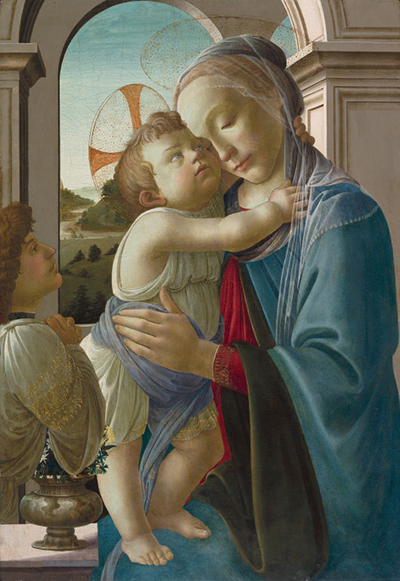
The infant Jesus turns toward Mary and reaches up to her. She leans down and steadies him while an angel stands beside them. The angel looks up toward their encounter, leading the eye from the edge of the panel to mother and child. In this small painting, Botticelli makes a devotional image out of a simple exchange: a child reaches, a mother receives him, and a third figure helps us follow it.[1]
The painting belongs to the Museo degli Innocenti in Florence, whose current collection page calls it Madonna and Child with an Angel and dates it to about 1465. Its size is 69 by 64 centimetres. The museum connects this early work with a celebrated painting by Botticelli's teacher Filippo Lippi. An Italian national catalogue record, however, uses the more guarded wording attributed to Botticelli and notes an earlier Lippi attribution. Both records identify the same panel.[1][2]
At a glance
- Current museum titleMadonna and Child with an Angel
- Artist lineSandro Botticelli in the Museo degli Innocenti display; “attributed to Botticelli” in the Italian national catalogue
- Dateabout 1465
- Mediumtempera on panel
- Dimensions69 × 64 cm in the current museum display and national catalogue; other institutional records disagree
- CollectionMuseo degli Innocenti, Florence
- National catalogue record0900284484
- Later historyacquired by the Hospital of the Innocents in the mid-nineteenth century
That acquisition is a documented part of the panel's history, not evidence that the hospital commissioned it in the fifteenth century. The current museum page does not identify a first patron or original place of display. Its value for a close reading lies in the faces, supporting hands and architectural setting that survive on the painted surface.[1][2]
This work in Botticelli’s career
Fortitude
1470Innocenti Madonna
about 1465Primavera
c. 1480Birth of Venus
c. 1485Mystic Nativity
1500Contents
- At a Glance
- A Small Group Held Together by Hands
- The Arch Behind Them
- In the Wake of Filippo Lippi
- An Innocenti Painting with an Earlier Life
A Small Group Held Together by Hands
Mary fills the right half of the panel. Her blue mantle falls in broad folds around a red garment, and a translucent veil crosses her head and shoulder. She inclines her face toward the child. The gesture brings their heads close, but their expressions differ: the museum describes Mary as thoughtful and the child as carefree. The picture allows the mother to seem aware of a future beyond this moment while he is occupied with reaching her.[1]
The child stands or is held between Mary and the angel rather than resting quietly in her lap. One arm crosses in front of her blue clothing, drawing attention to the space between their faces. Mary's visible hand steadies his body. The museum describes the angel as supporting him too, though the small reproduction makes the exact contact less easy to trace. The child's movement and Mary's response give the group its structure before the viewer has read any symbol in the background.[1]
The angel is lower and smaller than Mary, close to the picture's left edge. Its face turns upward toward the child. The museum says this gaze draws viewers into the scene; the image shows a line of attention toward the central exchange, rather than direct eye contact with us. The angel's position at the edge gives the eye a path into the close family group.[1]
Gold halos mark the sacred figures, but their touch and directed looks carry much of the meaning. The painting does not depend on a crowd of attendants or a complicated narrative. The angel's upward attention helps return the viewer's eye to the child. The result is an image that can be approached at the scale of personal looking, while its careful framing keeps it ceremonious.[1]
The Arch Behind Them
Stone columns and an arch rise behind the figures. Through the opening, a pale landscape extends beyond the close group. The architecture gives Mary and the child a defined place, but it also lets the eye move away from their faces for a moment. A vessel with flowers sits near the lower left, partly overlapped by the angel. Foreground objects, figures and distant view form several layers in a panel slightly taller than it is wide.[1][2]
The Museo degli Innocenti points out a subtle irregularity in this setting: the viewpoint implied by the architectural background is slightly lower than the viewpoint of the rest of the composition. Once noticed, that difference is not a reason to dismiss the picture as a failed exercise. The arch still frames the heads and the landscape still opens space behind them. The adjustment allows the close grouping to dominate the eye even while the built setting suggests depth.[1]
This is a distinct feature of the Innocenti panel. The architecture does not simply serve as decoration borrowed from another image. Its arch encloses the encounter, while the differing perspective reveals how an early painter could combine a monumental setting with figures conceived for intimate attention. We can see the effect without pretending to know a lost preliminary drawing or the artist's exact sequence of revisions.[1]
In the Wake of Filippo Lippi
The museum directly relates this panel to Filippo Lippi's Madonna and Child with Two Angels, now in the Uffizi. Lippi's work was made about 1460–65. There, two angels bring the child toward Mary, a foreground angel looks out at the viewer, and a landscape appears behind them. The Uffizi says the composition became a model for the young Botticelli. The family likeness helps place the Innocenti panel within the visual education of an artist working close to Lippi.[1][3]
Botticelli's painting condenses the group. It has one visible angel, not two, and Mary receives a child who stretches towards her. Lippi's foreground angel faces the viewer; the Innocenti angel turns up toward the central pair. The arch and the compressed exchange give this version its own balance. Similarity to Lippi explains how Botticelli learned from a successful design; the changed direction of looking shows what this painting makes newly central.[1][3]
The national catalogue records why this relationship has also complicated the painting's attribution. It notes that the Innocenti panel was long assigned to Lippi and now treats it as a youthful Botticelli work close to Lippi's manner, while its formal artist field says “attributed to Botticelli.” The museum's present display line is firmer. These are two ways current public institutions express the state of the evidence. It would be misleading to use the old Lippi name as though it were the museum's current view, or to omit the catalogue's qualification entirely.[1][2]
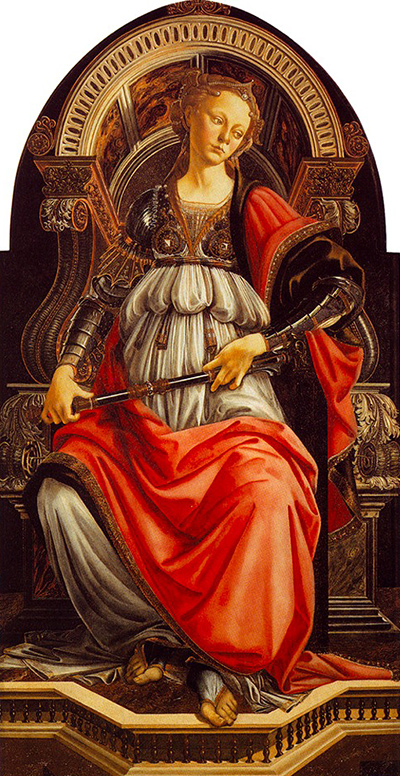
The national record places the work around 1465 and cites an argument that it predates Botticelli's Fortitude of 1470 on stylistic grounds. This makes it plausible as an early work, but the date is approximate. Neither the museum nor the catalogue supplies a signed date or a document of its first commission.[1][2]
The change from a Lippi to a Botticelli attribution can be located more precisely in the painting's modern history. The Istituto degli Innocenti says older inventories alternated between Filippo Lippi and his school, and that Botticelli's name was first proposed near the end of the nineteenth century. A photographic record held by the Istituto Nazionale di Studi sul Rinascimento identifies Hermann Ulmann's 1893 attribution as that turning point. This does not create a fifteenth-century signature, but it shows that the modern label developed through study of the panel rather than a newly discovered commission contract.[4][5]
An Innocenti Painting with an Earlier Life
The Hospital of the Innocents acquired the painting in the middle of the nineteenth century. Its present place in the museum connects it with an institution devoted to children, but that later setting should not be read backward into Botticelli's original intent. The panel's first owner and first room remain unidentified in the sources used here.[1]
The painting has also been seen outside Florence. The Innocenti institute records its loan to the Tokyo Metropolitan Art Museum for Arte a Firenze da Botticelli a Bronzino, held from 11 October to 4 December 2014. The institute grouped it with related Botticelli Madonnas in Washington and New York as responses to Lippi's Uffizi model. That exhibition context is useful for comparison, but the panels remain separate objects with their own attributions and histories. A later international loan cannot tell us how the Innocenti picture was displayed when new.[4]
Even the panel's measurements and medium vary in reputable records. Both the present museum page and the Italian national catalogue's full card give 69 × 64 cm and tempera on wood. A research institute's photo record lists 87 × 60 cm; Palazzo Strozzi's 2011 exhibition press list gives 95 × 64 cm and calls the medium tempera and oil on wood. These are too different to dismiss as simple rounding. The accessible records do not explain whether the entries measured different extents, included a frame, or contain an error. The current owning museum's description is used in the facts above, with the disagreement stated so that the numbers are not mistaken for a settled technical finding.[1][2][5][6]
Other works also bear the title Madonna and Child with an Angel, and several early Botticelli-associated Madonnas look back to Lippi. This Florence panel is identified by its one angel, its 69 × 64 cm format, the arched setting and its home at the Innocenti. The Naples Capodimonte painting has two angels and a different arrangement; the Met's oval two-angels version has its own qualified attribution. Counting the attendants is an easy first step, but the direction of their looks and the placement of the child distinguish the pictures more fully.[1][2][3]
Return to the angel at the left edge after following the child's reach. Its upward look draws attention into the painting, then the touch between Mary and Jesus holds it there. The national catalogue's careful attribution and the museum's close description both matter. Together they help us see an early painting whose appeal depends on a small, precise arrangement of bodies within an ambitious architectural frame.[1][2]
Botticelli and related artworks
Discussion
Which detail changes how you read Innocenti Madonna?
Reader Insights
How do the hands hold the small group together?
Where do the angel and the Child direct your attention?
What does the museum record say about the painting’s later history?
Join the Conversation
Share a source-led observation or question below.
References
- Museo degli Innocenti, “Art: Madonna and Child and an Angel,” current Pinacoteca presentation, about 1465; accessed 29 September 2026 View source.
- Italian National Catalogue of Cultural Heritage, “Madonna con Bambino, angelo,” national record 0900284484; accessed 29 September 2026 View source.
- Uffizi Galleries, “Madonna and Child with Two Angels,” Filippo Lippi, inventory 1890 no. 1598; accessed 29 September 2026 View source.
- Istituto degli Innocenti, “In mostra a Tokyo la Madonna col Bambino di Botticelli”, 13 October 2014, institution's account of the 2014 exhibition, older Lippi/school labels and the late nineteenth-century Botticelli attribution; consulted 1 October 2026 View source.
- Istituto Nazionale di Studi sul Rinascimento, photographic subject record for the Innocenti Madonna, collection record in revision, noting Ulmann's 1893 attribution and giving 87 × 60 cm; consulted 1 October 2026. Its dimensions differ from the owning museum's current account View source.
- Palazzo Strozzi, Denaro e Bellezza press dossier, exhibition object 7.10, PDF pp. 8 and 35, listing the Innocenti panel as 95 × 64 cm and tempera and oil on wood; consulted 1 October 2026. The dossier does not explain its different measurements or medium wording View source.