 by Tom Gurney
Tom Gurney BSc (Hons) is an art history expert with over 20 years experience
Published on / Updated on
Email: tomgurney1@gmail.com / Phone: +44 7429 011000
William Blake’s Early Life and Apprenticeship: Introduction
A crowned king stands beneath a pointed arch, one hand lifted beside his face, the other gathering his robe. The small folds, patterned borders and curling beard demand attention as insistently as the figure’s identity. This drawing of the supposed King Sebert, preserved by the Society of Antiquaries, belongs to the Westminster Abbey work associated with William Blake’s apprenticeship to James Basire. Its attribution is qualified, but its task is clear: turn an old painted monument into a legible image on paper. Looking at it brings Blake’s artistic beginnings close to the workbench. [1]
Blake’s early education joined several kinds of looking. Plaster casts brought ancient sculpture into a London drawing school; prints carried Renaissance figures into a boy’s collection; antiquarian commissions required the recording of medieval monuments. When he registered at the Royal Academy Schools in 1779, he already had seven years of professional training behind him. The artist who would later give bodies to angels, prophets and personified energies had learned how to describe a hand, carry a contour around drapery and organise marks for printing. [2][3]
At a Glance
- BirthLondon, 28 November 1757 [4][5][6]
- ApprenticeshipJames Basire, 1772–1779 [2]
- Academy registration8 October 1779 [7]
Contents
- The household in Broad Street
- Casts, prints and an education in figures
- Seven years with James Basire
- Recording Westminster Abbey
- Practice preserved on the back of copper
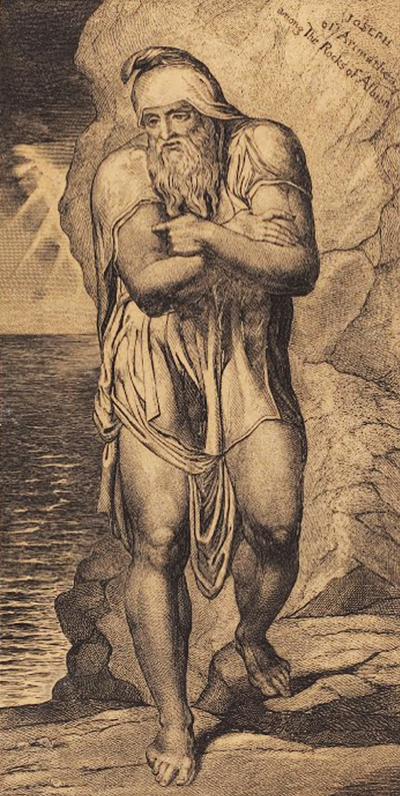
- Joseph of Arimathea and the apprentice’s own work
- Entering the Royal Academy
The household in Broad Street
William Blake was born in London on 28 November 1757. His father, James, kept a hosiery business in Broad Street, near Golden Square, and his mother was Catherine Blake, formerly Catherine Wright. The home and shop occupied the same address, 28 Broad Street. Blake’s own late autograph statement confirms his birth date; the parish-register transcription published by Arthur Symons records his baptism at St James’s, Piccadilly, on 11 December. His own statement and the parish transcription give the childhood a securely dated beginning. [4][5][6]
That distinction matters because the childhood has often been made to predict the whole life. Gilchrist’s biography, first published in 1863, helped establish the picture of a visionary boy wandering out towards the fields south of London. Its famous angel-filled tree on Peckham Rye is an account of something Blake reportedly related in later years. Gilchrist even leaves his age uncertain, around eight or ten. The story can be read as part of Blake’s remembered childhood without treating its dialogue, location and spiritual experience as an independently witnessed event. [8]
Family religion requires similar care, although here documentary discoveries have changed the picture. Marsha Keith Schuchard and Keri Davies identified Catherine’s membership in the Moravian congregation at Fetter Lane during her first marriage, to Thomas Armitage. Their published church-book transcription records that the couple entered the congregation in November 1750 and that Catherine left after becoming a widow. Her surviving application letter expresses an intense personal devotion to Christ. These are records of Catherine’s life before William’s birth, providing something much firmer than a general label attached to the household. [9]
They also have a limit. Catherine’s earlier membership does not establish that William was himself a Moravian, or supply a timetable of religious lessons at Broad Street. His baptism provides evidence of an Anglican ceremony, while the family’s spiritual life cannot be reconstructed from that ceremony alone. The discoveries give his mother a history and voice of her own. They invite attention to the religious possibilities surrounding the child without turning one documented connection into a complete explanation of the adult poet. [9]
Casts, prints and an education in figures
The fullest early account of Blake’s artistic childhood appeared during his lifetime, in Benjamin Heath Malkin’s A Father’s Memoirs of His Child in 1806. Malkin described him entering Henry Pars’s drawing school in the Strand at ten and learning from plaster casts. He also reported James Blake buying casts and providing money for prints. His list of favourite artists includes Raphael, Michelangelo, Dürer and Giulio Romano. Written decades after these events, the account remains valuable testimony, probably informed by Blake himself. [3]
Its practical setting is revealing. A cast allows a student to return to the same body, move around it and study the difference between a projected contour and a rounded surface. A cast hand concentrates those problems into a small object: the bend of a finger, the joint at the wrist, the relationship between an illuminated plane and a shadow. The material can be handled and lit independently of the sculpture from which it derives. Such exercises connect the young artist with a larger European tradition of learning through the human figure. [3][7]
Prints offered a different encounter. They made distant works available through another artist’s translation, often at a scale and in a material quite unlike the original. Blake could study an admired figure repeatedly, taking in the organisation of limbs and garments as well as the engraved marks that represented them. Copying thus involved two connected languages: the composition inherited from the earlier artist and the linear decisions through which a printmaker made it visible. His later work would draw freely on earlier art while insisting upon the force of individual invention. [2][3]
Calling Blake self-taught obscures this combination of lessons, purchased study material and subsequent professional instruction. The early accounts leave much of his general education uncertain, but artistic training occupied a substantial part of his youth. Nor was his father’s trade an obvious barrier separating the household from visual culture. Myrone’s study of Blake’s Academy contemporaries finds a strong representation of families connected with commerce and design, including textile trades. He situates James Blake’s reported encouragement among other examples of parents supporting artistic careers. [7]
Seven years with James Basire
In 1772 Blake began his apprenticeship with James Basire at Great Queen Street, near Lincoln’s Inn Fields. The term continued until 1779. Basire was engraver to the Society of Antiquaries and the Royal Society, placing the workshop within established networks of learned publication. For Blake, this was a move from studying representations to participating in their production: making drawings and plates for readers who expected images to communicate reliable information. [2]
Basire’s range has sometimes disappeared behind an unflattering image of a mechanically correct antiquarian engraver. Mark Crosby’s study of the apprenticeship describes a broader practice. The workshop produced portraits, historical compositions, travel illustrations and reproductions of drawings as well as archaeological material. Different commissions required different handling. A strong architectural outline, a smoothly modelled face and an imitation of a rapidly drawn sketch were distinct technical problems. Blake’s master offered a repertoire of solutions to the question of how marks on copper could represent something seen on paper or in the world. [2]
Much of the work employed a combination of etching and engraving. Etching could establish lines through acid acting on exposed copper; cutting with the burin could develop or strengthen the image. Parallel strokes and intersecting networks supplied changes of tone. Spacing mattered, as did the width, direction and depth of a mark. A passage that became muddy or uneven in print could defeat an otherwise accurate drawing. These demands made sustained control of the hand part of the apprentice’s education. [2]
The training also extended beyond making marks. The Society of Antiquaries describes preparation of plates, reversed writing, inking, paper preparation and use of the rolling press among the skills associated with Blake’s apprenticeship. A printed sheet depended upon a sequence of operations, each capable of changing the result. The useful unit of work was consequently larger than an isolated drawing: the apprentice needed to understand how an image could pass through the workshop and emerge as a reproducible impression. [6]
Stories of life inside the shop are less secure than this professional framework. Malkin describes disturbances among apprentices leading Basire to send Blake out drawing. Crosby compares that recollection with the surviving apprenticeship records, which show a more complicated sequence of arrivals and departures. A later anecdote does not provide a dependable daily roster. The important opportunity it describes, work among old monuments, can be examined through surviving drawings, plates and publications as well as recollection. [2][3]
Recording Westminster Abbey
Westminster Abbey offered an extraordinary concentration of bodies made to endure: recumbent kings and queens, figures carved beside tombs, painted rulers and elaborate architectural settings. The commission required the apprentice to examine these things as evidence. Heads, garments, inscriptions and ornaments could matter to an antiquarian reader separately from the effect of the whole monument. An artist had to notice both the large arrangement and the detail that a smaller engraved illustration might need to preserve. [1][2]
The surviving drawing of Henry III in the Society of Antiquaries makes that attention tangible. The crowned figure wears a long red garment and a dark outer robe edged with small ornaments. The sceptre rises beside his face; a pale patterned lining folds across the lower body. The narrow architectural frame keeps the whole figure upright and enclosed. The record identifies ink, watercolour and gold leaf, materials that preserve differences a monochrome engraving would have to translate into marks. The museum attributes the sheet to Blake while also naming Basire and recording his signature. [6]
The supposed Sebert offers another richly worked arrangement. His raised hand is carefully separated from the dark background, while the other hand emerges over a broad fold of white cloth. Red and green-edged borders travel through the drapery, and the curling hair and beard give the head a distinct character. The pointed canopy repeats the enclosed shape around him. These details reward looking even before the disputed question of individual authorship is answered: the image records a painted surface with considerable attention to gesture, pattern and colour. [1]
The attribution needs to remain visible. Basire’s signature appears on workshop drawings and prints, while an apprentice’s participation may have taken place at several stages. The Society favours Blake on stylistic grounds. Bernard Nurse’s account for the digital edition of Vetusta Monumenta sets that position beside a more cautious reconstruction associated with Richard Goddard: Basire may have completed finished watercolours and engraved plates, even where Blake supplied preliminary work. Shared linear habits can identify a workshop practice more readily than a single hand. [1][6][10]
There were also separate publishing projects. Malkin’s named royal tombs chiefly relate to Richard Gough’s Sepulchral Monuments. Another group of Abbey images was commissioned through Joseph Ayloffe and appeared in his 1780 account before being gathered into Vetusta Monumenta. Preparatory drawing, finishing, engraving and publication could be separated by years. The date of a book therefore cannot by itself date Blake’s contribution, and a sheet emerging from Basire’s workshop cannot automatically be called entirely Blake’s work. [2][10]
Malkin’s account of changing viewpoints helps explain the training’s significance. He describes Blake examining monuments from positions that included looking down on their figures, and treating the heads as portraits. An effigy that appears still and self-contained from one angle presents different relations of head, shoulder and garment from another. Recording it asks the draughtsman to make choices about viewpoint before deciding how to lay out the page. In this education, exact observation and imaginative selection were already closely connected. [3]
Watch: William Blake’s world and working methods
Choose an introduction to Blake, a printing demonstration, or a discussion of his radical ideas.
William Blake: Poet, Artist & Visionary - a genius of early Romanticism in England
An introduction to Blake’s art, poetry and imaginative world.
Watch on YouTubePractice preserved on the back of copper
A recent investigation has brought the workshop’s smallest movements into view. In 2024 the Bodleian Libraries announced the discovery of incised marks on the backs of copperplates connected with Gough’s project. Surface imaging revealed hatching, curves and small motifs that could be difficult to see under ordinary conditions. Crosby’s fuller study examines three plates and compares their marks with the linear systems used in the workshop’s finished images. [2][11]
Some groups look deliberately methodical: parallel strokes occupying defined areas, lines crossed at different angles, arcs and circles. They suggest the repeated testing of pressure, spacing and shape. On one plate, an array of strokes of varying lengths creates a circular form. The exercise joins two tasks at once, keeping the individual marks consistent while making their collective outline describe something else. It is a particularly direct demonstration of the labour hidden inside a finished engraved surface. [2]
Other marks suggest play, including a tiny face and a short arrow. Their attraction lies partly in the possibility that a young Blake made them during his apprenticeship. Crosby nevertheless retains the alternatives: another apprentice, more than one worker, or Basire himself. Similar motifs in Blake’s later work contribute to the argument without functioning as a signature. These plate backs are evidence of training in the workshop; identifying the person responsible remains a scholarly proposal. [2]
The work also separates an eighteenth-century exercise from its modern visibility. A modern facsimile made from the recorded surface has been printed to help examine the marks. That experiment does not show that the old plate backs were originally used for printing. Crosby argues that their marks served as practice spaces. Their survival allows a glimpse of an activity that was useful precisely because it did not yet have to succeed as a public image. [2]
Joseph of Arimathea and the apprentice’s own work
An early print connects this training with Blake’s continuing interest in older art. The Fitzwilliam Museum’s Joseph of Arimathea among the Rocks of Albion, P.391-1985, is catalogued as the first state, dated 1773. It bears a handwritten inscription identifying the work with his beginnings at Basire’s and associating its source with Salviati after Michelangelo. The museum’s account also identifies an intermediary print attributed to Nicolas Beatrizet. Such a chain of drawings, prints and borrowed figures was a route through which an apprentice could encounter Renaissance invention. [12]
The object is especially useful because later versions can blur the chronology. Blake returned to the plate and added engraved wording; a familiar reproduction may show this developed state. The early date associated with the composition does not make every surviving impression an untouched example of adolescent work. Crosby compares the first and second states to show changes in the organisation of the lines. The distinction lets the apprentice’s effort remain visible without denying the mature artist’s later intervention. [2][12]
The later title and additions belong to the plate’s continuing life. They should not all be projected back into 1773. The apprentice’s work is already interesting on its own terms: he selected a figure from an inherited composition and learned how to carry it into copper. The object allows study, adaptation and technical ambition to occupy the same early image. [2][12]
Entering the Royal Academy
Blake’s formal registration at the Royal Academy Schools took place on 8 October 1779. Myrone reproduces the register’s identification of him as an engraver, aged twenty-one, with his birthday recorded as the previous 28 November. This is a useful contemporary anchor at the end of the apprenticeship. Entry to the schools was a further stage of education for someone who already possessed a trade. [7]
The institution gave students access to casts, a library, lectures and opportunities to draw from living models. Malkin describes Blake making many studies from the antique and drawing from life both there and at home. He also records Blake’s distaste for the latter activity. The two statements can coexist: an artist’s later judgement about an exercise does not establish that he avoided doing it. Myrone similarly warns that the small survival of academic studies cannot measure the quantity of work originally produced. Exercises were often discarded. [3][7]
How long Blake attended remains uncertain. Myrone presents attendance through about 1785 as a possibility, while observing that his name does not occur in the surviving later attendance records. The Academy years should consequently be described without inventing an uninterrupted course or a dramatic early departure. They placed him among artists with different ambitions and backgrounds, and within a culture that gave elevated historical and literary subjects particular prestige. His subsequent disagreements with academic taste developed from this participation. [7]
The Royal Collection’s drawing of Joseph and his brothers, dated about 1780–85, locates the next ambitions in that setting. Its commentary relates Blake’s historical watercolours to the examples of James Barry, Henry Fuseli and John Hamilton Mortimer. During these years, his abilities as a draughtsman could serve compositions on biblical and literary themes as well as reproductive employment. The move towards invention happened alongside the work through which he earned his living. [5]
Writing belonged to this transition too. The poems eventually printed as Poetical Sketches in 1783 had accumulated during his youth; the Blake Archive’s editors date their composition approximately 1769–77. Their account emphasises the variety of literary examples available to him, including Shakespeare, Milton and contemporary poetry. The volume is evidence of another education proceeding beside the visual one. It does not supply exact dates for every poem, but it prevents the apprenticeship years from being imagined as a period devoted exclusively to technical exercises. [13]
By 1784–85, when Blake and James Parker attempted independent publishing in Broad Street, the apprentice had become a working engraver and an Academy student, with early poems in print. This is an appropriate threshold for the larger biography. The early years had supplied materials, examples and methods from which he could make his own choices. His subsequent drawings and engravings would carry those resources into very different subjects. [5]
In 1799 Blake described engraving as the profession to which he had been apprenticed and expressed his willingness to live by it or by painting. That later statement gives the training its proper weight. The trade remained available to him as labour, income and a means of artistic expression. The extraordinary imaginative life did not erase the young worker’s education in making an image hold together, one observed or incised line at a time. [14]
Works and designs directory
Browse separate works, impressions and book components. Dates distinguish versions; six Tate copies after Blake are labelled. These records are not a complete catalogue of unique designs.
| Name | Date | Medium |
|---|---|---|
| A Figure Standing in a Gothic Apse, perhaps the Empress Maud. Verso: Detailed Drawings for ‘The Empress Maud in Bed’ | c.1819 | Pencil drawing |
| A Rolling Stone Is Ever Bare of Moss, from Thornton's "Pastorals of Virgil" | 1821 | Wood engraving |
| A Title Page for The Grave | 1806 | Watercolour |
| A Vision of the Last Judgment | 1808 | Watercolour |
| A Vision: The Inspiration of the Poet (Elisha in the Chamber on the Wall) | c.1819–20? | Watercolour |
| Adam and the Beasts, Frontispiece to Hayley's "Ballads" | June 1, 1802 | Engraving |
| Age Teaching Youth | c.1785–90 | Watercolour |
| Alfred and the Neat-Herd’s Wife (after Henry Fuseli) | 1797, published 1798 | Etching and engraving |
| An Allegory of the Bible. Verso: The Shins of an Écorché Male Figure | c.1780–5, ?c.1780 | Watercolour |
| Angel of the Divine Presence Bringing Eve to Adam (The Creation of Eve: "And She Shall be Called Woman) (recto); Sketch for the same (verso) | ca. 1803 | Watercolour |
| Angel of the Revelation (Book of Revelation, chapter 10) | ca. 1803–5 | Watercolour |
| Antaeus setting down Dante and Virgil in the Last Circle of Hell | 1824–1827 | Watercolour |
| Bathsheba at the Bath | c.1799–1800 | Tempera |
| Beatrice Addressing Dante from the Car | 1824–7 | Watercolour |
| Behemoth and Leviathan | 1825–26 | Engraving |
| Behemoth and Leviathan | 1825, reprinted 1874 | Engraving |
| Behemoth and Leviathan | 1826 | Engraving |
| Blasted Trees and Flattened Crops, from Thornton's "Pastorals of Virgil" | 1821 | Wood engraving |
| Boy Returning Joyfully, with Plough and Oxen, from Thornton's "Pastorals of Virgil" | 1821 | Wood engraving |
| Boy Returning Joyfully, with Plough and Oxen, from Thornton's "Pastorals of Virgil" | 1821 | Wood engraving |
| Catherine Blake. Verso: A Man’s Head and Other Drawings | c.1805 | Pencil drawing |
| Cerberus | 1824–7 | Watercolour |
| Cerberus (second version) | 1824–1827 | Watercolour |
| Chaucer’s Canterbury Pilgrims | 1810, reprinted before 1881 | Engraving |
| Christ Appearing to His Disciples After the Resurrection | c.1795 | Colour print |
| Christ Appearing to the Apostles after the Resurrection | c.1795 | Watercolour |
| Christ Blessing the Little Children | 1799 | Tempera |
| Christ in the Carpenter’s Shop: The Humility of the Saviour (after William Blake) | Date not stated | Watercolour |
| Ciampolo the Barrator Tormented by the Devils | 1826–7, reprinted 1892 | Engraving |
| Ciampolo the Barrator Tormented by the Devils | 1826–7, reprinted 1968 | Engraving |
| Circle of Theives: Agnello Brunelleschi Attacked By a Six-Footed Serpent | ca. 1825–27 | Engraving |
| Clarence's Dream (Shakespeare, Richard III, Act 1, Scene 4) | 1774 | Etching and engraving |
| Colinet Mocked by Two Boys, from Thornton's "Pastorals of Virgil" | 1821 | Wood engraving |
| Colinet Rests by a Stream at Night | c.1821, printed 1830 | Wood engraving |
| Colinet Rests by a Stream at Night | 1821, reprinted 1977 | Wood engraving |
| Colinet with his Shepherd’s Pipe, Mocked by Two Boys | c.1821, printed 1830 | Wood engraving |
| Colinet with his Shepherd’s Pipe, Mocked by Two Boys | 1821, reprinted 1977 | Wood engraving |
| Colinet's Journey, Milestone Marked 'LXII Miles to London', from Thornton's "Pastorals of Virgil" | 1821 | Wood engraving |
| Colinet's Journey: Milestone Marked 'LXII Miles to London', from Thornton's "Pastorals of Virgil" | 1821 | Wood engraving |
| Colinet’s Fond Desire Strange Lands to Know | 1821, reprinted 1977 | Wood engraving |
| Colinet’s ‘Fond Desire Strange Lands to Know’ | c.1821, printed 1830 | Wood engraving |
| Composition Sketch for ‘The Fall of the Rebel Angels’? Verso: Standing Figure with Flaming Hair | ?c.1805–10 | Pencil drawing |
| Composition Sketch, Possibly a Subject from Dante. Verso: A Man Standing over a Figure Reclining on a Bed | ?1824–7, ?c.1800–10 | Pencil drawing |
| Composition Sketch. Verso: Standing Figure Holding a Spear | ?c.1805–10 | Pencil drawing |
| Dante and Virgil Approaching the Angel Who Guards the Entrance of Purgatory | 1824–7 | Watercolour |
| Dante and Virgil Penetrating the Forest | 1824–7 | Watercolour |
| Dante in the Empyrean, Drinking at the River of Light | 1824–7 | Watercolour |
| Dante running from the Three Beasts | 1824–1827 | Watercolour |
| Dante Striking against Bocca Degli Abati | 1826–7, reprinted 1892 | Engraving |
| Dante Striking Against Bocca degli Abati | 1826–7, reprinted 1968 | Engraving |
| David Delivered out of Many Waters | c.1805 | Watercolour |
| David Delivered out of Many Waters (after William Blake) | Date not stated | Watercolour |
| Detailed Drawings for ‘A Figure Standing in a Gothic Apse’ | 1819 | Pencil drawing |
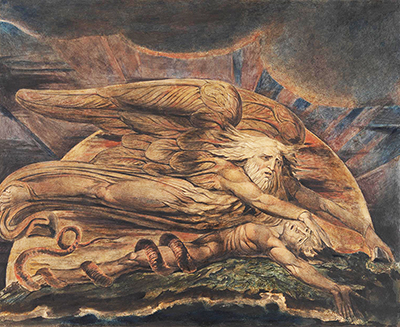
| Elohim Creating Adam | 1795–c.1805 | Colour print |
| Enoch | 1806–7 | Lithograph |
| Epitome of James Hervey’s ‘Meditations among the Tombs’ | c.1820–5 | Watercolour |
| Europe. A Prophecy; Frontispiece | ca. 1820 | Relief etching |
| Evening | c.1820/1825 | Watercolour |
| Every Man also Gave him a Piece of Money | 1825, reprinted 1874 | Engraving |
| Every Man also Gave him a Piece of Money. Verso: God the Father with Attendant Angels | c.1821–3 | Watercolour |
| Every One also Gave Him a Piece of Money | 1826 | Engraving |
| Fertilization of Egypt, from Erasmus Darwin's "The Botanic Garden" | 1791 | Engraving |
| First Book of Urizen pl. 10 | 1796, c.1818 | Etching |
| First Book of Urizen pl. 11 | 1796, c.1818 | Etching |
| First Book of Urizen pl. 15 | 1796, c.1818 | Etching |
| First Book of Urizen pl. 17 | 1796, c.1818 | Etching |
| First Book of Urizen pl. 21 | 1796, c.1818 | Etching |
| First Book of Urizen pl. 6 | 1796, c.1818 | Etching |
| Frontispiece to Jerusalem, the Emanation of the Great Albion | [ca. 1804–20] (?) | Engraving |
| Frontispiece to ‘Visions of the Daughters of Albion’ | c.1795 | Relief etching |
| Frontispiece: Thenot and Colinet | c.1821, printed 1830 | Wood engraving |
| George Cumberland's Message Card | 1827 | Engraving |
| God Judging Adam | ca. 1795 | Relief etching |
| God Judging Adam | 1795 | Relief etching |
| Hiding of Moses, from "Remember Me!, or a Pocket Companion" | 1825 | Engraving |
| Homer and the Ancient Poets | 1824–7 | Watercolour |
| Illustration 1 to Milton’s On the Morning of Christ’s Nativity: The Descent of Peace | c.1814–1816 | Watercolour |
| Illustration 1 to Milton’s Paradise Lost: Satan Calling Up His Legions | 1807 | Watercolour |
| Job accepting Charity | 1825–26 | Engraving |
| Job and his Daughters | 1825–26 | Engraving |
| Job and his Daughters | 1825, reprinted 1874 | Engraving |
| Job and His Daughters | 1826 | Engraving |
| Job and His Family | 1825–26 | Engraving |
| Job and his Family | Reprinted 1874; engraved 1828 date is an error | Engraving |
| Job and His Family | 1826 | Engraving |
| Job and his Family Restored to Prosperity | 1825, reprinted 1874 | Engraving |
| Job and his Wife restored to Prosperity | 1825–26 | Engraving |
| Job rebuked by his Friends | 1825–26 | Engraving |
| Job Rebuked by his Friends | 1825, reprinted 1874 | Engraving |
| Job Rebuked by His Friends | 1826 | Engraving |
| Job's Comforters | 1825–26 | Engraving |
| Job's Comforters | 1826 | Engraving |
| Job's Despair | 1825–26 | Engraving |
| Job's Evil Dreams | 1825–26 | Engraving |
| Job's Evil Dreams | 1826 | Engraving |
| Job's Sacrifice | 1825–26 | Engraving |
| Job's Sons and Daughters Overwhelmed by Satan | 1826 | Engraving |
| Job, his Wife and his Friends: The Complaint of Job. Verso: Job’s Wife and Eight Other Sketches | c.1785 | Watercolour |
| Job’s Comforters | 1825, reprinted 1874 | Engraving |
| Job’s Despair | 1825, reprinted 1874 | Engraving |
| Job’s Evil Dreams | 1825, reprinted 1874 | Engraving |
| Job’s Sacrifice | 1825, reprinted 1874 | Engraving |
| Job’s Sons and Daughters Overwhelmed by Satan | 1825, reprinted 1874 | Engraving |
| John Linnell | 1825 | Pencil drawing |
| Joseph of Arimathea Preaching to the Britons | c.1794/1796 | Relief etching |
| Judas Betrays Him | c.1803–5 | Watercolour |
| King John Absolved by Pandulph (after Henry Fuseli) | 1797, published 1798 | Etching and engraving |
| Lamech and his Two Wives | 1795 | Colour print |
| Landscape near Felpham | c.1800 | Watercolour |
| Lear and Cordelia in Prison | c.1779 | Watercolour |
| Los and Orc | c.1792–3 | Watercolour |
| Lower Half of a Woman Playing a Harp. Verso: Seraphim and Other Drawings | c.1785, c.?1807 | Pencil drawing |
| Menalcus Watching Women Dance, from Thornton's "Pastorals of Virgil" | 1821 | Wood engraving |
| Menalcus Watching Women Dance, from Thornton's "Pastorals of Virgil" | 1821 | Wood engraving |
| Moses Indignant at the Golden Calf | c.1799–1800 | Tempera |
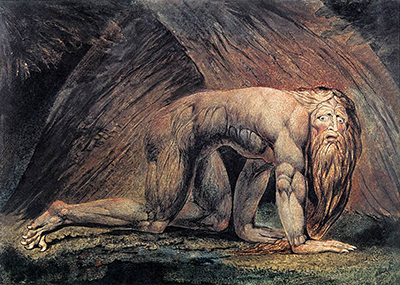
| Nebuchadnezzar | 1795–c.1805 | Colour print |
| Newton | 1795–c.1805 | Colour print |
| Oberon, Titania and Puck with Fairies Dancing | c.1786 | Watercolour |
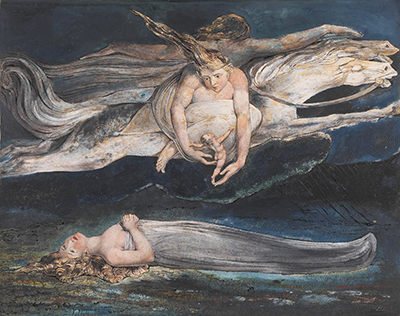
| Pity | ca. 1795 | Relief etching |
| Pity | c.1795 | Colour print |
| Plate 2 of ‘Urizen’: ‘Teach these Souls to Fly’ | ?1796 | Relief etching |
| Plate 3 of ‘Urizen’: Oh! Flames of Furious Desires’ (after William Blake) | Date not stated | Watercolour |
| Plate 4 of ‘Visions of the Daughters of Albion’ | c.1795 | Relief etching |
| Plutus | 1824–7 | Watercolour |
| Preliminary Sketch for ‘Christ Girding Himself with Strength’. Verso: Standing Figure with One Arm Raised | c.1805, c.1805–10 | Pencil drawing |
| Preludium. "The shadowy daughter of Urthona stood before red Orc..." (Plate 3) | 1793 | Relief etching |
| Queen Elizabeth and Essex (after Henry Fuseli) | 1797, published 1798 | Engraving |
| Sabrina's Silvery Flood, from Thornton's "Pastorals of Virgil" | 1821 | Wood engraving |
| Sabrina's Silvery Flood, from Thornton's "Pastorals of Virgil" | 1821 | Wood engraving |
| Sabrina’s Silvery Flood | c.1821, printed 1830 | Wood engraving |
| Sabrina’s Silvery Flood | 1821, reprinted 1977 | Wood engraving |
| Satan Before the Throne of God | 1825–26 | Engraving |
| Satan before the Throne of God | 1825, reprinted 1874 | Engraving |
| Satan before the Throne of God | 1826 | Engraving |
| Satan calling up his Legions | c.1800–05 | Tempera |
| Satan Exulting over Eve | c.1795 | Colour print |
| Satan Going Forth from the Presence of the Lord, and Job’s Charity | 1825, reprinted 1874 | Engraving |
| Satan Going Forth fron the Presence of the Lord | 1825–26 | Engraving |
| Satan in his Original Glory: ‘Thou wast Perfect till Iniquity was Found in Thee’ | c.1805 | Watercolour |
| Satan Smiting Job with Boils | 1825–26 | Engraving |
| Satan Smiting Job with Sore Boils | 1825, reprinted 1874 | Engraving |
| Satan Smiting Job with Sore Boils | c.1826 | Tempera |
| Satan Smiting Job with Sore Boils | 1826 | Engraving |
| Shepherd Chases Away a Wolf, from Thornton's "Pastorals of Virgil" | 1821 | Wood engraving |
| Shepherd Chases Away a Wolf, from Thornton's "Pastorals of Virgil" | 1821 | Wood engraving |
| Sketch for the Title-Page of the Engraved Illustrations to the Book of Job | c.1823/1826 | Pencil drawing |
| Sketch for ‘The Four and Twenty Elders Casting their Crowns before the Divine Throne’. Verso: Standing Figure with Arms at his Side | c.1803, c.1805–10 | Pencil drawing |
| Sketch for ‘Tiriel Supporting the Dying Myratana’. Verso: Sketch for ‘Tiriel Supporting the Dying Myratana’ | c.1786–9 | Pencil drawing |
| Songs of Experience: A Little Boy Lost | [1794] printed ca. 1825 | Relief etching |
| Songs of Experience: A Little Girl Lost | [1794] printed ca. 1825 | Relief etching |
| Songs of Experience: A Poison Tree | [1794] printed ca. 1825 | Relief etching |
| Songs of Experience: Earth's Answer | [1794] printed ca. 1825 | Relief etching |
| Songs of Experience: Frontispiece | [1794] printed ca. 1825 | Relief etching |
| Songs of Experience: Holy Thursday | [1794] printed ca. 1825 | Relief etching |
| Songs of Experience: Infant Sorrow | [1794] printed ca. 1825 | Relief etching |
| Songs of Experience: Introduction | [1794] printed ca. 1825 | Relief etching |
| Songs of Experience: London | [1794] printed ca. 1825 | Relief etching |
| Songs of Experience: My Pretty Rose Tree, Ah! Sun-Flower, The Lilly | [1794] printed ca. 1825 | Relief etching |
| Songs of Experience: Nurses Song | [1794] printed ca. 1825 | Relief etching |
| Songs of Experience: The Angel | [1794] printed ca. 1825 | Relief etching |
| Songs of Experience: The Chimney Sweeper | [1794] printed ca. 1825 | Relief etching |
| Songs of Experience: The Clod & the Pebble | [1794] printed ca. 1825 | Relief etching |
| Songs of Experience: The Fly | [1794] printed ca. 1825 | Relief etching |
| Songs of Experience: The Garden of Love | [1794] printed ca. 1825 | Relief etching |
| Songs of Experience: The Human Abstract | [1794] printed ca. 1825 | Relief etching |
| Songs of Experience: The Little Girl Found (second plate) | [1789] printed ca. 1825 | Relief etching |
| Songs of Experience: The Little Girl Lost | [1789] printed ca. 1825 | Relief etching |
| Songs of Experience: The Little Girl Lost (second plate); The Little Girl Found | [1789] printed ca. 1825 | Relief etching |
| Songs of Experience: The Little Vagabond | [1794] printed ca. 1825 | Relief etching |
| Songs of Experience: The School Boy | [1789] printed ca. 1825 | Relief etching |
| Songs of Experience: The Sick Rose | [1794] printed ca. 1825 | Relief etching |
| Songs of Experience: The Tyger | [1794] printed ca. 1825 | Relief etching |
| Songs of Experience: The Voice of the Ancient Bard | [1789] printed ca. 1825 | Relief etching |
| Songs of Experience: Title-page | [1794] printed ca. 1825 | Relief etching |
| Songs of Experience: To Tirzah | [1794] printed ca. 1825 | Relief etching |
| Songs of Innocence and of Experience, Shewing the Two Contrary States of the Human Soul: Combined Title-page | [1789–94] printed ca. 1825 | Relief etching |
| Songs of Innocence and of Experience: Infant Sorrow | 1794, reprinted 1831 or later | Relief etching |
| Songs of Innocence: A Cradle Song | [1789] printed ca. 1825 | Relief etching |
| Songs of Innocence: A Cradle Song (second plate) | [1789] printed ca. 1825 | Relief etching |
| Songs of Innocence: A Dream | [1794] printed ca. 1825 | Relief etching |
| Songs of Innocence: Frontispiece | [1789] printed ca. 1825 | Relief etching |
| Songs of Innocence: Holy Thursday | [1789] printed ca. 1825 | Relief etching |
| Songs of Innocence: Infant Joy | [1789] printed ca. 1825 | Relief etching |
| Songs of Innocence: Introduction | [1789] printed ca. 1825 | Relief etching |
| Songs of Innocence: Laughing Song | [1789] printed ca. 1825 | Relief etching |
| Songs of Innocence: Little Boy Lost | [1789] printed ca. 1825 | Relief etching |
| Songs of Innocence: Night | [1789] printed ca. 1825 | Relief etching |
| Songs of Innocence: Night (second plate) | [1789] printed ca. 1825 | Relief etching |
| Songs of Innocence: Nurse's Song | [1789] printed ca. 1825 | Relief etching |
| Songs of Innocence: On Anothers Sorrow | [1789] printed ca. 1825 | Relief etching |
| Songs of Innocence: Spring | [1789] printed ca. 1825 | Relief etching |
| Songs of Innocence: Spring (second plate) | [1789] printed ca. 1825 | Relief etching |
| Songs of Innocence: The Blossom | [1789] printed ca. 1825 | Relief etching |
| Songs of Innocence: The Chimney Sweeper | [1789] printed ca. 1825 | Relief etching |
| Songs of Innocence: The Divine Image | [1789] printed ca. 1825 | Relief etching |
| Songs of Innocence: The Ecchoing Green | [1789] printed ca. 1825 | Relief etching |
| Songs of Innocence: The Ecchoing Green (second plate) | [1789] printed ca. 1825 | Relief etching |
| Songs of Innocence: The Lamb | [1789] printed ca. 1825 | Relief etching |
| Songs of Innocence: The Little Black Boy | [1789] printed ca. 1825 | Relief etching |
| Songs of Innocence: The Little Black Boy (second plate) | [1789] printed ca. 1825 | Relief etching |
| Songs of Innocence: The Little Boy Found | [1789] printed ca. 1825 | Relief etching |
| Songs of Innocence: The Shepherd | [1789] printed ca. 1825 | Relief etching |
| Songs of Innocence: Title Page | [1789] printed ca. 1825 | Relief etching |
| St Christopher, Copy from an Engraving? Verso:Part of a Face: Copy from a Plaster Cast: a Daughter of Niobe? | ?c.1779–80 | Pencil drawing |
| The Agony in the Garden | c.1799–1800 | Tempera |
| The Angel Appearing to Zacharias | 1799–1800 | Tempera |
| The Ascent of the Mountain of Purgatory | 1824–7 | Watercolour |
| The Baffled Devils Fighting | 1826–7, reprinted 1892 | Engraving |
| The Baffled Devils Fighting | 1826–7, reprinted 1968 | Engraving |
| The Bard, from Gray | ?1809 | Tempera |
| The Beggar's Opera, Act III | July 1, 1790 | Etching and engraving |
| The Beggar's Opera, Act III | July 1, 1790 | Engraving |
| The Beggar's Opera, Act III | 1790 | Engraving |
| The Blasphemer | c.1800 | Watercolour |
| The Blighted Corn | c.1821, printed 1830 | Wood engraving |
| The Blighted Corn | 1821, reprinted 1977 | Wood engraving |
| The Body of Abel Found by Adam and Eve | c.1826 | Tempera |
| The Body of Christ Borne to the Tomb | c.1799–1800 | Tempera |
| The Book of Job: Title Page | 1825 | Engraving |
| The Book of Thel pl. 6 | 1796, c.1818 | Etching |
| The Circle of Corrupt Officials: The Devils Mauling Each Other | ca. 1825–27 | Engraving |
| The Circle of Corrupt Officials: The Devils Tormenting Ciampolo | ca. 1825–27 | Engraving |
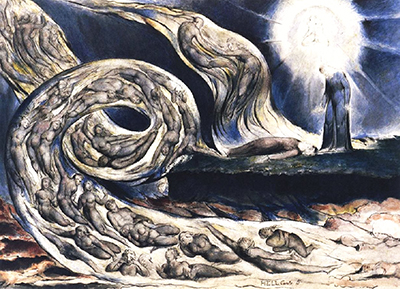
| The Circle of the Lustful: Francesca da Rimini (‘The Whirlwind of Lovers’) | 1826–7, reprinted 1892 | Engraving |
| The Circle of the Lustful: Francesca da Rimini (‘The Whirlwind of Lovers’) | 1826–7, reprinted 1968 | Engraving |
| The Circle of the Lustful: Paolo and Francesca | ca. 1825–27 | Engraving |
| The Circle of the Thieves; Buoso Donati Attacked by the Serpent | ca. 1825–27 | Engraving |
| The Circle of Traitors: Dante's Foot Striking Bocca degli Abbate | ca. 1825–27 | Engraving |
| The Complaint and the Consolation; or, Night Thoughts | 1797 | Etching and engraving |
| The Creation | 1825–26 | Engraving |
| The Crucifixion | c.1825–7 | Pencil drawing |
| The Crucifixion: ‘Behold Thy Mother’ | c.1805 | Watercolour |
| The Dance of Albion (Glad Day) | c.1803/1810 | Engraving |
| The Death of Lucretia, from Allen's "New and Impartial Roman History" | 1797 | Engraving |
| The Death of Saint Joseph | 1803 | Watercolour |
| The Death of the Virgin | 1803 | Watercolour |
| The Descent of Peace [recto] | c.1815 | Pencil drawing |
| The Destruction of Job's Sons | 1825–26 | Engraving |
| The Devils, with Dante and Virgil by the Side of the Pool | 1824–7 | Watercolour |
| The Entombment | c.1805 | Watercolour |
| The Fall of Rosamond (after Thomas Stothard) | 1783 | Etching and engraving |
| The Fall of Satan | 1825–26 | Engraving |
| The Fall of Satan | 1825, reprinted 1874 | Engraving |
| The Fall of Satan | 1826 | Engraving |
| The Four and Twenty Elders Casting their Crowns before the Divine Throne | c.1803–5 | Watercolour |
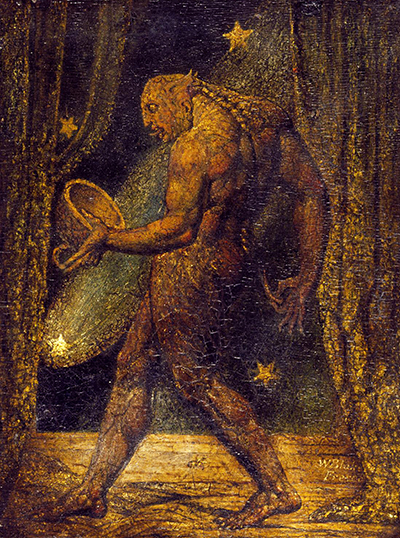
| The Ghost of a Flea | c.1819–20 | Tempera |
| The Good and Evil Angels | 1795–?c.1805 | Colour print |
| The Good Farmer, Probably the Parable of the Wheat and the Tares. Verso: Rough Sketch of Two or Three Figures in a Landscape | c.1780–5 | Watercolour |
| The Great Red Dragon and the Beast from the Sea | c.1805 | Watercolour |
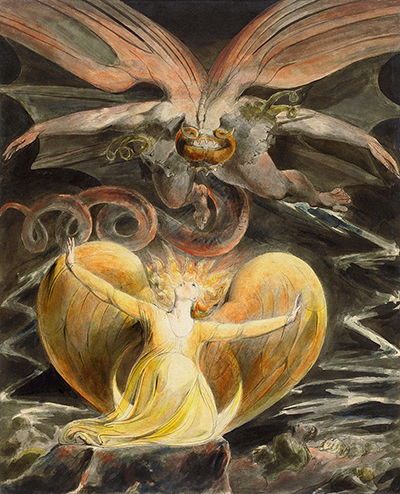
| The Great Red Dragon and the Woman Clothed with the Sun | c.1805 | Watercolour |
| The Head of the Ghost of a Flea. Verso: A Profile and a Reduced Drawing of Milton’s First Wife | c.1819 | Pencil drawing |
| The Hermit’s Dog, from William Hayley’s "Ballads" | 1805 | Etching and engraving |
| The Hiding of Moses | 1824 | Engraving |
| The House of Death | 1795–c.1805 | Colour print |
| The House of Death | c.1790 | Watercolour |
| The Hypocrites with Caiaphas. Verso: Sketch of a Stooping Figure | 1824–7 | Watercolour |
| The Inscription over the Gate | 1824–7 | Watercolour |
| The Laborious Passage along the Rocks | 1824–7 | Watercolour |
| The Last Trumpet (recto); Two studies of a right eye, a profile of an open-mouthed young man, the head of an eagle, and the head of a lion (verso) | 1780–85 | Pencil drawing |
| The Lord Answering Job out of the Whirlwind | 1825–26 | Engraving |
| The Lord Answering Job out of the Whirlwind | 1825, reprinted 1874 | Engraving |
| The Man Who Taught Blake Painting in his Dreams (counterproof) (after William Blake) | after c.1819–20 | Pencil drawing |
| The Marriage of Heaven and Hell pl. 16 | 1796, c.1818 | Etching |
| The Messengers tell Job of his Misfortunes | 1825–26 | Engraving |
| The Messengers tell Job of his Misfortunes | 1825, reprinted 1874 | Engraving |
| The Night of Enitharmon’s Joy (formerly called ‘Hecate’) | c.1795 | Colour print |
| The Parable of the Wise and Foolish Virgins | ca. 1799–1800 | Watercolour |
| The Parable of the Wise and Foolish Virgins (after William Blake) | Date not stated | Watercolour |
| The Pastorals of Virgil, with a Course of English Reading, Adapted for Schools, Vol. I | 1821 | Wood engraving |
| The Penance of Jane Shore in St Paul’s Church | c.1793 | Watercolour |
| The Pit of Disease: The Falsifiers | 1826–7, reprinted 1892 | Engraving |
| The Pit of Disease: The Falsifiers | 1824–7 | Watercolour |
| The Pit of Disease: The Falsifiers | 1826–7, reprinted 1968 | Engraving |
| The Primaeval Giants Sunk in the Soil | 1824–7 | Watercolour |
| The Punishment of the Thieves | 1824–7 | Watercolour |
| The Raising of Lazarus (after William Blake) | Date not stated | Watercolour |
| The Rest on the Flight into Egypt (The Repose of the Holy Family in Egypt) | 1806 | Watercolour |
| The River of Life | c.1805 | Watercolour |
| The Rock Sculptured with the Recovery of the Ark and the Annunciation | 1824–7 | Watercolour |
| The Serpent Attacking Buoso Donati | 1826–7, reprinted 1892 | Engraving |
| The Serpent Attacking Buoso Donati | 1826–7, reprinted 1968 | Engraving |
| The Serpent Attacking Buoso Donati. Verso: A Man with a Transparent Hood (?) over his Head | 1824–7 | Watercolour |
| The Simoniac Pope | 1824–7 | Watercolour |
| The Six-Footed Serpent Attacking Agnolo Brunelleschi | 1826–7, reprinted 1892 | Engraving |
| The Six-Footed Serpent Attacking Agnolo Brunelleschi | 1826–7, reprinted 1968 | Engraving |
| The Soul Hovering over the Body Reluctantly Parting with Life | c.1805 | Pencil drawing |
| The Spiritual Form of Nelson Guiding Leviathan | c.1805–9 | Tempera |
| The Spiritual Form of Pitt Guiding Behemoth | ?1805 | Tempera |
| The Sun at His Eastern Gate | c.1816–1820 | Watercolour |
| The Temple of Mirth, after Thomas Stothard | 1784 | Engraving |
| The Temptation and Fall of Eve | 1807 | Watercolour |
| The Temptation and Fall of Eve (Illustration to Milton’s Paradise Lost) | 1808 | Watercolour |
| The Thieves and Serpents | 1824–1827 | Watercolour |
| The Vision of Christ | 1825, reprinted 1874 | Engraving |
| The Vision of Eliphaz | 1825–26 | Engraving |
| The Vision of Eliphaz | 1825, reprinted 1874 | Engraving |
| The Vision of God | 1825–26 | Engraving |
| The Wood of the Self-Murderers: The Harpies and the Suicides | 1824–7 | Watercolour |
| The Wrath of Elihu | 1825–26 | Engraving |
| The Wrath of Elihu | 1825, reprinted 1874 | Engraving |
| Thenot and Colinet | 1821, reprinted 1977 | Wood engraving |
| Thenot and Colinet at Supper | c.1821, printed 1830 | Wood engraving |
| Thenot and Colinet at Supper | 1821, reprinted 1977 | Wood engraving |
| Thenot and Colinet Converse Seated between Two Trees | c.1821, printed 1830 | Wood engraving |
| Thenot and Colinet Converse Seated between Two Trees | 1821, reprinted 1977 | Wood engraving |
| Thenot and Colinet Eat Their Evening Meal, from Thornton's "Pastorals of Virgil" | 1821 | Wood engraving |
| Thenot and Colinet Folding their Flocks together at Sunset | c.1821, printed 1830 | Wood engraving |
| Thenot and Colinet Folding their Flocks together at Sunset | 1821, reprinted 1977 | Wood engraving |
| Thenot and Colinet Lead Their Flocks Together, from Thornton's "Pastorals of Virgil" | 1821 | Wood engraving |
| Thenot and Colinet Lead Their Flocks Together, from Thornton's "Pastorals of Virgil" | 1821 | Wood engraving |
| Thenot Remonstrates with Colinet | c.1821, printed 1830 | Wood engraving |
| Thenot Remonstrates with Colinet | 1821, reprinted 1977 | Wood engraving |
| Thenot Remonstrates With Colinet, from Thornton's "Pastorals of Virgil" | 1821 | Wood engraving |
| Thenot Remonstrates With Colinet, from Thornton's "Pastorals of Virgil" | 1821 | Wood engraving |
| Thenot Remonstrates with Colinet, Lightfoot in the Background, from Thornton's "Pastorals of Virgil" | 1821 | Wood engraving |
| Thenot Remonstrates with Colinet: Lightfoot in the Distance | 1821, reprinted 1977 | Wood engraving |
| Thenot Remonstrates with Colinet; Lightfoot in the Distance | c.1821, printed 1830 | Wood engraving |
| Thenot Under a Fruit Tree, from Thornton's "Pastorals of Virgil" | 1821 | Wood engraving |
| Thenot, with Colinet Waving his Arms in Sorrow | c.1821, printed 1830 | Wood engraving |
| Thenot, with Colinet Waving his Arms in Sorrow | 1821, reprinted 1977 | Wood engraving |
| Title Page: Illustrations of the Book of Job | 1825–26 | Engraving |
| Title-Page of ‘The Book of Job’ | 1825, reprinted 1874 | Engraving |
| Tornado–Zeus Battling Typhon, from Erasmus Darwin's "Botanic Garden" | August 1, 1795 | Engraving |
| Tornado–Zeus Battling Typhon, from Erasmus Darwin's "The Botanic Garden" | August 1, 1795 | Engraving |
| Two Figures in a Decorative Border | c.1790 | Pencil drawing |
| Unyok'd Heifers, Loitering Homeward (Return of the Shepherd), from Thornton's "Pastorals of Virgil" | 1821 | Wood engraving |
| Virgil Girding Dante’s Brow with a Rush | 1824–7 | Watercolour |
| Wat Tyler and the Tax-Gatherer (after Henry Fuseli) | 1797, published 1798 | Etching and engraving |
| When the Morning Stars Sang Together | 1825, reprinted 1874 | Engraving |
| When the Morning Stars Sang Together | 1826 | Engraving |
| Winged Figure Flying Through Clouds, from Bell's "Poets" | 1790 | Etching and engraving |
| Winter | c.1820–5 | Tempera |
| ‘A Rolling Stone is ever Bare of Moss’ | c.1821, printed 1830 | Wood engraving |
| ‘A Rolling Stone is ever Bare of Moss’ | 1821, reprinted 1977 | Wood engraving |
| ‘And Unyok’d Heifers, Loitering Homeward, Low’ | c.1821, printed 1830 | Wood engraving |
| ‘And Unyok’d Heifers, Loitering Homewards, Low’ | 1821, reprinted 1977 | Wood engraving |
| ‘Europe’: Fragment of Pages 3 and 4 | 1794–c.1830–5 | Relief etching |
| ‘For him Our Yearly Wakes and Feasts We Hold’ | c.1821, printed 1830 | Wood engraving |
| ‘For him Our Yearly Wakes and Feasts We Hold’ | 1821, reprinted 1977 | Wood engraving |
| ‘Nor Fox, nor Wolf, nor Rat among our Sheep’ | c.1821, printed 1830 | Wood engraving |
| ‘Nor Fox, nor Wolf, nor Rat among our Sheep’ | 1821, reprinted 1977 | Wood engraving |
| ‘Songs of Innocence and of Experience’: ‘Infant Sorrow’ | 1794, reprinted 1831 or later | Relief etching |
| ‘Songs of Innocence and of Experience’: ‘Spring’ | 1794, reprinted 1831 or later | Relief etching |
| ‘Songs of Innocence’: Title-Page | 1789, reprinted 1831 or later | Relief etching |
| ‘Songs of Innocence’: Title-Page | 1789, reprinted 1831 or later | Relief etching |
| ‘With Songs the Jovial Hinds Return from Plow’ | c.1821, printed 1830 | Wood engraving |
| ‘With Songs the Jovial Hinds Return from Plow’ | 1821, reprinted 1977 | Wood engraving |
Frequently Asked Questions
It was published in 1806, decades after the events. The essay treats it as valuable later testimony, probably informed by Blake. [3]
His 1779 registration followed the apprenticeship. He entered further education as someone who already possessed a trade. [7]
Discussion
Look again at the images and ideas explored in William Blake’s Early Life and Apprenticeship. These editorial prompts invite your observations.
Reader Insights
The supposed Sebert drawing brings artistic beginnings close to the workbench. Its antiquarian task is clearer than an unqualified attribution.
Monument recording required both the whole arrangement and details a small engraved image would need to preserve.
The Renaissance figure reached an apprentice through intermediary prints. Such chains made older invention available for new work.
Join the Conversation
Share a detail, comparison or question about William Blake’s Early Life and Apprenticeship below.
References
- Society of Antiquaries of London. “King Sebert (Westminster Abbey)”, LDSAL2025.37.1, current object record, attribution and inscriptions; image consulted through the preparatory drawings reproduced in the Vetusta Monumenta digital edition. Collection record; preparatory drawings. View source 1. View source 2.
- Crosby, Mark. “‘Unentangled in the intricate windings of modern practice’: William Blake’s Apprentice Copperplates and Engravings.” Blake/An Illustrated Quarterly 58.3 (Winter 2024–25). Complete text consulted via Distant Reader’s journal mirror. Article text; DOI. View source 1. View source 2.
- Malkin, Benjamin Heath. A Father’s Memoirs of His Child. London: Longman, Hurst, Rees, and Orme, 1806, dedicatory epistle, especially pp. xviii–xxii. Consulted in Arthur Symons, William Blake (1907), documentary appendix II, “From ‘A Father’s Memoirs of His Child’”. Primary-text reprint. View source.
- Blake, William. Autograph statement in William Upcott’s album, 16 January 1826. In David V. Erdman, ed., The Complete Poetry and Prose of William Blake, p. 698; digital text hosted by Arizona State University. Baptism cross-check: Arthur Symons, William Blake (1907), narrative chapter I, transcription of St James’s parish-register entries. Blake’s statement; Symons’s register transcription. View source 1. View source 2.
- Royal Collection Trust. “Recto: Joseph discovering himself; the brethren alarmed. Verso: Benjamin accepted as a hostage”, c.1780–85, RCIN 913599. Current object record and historical commentary, consulted in the complete indexed entry. Collection record. View source.
- Society of Antiquaries of London. “King Henry III (Westminster Abbey)”, LDSAL2025.37.2. Current object record, attribution, materials, inscriptions and apprenticeship commentary. Collection record. View source.
- Myrone, Martin. “William Blake as a Student of the Royal Academy: A Prosopographical Perspective.” Blake/An Illustrated Quarterly 51.2 (Fall 2017), introductory essay and biographical dictionary entry for William Blake, H358. Article and register transcription. View source.
- Gilchrist, Alexander. Life of William Blake, 1880 edition, vol. I, chapter II, “Childhood. 1757–71”, especially the Peckham Rye passage. Primary-text transcription. View source.
- Schuchard, Marsha Keith, and Keri Davies. “Recovering the Lost Moravian History of William Blake’s Family.” Blake/An Illustrated Quarterly 38.1 (Summer 2004), pp. 36–43, especially church-book entries on p. 39 and Catherine Armitage’s letter on pp. 40–41. Published article. View source.
- Nurse, Bernard. “Plates 2.29–2.35: Three Monuments in Westminster Abbey.” Vetusta Monumenta: Ancient Monuments, a Digital Edition. Plate descriptions, transcriptions and opening commentary on commissions, workshop attribution and publication. Scholarly edition. View source.
- Bodleian Libraries. “Engravings discovered on reverse of copper plates thought to be the earliest produced by William Blake”, 23 October 2024. Institutional announcement. View source.
- Fitzwilliam Museum. “Joseph of Arimathea among the Rocks of Albion”, P.391-1985. Current collection record: first state, 1773, source and handwritten inscription. Collection record. View source.
- Eaves, Morris, Robert N. Essick, and Joseph Viscomi, editors. “Publication: Blake’s Poetical Sketches.” William Blake Archive, 14 January 2021. Editorial account. View source.
- Blake, William. Letter to the Reverend John Trusler, 23 August 1799, postmarked 28 August. Erdman, pp. 702–703. Primary text. View source.