


 by Tom Gurney
Tom Gurney BSc (Hons) is an art history expert with over 20 years experience
Published on / Updated on
Email: tomgurney1@gmail.com / Phone: +44 7429 011000
William Blake’s Night Thoughts Illustrations: Introduction
A man lies awake beneath a page of poetry. His cloak covers almost his whole body, but his face remains exposed, turned towards us with an expression of exhaustion. Beside him, a small winged figure descends through a dark, starry space. The words occupy a rectangle above the man; the picture reaches around its edges. Reading and looking begin together, because Edward Young’s opening lines describe precisely the comfort the unhappy speaker cannot obtain: sleep visits the fortunate and leaves the wretched behind. Blake makes that abandonment visible. [1][2]
The scene belongs to one of the largest sustained undertakings of William Blake’s career. For Young’s Night Thoughts, he made 537 watercolour designs; forty-three compositions reached the engraved edition published in 1797. The scale can seem daunting, yet an individual page offers a direct entrance. Notice where a hand appears beside the text, where a body disappears behind it, or where a wing carries the eye away from the words. Blake’s margins give thought a place to move. [3]
The drawings and the printed book offer related experiences with important differences. The original designs surround actual pages from earlier editions of Young’s poem. The published engravings accompany newly printed text, with a changed arrangement of lines. Following a few pages closely reveals both the imaginative achievement and the practical decisions that shaped it. [4][5]
At a Glance
- Author of poemEdward Young [1][2]
- Published selectionFirst four Nights, 1797 [3][6]
- Illustrated countForty-three engravings: thirty-nine margins and four titles [3][6]
Contents
- Richard Edwards and an enormous commission
- Young’s complaint and his answer
- A page made larger
- Sleep leaves the unhappy
- Death beside the first Night’s title
- Narcissa and the encircling serpent
- Colour and the identity of a copy
- The incomplete published book
- The designs after the commission
- Following a page through the series
Richard Edwards and an enormous commission
The publisher Richard Edwards employed Blake during the middle of the 1790s to illustrate Young’s poem. Young had divided his work into nine sections, called Nights. Blake’s commission ultimately generated designs across the whole poem, while the edition that reached readers contained the first four Nights. The watercolours belong to the extensive drawn series; the engravings form a much smaller selection prepared for publication. [3][4][5]
A report from 1796 allows a glimpse of the work in progress. Joseph Farington recorded information received from Henry Fuseli about Blake surrounding each page of the poem with designs. As G. E. Bentley Jr. recounts the testimony, Blake had asked one hundred guineas for the watercolours, and Edwards offered twenty, which Blake accepted. The report reaches us through other people’s words; it nevertheless places the extraordinary labour beside a definite negotiation over payment. The commission was an arrangement between an artist and a bookseller, as well as an opportunity for imaginative invention. [4]
The plans also changed in their reported extent. Fuseli’s information, preserved in Farington’s diary and discussed by Bentley, envisaged about two hundred designs being selected for engraving. Bentley distinguishes that report from a prospectus specifying one hundred and fifty. Sir John Soane’s Museum describes the intended publication as four volumes. These figures record proposals, rather than plates we can assume Blake completed. The realised book contains forty-three illustrations and bears the date 1797. [3][4]
Its making required several kinds of work. Blake invented the designs and executed the illustrative plates; Richard Edwards was the publisher and R. Noble the printer. The Metropolitan Museum identifies the illustrations as etching and engraving. The book brought separately produced words and pictures into a common page, giving Blake a different set of conditions from the illuminated books in which his own writing and designs were worked together on the printing surface. Young’s existing poem had to remain readable within Blake’s new visual field. [7]
The commission placed unusual demands on an illustrator. Young’s speaker does recount particular losses, but much of the poem consists of reflection, persuasion and sudden metaphor. An artist following it page by page repeatedly encounters ideas instead of incidents. Time, memory, grief, friendship, mortality and divine love must acquire visible actions. Blake answers that challenge through bodies: a sleeper, an archer, a chained figure, an embracing pair, a person lifted or bent beneath a burden. The changing postures allow an argument to become something that can be seen. [2]
Young’s complaint and his answer
Young explains in his preface that the narrative is brief and the moral reflection occupies most of the poem. That is an excellent guide to its unusual movement. A memory of a dead friend opens into a consideration of time; a cry of distress becomes an accusation against worldly ambition; an image of the grave leads towards a claim about immortality. The poem does not proceed as a continuous adventure with a stable cast moving through successive locations. Its scenes arise within the speaker’s effort to think through loss. [2]
Night I begins with disturbed sleep and a wish for an end to suffering. The speaker then asks for wisdom, turning the darkness around him into a condition of mind as well as a time of day. When a bell strikes, its sound becomes an admonition about lost hours. Young repeatedly changes scale: an individual awake at night considers the condition of humanity, the fate of empires and the limits of earthly existence. A personal wound becomes the beginning of a much wider argument. [2]
The violence of that argument should remain audible. The speaker imagines Death as an archer who has struck him repeatedly. He looks back on pleasures that now cause pain because their companions have disappeared. He also enlarges grief into sympathy for others: miners deprived of daylight, people condemned to the oar, wounded soldiers, the sick and those refused charity. The poem’s concern with death includes sharp attention to the injuries people suffer while alive. Its consolation develops amid that pressure. [2]
Young addresses Lorenzo as someone who needs to learn how to live. In the opening of Night II, mourning becomes a question of conduct: professing sorrow for a friend has little value if the survivor’s life ignores what that friend would wish. Time is treated as a resource that demands an account, and amusement as a possible means of evading thought. The speaker even acknowledges that he is preaching. His urgency comes from the conviction that an apparently ordinary hour has consequences beyond the life in which it is spent. [2]
Such passages help us approach Blake’s figures without immediately assigning them names from his own mythology. Young already supplies an abundance of personification. Time has wings and children; Death hunts, arrests and liberates; thoughts can travel, recoil or become prisoners. Blake’s images can intensify these figures of speech, rearrange their emphasis or give them an unexpected bodily form. Beginning with the nearby verse preserves the particular encounter between illustrator and author. It also leaves room to ask where the image becomes more complicated than the verbal instruction. [2]
The broad movement is from complaint towards Christian assurance, but it repeatedly passes through fear and anger. In Night III, the speaker grieves for Narcissa and denounces the religious hostility that denied her a grave. Later in the same Night he presents death as release from confinement, even as the loss remains painful. A reader therefore meets changing descriptions of death within one sustained argument. Blake’s varied Death figures respond to a poem that can make the same power terrifying in one passage and welcome in another. [2]
A page made larger
The original watercolours began with an unusual physical arrangement. Pages of Young’s printed poem were mounted within much larger sheets, leaving broad areas for Blake’s inventions. The visible rectangle of type belongs to an older book; the surrounding drawing gives it a new scale and setting. On the opening page, even an ornamental heading from that earlier printing remains inside the text area. Blake’s work changes the conditions under which those familiar words can be encountered. [1][4]
Luisa Calè describes this construction as a composite page, drawing attention to its different papers, the red ruled boundary and the off-centre text window. In the 1797 edition, the words were reset more closely, and some illustrated lines moved onto a preceding page. Her account makes a useful practical point: the relationship between a design and its verbal prompt can change during the making of the book. The printed page is a new arrangement of the drawing’s elements. [5]
The opening watercolour makes the unequal spaces especially productive. The narrow area on the left accommodates a thin ascending plant. The wider right margin becomes a dark passage for the winged figure. Below, the recumbent man stretches almost the width of the whole image. Each part of the surround has a different task. The rectangle establishes a regular field for reading, while the asymmetry around it gives Blake several directions in which to develop the scene. [1]
This is also a question of apparent scale. The wakeful man has a head large enough for his expression to register immediately. Sleep appears smaller, farther away and moving independently. The printed lines between them are neither a landscape nor a neutral strip outside the picture. Their edges become part of the distance separating the figures. If the poetry were removed and replaced by an empty rectangle, much of the scene’s peculiar tension would remain, but its precise account of abandonment would become harder to recover. [1][2]
A reproduction cropped to one figure loses that relationship. Blake’s tiny personifications can be beautiful or strange in isolation, yet their placement around the words often supplies the action. A hand that seems oddly detached may belong to a body concealed behind the text. A curved form may carry the eye around a corner before revealing itself as a limb, a garment or an animal. The whole page provides the scale against which each fragment becomes intelligible. [1][7]
Sleep leaves the unhappy
In the original drawing for Night I, page 3, the man’s cloak sweeps from his raised head towards his feet in long pale folds. The fabric gathers his body into an almost continuous horizontal shape. His eyes, however, are open. The low position and enclosing cloth suggest rest, while the face denies its relief. Above him the older printed page introduces the poem, and behind that text a second pale recumbent form is partly visible at the top. Blake lets the words obscure as well as disclose. [1]
Sleep’s position on the right answers the opening passage more precisely than a general picture of someone sleeping would do. The figure is winged and inverted, passing headfirst through the darkness. Its long pale wings rise towards the top of the margin, while the arms reach downward. The pose gives movement to a power Young describes as selective in its visits. Sleep can arrive elsewhere; the suffering speaker remains where he is. The stillness of one body and movement of the other make the missed encounter legible. [1][2]
Young’s first seven lines already contain that difference between repose and waking misery. The speaker’s relief has been short and disturbed. On the next page, he imagines dreams following people even into the grave, then describes thought tossed through a sea of imagined misfortune. The poem does not allow sleep to remain a simple emblem of peace. It can fail to arrive, fail to last or bring its own torments. The first design introduces an uncertainty that the words immediately develop. [2]
The reverse of this original leaf, page 4, changes the visual register. A large grey and dark form rises around the rectangle of text, its head bent above the upper edge. Broad washes replace the more open ground of the previous scene. The words occupy a bright enclosed patch within the surrounding darkness. Seen together, the two sides move from an individual unable to sleep towards a more encompassing nocturnal presence. That observation concerns this particular leaf; it does not require every dark figure in the series to receive the same symbolic name. [1]
The engraved opening, page 1 of the 1797 edition, retains the wakeful man, the winged figure and the little plant, but the text area has changed substantially. In the coloured Yale reproduction, a large blank space separates the page number from the heading, while the poem continues much farther down than in the original mounted page. The earlier printer’s decorative headpiece has disappeared. The dark surround now accompanies additional lines about the speaker’s disturbed dreams and the relation of night to his distress. The same central invention receives a longer verbal setting. [8]
Colour gives the particular printed copy another character. The cloak appears lilac, a yellow passage lies near the man’s neck and chest, and green and ochre colour the low ground. The white wings remain sharply legible against the dark sky. Those colours belong to the reproduced impression we are looking at; they do not establish who coloured every copy. Comparing it with the original makes the distinction helpful: one can follow the continuity of the composition while noticing how a new surface alters its atmosphere. [1][8]
Death beside the first Night’s title
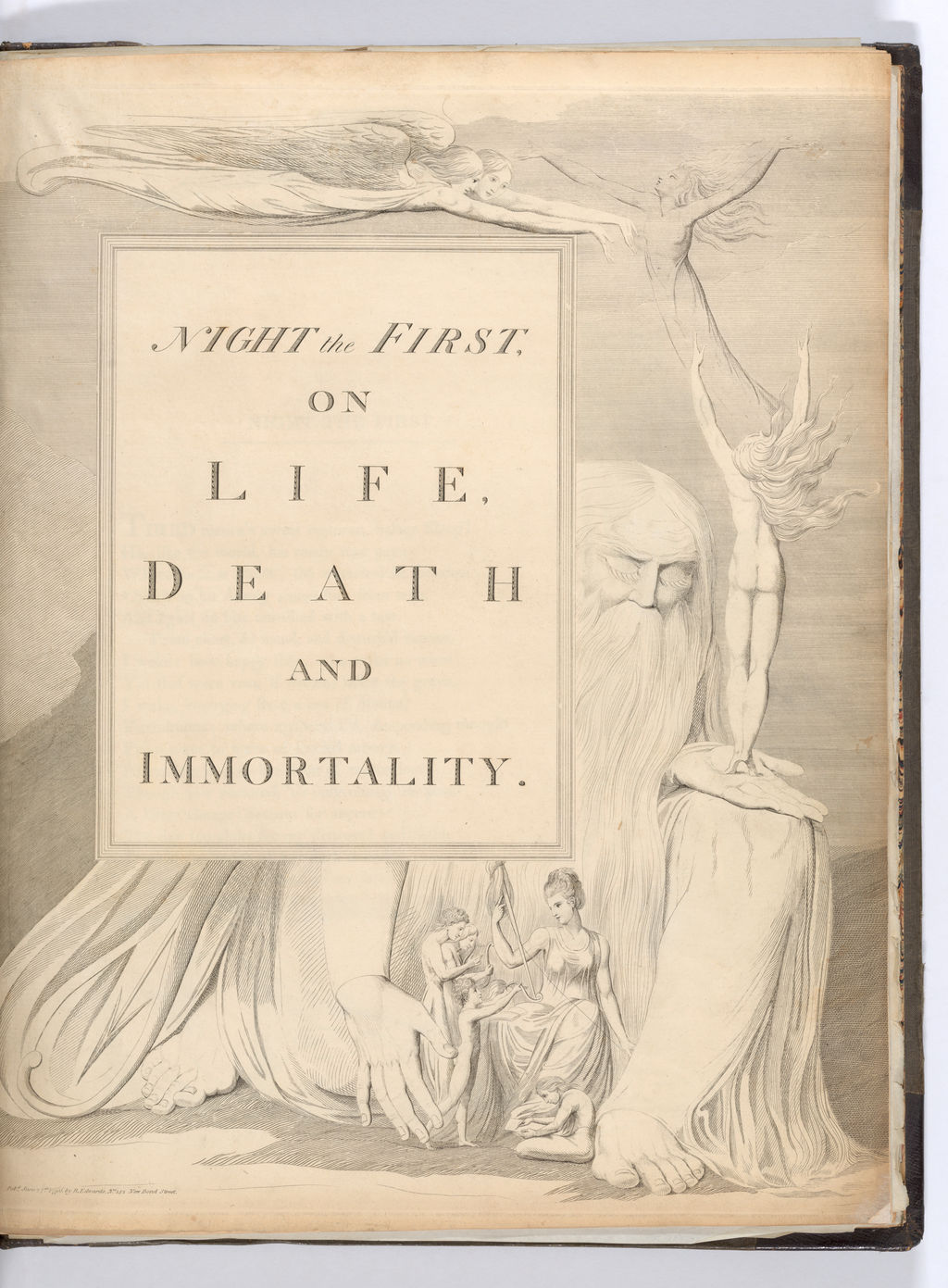
The engraved title to Night I gives the reader a much more monumental encounter. In the Metropolitan Museum’s copy, an immense bearded figure sits behind and beside the title panel. The face appears in the broad right margin; the beard descends towards the lower edge. One large hand reaches down near a much smaller standing child. Human life has entered a space governed by a body too large to be contained within the ordinary proportions of the page. [7]
The picture uses the title panel to make that immensity felt. Most of the seated figure’s torso is hidden. A foot emerges below the panel at the left, a knee and another foot occupy the lower right, and the head appears above them. We mentally connect these separated parts into a single body. The rectangle therefore does more than cover the figure. It encourages the viewer to imagine the missing extent, turning an interruption into an instrument of scale. [7]
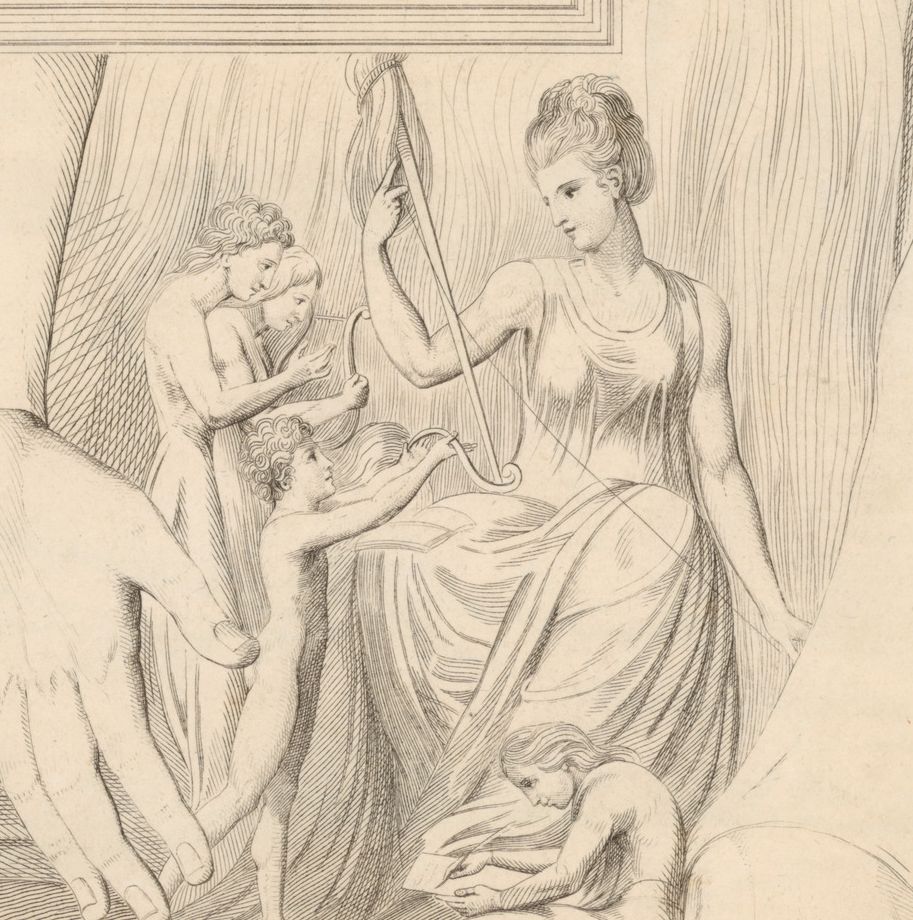
Below the title, a seated woman and small children form a compact group. Their delicate gestures and modest dimensions are exposed beside the enormous hands and feet. At the upper right, a pale female form rises from another standing woman, while flying figures reach towards her from above the panel. The composition makes the title’s three concerns—life, death and immortality—available as bodily relations: nurture below, an overwhelming presence around it and an upward passage at the side. [7]
Young’s Night I provides several ways to understand such changes of scale. Death can possess empires and stars, yet can also strike the private happiness of a household. The speaker’s protest asks why so vast a power should direct repeated attacks against one small human life. Elsewhere he argues that the grave opens towards a fuller existence. The title design brings these unlike measures into a single page. Its giant and its tiny family can be read against the poem’s movement between universal power and particular grief. [2][7]
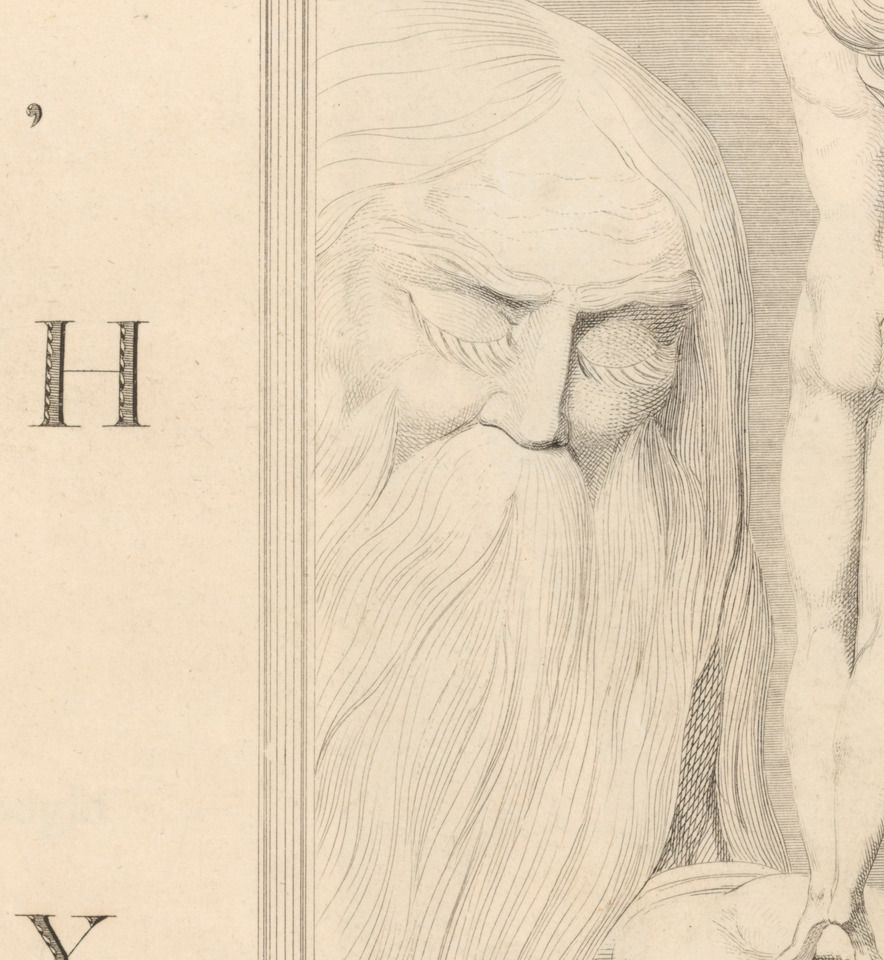
The old figure’s downcast gaze also complicates the encounter. There is no need to imagine a simple monster triumphantly attacking its victims. His closed or lowered eyes and long falling beard make him seem withdrawn within his immense occupation of the page. The active exchange takes place among the smaller figures above and below him. Looking first at the face, then at the raised arms near the top corner, changes the emotional centre of the image. [7]
This is one reason a quick caption can be insufficient. Identifying a personification begins a reading, but the figure’s size, posture and relation to the text shape what the personification does. Death’s presence may surround the world of the little family without exhausting the possibilities shown above it. The page can hold the fact of separation and a promise of passage together, much as Young’s poem keeps returning to both pain and assurance. [2][7]
Annotated Details from Looking around the First Night’s Title
These details show the engraved title to Night I in the Metropolitan Museum of Art’s 1797 edition, 2021.164.2. The enormous figure, smaller bodies and title panel make the page’s differences of scale visible. This printed book is distinct from Blake’s original watercolour designs.
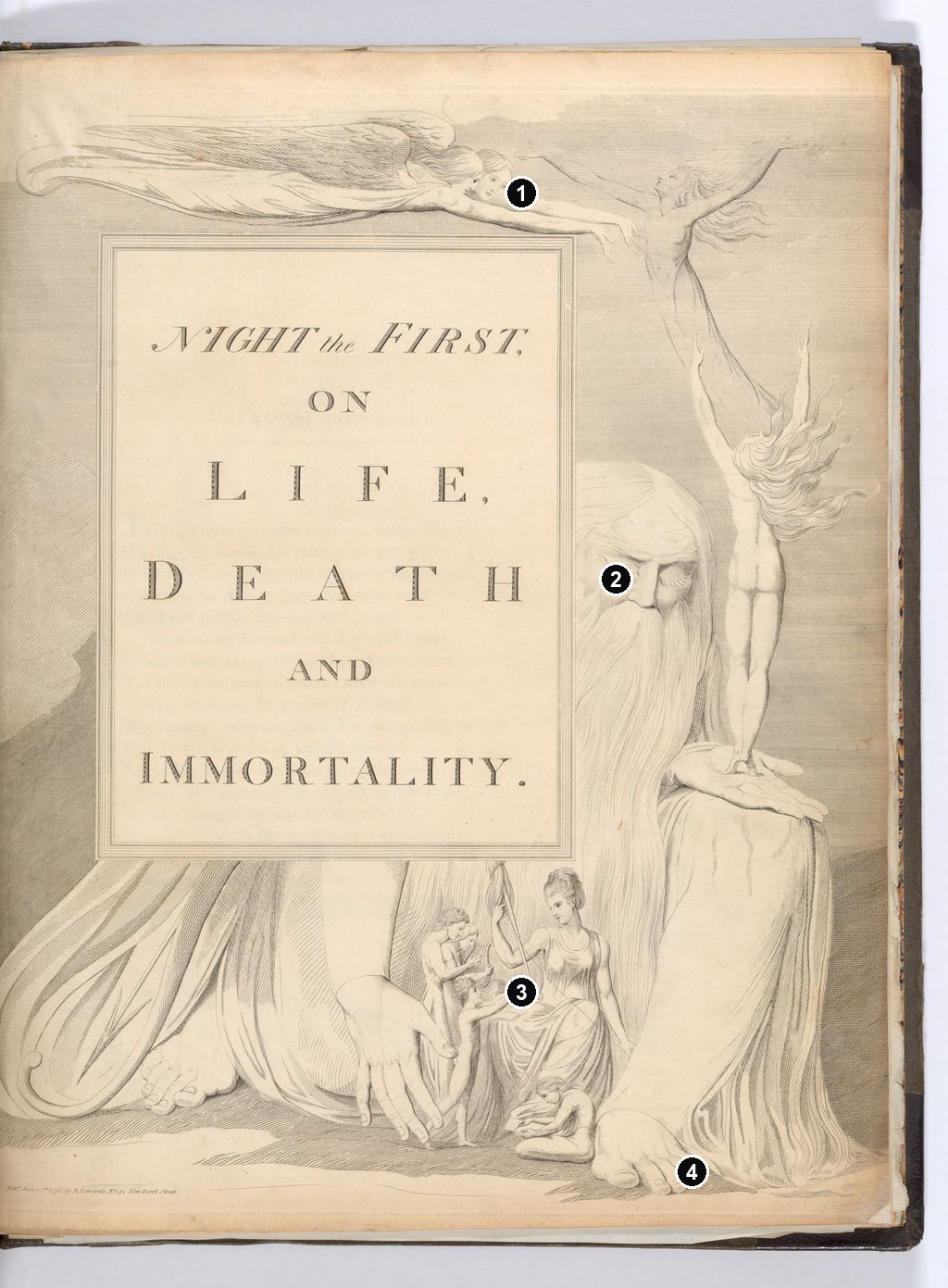
Details from LOOKING AROUND THE FIRST NIGHT’S TITLE
Move between the surrounding bodies and the rectangle of words, then return to the complete page.
The reaching figures above the title
Flying figures stretch along the upper edge of the title. Their extended arms carry movement towards the bodies in the right margin.

The immense face and beard
A downcast face emerges beside the printed rectangle. Long lines carry the beard towards the smaller figures below.
Small figures below the words
The little group occupies the space beside an enormous hand. The difference in scale makes the surrounding body feel larger than the page can contain.
The foot below the panel
A foot emerges below the words while the torso remains concealed. Following these separated parts asks the viewer to imagine the extent of one enormous body.
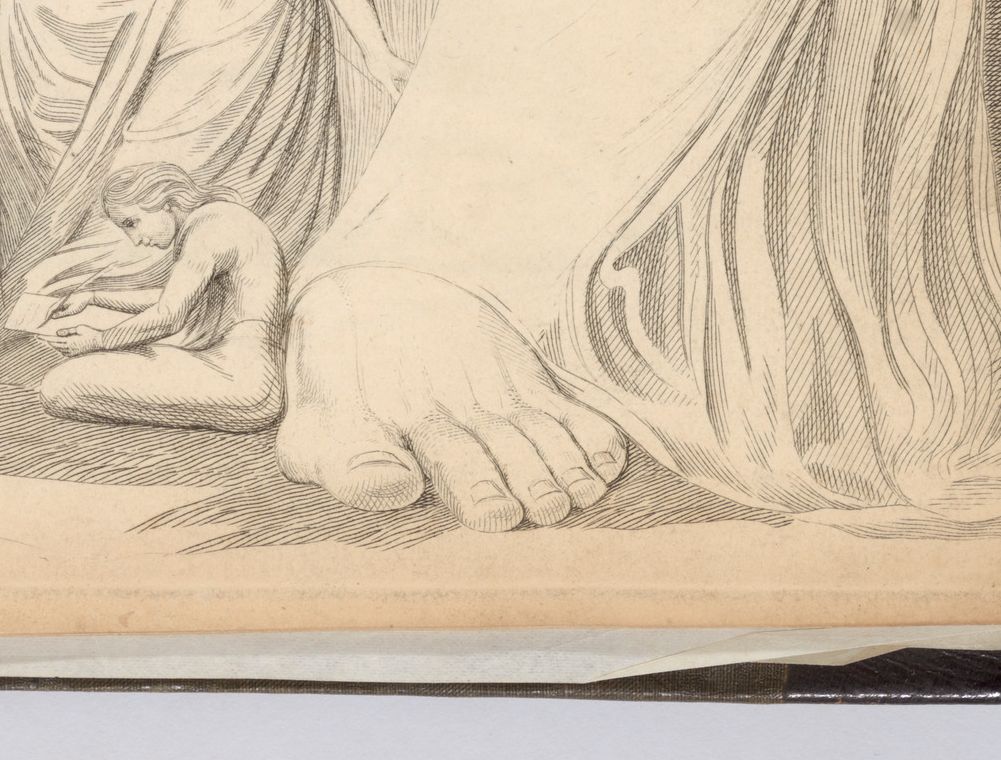
Image: The Metropolitan Museum of Art, 2021.164.2. Numbered overview and detail crops from the collection’s original image. Collection record · CC0 1.0
Watch: William Blake’s world and working methods
Choose an introduction to Blake, a printing demonstration, or a discussion of his radical ideas.
William Blake: Poet, Artist & Visionary - a genius of early Romanticism in England
An introduction to Blake’s art, poetry and imaginative world.
Watch on YouTubeNarcissa and the encircling serpent
The title to Night III makes an arresting comparison between drawing and engraving. In the original watercolour, a huge serpent curls around the upper and left sides of the mounted title. Its patterned body loops beneath the lower corner, and its head reaches across the bottom towards a kneeling woman. She bends back and stretches an arm into a field of light. The text panel occupies a substantial part of the serpent’s coil, as though the animal could continue behind it. [9]
The old title page remains visible within that construction, including its dedication, printer’s ornament and statement that it is a second edition. Those details identify the printed object that Blake has surrounded. They also create a remarkable meeting of scales: an earlier publisher’s small ornamental device sits inside a new picture occupied by a colossal animal. The calm alignment of the type persists amid a scene of bodily danger and upward appeal. [9]
The Metropolitan Museum’s uncoloured engraving preserves the major arrangement while transforming its surface. The woman’s sweeping drapery spreads across the lower part of the page; the serpent’s open mouth lies beneath her. Repeated engraved marks distinguish its dark patterned body from her pale limbs and flowing cloth. The snake’s topmost loop arches behind the title. In the absence of the original’s strong yellow, red and green passages, light and darkness carry more of the encounter. [7][9]
The title names Narcissa, whose death is the subject of Young’s third Night. The poem begins with another awakening from dreams, then accumulates losses: Narcissa follows Philander before grief for him has settled. Young remembers her youth, beauty, song and happiness, and recalls the attempt to take her towards a warmer climate. That effort fails. The pressure of the passage comes from the collision of tenderness with the inability to preserve the person loved. [2]
The following account turns outward in anger. People who pity Narcissa nevertheless deny her burial, and the speaker condemns religious zeal that has hardened their hearts. He describes a stolen grave and his own fearfulness in performing the burial. Read in this context, a woman confronting an encompassing danger need not be reduced to an abstract lesson about the soul. The Night begins with a particular lost person and asks how human cruelty compounds bereavement. Blake’s title brings bodily vulnerability before the reader even before that account unfolds. [2][9]
Later, Young gathers Narcissa’s circumstances into a striking cluster of serpent imagery. Each circumstance is compared to an asp, their combined force to a many-headed affliction. Still later, he argues that death releases the soul from the confinement of earthly life. These passages provide relevant verbal company for Blake’s coil and the woman’s lifted arm. They do not require us to select one sentence as an exhaustive key. The design can introduce the Night’s encompassing danger while allowing the gesture towards light to carry another possibility. [2]
The difference between her raised hand and the serpent’s mouth is especially effective. One reaches beyond the immediate circuit of the body around her; the other opens within it. Her long garment crosses the lower foreground and partly separates her from the head below. The reader’s eye follows a circuit around the title, then finds a movement that resists that circuit. Blake turns the restricted space of a margin into the scene’s central difficulty: how can a figure surrounded by such a power move towards release? [7][9]
Colour and the identity of a copy
A coloured Night Thoughts engraving presents another set of decisions. Colour can distinguish a transparent spirit from a body, turn an uncertain shape into a plant or architectural support, and change the apparent depth of a surrounding space. It may also depart from the original watercolour. The existence of a drawing by Blake does not make every painted version of the engraved design an equally direct record of his intentions. Individual copies need individual attention. [10]
Michael J. Tolley’s study of the National Gallery of Victoria’s William à Beckett copy is particularly useful here. He identifies an unknown colourist whose scheme differs from the established groups of coloured copies. He also examines differing states of the Night II title, where the figure standing in Time’s lap was altered before the frequently encountered final state. Colouring and changes to the plate are distinct sources of variation. Tolley’s proposed explanations for editorial intervention remain hypotheses. [10]
That distinction changes the questions we ask. A green robe may identify the appearance of one copy without proving the date of its colouring. A more rounded body may reflect lines present in a particular plate state, paint applied to them, or both. Comparing copies becomes rewarding when we keep those possibilities open and identify the object before us. Identifying the copy gives those visible differences a firm setting. [10]
The original Narcissa title and the Met engraving offer an accessible starting point. Their continuity lies in the coil, panel, woman and lifted arm. Their differences include the physical old title sheet, the newly composed title lettering and the means by which the surrounding world becomes light or dark. Only after those visible distinctions have been established is it helpful to introduce another coloured impression. Otherwise several separate stages of making can collapse into one apparently authoritative image. [7][9]
The incomplete published book
The 1797 volume can be confusing when described in abbreviated form. It is a book containing the first four Nights of a nine-Night poem, with forty-three engraved illustrations. NYPL’s record makes the illustrated count more exact by identifying thirty-nine engravings in margins around letterpress text. The other four are the section titles. Neither forty-three illustrated compositions nor ninety-five numbered pages describes the full 537-design watercolour undertaking. A page, a Night, a drawing and a plate answer different questions. [3][6]
Nor should incompletion erase what was achieved. The published book sustains the illustrated surround across four sections with different emotional movements. Titles gather a Night’s concerns into a concentrated encounter; the marginal pictures accompany particular turns of speech. An opening page about sleep and a title about Narcissa do different work even when both rely on the central rectangle. Repetition of the format allows changes of scale, posture and mood to become unusually apparent. [1][7][8][9]
The reasons the enterprise stopped require care. Soane’s catalogue describes the volume as commercially unsuccessful. Bentley records that Edwards soon retired from bookselling and took a government position in Minorca. Those are useful pieces of publication history, but they do not supply a detailed balance sheet or a complete account of everyone’s decisions. The secure outcome is that the projected continuation did not appear. The surviving outcome leaves room for a more complex history of decisions and circumstances. [3][4]
The original drawings nevertheless survived together. Bentley traces their passage through the Edwards family and later collectors, recording that they remained bound in two volumes well into their later exhibition history. They were disbound by May 1928, and Frances White Emerson gave them to the British Museum in 1928. The circumstances remind us that the object now encountered as selected museum sheets once offered the repeated experience of turning pages through an extensive illustrated poem. [4]
That survival gives the unfinished commission an unusually rich legacy. We can compare a preparation with a printed result, and we can also encounter designs for portions of the poem that Blake never engraved. The wider series should be approached as an additional body of work, with its own changing imagery. The printed selection provides a manageable entrance, but it cannot stand for every solution Blake devised across the nine Nights. [3][4]
The designs after the commission
The project also continued within Blake’s own work. Calè follows his reuse of engraved Night Thoughts proofs in the manuscript of Vala, or The Four Zoas. Proofs lacking Young’s letterpress offered blank areas for new writing, and their rearrangement altered the relationship between the old designs and the poem they now accompanied. A page devised for a commercial edition became material for another act of composition. [5]
Blake returned to the illustration of a poem about death in The Grave, published in 1808. That book illustrates Robert Blair, and its plates were executed by Luigi Schiavonetti after Blake’s designs. It belongs to a separate undertaking, with another author, publisher and division of artistic labour. Similar subjects—death, bodily separation, resurrection and consolation—make comparison worthwhile, but a familiar theme does not identify a picture’s series. [11]
The same care helps when approaching Blake’s paintings and poetry. A biblical picture of Christ or a personification of Death need not belong to Young’s commission. Conversely, a Night Thoughts design can be an intense imaginative invention while remaining an illustration to another poet’s words. Holding author, page and object together allows the reader to enjoy those connections without losing the particular work being encountered.
Following a page through the series
A rewarding way to begin is to choose a complete page and read the adjacent passage before interpreting the surround. In the opening scene, notice the difference between a body lying down and a body enjoying sleep. On the first Night’s title, connect the giant’s separated hands, feet and head before considering the small family below. With Narcissa, follow the serpent around the panel, then look for the direction established by the woman’s arm. These are small acts of looking with large consequences. [1][7][9]
Next compare a drawing with an engraved version, keeping their page numbers separate. Look at the heading, the amount of verse and the place where the final line falls. Those ordinary details can explain why a figure seems more closely connected to the words in one version than in another. Finally, consider the colouring of the particular printed copy. A wash can clarify a body, thicken darkness or suggest an environment that the engraved outlines leave open. [1][5][8][10]
Blake’s Night Thoughts rewards that patient movement between verse and margin. Young makes grief unfold through arguments, appeals and changing metaphors; Blake gives those movements bodies and spatial relations. The surrounding image can protect the text, interrupt it, tower behind it or lead the eye beyond it. What begins as the illustration of a poem becomes an extended exploration of how a page can carry thought.
Works and designs directory
Browse separate works, impressions and book components. Dates distinguish versions; six Tate copies after Blake are labelled. These records are not a complete catalogue of unique designs.
| Name | Date | Medium |
|---|---|---|
| A Figure Standing in a Gothic Apse, perhaps the Empress Maud. Verso: Detailed Drawings for ‘The Empress Maud in Bed’ | c.1819 | Pencil drawing |
| A Rolling Stone Is Ever Bare of Moss, from Thornton's "Pastorals of Virgil" | 1821 | Wood engraving |
| A Title Page for The Grave | 1806 | Watercolour |
| A Vision of the Last Judgment | 1808 | Watercolour |
| A Vision: The Inspiration of the Poet (Elisha in the Chamber on the Wall) | c.1819–20? | Watercolour |
| Adam and the Beasts, Frontispiece to Hayley's "Ballads" | June 1, 1802 | Engraving |
| Age Teaching Youth | c.1785–90 | Watercolour |
| Alfred and the Neat-Herd’s Wife (after Henry Fuseli) | 1797, published 1798 | Etching and engraving |
| An Allegory of the Bible. Verso: The Shins of an Écorché Male Figure | c.1780–5, ?c.1780 | Watercolour |
| Angel of the Divine Presence Bringing Eve to Adam (The Creation of Eve: "And She Shall be Called Woman) (recto); Sketch for the same (verso) | ca. 1803 | Watercolour |
| Angel of the Revelation (Book of Revelation, chapter 10) | ca. 1803–5 | Watercolour |
| Antaeus setting down Dante and Virgil in the Last Circle of Hell | 1824–1827 | Watercolour |
| Bathsheba at the Bath | c.1799–1800 | Tempera |
| Beatrice Addressing Dante from the Car | 1824–7 | Watercolour |
| Behemoth and Leviathan | 1825–26 | Engraving |
| Behemoth and Leviathan | 1825, reprinted 1874 | Engraving |
| Behemoth and Leviathan | 1826 | Engraving |
| Blasted Trees and Flattened Crops, from Thornton's "Pastorals of Virgil" | 1821 | Wood engraving |
| Boy Returning Joyfully, with Plough and Oxen, from Thornton's "Pastorals of Virgil" | 1821 | Wood engraving |
| Boy Returning Joyfully, with Plough and Oxen, from Thornton's "Pastorals of Virgil" | 1821 | Wood engraving |
| Catherine Blake. Verso: A Man’s Head and Other Drawings | c.1805 | Pencil drawing |
| Cerberus | 1824–7 | Watercolour |
| Cerberus (second version) | 1824–1827 | Watercolour |
| Chaucer’s Canterbury Pilgrims | 1810, reprinted before 1881 | Engraving |
| Christ Appearing to His Disciples After the Resurrection | c.1795 | Colour print |
| Christ Appearing to the Apostles after the Resurrection | c.1795 | Watercolour |
| Christ Blessing the Little Children | 1799 | Tempera |
| Christ in the Carpenter’s Shop: The Humility of the Saviour (after William Blake) | Date not stated | Watercolour |
| Ciampolo the Barrator Tormented by the Devils | 1826–7, reprinted 1892 | Engraving |
| Ciampolo the Barrator Tormented by the Devils | 1826–7, reprinted 1968 | Engraving |
| Circle of Theives: Agnello Brunelleschi Attacked By a Six-Footed Serpent | ca. 1825–27 | Engraving |
| Clarence's Dream (Shakespeare, Richard III, Act 1, Scene 4) | 1774 | Etching and engraving |
| Colinet Mocked by Two Boys, from Thornton's "Pastorals of Virgil" | 1821 | Wood engraving |
| Colinet Rests by a Stream at Night | c.1821, printed 1830 | Wood engraving |
| Colinet Rests by a Stream at Night | 1821, reprinted 1977 | Wood engraving |
| Colinet with his Shepherd’s Pipe, Mocked by Two Boys | c.1821, printed 1830 | Wood engraving |
| Colinet with his Shepherd’s Pipe, Mocked by Two Boys | 1821, reprinted 1977 | Wood engraving |
| Colinet's Journey, Milestone Marked 'LXII Miles to London', from Thornton's "Pastorals of Virgil" | 1821 | Wood engraving |
| Colinet's Journey: Milestone Marked 'LXII Miles to London', from Thornton's "Pastorals of Virgil" | 1821 | Wood engraving |
| Colinet’s Fond Desire Strange Lands to Know | 1821, reprinted 1977 | Wood engraving |
| Colinet’s ‘Fond Desire Strange Lands to Know’ | c.1821, printed 1830 | Wood engraving |
| Composition Sketch for ‘The Fall of the Rebel Angels’? Verso: Standing Figure with Flaming Hair | ?c.1805–10 | Pencil drawing |
| Composition Sketch, Possibly a Subject from Dante. Verso: A Man Standing over a Figure Reclining on a Bed | ?1824–7, ?c.1800–10 | Pencil drawing |
| Composition Sketch. Verso: Standing Figure Holding a Spear | ?c.1805–10 | Pencil drawing |
| Dante and Virgil Approaching the Angel Who Guards the Entrance of Purgatory | 1824–7 | Watercolour |
| Dante and Virgil Penetrating the Forest | 1824–7 | Watercolour |
| Dante in the Empyrean, Drinking at the River of Light | 1824–7 | Watercolour |
| Dante running from the Three Beasts | 1824–1827 | Watercolour |
| Dante Striking against Bocca Degli Abati | 1826–7, reprinted 1892 | Engraving |
| Dante Striking Against Bocca degli Abati | 1826–7, reprinted 1968 | Engraving |
| David Delivered out of Many Waters | c.1805 | Watercolour |
| David Delivered out of Many Waters (after William Blake) | Date not stated | Watercolour |
| Detailed Drawings for ‘A Figure Standing in a Gothic Apse’ | 1819 | Pencil drawing |
| Elohim Creating Adam | 1795–c.1805 | Colour print |
| Enoch | 1806–7 | Lithograph |
| Epitome of James Hervey’s ‘Meditations among the Tombs’ | c.1820–5 | Watercolour |
| Europe. A Prophecy; Frontispiece | ca. 1820 | Relief etching |
| Evening | c.1820/1825 | Watercolour |
| Every Man also Gave him a Piece of Money | 1825, reprinted 1874 | Engraving |
| Every Man also Gave him a Piece of Money. Verso: God the Father with Attendant Angels | c.1821–3 | Watercolour |
| Every One also Gave Him a Piece of Money | 1826 | Engraving |
| Fertilization of Egypt, from Erasmus Darwin's "The Botanic Garden" | 1791 | Engraving |
| First Book of Urizen pl. 10 | 1796, c.1818 | Etching |
| First Book of Urizen pl. 11 | 1796, c.1818 | Etching |
| First Book of Urizen pl. 15 | 1796, c.1818 | Etching |
| First Book of Urizen pl. 17 | 1796, c.1818 | Etching |
| First Book of Urizen pl. 21 | 1796, c.1818 | Etching |
| First Book of Urizen pl. 6 | 1796, c.1818 | Etching |
| Frontispiece to Jerusalem, the Emanation of the Great Albion | [ca. 1804–20] (?) | Engraving |
| Frontispiece to ‘Visions of the Daughters of Albion’ | c.1795 | Relief etching |
| Frontispiece: Thenot and Colinet | c.1821, printed 1830 | Wood engraving |
| George Cumberland's Message Card | 1827 | Engraving |
| God Judging Adam | ca. 1795 | Relief etching |
| God Judging Adam | 1795 | Relief etching |
| Hiding of Moses, from "Remember Me!, or a Pocket Companion" | 1825 | Engraving |
| Homer and the Ancient Poets | 1824–7 | Watercolour |
| Illustration 1 to Milton’s On the Morning of Christ’s Nativity: The Descent of Peace | c.1814–1816 | Watercolour |
| Illustration 1 to Milton’s Paradise Lost: Satan Calling Up His Legions | 1807 | Watercolour |
| Job accepting Charity | 1825–26 | Engraving |
| Job and his Daughters | 1825–26 | Engraving |
| Job and his Daughters | 1825, reprinted 1874 | Engraving |
| Job and His Daughters | 1826 | Engraving |
| Job and His Family | 1825–26 | Engraving |
| Job and his Family | Reprinted 1874; engraved 1828 date is an error | Engraving |
| Job and His Family | 1826 | Engraving |
| Job and his Family Restored to Prosperity | 1825, reprinted 1874 | Engraving |
| Job and his Wife restored to Prosperity | 1825–26 | Engraving |
| Job rebuked by his Friends | 1825–26 | Engraving |
| Job Rebuked by his Friends | 1825, reprinted 1874 | Engraving |
| Job Rebuked by His Friends | 1826 | Engraving |
| Job's Comforters | 1825–26 | Engraving |
| Job's Comforters | 1826 | Engraving |
| Job's Despair | 1825–26 | Engraving |
| Job's Evil Dreams | 1825–26 | Engraving |
| Job's Evil Dreams | 1826 | Engraving |
| Job's Sacrifice | 1825–26 | Engraving |
| Job's Sons and Daughters Overwhelmed by Satan | 1826 | Engraving |
| Job, his Wife and his Friends: The Complaint of Job. Verso: Job’s Wife and Eight Other Sketches | c.1785 | Watercolour |
| Job’s Comforters | 1825, reprinted 1874 | Engraving |
| Job’s Despair | 1825, reprinted 1874 | Engraving |
| Job’s Evil Dreams | 1825, reprinted 1874 | Engraving |
| Job’s Sacrifice | 1825, reprinted 1874 | Engraving |
| Job’s Sons and Daughters Overwhelmed by Satan | 1825, reprinted 1874 | Engraving |
| John Linnell | 1825 | Pencil drawing |
| Joseph of Arimathea Preaching to the Britons | c.1794/1796 | Relief etching |
| Judas Betrays Him | c.1803–5 | Watercolour |
| King John Absolved by Pandulph (after Henry Fuseli) | 1797, published 1798 | Etching and engraving |
| Lamech and his Two Wives | 1795 | Colour print |
| Landscape near Felpham | c.1800 | Watercolour |
| Lear and Cordelia in Prison | c.1779 | Watercolour |
| Los and Orc | c.1792–3 | Watercolour |
| Lower Half of a Woman Playing a Harp. Verso: Seraphim and Other Drawings | c.1785, c.?1807 | Pencil drawing |
| Menalcus Watching Women Dance, from Thornton's "Pastorals of Virgil" | 1821 | Wood engraving |
| Menalcus Watching Women Dance, from Thornton's "Pastorals of Virgil" | 1821 | Wood engraving |
| Moses Indignant at the Golden Calf | c.1799–1800 | Tempera |
| Nebuchadnezzar | 1795–c.1805 | Colour print |
| Newton | 1795–c.1805 | Colour print |
| Oberon, Titania and Puck with Fairies Dancing | c.1786 | Watercolour |
| Pity | ca. 1795 | Relief etching |
| Pity | c.1795 | Colour print |
| Plate 2 of ‘Urizen’: ‘Teach these Souls to Fly’ | ?1796 | Relief etching |
| Plate 3 of ‘Urizen’: Oh! Flames of Furious Desires’ (after William Blake) | Date not stated | Watercolour |
| Plate 4 of ‘Visions of the Daughters of Albion’ | c.1795 | Relief etching |
| Plutus | 1824–7 | Watercolour |
| Preliminary Sketch for ‘Christ Girding Himself with Strength’. Verso: Standing Figure with One Arm Raised | c.1805, c.1805–10 | Pencil drawing |
| Preludium. "The shadowy daughter of Urthona stood before red Orc..." (Plate 3) | 1793 | Relief etching |
| Queen Elizabeth and Essex (after Henry Fuseli) | 1797, published 1798 | Engraving |
| Sabrina's Silvery Flood, from Thornton's "Pastorals of Virgil" | 1821 | Wood engraving |
| Sabrina's Silvery Flood, from Thornton's "Pastorals of Virgil" | 1821 | Wood engraving |
| Sabrina’s Silvery Flood | c.1821, printed 1830 | Wood engraving |
| Sabrina’s Silvery Flood | 1821, reprinted 1977 | Wood engraving |
| Satan Before the Throne of God | 1825–26 | Engraving |
| Satan before the Throne of God | 1825, reprinted 1874 | Engraving |
| Satan before the Throne of God | 1826 | Engraving |
| Satan calling up his Legions | c.1800–05 | Tempera |
| Satan Exulting over Eve | c.1795 | Colour print |
| Satan Going Forth from the Presence of the Lord, and Job’s Charity | 1825, reprinted 1874 | Engraving |
| Satan Going Forth fron the Presence of the Lord | 1825–26 | Engraving |
| Satan in his Original Glory: ‘Thou wast Perfect till Iniquity was Found in Thee’ | c.1805 | Watercolour |
| Satan Smiting Job with Boils | 1825–26 | Engraving |
| Satan Smiting Job with Sore Boils | 1825, reprinted 1874 | Engraving |
| Satan Smiting Job with Sore Boils | c.1826 | Tempera |
| Satan Smiting Job with Sore Boils | 1826 | Engraving |
| Shepherd Chases Away a Wolf, from Thornton's "Pastorals of Virgil" | 1821 | Wood engraving |
| Shepherd Chases Away a Wolf, from Thornton's "Pastorals of Virgil" | 1821 | Wood engraving |
| Sketch for the Title-Page of the Engraved Illustrations to the Book of Job | c.1823/1826 | Pencil drawing |
| Sketch for ‘The Four and Twenty Elders Casting their Crowns before the Divine Throne’. Verso: Standing Figure with Arms at his Side | c.1803, c.1805–10 | Pencil drawing |
| Sketch for ‘Tiriel Supporting the Dying Myratana’. Verso: Sketch for ‘Tiriel Supporting the Dying Myratana’ | c.1786–9 | Pencil drawing |
| Songs of Experience: A Little Boy Lost | [1794] printed ca. 1825 | Relief etching |
| Songs of Experience: A Little Girl Lost | [1794] printed ca. 1825 | Relief etching |
| Songs of Experience: A Poison Tree | [1794] printed ca. 1825 | Relief etching |
| Songs of Experience: Earth's Answer | [1794] printed ca. 1825 | Relief etching |
| Songs of Experience: Frontispiece | [1794] printed ca. 1825 | Relief etching |
| Songs of Experience: Holy Thursday | [1794] printed ca. 1825 | Relief etching |
| Songs of Experience: Infant Sorrow | [1794] printed ca. 1825 | Relief etching |
| Songs of Experience: Introduction | [1794] printed ca. 1825 | Relief etching |
| Songs of Experience: London | [1794] printed ca. 1825 | Relief etching |
| Songs of Experience: My Pretty Rose Tree, Ah! Sun-Flower, The Lilly | [1794] printed ca. 1825 | Relief etching |
| Songs of Experience: Nurses Song | [1794] printed ca. 1825 | Relief etching |
| Songs of Experience: The Angel | [1794] printed ca. 1825 | Relief etching |
| Songs of Experience: The Chimney Sweeper | [1794] printed ca. 1825 | Relief etching |
| Songs of Experience: The Clod & the Pebble | [1794] printed ca. 1825 | Relief etching |
| Songs of Experience: The Fly | [1794] printed ca. 1825 | Relief etching |
| Songs of Experience: The Garden of Love | [1794] printed ca. 1825 | Relief etching |
| Songs of Experience: The Human Abstract | [1794] printed ca. 1825 | Relief etching |
| Songs of Experience: The Little Girl Found (second plate) | [1789] printed ca. 1825 | Relief etching |
| Songs of Experience: The Little Girl Lost | [1789] printed ca. 1825 | Relief etching |
| Songs of Experience: The Little Girl Lost (second plate); The Little Girl Found | [1789] printed ca. 1825 | Relief etching |
| Songs of Experience: The Little Vagabond | [1794] printed ca. 1825 | Relief etching |
| Songs of Experience: The School Boy | [1789] printed ca. 1825 | Relief etching |
| Songs of Experience: The Sick Rose | [1794] printed ca. 1825 | Relief etching |
| Songs of Experience: The Tyger | [1794] printed ca. 1825 | Relief etching |
| Songs of Experience: The Voice of the Ancient Bard | [1789] printed ca. 1825 | Relief etching |
| Songs of Experience: Title-page | [1794] printed ca. 1825 | Relief etching |
| Songs of Experience: To Tirzah | [1794] printed ca. 1825 | Relief etching |
| Songs of Innocence and of Experience, Shewing the Two Contrary States of the Human Soul: Combined Title-page | [1789–94] printed ca. 1825 | Relief etching |
| Songs of Innocence and of Experience: Infant Sorrow | 1794, reprinted 1831 or later | Relief etching |
| Songs of Innocence: A Cradle Song | [1789] printed ca. 1825 | Relief etching |
| Songs of Innocence: A Cradle Song (second plate) | [1789] printed ca. 1825 | Relief etching |
| Songs of Innocence: A Dream | [1794] printed ca. 1825 | Relief etching |
| Songs of Innocence: Frontispiece | [1789] printed ca. 1825 | Relief etching |
| Songs of Innocence: Holy Thursday | [1789] printed ca. 1825 | Relief etching |
| Songs of Innocence: Infant Joy | [1789] printed ca. 1825 | Relief etching |
| Songs of Innocence: Introduction | [1789] printed ca. 1825 | Relief etching |
| Songs of Innocence: Laughing Song | [1789] printed ca. 1825 | Relief etching |
| Songs of Innocence: Little Boy Lost | [1789] printed ca. 1825 | Relief etching |
| Songs of Innocence: Night | [1789] printed ca. 1825 | Relief etching |
| Songs of Innocence: Night (second plate) | [1789] printed ca. 1825 | Relief etching |
| Songs of Innocence: Nurse's Song | [1789] printed ca. 1825 | Relief etching |
| Songs of Innocence: On Anothers Sorrow | [1789] printed ca. 1825 | Relief etching |
| Songs of Innocence: Spring | [1789] printed ca. 1825 | Relief etching |
| Songs of Innocence: Spring (second plate) | [1789] printed ca. 1825 | Relief etching |
| Songs of Innocence: The Blossom | [1789] printed ca. 1825 | Relief etching |
| Songs of Innocence: The Chimney Sweeper | [1789] printed ca. 1825 | Relief etching |
| Songs of Innocence: The Divine Image | [1789] printed ca. 1825 | Relief etching |
| Songs of Innocence: The Ecchoing Green | [1789] printed ca. 1825 | Relief etching |
| Songs of Innocence: The Ecchoing Green (second plate) | [1789] printed ca. 1825 | Relief etching |
| Songs of Innocence: The Lamb | [1789] printed ca. 1825 | Relief etching |
| Songs of Innocence: The Little Black Boy | [1789] printed ca. 1825 | Relief etching |
| Songs of Innocence: The Little Black Boy (second plate) | [1789] printed ca. 1825 | Relief etching |
| Songs of Innocence: The Little Boy Found | [1789] printed ca. 1825 | Relief etching |
| Songs of Innocence: The Shepherd | [1789] printed ca. 1825 | Relief etching |
| Songs of Innocence: Title Page | [1789] printed ca. 1825 | Relief etching |
| St Christopher, Copy from an Engraving? Verso:Part of a Face: Copy from a Plaster Cast: a Daughter of Niobe? | ?c.1779–80 | Pencil drawing |
| The Agony in the Garden | c.1799–1800 | Tempera |
| The Angel Appearing to Zacharias | 1799–1800 | Tempera |
| The Ascent of the Mountain of Purgatory | 1824–7 | Watercolour |
| The Baffled Devils Fighting | 1826–7, reprinted 1892 | Engraving |
| The Baffled Devils Fighting | 1826–7, reprinted 1968 | Engraving |
| The Bard, from Gray | ?1809 | Tempera |
| The Beggar's Opera, Act III | July 1, 1790 | Etching and engraving |
| The Beggar's Opera, Act III | July 1, 1790 | Engraving |
| The Beggar's Opera, Act III | 1790 | Engraving |
| The Blasphemer | c.1800 | Watercolour |
| The Blighted Corn | c.1821, printed 1830 | Wood engraving |
| The Blighted Corn | 1821, reprinted 1977 | Wood engraving |
| The Body of Abel Found by Adam and Eve | c.1826 | Tempera |
| The Body of Christ Borne to the Tomb | c.1799–1800 | Tempera |
| The Book of Job: Title Page | 1825 | Engraving |
| The Book of Thel pl. 6 | 1796, c.1818 | Etching |
| The Circle of Corrupt Officials: The Devils Mauling Each Other | ca. 1825–27 | Engraving |
| The Circle of Corrupt Officials: The Devils Tormenting Ciampolo | ca. 1825–27 | Engraving |
| The Circle of the Lustful: Francesca da Rimini (‘The Whirlwind of Lovers’) | 1826–7, reprinted 1892 | Engraving |
| The Circle of the Lustful: Francesca da Rimini (‘The Whirlwind of Lovers’) | 1826–7, reprinted 1968 | Engraving |
| The Circle of the Lustful: Paolo and Francesca | ca. 1825–27 | Engraving |
| The Circle of the Thieves; Buoso Donati Attacked by the Serpent | ca. 1825–27 | Engraving |
| The Circle of Traitors: Dante's Foot Striking Bocca degli Abbate | ca. 1825–27 | Engraving |
| The Complaint and the Consolation; or, Night Thoughts | 1797 | Etching and engraving |
| The Creation | 1825–26 | Engraving |
| The Crucifixion | c.1825–7 | Pencil drawing |
| The Crucifixion: ‘Behold Thy Mother’ | c.1805 | Watercolour |
| The Dance of Albion (Glad Day) | c.1803/1810 | Engraving |
| The Death of Lucretia, from Allen's "New and Impartial Roman History" | 1797 | Engraving |
| The Death of Saint Joseph | 1803 | Watercolour |
| The Death of the Virgin | 1803 | Watercolour |
| The Descent of Peace [recto] | c.1815 | Pencil drawing |
| The Destruction of Job's Sons | 1825–26 | Engraving |
| The Devils, with Dante and Virgil by the Side of the Pool | 1824–7 | Watercolour |
| The Entombment | c.1805 | Watercolour |
| The Fall of Rosamond (after Thomas Stothard) | 1783 | Etching and engraving |
| The Fall of Satan | 1825–26 | Engraving |
| The Fall of Satan | 1825, reprinted 1874 | Engraving |
| The Fall of Satan | 1826 | Engraving |
| The Four and Twenty Elders Casting their Crowns before the Divine Throne | c.1803–5 | Watercolour |
| The Ghost of a Flea | c.1819–20 | Tempera |
| The Good and Evil Angels | 1795–?c.1805 | Colour print |
| The Good Farmer, Probably the Parable of the Wheat and the Tares. Verso: Rough Sketch of Two or Three Figures in a Landscape | c.1780–5 | Watercolour |
| The Great Red Dragon and the Beast from the Sea | c.1805 | Watercolour |
| The Great Red Dragon and the Woman Clothed with the Sun | c.1805 | Watercolour |
| The Head of the Ghost of a Flea. Verso: A Profile and a Reduced Drawing of Milton’s First Wife | c.1819 | Pencil drawing |
| The Hermit’s Dog, from William Hayley’s "Ballads" | 1805 | Etching and engraving |
| The Hiding of Moses | 1824 | Engraving |
| The House of Death | 1795–c.1805 | Colour print |
| The House of Death | c.1790 | Watercolour |
| The Hypocrites with Caiaphas. Verso: Sketch of a Stooping Figure | 1824–7 | Watercolour |
| The Inscription over the Gate | 1824–7 | Watercolour |
| The Laborious Passage along the Rocks | 1824–7 | Watercolour |
| The Last Trumpet (recto); Two studies of a right eye, a profile of an open-mouthed young man, the head of an eagle, and the head of a lion (verso) | 1780–85 | Pencil drawing |
| The Lord Answering Job out of the Whirlwind | 1825–26 | Engraving |
| The Lord Answering Job out of the Whirlwind | 1825, reprinted 1874 | Engraving |
| The Man Who Taught Blake Painting in his Dreams (counterproof) (after William Blake) | after c.1819–20 | Pencil drawing |
| The Marriage of Heaven and Hell pl. 16 | 1796, c.1818 | Etching |
| The Messengers tell Job of his Misfortunes | 1825–26 | Engraving |
| The Messengers tell Job of his Misfortunes | 1825, reprinted 1874 | Engraving |
| The Night of Enitharmon’s Joy (formerly called ‘Hecate’) | c.1795 | Colour print |
| The Parable of the Wise and Foolish Virgins | ca. 1799–1800 | Watercolour |
| The Parable of the Wise and Foolish Virgins (after William Blake) | Date not stated | Watercolour |
| The Pastorals of Virgil, with a Course of English Reading, Adapted for Schools, Vol. I | 1821 | Wood engraving |
| The Penance of Jane Shore in St Paul’s Church | c.1793 | Watercolour |
| The Pit of Disease: The Falsifiers | 1826–7, reprinted 1892 | Engraving |
| The Pit of Disease: The Falsifiers | 1824–7 | Watercolour |
| The Pit of Disease: The Falsifiers | 1826–7, reprinted 1968 | Engraving |
| The Primaeval Giants Sunk in the Soil | 1824–7 | Watercolour |
| The Punishment of the Thieves | 1824–7 | Watercolour |
| The Raising of Lazarus (after William Blake) | Date not stated | Watercolour |
| The Rest on the Flight into Egypt (The Repose of the Holy Family in Egypt) | 1806 | Watercolour |
| The River of Life | c.1805 | Watercolour |
| The Rock Sculptured with the Recovery of the Ark and the Annunciation | 1824–7 | Watercolour |
| The Serpent Attacking Buoso Donati | 1826–7, reprinted 1892 | Engraving |
| The Serpent Attacking Buoso Donati | 1826–7, reprinted 1968 | Engraving |
| The Serpent Attacking Buoso Donati. Verso: A Man with a Transparent Hood (?) over his Head | 1824–7 | Watercolour |
| The Simoniac Pope | 1824–7 | Watercolour |
| The Six-Footed Serpent Attacking Agnolo Brunelleschi | 1826–7, reprinted 1892 | Engraving |
| The Six-Footed Serpent Attacking Agnolo Brunelleschi | 1826–7, reprinted 1968 | Engraving |
| The Soul Hovering over the Body Reluctantly Parting with Life | c.1805 | Pencil drawing |
| The Spiritual Form of Nelson Guiding Leviathan | c.1805–9 | Tempera |
| The Spiritual Form of Pitt Guiding Behemoth | ?1805 | Tempera |
| The Sun at His Eastern Gate | c.1816–1820 | Watercolour |
| The Temple of Mirth, after Thomas Stothard | 1784 | Engraving |
| The Temptation and Fall of Eve | 1807 | Watercolour |
| The Temptation and Fall of Eve (Illustration to Milton’s Paradise Lost) | 1808 | Watercolour |
| The Thieves and Serpents | 1824–1827 | Watercolour |
| The Vision of Christ | 1825, reprinted 1874 | Engraving |
| The Vision of Eliphaz | 1825–26 | Engraving |
| The Vision of Eliphaz | 1825, reprinted 1874 | Engraving |
| The Vision of God | 1825–26 | Engraving |
| The Wood of the Self-Murderers: The Harpies and the Suicides | 1824–7 | Watercolour |
| The Wrath of Elihu | 1825–26 | Engraving |
| The Wrath of Elihu | 1825, reprinted 1874 | Engraving |
| Thenot and Colinet | 1821, reprinted 1977 | Wood engraving |
| Thenot and Colinet at Supper | c.1821, printed 1830 | Wood engraving |
| Thenot and Colinet at Supper | 1821, reprinted 1977 | Wood engraving |
| Thenot and Colinet Converse Seated between Two Trees | c.1821, printed 1830 | Wood engraving |
| Thenot and Colinet Converse Seated between Two Trees | 1821, reprinted 1977 | Wood engraving |
| Thenot and Colinet Eat Their Evening Meal, from Thornton's "Pastorals of Virgil" | 1821 | Wood engraving |
| Thenot and Colinet Folding their Flocks together at Sunset | c.1821, printed 1830 | Wood engraving |
| Thenot and Colinet Folding their Flocks together at Sunset | 1821, reprinted 1977 | Wood engraving |
| Thenot and Colinet Lead Their Flocks Together, from Thornton's "Pastorals of Virgil" | 1821 | Wood engraving |
| Thenot and Colinet Lead Their Flocks Together, from Thornton's "Pastorals of Virgil" | 1821 | Wood engraving |
| Thenot Remonstrates with Colinet | c.1821, printed 1830 | Wood engraving |
| Thenot Remonstrates with Colinet | 1821, reprinted 1977 | Wood engraving |
| Thenot Remonstrates With Colinet, from Thornton's "Pastorals of Virgil" | 1821 | Wood engraving |
| Thenot Remonstrates With Colinet, from Thornton's "Pastorals of Virgil" | 1821 | Wood engraving |
| Thenot Remonstrates with Colinet, Lightfoot in the Background, from Thornton's "Pastorals of Virgil" | 1821 | Wood engraving |
| Thenot Remonstrates with Colinet: Lightfoot in the Distance | 1821, reprinted 1977 | Wood engraving |
| Thenot Remonstrates with Colinet; Lightfoot in the Distance | c.1821, printed 1830 | Wood engraving |
| Thenot Under a Fruit Tree, from Thornton's "Pastorals of Virgil" | 1821 | Wood engraving |
| Thenot, with Colinet Waving his Arms in Sorrow | c.1821, printed 1830 | Wood engraving |
| Thenot, with Colinet Waving his Arms in Sorrow | 1821, reprinted 1977 | Wood engraving |
| Title Page: Illustrations of the Book of Job | 1825–26 | Engraving |
| Title-Page of ‘The Book of Job’ | 1825, reprinted 1874 | Engraving |
| Tornado–Zeus Battling Typhon, from Erasmus Darwin's "Botanic Garden" | August 1, 1795 | Engraving |
| Tornado–Zeus Battling Typhon, from Erasmus Darwin's "The Botanic Garden" | August 1, 1795 | Engraving |
| Two Figures in a Decorative Border | c.1790 | Pencil drawing |
| Unyok'd Heifers, Loitering Homeward (Return of the Shepherd), from Thornton's "Pastorals of Virgil" | 1821 | Wood engraving |
| Virgil Girding Dante’s Brow with a Rush | 1824–7 | Watercolour |
| Wat Tyler and the Tax-Gatherer (after Henry Fuseli) | 1797, published 1798 | Etching and engraving |
| When the Morning Stars Sang Together | 1825, reprinted 1874 | Engraving |
| When the Morning Stars Sang Together | 1826 | Engraving |
| Winged Figure Flying Through Clouds, from Bell's "Poets" | 1790 | Etching and engraving |
| Winter | c.1820–5 | Tempera |
| ‘A Rolling Stone is ever Bare of Moss’ | c.1821, printed 1830 | Wood engraving |
| ‘A Rolling Stone is ever Bare of Moss’ | 1821, reprinted 1977 | Wood engraving |
| ‘And Unyok’d Heifers, Loitering Homeward, Low’ | c.1821, printed 1830 | Wood engraving |
| ‘And Unyok’d Heifers, Loitering Homewards, Low’ | 1821, reprinted 1977 | Wood engraving |
| ‘Europe’: Fragment of Pages 3 and 4 | 1794–c.1830–5 | Relief etching |
| ‘For him Our Yearly Wakes and Feasts We Hold’ | c.1821, printed 1830 | Wood engraving |
| ‘For him Our Yearly Wakes and Feasts We Hold’ | 1821, reprinted 1977 | Wood engraving |
| ‘Nor Fox, nor Wolf, nor Rat among our Sheep’ | c.1821, printed 1830 | Wood engraving |
| ‘Nor Fox, nor Wolf, nor Rat among our Sheep’ | 1821, reprinted 1977 | Wood engraving |
| ‘Songs of Innocence and of Experience’: ‘Infant Sorrow’ | 1794, reprinted 1831 or later | Relief etching |
| ‘Songs of Innocence and of Experience’: ‘Spring’ | 1794, reprinted 1831 or later | Relief etching |
| ‘Songs of Innocence’: Title-Page | 1789, reprinted 1831 or later | Relief etching |
| ‘Songs of Innocence’: Title-Page | 1789, reprinted 1831 or later | Relief etching |
| ‘With Songs the Jovial Hinds Return from Plow’ | c.1821, printed 1830 | Wood engraving |
| ‘With Songs the Jovial Hinds Return from Plow’ | 1821, reprinted 1977 | Wood engraving |
Frequently Asked Questions
Discussion
Look again at the images and ideas explored in William Blake’s Night Thoughts Illustrations. These editorial prompts invite your observations.
Reader Insights
The man lies down without receiving sleep’s comfort. The exposed wakeful face makes the printed words’ abandonment visible.
Mounted printed pages gave Blake broad new margins. An older rectangle of type acquired a different scale and setting.
Colour belongs to a particular engraved copy’s decisions. It cannot automatically be treated as a direct record of the original watercolour’s intention.
Join the Conversation
Share a detail, comparison or question about William Blake’s Night Thoughts Illustrations below.
References
- William Blake. Original watercolour designs for Edward Young’s Night Thoughts, Night I, pp.3–4, British Museum, 1929,0713.5, recto and verso, c.1795–97. Whole-page reproductions visually inspected; descriptive museum metadata preserved with the reproductions. Recto reproduction; verso reproduction. View source 1. View source 2.
- Edward Young. Night Thoughts, in George Gilfillan, ed., Young’s Night Thoughts (Edinburgh: James Nichol, 1853). Young’s Preface; Night I, complete; Night II, opening through line 232; Night III, complete; Night IV, Crucifixion passage around lines 170–278. This later-edition transcription supplies verbal context, not the exact typography of the 1797 book. Read the poem. View source.
- Sir John Soane’s Museum. The Complaint, and the Consolation; or, Night Thoughts, London: R. Noble for R. Edwards, 1797, reference 3653. Catalogue entry, publication plans and copy notes. Collection record. View source.
- G. E. Bentley Jr. William Blake and His Circle, Part II: Drawings and Paintings, printed pp. 511–513. Documentary compilation on the commission, reported payments, proposed engraving counts, bindings and subsequent history. Farington/Fuseli testimony is cited through Bentley. Read the compilation. View source.
- Luisa Calè. “Blake, Young, and the Poetics of the Composite Page,” Huntington Library Quarterly 80, no.3 (2017), pp.453–479; especially pp.455–459 and 461–463 on mounted pages, the 1797 typography and recycled proofs. Institutional repository text. View source.
- New York Public Library, Carl H. Pforzheimer Collection. The Complaint, and the Consolation: or, Night Thoughts,1797. Collection Data, shelf locator Pforz DESK, catalog ID b12011627: forty-three engravings, thirty-nine surrounding letterpress. Catalogue and collection metadata. View source.
- Metropolitan Museum of Art. The Complaint and the Consolation; or, Night Thoughts,1797,2021.164.2. Object fields and images of the first and third Nights’ engraved title pages; original visual observations refer to this copy. Collection record and images. View source.
- William Blake. Night Thoughts,1797, engraved page1, “Swift on His Downy Pinion Flies from Woe,” coloured impression, Yale Center for British Art. Whole-page Google Art Project reproduction visually compared with the original drawing. No colourist attribution is assumed. View the reproduced impression. View source.
- William Blake. Original watercolour title to Night III, “Narcissa,” British Museum,1929,0713.40 recto,c.1795–97. Whole-page reproduction visually inspected, including the mounted second-edition title. Exact sheet identification cross-checked against Sarah-Jean Jahan Zubair, The Aesthetics of Altered Consciousness in English Romantic Texts, 1797–1820, UCL doctoral thesis, list of illustrations p.8, figure14, and the reproduced sheet on p.118. Identity and reproduction cross-check. View the original design. View source 1. View source 2.
- Michael J. Tolley. “William à Beckett’s Copy of Young’s Night Thoughts,” Art Bulletin of Victoria 30 (1989), National Gallery of Victoria digital edition, 18 June 2014. Entire essay and notes, especially colouring, plate states and the unknown colourist of the à Beckett copy. Read the study. View source.
- Sir John Soane’s Museum. Robert Blair, The Grave,1808, reference 1708. Catalogue entry identifying Schiavonetti’s twelve etchings after Blake and the separate portrait. Collection record. View source.


