


 by Tom Gurney
Tom Gurney BSc (Hons) is an art history expert with over 20 years experience
Published on / Updated on
Email: tomgurney1@gmail.com / Phone: +44 7429 011000
William Blake’s Mythology: Actions, Relations and Change: Introduction
Urizen wants a world in which joy will never bring pain and solid things will never change. Los watches him take shape, terrified by what he sees, and begins binding each alteration with metal. Enitharmon emerges through an agonising division from Los; their son Orc is born amid fire and eventually chained to a mountain. These are events in The First Book of Urizen. They introduce William Blake’s mythology through actions that a reader can follow: withdrawing, making, separating, loving and imprisoning. The extraordinary names become more intelligible once their bearers begin doing things. [1]
Blake gives mental and social conflicts human bodies, families, landscapes and tools. A jealous feeling can harden into a chain; a withdrawn person can become a continent; a city can be constructed from acts of kindness. His figures also change. Los can preserve imaginative life and become a frightened jailer. Urizen can issue impossible laws and later take up a plough. A name gathers a history across the poems, while each new encounter adds pressures that an isolated definition cannot contain. [1][2]
The Blake scholar Susanne Sklar stresses this capacity for relationship and change. In her account of the mythic system, the figures have emotions and domestic disagreements, while also acting within individual lives and on the scale of nations. That combination makes the mythology demanding and unusually intimate. An immense struggle can turn upon something as recognisable as a parent’s fear of a child or a friend’s refusal to abandon another person. Reading for those encounters gives the unfamiliar world a human foothold. [3]
At a Glance
- Starting pointThe First Book of Urizen [1]
- Reading methodFollow actions and consequences [1][4][5]
- Later transformationUrizen works the ground in Four Zoas IX [2]
Contents
- Urizen makes a law for everything
- Los, Enitharmon and the child they bind
- Enitharmon’s night in Europe
- The Song of Los: who carries the laws?
- Four Zoas within human life
- What a picture can tell us
- Albion, his emanation and Los’s Spectre
- Powers capable of change
- Ways into Blake’s mythic world
Urizen makes a law for everything
The First Book of Urizen, whose title page carries 1794, begins before the familiar earth exists. Urizen has withdrawn into darkness. He divides and measures, fights terrifying forms and labours within a self-enclosed world. The opening repeatedly limits what others can know about him. Even his identity arrives through the report that some call this unknown power Urizen. The poem begins with uncertainty about a being who will soon demand certainty from everyone else. [1]
When he speaks, he explains his wish to escape pain and fluctuation. He has fought fire and water, built a world of solid obstruction, and recorded his wisdom in metal books. He then announces laws of peace, love, pity and forgiveness. The promises sound generous, but they contract into a demand for one command, desire, weight, measure, king, God and law. His imagined unity requires every being to inhabit the order he has constructed alone. The passage lets the wish for security become a claim to universal government. [1]
That movement is more revealing than attaching a single abstract noun to Urizen. Reasoning, measurement and law become dangerous here through the relations they establish. A solitary figure treats his own answer to suffering as an obligation binding all existence. He offers love without allowing the plurality of loves; he promises peace through an authority that leaves little room for another person’s experience. The Eternals respond with violent indignation, and the resulting rupture leaves fragments of life hanging around a void. The poem makes the establishment of a supposedly stable world catastrophic. [1]
Urizen is also vulnerable within the order being made. Los surrounds him, and the forging of chains accompanies the emergence of a body. Spine, ribs, heart, brain, eyes, ears and nostrils form through successive ages of pain. The new bodily organs make a world accessible while limiting its extent. The eyes become little cavities through which only portions of life can be seen. Creation takes the shape of a terrible contraction from a more expansive existence. The newly formed body is simultaneously a structure and a record of injury. [1]
Later Urizen explores the abyss with a line, plummet, rule, scales, weights, quadrant and compasses. The tools form a recognisable equipment of ordering. He encounters beings that resemble disconnected bodily parts and grows sick at the sight of his own children. His laws cannot be kept, even for a moment. The ruler who wanted a secure solution discovers that living creatures exceed the commands he has given them. His response combines condemnation with grief. The same figure who curses his offspring also hears an ox suffering in a slaughterhouse and a dog outside a wintry door. [1]
His tears produce a web that extends across the tormented world. This becomes the Net of Religion, accompanied by shrinking senses and narrowing perceptions. Compassion has become entangled with confinement. Blake makes the connection through an unfolding process: Urizen suffers, weeps, casts a shadow and draws the net from his sorrowing soul. Pity therefore requires attention to what it does. Its presence in a speech cannot establish that the speaker’s actions will free those who suffer. [1]
The ending carries that process into human custom. The inhabitants forget their eternal life, build tombs and name their laws of prudence the eternal laws of God. A world produced through particular fears and choices now treats those arrangements as permanent divine necessities. The mythology gives this mistake a history. Following the story backwards enables the reader to see what its inhabitants have forgotten: the rules surrounding them were made, and the making involved conflict, exclusion and loss. [1]
Los, Enitharmon and the child they bind
Los is deeply implicated in this history. While Urizen lies in a stony sleep, Los works around him with bellows, tongs, hammer and rivets. His labour gives form to a terrifying disorder, but its products include chains and measured time. Hours, days and years acquire links. The figure repeatedly called the “Eternal Prophet” finds himself manufacturing the structures that enclose an altered existence. His imaginative and formative power carries responsibility for the world it produces. [1]
As he looks upon Urizen, Los’s pity divides him. A trembling globe of blood becomes a separate female form, eventually named Enitharmon. The poem describes roots, fibres, milk and tears, making an altered relationship take bodily shape. The beings of Eternity react with horror to this separation and weave curtains around the scene. Their attempt to shield themselves from what has happened creates another barrier. Fear of division keeps generating new acts of enclosure. [1]
Enitharmon’s pregnancy continues the unsettling transformations. The life within her takes the forms of worm and serpent before the birth of a fiery child. Orc’s infancy belongs to this changing bodily world. Los bathes him in sorrow and gives him to Enitharmon, who feeds him. The domestic gestures make their eventual violence more painful. These beings can nourish the life that they will also constrain. [1]
A tightening girdle grows around Los’s chest. He breaks it, but another returns; the fallen pieces join into an iron chain. Los and Enitharmon take Orc to a mountain and bind him beneath Urizen’s shadow. Enitharmon weeps. The child’s voice nevertheless reaches the dead and begins awakening life. The chain has acquired its force from a feeling within Los, yet its effects extend beyond the family. What the parents fear is also a power capable of stirring the world. [1]
The later manuscript The Four Zoas develops the consequences. In Night the Fifth, Los believes the growing Orc threatens him, binds him, and later repents of the deed. He and Enitharmon return to free their son, only to discover that his limbs and the chain have become rooted in the rock. Their wish to undo the deed comes after the imprisonment has established a life of its own. This passage gives regret a terrible material limit: a changed intention does not immediately dissolve the consequences of an earlier action. [6]
Tate’s watercolour Los and Orc offers a concentrated visual encounter with this subject. One naked figure stands with raised hands while another lies stretched across the rock, a chain descending from his wrist. The dark, sloping ground leaves a physical interval between the standing body and the captive. Their exposed bodies make the unequal freedom especially stark. Tate’s catalogue, by Martin Butlin, connects the scene with the later account of repentance, while explaining that the visual theme precedes that particular textual formulation. The picture can help a reader recognise a predicament without being reduced to an illustration executed after the later poem. [7]
These scenes also complicate the temptation to identify Los with a consistently benevolent imagination. His shaping power can work through fear and possession. Enitharmon can suffer the enclosure while participating in the family that maintains it. Orc’s capacity to awaken life persists within a terrifying anger. Their relations supply the drama; any account that assigns the three fixed moral positions loses the changes that make the drama matter. [1][6]

Los and Orc. Whole watercolour composition discussed beside the poems.
Enitharmon’s night in Europe
In Europe a Prophecy, also dated 1794 on its title page, Enitharmon’s authority expands far beyond a single household. The opening shadowy female protests against the forms her mother stamps upon the life she brings forth. Generation becomes a struggle over who determines the shape of another being. The question of whether the infinite can be bound returns through the ordinary imagery of feeding and swaddling a child. Care and control press against one another from the beginning. [4]
Enitharmon then calls her children together and announces her night of joy. She sends messengers to teach humanity that women’s love is sinful, that eternal life lies in a remote allegorical abode, and that joy must be forbidden. These are the commands of a speaker seeking dominion. The world unfolding during her sleep of eighteen hundred years gives those commands their consequences. Her desire for power takes effect through a doctrine that makes intimacy shameful and happiness suspect. [4]
Blake’s gendered language here needs its dramatic frame. Enitharmon’s claims concern women, sexuality and dominion, but their presence in her speech does not turn them into reliable generalisations about women. Within this story, a powerful female figure promotes restrictions that damage human relationships. The surrounding action permits the reader to examine that exercise of authority. Reading the episode as an assertion of an eternally deceptive feminine nature would reproduce the kind of fixed judgment that the poem’s changing relations require us to question. [4]
Her authority also intersects with Urizen’s. Albion’s Angel sees a brass book that kings and priests have copied on earth. London’s churches, palaces and towers become involved in the encompassing mist. Prohibition and fear are written across houses; citizens are fastened to walls, while suburban inhabitants walk in heavy fetters. The immense mythic figures become intelligible through the institutions and bodily restrictions their actions produce. Their world has recognisable streets and homes as well as stars and furnaces. [4]
Orc’s fire disturbs that enclosure. The guardian of secret codes flees through Great George Street, his professional costume horribly growing into his flesh. The scene joins satire with bodily nightmare: an office becomes inseparable from the official’s body. Yet the poem gives disruptive power no uncomplicated triumph. When Orc appears in the vineyards of France, the chariots have wheels dropping blood; predatory animals feed; Enitharmon cries in anguish. Los concludes by calling his sons into the conflict. The final summons leaves the reader amid violence. [4]
This ending makes the mythology historically charged without supplying a simple equation between revolution and redemption. Fire breaks the hold of an oppressive order, while the release can produce slaughter. Los’s presence does not settle which outcome will prevail. Even Newton complicates an expected cast list: he seizes the trumpet that Albion’s Angel cannot blow and sounds its enormous blast. A figure associated elsewhere with restricted perception acts here within the collapse of an angelic order. Each appearance asks to be read where it occurs. [4]
The Song of Los: who carries the laws?
The Song of Los, printed with 1795 on its title page, makes another important change of emphasis. It describes Urizen giving his laws to nations through the children of Los. This is a disturbing alliance for a reader expecting a clean division between restrictive reason and liberating prophecy. The family associated with imaginative production becomes a channel through which narrowing beliefs and institutions spread. The mythology places responsibility across a network of makers and transmitters. [5]
The poem’s Africa section compresses biblical figures, philosophers and religious traditions into an invented history of restriction. Its claims about those traditions belong to Blake’s polemical myth; they cannot serve as an impartial account of their actual beliefs or development. The movement that matters within the poem is the accumulation of constraints. Churches, hospitals, castles and palaces become trapping structures; a completed philosophy of the five senses passes into the hands of Newton and Locke. The result is a world increasingly unable to remember the existence it has narrowed. [5]
In Asia, the rulers speak for themselves. Alarmed by Orc’s fires, kings, priests and counsellors discuss famine, pestilence, poverty and the fixing of labour’s price as ways to secure obedience. Their speech makes the social purpose of restriction explicit. The apparently remote mythology opens onto bread, work, prosperity and control of a population. Bodily deprivation becomes an instrument of government, and the living senses become targets to be dulled. [5]
Urizen hears them and moves above the flames, carrying clouds of despair. His metal books melt over the land. Orc rises like a pillar of fire; bones join, clay breathes and the dead stand naked. The ending joins resurrection imagery to a grave that shrieks with delight. The body becomes active again, but the scene retains the convulsion of its emergence. The passage changes the scale of the earlier family drama while preserving its concern with the forces that restrain life and the difficulty of its release. [5]
Read beside Urizen and Europe, this short poem makes the value of comparison clear. Los’s name and family recur, but their role cannot be established in advance by the adjective prophetic. Urizen’s laws travel through other beings; Orc’s fire travels between continents. Following those exchanges reveals how a power can enter relationships that alter its effects. The myth has movement because its figures can participate in conditions they also struggle against. [1][4][5]
Watch: William Blake’s world and working methods
Choose an introduction to Blake, a printing demonstration, or a discussion of his radical ideas.
William Blake: Poet, Artist & Visionary - a genius of early Romanticism in England
An introduction to Blake’s art, poetry and imaginative world.
Watch on YouTubeFour Zoas within human life
The opening of The Four Zoas gives a striking warning to anyone hoping for complete mastery. It announces four mighty beings within every person and connects perfect unity with universal brotherhood, then says that no individual can know the nature of these living creatures in eternity. The poem promises an immense account while placing a limit upon the knowledge of an isolated observer. That limit belongs inside its mythology. [6]
The four names are Urizen, Luvah, Tharmas and Urthona. They become easier to remember through what they do. Urizen orders and divides; Luvah’s life involves love, passion and the terrible vintage; Tharmas moves through waters and bodily existence; Urthona’s identity appears through the work of Los. These associations offer bearings, but the poems repeatedly draw the powers into one another’s activities. A faculty chart can help someone recognise names while concealing the events through which those names acquire significance. [6][2]
The opening identifies Los with Urthona in Eden before asking for the story of his division and renewal. It then begins with Tharmas and Enion in a devastating exchange. They accuse, fear and love one another; intimate scrutiny becomes a source of terror. Enion’s weaving gives shape to a world whose life will no longer remain obedient to its maker. Tharmas sinks into the sea, and a Spectre emerges through the process of separation. Water, threads and nerves make the collapse of trust take material form. [6]
An emanation is therefore best approached through a relation in a particular passage. Enion is bound to Tharmas’s life; Enitharmon emerges from Los; Jerusalem is named as Albion’s emanation. The term brings questions of connection, expression and division into the drama. Sklar emphasises the emanations’ role in enabling relationships between beings and within a shared divine life. That account is useful because it makes relationship central, while the poems’ actual encounters prevent it becoming a rule that explains every speech in advance. [3][6][8]
The language is frequently gendered, often disturbingly so. Reading a female emanation as an independent woman in one sentence and as an obedient psychological faculty in the next can hide that difficulty. Blake gives these figures voices, grievances and powers; he also writes scenes governed by male fear and demands upon women. Those tensions deserve to remain visible. The opening quarrel between Tharmas and Enion is richer when both voices can be heard than when either has been dismissed as the automatic embodiment of an inferior function. [6]
The places associated with these beings also ask to be encountered in context. Near the beginning of The Four Zoas, Beulah is a gentle, moonlit rest provided around the Universal Man. Its daughters make spaces to protect sleepers from eternal death. In Jerusalem, Golgonooza has aspects facing Eden, Generation, Beulah and Ulro, and the city’s gates differ according to those relations. These names describe a changing imaginative geography through which life can be sheltered, constrained or renewed. They help orient a passage without supplying a fixed address outside the poem. [6][8]
What a picture can tell us
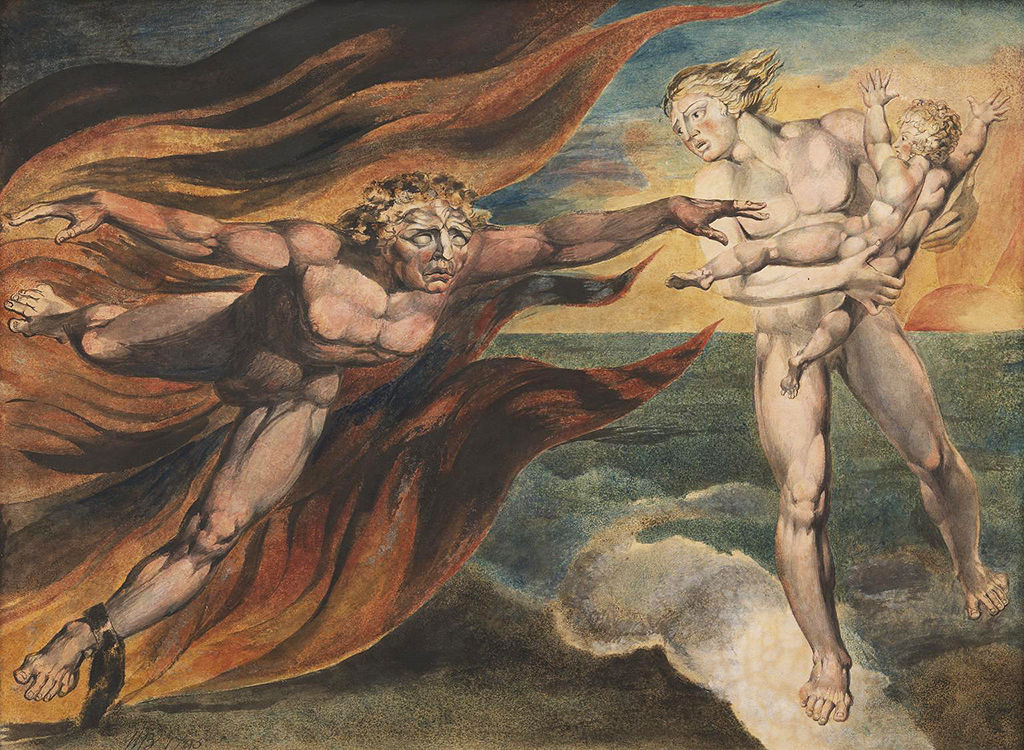
Images offer immediate help with the bodily actions of this world. They also create their own problems of identification. In The Good and Evil Angels, a fettered adult reaches from a region of flame towards a second adult holding a child. The reaching hand, the held child and the restraint around the ankle establish a charged encounter before names are supplied. Butlin’s Tate catalogue interprets the adults as Orc and Los in fallen conditions. This is an argued identification connecting related designs and poetry, whose usefulness depends upon retaining its interpretive status. [9]
The large print also has an earlier relation to the design beneath the text of The Marriage of Heaven and Hell, plate 4. In the Library of Congress’s copy D reproduction, the upright adult and child occupy the left, with the approaching fiery figure on the right. The text above them challenges the separation of body from soul and the assignment of reason and energy to opposed moral categories. The later independent print reverses the arrangement and presents the encounter outside that particular page of argument. A related composition can carry different pressures in a changed setting. [9][10]
The Ancient of Days supplies another useful test. In the Whitworth’s impression, a muscular old figure curls within an incandescent circle and lowers spreading compasses into the darkness. The museum identifies him as Urizen. Comparing this action with the measurement and division in Urizen makes the identification productive: the instrument and the act of setting bounds have textual force. The comparison does not authorise calling every bearded maker in Blake’s art by that name. The work’s particular source, setting and action still matter. [11][1]
Blake’s names can change the apparent moral identity of a figure as well. The Marriage of Heaven and Hell presents opposed accounts of Messiah and Satan and later describes an angel embracing fire, being consumed and arising as Elijah. Its earlier account of poets giving divine names to the perceived world warns that those names can be detached from living experience and turned into instruments of priestly authority. The reader’s problem is therefore part of Blake’s subject: an illuminating name can become a constraining system when treated as a final explanation. [10]
Albion, his emanation and Los’s Spectre
In Jerusalem, Albion’s withdrawal makes the relation between person and world especially vivid. He claims mountains as his own, hides his emanation Jerusalem and rejects the invitation to shared divine life. The landscape subsequently scatters and darkens. A human being’s condition occupies rivers, cities and counties; the consequences of his refusal become collective. Albion can be encountered as a figure of Britain and of humanity without reducing every detail to a geographical code. The poem continually moves between his body and the lives around it. [8]
Jerusalem herself is a woman and a city, a figure whose displacement affects the possibilities of relationship. Her existence cannot be contained by saying that she supplies Albion with a single missing emotion. She speaks, pleads and questions punishment; she has children, a civic form and a spiritual relation to the Lamb. In the opening chapter, Albion’s accusations expose her to a scrutiny that turns love into shame. The conflict gives an intimate life to the collapse of a whole social world. [8]
Los keeps working within that collapse. His own emanation divides, and his Spectre separates as a dark, hostile presence. The Spectre tries to persuade him that friendship with Albion is self-destructive. Its argument feeds upon actual injuries. Los admits the cause for irritation, yet insists that division through wrath must be answered by pity and eventual reunion. His resistance matters because it requires him to recognise injury without making injury the final truth about the injured relationship. [8]
The exchange does not make Los serene. He threatens his Spectre, commands its labour and fears his own fury. He calls it his pride and self-righteousness, then forces it to help at the forge. Near the end of their early argument, he wipes the Spectre’s tears even though he cannot comfort it. The episode gives that difficult term a sequence of actions: separation, accusation, coercion, labour and a gesture of care. The Spectre is more than a ghost and more active than a label for a bad thought. It becomes an adversarial part of Los’s life with which he must contend. [8]
The famous declaration that Los must create a system occurs within this struggle. The following plate describes his effort to use systems to deliver individuals from systems. Read together, the two passages make the ambition hazardous and purposeful. Creating gives form to something that might otherwise remain hidden; that form must also leave room for living individuals. Los’s work can be judged by its capacity to make another future possible. [8]
Golgonooza gives that work a place. Its building materials include pity, affections, forgiveness, honest tears and words that continue to comfort. Tools, joints and rooms translate relationships into a city that must be made through sustained labour. The imagery answers the earlier chains without pretending that all acts of formation are alike. A rivet can bind a body; a building can make shelter for an affection. Attention to what is being made, for whom and with what consequences is more useful than declaring every boundary oppressive. [8]
Powers capable of change
The later movements of the long poems reopen judgments made earlier. In Night the Ninth of The Four Zoas, Urizen confronts the desolation produced by his pursuit of the future and casts off his aged coverings. His sons recover a rusted plough; weapons yield to agricultural tools; Urizen works the ground and later gathers a harvest. The transformation is intelligible because the power that ordered a restrictive world can acquire a different task. The narrative does not require the permanent exclusion of his capacities. [2]
The harvest is nevertheless surrounded by pain. Ahania’s overwhelming joy collapses into death; the winepresses of Luvah contain torment as well as celebration; Urthona’s mills grind nations amid groans. These scenes prevent the final Night becoming a reassuring list of faculties restored to their proper boxes. Renewal is narrated through difficult bodily processes, and the poem leaves suffering audible within its images of abundance. Near its close, Urthona’s renewed labour accompanies the departure of the war of swords and the arrival of “sweet Science”. [2]
Jerusalem ends with a different concentration. Albion encounters Jesus in the likeness of Los, and their conversation places friendship and self-giving at the centre of human existence. When Albion responds to the danger facing his friend, the furnaces become fountains of living water. Urizen, Luvah, Tharmas and Urthona rise into his bosom. The renewed life retains all four names. Its images culminate in conversation and imaginative forms, in beings seeing and reflecting one another. Connection allows difference to remain active. [12]
These endings explain why the figures need histories. The reader who has met Urizen’s impossible law can recognise the importance of his changed work. The reader who has watched Los chain a child can feel the difficulty of his later labour for another being. Blake gives their transformations weight by allowing their earlier acts to remain part of the encounter. The mythology asks how a power lives among other powers and whether those relations can change. [1][6][8][2][12]
Ways into Blake’s mythic world
Begin with a complete short work. Urizen offers a sequence of actions and consequences that remains followable even when some of its beings are mysterious. Europe makes a useful second encounter because the same names return in a changed configuration. Then read The Song of Los for the troubling distribution of law through Los’s own family. Keep a few observations about what each figure does, whom the action affects and what happens next. A record of changing relations becomes more useful than a list of single-word equivalents. [1][4][5]
For the larger poems, the opening of The Four Zoas and the first exchange between Los and his Spectre in Jerusalem provide manageable encounters. Read each conversation beyond the sentence that seems to explain everything. The next speech may expose an assumption, and the next action may reveal the cost of a declaration. The separate introductions to Blake’s poetry and illuminated books offer routes into the wider forms and the designed pages. [6][8]
Writing to Thomas Butts on 22 November 1802, Blake shows how personally this imaginative activity could work. In verse composed more than a year before the letter, a thistle becomes an old man and the outward sun becomes Los in his inward vision. The encounter involves work, friendships, poverty and conflicting duties. Los belongs to the pressure of a lived situation as well as to an immense poem. The letter offers a last helpful entrance: attend to the familiar human difficulty that gives the strange figure something urgent to do. [13]
Works and designs directory
Browse separate works, impressions and book components. Dates distinguish versions; six Tate copies after Blake are labelled. These records are not a complete catalogue of unique designs.
| Name | Date | Medium |
|---|---|---|
| A Figure Standing in a Gothic Apse, perhaps the Empress Maud. Verso: Detailed Drawings for ‘The Empress Maud in Bed’ | c.1819 | Pencil drawing |
| A Rolling Stone Is Ever Bare of Moss, from Thornton's "Pastorals of Virgil" | 1821 | Wood engraving |
| A Title Page for The Grave | 1806 | Watercolour |
| A Vision of the Last Judgment | 1808 | Watercolour |
| A Vision: The Inspiration of the Poet (Elisha in the Chamber on the Wall) | c.1819–20? | Watercolour |
| Adam and the Beasts, Frontispiece to Hayley's "Ballads" | June 1, 1802 | Engraving |
| Age Teaching Youth | c.1785–90 | Watercolour |
| Alfred and the Neat-Herd’s Wife (after Henry Fuseli) | 1797, published 1798 | Etching and engraving |
| An Allegory of the Bible. Verso: The Shins of an Écorché Male Figure | c.1780–5, ?c.1780 | Watercolour |
| Angel of the Divine Presence Bringing Eve to Adam (The Creation of Eve: "And She Shall be Called Woman) (recto); Sketch for the same (verso) | ca. 1803 | Watercolour |
| Angel of the Revelation (Book of Revelation, chapter 10) | ca. 1803–5 | Watercolour |
| Antaeus setting down Dante and Virgil in the Last Circle of Hell | 1824–1827 | Watercolour |
| Bathsheba at the Bath | c.1799–1800 | Tempera |
| Beatrice Addressing Dante from the Car | 1824–7 | Watercolour |
| Behemoth and Leviathan | 1825–26 | Engraving |
| Behemoth and Leviathan | 1825, reprinted 1874 | Engraving |
| Behemoth and Leviathan | 1826 | Engraving |
| Blasted Trees and Flattened Crops, from Thornton's "Pastorals of Virgil" | 1821 | Wood engraving |
| Boy Returning Joyfully, with Plough and Oxen, from Thornton's "Pastorals of Virgil" | 1821 | Wood engraving |
| Boy Returning Joyfully, with Plough and Oxen, from Thornton's "Pastorals of Virgil" | 1821 | Wood engraving |
| Catherine Blake. Verso: A Man’s Head and Other Drawings | c.1805 | Pencil drawing |
| Cerberus | 1824–7 | Watercolour |
| Cerberus (second version) | 1824–1827 | Watercolour |
| Chaucer’s Canterbury Pilgrims | 1810, reprinted before 1881 | Engraving |
| Christ Appearing to His Disciples After the Resurrection | c.1795 | Colour print |
| Christ Appearing to the Apostles after the Resurrection | c.1795 | Watercolour |
| Christ Blessing the Little Children | 1799 | Tempera |
| Christ in the Carpenter’s Shop: The Humility of the Saviour (after William Blake) | Date not stated | Watercolour |
| Ciampolo the Barrator Tormented by the Devils | 1826–7, reprinted 1892 | Engraving |
| Ciampolo the Barrator Tormented by the Devils | 1826–7, reprinted 1968 | Engraving |
| Circle of Theives: Agnello Brunelleschi Attacked By a Six-Footed Serpent | ca. 1825–27 | Engraving |
| Clarence's Dream (Shakespeare, Richard III, Act 1, Scene 4) | 1774 | Etching and engraving |
| Colinet Mocked by Two Boys, from Thornton's "Pastorals of Virgil" | 1821 | Wood engraving |
| Colinet Rests by a Stream at Night | c.1821, printed 1830 | Wood engraving |
| Colinet Rests by a Stream at Night | 1821, reprinted 1977 | Wood engraving |
| Colinet with his Shepherd’s Pipe, Mocked by Two Boys | c.1821, printed 1830 | Wood engraving |
| Colinet with his Shepherd’s Pipe, Mocked by Two Boys | 1821, reprinted 1977 | Wood engraving |
| Colinet's Journey, Milestone Marked 'LXII Miles to London', from Thornton's "Pastorals of Virgil" | 1821 | Wood engraving |
| Colinet's Journey: Milestone Marked 'LXII Miles to London', from Thornton's "Pastorals of Virgil" | 1821 | Wood engraving |
| Colinet’s Fond Desire Strange Lands to Know | 1821, reprinted 1977 | Wood engraving |
| Colinet’s ‘Fond Desire Strange Lands to Know’ | c.1821, printed 1830 | Wood engraving |
| Composition Sketch for ‘The Fall of the Rebel Angels’? Verso: Standing Figure with Flaming Hair | ?c.1805–10 | Pencil drawing |
| Composition Sketch, Possibly a Subject from Dante. Verso: A Man Standing over a Figure Reclining on a Bed | ?1824–7, ?c.1800–10 | Pencil drawing |
| Composition Sketch. Verso: Standing Figure Holding a Spear | ?c.1805–10 | Pencil drawing |
| Dante and Virgil Approaching the Angel Who Guards the Entrance of Purgatory | 1824–7 | Watercolour |
| Dante and Virgil Penetrating the Forest | 1824–7 | Watercolour |
| Dante in the Empyrean, Drinking at the River of Light | 1824–7 | Watercolour |
| Dante running from the Three Beasts | 1824–1827 | Watercolour |
| Dante Striking against Bocca Degli Abati | 1826–7, reprinted 1892 | Engraving |
| Dante Striking Against Bocca degli Abati | 1826–7, reprinted 1968 | Engraving |
| David Delivered out of Many Waters | c.1805 | Watercolour |
| David Delivered out of Many Waters (after William Blake) | Date not stated | Watercolour |
| Detailed Drawings for ‘A Figure Standing in a Gothic Apse’ | 1819 | Pencil drawing |
| Elohim Creating Adam | 1795–c.1805 | Colour print |
| Enoch | 1806–7 | Lithograph |
| Epitome of James Hervey’s ‘Meditations among the Tombs’ | c.1820–5 | Watercolour |
| Europe. A Prophecy; Frontispiece | ca. 1820 | Relief etching |
| Evening | c.1820/1825 | Watercolour |
| Every Man also Gave him a Piece of Money | 1825, reprinted 1874 | Engraving |
| Every Man also Gave him a Piece of Money. Verso: God the Father with Attendant Angels | c.1821–3 | Watercolour |
| Every One also Gave Him a Piece of Money | 1826 | Engraving |
| Fertilization of Egypt, from Erasmus Darwin's "The Botanic Garden" | 1791 | Engraving |
| First Book of Urizen pl. 10 | 1796, c.1818 | Etching |
| First Book of Urizen pl. 11 | 1796, c.1818 | Etching |
| First Book of Urizen pl. 15 | 1796, c.1818 | Etching |
| First Book of Urizen pl. 17 | 1796, c.1818 | Etching |
| First Book of Urizen pl. 21 | 1796, c.1818 | Etching |
| First Book of Urizen pl. 6 | 1796, c.1818 | Etching |
| Frontispiece to Jerusalem, the Emanation of the Great Albion | [ca. 1804–20] (?) | Engraving |
| Frontispiece to ‘Visions of the Daughters of Albion’ | c.1795 | Relief etching |
| Frontispiece: Thenot and Colinet | c.1821, printed 1830 | Wood engraving |
| George Cumberland's Message Card | 1827 | Engraving |
| God Judging Adam | ca. 1795 | Relief etching |
| God Judging Adam | 1795 | Relief etching |
| Hiding of Moses, from "Remember Me!, or a Pocket Companion" | 1825 | Engraving |
| Homer and the Ancient Poets | 1824–7 | Watercolour |
| Illustration 1 to Milton’s On the Morning of Christ’s Nativity: The Descent of Peace | c.1814–1816 | Watercolour |
| Illustration 1 to Milton’s Paradise Lost: Satan Calling Up His Legions | 1807 | Watercolour |
| Job accepting Charity | 1825–26 | Engraving |
| Job and his Daughters | 1825–26 | Engraving |
| Job and his Daughters | 1825, reprinted 1874 | Engraving |
| Job and His Daughters | 1826 | Engraving |
| Job and His Family | 1825–26 | Engraving |
| Job and his Family | Reprinted 1874; engraved 1828 date is an error | Engraving |
| Job and His Family | 1826 | Engraving |
| Job and his Family Restored to Prosperity | 1825, reprinted 1874 | Engraving |
| Job and his Wife restored to Prosperity | 1825–26 | Engraving |
| Job rebuked by his Friends | 1825–26 | Engraving |
| Job Rebuked by his Friends | 1825, reprinted 1874 | Engraving |
| Job Rebuked by His Friends | 1826 | Engraving |
| Job's Comforters | 1825–26 | Engraving |
| Job's Comforters | 1826 | Engraving |
| Job's Despair | 1825–26 | Engraving |
| Job's Evil Dreams | 1825–26 | Engraving |
| Job's Evil Dreams | 1826 | Engraving |
| Job's Sacrifice | 1825–26 | Engraving |
| Job's Sons and Daughters Overwhelmed by Satan | 1826 | Engraving |
| Job, his Wife and his Friends: The Complaint of Job. Verso: Job’s Wife and Eight Other Sketches | c.1785 | Watercolour |
| Job’s Comforters | 1825, reprinted 1874 | Engraving |
| Job’s Despair | 1825, reprinted 1874 | Engraving |
| Job’s Evil Dreams | 1825, reprinted 1874 | Engraving |
| Job’s Sacrifice | 1825, reprinted 1874 | Engraving |
| Job’s Sons and Daughters Overwhelmed by Satan | 1825, reprinted 1874 | Engraving |
| John Linnell | 1825 | Pencil drawing |
| Joseph of Arimathea Preaching to the Britons | c.1794/1796 | Relief etching |
| Judas Betrays Him | c.1803–5 | Watercolour |
| King John Absolved by Pandulph (after Henry Fuseli) | 1797, published 1798 | Etching and engraving |
| Lamech and his Two Wives | 1795 | Colour print |
| Landscape near Felpham | c.1800 | Watercolour |
| Lear and Cordelia in Prison | c.1779 | Watercolour |
| Los and Orc | c.1792–3 | Watercolour |
| Lower Half of a Woman Playing a Harp. Verso: Seraphim and Other Drawings | c.1785, c.?1807 | Pencil drawing |
| Menalcus Watching Women Dance, from Thornton's "Pastorals of Virgil" | 1821 | Wood engraving |
| Menalcus Watching Women Dance, from Thornton's "Pastorals of Virgil" | 1821 | Wood engraving |
| Moses Indignant at the Golden Calf | c.1799–1800 | Tempera |
| Nebuchadnezzar | 1795–c.1805 | Colour print |
| Newton | 1795–c.1805 | Colour print |
| Oberon, Titania and Puck with Fairies Dancing | c.1786 | Watercolour |
| Pity | ca. 1795 | Relief etching |
| Pity | c.1795 | Colour print |
| Plate 2 of ‘Urizen’: ‘Teach these Souls to Fly’ | ?1796 | Relief etching |
| Plate 3 of ‘Urizen’: Oh! Flames of Furious Desires’ (after William Blake) | Date not stated | Watercolour |
| Plate 4 of ‘Visions of the Daughters of Albion’ | c.1795 | Relief etching |
| Plutus | 1824–7 | Watercolour |
| Preliminary Sketch for ‘Christ Girding Himself with Strength’. Verso: Standing Figure with One Arm Raised | c.1805, c.1805–10 | Pencil drawing |
| Preludium. "The shadowy daughter of Urthona stood before red Orc..." (Plate 3) | 1793 | Relief etching |
| Queen Elizabeth and Essex (after Henry Fuseli) | 1797, published 1798 | Engraving |
| Sabrina's Silvery Flood, from Thornton's "Pastorals of Virgil" | 1821 | Wood engraving |
| Sabrina's Silvery Flood, from Thornton's "Pastorals of Virgil" | 1821 | Wood engraving |
| Sabrina’s Silvery Flood | c.1821, printed 1830 | Wood engraving |
| Sabrina’s Silvery Flood | 1821, reprinted 1977 | Wood engraving |
| Satan Before the Throne of God | 1825–26 | Engraving |
| Satan before the Throne of God | 1825, reprinted 1874 | Engraving |
| Satan before the Throne of God | 1826 | Engraving |
| Satan calling up his Legions | c.1800–05 | Tempera |
| Satan Exulting over Eve | c.1795 | Colour print |
| Satan Going Forth from the Presence of the Lord, and Job’s Charity | 1825, reprinted 1874 | Engraving |
| Satan Going Forth fron the Presence of the Lord | 1825–26 | Engraving |
| Satan in his Original Glory: ‘Thou wast Perfect till Iniquity was Found in Thee’ | c.1805 | Watercolour |
| Satan Smiting Job with Boils | 1825–26 | Engraving |
| Satan Smiting Job with Sore Boils | 1825, reprinted 1874 | Engraving |
| Satan Smiting Job with Sore Boils | c.1826 | Tempera |
| Satan Smiting Job with Sore Boils | 1826 | Engraving |
| Shepherd Chases Away a Wolf, from Thornton's "Pastorals of Virgil" | 1821 | Wood engraving |
| Shepherd Chases Away a Wolf, from Thornton's "Pastorals of Virgil" | 1821 | Wood engraving |
| Sketch for the Title-Page of the Engraved Illustrations to the Book of Job | c.1823/1826 | Pencil drawing |
| Sketch for ‘The Four and Twenty Elders Casting their Crowns before the Divine Throne’. Verso: Standing Figure with Arms at his Side | c.1803, c.1805–10 | Pencil drawing |
| Sketch for ‘Tiriel Supporting the Dying Myratana’. Verso: Sketch for ‘Tiriel Supporting the Dying Myratana’ | c.1786–9 | Pencil drawing |
| Songs of Experience: A Little Boy Lost | [1794] printed ca. 1825 | Relief etching |
| Songs of Experience: A Little Girl Lost | [1794] printed ca. 1825 | Relief etching |
| Songs of Experience: A Poison Tree | [1794] printed ca. 1825 | Relief etching |
| Songs of Experience: Earth's Answer | [1794] printed ca. 1825 | Relief etching |
| Songs of Experience: Frontispiece | [1794] printed ca. 1825 | Relief etching |
| Songs of Experience: Holy Thursday | [1794] printed ca. 1825 | Relief etching |
| Songs of Experience: Infant Sorrow | [1794] printed ca. 1825 | Relief etching |
| Songs of Experience: Introduction | [1794] printed ca. 1825 | Relief etching |
| Songs of Experience: London | [1794] printed ca. 1825 | Relief etching |
| Songs of Experience: My Pretty Rose Tree, Ah! Sun-Flower, The Lilly | [1794] printed ca. 1825 | Relief etching |
| Songs of Experience: Nurses Song | [1794] printed ca. 1825 | Relief etching |
| Songs of Experience: The Angel | [1794] printed ca. 1825 | Relief etching |
| Songs of Experience: The Chimney Sweeper | [1794] printed ca. 1825 | Relief etching |
| Songs of Experience: The Clod & the Pebble | [1794] printed ca. 1825 | Relief etching |
| Songs of Experience: The Fly | [1794] printed ca. 1825 | Relief etching |
| Songs of Experience: The Garden of Love | [1794] printed ca. 1825 | Relief etching |
| Songs of Experience: The Human Abstract | [1794] printed ca. 1825 | Relief etching |
| Songs of Experience: The Little Girl Found (second plate) | [1789] printed ca. 1825 | Relief etching |
| Songs of Experience: The Little Girl Lost | [1789] printed ca. 1825 | Relief etching |
| Songs of Experience: The Little Girl Lost (second plate); The Little Girl Found | [1789] printed ca. 1825 | Relief etching |
| Songs of Experience: The Little Vagabond | [1794] printed ca. 1825 | Relief etching |
| Songs of Experience: The School Boy | [1789] printed ca. 1825 | Relief etching |
| Songs of Experience: The Sick Rose | [1794] printed ca. 1825 | Relief etching |
| Songs of Experience: The Tyger | [1794] printed ca. 1825 | Relief etching |
| Songs of Experience: The Voice of the Ancient Bard | [1789] printed ca. 1825 | Relief etching |
| Songs of Experience: Title-page | [1794] printed ca. 1825 | Relief etching |
| Songs of Experience: To Tirzah | [1794] printed ca. 1825 | Relief etching |
| Songs of Innocence and of Experience, Shewing the Two Contrary States of the Human Soul: Combined Title-page | [1789–94] printed ca. 1825 | Relief etching |
| Songs of Innocence and of Experience: Infant Sorrow | 1794, reprinted 1831 or later | Relief etching |
| Songs of Innocence: A Cradle Song | [1789] printed ca. 1825 | Relief etching |
| Songs of Innocence: A Cradle Song (second plate) | [1789] printed ca. 1825 | Relief etching |
| Songs of Innocence: A Dream | [1794] printed ca. 1825 | Relief etching |
| Songs of Innocence: Frontispiece | [1789] printed ca. 1825 | Relief etching |
| Songs of Innocence: Holy Thursday | [1789] printed ca. 1825 | Relief etching |
| Songs of Innocence: Infant Joy | [1789] printed ca. 1825 | Relief etching |
| Songs of Innocence: Introduction | [1789] printed ca. 1825 | Relief etching |
| Songs of Innocence: Laughing Song | [1789] printed ca. 1825 | Relief etching |
| Songs of Innocence: Little Boy Lost | [1789] printed ca. 1825 | Relief etching |
| Songs of Innocence: Night | [1789] printed ca. 1825 | Relief etching |
| Songs of Innocence: Night (second plate) | [1789] printed ca. 1825 | Relief etching |
| Songs of Innocence: Nurse's Song | [1789] printed ca. 1825 | Relief etching |
| Songs of Innocence: On Anothers Sorrow | [1789] printed ca. 1825 | Relief etching |
| Songs of Innocence: Spring | [1789] printed ca. 1825 | Relief etching |
| Songs of Innocence: Spring (second plate) | [1789] printed ca. 1825 | Relief etching |
| Songs of Innocence: The Blossom | [1789] printed ca. 1825 | Relief etching |
| Songs of Innocence: The Chimney Sweeper | [1789] printed ca. 1825 | Relief etching |
| Songs of Innocence: The Divine Image | [1789] printed ca. 1825 | Relief etching |
| Songs of Innocence: The Ecchoing Green | [1789] printed ca. 1825 | Relief etching |
| Songs of Innocence: The Ecchoing Green (second plate) | [1789] printed ca. 1825 | Relief etching |
| Songs of Innocence: The Lamb | [1789] printed ca. 1825 | Relief etching |
| Songs of Innocence: The Little Black Boy | [1789] printed ca. 1825 | Relief etching |
| Songs of Innocence: The Little Black Boy (second plate) | [1789] printed ca. 1825 | Relief etching |
| Songs of Innocence: The Little Boy Found | [1789] printed ca. 1825 | Relief etching |
| Songs of Innocence: The Shepherd | [1789] printed ca. 1825 | Relief etching |
| Songs of Innocence: Title Page | [1789] printed ca. 1825 | Relief etching |
| St Christopher, Copy from an Engraving? Verso:Part of a Face: Copy from a Plaster Cast: a Daughter of Niobe? | ?c.1779–80 | Pencil drawing |
| The Agony in the Garden | c.1799–1800 | Tempera |
| The Angel Appearing to Zacharias | 1799–1800 | Tempera |
| The Ascent of the Mountain of Purgatory | 1824–7 | Watercolour |
| The Baffled Devils Fighting | 1826–7, reprinted 1892 | Engraving |
| The Baffled Devils Fighting | 1826–7, reprinted 1968 | Engraving |
| The Bard, from Gray | ?1809 | Tempera |
| The Beggar's Opera, Act III | July 1, 1790 | Etching and engraving |
| The Beggar's Opera, Act III | July 1, 1790 | Engraving |
| The Beggar's Opera, Act III | 1790 | Engraving |
| The Blasphemer | c.1800 | Watercolour |
| The Blighted Corn | c.1821, printed 1830 | Wood engraving |
| The Blighted Corn | 1821, reprinted 1977 | Wood engraving |
| The Body of Abel Found by Adam and Eve | c.1826 | Tempera |
| The Body of Christ Borne to the Tomb | c.1799–1800 | Tempera |
| The Book of Job: Title Page | 1825 | Engraving |
| The Book of Thel pl. 6 | 1796, c.1818 | Etching |
| The Circle of Corrupt Officials: The Devils Mauling Each Other | ca. 1825–27 | Engraving |
| The Circle of Corrupt Officials: The Devils Tormenting Ciampolo | ca. 1825–27 | Engraving |
| The Circle of the Lustful: Francesca da Rimini (‘The Whirlwind of Lovers’) | 1826–7, reprinted 1892 | Engraving |
| The Circle of the Lustful: Francesca da Rimini (‘The Whirlwind of Lovers’) | 1826–7, reprinted 1968 | Engraving |
| The Circle of the Lustful: Paolo and Francesca | ca. 1825–27 | Engraving |
| The Circle of the Thieves; Buoso Donati Attacked by the Serpent | ca. 1825–27 | Engraving |
| The Circle of Traitors: Dante's Foot Striking Bocca degli Abbate | ca. 1825–27 | Engraving |
| The Complaint and the Consolation; or, Night Thoughts | 1797 | Etching and engraving |
| The Creation | 1825–26 | Engraving |
| The Crucifixion | c.1825–7 | Pencil drawing |
| The Crucifixion: ‘Behold Thy Mother’ | c.1805 | Watercolour |
| The Dance of Albion (Glad Day) | c.1803/1810 | Engraving |
| The Death of Lucretia, from Allen's "New and Impartial Roman History" | 1797 | Engraving |
| The Death of Saint Joseph | 1803 | Watercolour |
| The Death of the Virgin | 1803 | Watercolour |
| The Descent of Peace [recto] | c.1815 | Pencil drawing |
| The Destruction of Job's Sons | 1825–26 | Engraving |
| The Devils, with Dante and Virgil by the Side of the Pool | 1824–7 | Watercolour |
| The Entombment | c.1805 | Watercolour |
| The Fall of Rosamond (after Thomas Stothard) | 1783 | Etching and engraving |
| The Fall of Satan | 1825–26 | Engraving |
| The Fall of Satan | 1825, reprinted 1874 | Engraving |
| The Fall of Satan | 1826 | Engraving |
| The Four and Twenty Elders Casting their Crowns before the Divine Throne | c.1803–5 | Watercolour |
| The Ghost of a Flea | c.1819–20 | Tempera |
| The Good and Evil Angels | 1795–?c.1805 | Colour print |
| The Good Farmer, Probably the Parable of the Wheat and the Tares. Verso: Rough Sketch of Two or Three Figures in a Landscape | c.1780–5 | Watercolour |
| The Great Red Dragon and the Beast from the Sea | c.1805 | Watercolour |
| The Great Red Dragon and the Woman Clothed with the Sun | c.1805 | Watercolour |
| The Head of the Ghost of a Flea. Verso: A Profile and a Reduced Drawing of Milton’s First Wife | c.1819 | Pencil drawing |
| The Hermit’s Dog, from William Hayley’s "Ballads" | 1805 | Etching and engraving |
| The Hiding of Moses | 1824 | Engraving |
| The House of Death | 1795–c.1805 | Colour print |
| The House of Death | c.1790 | Watercolour |
| The Hypocrites with Caiaphas. Verso: Sketch of a Stooping Figure | 1824–7 | Watercolour |
| The Inscription over the Gate | 1824–7 | Watercolour |
| The Laborious Passage along the Rocks | 1824–7 | Watercolour |
| The Last Trumpet (recto); Two studies of a right eye, a profile of an open-mouthed young man, the head of an eagle, and the head of a lion (verso) | 1780–85 | Pencil drawing |
| The Lord Answering Job out of the Whirlwind | 1825–26 | Engraving |
| The Lord Answering Job out of the Whirlwind | 1825, reprinted 1874 | Engraving |
| The Man Who Taught Blake Painting in his Dreams (counterproof) (after William Blake) | after c.1819–20 | Pencil drawing |
| The Marriage of Heaven and Hell pl. 16 | 1796, c.1818 | Etching |
| The Messengers tell Job of his Misfortunes | 1825–26 | Engraving |
| The Messengers tell Job of his Misfortunes | 1825, reprinted 1874 | Engraving |
| The Night of Enitharmon’s Joy (formerly called ‘Hecate’) | c.1795 | Colour print |
| The Parable of the Wise and Foolish Virgins | ca. 1799–1800 | Watercolour |
| The Parable of the Wise and Foolish Virgins (after William Blake) | Date not stated | Watercolour |
| The Pastorals of Virgil, with a Course of English Reading, Adapted for Schools, Vol. I | 1821 | Wood engraving |
| The Penance of Jane Shore in St Paul’s Church | c.1793 | Watercolour |
| The Pit of Disease: The Falsifiers | 1826–7, reprinted 1892 | Engraving |
| The Pit of Disease: The Falsifiers | 1824–7 | Watercolour |
| The Pit of Disease: The Falsifiers | 1826–7, reprinted 1968 | Engraving |
| The Primaeval Giants Sunk in the Soil | 1824–7 | Watercolour |
| The Punishment of the Thieves | 1824–7 | Watercolour |
| The Raising of Lazarus (after William Blake) | Date not stated | Watercolour |
| The Rest on the Flight into Egypt (The Repose of the Holy Family in Egypt) | 1806 | Watercolour |
| The River of Life | c.1805 | Watercolour |
| The Rock Sculptured with the Recovery of the Ark and the Annunciation | 1824–7 | Watercolour |
| The Serpent Attacking Buoso Donati | 1826–7, reprinted 1892 | Engraving |
| The Serpent Attacking Buoso Donati | 1826–7, reprinted 1968 | Engraving |
| The Serpent Attacking Buoso Donati. Verso: A Man with a Transparent Hood (?) over his Head | 1824–7 | Watercolour |
| The Simoniac Pope | 1824–7 | Watercolour |
| The Six-Footed Serpent Attacking Agnolo Brunelleschi | 1826–7, reprinted 1892 | Engraving |
| The Six-Footed Serpent Attacking Agnolo Brunelleschi | 1826–7, reprinted 1968 | Engraving |
| The Soul Hovering over the Body Reluctantly Parting with Life | c.1805 | Pencil drawing |
| The Spiritual Form of Nelson Guiding Leviathan | c.1805–9 | Tempera |
| The Spiritual Form of Pitt Guiding Behemoth | ?1805 | Tempera |
| The Sun at His Eastern Gate | c.1816–1820 | Watercolour |
| The Temple of Mirth, after Thomas Stothard | 1784 | Engraving |
| The Temptation and Fall of Eve | 1807 | Watercolour |
| The Temptation and Fall of Eve (Illustration to Milton’s Paradise Lost) | 1808 | Watercolour |
| The Thieves and Serpents | 1824–1827 | Watercolour |
| The Vision of Christ | 1825, reprinted 1874 | Engraving |
| The Vision of Eliphaz | 1825–26 | Engraving |
| The Vision of Eliphaz | 1825, reprinted 1874 | Engraving |
| The Vision of God | 1825–26 | Engraving |
| The Wood of the Self-Murderers: The Harpies and the Suicides | 1824–7 | Watercolour |
| The Wrath of Elihu | 1825–26 | Engraving |
| The Wrath of Elihu | 1825, reprinted 1874 | Engraving |
| Thenot and Colinet | 1821, reprinted 1977 | Wood engraving |
| Thenot and Colinet at Supper | c.1821, printed 1830 | Wood engraving |
| Thenot and Colinet at Supper | 1821, reprinted 1977 | Wood engraving |
| Thenot and Colinet Converse Seated between Two Trees | c.1821, printed 1830 | Wood engraving |
| Thenot and Colinet Converse Seated between Two Trees | 1821, reprinted 1977 | Wood engraving |
| Thenot and Colinet Eat Their Evening Meal, from Thornton's "Pastorals of Virgil" | 1821 | Wood engraving |
| Thenot and Colinet Folding their Flocks together at Sunset | c.1821, printed 1830 | Wood engraving |
| Thenot and Colinet Folding their Flocks together at Sunset | 1821, reprinted 1977 | Wood engraving |
| Thenot and Colinet Lead Their Flocks Together, from Thornton's "Pastorals of Virgil" | 1821 | Wood engraving |
| Thenot and Colinet Lead Their Flocks Together, from Thornton's "Pastorals of Virgil" | 1821 | Wood engraving |
| Thenot Remonstrates with Colinet | c.1821, printed 1830 | Wood engraving |
| Thenot Remonstrates with Colinet | 1821, reprinted 1977 | Wood engraving |
| Thenot Remonstrates With Colinet, from Thornton's "Pastorals of Virgil" | 1821 | Wood engraving |
| Thenot Remonstrates With Colinet, from Thornton's "Pastorals of Virgil" | 1821 | Wood engraving |
| Thenot Remonstrates with Colinet, Lightfoot in the Background, from Thornton's "Pastorals of Virgil" | 1821 | Wood engraving |
| Thenot Remonstrates with Colinet: Lightfoot in the Distance | 1821, reprinted 1977 | Wood engraving |
| Thenot Remonstrates with Colinet; Lightfoot in the Distance | c.1821, printed 1830 | Wood engraving |
| Thenot Under a Fruit Tree, from Thornton's "Pastorals of Virgil" | 1821 | Wood engraving |
| Thenot, with Colinet Waving his Arms in Sorrow | c.1821, printed 1830 | Wood engraving |
| Thenot, with Colinet Waving his Arms in Sorrow | 1821, reprinted 1977 | Wood engraving |
| Title Page: Illustrations of the Book of Job | 1825–26 | Engraving |
| Title-Page of ‘The Book of Job’ | 1825, reprinted 1874 | Engraving |
| Tornado–Zeus Battling Typhon, from Erasmus Darwin's "Botanic Garden" | August 1, 1795 | Engraving |
| Tornado–Zeus Battling Typhon, from Erasmus Darwin's "The Botanic Garden" | August 1, 1795 | Engraving |
| Two Figures in a Decorative Border | c.1790 | Pencil drawing |
| Unyok'd Heifers, Loitering Homeward (Return of the Shepherd), from Thornton's "Pastorals of Virgil" | 1821 | Wood engraving |
| Virgil Girding Dante’s Brow with a Rush | 1824–7 | Watercolour |
| Wat Tyler and the Tax-Gatherer (after Henry Fuseli) | 1797, published 1798 | Etching and engraving |
| When the Morning Stars Sang Together | 1825, reprinted 1874 | Engraving |
| When the Morning Stars Sang Together | 1826 | Engraving |
| Winged Figure Flying Through Clouds, from Bell's "Poets" | 1790 | Etching and engraving |
| Winter | c.1820–5 | Tempera |
| ‘A Rolling Stone is ever Bare of Moss’ | c.1821, printed 1830 | Wood engraving |
| ‘A Rolling Stone is ever Bare of Moss’ | 1821, reprinted 1977 | Wood engraving |
| ‘And Unyok’d Heifers, Loitering Homeward, Low’ | c.1821, printed 1830 | Wood engraving |
| ‘And Unyok’d Heifers, Loitering Homewards, Low’ | 1821, reprinted 1977 | Wood engraving |
| ‘Europe’: Fragment of Pages 3 and 4 | 1794–c.1830–5 | Relief etching |
| ‘For him Our Yearly Wakes and Feasts We Hold’ | c.1821, printed 1830 | Wood engraving |
| ‘For him Our Yearly Wakes and Feasts We Hold’ | 1821, reprinted 1977 | Wood engraving |
| ‘Nor Fox, nor Wolf, nor Rat among our Sheep’ | c.1821, printed 1830 | Wood engraving |
| ‘Nor Fox, nor Wolf, nor Rat among our Sheep’ | 1821, reprinted 1977 | Wood engraving |
| ‘Songs of Innocence and of Experience’: ‘Infant Sorrow’ | 1794, reprinted 1831 or later | Relief etching |
| ‘Songs of Innocence and of Experience’: ‘Spring’ | 1794, reprinted 1831 or later | Relief etching |
| ‘Songs of Innocence’: Title-Page | 1789, reprinted 1831 or later | Relief etching |
| ‘Songs of Innocence’: Title-Page | 1789, reprinted 1831 or later | Relief etching |
| ‘With Songs the Jovial Hinds Return from Plow’ | c.1821, printed 1830 | Wood engraving |
| ‘With Songs the Jovial Hinds Return from Plow’ | 1821, reprinted 1977 | Wood engraving |
Frequently Asked Questions
Butlin interprets them as Orc and Los in fallen conditions. The identification connects the design with Blake’s poetry. [9]
Discussion
Look again at the images and ideas explored in William Blake’s Mythology: Actions, Relations and Change. These editorial prompts invite your observations.
Reader Insights
Los gives disorder form, but his tools also make chains and measured time. Creative power carries responsibility for what it produces.
The children of Los transmit Urizen’s law. The mythology distributes responsibility beyond a simple opposition of reason and prophecy.
Urizen can take up a plough after making a restrictive world. A change of task keeps his powers from having one permanent meaning.
Join the Conversation
Share a detail, comparison or question about William Blake’s Mythology: Actions, Relations and Change below.
References
- William Blake. The First Book of Urizen, title, Preludium and chapters I–IX, E70–83, especially II.4–8; III.8–IV; V–VII; VIII–IX. David V. Erdman, ed., digital transcription, Arizona State University. Read the text. View source.
- William Blake. The Four Zoas, Night IX, manuscript pp.121–124, E390–394, and pp.132–139, E400–407. Urizen’s change and plough, shared labour, violent vintage and concluding Urthona passage. Erdman digital transcription, ASU. Read Night IX. View source.
- Susanne Sklar. “Vision and reality: William Blake’s mythic system”, Journal of Creativity and Inspiration, 2.3, 5 July 2024. Used for the expressly attributed account of change, scale and relational emanations. Read the article. View source.
- William Blake. Europe a Prophecy, complete text, E60–66; especially Preludium, plates 5, 9, 11–15, including 13.1–15 and 15.1–11. Erdman digital transcription, ASU. Read the text. View source.
- William Blake. The Song of Los, Africa and Asia, E67–69. Erdman digital transcription, ASU. Read the text. View source.
- William Blake. The Four Zoas, Night I, manuscript pp.3–7, E300–304; Night V, pp.60–62, E340–342, especially p.62.9–32. Erdman digital transcription, ASU. Read the text. View source.
- Tate / Martin Butlin. Los and Orc, T00547, c.1792–3; collection record, 2004 display caption and catalogue entry from William Blake 1757–1827, Tate Gallery Collections V, 1990. Visual/textual sequence and retrospective connection with The Four Zoas. View the record. View source.
- William Blake. Jerusalem, chapter I, plates 4–13, E146–158, especially 4.14–35; 6–10; 11.1–7; 12.24–42; and plates 19–24, E163–170, especially 20–23. Erdman digital transcription, ASU. Read chapter I. View source.
- Tate / Martin Butlin. The Good and Evil Angels, N05057; collection record, 2011 display caption and catalogue entry from William Blake 1757–1827, 1990. Earlier design on Marriage plate 4 and interpreted Los/Orc identities. The inspected plate 4 comparison is Library of Congress copy D, reproduced as figure 4 in Joseph Viscomi’s 2022 BRANCH essay. View Tate’s record · View the named plate comparison. View source 1. View source 2.
- William Blake. The Marriage of Heaven and Hell, plates 4–6, 11 and 22–24, E34–35, E38, E42–44. Erdman digital transcription, ASU. Read the text. View source.
- The Whitworth, University of Manchester. ‘Europe’ Plate i: Frontispiece, ‘The Ancient of Days’, D.1892.32, collection description and institutional reproduction. Used for the museum’s identification and the particular composition; other impressions require their own records. View the record. View source.
- William Blake. Jerusalem, chapter IV, plates 96–99, E255–259, especially 96.3–43 and 98.28–45. Erdman digital transcription, ASU. Read chapter IV. View source.
- William Blake. Letter to Thomas Butts, 22 November 1802, E720–722. Complete letter and enclosed verse, which Blake says was composed more than a year earlier. Erdman digital transcription, ASU. Read the letter. View source.


