


 by Tom Gurney
Tom Gurney BSc (Hons) is an art history expert with over 20 years experience
Published on / Updated on
Email: tomgurney1@gmail.com / Phone: +44 7429 011000
Songs of Innocence and of Experience by William Blake: Introduction
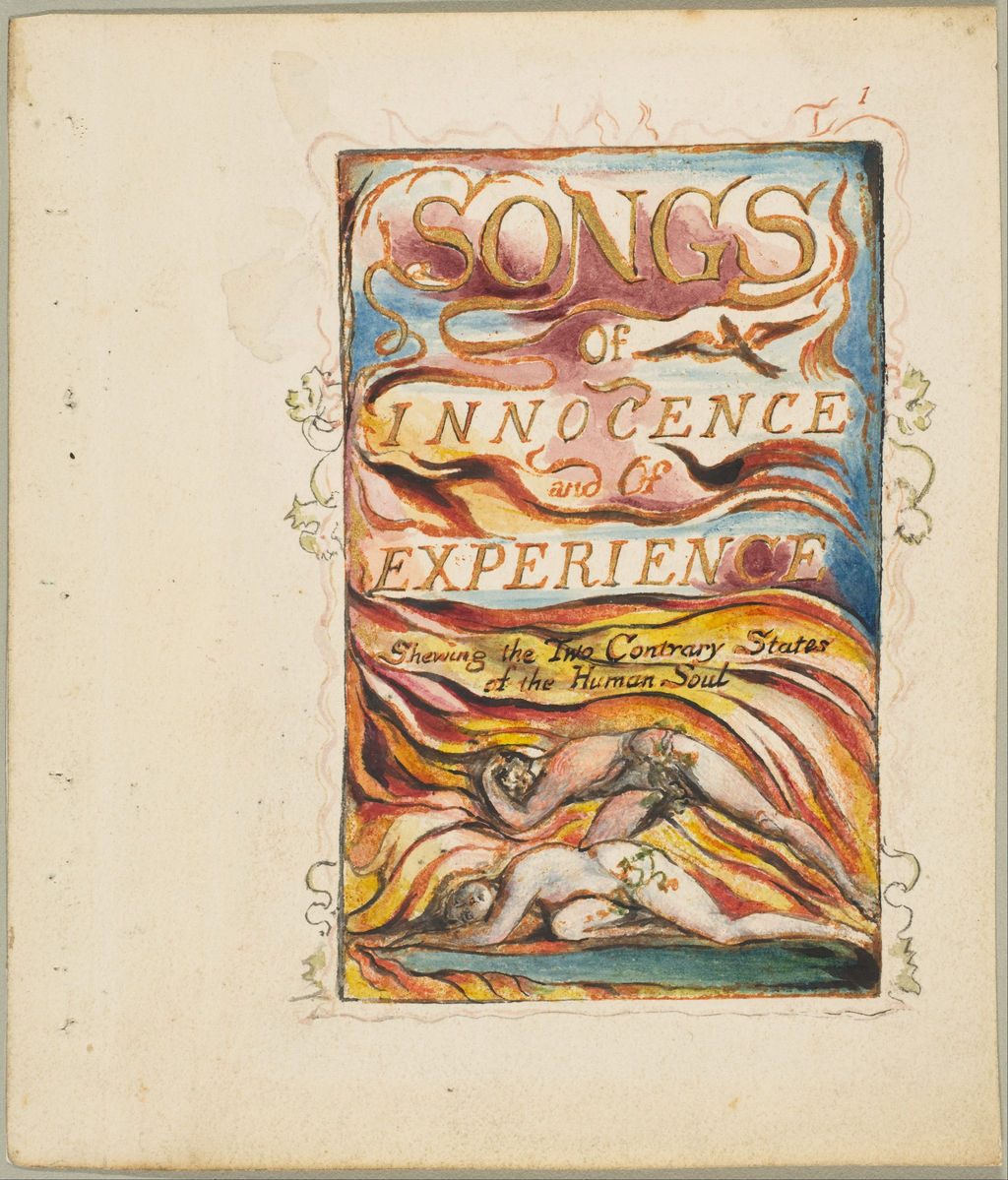
William Blake’s Songs of Innocence and of Experience asks to be read with the eyes as well as the ear. A short poem may sit beneath branches, beside a climbing stem or above a group of grieving bodies. Its lettering belongs to the design. In the Metropolitan Museum of Art’s copy Y, the combined title rises through bands of orange, red and blue above two reclining figures. Before any poem begins, the page makes the book’s two states something to encounter through colour, bodies and movement. [1][2]
The familiar title can suggest a settled collection divided neatly in half. The surviving books offer a more active history. Blake’s Innocence title is dated 1789; Experience is dated 1794. Yet an individual impression might have been printed, coloured or assembled into a book much later. The Met’s copy Y was printed around 1825, bringing designs from decades earlier into a late book. A date on a design and the date of the book in someone’s hands may therefore describe different events. [2][3][4]
That material history belongs to the reading. Some poems changed their position between the two groups; hand colouring changes the balance of a page; printed words sometimes received further work in pen. There is a continuing exchange between what a poem says and how a particular book presents it. Following a few identified copies brings that exchange into view without losing the songs’ direct appeals to pleasure, fear, compassion and freedom. [1][5][6]
At a Glance
- Artist and poetWilliam Blake.
- WorkSongs of Innocence and of Experience: Shewing the Two Contrary States of the Human Soul.
- Principal datesInnocence, 1789; Experience, 1794; individual copies printed and finished over subsequent decades. [2][3][4]
- FormIlluminated book combining relief-etched words and designs, with colouring and other finishing varying between copies. [7][2]
- Copies discussedMet copy Y, printed around 1825; NGV Songs of Innocence copy X, coloured before 1794; Huntington combined Songs copy E, assembled in 1806. [2][5][6]
Contents
- One title, several kinds of date
- How words became part of a printed image
- The book opens more than once
- Two introductions and an answer
- Care and danger within Innocence
- A child’s speech and the page of A Little Boy Lost
- The Tyger as a designed page
- When poems change sides
- A book assembled across years
- A title page printed after Blake
One title, several kinds of date
The first distinction is between the two collections and the combined book. On the Innocence title page, Blake identifies himself as author and printer and gives the date 1789. The title remains visible in the Met’s much later impression, surrounded by vigorous foliage and a scene of reading. An original date is thus carried into a new physical object. It tells us about the work’s beginning, while the museum’s dating of the impression tells us about this particular return to the plate. Both dates matter. [3]
Blake was already advertising Songs of Experience before its dated title appeared. His prospectus of 10 October 1793 lists Songs of Innocence and Songs of Experience separately, each described as an octavo illuminated book with twenty-five designs, priced at five shillings. The printed offer is valuable evidence of how he presented the books to prospective buyers at that moment. It should not be mistaken for a definitive inventory of every later copy, or for proof that every advertised arrangement survives. The list catches a developing undertaking in the act of being offered for sale. [8]
The prospectus also places the songs among other works available from Blake’s address in Hercules Buildings, Lambeth. He advertises coloured printing on fine wove paper and declares that he will produce his works and offer them at a fair price. Poetry, material quality and commercial presentation appear together. The reader invited into this enterprise was being offered an object whose making was part of its claim to attention. Blake’s assertion that his method greatly reduced expense is his own promotional claim; the prospectus does not establish a full account of his costs or earnings. [8]
A surviving copy needs a more particular description. Copy Y at the Met consists of fifty-four plates, catalogued as designs of 1789–94 printed around 1825, in orange-brown ink with watercolour, ink and shell gold. Its small sheets are approximately 15.7 by 14.1 centimetres. The museum associates the commission with the artist Edward Calvert, who met Blake around 1825. These are facts about a late book, rather than a colour scheme that can be projected backwards onto every Songs issued since 1789. [2][4]
Even a carefully stated date leaves several operations to consider. Writing a poem, devising a page, etching copper, printing an impression, colouring it and arranging leaves are related acts, but they need not be simultaneous. The Met’s late impression of the Innocence title page makes their separation clear. The question to ask of any reproduction is therefore quite concrete: which copy is this, and what does its date identify? That question makes comparison more rewarding, because differences can be recognised as features of particular books. [2][3]
How words became part of a printed image
Blake’s technique helps explain why the poems look as they do. As Joseph Viscomi describes it, Blake wrote and drew on copper with an acid-resistant liquid, working the lettering in reverse. Acid removed unprotected metal, leaving the words and design raised for inking and printing. Pen and brush could therefore make marks that belonged to the same printable surface. The words were not set in movable type and then placed beside an independently engraved illustration. [7]
This process allowed handwriting, ornament and figures to share a page. A title could become a canopy, a stem could turn around a stanza, and a curl of lettering could answer the movement of a branch. In the Met’s Innocence title page, the large word Songs and the curving growth above it are so closely interwoven that reading the name and following the vegetation become related actions. The design does not offer a neutral space into which the text has been inserted. It gives the title a particular way of occupying the paper. [3]
Viscomi also cautions against an appealing origin story: that Blake first completed a set of illustrated songs and then invented the process simply to reproduce them. His account places the invention within experiments in preserving the direct marks of pen and brush in metal. The resulting method helped generate the form of illuminated poetry itself. This makes the book’s appearance an outcome of invention through making, rather than the mechanical delivery of an already finished illustrated manuscript. [7]
An impression could then receive further attention. In copy Y, washes of colour establish zones within the printed design, while fine green tendrils extend around the outer margins of several pages. The reader sees both a compact, bounded image and lines that reach beyond it. The distinction is especially clear on The Tyger: a strongly coloured inner rectangle contains the poem and animal, while lighter loops surround its edges. The page has a surface to inspect beyond the words needed to transcribe the poem. [9]
This is one reason a transcription and an image offer different kinds of access. A transcription makes the sequence of words easy to follow and compare; a whole-page image preserves the relative scale of title, verse, figure and empty paper. On A Little Boy Lost, the poem occupies most of the inner field, but the bodies and flames along its lower edge change what the eye meets after the last line. Reading the words alone and then returning to the page can make that encounter more forceful. Neither act exhausts the other. [1][10]
The book opens more than once
Copy Y begins with a combined title, an Innocence frontispiece and an Innocence title page. The separate designs slow the entrance into the poems. They offer different ways of imagining what a song is: an encounter between figures, a spoken or musical act, a written text, a reading shared between generations. The small red numbers above the designs establish their place within this particular copy. Its sequence has a visible physical record as well as a succession of subjects. [2][11][3][4]
On the combined title, large letters occupy most of the upper space. The smaller subtitle, “Shewing the Two Contrary States of the Human Soul”, stretches across a lower band. Beneath it, two bodies lie among flowing forms and tongues of colour. The bright bands do not separate into two tidy compartments labelled innocence and experience. They move through the page, carrying the title towards a bodily scene. The subtitle asks for a comparison of states, while the design resists turning that comparison into an abstract diagram. [2]
The Innocence frontispiece changes the pace. A piper stands beneath a child who floats above him on a cloud. Sheep occupy the lower setting; enclosing trees make the meeting feel like an opening within a wood. The standing figure looks upward, and the child extends its arms. Their relation directs the eye from the ground towards the air. In copy Y, the blue of the piper’s clothing and the pink of the cloud make the two figures distinct while keeping them inside a richly worked green enclosure. [11]
This image prepares for the Introduction, whose piper first entertains a child on a cloud. The child asks for piping, then song, then a book that others may read. The encounter moves from a performance heard by one listener towards words available in the listener’s absence. It is the child who requests the change of medium. The adult maker responds, takes a reed for a pen and writes songs intended for children to hear. The book imagines its origin as an exchange, with instruction travelling from the child towards the poet. [1][11]
The Innocence title page offers another relation between adults, children and words. Below its great curling letters, a seated woman holds an open book towards two children. A tree rises beside the little group and spreads across the title. Reading takes place within the vegetation rather than outside it. There is a useful difference from the frontispiece: the cloud child directs a solitary piper, while the title page presents an adult and children gathered around a book already made. The opening designs move between inspiration and the shared activity of reading. [3]
The title page also makes the maker’s name part of the composition. The line identifying Blake as author and printer sits beneath the reading group, within the lower boundary of the design. It connects the small scene of instruction to the physical work that enables it. The statement need not be read as a declaration that every task was performed without assistance; it visibly joins the roles of writing and printing in Blake’s presentation of the book. The page itself supplies that claim before the poems begin. [3]
At the entrance to Experience, the frontispiece returns to a standing figure and a child, but changes their relation. In copy Y, the winged child sits on the adult’s head, its hands held above the figure’s shoulders. The adult faces forward and looks out towards the viewer. A tree rises at the right, and the landscape opens behind. Compared with the piper’s upward gaze, this is a more frontal encounter. The figures remain connected, but the child is no longer suspended at a distance on a cloud. [4]
That change gives a reader something specific to compare without supplying a single compulsory explanation. The adult may appear to support the child; the child may seem to guide or crown the adult. The hands join them, while the adult’s direct gaze brings the viewer into their arrangement. The design can be read alongside the new collection’s more commanding Introduction, yet its bodily relation remains open enough to complicate a simple story of inspiration first possessed and then lost. The two frontispieces reward looking back as well as moving forward. [1][11][4]
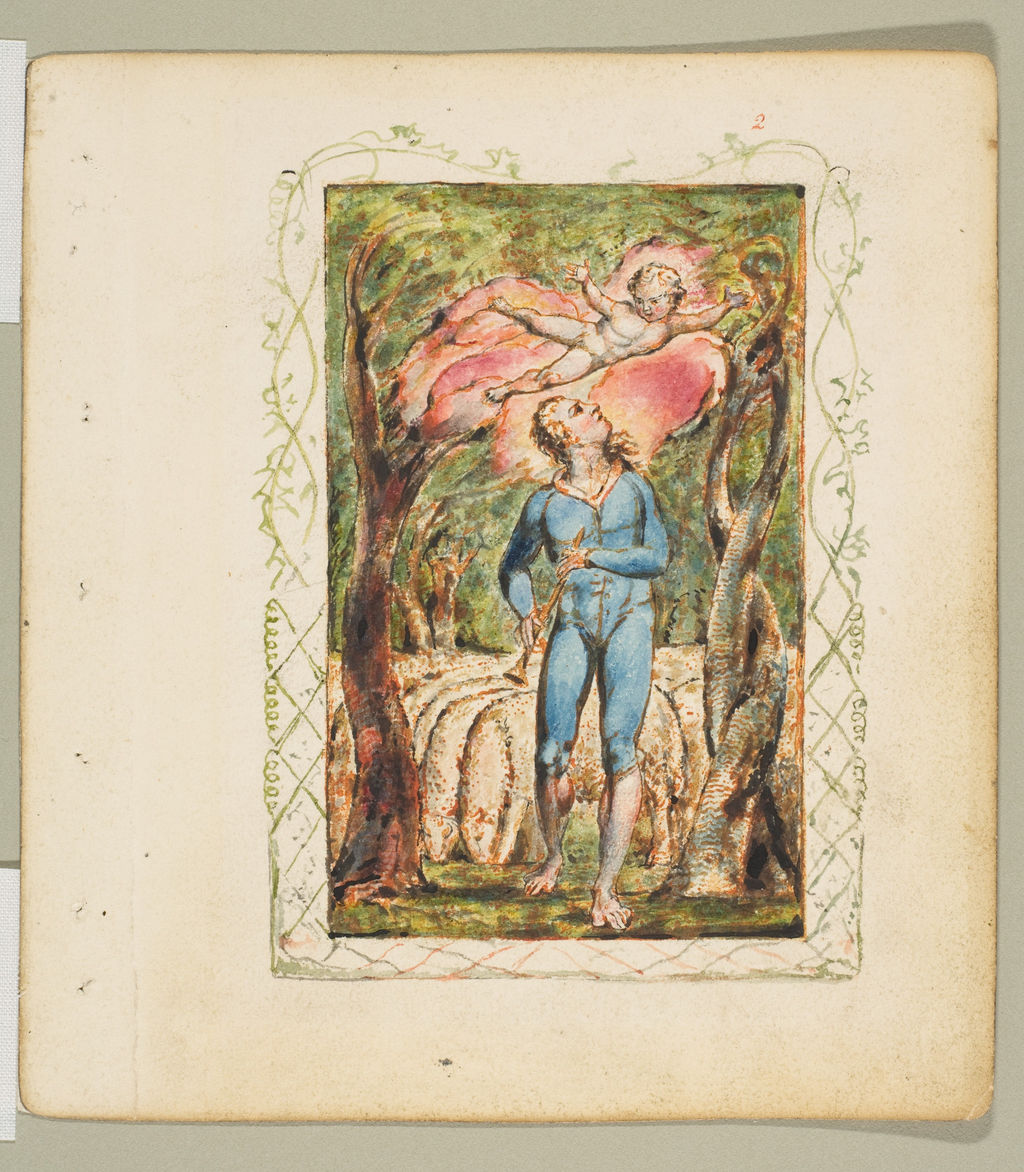
Songs of Innocence: frontispiece, copy Y, plate 2, Metropolitan Museum of Art, 17.10.2. Design 1789, printed c.1825.
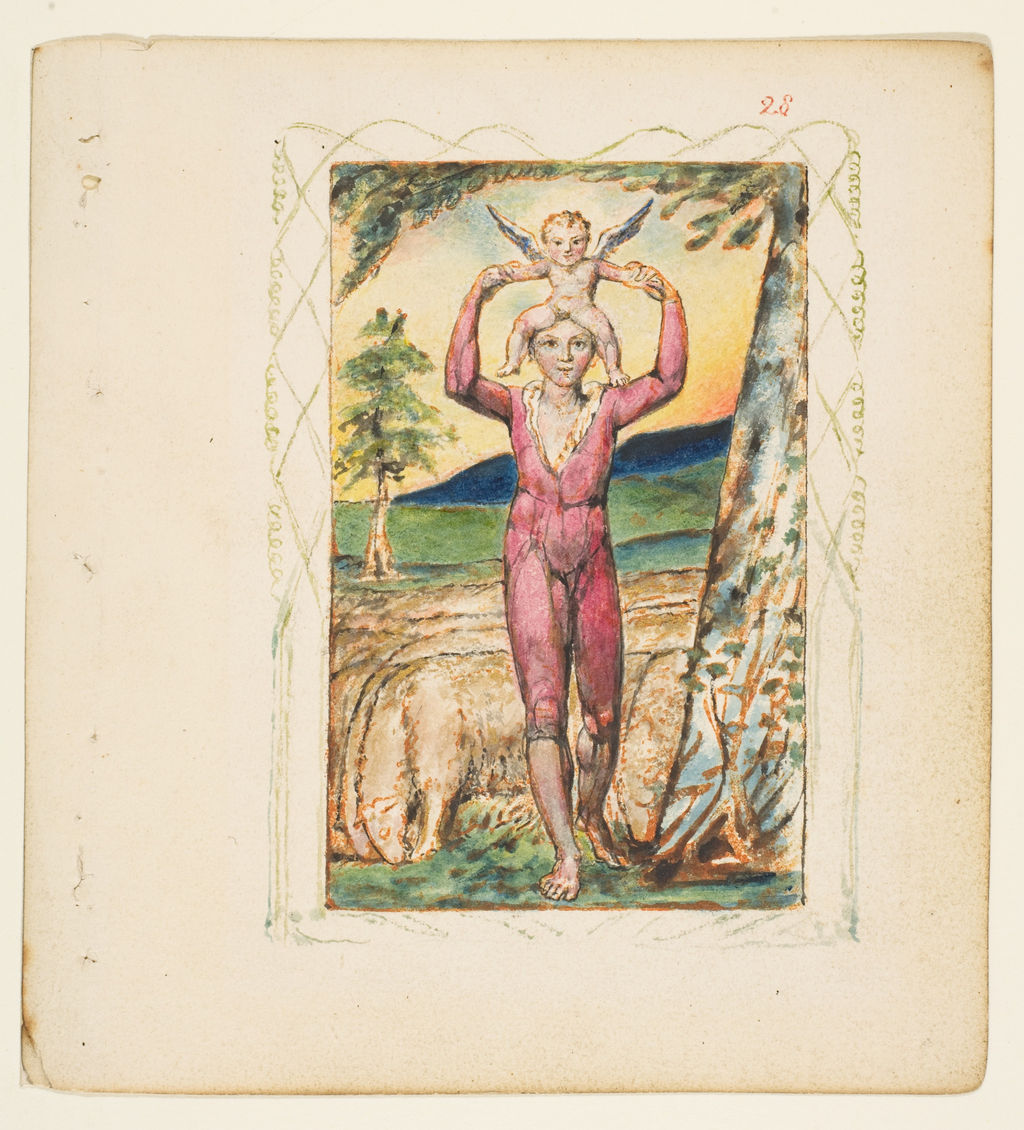
Songs of Experience: frontispiece, copy Y, plate 28, Metropolitan Museum of Art, 17.10.28. Design 1794, printed c.1825.
Two introductions and an answer
The two Introductions establish different kinds of address. The piper begins by responding to an encounter. He changes his activity when the child asks him to, and the resulting songs are offered for others to hear. The Experience introduction begins with an imperative to hear the Bard. This speaker claims a view of past, present and future, and calls upon Earth to return from her fall. The relation between speaker and listener has become more overtly authoritative. [1]
Yet the book does not leave that summons unanswered. Earth’s Answer follows with a voice speaking from confinement, darkness and despair. Earth attributes her imprisonment to a jealous and fearful power and asks whether spring can hide its joy, whether sowing happens in darkness, and whether a ploughman works only by night. Images of seasonal growth test the conditions under which she is being addressed. Her answer changes the scene from a call to rise into an account of what holds her down. [1]
The dialogue matters because a reader might otherwise receive the Bard’s address as the book’s final diagnosis. Earth’s response requires another hearing. The language of return sounds different when answered by a speaker who understands herself to be chained. Her appeal is for the breaking of a bond, and her questions invoke activities that need light, openness and freedom to grow. The answering poem does not merely repeat the introduction’s account from another angle. It makes the summons answerable to the experience of the one being summoned. [1]
The sequence also shows why Blake’s speakers deserve individual attention. A voice may sound prophetic without every part of its speech becoming an instruction from Blake to the reader. The book makes room for a response that alters the first voice’s claim. Its thinking happens between poems as well as inside them. Following the opening pair in order lets the reader experience that alteration, rather than collecting their most memorable lines as independent declarations. [1]
This gives the subtitle’s contraries a practical form. Two perspectives do not have to be arranged as a correct answer followed by a mistaken one. A comparison may disclose what a position can see, what it assumes and what its language leaves unheard. The brief poems make that work possible through changes of voice and situation. Their simplicity of diction can carry a demanding structure of listening, especially when the next page gives a voice to the person or world previously spoken about. [1]
Care and danger within Innocence
Night is a useful test of any assumption that Innocence means a world without harm. The poem begins with evening, birds at rest and the appearance of a radiant star. Angels visit the places where creatures sleep and attend to distress. But the guardians do not simply prevent every injury: when predators attack, they receive the spirits of the victims. The poem’s consolation exists alongside an acknowledgement that suffering has occurred. Its gentleness depends on sustained attention to vulnerability. [1]
The lion’s speech carries the poem towards another possibility. Pity draws tears from its eyes, and it imagines lying beside the lamb and guarding the fold. Predation gives way to companionship within the vision voiced by a former predator. The transformation matters because the poem has already allowed violence into its night landscape. A peaceful ending does not make the preceding danger unreal. It imagines a change in the creature capable of doing harm, rather than simply removing that creature from the scene. [1]
The poem therefore asks more of a reader than belief in an automatically safe pastoral world. It makes care active: watching, visiting, weeping, receiving and finally guarding. Its movement depends on the possibility that one being may attend to another’s suffering and become different through that attention. The lion’s promise is a response within the poem, with all the force and particularity of a speaker’s vow. It should be heard in that setting rather than reduced to a universal description of how the book’s world already works. [1]
On Another’s Sorrow gives a related pressure to compassion. Its repeated questions ask whether one can witness another’s grief without sharing it. Human responses lead towards the image of a divine presence that sits beside suffering, grieves and seeks to remove it. The poem’s argument proceeds through intimacy and participation. Its religious vision takes shape in acts of accompanying another being, rather than in the detached explanation of why pain was necessary. [1]
Read together, these poems make innocence capable of recognising need. Their reassuring forms need not be dismissed as merely naïve, but neither should reassurance be allowed to conceal the injuries they mention. The difference between attending to suffering and explaining it away is central to their effect. The songs’ small scale helps make that difference audible: a tear, a bedside visit or the sound of crying carries the weight of a much larger claim about how beings ought to live with one another. [1]
Watch: William Blake’s world and working methods
Choose an introduction to Blake, a printing demonstration, or a discussion of his radical ideas.
William Blake: Poet, Artist & Visionary - a genius of early Romanticism in England
An introduction to Blake’s art, poetry and imaginative world.
Watch on YouTubeA child’s speech and the page of A Little Boy Lost
A Little Boy Lost presents a much harsher encounter between a child’s voice and adult authority. Its opening gives the child a difficult thought about the limits of loving and knowing another person. He then asks his father how he can love him or his brothers more, comparing his love to that of a small bird taking crumbs near a door. The movement is tentative and intimate. An abstract question becomes a domestic image of dependence and nearness. [1]
A listening priest turns the speech into an offence. He seizes the child and displays him before the community, treating questioning as an attempt to judge religious mystery. The narrative then moves through the failure to hear the weeping child, the parents’ ineffective grief, binding and execution. The contrast is between a small voice trying to understand a relation and an institution that claims the power to decide what that voice means. The child’s words are preserved for the reader even as the story shows their suppression. [1]
The closing question asks whether such things happen on Albion’s shore. That question prevents the punishment from remaining safely enclosed in a distant tale. The poem turns towards the reader’s world and asks for recognition. It does not identify a particular recorded trial or supply a historical case file. Its force comes from the sequence it has made us follow: inquiry heard as threat, power exercised as piety, and public violence carried out despite the suffering plainly before it. [1]
The Met’s copy Y places that account inside a page whose beauty requires attention of its own. Orange-brown lettering fills most of a pale field. A tall, curling plant runs down the right, its leaves opening around the verse; blue, green and pink washes give it a vigorous life. The title extends across the top with large, varied capitals. The poem’s words occupy a made and tended space, even while they describe the destruction of a child. [10]
At the lower left, red and yellow flames rise beside clustered, bent bodies. Blue and purple clothing forms a dark mass across the bottom; pale heads and bowed backs give the group a weight very different from the rising plant. The eye that has followed the final question meets this compact scene of grief. The design neither illustrates every event nor labels every figure. Its forms make sorrow and danger physically present without turning the poem into a sequence of explanatory pictures. [10]
There is a tension between upward growth and downward bending. The stem carries colour along the right edge towards the title, while the figures press towards the ground. The reader can follow both movements without deciding that one cancels the other. In this page, ornament does not guarantee comfort. It surrounds words and bodies that make a severe demand on the viewer’s attention. The survival of brightness beside suffering is part of the design’s difficulty. [10]
The image also changes the poem’s final silence. No adult speaker arrives to explain the punishment away or announce a rescue. The grieving forms remain beneath the closing question. A reading that stops at the verbal argument misses the way the page holds the aftermath in view. A reading that treats the page only as a decorative object misses the accusation carried by the words. The two forms of attention need to remain in contact. [1][10]
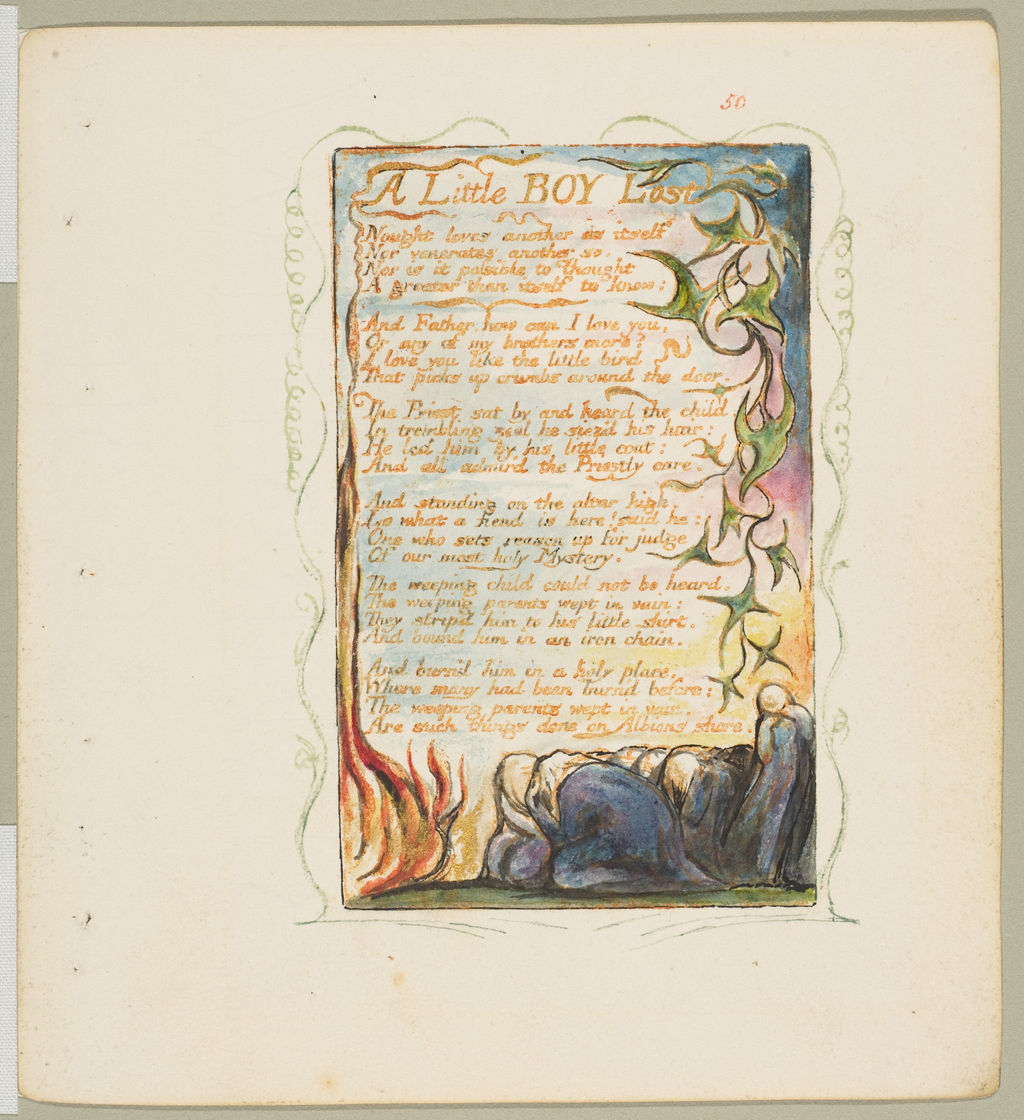
A Little Boy Lost, copy Y, plate 50, Metropolitan Museum of Art, 17.10.50. Design 1794, printed c.1825.
The Tyger as a designed page
The Tyger offers another revealing encounter between words and their setting. In copy Y, the poem rises above an animal standing at the bottom of the design. A large tree climbs the right side, with trunk and branches framing the verse; slender growth appears on the left. The animal is small in relation to the full page. Its striped body stands in profile, its face turned towards the viewer. The visual encounter is more compact and grounded than the immense acts of making imagined in the poem’s questions. [1][9]
That difference need not be solved by calling the picture a failure to illustrate the words. The poem repeatedly asks about a maker, the creature’s fearful form and the labour capable of bringing it into being. The image offers a visible animal whose body the reader can inspect, while leaving those questions intact. A printed creature cannot show every imagined furnace, weapon or act of daring named in the verse. Its presence gives those imaginings a particular scale and setting rather than a final explanation. [1][9]
Colour makes the whole page important. The warm lettering and striped animal share a range of orange and brown, while blue washes and the pale trunk give the right border a cooler character. The small areas of green ground tie the standing creature to the base of the page. Beyond the inner rectangle, fine loops turn along the margins. The eye moves from a readable poem to an animal, a tree and the worked edges of the paper. The title’s great creature is encountered within this carefully delimited space. [9]
Looking at an identified impression also guards against treating a familiar reproduction as the poem’s permanent appearance. Copy Y’s colouring belongs to its late making. The title, tree and tiger are parts of a repeatable design, yet this arrangement of washes, strengthened outlines and outer ornament is what this copy presents. A discussion of Blake’s animal gains precision when it identifies the visible page before judging the relation between the creature in the poem and the one below it. [2][9]
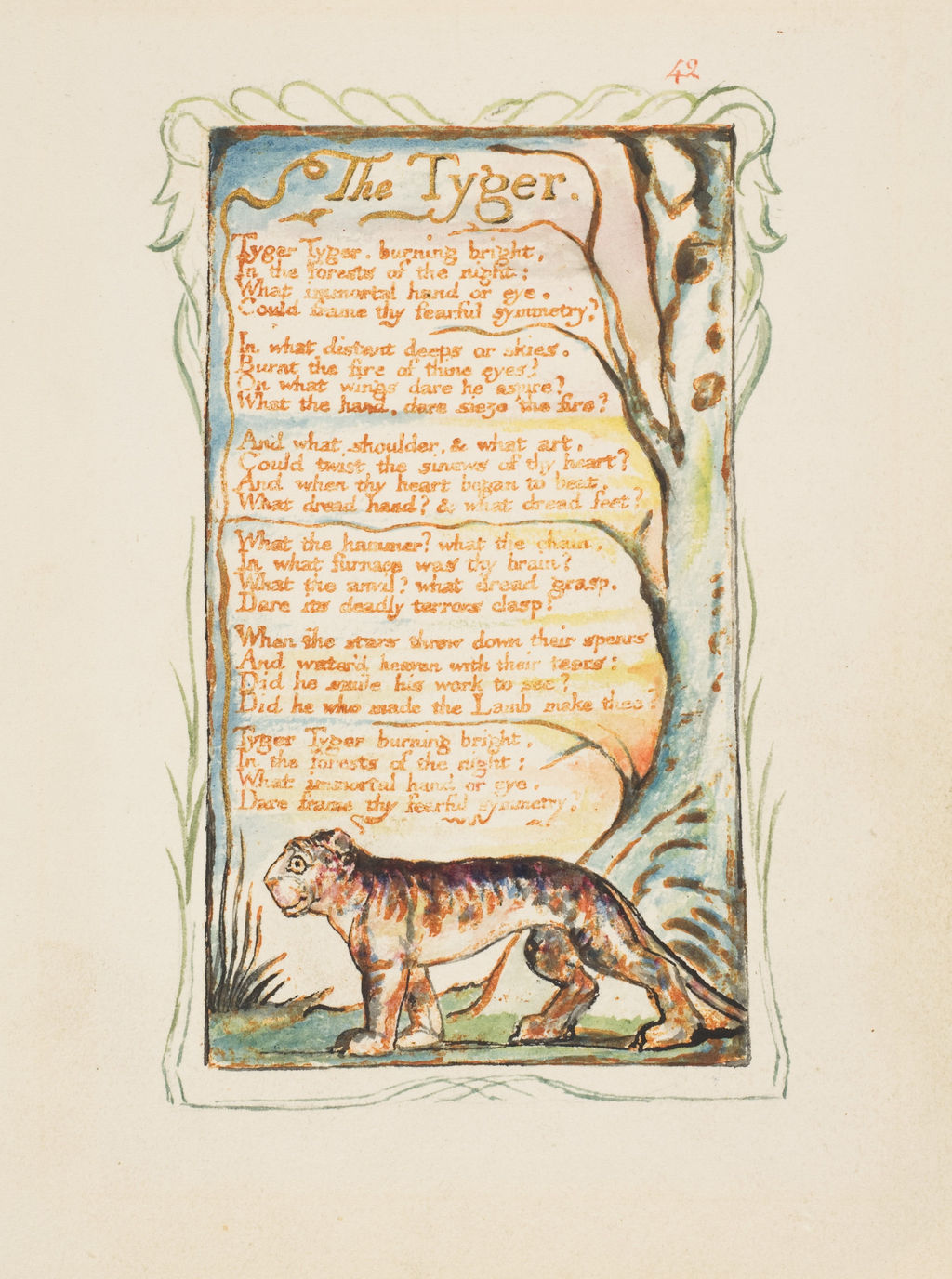
The Tyger, copy Y, plate 42, Metropolitan Museum of Art, 17.10.42. Design 1794, printed c.1825.
When poems change sides
The distinction between Innocence and Experience is further complicated by poems that appeared in different groupings. The National Gallery of Victoria holds Songs of Innocence copy X, a small group of fourteen impressions on seven sheets, coloured before 1794. Its records include The Little Girl Lost and The Little Girl Found, The Voice of the Ancient Bard and The School Boy. These titles can be encountered under Experience in the combined collection. An early book thus preserves a different setting for words that a later arrangement encourages us to read through another state. [1][5][12]
The School Boy shows why the change matters. The speaker loves the sounds and movement of a summer morning, but schooling turns that pleasure into anxiety and confinement. A caged bird and an injured plant become ways to ask what happens when growth is checked. The poem closes by connecting damage in spring with the failure of later fruit. Its argument follows a living sequence: early joy makes future flourishing possible, and oppression can interrupt the process. [1]
Within an Innocence gathering, the poem can sound like a defence of the conditions that permit delight to continue. Under Experience, its cages, restraints and warnings can take a more immediately accusatory place among other accounts of injury. Neither position changes its words into their opposite. Placement changes what a reader has recently heard and what other voices seem to answer it. The early NGV leaf makes this a material question about books, rather than only an abstract debate about what innocence ought to mean. [1][12]
The two Lyca poems bring a still more unsettling movement through danger. In The Little Girl Lost, the seven-year-old child sleeps among wild animals; a lion approaches her with tears and tenderness. In The Little Girl Found, her searching parents initially fear the creature, but the encounter changes when the lion appears as a golden spirit and leads them towards their daughter. The family’s eventual life with the beasts transforms the meaning of the wilderness through the course of the narrative. [1]
The tenderness is inseparable from strangeness. The child’s exposure, the animals’ actions and the parents’ fear make this an uneasy rescue to describe as a straightforward return to ordinary safety. The story instead changes the relation between human beings and the creatures they dread. Read beside Night, it gives another version of a lion whose behaviour exceeds the expectations attached to predation. The shared animal does different work in the two sequences, but both ask the reader to imagine altered relations between vulnerable and powerful beings. [1]
The fact that the Lyca sequence belongs to the early NGV Innocence group and to Experience in the combined text discourages an overly rigid classification. It does not establish that the two states mean the same thing. It shows that the poems’ relations can be reconsidered through arrangement. Readers can ask how the sequence changes its neighbours, as well as how its neighbours change it. The book’s organisation becomes one of the means by which it thinks. [1][5]
A book assembled across years
The Huntington’s copy E brings printing and later finishing into especially close contact. In the Blake Archive editors’ account, the volume was assembled for Thomas Butts in 1806 from impressions printed at several earlier dates. Extensive recolouring accompanied the retracing of weakly printed words. Making a readable page could require renewed pen work years after the impression came off the press. [6]
One striking example is the Experience poem Nurses Song. The Archive’s account identifies a double impression, with one printing displaced below and to the left of the other. The editors trace the doubled forms in details of vines and leaves. This is a particular printing event, not a change in the poem’s verbal argument. It gives the decorated margin another kind of evidence to carry: its marks help reconstruct how a page was made. [6]
The account also distinguishes Blake’s assembly from a posthumous leaf inserted by a later owner. A surviving volume can therefore record actions by more than one maker. Reading its contents involves understanding how the physical book arrived at its present form. [6]
A title page printed after Blake
A further distinction appears in Tate’s impressions of the Songs of Innocence title page, A00038 and A00039. Martin Butlin’s catalogue associates these grey impressions with a group thought to have been printed after Blake’s death, probably by Frederick Tatham. The evidence includes an 1831 watermark on another sheet in the group and similarities of paper and ink. The cautious attribution belongs to the impressions, not to the invention of the title-page design, which remains dated 1789. [13][14]
This creates a useful comparison with the Met’s coloured copy Y title page. The same underlying design can belong to objects with different printing histories and finishes. A reproduction labelled only with Blake’s name and 1789 may conceal that distinction. Identifying the Tate object number or the Met’s copy letter makes it possible to ask a more precise question about what is being shown: the design, a lifetime impression, a later printing, or a particular coloured page. [3][13][14]
Reading across the whole book
A rewarding route through Songs begins with the openings, then follows the poems in one identified sequence before turning to comparisons. The frontispieces establish relations between adult and child; the introductions establish voices; the answering poems test how those voices are heard. A page such as A Little Boy Lost then makes the treatment of a child’s speech inseparable from the way grief occupies the lower design. The book’s concerns recur through changing forms of encounter. [1][11][4][10]
Comparison is most useful when it returns to something visible or audible. The lion of Night and the lion in the Lyca sequence offer related transformations without becoming interchangeable symbols. The moved position of The School Boy changes the field around a poem whose words remain recognisable. The Met’s late colouring shows that the collection also has a life beyond the first making of its plates. Each return gives another reason to attend closely to the particular page. [1][2][5][12]
The songs remain approachable because their scenes are so concrete: a child asking, a piper listening, a bird confined, a body grieving, a creature standing below a tree. Their difficulty emerges through the relations between those scenes. Reading the book whole allows an apparent reassurance to meet a later challenge, or a threatening figure to become a guardian. Looking at its pages keeps that process tied to the small, intensely made objects through which Blake brought words and images together. [1][2][11][9][10]
Works and designs directory
Browse separate works, impressions and book components. Dates distinguish versions; six Tate copies after Blake are labelled. These records are not a complete catalogue of unique designs.
| Name | Date | Medium |
|---|---|---|
| A Figure Standing in a Gothic Apse, perhaps the Empress Maud. Verso: Detailed Drawings for ‘The Empress Maud in Bed’ | c.1819 | Pencil drawing |
| A Rolling Stone Is Ever Bare of Moss, from Thornton's "Pastorals of Virgil" | 1821 | Wood engraving |
| A Title Page for The Grave | 1806 | Watercolour |
| A Vision of the Last Judgment | 1808 | Watercolour |
| A Vision: The Inspiration of the Poet (Elisha in the Chamber on the Wall) | c.1819–20? | Watercolour |
| Adam and the Beasts, Frontispiece to Hayley's "Ballads" | June 1, 1802 | Engraving |
| Age Teaching Youth | c.1785–90 | Watercolour |
| Alfred and the Neat-Herd’s Wife (after Henry Fuseli) | 1797, published 1798 | Etching and engraving |
| An Allegory of the Bible. Verso: The Shins of an Écorché Male Figure | c.1780–5, ?c.1780 | Watercolour |
| Angel of the Divine Presence Bringing Eve to Adam (The Creation of Eve: "And She Shall be Called Woman) (recto); Sketch for the same (verso) | ca. 1803 | Watercolour |
| Angel of the Revelation (Book of Revelation, chapter 10) | ca. 1803–5 | Watercolour |
| Antaeus setting down Dante and Virgil in the Last Circle of Hell | 1824–1827 | Watercolour |
| Bathsheba at the Bath | c.1799–1800 | Tempera |
| Beatrice Addressing Dante from the Car | 1824–7 | Watercolour |
| Behemoth and Leviathan | 1825–26 | Engraving |
| Behemoth and Leviathan | 1825, reprinted 1874 | Engraving |
| Behemoth and Leviathan | 1826 | Engraving |
| Blasted Trees and Flattened Crops, from Thornton's "Pastorals of Virgil" | 1821 | Wood engraving |
| Boy Returning Joyfully, with Plough and Oxen, from Thornton's "Pastorals of Virgil" | 1821 | Wood engraving |
| Boy Returning Joyfully, with Plough and Oxen, from Thornton's "Pastorals of Virgil" | 1821 | Wood engraving |
| Catherine Blake. Verso: A Man’s Head and Other Drawings | c.1805 | Pencil drawing |
| Cerberus | 1824–7 | Watercolour |
| Cerberus (second version) | 1824–1827 | Watercolour |
| Chaucer’s Canterbury Pilgrims | 1810, reprinted before 1881 | Engraving |
| Christ Appearing to His Disciples After the Resurrection | c.1795 | Colour print |
| Christ Appearing to the Apostles after the Resurrection | c.1795 | Watercolour |
| Christ Blessing the Little Children | 1799 | Tempera |
| Christ in the Carpenter’s Shop: The Humility of the Saviour (after William Blake) | Date not stated | Watercolour |
| Ciampolo the Barrator Tormented by the Devils | 1826–7, reprinted 1892 | Engraving |
| Ciampolo the Barrator Tormented by the Devils | 1826–7, reprinted 1968 | Engraving |
| Circle of Theives: Agnello Brunelleschi Attacked By a Six-Footed Serpent | ca. 1825–27 | Engraving |
| Clarence's Dream (Shakespeare, Richard III, Act 1, Scene 4) | 1774 | Etching and engraving |
| Colinet Mocked by Two Boys, from Thornton's "Pastorals of Virgil" | 1821 | Wood engraving |
| Colinet Rests by a Stream at Night | c.1821, printed 1830 | Wood engraving |
| Colinet Rests by a Stream at Night | 1821, reprinted 1977 | Wood engraving |
| Colinet with his Shepherd’s Pipe, Mocked by Two Boys | c.1821, printed 1830 | Wood engraving |
| Colinet with his Shepherd’s Pipe, Mocked by Two Boys | 1821, reprinted 1977 | Wood engraving |
| Colinet's Journey, Milestone Marked 'LXII Miles to London', from Thornton's "Pastorals of Virgil" | 1821 | Wood engraving |
| Colinet's Journey: Milestone Marked 'LXII Miles to London', from Thornton's "Pastorals of Virgil" | 1821 | Wood engraving |
| Colinet’s Fond Desire Strange Lands to Know | 1821, reprinted 1977 | Wood engraving |
| Colinet’s ‘Fond Desire Strange Lands to Know’ | c.1821, printed 1830 | Wood engraving |
| Composition Sketch for ‘The Fall of the Rebel Angels’? Verso: Standing Figure with Flaming Hair | ?c.1805–10 | Pencil drawing |
| Composition Sketch, Possibly a Subject from Dante. Verso: A Man Standing over a Figure Reclining on a Bed | ?1824–7, ?c.1800–10 | Pencil drawing |
| Composition Sketch. Verso: Standing Figure Holding a Spear | ?c.1805–10 | Pencil drawing |
| Dante and Virgil Approaching the Angel Who Guards the Entrance of Purgatory | 1824–7 | Watercolour |
| Dante and Virgil Penetrating the Forest | 1824–7 | Watercolour |
| Dante in the Empyrean, Drinking at the River of Light | 1824–7 | Watercolour |
| Dante running from the Three Beasts | 1824–1827 | Watercolour |
| Dante Striking against Bocca Degli Abati | 1826–7, reprinted 1892 | Engraving |
| Dante Striking Against Bocca degli Abati | 1826–7, reprinted 1968 | Engraving |
| David Delivered out of Many Waters | c.1805 | Watercolour |
| David Delivered out of Many Waters (after William Blake) | Date not stated | Watercolour |
| Detailed Drawings for ‘A Figure Standing in a Gothic Apse’ | 1819 | Pencil drawing |
| Elohim Creating Adam | 1795–c.1805 | Colour print |
| Enoch | 1806–7 | Lithograph |
| Epitome of James Hervey’s ‘Meditations among the Tombs’ | c.1820–5 | Watercolour |
| Europe. A Prophecy; Frontispiece | ca. 1820 | Relief etching |
| Evening | c.1820/1825 | Watercolour |
| Every Man also Gave him a Piece of Money | 1825, reprinted 1874 | Engraving |
| Every Man also Gave him a Piece of Money. Verso: God the Father with Attendant Angels | c.1821–3 | Watercolour |
| Every One also Gave Him a Piece of Money | 1826 | Engraving |
| Fertilization of Egypt, from Erasmus Darwin's "The Botanic Garden" | 1791 | Engraving |
| First Book of Urizen pl. 10 | 1796, c.1818 | Etching |
| First Book of Urizen pl. 11 | 1796, c.1818 | Etching |
| First Book of Urizen pl. 15 | 1796, c.1818 | Etching |
| First Book of Urizen pl. 17 | 1796, c.1818 | Etching |
| First Book of Urizen pl. 21 | 1796, c.1818 | Etching |
| First Book of Urizen pl. 6 | 1796, c.1818 | Etching |
| Frontispiece to Jerusalem, the Emanation of the Great Albion | [ca. 1804–20] (?) | Engraving |
| Frontispiece to ‘Visions of the Daughters of Albion’ | c.1795 | Relief etching |
| Frontispiece: Thenot and Colinet | c.1821, printed 1830 | Wood engraving |
| George Cumberland's Message Card | 1827 | Engraving |
| God Judging Adam | ca. 1795 | Relief etching |
| God Judging Adam | 1795 | Relief etching |
| Hiding of Moses, from "Remember Me!, or a Pocket Companion" | 1825 | Engraving |
| Homer and the Ancient Poets | 1824–7 | Watercolour |
| Illustration 1 to Milton’s On the Morning of Christ’s Nativity: The Descent of Peace | c.1814–1816 | Watercolour |
| Illustration 1 to Milton’s Paradise Lost: Satan Calling Up His Legions | 1807 | Watercolour |
| Job accepting Charity | 1825–26 | Engraving |
| Job and his Daughters | 1825–26 | Engraving |
| Job and his Daughters | 1825, reprinted 1874 | Engraving |
| Job and His Daughters | 1826 | Engraving |
| Job and His Family | 1825–26 | Engraving |
| Job and his Family | Reprinted 1874; engraved 1828 date is an error | Engraving |
| Job and His Family | 1826 | Engraving |
| Job and his Family Restored to Prosperity | 1825, reprinted 1874 | Engraving |
| Job and his Wife restored to Prosperity | 1825–26 | Engraving |
| Job rebuked by his Friends | 1825–26 | Engraving |
| Job Rebuked by his Friends | 1825, reprinted 1874 | Engraving |
| Job Rebuked by His Friends | 1826 | Engraving |
| Job's Comforters | 1825–26 | Engraving |
| Job's Comforters | 1826 | Engraving |
| Job's Despair | 1825–26 | Engraving |
| Job's Evil Dreams | 1825–26 | Engraving |
| Job's Evil Dreams | 1826 | Engraving |
| Job's Sacrifice | 1825–26 | Engraving |
| Job's Sons and Daughters Overwhelmed by Satan | 1826 | Engraving |
| Job, his Wife and his Friends: The Complaint of Job. Verso: Job’s Wife and Eight Other Sketches | c.1785 | Watercolour |
| Job’s Comforters | 1825, reprinted 1874 | Engraving |
| Job’s Despair | 1825, reprinted 1874 | Engraving |
| Job’s Evil Dreams | 1825, reprinted 1874 | Engraving |
| Job’s Sacrifice | 1825, reprinted 1874 | Engraving |
| Job’s Sons and Daughters Overwhelmed by Satan | 1825, reprinted 1874 | Engraving |
| John Linnell | 1825 | Pencil drawing |
| Joseph of Arimathea Preaching to the Britons | c.1794/1796 | Relief etching |
| Judas Betrays Him | c.1803–5 | Watercolour |
| King John Absolved by Pandulph (after Henry Fuseli) | 1797, published 1798 | Etching and engraving |
| Lamech and his Two Wives | 1795 | Colour print |
| Landscape near Felpham | c.1800 | Watercolour |
| Lear and Cordelia in Prison | c.1779 | Watercolour |
| Los and Orc | c.1792–3 | Watercolour |
| Lower Half of a Woman Playing a Harp. Verso: Seraphim and Other Drawings | c.1785, c.?1807 | Pencil drawing |
| Menalcus Watching Women Dance, from Thornton's "Pastorals of Virgil" | 1821 | Wood engraving |
| Menalcus Watching Women Dance, from Thornton's "Pastorals of Virgil" | 1821 | Wood engraving |
| Moses Indignant at the Golden Calf | c.1799–1800 | Tempera |
| Nebuchadnezzar | 1795–c.1805 | Colour print |
| Newton | 1795–c.1805 | Colour print |
| Oberon, Titania and Puck with Fairies Dancing | c.1786 | Watercolour |
| Pity | ca. 1795 | Relief etching |
| Pity | c.1795 | Colour print |
| Plate 2 of ‘Urizen’: ‘Teach these Souls to Fly’ | ?1796 | Relief etching |
| Plate 3 of ‘Urizen’: Oh! Flames of Furious Desires’ (after William Blake) | Date not stated | Watercolour |
| Plate 4 of ‘Visions of the Daughters of Albion’ | c.1795 | Relief etching |
| Plutus | 1824–7 | Watercolour |
| Preliminary Sketch for ‘Christ Girding Himself with Strength’. Verso: Standing Figure with One Arm Raised | c.1805, c.1805–10 | Pencil drawing |
| Preludium. "The shadowy daughter of Urthona stood before red Orc..." (Plate 3) | 1793 | Relief etching |
| Queen Elizabeth and Essex (after Henry Fuseli) | 1797, published 1798 | Engraving |
| Sabrina's Silvery Flood, from Thornton's "Pastorals of Virgil" | 1821 | Wood engraving |
| Sabrina's Silvery Flood, from Thornton's "Pastorals of Virgil" | 1821 | Wood engraving |
| Sabrina’s Silvery Flood | c.1821, printed 1830 | Wood engraving |
| Sabrina’s Silvery Flood | 1821, reprinted 1977 | Wood engraving |
| Satan Before the Throne of God | 1825–26 | Engraving |
| Satan before the Throne of God | 1825, reprinted 1874 | Engraving |
| Satan before the Throne of God | 1826 | Engraving |
| Satan calling up his Legions | c.1800–05 | Tempera |
| Satan Exulting over Eve | c.1795 | Colour print |
| Satan Going Forth from the Presence of the Lord, and Job’s Charity | 1825, reprinted 1874 | Engraving |
| Satan Going Forth fron the Presence of the Lord | 1825–26 | Engraving |
| Satan in his Original Glory: ‘Thou wast Perfect till Iniquity was Found in Thee’ | c.1805 | Watercolour |
| Satan Smiting Job with Boils | 1825–26 | Engraving |
| Satan Smiting Job with Sore Boils | 1825, reprinted 1874 | Engraving |
| Satan Smiting Job with Sore Boils | c.1826 | Tempera |
| Satan Smiting Job with Sore Boils | 1826 | Engraving |
| Shepherd Chases Away a Wolf, from Thornton's "Pastorals of Virgil" | 1821 | Wood engraving |
| Shepherd Chases Away a Wolf, from Thornton's "Pastorals of Virgil" | 1821 | Wood engraving |
| Sketch for the Title-Page of the Engraved Illustrations to the Book of Job | c.1823/1826 | Pencil drawing |
| Sketch for ‘The Four and Twenty Elders Casting their Crowns before the Divine Throne’. Verso: Standing Figure with Arms at his Side | c.1803, c.1805–10 | Pencil drawing |
| Sketch for ‘Tiriel Supporting the Dying Myratana’. Verso: Sketch for ‘Tiriel Supporting the Dying Myratana’ | c.1786–9 | Pencil drawing |
| Songs of Experience: A Little Boy Lost | [1794] printed ca. 1825 | Relief etching |
| Songs of Experience: A Little Girl Lost | [1794] printed ca. 1825 | Relief etching |
| Songs of Experience: A Poison Tree | [1794] printed ca. 1825 | Relief etching |
| Songs of Experience: Earth's Answer | [1794] printed ca. 1825 | Relief etching |
| Songs of Experience: Frontispiece | [1794] printed ca. 1825 | Relief etching |
| Songs of Experience: Holy Thursday | [1794] printed ca. 1825 | Relief etching |
| Songs of Experience: Infant Sorrow | [1794] printed ca. 1825 | Relief etching |
| Songs of Experience: Introduction | [1794] printed ca. 1825 | Relief etching |
| Songs of Experience: London | [1794] printed ca. 1825 | Relief etching |
| Songs of Experience: My Pretty Rose Tree, Ah! Sun-Flower, The Lilly | [1794] printed ca. 1825 | Relief etching |
| Songs of Experience: Nurses Song | [1794] printed ca. 1825 | Relief etching |
| Songs of Experience: The Angel | [1794] printed ca. 1825 | Relief etching |
| Songs of Experience: The Chimney Sweeper | [1794] printed ca. 1825 | Relief etching |
| Songs of Experience: The Clod & the Pebble | [1794] printed ca. 1825 | Relief etching |
| Songs of Experience: The Fly | [1794] printed ca. 1825 | Relief etching |
| Songs of Experience: The Garden of Love | [1794] printed ca. 1825 | Relief etching |
| Songs of Experience: The Human Abstract | [1794] printed ca. 1825 | Relief etching |
| Songs of Experience: The Little Girl Found (second plate) | [1789] printed ca. 1825 | Relief etching |
| Songs of Experience: The Little Girl Lost | [1789] printed ca. 1825 | Relief etching |
| Songs of Experience: The Little Girl Lost (second plate); The Little Girl Found | [1789] printed ca. 1825 | Relief etching |
| Songs of Experience: The Little Vagabond | [1794] printed ca. 1825 | Relief etching |
| Songs of Experience: The School Boy | [1789] printed ca. 1825 | Relief etching |
| Songs of Experience: The Sick Rose | [1794] printed ca. 1825 | Relief etching |
| Songs of Experience: The Tyger | [1794] printed ca. 1825 | Relief etching |
| Songs of Experience: The Voice of the Ancient Bard | [1789] printed ca. 1825 | Relief etching |
| Songs of Experience: Title-page | [1794] printed ca. 1825 | Relief etching |
| Songs of Experience: To Tirzah | [1794] printed ca. 1825 | Relief etching |
| Songs of Innocence and of Experience, Shewing the Two Contrary States of the Human Soul: Combined Title-page | [1789–94] printed ca. 1825 | Relief etching |
| Songs of Innocence and of Experience: Infant Sorrow | 1794, reprinted 1831 or later | Relief etching |
| Songs of Innocence: A Cradle Song | [1789] printed ca. 1825 | Relief etching |
| Songs of Innocence: A Cradle Song (second plate) | [1789] printed ca. 1825 | Relief etching |
| Songs of Innocence: A Dream | [1794] printed ca. 1825 | Relief etching |
| Songs of Innocence: Frontispiece | [1789] printed ca. 1825 | Relief etching |
| Songs of Innocence: Holy Thursday | [1789] printed ca. 1825 | Relief etching |
| Songs of Innocence: Infant Joy | [1789] printed ca. 1825 | Relief etching |
| Songs of Innocence: Introduction | [1789] printed ca. 1825 | Relief etching |
| Songs of Innocence: Laughing Song | [1789] printed ca. 1825 | Relief etching |
| Songs of Innocence: Little Boy Lost | [1789] printed ca. 1825 | Relief etching |
| Songs of Innocence: Night | [1789] printed ca. 1825 | Relief etching |
| Songs of Innocence: Night (second plate) | [1789] printed ca. 1825 | Relief etching |
| Songs of Innocence: Nurse's Song | [1789] printed ca. 1825 | Relief etching |
| Songs of Innocence: On Anothers Sorrow | [1789] printed ca. 1825 | Relief etching |
| Songs of Innocence: Spring | [1789] printed ca. 1825 | Relief etching |
| Songs of Innocence: Spring (second plate) | [1789] printed ca. 1825 | Relief etching |
| Songs of Innocence: The Blossom | [1789] printed ca. 1825 | Relief etching |
| Songs of Innocence: The Chimney Sweeper | [1789] printed ca. 1825 | Relief etching |
| Songs of Innocence: The Divine Image | [1789] printed ca. 1825 | Relief etching |
| Songs of Innocence: The Ecchoing Green | [1789] printed ca. 1825 | Relief etching |
| Songs of Innocence: The Ecchoing Green (second plate) | [1789] printed ca. 1825 | Relief etching |
| Songs of Innocence: The Lamb | [1789] printed ca. 1825 | Relief etching |
| Songs of Innocence: The Little Black Boy | [1789] printed ca. 1825 | Relief etching |
| Songs of Innocence: The Little Black Boy (second plate) | [1789] printed ca. 1825 | Relief etching |
| Songs of Innocence: The Little Boy Found | [1789] printed ca. 1825 | Relief etching |
| Songs of Innocence: The Shepherd | [1789] printed ca. 1825 | Relief etching |
| Songs of Innocence: Title Page | [1789] printed ca. 1825 | Relief etching |
| St Christopher, Copy from an Engraving? Verso:Part of a Face: Copy from a Plaster Cast: a Daughter of Niobe? | ?c.1779–80 | Pencil drawing |
| The Agony in the Garden | c.1799–1800 | Tempera |
| The Angel Appearing to Zacharias | 1799–1800 | Tempera |
| The Ascent of the Mountain of Purgatory | 1824–7 | Watercolour |
| The Baffled Devils Fighting | 1826–7, reprinted 1892 | Engraving |
| The Baffled Devils Fighting | 1826–7, reprinted 1968 | Engraving |
| The Bard, from Gray | ?1809 | Tempera |
| The Beggar's Opera, Act III | July 1, 1790 | Etching and engraving |
| The Beggar's Opera, Act III | July 1, 1790 | Engraving |
| The Beggar's Opera, Act III | 1790 | Engraving |
| The Blasphemer | c.1800 | Watercolour |
| The Blighted Corn | c.1821, printed 1830 | Wood engraving |
| The Blighted Corn | 1821, reprinted 1977 | Wood engraving |
| The Body of Abel Found by Adam and Eve | c.1826 | Tempera |
| The Body of Christ Borne to the Tomb | c.1799–1800 | Tempera |
| The Book of Job: Title Page | 1825 | Engraving |
| The Book of Thel pl. 6 | 1796, c.1818 | Etching |
| The Circle of Corrupt Officials: The Devils Mauling Each Other | ca. 1825–27 | Engraving |
| The Circle of Corrupt Officials: The Devils Tormenting Ciampolo | ca. 1825–27 | Engraving |
| The Circle of the Lustful: Francesca da Rimini (‘The Whirlwind of Lovers’) | 1826–7, reprinted 1892 | Engraving |
| The Circle of the Lustful: Francesca da Rimini (‘The Whirlwind of Lovers’) | 1826–7, reprinted 1968 | Engraving |
| The Circle of the Lustful: Paolo and Francesca | ca. 1825–27 | Engraving |
| The Circle of the Thieves; Buoso Donati Attacked by the Serpent | ca. 1825–27 | Engraving |
| The Circle of Traitors: Dante's Foot Striking Bocca degli Abbate | ca. 1825–27 | Engraving |
| The Complaint and the Consolation; or, Night Thoughts | 1797 | Etching and engraving |
| The Creation | 1825–26 | Engraving |
| The Crucifixion | c.1825–7 | Pencil drawing |
| The Crucifixion: ‘Behold Thy Mother’ | c.1805 | Watercolour |
| The Dance of Albion (Glad Day) | c.1803/1810 | Engraving |
| The Death of Lucretia, from Allen's "New and Impartial Roman History" | 1797 | Engraving |
| The Death of Saint Joseph | 1803 | Watercolour |
| The Death of the Virgin | 1803 | Watercolour |
| The Descent of Peace [recto] | c.1815 | Pencil drawing |
| The Destruction of Job's Sons | 1825–26 | Engraving |
| The Devils, with Dante and Virgil by the Side of the Pool | 1824–7 | Watercolour |
| The Entombment | c.1805 | Watercolour |
| The Fall of Rosamond (after Thomas Stothard) | 1783 | Etching and engraving |
| The Fall of Satan | 1825–26 | Engraving |
| The Fall of Satan | 1825, reprinted 1874 | Engraving |
| The Fall of Satan | 1826 | Engraving |
| The Four and Twenty Elders Casting their Crowns before the Divine Throne | c.1803–5 | Watercolour |
| The Ghost of a Flea | c.1819–20 | Tempera |
| The Good and Evil Angels | 1795–?c.1805 | Colour print |
| The Good Farmer, Probably the Parable of the Wheat and the Tares. Verso: Rough Sketch of Two or Three Figures in a Landscape | c.1780–5 | Watercolour |
| The Great Red Dragon and the Beast from the Sea | c.1805 | Watercolour |
| The Great Red Dragon and the Woman Clothed with the Sun | c.1805 | Watercolour |
| The Head of the Ghost of a Flea. Verso: A Profile and a Reduced Drawing of Milton’s First Wife | c.1819 | Pencil drawing |
| The Hermit’s Dog, from William Hayley’s "Ballads" | 1805 | Etching and engraving |
| The Hiding of Moses | 1824 | Engraving |
| The House of Death | 1795–c.1805 | Colour print |
| The House of Death | c.1790 | Watercolour |
| The Hypocrites with Caiaphas. Verso: Sketch of a Stooping Figure | 1824–7 | Watercolour |
| The Inscription over the Gate | 1824–7 | Watercolour |
| The Laborious Passage along the Rocks | 1824–7 | Watercolour |
| The Last Trumpet (recto); Two studies of a right eye, a profile of an open-mouthed young man, the head of an eagle, and the head of a lion (verso) | 1780–85 | Pencil drawing |
| The Lord Answering Job out of the Whirlwind | 1825–26 | Engraving |
| The Lord Answering Job out of the Whirlwind | 1825, reprinted 1874 | Engraving |
| The Man Who Taught Blake Painting in his Dreams (counterproof) (after William Blake) | after c.1819–20 | Pencil drawing |
| The Marriage of Heaven and Hell pl. 16 | 1796, c.1818 | Etching |
| The Messengers tell Job of his Misfortunes | 1825–26 | Engraving |
| The Messengers tell Job of his Misfortunes | 1825, reprinted 1874 | Engraving |
| The Night of Enitharmon’s Joy (formerly called ‘Hecate’) | c.1795 | Colour print |
| The Parable of the Wise and Foolish Virgins | ca. 1799–1800 | Watercolour |
| The Parable of the Wise and Foolish Virgins (after William Blake) | Date not stated | Watercolour |
| The Pastorals of Virgil, with a Course of English Reading, Adapted for Schools, Vol. I | 1821 | Wood engraving |
| The Penance of Jane Shore in St Paul’s Church | c.1793 | Watercolour |
| The Pit of Disease: The Falsifiers | 1826–7, reprinted 1892 | Engraving |
| The Pit of Disease: The Falsifiers | 1824–7 | Watercolour |
| The Pit of Disease: The Falsifiers | 1826–7, reprinted 1968 | Engraving |
| The Primaeval Giants Sunk in the Soil | 1824–7 | Watercolour |
| The Punishment of the Thieves | 1824–7 | Watercolour |
| The Raising of Lazarus (after William Blake) | Date not stated | Watercolour |
| The Rest on the Flight into Egypt (The Repose of the Holy Family in Egypt) | 1806 | Watercolour |
| The River of Life | c.1805 | Watercolour |
| The Rock Sculptured with the Recovery of the Ark and the Annunciation | 1824–7 | Watercolour |
| The Serpent Attacking Buoso Donati | 1826–7, reprinted 1892 | Engraving |
| The Serpent Attacking Buoso Donati | 1826–7, reprinted 1968 | Engraving |
| The Serpent Attacking Buoso Donati. Verso: A Man with a Transparent Hood (?) over his Head | 1824–7 | Watercolour |
| The Simoniac Pope | 1824–7 | Watercolour |
| The Six-Footed Serpent Attacking Agnolo Brunelleschi | 1826–7, reprinted 1892 | Engraving |
| The Six-Footed Serpent Attacking Agnolo Brunelleschi | 1826–7, reprinted 1968 | Engraving |
| The Soul Hovering over the Body Reluctantly Parting with Life | c.1805 | Pencil drawing |
| The Spiritual Form of Nelson Guiding Leviathan | c.1805–9 | Tempera |
| The Spiritual Form of Pitt Guiding Behemoth | ?1805 | Tempera |
| The Sun at His Eastern Gate | c.1816–1820 | Watercolour |
| The Temple of Mirth, after Thomas Stothard | 1784 | Engraving |
| The Temptation and Fall of Eve | 1807 | Watercolour |
| The Temptation and Fall of Eve (Illustration to Milton’s Paradise Lost) | 1808 | Watercolour |
| The Thieves and Serpents | 1824–1827 | Watercolour |
| The Vision of Christ | 1825, reprinted 1874 | Engraving |
| The Vision of Eliphaz | 1825–26 | Engraving |
| The Vision of Eliphaz | 1825, reprinted 1874 | Engraving |
| The Vision of God | 1825–26 | Engraving |
| The Wood of the Self-Murderers: The Harpies and the Suicides | 1824–7 | Watercolour |
| The Wrath of Elihu | 1825–26 | Engraving |
| The Wrath of Elihu | 1825, reprinted 1874 | Engraving |
| Thenot and Colinet | 1821, reprinted 1977 | Wood engraving |
| Thenot and Colinet at Supper | c.1821, printed 1830 | Wood engraving |
| Thenot and Colinet at Supper | 1821, reprinted 1977 | Wood engraving |
| Thenot and Colinet Converse Seated between Two Trees | c.1821, printed 1830 | Wood engraving |
| Thenot and Colinet Converse Seated between Two Trees | 1821, reprinted 1977 | Wood engraving |
| Thenot and Colinet Eat Their Evening Meal, from Thornton's "Pastorals of Virgil" | 1821 | Wood engraving |
| Thenot and Colinet Folding their Flocks together at Sunset | c.1821, printed 1830 | Wood engraving |
| Thenot and Colinet Folding their Flocks together at Sunset | 1821, reprinted 1977 | Wood engraving |
| Thenot and Colinet Lead Their Flocks Together, from Thornton's "Pastorals of Virgil" | 1821 | Wood engraving |
| Thenot and Colinet Lead Their Flocks Together, from Thornton's "Pastorals of Virgil" | 1821 | Wood engraving |
| Thenot Remonstrates with Colinet | c.1821, printed 1830 | Wood engraving |
| Thenot Remonstrates with Colinet | 1821, reprinted 1977 | Wood engraving |
| Thenot Remonstrates With Colinet, from Thornton's "Pastorals of Virgil" | 1821 | Wood engraving |
| Thenot Remonstrates With Colinet, from Thornton's "Pastorals of Virgil" | 1821 | Wood engraving |
| Thenot Remonstrates with Colinet, Lightfoot in the Background, from Thornton's "Pastorals of Virgil" | 1821 | Wood engraving |
| Thenot Remonstrates with Colinet: Lightfoot in the Distance | 1821, reprinted 1977 | Wood engraving |
| Thenot Remonstrates with Colinet; Lightfoot in the Distance | c.1821, printed 1830 | Wood engraving |
| Thenot Under a Fruit Tree, from Thornton's "Pastorals of Virgil" | 1821 | Wood engraving |
| Thenot, with Colinet Waving his Arms in Sorrow | c.1821, printed 1830 | Wood engraving |
| Thenot, with Colinet Waving his Arms in Sorrow | 1821, reprinted 1977 | Wood engraving |
| Title Page: Illustrations of the Book of Job | 1825–26 | Engraving |
| Title-Page of ‘The Book of Job’ | 1825, reprinted 1874 | Engraving |
| Tornado–Zeus Battling Typhon, from Erasmus Darwin's "Botanic Garden" | August 1, 1795 | Engraving |
| Tornado–Zeus Battling Typhon, from Erasmus Darwin's "The Botanic Garden" | August 1, 1795 | Engraving |
| Two Figures in a Decorative Border | c.1790 | Pencil drawing |
| Unyok'd Heifers, Loitering Homeward (Return of the Shepherd), from Thornton's "Pastorals of Virgil" | 1821 | Wood engraving |
| Virgil Girding Dante’s Brow with a Rush | 1824–7 | Watercolour |
| Wat Tyler and the Tax-Gatherer (after Henry Fuseli) | 1797, published 1798 | Etching and engraving |
| When the Morning Stars Sang Together | 1825, reprinted 1874 | Engraving |
| When the Morning Stars Sang Together | 1826 | Engraving |
| Winged Figure Flying Through Clouds, from Bell's "Poets" | 1790 | Etching and engraving |
| Winter | c.1820–5 | Tempera |
| ‘A Rolling Stone is ever Bare of Moss’ | c.1821, printed 1830 | Wood engraving |
| ‘A Rolling Stone is ever Bare of Moss’ | 1821, reprinted 1977 | Wood engraving |
| ‘And Unyok’d Heifers, Loitering Homeward, Low’ | c.1821, printed 1830 | Wood engraving |
| ‘And Unyok’d Heifers, Loitering Homewards, Low’ | 1821, reprinted 1977 | Wood engraving |
| ‘Europe’: Fragment of Pages 3 and 4 | 1794–c.1830–5 | Relief etching |
| ‘For him Our Yearly Wakes and Feasts We Hold’ | c.1821, printed 1830 | Wood engraving |
| ‘For him Our Yearly Wakes and Feasts We Hold’ | 1821, reprinted 1977 | Wood engraving |
| ‘Nor Fox, nor Wolf, nor Rat among our Sheep’ | c.1821, printed 1830 | Wood engraving |
| ‘Nor Fox, nor Wolf, nor Rat among our Sheep’ | 1821, reprinted 1977 | Wood engraving |
| ‘Songs of Innocence and of Experience’: ‘Infant Sorrow’ | 1794, reprinted 1831 or later | Relief etching |
| ‘Songs of Innocence and of Experience’: ‘Spring’ | 1794, reprinted 1831 or later | Relief etching |
| ‘Songs of Innocence’: Title-Page | 1789, reprinted 1831 or later | Relief etching |
| ‘Songs of Innocence’: Title-Page | 1789, reprinted 1831 or later | Relief etching |
| ‘With Songs the Jovial Hinds Return from Plow’ | c.1821, printed 1830 | Wood engraving |
| ‘With Songs the Jovial Hinds Return from Plow’ | 1821, reprinted 1977 | Wood engraving |
Frequently Asked Questions
The poems resist that simple division. Night includes violence within Innocence, while its lion imagines becoming a guardian. Changes of voice and arrangement make the two states subjects for comparison rather than fixed lists of happy and unhappy events. [1]
Discussion
Look again at the images and ideas explored in Songs of Innocence and of Experience by William Blake. These editorial prompts invite your observations.
Reader Insights
The original title date remains visible in a later impression. Both the work’s beginning and the physical sheet’s later making matter.
The piper changes his activity at a child’s request; the Bard commands an audience to hear. The introductions establish different kinds of authority.
Poems can change their surroundings when they change collections. NGV copy X preserves an early setting for titles later grouped with Experience.
Join the Conversation
Share a detail, comparison or question about Songs of Innocence and of Experience by William Blake below.
References
- William Blake. Songs of Innocence and of Experience, David V. Erdman, ed., The Complete Poetry and Prose of William Blake, electronic transcription hosted by Arizona State University, E7–32. Complete poem texts consulted; passages discussed include both Introductions, Earth’s Answer, Night, On Another’s Sorrow, A Little Boy Lost, The Tyger, The School Boy, The Little Girl Lost and The Little Girl Found. View source.
- William Blake; Metropolitan Museum of Art. Songs of Innocence and of Experience: Shewing the Two Contrary States of the Human Soul, copy Y, plates 1–54, 17.10.1–54; overall record, and Combined Title Page, plate 1, 17.10.1, designs 1789–94, printed around 1825. Whole-page image of plate 1 consulted for visual discussion. View collection record · View title page View source 1. View source 2.
- William Blake; Metropolitan Museum of Art. Songs of Innocence: Title Page, copy Y, plate 3, 17.10.3, design 1789, printed around 1825. Current record and whole-page image consulted. View source.
- William Blake; Metropolitan Museum of Art. Songs of Experience: Frontispiece, copy Y, plate 28, 17.10.28, design 1794, printed around 1825. Current record, curatorial account of Calvert and page numbering, and whole-page image consulted. View source.
- National Gallery of Victoria. Songs of Innocence, copy X, P122.1–14-1988, relief etchings, 1789, hand-coloured before 1794; current series and component record text, supplemented by the museum’s 1999 exhibition section description of fourteen impressions on seven sheets. View collection record · View exhibition section View source 1. View source 2.
- Morris Eaves, Robert N. Essick and Joseph Viscomi, editors, William Blake Archive. Publication Announcement: Songs of Innocence and of Experience, Copy E, 1 November 2011. Complete announcement consulted for the Huntington copy’s early impressions, 1806 assembly and refinishing, duplicated and missing poems, double printing and later insertion. View source.
- Joseph Viscomi. Blake’s Invention of Illuminated Printing, 1788, BRANCH: Britain, Representation and Nineteenth-Century History. Selected technical and historical argument, especially opening account of relief etching and the concluding discussion of direct work on copper, invention and later printing. View source.
- William Blake. To the Public, prospectus dated 10 October 1793, paragraphs 1–7 and numbered sale list, especially items 7–8; in David V. Erdman, ed., The Complete Poetry and Prose of William Blake, E692–693. View source.
- William Blake; Metropolitan Museum of Art. The Tyger, copy Y, plate 42, 17.10.42, design 1794, printed around 1825. Current record and whole-page image consulted. View source.
- William Blake; Metropolitan Museum of Art. A Little Boy Lost, copy Y, plate 50, 17.10.50, design 1794, printed around 1825. Current record and full-page digital image consulted for lettering, vegetation, colour and lower figure group. View source.
- William Blake; Metropolitan Museum of Art. Songs of Innocence: Frontispiece, copy Y, plate 2, 17.10.2, design 1789, printed around 1825. Current record and whole-page image consulted. View source.
- William Blake; National Gallery of Victoria. The School Boy, Songs of Innocence copy X, leaf 7 verso, P122.14-1988, 1789, hand-coloured before 1794. Object record text consulted for this leaf’s place within the early group. View source.
- Martin Butlin; Tate. Songs of Innocence: Title Page, A00038, in William Blake 1757–1827, Tate Gallery Collections V, 1990, online catalogue entry published 22 September 2004. Posthumous printing assessment and group watermark evidence. View source.
- Martin Butlin; Tate. Songs of Innocence: Title Page, A00039, in William Blake 1757–1827, Tate Gallery Collections V, 1990, online catalogue entry published 22 September 2004; display caption, 18 August 2004. Second grey impression and distinction between design and later printing. View source.


