


 by Tom Gurney
Tom Gurney BSc (Hons) is an art history expert with over 20 years experience
Published on / Updated on
Email: tomgurney1@gmail.com / Phone: +44 7429 011000
William Blake’s Late Years and John Linnell: Introduction
In July 1826 William Blake was planning what to take to Hampstead. Besides a change of clothes, he proposed bringing his book of Dante drawings and a copperplate tucked inside it. The luggage would fit in a coach; the difficulty was whether his weakened body could bear the journey. He thanked John Linnell for arranging accommodation, worried about the expense, and looked forward to being with his friend’s family. Work, money, illness and affection occupy the same short letter. Together they describe the friendship that sustained much of Blake’s final decade. [1]
Linnell’s help reached into several parts of that life. He bought work, commissioned new projects, introduced potential customers and younger artists, and welcomed Blake into a household with children. Their relationship also included the judgement of one artist by another. Blake could ask for Linnell’s suggestions about a plate, congratulate him on professional success, or refuse an arrangement that frightened him. The letters preserve a friendship with practical obligations and room for disagreement. Their warmth grows from the things these two artists did for one another. [1] [2]
At a Glance
- MeetingBlake and Linnell, 1818 [2]
- Home and workshopFountain Court from 1821 [2][3]
- Death12 August 1827, aged sixty-nine [4][5]
Contents
- A friendship begins with an engraving
- New work through a widening circle
- A finished book still needed buyers
- Fountain Court and Sundays at Hampstead
- Faces preserved by the friendship
- What the younger artists found
- Illness and a move repeatedly postponed
- Dante, Catherine and the last months
- Death and the care of what remained
A friendship begins with an engraving
John Linnell was born in 1792, thirty-five years after Blake. When they met in 1818, the younger man was building a career as a painter and engraver. Blake had already made his major illuminated books, exhibited his paintings and spent decades working for publishers. Their acquaintance began in that professional world. In autobiographical notes later transmitted by his son, Linnell remembered visiting Blake with the younger George Cumberland at the rooms in South Molton Street. He then employed him on an engraving after his portrait of James Upton, a Baptist minister. [2]
Arthur Symons, printing this recollection in his 1907 study, also identifies 24 June 1818 as the first entry concerning Blake in Linnell’s journal. The evidence fixes a dated beginning for their recorded business, while the autobiographical account explains the introduction. We need not imagine the exact conversation at their first meeting. The portrait and its copperplate gave the artists something specific to work on together. A relationship later associated with biblical visions began through the ordinary division of an engraver’s labour. [2]
Linnell’s remembered account says that Blake had too little employment at the prices available to him. That is the testimony of someone who became a close supporter, rather than a complete statement of the older artist’s finances. It nevertheless explains why an apparently modest job mattered. Paid work could establish trust before the much larger undertakings followed. Linnell encountered Blake’s forceful opinions early and recalled trying to understand them through friendly conversation. His recollection presents listening as part of the relationship, alongside employment. [2]
The friendship soon included looking at art. Symons quotes journal entries recording visits together to exhibitions and, in April 1823, to the British Museum’s prints. Such outings connect Linnell’s support with Blake’s continuing interests as a maker. Prints could be studied together; paintings could be discussed; a friend might become a source of introductions as well as commissions. The older artist’s last years contained active encounters with other people’s work. [2]
New work through a widening circle
One introduction led to Robert John Thornton, Linnell’s doctor and the editor of a school edition of Virgil. Tate’s catalogue places Blake’s first meeting with Thornton in September 1818 and records that he was working on the illustrations by September 1820. The book appeared in 1821. For Ambrose Philips’s English imitation of Virgil’s first eclogue, Blake designed and cut seventeen wood engravings; other designs in the sequence were cut by another hand. His employment also included copperplate illustrations elsewhere in Thornton’s volumes. [6]
The commission offered a new material challenge within an established livelihood. Blake had extensive experience with copper, but these little pastoral scenes required cutting wood so that pale forms emerged from a printing surface carrying dark ink. Their later importance to Samuel Palmer and Edward Calvert belongs to the history of the same circle. A job obtained through Linnell produced works that younger artists could keep studying. The Virgil illustrations have their own story of reduction, publication and later printing; here their importance is the connection between a paid commission and a new artistic audience. [6]
Linnell also wanted Blake’s responses to Milton. A later Paradise Lost project dates from 1822, distinct from the complete groups made for Joseph Thomas and Thomas Butts in 1807 and 1808. The William Blake Archive treats these as separate series. The return to an earlier subject was therefore a new transaction and a renewed engagement with familiar compositions. It should also be kept distinct from Linnell’s acquisition of the Paradise Regained watercolours. Similar names can conceal different acts of patronage. [2] [7]
The largest completed undertaking was the engraving of the Book of Job. Linnell had commissioned a second watercolour set in 1821. On 25 March 1823 he and Blake made a formal agreement for engravings: five pounds a plate, or one hundred pounds for the proposed twenty subjects, with another hundred pounds dependent on profits. The finished sequence grew to twenty-one subjects and a title page. The arrangement gave Blake a substantial project extending over several years, with defined terms as well as artistic possibilities. [8]
Its scale can be felt in the correspondence. In a note assigned by the editor to March 1825, Blake reports a shivering attack and sends the Pilgrims and the first two Job plates into Linnell’s care. In November he thinks he has nearly completed their agreement and invites his friend to consider further improvements. His wish for another pair of eyes sits beside his account of being confined to bed. Linnell’s role included discussing the work while helping it move towards the printer. [9]
A finished book still needed buyers
The Job plates carry publication lines dated March 1825, but Tate’s catalogue distinguishes those inscriptions from the completed issue in 1826. The paperwork continued after the plates had reached their finished form. On 14 July 1826 Blake signed a declaration that Linnell had bought the plates and copyright. A receipt dated the same day records one hundred and fifty pounds for the twenty-two plates and their copyright. The receipt preserves the earlier publication formula, while the documents record an actual transfer of property. [8] [10]
These details help us understand what support meant. A purchaser could provide money over the course of making a work and eventually own the means of printing further impressions. Blake received payment for demanding labour; Linnell assumed a continuing interest in the edition’s circulation. The relationship had a commercial structure even when its language was affectionate. The signed papers prevent gratitude from obscuring the rights and objects being exchanged. [10]
Finding buyers remained difficult. In March 1827 Blake reported that Cumberland wanted a Job set for himself but had not yet found another customer in Bristol. Cumberland’s friends apparently thought the work excessively finished. Blake’s reply to Cumberland the following month turns that criticism into a vigorous defence of distinct lines and individual judgement. Illness had not made him indifferent to the reception of his engraving, nor willing to concede that elaborate finish was a fault. [11]
He was still dealing with subscriptions and prices. The letters of March and April 1826 distinguish the copies intended for Henry Crabb Robinson from the proof copy requested by Butts. These are small negotiations, but they reveal an artist attentive to what a customer had ordered and what he should pay. Butts had not simply vanished when Linnell became important. The older patron called at Fountain Court, and Blake reported his decision about the Job copy to the newer one. Their circles overlapped. [11]
The April 1827 letter to Cumberland also explains why making another illuminated book could be expensive. Blake contrasted the house in which he had once printed with his present restricted space. A set of the Songs, priced at ten guineas, would take six months alongside his other work. Printing Jerusalem required time he valued at twenty guineas, and he doubted whether a buyer would come. These are his own estimates, made in a letter seeking sales, but their specificity matters. The remaining work demanded room, time and sustained manual effort. [11]
Fountain Court and Sundays at Hampstead
William and Catherine moved to Fountain Court, near the Strand, in 1821. Linnell’s account, quoted by Symons, places the move within changes in their lodging arrangements. The rooms became home and workplace together. Palmer later remembered a glimpse of the Thames and Surrey beyond the buildings visible from Blake’s window, and a welcome offered to visitors at the engraving table. The river view and the workbench belong to the same remembered interior. [2] [3]
Hampstead offered another setting. Linnell’s family lived at Collins’s Farm, North End, and Blake’s October 1825 letter to Mrs Linnell anticipates his usual Sunday visit. The note is unexpectedly comic. He had climbed into Linnell’s coach to say goodbye, become absorbed in conversation, and found himself travelling with the passengers. He persuaded the driver to let him out. Otherwise, he explains, he might have been carried towards Gloucester and missed Sunday altogether. His pleasure in recounting the mistake gives us a social voice that solemn accounts of the visionary can miss. [12]
The correspondence with Mrs Linnell continued. In a note tentatively dated February 1826, he reported her husband’s safe departure and conveyed Catherine’s affectionate remembrances. The concern was mutual and domestic: the time of a coach, its comfortable construction, news that would relieve someone waiting at home. Such details show the households connected through more than the delivery of drawings. Catherine appears within this exchange, although the letters do not give us a complete record of her own experience of the visits. [12]
Gilchrist’s later biography adds memories collected from the Linnell family: children watching for Blake’s arrival, stories told to them, songs heard or sung, and walks in the garden. These are recollections gathered decades afterwards. Their value lies in the texture they preserve, while their distance from the events should remain visible. They agree with the letters’ simpler evidence that Blake wanted to visit, knew the family closely, and took pleasure in their company. [3] [12]
He also worried about imposing on them. On 5 July 1826 he thanked Linnell for five pounds and congratulated him on the birth of another son. He urged his friend to consider his own health and household responsibilities. Eleven days later he wrote anxiously about the baby’s name, believing that the maternal grandfather should be honoured. The exchange shows how closely he felt involved in family life. Gratitude did not require silence; he could intervene with considerable urgency in a matter that concerned him. [13]
Faces preserved by the friendship
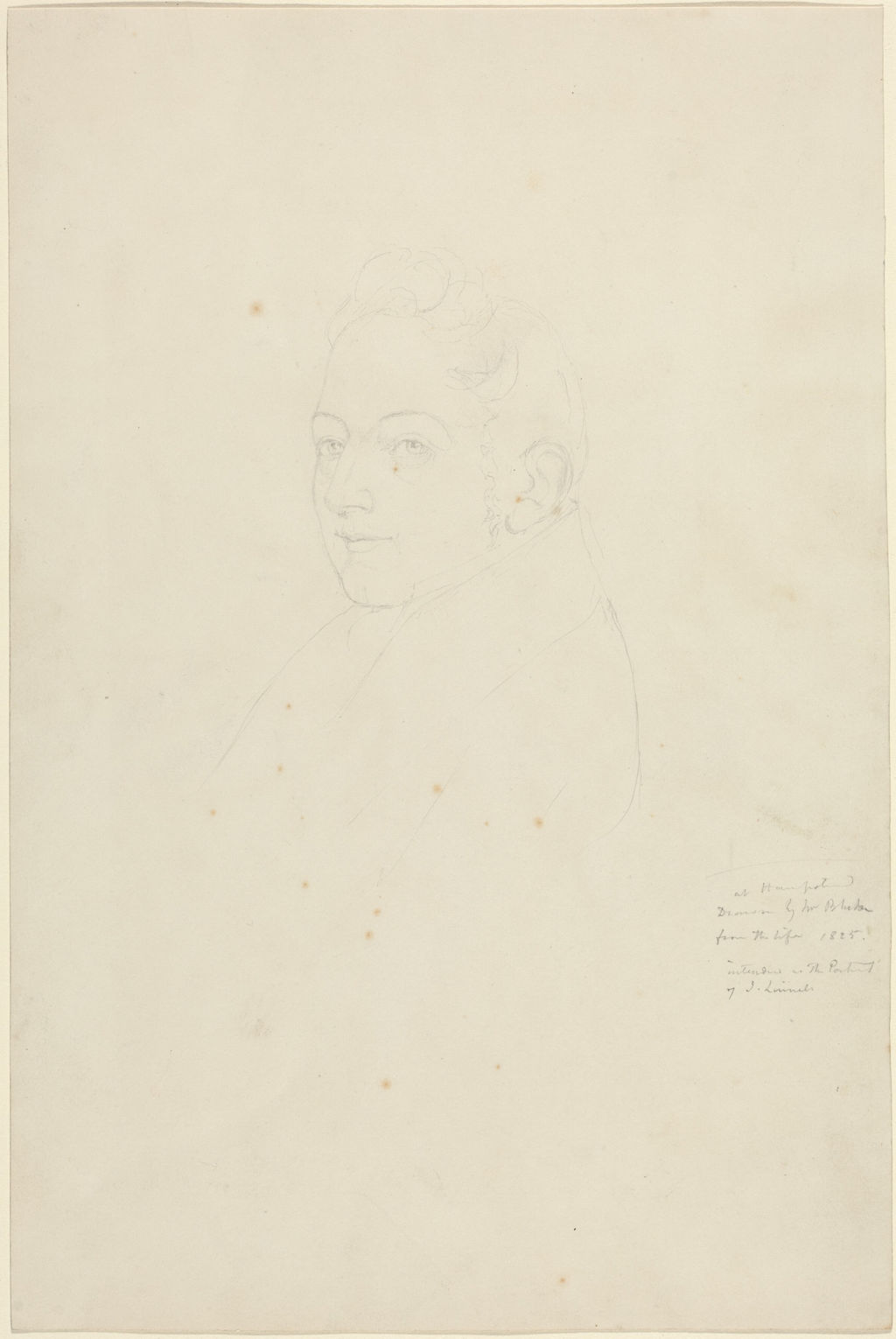
A lightly drawn portrait of Linnell gives the relationship another material presence. The National Gallery of Art’s graphite sheet, accession 1943.3.9016, carries Linnell’s inscription identifying it as drawn by Blake from life at Hampstead in 1825. The small head occupies a broad area of pale paper; the clothing is much more faintly indicated. An image of a person survives alongside that person’s own record of who drew him, where, and when. The separate John Linnell drawing invites closer attention to the portrait itself. [14]
The portraits in the other direction require a distinction. The Fitzwilliam Museum dates Linnell’s miniature of Blake, watercolour on ivory, to 1821. The National Portrait Gallery owns a replica Linnell made in 1861 from that earlier work. Its catalogue explains that C. H. Jeens’s engraving for Gilchrist’s biography wrongly gave the original miniature’s date as 1827. These are three stages: a portrait made during the friendship, a later repetition, and a published engraving. They do not all show a sitting in Blake’s final year. [15]
That small correction affects the larger story. A face known through a biography may seem inseparable from the account of the sitter’s death, although its source belongs several years earlier. Linnell’s continuing attachment to Blake helped preserve his appearance; subsequent reproduction also changed the circumstances in which viewers encountered it. The friendship created objects that would become evidence, and those objects retained histories of their own. [15]
Watch: William Blake’s world and working methods
Choose an introduction to Blake, a printing demonstration, or a discussion of his radical ideas.
William Blake: Poet, Artist & Visionary - a genius of early Romanticism in England
An introduction to Blake’s art, poetry and imaginative world.
Watch on YouTubeWhat the younger artists found
Samuel Palmer, George Richmond, Edward Calvert and other younger admirers found encouragement around Blake. Their conversations formed part of the circle associated with the Ancients. In Gilchrist’s account, the name they used for Blake’s home came from Bunyan: the House of the Interpreter. It suggests what they hoped to find there, a place where an older artist could help them understand their own work and the art they loved. [3]
Palmer’s letter to Gilchrist, dated 23 August 1855, begins with an admission that particulars had become difficult to recall. That qualification belongs beside the vivid memories that follow. He describes examining antique gems, Italian prints and pictures with Blake. Admiration did not preclude criticism: Blake could object to Dürer’s handling of drapery while revering his achievement. Palmer’s recollection gives us an artist exercising judgement in company, attentive to how a garment expressed the body beneath it. [3]
He also remembered the effect of walking with Blake, whose conversation could transform the younger man’s experience of a landscape. The influence was personal as well as formal. Advice, looking, enthusiasm and argument passed between people before becoming something later historians could trace through pictures. Palmer’s affectionate account is itself a response to that influence, written by a mature artist remembering someone encountered in youth. Its admiration should be understood as testimony with a particular history. [3]
Richmond supplied Gilchrist with another remembered scene. Troubled by a period without invention, he sought Blake’s advice and found him at tea with Catherine. In the story Blake appealed to his wife about what they did when inspiration deserted them, and she answered that they prayed. It is a recollection transmitted through a later biographer, not a conversation recorded at the table. Even so, the story’s point is striking: the younger artist’s difficulty was answered by acknowledging a shared difficulty. Invention could fail the admired master too. [3]
These accounts need not make Blake the founder of a formal school. The visitors brought their own interests and went on to different careers. What the memories repeatedly preserve is access: time spent looking at prints, a conversation taken seriously, a welcome at the working table. Linnell’s introductions helped make that contact possible. The most lasting gift might be neither a payment nor a doctrine, but permission to persist in a kind of art a young painter scarcely knew how to defend. [3]
Illness and a move repeatedly postponed
By 1825 illness was interrupting Blake’s work and journeys. He described shivering attacks, stomach pain, weakness and temporary improvement. In June that year he distinguished what he could do in bed: drawing remained possible, engraving did not. That difference gave the Dante drawings a practical place during enforced rest. The letters follow changing capacities, rather than an uninterrupted heroic effort. [9]
The trouble also changed his relationship with Hampstead. In February 1826 he described northern air as something that had long made him ill and resisted the idea that discipline could train away his bodily particularities. His explanation belongs to his understanding of himself. We can see why journeys became a subject of negotiation without turning his account into a modern medical diagnosis. May brought another attack and another lost Sunday visit. [16]
The proposed longer stay in July required decisions about accommodation, expense and transport. Blake wanted the prospect of North End but asked Linnell to spare unnecessary cost. By August he proposed a cabriolet because walking to and from the stagecoach was beyond him. This was a substantial alteration for a man whom friends remembered walking between London and Hampstead. A visit now depended on how the whole journey could be managed. [1] [16]
A further plan for removal was eventually abandoned. In a letter assigned to February 1827, Blake thanked Linnell for money and discussed the Dante engravings before explaining his growing fear of the change. He had wanted the arrangement and still wished for it, yet could not undertake it. He connected that fear with his need for intellectual seclusion and referred to dreams and visions without recounting them. We have his explanation of a decision, not the means to reconstruct the experiences he withheld. [17]
The refusal did not end their friendship. In the same letter Blake rejoiced in Linnell’s professional success. Another note, also tentatively placed in February, describes bringing plates while out walking so that his friend could see their progress. The record moves between dependence, resistance and renewed contact. It leaves room for an older artist to need assistance while retaining authority over where he would live. [17]
Dante, Catherine and the last months
Blake’s shrinking movements also affected other friendships. In December 1826 he apologised to Mrs Aders for being unable to visit her and see the old-master paintings again. The social world remained attractive when his body made it difficult to enter. Letters could maintain a connection across the distance between a sickroom and a collection he wished to revisit. [18]
Meanwhile the Dante plates continued travelling between Blake and Linnell. In the February letter Blake requested two plates his friend held so he could improve them; in April he reported proofs taken from six and preparation for the next composition. The Dante project would remain unfinished. Here the movement of actual plates makes its continuing labour tangible. Drawings, copper, proofs and discussion connected the artist at Fountain Court with the person supporting the undertaking. [17] [19]
The April letter contains a particularly important acknowledgement of Catherine. Referring to works including Ugolino, Blake credited his wife with their existence in a finished state. His acknowledgement makes her essential to the work’s completion while leaving the nature of her intervention unstated. We cannot tell from this sentence whether she encouraged him, helped with an operation, or found another way to bring the work to completion. What survives is his own insistence on her importance. [19]
Money continued arriving. In January Blake apologised for failing promptly to acknowledge five pounds; in April he thanked Linnell for ten and for the prospect of a useful acquaintance with the collector William Young Ottley. He described himself as sufficiently paid if he could continue living as he did, while fearing that his work might prove unlucky for his friends. The thought gives gratitude an anxious edge. Someone else’s continued belief could be sustaining and also create a burden of concern about what they would receive. [19]
On 3 July 1827 he again thanked Linnell for ten pounds. A Sunday journey to Hampstead had caused a relapse; he had been yellow and experienced the return of earlier symptoms. He recognised that he could no longer travel as though young, yet hoped he was improving. The letter is brief and forward-looking. It was written by a man still assessing the next recovery, rather than composing the final scene of his biography. [20]
Death and the care of what remained
Blake died at Fountain Court on Sunday 12 August 1827, aged sixty-nine. J. T. Smith’s account, published the following year, describes songs addressed to God, affectionate words to Catherine, and death at about six in the evening. Smith’s narrative draws on the people around Blake; Gilchrist later identifies Catherine as the source for the account of the songs. These are close reports shaped by religious feeling, rather than a surviving record of the melodies or the complete words. [4] [5]
Gilchrist also reproduced a letter written within days of the death. Its writer described Blake’s happiness, singing and Christian hope, and invited a friend to the funeral. The letter’s language presents an exemplary departure. It shows how quickly the admiring circle understood the death through the faith they associated with his life. The testimony can be preserved without treating the reported heavenly sights as independently observable events. [5]
The celebrated last pictures belong to a further chain of evidence. Smith says that Tatham commissioned a coloured impression of The Ancient of Days and supplied the story of Blake judging it finished. Smith then places a sketch of Catherine after that act. Gilchrist retold both episodes with additional description. The accounts are moving, but they do not justify identifying the print as his final artwork, or imagining a securely documented deathbed portrait available for us to inspect. Smith names Tatham as his informant for the finished print; Gilchrist also records Tatham’s description of the sketch. The two episodes preserve memories of work and affection through those particular witnesses. [4] [5]
Friends attended the burial at Bunhill Fields on 17 August. Catherine then faced the practical life of the remaining drawings, printed books and plates. Gilchrist describes her staying with Linnell and later in arrangements involving Tatham, selling works and continuing some colouring. His account is retrospective and cannot assign her hand to every surviving late sheet. It does, however, show that looking after the art and finding support for its maker’s widow became closely connected responsibilities. [21]
Linnell’s friendship had helped Blake keep working while he lived. Its consequences continued in the preservation of pictures, plates, papers and recollections. The most revealing evidence remains ordinary in its particulars: a receipt, a request to return copperplates, a coach missed or feared, a meal offered before a journey. Through those details, the late achievement acquires human dimensions. It depended on the artist’s continued invention and on other people finding ways for that invention to go on. [1] [10] [12] [16] [17] [19]
Works and designs directory
Browse separate works, impressions and book components. Dates distinguish versions; six Tate copies after Blake are labelled. These records are not a complete catalogue of unique designs.
| Name | Date | Medium |
|---|---|---|
| A Figure Standing in a Gothic Apse, perhaps the Empress Maud. Verso: Detailed Drawings for ‘The Empress Maud in Bed’ | c.1819 | Pencil drawing |
| A Rolling Stone Is Ever Bare of Moss, from Thornton's "Pastorals of Virgil" | 1821 | Wood engraving |
| A Title Page for The Grave | 1806 | Watercolour |
| A Vision of the Last Judgment | 1808 | Watercolour |
| A Vision: The Inspiration of the Poet (Elisha in the Chamber on the Wall) | c.1819–20? | Watercolour |
| Adam and the Beasts, Frontispiece to Hayley's "Ballads" | June 1, 1802 | Engraving |
| Age Teaching Youth | c.1785–90 | Watercolour |
| Alfred and the Neat-Herd’s Wife (after Henry Fuseli) | 1797, published 1798 | Etching and engraving |
| An Allegory of the Bible. Verso: The Shins of an Écorché Male Figure | c.1780–5, ?c.1780 | Watercolour |
| Angel of the Divine Presence Bringing Eve to Adam (The Creation of Eve: "And She Shall be Called Woman) (recto); Sketch for the same (verso) | ca. 1803 | Watercolour |
| Angel of the Revelation (Book of Revelation, chapter 10) | ca. 1803–5 | Watercolour |
| Antaeus setting down Dante and Virgil in the Last Circle of Hell | 1824–1827 | Watercolour |
| Bathsheba at the Bath | c.1799–1800 | Tempera |
| Beatrice Addressing Dante from the Car | 1824–7 | Watercolour |
| Behemoth and Leviathan | 1825–26 | Engraving |
| Behemoth and Leviathan | 1825, reprinted 1874 | Engraving |
| Behemoth and Leviathan | 1826 | Engraving |
| Blasted Trees and Flattened Crops, from Thornton's "Pastorals of Virgil" | 1821 | Wood engraving |
| Boy Returning Joyfully, with Plough and Oxen, from Thornton's "Pastorals of Virgil" | 1821 | Wood engraving |
| Boy Returning Joyfully, with Plough and Oxen, from Thornton's "Pastorals of Virgil" | 1821 | Wood engraving |
| Catherine Blake. Verso: A Man’s Head and Other Drawings | c.1805 | Pencil drawing |
| Cerberus | 1824–7 | Watercolour |
| Cerberus (second version) | 1824–1827 | Watercolour |
| Chaucer’s Canterbury Pilgrims | 1810, reprinted before 1881 | Engraving |
| Christ Appearing to His Disciples After the Resurrection | c.1795 | Colour print |
| Christ Appearing to the Apostles after the Resurrection | c.1795 | Watercolour |
| Christ Blessing the Little Children | 1799 | Tempera |
| Christ in the Carpenter’s Shop: The Humility of the Saviour (after William Blake) | Date not stated | Watercolour |
| Ciampolo the Barrator Tormented by the Devils | 1826–7, reprinted 1892 | Engraving |
| Ciampolo the Barrator Tormented by the Devils | 1826–7, reprinted 1968 | Engraving |
| Circle of Theives: Agnello Brunelleschi Attacked By a Six-Footed Serpent | ca. 1825–27 | Engraving |
| Clarence's Dream (Shakespeare, Richard III, Act 1, Scene 4) | 1774 | Etching and engraving |
| Colinet Mocked by Two Boys, from Thornton's "Pastorals of Virgil" | 1821 | Wood engraving |
| Colinet Rests by a Stream at Night | c.1821, printed 1830 | Wood engraving |
| Colinet Rests by a Stream at Night | 1821, reprinted 1977 | Wood engraving |
| Colinet with his Shepherd’s Pipe, Mocked by Two Boys | c.1821, printed 1830 | Wood engraving |
| Colinet with his Shepherd’s Pipe, Mocked by Two Boys | 1821, reprinted 1977 | Wood engraving |
| Colinet's Journey, Milestone Marked 'LXII Miles to London', from Thornton's "Pastorals of Virgil" | 1821 | Wood engraving |
| Colinet's Journey: Milestone Marked 'LXII Miles to London', from Thornton's "Pastorals of Virgil" | 1821 | Wood engraving |
| Colinet’s Fond Desire Strange Lands to Know | 1821, reprinted 1977 | Wood engraving |
| Colinet’s ‘Fond Desire Strange Lands to Know’ | c.1821, printed 1830 | Wood engraving |
| Composition Sketch for ‘The Fall of the Rebel Angels’? Verso: Standing Figure with Flaming Hair | ?c.1805–10 | Pencil drawing |
| Composition Sketch, Possibly a Subject from Dante. Verso: A Man Standing over a Figure Reclining on a Bed | ?1824–7, ?c.1800–10 | Pencil drawing |
| Composition Sketch. Verso: Standing Figure Holding a Spear | ?c.1805–10 | Pencil drawing |
| Dante and Virgil Approaching the Angel Who Guards the Entrance of Purgatory | 1824–7 | Watercolour |
| Dante and Virgil Penetrating the Forest | 1824–7 | Watercolour |
| Dante in the Empyrean, Drinking at the River of Light | 1824–7 | Watercolour |
| Dante running from the Three Beasts | 1824–1827 | Watercolour |
| Dante Striking against Bocca Degli Abati | 1826–7, reprinted 1892 | Engraving |
| Dante Striking Against Bocca degli Abati | 1826–7, reprinted 1968 | Engraving |
| David Delivered out of Many Waters | c.1805 | Watercolour |
| David Delivered out of Many Waters (after William Blake) | Date not stated | Watercolour |
| Detailed Drawings for ‘A Figure Standing in a Gothic Apse’ | 1819 | Pencil drawing |
| Elohim Creating Adam | 1795–c.1805 | Colour print |
| Enoch | 1806–7 | Lithograph |
| Epitome of James Hervey’s ‘Meditations among the Tombs’ | c.1820–5 | Watercolour |
| Europe. A Prophecy; Frontispiece | ca. 1820 | Relief etching |
| Evening | c.1820/1825 | Watercolour |
| Every Man also Gave him a Piece of Money | 1825, reprinted 1874 | Engraving |
| Every Man also Gave him a Piece of Money. Verso: God the Father with Attendant Angels | c.1821–3 | Watercolour |
| Every One also Gave Him a Piece of Money | 1826 | Engraving |
| Fertilization of Egypt, from Erasmus Darwin's "The Botanic Garden" | 1791 | Engraving |
| First Book of Urizen pl. 10 | 1796, c.1818 | Etching |
| First Book of Urizen pl. 11 | 1796, c.1818 | Etching |
| First Book of Urizen pl. 15 | 1796, c.1818 | Etching |
| First Book of Urizen pl. 17 | 1796, c.1818 | Etching |
| First Book of Urizen pl. 21 | 1796, c.1818 | Etching |
| First Book of Urizen pl. 6 | 1796, c.1818 | Etching |
| Frontispiece to Jerusalem, the Emanation of the Great Albion | [ca. 1804–20] (?) | Engraving |
| Frontispiece to ‘Visions of the Daughters of Albion’ | c.1795 | Relief etching |
| Frontispiece: Thenot and Colinet | c.1821, printed 1830 | Wood engraving |
| George Cumberland's Message Card | 1827 | Engraving |
| God Judging Adam | ca. 1795 | Relief etching |
| God Judging Adam | 1795 | Relief etching |
| Hiding of Moses, from "Remember Me!, or a Pocket Companion" | 1825 | Engraving |
| Homer and the Ancient Poets | 1824–7 | Watercolour |
| Illustration 1 to Milton’s On the Morning of Christ’s Nativity: The Descent of Peace | c.1814–1816 | Watercolour |
| Illustration 1 to Milton’s Paradise Lost: Satan Calling Up His Legions | 1807 | Watercolour |
| Job accepting Charity | 1825–26 | Engraving |
| Job and his Daughters | 1825–26 | Engraving |
| Job and his Daughters | 1825, reprinted 1874 | Engraving |
| Job and His Daughters | 1826 | Engraving |
| Job and His Family | 1825–26 | Engraving |
| Job and his Family | Reprinted 1874; engraved 1828 date is an error | Engraving |
| Job and His Family | 1826 | Engraving |
| Job and his Family Restored to Prosperity | 1825, reprinted 1874 | Engraving |
| Job and his Wife restored to Prosperity | 1825–26 | Engraving |
| Job rebuked by his Friends | 1825–26 | Engraving |
| Job Rebuked by his Friends | 1825, reprinted 1874 | Engraving |
| Job Rebuked by His Friends | 1826 | Engraving |
| Job's Comforters | 1825–26 | Engraving |
| Job's Comforters | 1826 | Engraving |
| Job's Despair | 1825–26 | Engraving |
| Job's Evil Dreams | 1825–26 | Engraving |
| Job's Evil Dreams | 1826 | Engraving |
| Job's Sacrifice | 1825–26 | Engraving |
| Job's Sons and Daughters Overwhelmed by Satan | 1826 | Engraving |
| Job, his Wife and his Friends: The Complaint of Job. Verso: Job’s Wife and Eight Other Sketches | c.1785 | Watercolour |
| Job’s Comforters | 1825, reprinted 1874 | Engraving |
| Job’s Despair | 1825, reprinted 1874 | Engraving |
| Job’s Evil Dreams | 1825, reprinted 1874 | Engraving |
| Job’s Sacrifice | 1825, reprinted 1874 | Engraving |
| Job’s Sons and Daughters Overwhelmed by Satan | 1825, reprinted 1874 | Engraving |
| John Linnell | 1825 | Pencil drawing |
| Joseph of Arimathea Preaching to the Britons | c.1794/1796 | Relief etching |
| Judas Betrays Him | c.1803–5 | Watercolour |
| King John Absolved by Pandulph (after Henry Fuseli) | 1797, published 1798 | Etching and engraving |
| Lamech and his Two Wives | 1795 | Colour print |
| Landscape near Felpham | c.1800 | Watercolour |
| Lear and Cordelia in Prison | c.1779 | Watercolour |
| Los and Orc | c.1792–3 | Watercolour |
| Lower Half of a Woman Playing a Harp. Verso: Seraphim and Other Drawings | c.1785, c.?1807 | Pencil drawing |
| Menalcus Watching Women Dance, from Thornton's "Pastorals of Virgil" | 1821 | Wood engraving |
| Menalcus Watching Women Dance, from Thornton's "Pastorals of Virgil" | 1821 | Wood engraving |
| Moses Indignant at the Golden Calf | c.1799–1800 | Tempera |
| Nebuchadnezzar | 1795–c.1805 | Colour print |
| Newton | 1795–c.1805 | Colour print |
| Oberon, Titania and Puck with Fairies Dancing | c.1786 | Watercolour |
| Pity | ca. 1795 | Relief etching |
| Pity | c.1795 | Colour print |
| Plate 2 of ‘Urizen’: ‘Teach these Souls to Fly’ | ?1796 | Relief etching |
| Plate 3 of ‘Urizen’: Oh! Flames of Furious Desires’ (after William Blake) | Date not stated | Watercolour |
| Plate 4 of ‘Visions of the Daughters of Albion’ | c.1795 | Relief etching |
| Plutus | 1824–7 | Watercolour |
| Preliminary Sketch for ‘Christ Girding Himself with Strength’. Verso: Standing Figure with One Arm Raised | c.1805, c.1805–10 | Pencil drawing |
| Preludium. "The shadowy daughter of Urthona stood before red Orc..." (Plate 3) | 1793 | Relief etching |
| Queen Elizabeth and Essex (after Henry Fuseli) | 1797, published 1798 | Engraving |
| Sabrina's Silvery Flood, from Thornton's "Pastorals of Virgil" | 1821 | Wood engraving |
| Sabrina's Silvery Flood, from Thornton's "Pastorals of Virgil" | 1821 | Wood engraving |
| Sabrina’s Silvery Flood | c.1821, printed 1830 | Wood engraving |
| Sabrina’s Silvery Flood | 1821, reprinted 1977 | Wood engraving |
| Satan Before the Throne of God | 1825–26 | Engraving |
| Satan before the Throne of God | 1825, reprinted 1874 | Engraving |
| Satan before the Throne of God | 1826 | Engraving |
| Satan calling up his Legions | c.1800–05 | Tempera |
| Satan Exulting over Eve | c.1795 | Colour print |
| Satan Going Forth from the Presence of the Lord, and Job’s Charity | 1825, reprinted 1874 | Engraving |
| Satan Going Forth fron the Presence of the Lord | 1825–26 | Engraving |
| Satan in his Original Glory: ‘Thou wast Perfect till Iniquity was Found in Thee’ | c.1805 | Watercolour |
| Satan Smiting Job with Boils | 1825–26 | Engraving |
| Satan Smiting Job with Sore Boils | 1825, reprinted 1874 | Engraving |
| Satan Smiting Job with Sore Boils | c.1826 | Tempera |
| Satan Smiting Job with Sore Boils | 1826 | Engraving |
| Shepherd Chases Away a Wolf, from Thornton's "Pastorals of Virgil" | 1821 | Wood engraving |
| Shepherd Chases Away a Wolf, from Thornton's "Pastorals of Virgil" | 1821 | Wood engraving |
| Sketch for the Title-Page of the Engraved Illustrations to the Book of Job | c.1823/1826 | Pencil drawing |
| Sketch for ‘The Four and Twenty Elders Casting their Crowns before the Divine Throne’. Verso: Standing Figure with Arms at his Side | c.1803, c.1805–10 | Pencil drawing |
| Sketch for ‘Tiriel Supporting the Dying Myratana’. Verso: Sketch for ‘Tiriel Supporting the Dying Myratana’ | c.1786–9 | Pencil drawing |
| Songs of Experience: A Little Boy Lost | [1794] printed ca. 1825 | Relief etching |
| Songs of Experience: A Little Girl Lost | [1794] printed ca. 1825 | Relief etching |
| Songs of Experience: A Poison Tree | [1794] printed ca. 1825 | Relief etching |
| Songs of Experience: Earth's Answer | [1794] printed ca. 1825 | Relief etching |
| Songs of Experience: Frontispiece | [1794] printed ca. 1825 | Relief etching |
| Songs of Experience: Holy Thursday | [1794] printed ca. 1825 | Relief etching |
| Songs of Experience: Infant Sorrow | [1794] printed ca. 1825 | Relief etching |
| Songs of Experience: Introduction | [1794] printed ca. 1825 | Relief etching |
| Songs of Experience: London | [1794] printed ca. 1825 | Relief etching |
| Songs of Experience: My Pretty Rose Tree, Ah! Sun-Flower, The Lilly | [1794] printed ca. 1825 | Relief etching |
| Songs of Experience: Nurses Song | [1794] printed ca. 1825 | Relief etching |
| Songs of Experience: The Angel | [1794] printed ca. 1825 | Relief etching |
| Songs of Experience: The Chimney Sweeper | [1794] printed ca. 1825 | Relief etching |
| Songs of Experience: The Clod & the Pebble | [1794] printed ca. 1825 | Relief etching |
| Songs of Experience: The Fly | [1794] printed ca. 1825 | Relief etching |
| Songs of Experience: The Garden of Love | [1794] printed ca. 1825 | Relief etching |
| Songs of Experience: The Human Abstract | [1794] printed ca. 1825 | Relief etching |
| Songs of Experience: The Little Girl Found (second plate) | [1789] printed ca. 1825 | Relief etching |
| Songs of Experience: The Little Girl Lost | [1789] printed ca. 1825 | Relief etching |
| Songs of Experience: The Little Girl Lost (second plate); The Little Girl Found | [1789] printed ca. 1825 | Relief etching |
| Songs of Experience: The Little Vagabond | [1794] printed ca. 1825 | Relief etching |
| Songs of Experience: The School Boy | [1789] printed ca. 1825 | Relief etching |
| Songs of Experience: The Sick Rose | [1794] printed ca. 1825 | Relief etching |
| Songs of Experience: The Tyger | [1794] printed ca. 1825 | Relief etching |
| Songs of Experience: The Voice of the Ancient Bard | [1789] printed ca. 1825 | Relief etching |
| Songs of Experience: Title-page | [1794] printed ca. 1825 | Relief etching |
| Songs of Experience: To Tirzah | [1794] printed ca. 1825 | Relief etching |
| Songs of Innocence and of Experience, Shewing the Two Contrary States of the Human Soul: Combined Title-page | [1789–94] printed ca. 1825 | Relief etching |
| Songs of Innocence and of Experience: Infant Sorrow | 1794, reprinted 1831 or later | Relief etching |
| Songs of Innocence: A Cradle Song | [1789] printed ca. 1825 | Relief etching |
| Songs of Innocence: A Cradle Song (second plate) | [1789] printed ca. 1825 | Relief etching |
| Songs of Innocence: A Dream | [1794] printed ca. 1825 | Relief etching |
| Songs of Innocence: Frontispiece | [1789] printed ca. 1825 | Relief etching |
| Songs of Innocence: Holy Thursday | [1789] printed ca. 1825 | Relief etching |
| Songs of Innocence: Infant Joy | [1789] printed ca. 1825 | Relief etching |
| Songs of Innocence: Introduction | [1789] printed ca. 1825 | Relief etching |
| Songs of Innocence: Laughing Song | [1789] printed ca. 1825 | Relief etching |
| Songs of Innocence: Little Boy Lost | [1789] printed ca. 1825 | Relief etching |
| Songs of Innocence: Night | [1789] printed ca. 1825 | Relief etching |
| Songs of Innocence: Night (second plate) | [1789] printed ca. 1825 | Relief etching |
| Songs of Innocence: Nurse's Song | [1789] printed ca. 1825 | Relief etching |
| Songs of Innocence: On Anothers Sorrow | [1789] printed ca. 1825 | Relief etching |
| Songs of Innocence: Spring | [1789] printed ca. 1825 | Relief etching |
| Songs of Innocence: Spring (second plate) | [1789] printed ca. 1825 | Relief etching |
| Songs of Innocence: The Blossom | [1789] printed ca. 1825 | Relief etching |
| Songs of Innocence: The Chimney Sweeper | [1789] printed ca. 1825 | Relief etching |
| Songs of Innocence: The Divine Image | [1789] printed ca. 1825 | Relief etching |
| Songs of Innocence: The Ecchoing Green | [1789] printed ca. 1825 | Relief etching |
| Songs of Innocence: The Ecchoing Green (second plate) | [1789] printed ca. 1825 | Relief etching |
| Songs of Innocence: The Lamb | [1789] printed ca. 1825 | Relief etching |
| Songs of Innocence: The Little Black Boy | [1789] printed ca. 1825 | Relief etching |
| Songs of Innocence: The Little Black Boy (second plate) | [1789] printed ca. 1825 | Relief etching |
| Songs of Innocence: The Little Boy Found | [1789] printed ca. 1825 | Relief etching |
| Songs of Innocence: The Shepherd | [1789] printed ca. 1825 | Relief etching |
| Songs of Innocence: Title Page | [1789] printed ca. 1825 | Relief etching |
| St Christopher, Copy from an Engraving? Verso:Part of a Face: Copy from a Plaster Cast: a Daughter of Niobe? | ?c.1779–80 | Pencil drawing |
| The Agony in the Garden | c.1799–1800 | Tempera |
| The Angel Appearing to Zacharias | 1799–1800 | Tempera |
| The Ascent of the Mountain of Purgatory | 1824–7 | Watercolour |
| The Baffled Devils Fighting | 1826–7, reprinted 1892 | Engraving |
| The Baffled Devils Fighting | 1826–7, reprinted 1968 | Engraving |
| The Bard, from Gray | ?1809 | Tempera |
| The Beggar's Opera, Act III | July 1, 1790 | Etching and engraving |
| The Beggar's Opera, Act III | July 1, 1790 | Engraving |
| The Beggar's Opera, Act III | 1790 | Engraving |
| The Blasphemer | c.1800 | Watercolour |
| The Blighted Corn | c.1821, printed 1830 | Wood engraving |
| The Blighted Corn | 1821, reprinted 1977 | Wood engraving |
| The Body of Abel Found by Adam and Eve | c.1826 | Tempera |
| The Body of Christ Borne to the Tomb | c.1799–1800 | Tempera |
| The Book of Job: Title Page | 1825 | Engraving |
| The Book of Thel pl. 6 | 1796, c.1818 | Etching |
| The Circle of Corrupt Officials: The Devils Mauling Each Other | ca. 1825–27 | Engraving |
| The Circle of Corrupt Officials: The Devils Tormenting Ciampolo | ca. 1825–27 | Engraving |
| The Circle of the Lustful: Francesca da Rimini (‘The Whirlwind of Lovers’) | 1826–7, reprinted 1892 | Engraving |
| The Circle of the Lustful: Francesca da Rimini (‘The Whirlwind of Lovers’) | 1826–7, reprinted 1968 | Engraving |
| The Circle of the Lustful: Paolo and Francesca | ca. 1825–27 | Engraving |
| The Circle of the Thieves; Buoso Donati Attacked by the Serpent | ca. 1825–27 | Engraving |
| The Circle of Traitors: Dante's Foot Striking Bocca degli Abbate | ca. 1825–27 | Engraving |
| The Complaint and the Consolation; or, Night Thoughts | 1797 | Etching and engraving |
| The Creation | 1825–26 | Engraving |
| The Crucifixion | c.1825–7 | Pencil drawing |
| The Crucifixion: ‘Behold Thy Mother’ | c.1805 | Watercolour |
| The Dance of Albion (Glad Day) | c.1803/1810 | Engraving |
| The Death of Lucretia, from Allen's "New and Impartial Roman History" | 1797 | Engraving |
| The Death of Saint Joseph | 1803 | Watercolour |
| The Death of the Virgin | 1803 | Watercolour |
| The Descent of Peace [recto] | c.1815 | Pencil drawing |
| The Destruction of Job's Sons | 1825–26 | Engraving |
| The Devils, with Dante and Virgil by the Side of the Pool | 1824–7 | Watercolour |
| The Entombment | c.1805 | Watercolour |
| The Fall of Rosamond (after Thomas Stothard) | 1783 | Etching and engraving |
| The Fall of Satan | 1825–26 | Engraving |
| The Fall of Satan | 1825, reprinted 1874 | Engraving |
| The Fall of Satan | 1826 | Engraving |
| The Four and Twenty Elders Casting their Crowns before the Divine Throne | c.1803–5 | Watercolour |
| The Ghost of a Flea | c.1819–20 | Tempera |
| The Good and Evil Angels | 1795–?c.1805 | Colour print |
| The Good Farmer, Probably the Parable of the Wheat and the Tares. Verso: Rough Sketch of Two or Three Figures in a Landscape | c.1780–5 | Watercolour |
| The Great Red Dragon and the Beast from the Sea | c.1805 | Watercolour |
| The Great Red Dragon and the Woman Clothed with the Sun | c.1805 | Watercolour |
| The Head of the Ghost of a Flea. Verso: A Profile and a Reduced Drawing of Milton’s First Wife | c.1819 | Pencil drawing |
| The Hermit’s Dog, from William Hayley’s "Ballads" | 1805 | Etching and engraving |
| The Hiding of Moses | 1824 | Engraving |
| The House of Death | 1795–c.1805 | Colour print |
| The House of Death | c.1790 | Watercolour |
| The Hypocrites with Caiaphas. Verso: Sketch of a Stooping Figure | 1824–7 | Watercolour |
| The Inscription over the Gate | 1824–7 | Watercolour |
| The Laborious Passage along the Rocks | 1824–7 | Watercolour |
| The Last Trumpet (recto); Two studies of a right eye, a profile of an open-mouthed young man, the head of an eagle, and the head of a lion (verso) | 1780–85 | Pencil drawing |
| The Lord Answering Job out of the Whirlwind | 1825–26 | Engraving |
| The Lord Answering Job out of the Whirlwind | 1825, reprinted 1874 | Engraving |
| The Man Who Taught Blake Painting in his Dreams (counterproof) (after William Blake) | after c.1819–20 | Pencil drawing |
| The Marriage of Heaven and Hell pl. 16 | 1796, c.1818 | Etching |
| The Messengers tell Job of his Misfortunes | 1825–26 | Engraving |
| The Messengers tell Job of his Misfortunes | 1825, reprinted 1874 | Engraving |
| The Night of Enitharmon’s Joy (formerly called ‘Hecate’) | c.1795 | Colour print |
| The Parable of the Wise and Foolish Virgins | ca. 1799–1800 | Watercolour |
| The Parable of the Wise and Foolish Virgins (after William Blake) | Date not stated | Watercolour |
| The Pastorals of Virgil, with a Course of English Reading, Adapted for Schools, Vol. I | 1821 | Wood engraving |
| The Penance of Jane Shore in St Paul’s Church | c.1793 | Watercolour |
| The Pit of Disease: The Falsifiers | 1826–7, reprinted 1892 | Engraving |
| The Pit of Disease: The Falsifiers | 1824–7 | Watercolour |
| The Pit of Disease: The Falsifiers | 1826–7, reprinted 1968 | Engraving |
| The Primaeval Giants Sunk in the Soil | 1824–7 | Watercolour |
| The Punishment of the Thieves | 1824–7 | Watercolour |
| The Raising of Lazarus (after William Blake) | Date not stated | Watercolour |
| The Rest on the Flight into Egypt (The Repose of the Holy Family in Egypt) | 1806 | Watercolour |
| The River of Life | c.1805 | Watercolour |
| The Rock Sculptured with the Recovery of the Ark and the Annunciation | 1824–7 | Watercolour |
| The Serpent Attacking Buoso Donati | 1826–7, reprinted 1892 | Engraving |
| The Serpent Attacking Buoso Donati | 1826–7, reprinted 1968 | Engraving |
| The Serpent Attacking Buoso Donati. Verso: A Man with a Transparent Hood (?) over his Head | 1824–7 | Watercolour |
| The Simoniac Pope | 1824–7 | Watercolour |
| The Six-Footed Serpent Attacking Agnolo Brunelleschi | 1826–7, reprinted 1892 | Engraving |
| The Six-Footed Serpent Attacking Agnolo Brunelleschi | 1826–7, reprinted 1968 | Engraving |
| The Soul Hovering over the Body Reluctantly Parting with Life | c.1805 | Pencil drawing |
| The Spiritual Form of Nelson Guiding Leviathan | c.1805–9 | Tempera |
| The Spiritual Form of Pitt Guiding Behemoth | ?1805 | Tempera |
| The Sun at His Eastern Gate | c.1816–1820 | Watercolour |
| The Temple of Mirth, after Thomas Stothard | 1784 | Engraving |
| The Temptation and Fall of Eve | 1807 | Watercolour |
| The Temptation and Fall of Eve (Illustration to Milton’s Paradise Lost) | 1808 | Watercolour |
| The Thieves and Serpents | 1824–1827 | Watercolour |
| The Vision of Christ | 1825, reprinted 1874 | Engraving |
| The Vision of Eliphaz | 1825–26 | Engraving |
| The Vision of Eliphaz | 1825, reprinted 1874 | Engraving |
| The Vision of God | 1825–26 | Engraving |
| The Wood of the Self-Murderers: The Harpies and the Suicides | 1824–7 | Watercolour |
| The Wrath of Elihu | 1825–26 | Engraving |
| The Wrath of Elihu | 1825, reprinted 1874 | Engraving |
| Thenot and Colinet | 1821, reprinted 1977 | Wood engraving |
| Thenot and Colinet at Supper | c.1821, printed 1830 | Wood engraving |
| Thenot and Colinet at Supper | 1821, reprinted 1977 | Wood engraving |
| Thenot and Colinet Converse Seated between Two Trees | c.1821, printed 1830 | Wood engraving |
| Thenot and Colinet Converse Seated between Two Trees | 1821, reprinted 1977 | Wood engraving |
| Thenot and Colinet Eat Their Evening Meal, from Thornton's "Pastorals of Virgil" | 1821 | Wood engraving |
| Thenot and Colinet Folding their Flocks together at Sunset | c.1821, printed 1830 | Wood engraving |
| Thenot and Colinet Folding their Flocks together at Sunset | 1821, reprinted 1977 | Wood engraving |
| Thenot and Colinet Lead Their Flocks Together, from Thornton's "Pastorals of Virgil" | 1821 | Wood engraving |
| Thenot and Colinet Lead Their Flocks Together, from Thornton's "Pastorals of Virgil" | 1821 | Wood engraving |
| Thenot Remonstrates with Colinet | c.1821, printed 1830 | Wood engraving |
| Thenot Remonstrates with Colinet | 1821, reprinted 1977 | Wood engraving |
| Thenot Remonstrates With Colinet, from Thornton's "Pastorals of Virgil" | 1821 | Wood engraving |
| Thenot Remonstrates With Colinet, from Thornton's "Pastorals of Virgil" | 1821 | Wood engraving |
| Thenot Remonstrates with Colinet, Lightfoot in the Background, from Thornton's "Pastorals of Virgil" | 1821 | Wood engraving |
| Thenot Remonstrates with Colinet: Lightfoot in the Distance | 1821, reprinted 1977 | Wood engraving |
| Thenot Remonstrates with Colinet; Lightfoot in the Distance | c.1821, printed 1830 | Wood engraving |
| Thenot Under a Fruit Tree, from Thornton's "Pastorals of Virgil" | 1821 | Wood engraving |
| Thenot, with Colinet Waving his Arms in Sorrow | c.1821, printed 1830 | Wood engraving |
| Thenot, with Colinet Waving his Arms in Sorrow | 1821, reprinted 1977 | Wood engraving |
| Title Page: Illustrations of the Book of Job | 1825–26 | Engraving |
| Title-Page of ‘The Book of Job’ | 1825, reprinted 1874 | Engraving |
| Tornado–Zeus Battling Typhon, from Erasmus Darwin's "Botanic Garden" | August 1, 1795 | Engraving |
| Tornado–Zeus Battling Typhon, from Erasmus Darwin's "The Botanic Garden" | August 1, 1795 | Engraving |
| Two Figures in a Decorative Border | c.1790 | Pencil drawing |
| Unyok'd Heifers, Loitering Homeward (Return of the Shepherd), from Thornton's "Pastorals of Virgil" | 1821 | Wood engraving |
| Virgil Girding Dante’s Brow with a Rush | 1824–7 | Watercolour |
| Wat Tyler and the Tax-Gatherer (after Henry Fuseli) | 1797, published 1798 | Etching and engraving |
| When the Morning Stars Sang Together | 1825, reprinted 1874 | Engraving |
| When the Morning Stars Sang Together | 1826 | Engraving |
| Winged Figure Flying Through Clouds, from Bell's "Poets" | 1790 | Etching and engraving |
| Winter | c.1820–5 | Tempera |
| ‘A Rolling Stone is ever Bare of Moss’ | c.1821, printed 1830 | Wood engraving |
| ‘A Rolling Stone is ever Bare of Moss’ | 1821, reprinted 1977 | Wood engraving |
| ‘And Unyok’d Heifers, Loitering Homeward, Low’ | c.1821, printed 1830 | Wood engraving |
| ‘And Unyok’d Heifers, Loitering Homewards, Low’ | 1821, reprinted 1977 | Wood engraving |
| ‘Europe’: Fragment of Pages 3 and 4 | 1794–c.1830–5 | Relief etching |
| ‘For him Our Yearly Wakes and Feasts We Hold’ | c.1821, printed 1830 | Wood engraving |
| ‘For him Our Yearly Wakes and Feasts We Hold’ | 1821, reprinted 1977 | Wood engraving |
| ‘Nor Fox, nor Wolf, nor Rat among our Sheep’ | c.1821, printed 1830 | Wood engraving |
| ‘Nor Fox, nor Wolf, nor Rat among our Sheep’ | 1821, reprinted 1977 | Wood engraving |
| ‘Songs of Innocence and of Experience’: ‘Infant Sorrow’ | 1794, reprinted 1831 or later | Relief etching |
| ‘Songs of Innocence and of Experience’: ‘Spring’ | 1794, reprinted 1831 or later | Relief etching |
| ‘Songs of Innocence’: Title-Page | 1789, reprinted 1831 or later | Relief etching |
| ‘Songs of Innocence’: Title-Page | 1789, reprinted 1831 or later | Relief etching |
| ‘With Songs the Jovial Hinds Return from Plow’ | c.1821, printed 1830 | Wood engraving |
| ‘With Songs the Jovial Hinds Return from Plow’ | 1821, reprinted 1977 | Wood engraving |
Frequently Asked Questions
Discussion
Look again at the images and ideas explored in William Blake’s Late Years and John Linnell. These editorial prompts invite your observations.
Reader Insights
A coach journey has to accommodate a copperplate, drawings, expense and a weakened body. The practical details make friendship tangible.
The remembered river view and engraving table share an interior. Home, work and welcome belong to the same room.
Blake distinguishes drawing in bed from engraving he could no longer manage. His letters record changing capacity rather than uninterrupted effort.
Join the Conversation
Share a detail, comparison or question about William Blake’s Late Years and John Linnell below.
References
- William Blake. Letter to John Linnell, postmarked 2 July 1826, E778, in David V. Erdman, ed., The Complete Poetry and Prose of William Blake, digital transcription, Arizona State University. View source.
- Arthur Symons. William Blake (London: Archibald Constable, 1907), biographical narrative, passage beginning with the correction of the Linnell meeting date to 1818, including extracts from Linnell’s autobiography and journal, the South Molton Street/Fountain Court move and late commissions. Project Gutenberg ebook 60448. These are mediated transcriptions of Linnell’s records. Read source. For Linnell’s dates and patronage, see also The Fitzwilliam Museum, “John Linnell,” collection highlight. Read museum account. View source 1. View source 2.
- Alexander Gilchrist; Samuel Palmer. Life of William Blake, “Pictor Ignotus” (London: Macmillan, 1863), vol. 1, chapter XXXIII, pp. 292–304, recollections of the Linnell household, Richmond’s testimony and Palmer’s complete letter of 23 August 1855. Transcription, The Blake Society. Read source. View source.
- J. T. Smith. Account of Blake in Nollekens and His Times (1828), final-illness, death, funeral and widow passages, and note 9 on Tatham’s Ancient of Days and the Catherine sketch; reprinted in Arthur Symons, William Blake (1907), section “Biographical Sketch of Blake by J. T. Smith (1828).” Read reprint. View source.
- Alexander Gilchrist. Life of William Blake (1863), vol. 1, chapter XXXVII, “Last Days,” pp. 359–362, mediated Smith/Tatham testimony and the letter written within days of Blake’s death. Transcription, The Blake Society. Read source. View source.
- Tate; Martin Butlin. Thenot and Colinet, A00111, catalogue introduction to the Virgil wood engravings in William Blake 1757–1827, Tate Gallery Collections V (1990), commission, makers and publication. View source.
- William Blake Archive; Morris Eaves, Robert N. Essick and Joseph Viscomi, editors. “Publication Announcement: Republication of illustrations to Milton,” 20 September 2011, separate series and dates. Read source. Linnell’s acquisition of the Paradise Regained watercolours is documented in The Fitzwilliam Museum, “John Linnell.” Museum account. View source 1. View source 2.
- Tate; Martin Butlin. Job and His Family, A00012, catalogue introduction to the Job engravings, William Blake 1757–1827 (1990), agreement of 25 March 1823, plates and 1826 issue. View source.
- William Blake. Letters to John Linnell, [March 1825], E773; 7 June 1825, E773–774; and 10 November 1825, E774–775, Erdman/ASU. March, June, November. View source 1. View source 2. View source 3.
- William Blake. Letter, copyright declaration and receipt to John Linnell, 14 July 1826, E779, Erdman/ASU. View source.
- William Blake. Letters to John Linnell, 31 March and [April] 1826, E776–777; 15 March 1827, E782–783; and to George Cumberland, 12 April 1827, E783–784, Erdman/ASU. March 1826, April 1826, March 1827, Cumberland. View source 1. View source 2. View source 3. View source 4.
- William Blake. Letters to Mrs Linnell, 11 October 1825, E774, and [?5 February 1826], E776, Erdman/ASU. October, February. View source 1. View source 2.
- William Blake. Letters to John Linnell, 5 and 16 July 1826, E778–780, Erdman/ASU. 5 July, 16 July. View source 1. View source 2.
- National Gallery of Art. William Blake, John Linnell, 1825, graphite, Rosenwald Collection, 1943.3.9016; Butlin 688; object fields and Linnell’s inscription. View source.
- The Fitzwilliam Museum; National Portrait Gallery. John Linnell, William Blake, 1821, watercolour on ivory, PD.61-1950; and Linnell’s replica, 1861 after the 1821 miniature, NPG 2146, extended catalogue entry, including the Jeens engraving’s erroneous date. Fitzwilliam record, National Portrait Gallery record. View source 1. View source 2.
- William Blake. Letters to John Linnell, 1 February 1826, E775; 19 May, E777; 29 July, E780; and 1 August, E780–781, Erdman/ASU. February, May, July, August. View source 1. View source 2. View source 3. View source 4.
- William Blake. Letters to John Linnell, [February 1827] and [?February 1827], E781–782, Erdman/ASU. Removal and Dante, Visit with plates. View source 1. View source 2.
- William Blake. Note to Mrs Charles Aders, 29 December 1826, E781, Erdman/ASU. View source.
- William Blake. Letters to John Linnell, 27 January 1827, E781, and 25 April 1827, E784, Erdman/ASU. January, April. View source 1. View source 2.
- William Blake. Letter to John Linnell, 3 July 1827, E785, Erdman/ASU. View source.
- Alexander Gilchrist. Life of William Blake (1863), vol. 1, chapter XXXVIII, “Posthumous,” pp. 363–367, burial, Catherine’s accommodation, sales and colouring. Transcription, The Blake Society. Read source. View source.


