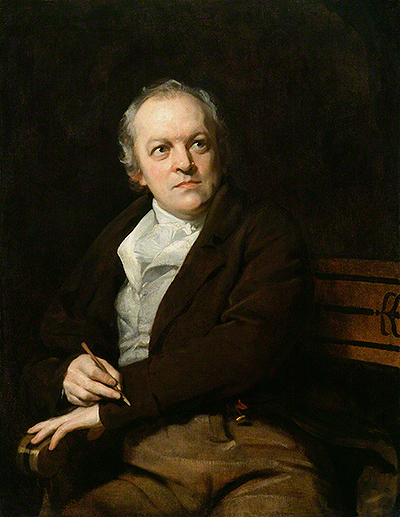
 by Tom Gurney
Tom Gurney BSc (Hons) is an art history expert with over 20 years experience
Published on / Updated on
Email: tomgurney1@gmail.com / Phone: +44 7429 011000
William Blake at Felpham and the Sedition Trial: Introduction
William Blake arrived at Felpham in September 1800 with sixteen heavy boxes, portfolios of prints and great expectations. The cottage near the Sussex coast seemed wonderfully suited to work. He admired its proportions, praised the air and the villagers, and imagined the small house enlarged into a palace. His wife Catherine and his sister accompanied him; the poet William Hayley welcomed them. After the long journey from London, Blake felt that a new life had begun. [1]
Three years later he was preparing to leave, disappointed by the limits of Hayley's patronage but convinced that the stay had enlarged his art. Then a quarrel with a soldier became a prosecution for seditious speech. The incident brought the pressures of wartime Britain into his garden and left him dependent on witnesses, financial guarantees and the assistance of the patron whose judgement he had come to resent. The decision to return to London had already been made before the confrontation. [2]
The hearing ended in acquittal on 11 January 1804. Its outcome is clear; the words spoken during the original quarrel remain disputed. Reading the episode through Blake's letters and contemporary testimony reveals a more complicated story than the familiar scene of an inspired poet throwing out an intrusive soldier. Felpham was a working household, a commercial experiment, a place of powerful imaginative experience and, eventually, an uncomfortable encounter with public authority. [3]
At a Glance
- ArrivalFelpham, September 1800 [1]
- Confrontation12 August 1803 [4][5]
- Hearing11 January 1804; acquitted of sedition and assault [3][4]
Contents
- The invitation and the journey
- Hayley's work and Catherine's printing
- Two patrons and the painter's judgement
- Why Blake resolved to leave
- Poetry, business and a coast at war
- The confrontation on 12 August 1803
- From accusation to indictment
- The hearing at Chichester
- Homecoming and gratitude
The invitation and the journey
Blake's association with Hayley grew through the sculptor John Flaxman. Before the move, engraving and personal sympathy were already intertwined. In April 1800 Blake sent Hayley a proof of a portrait of his gravely ill son, Thomas Alphonso. In May, after the young man's death, he reported further changes to the likeness, including a reduction of the lip at Hayley's suggestion. A commission demanded exact adjustments even in a letter of condolence. [6]
Blake tried to comfort the bereaved father by describing his own relationship with his dead brother Robert. He said that Robert remained present to him in imagination and offered advice. This was an intimate disclosure of Blake's spiritual life, made while discussing a practical piece of reproductive engraving. Hayley was becoming a patron within a relationship that also carried emotional and religious expectations. [6]
The surviving September letters show how eagerly the household anticipated its removal from Lambeth. Blake thanked Flaxman for introducing Hayley into his life. A letter to Anna Flaxman, written in William's hand and signed Catherine, imagined preparing a summer retreat for the couple at Felpham. Its accompanying poem pictured angels travelling through the village towards the cottage. The planned journey already had a place in the Blakes' shared imaginative language. [7]
Departure nevertheless involved exhausting work. On 16 September Blake told Hayley that Catherine had worn herself out through preparation and excitement. They finally travelled on Thursday, 18 September, changing vehicles repeatedly as their considerable luggage was transferred. His letter of the following Sunday records seven chaises and seven drivers, followed by arrival late at night. The boxes and portfolios matter: an engraver and his household were relocating the equipment, stock and unfinished business of a profession. [1] [7]
The surviving cottage provides a physical point of contact with that enterprise. Historic England identifies the altered two-storey building on Blake's Road, with its thatched roof and walls incorporating local stone, flint and brick. The listing also records later window changes. Its present fabric cannot be treated as a perfectly preserved stage set of the Blakes' occupation. Their letters are more immediate evidence of how the small rooms, garden and nearby sea entered daily experience. [8]
Hayley's work and Catherine's printing
At first Blake found ample reason to praise his new employer. Work encompassed the decoration of Hayley's library, engraving, portrait miniatures and publications. In November 1800 he reported studying the faces of Homer, Milton, Camoens, Ercilla, Ariosto and Spenser for the library. He described pleasure in this task, even as other work waited. His response to the commission was interested and energetic; later frustration should not erase that initial engagement. [9]
One delayed project was Little Tom the Sailor, Hayley's ballad. Blake's letter supplies unusually direct evidence of Catherine's part in production. Her illness had stopped further printing while Hayley was away. They could offer some impressions in colour and others in black, and intended to resume the following day. The report places her at the press, with a particular publication in hand, and makes the effects of illness on output visible. [9]
By May 1801 Blake was enthusiastic about miniature painting and said that orders were multiplying. He assured Thomas Butts, his London patron, that Hayley treated him generously. He also tried to arrange a visit from Butts and his wife, offering the limited sleeping space of the cottage or help securing accommodation in the village. Professional ties were sustained through hospitality, messages and the movement of pictures between Sussex and London. [9]
Hayley's biography of William Cowper supplied another substantial engraving project. An exact surviving example is the National Gallery of Art's William Cowper, an engraving dated 1802 after George Romney, associated with the first volume of Hayley's Life and Posthumous Writings of William Cowper, published in 1803. The distinction between the portrait's engraved date and the book's date helps place the work across the later Felpham years. [10]
The employment was demanding. In September 1801 Blake told Butts that engraving plates for Cowper's life was his principal labour. He was also painting miniatures and trying to complete Butts's commissions. His difficulty was therefore partly one of competing obligations: Hayley's plans did not replace work already owed to another supporter. Even in a letter apologising for delay, Blake could praise Hayley's industry and look forward to showing Butts the unfinished library. [11]
He also turned criticism upon himself. The same letter describes imaginative absorption carrying him away from immediate duties, despite his efforts to anchor himself to them. He wrote with humour as well as exasperation about the difficulty of finishing what he intended. This acknowledgement gives the later complaints about Hayley another dimension. Blake was struggling to reconcile different kinds of attention within his own working day, as well as resisting expectations imposed from outside. [11]
Two patrons and the painter's judgement
Butts was essential to the life Blake wanted to preserve within this busy schedule. The letters to him move between unfinished pictures, money received, gratitude and unusually candid explanations of artistic purpose. Distance made the friendship dependent on packages and correspondence, but also gave Blake someone to whom he could describe frustrations that were difficult to acknowledge to Hayley. [11] [12]
On 22 November 1802 he defended the pictures he had made for Butts after two years of reconsidering light, shade and colour. He had deliberately put himself back into the position of a learner. His conclusion was uncompromising: he continued to believe in the designs and the manner in which he had executed them. The large claims he made for their quality belong to an artist arguing his case to a patron, rather than to an impartial ranking of painters. [12]
His argument was more precise than a refusal to learn. Effects admired in one kind of painting might damage the clarity or grandeur of another. Portraiture demanded the presence of the sitter, he insisted, whereas historical invention required a different imaginative freedom. He wanted Butts to understand that the appearance of the pictures resulted from choices about what they should accomplish. Appreciation of his work meant allowing those choices to remain his own. [12]
An accompanying letter returned to the order book: a remaining canvas needed a subject, and eighteen drawings were still owed. It then introduced verses Catherine wanted copied for Butts. The poem moves through a walk in Sussex, family presences, a speaking thistle and the competing demands of friends and work. Its famous account of double and fourfold vision is embedded in those obligations. Blake's inward world was being described from within an everyday life of labour and promises. [12]
The dates require care. The accompanying text is separately numbered in Erdman's edition, with an editorial heading assigning it to 22 November 1802. Blake explicitly says that the verses had been composed more than a year earlier. They cannot be treated as a spontaneous report of his feelings on the day the two letters were sent. Their anxieties had a history, and Catherine's wish to share them gave that earlier writing a renewed purpose. [12]
Why Blake resolved to leave
By January 1803 the Blakes were determined to leave Felpham before another winter. Catherine's recurring illness was an immediate concern. William described her ague and rheumatism, his own ill health and the sorrow her suffering caused him. These are contemporary descriptions of symptoms and distress, not grounds for a retrospective medical diagnosis. They also qualify the early praise of a climate that had seemed so benign. [13]
The same letter to Butts explains the professional difficulty. Blake depended on engraving, particularly the plates then in hand for Hayley, but felt pressed to confine himself to routine business. His own artistic and spiritual duties could not be indefinitely postponed. At the same time, he said that income from their incessant labour covered their small expenses, and declined Butts's immediate offer of money. The problem exceeded a simple absence of employment. [13]
He also credited the country with a substantial achievement: it had helped him gather scattered thoughts on art and recover methods of painting and engraving that he felt he had lost amid London's confusion. His decision to leave did not require him to declare the entire experiment a failure. The useful work of Felpham and his need to escape its constraints could both be real. [13]
Writing privately to his brother James on 30 January, Blake was sharper. He believed Hayley was jealous of his poetry and intended to turn him towards portrait painting. These were Blake's interpretations of Hayley's motives. They should be read alongside his insistence in the same letter that he was fully employed, well paid and learning from his patron's publishing arrangements. He could resent the relationship while recognising its practical benefits. [14]
Catherine's work emerges again in this letter. She had undertaken the printing of the plates for Cowper's book, William praised her results, and he reported that the publishers already owed her twenty guineas for delivered work. This is stronger evidence of her professional contribution than a general description of an artist's supportive wife. Her labour helped sustain the household's position as the decision to leave took shape. [14]
Blake's account of publishing was correspondingly ambitious. Hayley's connections and methods had taught him possibilities he wished he had understood years earlier. He calculated large prospective returns on inexpensive books and imagined publishing substantial works of his own. Those optimistic estimates were expectations, rather than demonstrated profits. They show why independence from Hayley could appear achievable through lessons learned while working for him. [14]
Plans remained flexible for a time. Blake mentioned the possibility of living farther from the sea, perhaps at Lavant, as well as returning to London to publish. By 25 April he was explicitly announcing a London return. Hayley approved, he told Butts, but only there could he pursue his visionary studies free from the doubts of others. He allowed that those doubts might arise from kindness. A patron could intend to help and still leave an artist feeling that the most necessary part of his life was being obstructed. [2]
Watch: William Blake’s world and working methods
Choose an introduction to Blake, a printing demonstration, or a discussion of his radical ideas.
William Blake: Poet, Artist & Visionary - a genius of early Romanticism in England
An introduction to Blake’s art, poetry and imaginative world.
Watch on YouTubePoetry, business and a coast at war
Blake's April account of the stay was expansive. He described an immense poem, new figures and machinery, and passages received through immediate dictation. In July he spoke again of a grand poem and plans to print and illustrate it. These statements establish the importance he attached to poetic labour during the Sussex years. They do not securely identify every passage with the finished form of a particular surviving book. [2] [15]
Nor had he abandoned ordinary business. The July letter sent Butts a finished picture and listed further biblical subjects in progress. Blake expected to continue engraving for Hayley's projected publications after leaving Sussex. Yet he also complained vehemently about Hayley's response to his designs and poems, and insisted upon his right to make artistic decisions. The planned move was a renegotiation of a working relationship as much as a change of address. [15]
The political atmosphere around this household had changed during the stay. In October 1801 Blake had greeted peace with France enthusiastically, imagining easier access to French art and hoping that the arts of the two countries might flourish together. That letter expresses an aspiration for cultural exchange. It cannot establish what he said in a garden quarrel nearly two years later. [16]
By August 1803 Britain and France were again at war. The indictment that followed Blake's confrontation explicitly invoked the war, a possible invasion and the fidelity of the king's subjects and soldiers. Its language shows the framework through which the quarrel became a public accusation. A dispute over who belonged in a garden was being recast as speech encouraging an enemy. [4]
The confrontation on 12 August 1803
The incident occurred on 12 August. John Scolfield, a private in the Royal Dragoons, was in the garden while an ostler from the Fox Inn worked there. Blake's account says that the ostler had invited the soldier to assist without telling him. Scolfield's version differed. Even the purpose of his presence belongs to the disagreement, and the later familiar story of a soldier simply breaking into the garden compresses that uncertainty. [5] [4]
In his letter to Butts of 16 August, Blake admitted taking Scolfield by the elbows and pushing him out. He said the soldier had refused repeated requests to leave, threatened him and insulted his appearance. Once outside, according to Blake, the soldier continued threatening him; Blake followed and pushed him roughly fifty yards along the road to the Fox Inn. The landlord, who also owned the cottage, eventually compelled the soldiers to go indoors. [5]
Blake denied uttering anything about the king or government. He believed Scolfield and his comrade had devised a charge of sedition after the quarrel, in revenge for the humiliation. That explanation is his defence of his own conduct. His admission of physical force and his denial of seditious speech need to be kept distinct; one does not independently prove the other. [5]
His memorandum developed the defence through witnesses and the geography of the scene. It separated events in the garden from those at the stable door of the inn. Only the ostler, the soldier and Blake could know what had passed in the garden, he stressed. Several neighbours were available for the later encounter. Such distinctions mattered because the second soldier claimed to have heard seditious words at the inn. [17]
Mrs Haynes, a neighbour, was central to Blake's argument. He reported her observation that people quarrelling normally repeat the offence of which they complain, whereas neither soldier had immediately accused him of sedition. He also named people who might speak to threats of revenge and the ostler's refusal to swear falsely. These are proposed lines of defence recorded by the accused. The memorandum is not a transcript proving that every named person later testified in precisely those terms. [17]
The document also records Blake's suggestion that Scolfield had mistaken miniature painting for military painting and consequently suspected him of making plans for the enemy. This was Blake's explanation of another reported allegation. It conveys his alarm at the possibilities of accusation, without establishing a conspiracy against him. His closing questions imagine a householder and his wife vulnerable to an intruder who could then swear away their lives. [17]
From accusation to indictment
On 16 August Blake appeared before justices at Chichester and was required to find bail. Hayley and the printer Joseph Seagrave assisted. Blake described military pressure behind the prosecution, reporting what he said a lawyer had told him privately. The statement belongs to his contemporary understanding of the case; it is not independent proof of official collusion. [5]
The formal sequence continued at Petworth on 4 October. Court records transcribed by Herbert Ives in 1910 record Blake's not-guilty pleas and his obligation to appear at the next sessions. The sedition indictment alleged statements cursing the king and country, disparaging soldiers and contemplating a French invasion. A separate indictment concerned assault on Scolfield. The words set out in these documents are accusations framed for prosecution, not established quotations from Blake's mouth. [4]
Older accounts sometimes describe this as a trial for high treason. The official acquittal entries printed by Ives name sedition and assault. His article's title and its account of a capital charge go beyond the documentary wording he reproduced. The charges should retain the names given in those records. [4]
By this stage the Blakes had left Sussex. The threat of proceedings followed them back to London, rather than causing a sudden flight from Felpham after conviction. The move had been anticipated in January, announced in April and welcomed again in July. Their new home in South Molton Street did not immediately solve the difficulties of earning a living or Catherine's health. [2] [14] [15] [18]
Letters to Hayley during the autumn show work continuing across the distance. On 7 October Blake complained that other engravers were busy while commissions failed to reach him. Later that month he reported fresh employment, alongside disappointing news from a bookseller about the ballads' sales. In December he was still preparing Cowper material and thanking Hayley for help, but said he would be at ease only when the soldier's case was over. [18]
The hearing at Chichester
John Marsh's journal provides an independent contemporary account of the final hearing. Hayley came to Chichester on Tuesday, 10 January 1804, expecting to give character evidence. He and Marsh spent much of the day attending the hall, but Blake's case did not begin. Samuel Rose, the advocate Hayley had engaged, joined them for tea. Hayley returned home and came back the next morning. [3]
The case finally began at about four in the afternoon on Wednesday, 11 January, and continued until after five. Marsh says the two soldiers were examined separately, disagreed in their evidence and failed to make good their accusation. Blake was acquitted. The court entries, transcribed by Ives, separately record not-guilty findings for sedition and assault. [3] [4]
The dating helps explain some apparent confusion. The sessions formally opened on 10 January and continued for two days; the acquittal record carries the opening date in its heading. Marsh's account distinguishes that first day's waiting from the hearing on the following afternoon. Petworth's October proceedings were another stage of the same prosecution, not a completed earlier sedition trial followed by a second one. [3] [4]
Later narratives add vivid details. Gilchrist reports Catherine's recollection that Blake interrupted a false allegation with an emphatic denial. He also reproduces a Sussex Advertiser report, published on 16 January, describing noisy public delight at the acquittal. These accounts preserve the remembered force of the occasion, but their different forms matter: a wife's later recollection and a newspaper passage transmitted through a biographer do not supply a complete courtroom transcript. [19]
What can be stated firmly is that Hayley's assistance continued through the crisis. He helped secure bail, engaged Rose and attended the hearing. The result freed Blake from the two charges. It did not retrospectively settle every disputed detail of the quarrel or prove every suspicion he had entertained about its origins. [3] [5] [4]
Homecoming and gratitude
Marsh records that Blake left for London by the following day's coach. On 14 January Blake wrote to Hayley immediately after arriving home. His first concern was his patron's safety after a riding accident: information from an old soldier in the coach had prompted an urgent warning about mounting a trooper's horse. A soldier now figured in the correspondence as a helpful source of advice. [3] [20]
Catherine had been seriously ill during his absence. Blake thanked their neighbour Mrs Enoch for caring for her, and described her beginning to recover after his return. He also reported Flaxman's warm welcome and expressed deep gratitude towards Hayley and the people of Felpham. The letter places the legal outcome within a network of anxious friends, practical care and continuing affection. [20]
That gratitude need not cancel the earlier anger. Hayley's expectations had helped convince Blake that he must leave, while Hayley's assistance helped him withstand a frightening prosecution. Both experiences belong to the record. Felpham gave the Blakes paid work, publishing experience, illness, friendship and sustained opportunities for painting and poetry. Its end was difficult, but the letters resist turning the three years into a single story of betrayal. [13] [14] [15] [20]
For the wider course of his career, see the William Blake biography. Here the episode closes with an artist back at home, acquitted and grateful, still dependent on the labour of his household and the support of people whose wishes could differ from his own. The palace he had imagined in the little Sussex cottage had proved to be a more demanding place to inhabit. [1] [20]
Works and designs directory
Browse separate works, impressions and book components. Dates distinguish versions; six Tate copies after Blake are labelled. These records are not a complete catalogue of unique designs.
| Name | Date | Medium |
|---|---|---|
| A Figure Standing in a Gothic Apse, perhaps the Empress Maud. Verso: Detailed Drawings for ‘The Empress Maud in Bed’ | c.1819 | Pencil drawing |
| A Rolling Stone Is Ever Bare of Moss, from Thornton's "Pastorals of Virgil" | 1821 | Wood engraving |
| A Title Page for The Grave | 1806 | Watercolour |
| A Vision of the Last Judgment | 1808 | Watercolour |
| A Vision: The Inspiration of the Poet (Elisha in the Chamber on the Wall) | c.1819–20? | Watercolour |
| Adam and the Beasts, Frontispiece to Hayley's "Ballads" | June 1, 1802 | Engraving |
| Age Teaching Youth | c.1785–90 | Watercolour |
| Alfred and the Neat-Herd’s Wife (after Henry Fuseli) | 1797, published 1798 | Etching and engraving |
| An Allegory of the Bible. Verso: The Shins of an Écorché Male Figure | c.1780–5, ?c.1780 | Watercolour |
| Angel of the Divine Presence Bringing Eve to Adam (The Creation of Eve: "And She Shall be Called Woman) (recto); Sketch for the same (verso) | ca. 1803 | Watercolour |
| Angel of the Revelation (Book of Revelation, chapter 10) | ca. 1803–5 | Watercolour |
| Antaeus setting down Dante and Virgil in the Last Circle of Hell | 1824–1827 | Watercolour |
| Bathsheba at the Bath | c.1799–1800 | Tempera |
| Beatrice Addressing Dante from the Car | 1824–7 | Watercolour |
| Behemoth and Leviathan | 1825–26 | Engraving |
| Behemoth and Leviathan | 1825, reprinted 1874 | Engraving |
| Behemoth and Leviathan | 1826 | Engraving |
| Blasted Trees and Flattened Crops, from Thornton's "Pastorals of Virgil" | 1821 | Wood engraving |
| Boy Returning Joyfully, with Plough and Oxen, from Thornton's "Pastorals of Virgil" | 1821 | Wood engraving |
| Boy Returning Joyfully, with Plough and Oxen, from Thornton's "Pastorals of Virgil" | 1821 | Wood engraving |
| Catherine Blake. Verso: A Man’s Head and Other Drawings | c.1805 | Pencil drawing |
| Cerberus | 1824–7 | Watercolour |
| Cerberus (second version) | 1824–1827 | Watercolour |
| Chaucer’s Canterbury Pilgrims | 1810, reprinted before 1881 | Engraving |
| Christ Appearing to His Disciples After the Resurrection | c.1795 | Colour print |
| Christ Appearing to the Apostles after the Resurrection | c.1795 | Watercolour |
| Christ Blessing the Little Children | 1799 | Tempera |
| Christ in the Carpenter’s Shop: The Humility of the Saviour (after William Blake) | Date not stated | Watercolour |
| Ciampolo the Barrator Tormented by the Devils | 1826–7, reprinted 1892 | Engraving |
| Ciampolo the Barrator Tormented by the Devils | 1826–7, reprinted 1968 | Engraving |
| Circle of Theives: Agnello Brunelleschi Attacked By a Six-Footed Serpent | ca. 1825–27 | Engraving |
| Clarence's Dream (Shakespeare, Richard III, Act 1, Scene 4) | 1774 | Etching and engraving |
| Colinet Mocked by Two Boys, from Thornton's "Pastorals of Virgil" | 1821 | Wood engraving |
| Colinet Rests by a Stream at Night | c.1821, printed 1830 | Wood engraving |
| Colinet Rests by a Stream at Night | 1821, reprinted 1977 | Wood engraving |
| Colinet with his Shepherd’s Pipe, Mocked by Two Boys | c.1821, printed 1830 | Wood engraving |
| Colinet with his Shepherd’s Pipe, Mocked by Two Boys | 1821, reprinted 1977 | Wood engraving |
| Colinet's Journey, Milestone Marked 'LXII Miles to London', from Thornton's "Pastorals of Virgil" | 1821 | Wood engraving |
| Colinet's Journey: Milestone Marked 'LXII Miles to London', from Thornton's "Pastorals of Virgil" | 1821 | Wood engraving |
| Colinet’s Fond Desire Strange Lands to Know | 1821, reprinted 1977 | Wood engraving |
| Colinet’s ‘Fond Desire Strange Lands to Know’ | c.1821, printed 1830 | Wood engraving |
| Composition Sketch for ‘The Fall of the Rebel Angels’? Verso: Standing Figure with Flaming Hair | ?c.1805–10 | Pencil drawing |
| Composition Sketch, Possibly a Subject from Dante. Verso: A Man Standing over a Figure Reclining on a Bed | ?1824–7, ?c.1800–10 | Pencil drawing |
| Composition Sketch. Verso: Standing Figure Holding a Spear | ?c.1805–10 | Pencil drawing |
| Dante and Virgil Approaching the Angel Who Guards the Entrance of Purgatory | 1824–7 | Watercolour |
| Dante and Virgil Penetrating the Forest | 1824–7 | Watercolour |
| Dante in the Empyrean, Drinking at the River of Light | 1824–7 | Watercolour |
| Dante running from the Three Beasts | 1824–1827 | Watercolour |
| Dante Striking against Bocca Degli Abati | 1826–7, reprinted 1892 | Engraving |
| Dante Striking Against Bocca degli Abati | 1826–7, reprinted 1968 | Engraving |
| David Delivered out of Many Waters | c.1805 | Watercolour |
| David Delivered out of Many Waters (after William Blake) | Date not stated | Watercolour |
| Detailed Drawings for ‘A Figure Standing in a Gothic Apse’ | 1819 | Pencil drawing |
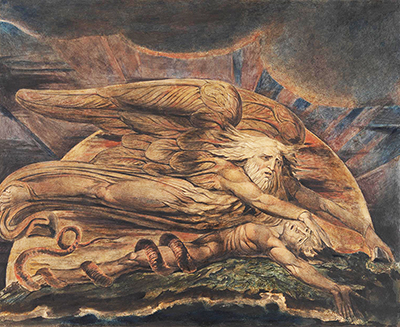
| Elohim Creating Adam | 1795–c.1805 | Colour print |
| Enoch | 1806–7 | Lithograph |
| Epitome of James Hervey’s ‘Meditations among the Tombs’ | c.1820–5 | Watercolour |
| Europe. A Prophecy; Frontispiece | ca. 1820 | Relief etching |
| Evening | c.1820/1825 | Watercolour |
| Every Man also Gave him a Piece of Money | 1825, reprinted 1874 | Engraving |
| Every Man also Gave him a Piece of Money. Verso: God the Father with Attendant Angels | c.1821–3 | Watercolour |
| Every One also Gave Him a Piece of Money | 1826 | Engraving |
| Fertilization of Egypt, from Erasmus Darwin's "The Botanic Garden" | 1791 | Engraving |
| First Book of Urizen pl. 10 | 1796, c.1818 | Etching |
| First Book of Urizen pl. 11 | 1796, c.1818 | Etching |
| First Book of Urizen pl. 15 | 1796, c.1818 | Etching |
| First Book of Urizen pl. 17 | 1796, c.1818 | Etching |
| First Book of Urizen pl. 21 | 1796, c.1818 | Etching |
| First Book of Urizen pl. 6 | 1796, c.1818 | Etching |
| Frontispiece to Jerusalem, the Emanation of the Great Albion | [ca. 1804–20] (?) | Engraving |
| Frontispiece to ‘Visions of the Daughters of Albion’ | c.1795 | Relief etching |
| Frontispiece: Thenot and Colinet | c.1821, printed 1830 | Wood engraving |
| George Cumberland's Message Card | 1827 | Engraving |
| God Judging Adam | ca. 1795 | Relief etching |
| God Judging Adam | 1795 | Relief etching |
| Hiding of Moses, from "Remember Me!, or a Pocket Companion" | 1825 | Engraving |
| Homer and the Ancient Poets | 1824–7 | Watercolour |
| Illustration 1 to Milton’s On the Morning of Christ’s Nativity: The Descent of Peace | c.1814–1816 | Watercolour |
| Illustration 1 to Milton’s Paradise Lost: Satan Calling Up His Legions | 1807 | Watercolour |
| Job accepting Charity | 1825–26 | Engraving |
| Job and his Daughters | 1825–26 | Engraving |
| Job and his Daughters | 1825, reprinted 1874 | Engraving |
| Job and His Daughters | 1826 | Engraving |
| Job and His Family | 1825–26 | Engraving |
| Job and his Family | Reprinted 1874; engraved 1828 date is an error | Engraving |
| Job and His Family | 1826 | Engraving |
| Job and his Family Restored to Prosperity | 1825, reprinted 1874 | Engraving |
| Job and his Wife restored to Prosperity | 1825–26 | Engraving |
| Job rebuked by his Friends | 1825–26 | Engraving |
| Job Rebuked by his Friends | 1825, reprinted 1874 | Engraving |
| Job Rebuked by His Friends | 1826 | Engraving |
| Job's Comforters | 1825–26 | Engraving |
| Job's Comforters | 1826 | Engraving |
| Job's Despair | 1825–26 | Engraving |
| Job's Evil Dreams | 1825–26 | Engraving |
| Job's Evil Dreams | 1826 | Engraving |
| Job's Sacrifice | 1825–26 | Engraving |
| Job's Sons and Daughters Overwhelmed by Satan | 1826 | Engraving |
| Job, his Wife and his Friends: The Complaint of Job. Verso: Job’s Wife and Eight Other Sketches | c.1785 | Watercolour |
| Job’s Comforters | 1825, reprinted 1874 | Engraving |
| Job’s Despair | 1825, reprinted 1874 | Engraving |
| Job’s Evil Dreams | 1825, reprinted 1874 | Engraving |
| Job’s Sacrifice | 1825, reprinted 1874 | Engraving |
| Job’s Sons and Daughters Overwhelmed by Satan | 1825, reprinted 1874 | Engraving |
| John Linnell | 1825 | Pencil drawing |
| Joseph of Arimathea Preaching to the Britons | c.1794/1796 | Relief etching |
| Judas Betrays Him | c.1803–5 | Watercolour |
| King John Absolved by Pandulph (after Henry Fuseli) | 1797, published 1798 | Etching and engraving |
| Lamech and his Two Wives | 1795 | Colour print |
| Landscape near Felpham | c.1800 | Watercolour |
| Lear and Cordelia in Prison | c.1779 | Watercolour |
| Los and Orc | c.1792–3 | Watercolour |
| Lower Half of a Woman Playing a Harp. Verso: Seraphim and Other Drawings | c.1785, c.?1807 | Pencil drawing |
| Menalcus Watching Women Dance, from Thornton's "Pastorals of Virgil" | 1821 | Wood engraving |
| Menalcus Watching Women Dance, from Thornton's "Pastorals of Virgil" | 1821 | Wood engraving |
| Moses Indignant at the Golden Calf | c.1799–1800 | Tempera |
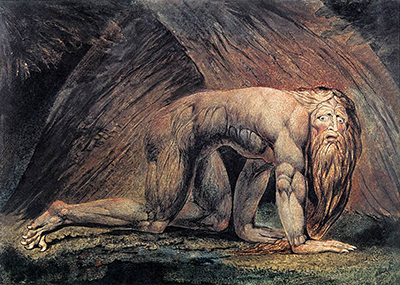
| Nebuchadnezzar | 1795–c.1805 | Colour print |
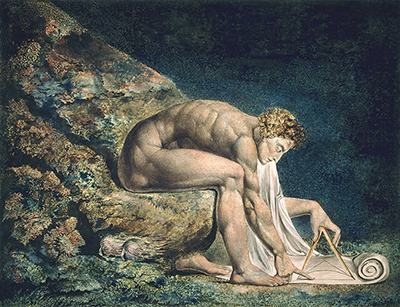
| Newton | 1795–c.1805 | Colour print |
| Oberon, Titania and Puck with Fairies Dancing | c.1786 | Watercolour |
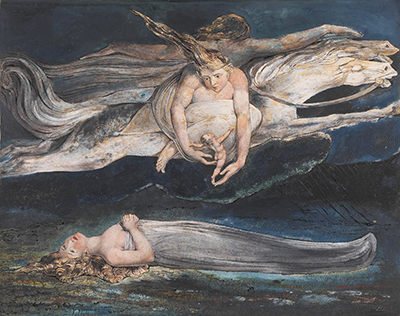
| Pity | ca. 1795 | Relief etching |
| Pity | c.1795 | Colour print |
| Plate 2 of ‘Urizen’: ‘Teach these Souls to Fly’ | ?1796 | Relief etching |
| Plate 3 of ‘Urizen’: Oh! Flames of Furious Desires’ (after William Blake) | Date not stated | Watercolour |
| Plate 4 of ‘Visions of the Daughters of Albion’ | c.1795 | Relief etching |
| Plutus | 1824–7 | Watercolour |
| Preliminary Sketch for ‘Christ Girding Himself with Strength’. Verso: Standing Figure with One Arm Raised | c.1805, c.1805–10 | Pencil drawing |
| Preludium. "The shadowy daughter of Urthona stood before red Orc..." (Plate 3) | 1793 | Relief etching |
| Queen Elizabeth and Essex (after Henry Fuseli) | 1797, published 1798 | Engraving |
| Sabrina's Silvery Flood, from Thornton's "Pastorals of Virgil" | 1821 | Wood engraving |
| Sabrina's Silvery Flood, from Thornton's "Pastorals of Virgil" | 1821 | Wood engraving |
| Sabrina’s Silvery Flood | c.1821, printed 1830 | Wood engraving |
| Sabrina’s Silvery Flood | 1821, reprinted 1977 | Wood engraving |
| Satan Before the Throne of God | 1825–26 | Engraving |
| Satan before the Throne of God | 1825, reprinted 1874 | Engraving |
| Satan before the Throne of God | 1826 | Engraving |
| Satan calling up his Legions | c.1800–05 | Tempera |
| Satan Exulting over Eve | c.1795 | Colour print |
| Satan Going Forth from the Presence of the Lord, and Job’s Charity | 1825, reprinted 1874 | Engraving |
| Satan Going Forth fron the Presence of the Lord | 1825–26 | Engraving |
| Satan in his Original Glory: ‘Thou wast Perfect till Iniquity was Found in Thee’ | c.1805 | Watercolour |
| Satan Smiting Job with Boils | 1825–26 | Engraving |
| Satan Smiting Job with Sore Boils | 1825, reprinted 1874 | Engraving |
| Satan Smiting Job with Sore Boils | c.1826 | Tempera |
| Satan Smiting Job with Sore Boils | 1826 | Engraving |
| Shepherd Chases Away a Wolf, from Thornton's "Pastorals of Virgil" | 1821 | Wood engraving |
| Shepherd Chases Away a Wolf, from Thornton's "Pastorals of Virgil" | 1821 | Wood engraving |
| Sketch for the Title-Page of the Engraved Illustrations to the Book of Job | c.1823/1826 | Pencil drawing |
| Sketch for ‘The Four and Twenty Elders Casting their Crowns before the Divine Throne’. Verso: Standing Figure with Arms at his Side | c.1803, c.1805–10 | Pencil drawing |
| Sketch for ‘Tiriel Supporting the Dying Myratana’. Verso: Sketch for ‘Tiriel Supporting the Dying Myratana’ | c.1786–9 | Pencil drawing |
| Songs of Experience: A Little Boy Lost | [1794] printed ca. 1825 | Relief etching |
| Songs of Experience: A Little Girl Lost | [1794] printed ca. 1825 | Relief etching |
| Songs of Experience: A Poison Tree | [1794] printed ca. 1825 | Relief etching |
| Songs of Experience: Earth's Answer | [1794] printed ca. 1825 | Relief etching |
| Songs of Experience: Frontispiece | [1794] printed ca. 1825 | Relief etching |
| Songs of Experience: Holy Thursday | [1794] printed ca. 1825 | Relief etching |
| Songs of Experience: Infant Sorrow | [1794] printed ca. 1825 | Relief etching |
| Songs of Experience: Introduction | [1794] printed ca. 1825 | Relief etching |
| Songs of Experience: London | [1794] printed ca. 1825 | Relief etching |
| Songs of Experience: My Pretty Rose Tree, Ah! Sun-Flower, The Lilly | [1794] printed ca. 1825 | Relief etching |
| Songs of Experience: Nurses Song | [1794] printed ca. 1825 | Relief etching |
| Songs of Experience: The Angel | [1794] printed ca. 1825 | Relief etching |
| Songs of Experience: The Chimney Sweeper | [1794] printed ca. 1825 | Relief etching |
| Songs of Experience: The Clod & the Pebble | [1794] printed ca. 1825 | Relief etching |
| Songs of Experience: The Fly | [1794] printed ca. 1825 | Relief etching |
| Songs of Experience: The Garden of Love | [1794] printed ca. 1825 | Relief etching |
| Songs of Experience: The Human Abstract | [1794] printed ca. 1825 | Relief etching |
| Songs of Experience: The Little Girl Found (second plate) | [1789] printed ca. 1825 | Relief etching |
| Songs of Experience: The Little Girl Lost | [1789] printed ca. 1825 | Relief etching |
| Songs of Experience: The Little Girl Lost (second plate); The Little Girl Found | [1789] printed ca. 1825 | Relief etching |
| Songs of Experience: The Little Vagabond | [1794] printed ca. 1825 | Relief etching |
| Songs of Experience: The School Boy | [1789] printed ca. 1825 | Relief etching |
| Songs of Experience: The Sick Rose | [1794] printed ca. 1825 | Relief etching |
| Songs of Experience: The Tyger | [1794] printed ca. 1825 | Relief etching |
| Songs of Experience: The Voice of the Ancient Bard | [1789] printed ca. 1825 | Relief etching |
| Songs of Experience: Title-page | [1794] printed ca. 1825 | Relief etching |
| Songs of Experience: To Tirzah | [1794] printed ca. 1825 | Relief etching |
| Songs of Innocence and of Experience, Shewing the Two Contrary States of the Human Soul: Combined Title-page | [1789–94] printed ca. 1825 | Relief etching |
| Songs of Innocence and of Experience: Infant Sorrow | 1794, reprinted 1831 or later | Relief etching |
| Songs of Innocence: A Cradle Song | [1789] printed ca. 1825 | Relief etching |
| Songs of Innocence: A Cradle Song (second plate) | [1789] printed ca. 1825 | Relief etching |
| Songs of Innocence: A Dream | [1794] printed ca. 1825 | Relief etching |
| Songs of Innocence: Frontispiece | [1789] printed ca. 1825 | Relief etching |
| Songs of Innocence: Holy Thursday | [1789] printed ca. 1825 | Relief etching |
| Songs of Innocence: Infant Joy | [1789] printed ca. 1825 | Relief etching |
| Songs of Innocence: Introduction | [1789] printed ca. 1825 | Relief etching |
| Songs of Innocence: Laughing Song | [1789] printed ca. 1825 | Relief etching |
| Songs of Innocence: Little Boy Lost | [1789] printed ca. 1825 | Relief etching |
| Songs of Innocence: Night | [1789] printed ca. 1825 | Relief etching |
| Songs of Innocence: Night (second plate) | [1789] printed ca. 1825 | Relief etching |
| Songs of Innocence: Nurse's Song | [1789] printed ca. 1825 | Relief etching |
| Songs of Innocence: On Anothers Sorrow | [1789] printed ca. 1825 | Relief etching |
| Songs of Innocence: Spring | [1789] printed ca. 1825 | Relief etching |
| Songs of Innocence: Spring (second plate) | [1789] printed ca. 1825 | Relief etching |
| Songs of Innocence: The Blossom | [1789] printed ca. 1825 | Relief etching |
| Songs of Innocence: The Chimney Sweeper | [1789] printed ca. 1825 | Relief etching |
| Songs of Innocence: The Divine Image | [1789] printed ca. 1825 | Relief etching |
| Songs of Innocence: The Ecchoing Green | [1789] printed ca. 1825 | Relief etching |
| Songs of Innocence: The Ecchoing Green (second plate) | [1789] printed ca. 1825 | Relief etching |
| Songs of Innocence: The Lamb | [1789] printed ca. 1825 | Relief etching |
| Songs of Innocence: The Little Black Boy | [1789] printed ca. 1825 | Relief etching |
| Songs of Innocence: The Little Black Boy (second plate) | [1789] printed ca. 1825 | Relief etching |
| Songs of Innocence: The Little Boy Found | [1789] printed ca. 1825 | Relief etching |
| Songs of Innocence: The Shepherd | [1789] printed ca. 1825 | Relief etching |
| Songs of Innocence: Title Page | [1789] printed ca. 1825 | Relief etching |
| St Christopher, Copy from an Engraving? Verso:Part of a Face: Copy from a Plaster Cast: a Daughter of Niobe? | ?c.1779–80 | Pencil drawing |
| The Agony in the Garden | c.1799–1800 | Tempera |
| The Angel Appearing to Zacharias | 1799–1800 | Tempera |
| The Ascent of the Mountain of Purgatory | 1824–7 | Watercolour |
| The Baffled Devils Fighting | 1826–7, reprinted 1892 | Engraving |
| The Baffled Devils Fighting | 1826–7, reprinted 1968 | Engraving |
| The Bard, from Gray | ?1809 | Tempera |
| The Beggar's Opera, Act III | July 1, 1790 | Etching and engraving |
| The Beggar's Opera, Act III | July 1, 1790 | Engraving |
| The Beggar's Opera, Act III | 1790 | Engraving |
| The Blasphemer | c.1800 | Watercolour |
| The Blighted Corn | c.1821, printed 1830 | Wood engraving |
| The Blighted Corn | 1821, reprinted 1977 | Wood engraving |
| The Body of Abel Found by Adam and Eve | c.1826 | Tempera |
| The Body of Christ Borne to the Tomb | c.1799–1800 | Tempera |
| The Book of Job: Title Page | 1825 | Engraving |
| The Book of Thel pl. 6 | 1796, c.1818 | Etching |
| The Circle of Corrupt Officials: The Devils Mauling Each Other | ca. 1825–27 | Engraving |
| The Circle of Corrupt Officials: The Devils Tormenting Ciampolo | ca. 1825–27 | Engraving |
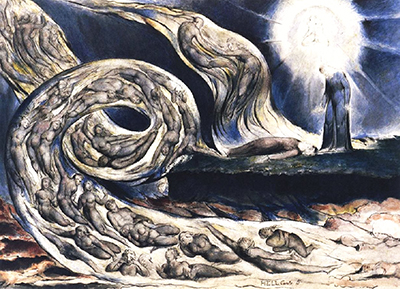
| The Circle of the Lustful: Francesca da Rimini (‘The Whirlwind of Lovers’) | 1826–7, reprinted 1892 | Engraving |
| The Circle of the Lustful: Francesca da Rimini (‘The Whirlwind of Lovers’) | 1826–7, reprinted 1968 | Engraving |
| The Circle of the Lustful: Paolo and Francesca | ca. 1825–27 | Engraving |
| The Circle of the Thieves; Buoso Donati Attacked by the Serpent | ca. 1825–27 | Engraving |
| The Circle of Traitors: Dante's Foot Striking Bocca degli Abbate | ca. 1825–27 | Engraving |
| The Complaint and the Consolation; or, Night Thoughts | 1797 | Etching and engraving |
| The Creation | 1825–26 | Engraving |
| The Crucifixion | c.1825–7 | Pencil drawing |
| The Crucifixion: ‘Behold Thy Mother’ | c.1805 | Watercolour |
| The Dance of Albion (Glad Day) | c.1803/1810 | Engraving |
| The Death of Lucretia, from Allen's "New and Impartial Roman History" | 1797 | Engraving |
| The Death of Saint Joseph | 1803 | Watercolour |
| The Death of the Virgin | 1803 | Watercolour |
| The Descent of Peace [recto] | c.1815 | Pencil drawing |
| The Destruction of Job's Sons | 1825–26 | Engraving |
| The Devils, with Dante and Virgil by the Side of the Pool | 1824–7 | Watercolour |
| The Entombment | c.1805 | Watercolour |
| The Fall of Rosamond (after Thomas Stothard) | 1783 | Etching and engraving |
| The Fall of Satan | 1825–26 | Engraving |
| The Fall of Satan | 1825, reprinted 1874 | Engraving |
| The Fall of Satan | 1826 | Engraving |
| The Four and Twenty Elders Casting their Crowns before the Divine Throne | c.1803–5 | Watercolour |
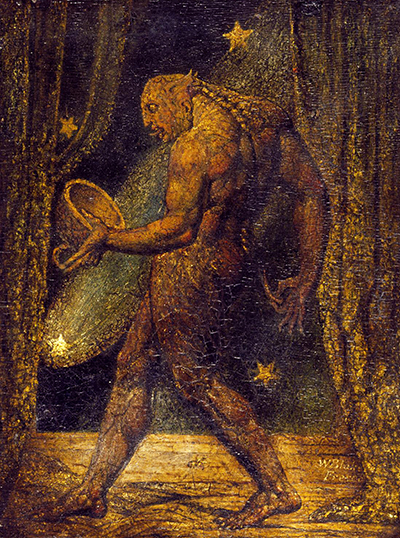
| The Ghost of a Flea | c.1819–20 | Tempera |
| The Good and Evil Angels | 1795–?c.1805 | Colour print |
| The Good Farmer, Probably the Parable of the Wheat and the Tares. Verso: Rough Sketch of Two or Three Figures in a Landscape | c.1780–5 | Watercolour |
| The Great Red Dragon and the Beast from the Sea | c.1805 | Watercolour |
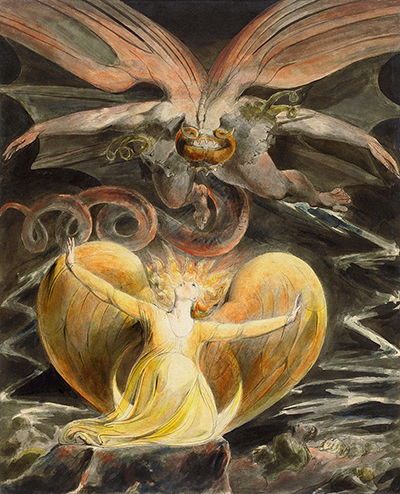
| The Great Red Dragon and the Woman Clothed with the Sun | c.1805 | Watercolour |
| The Head of the Ghost of a Flea. Verso: A Profile and a Reduced Drawing of Milton’s First Wife | c.1819 | Pencil drawing |
| The Hermit’s Dog, from William Hayley’s "Ballads" | 1805 | Etching and engraving |
| The Hiding of Moses | 1824 | Engraving |
| The House of Death | 1795–c.1805 | Colour print |
| The House of Death | c.1790 | Watercolour |
| The Hypocrites with Caiaphas. Verso: Sketch of a Stooping Figure | 1824–7 | Watercolour |
| The Inscription over the Gate | 1824–7 | Watercolour |
| The Laborious Passage along the Rocks | 1824–7 | Watercolour |
| The Last Trumpet (recto); Two studies of a right eye, a profile of an open-mouthed young man, the head of an eagle, and the head of a lion (verso) | 1780–85 | Pencil drawing |
| The Lord Answering Job out of the Whirlwind | 1825–26 | Engraving |
| The Lord Answering Job out of the Whirlwind | 1825, reprinted 1874 | Engraving |
| The Man Who Taught Blake Painting in his Dreams (counterproof) (after William Blake) | after c.1819–20 | Pencil drawing |
| The Marriage of Heaven and Hell pl. 16 | 1796, c.1818 | Etching |
| The Messengers tell Job of his Misfortunes | 1825–26 | Engraving |
| The Messengers tell Job of his Misfortunes | 1825, reprinted 1874 | Engraving |
| The Night of Enitharmon’s Joy (formerly called ‘Hecate’) | c.1795 | Colour print |
| The Parable of the Wise and Foolish Virgins | ca. 1799–1800 | Watercolour |
| The Parable of the Wise and Foolish Virgins (after William Blake) | Date not stated | Watercolour |
| The Pastorals of Virgil, with a Course of English Reading, Adapted for Schools, Vol. I | 1821 | Wood engraving |
| The Penance of Jane Shore in St Paul’s Church | c.1793 | Watercolour |
| The Pit of Disease: The Falsifiers | 1826–7, reprinted 1892 | Engraving |
| The Pit of Disease: The Falsifiers | 1824–7 | Watercolour |
| The Pit of Disease: The Falsifiers | 1826–7, reprinted 1968 | Engraving |
| The Primaeval Giants Sunk in the Soil | 1824–7 | Watercolour |
| The Punishment of the Thieves | 1824–7 | Watercolour |
| The Raising of Lazarus (after William Blake) | Date not stated | Watercolour |
| The Rest on the Flight into Egypt (The Repose of the Holy Family in Egypt) | 1806 | Watercolour |
| The River of Life | c.1805 | Watercolour |
| The Rock Sculptured with the Recovery of the Ark and the Annunciation | 1824–7 | Watercolour |
| The Serpent Attacking Buoso Donati | 1826–7, reprinted 1892 | Engraving |
| The Serpent Attacking Buoso Donati | 1826–7, reprinted 1968 | Engraving |
| The Serpent Attacking Buoso Donati. Verso: A Man with a Transparent Hood (?) over his Head | 1824–7 | Watercolour |
| The Simoniac Pope | 1824–7 | Watercolour |
| The Six-Footed Serpent Attacking Agnolo Brunelleschi | 1826–7, reprinted 1892 | Engraving |
| The Six-Footed Serpent Attacking Agnolo Brunelleschi | 1826–7, reprinted 1968 | Engraving |
| The Soul Hovering over the Body Reluctantly Parting with Life | c.1805 | Pencil drawing |
| The Spiritual Form of Nelson Guiding Leviathan | c.1805–9 | Tempera |
| The Spiritual Form of Pitt Guiding Behemoth | ?1805 | Tempera |
| The Sun at His Eastern Gate | c.1816–1820 | Watercolour |
| The Temple of Mirth, after Thomas Stothard | 1784 | Engraving |
| The Temptation and Fall of Eve | 1807 | Watercolour |
| The Temptation and Fall of Eve (Illustration to Milton’s Paradise Lost) | 1808 | Watercolour |
| The Thieves and Serpents | 1824–1827 | Watercolour |
| The Vision of Christ | 1825, reprinted 1874 | Engraving |
| The Vision of Eliphaz | 1825–26 | Engraving |
| The Vision of Eliphaz | 1825, reprinted 1874 | Engraving |
| The Vision of God | 1825–26 | Engraving |
| The Wood of the Self-Murderers: The Harpies and the Suicides | 1824–7 | Watercolour |
| The Wrath of Elihu | 1825–26 | Engraving |
| The Wrath of Elihu | 1825, reprinted 1874 | Engraving |
| Thenot and Colinet | 1821, reprinted 1977 | Wood engraving |
| Thenot and Colinet at Supper | c.1821, printed 1830 | Wood engraving |
| Thenot and Colinet at Supper | 1821, reprinted 1977 | Wood engraving |
| Thenot and Colinet Converse Seated between Two Trees | c.1821, printed 1830 | Wood engraving |
| Thenot and Colinet Converse Seated between Two Trees | 1821, reprinted 1977 | Wood engraving |
| Thenot and Colinet Eat Their Evening Meal, from Thornton's "Pastorals of Virgil" | 1821 | Wood engraving |
| Thenot and Colinet Folding their Flocks together at Sunset | c.1821, printed 1830 | Wood engraving |
| Thenot and Colinet Folding their Flocks together at Sunset | 1821, reprinted 1977 | Wood engraving |
| Thenot and Colinet Lead Their Flocks Together, from Thornton's "Pastorals of Virgil" | 1821 | Wood engraving |
| Thenot and Colinet Lead Their Flocks Together, from Thornton's "Pastorals of Virgil" | 1821 | Wood engraving |
| Thenot Remonstrates with Colinet | c.1821, printed 1830 | Wood engraving |
| Thenot Remonstrates with Colinet | 1821, reprinted 1977 | Wood engraving |
| Thenot Remonstrates With Colinet, from Thornton's "Pastorals of Virgil" | 1821 | Wood engraving |
| Thenot Remonstrates With Colinet, from Thornton's "Pastorals of Virgil" | 1821 | Wood engraving |
| Thenot Remonstrates with Colinet, Lightfoot in the Background, from Thornton's "Pastorals of Virgil" | 1821 | Wood engraving |
| Thenot Remonstrates with Colinet: Lightfoot in the Distance | 1821, reprinted 1977 | Wood engraving |
| Thenot Remonstrates with Colinet; Lightfoot in the Distance | c.1821, printed 1830 | Wood engraving |
| Thenot Under a Fruit Tree, from Thornton's "Pastorals of Virgil" | 1821 | Wood engraving |
| Thenot, with Colinet Waving his Arms in Sorrow | c.1821, printed 1830 | Wood engraving |
| Thenot, with Colinet Waving his Arms in Sorrow | 1821, reprinted 1977 | Wood engraving |
| Title Page: Illustrations of the Book of Job | 1825–26 | Engraving |
| Title-Page of ‘The Book of Job’ | 1825, reprinted 1874 | Engraving |
| Tornado–Zeus Battling Typhon, from Erasmus Darwin's "Botanic Garden" | August 1, 1795 | Engraving |
| Tornado–Zeus Battling Typhon, from Erasmus Darwin's "The Botanic Garden" | August 1, 1795 | Engraving |
| Two Figures in a Decorative Border | c.1790 | Pencil drawing |
| Unyok'd Heifers, Loitering Homeward (Return of the Shepherd), from Thornton's "Pastorals of Virgil" | 1821 | Wood engraving |
| Virgil Girding Dante’s Brow with a Rush | 1824–7 | Watercolour |
| Wat Tyler and the Tax-Gatherer (after Henry Fuseli) | 1797, published 1798 | Etching and engraving |
| When the Morning Stars Sang Together | 1825, reprinted 1874 | Engraving |
| When the Morning Stars Sang Together | 1826 | Engraving |
| Winged Figure Flying Through Clouds, from Bell's "Poets" | 1790 | Etching and engraving |
| Winter | c.1820–5 | Tempera |
| ‘A Rolling Stone is ever Bare of Moss’ | c.1821, printed 1830 | Wood engraving |
| ‘A Rolling Stone is ever Bare of Moss’ | 1821, reprinted 1977 | Wood engraving |
| ‘And Unyok’d Heifers, Loitering Homeward, Low’ | c.1821, printed 1830 | Wood engraving |
| ‘And Unyok’d Heifers, Loitering Homewards, Low’ | 1821, reprinted 1977 | Wood engraving |
| ‘Europe’: Fragment of Pages 3 and 4 | 1794–c.1830–5 | Relief etching |
| ‘For him Our Yearly Wakes and Feasts We Hold’ | c.1821, printed 1830 | Wood engraving |
| ‘For him Our Yearly Wakes and Feasts We Hold’ | 1821, reprinted 1977 | Wood engraving |
| ‘Nor Fox, nor Wolf, nor Rat among our Sheep’ | c.1821, printed 1830 | Wood engraving |
| ‘Nor Fox, nor Wolf, nor Rat among our Sheep’ | 1821, reprinted 1977 | Wood engraving |
| ‘Songs of Innocence and of Experience’: ‘Infant Sorrow’ | 1794, reprinted 1831 or later | Relief etching |
| ‘Songs of Innocence and of Experience’: ‘Spring’ | 1794, reprinted 1831 or later | Relief etching |
| ‘Songs of Innocence’: Title-Page | 1789, reprinted 1831 or later | Relief etching |
| ‘Songs of Innocence’: Title-Page | 1789, reprinted 1831 or later | Relief etching |
| ‘With Songs the Jovial Hinds Return from Plow’ | c.1821, printed 1830 | Wood engraving |
| ‘With Songs the Jovial Hinds Return from Plow’ | 1821, reprinted 1977 | Wood engraving |
Frequently Asked Questions
Discussion
Look again at the images and ideas explored in William Blake at Felpham and the Sedition Trial. These editorial prompts invite your observations.
Reader Insights
Hayley’s commissions first inspired pleasure and energy. Later frustration should leave room for that earlier engagement.
The decision to leave preceded the garden confrontation. January letters already describe illness and determination to avoid another winter.
A session opening date and a hearing date describe different events. Marsh separates the first day’s waiting from the following afternoon’s trial.
Join the Conversation
Share a detail, comparison or question about William Blake at Felpham and the Sedition Trial below.
References
- William Blake. Letters to John Flaxman, 21 September 1800, E710, and Thomas Butts, postmarked 23 September 1800, E711. David V. Erdman, ed., The Complete Poetry and Prose of William Blake, digital transcription, Arizona State University. Flaxman letter Butts letter View source 1. View source 2.
- William Blake. Letter to Thomas Butts, 25 April 1803, E728–729, Erdman digital transcription. View source.
- John Marsh; Brian Robins, ed. The John Marsh Journals, vol. II, The Life and Times of a Gentleman Composer (1752–1828), Boydell & Brewer, 2013, chapter 2, pp. 37–72; publicly available opening extract on the proceedings of 10–11 January 1804. View source.
- Herbert Ives. “The Trial of William Blake for High Treason,” The Nineteenth Century and After 67 (May 1910), pp. 849–861, especially the transcribed Petworth court records, pp. 853–855, and Chichester acquittal entries, p. 859. The article's title and surrounding interpretation are distinguished from the documentary transcriptions. View scan View source.
- William Blake. Letter to Thomas Butts, 16 August 1803, E731–734, Erdman digital transcription. View source.
- William Blake. Letters to William Hayley, 1 April and 6 May 1800, E705, Erdman digital transcription. April letter May letter View source 1. View source 2.
- William and Catherine Blake. William to John Flaxman, 12 September 1800, E707–708; Catherine to Anna Flaxman, 14 September 1800, in William's hand, E708–709; William to Hayley, 16 September 1800, E709, Erdman digital transcription. 12 September 14 September 16 September View source 1. View source 2. View source 3.
- Historic England. “Blake's Cottage,” National Heritage List for England, entry 1353792, official list entry and building details. View source.
- William Blake. Letters to William Hayley, 26 November 1800, E714–715, and Thomas Butts, 10 May 1801, E715, Erdman digital transcription. November letter May letter View source 1. View source 2.
- National Gallery of Art, Washington. William Blake after George Romney, William Cowper, 1802, engraving, 1983.103.6.a; associated with Hayley's Life and Posthumous Writings of William Cowper, volume I, 1803. View source.
- William Blake. Letter to Thomas Butts, 11 September 1801, E716–717, Erdman digital transcription. View source.
- William Blake. Letter to Thomas Butts, 22 November 1802, E718–720, and separately numbered accompanying letter, editorially dated 22 November 1802, E720–723, Erdman digital transcription. The accompanying verse is explicitly described as composed more than a year earlier. Letter 22 Letter 23 View source 1. View source 2.
- William Blake. Letter to Thomas Butts, 10 January 1803, E723–725, Erdman digital transcription. View source.
- William Blake. Letter to James Blake, 30 January 1803, E725–727, Erdman digital transcription. View source.
- William Blake. Letter to Thomas Butts, 6 July 1803, E729–731, Erdman digital transcription. View source.
- William Blake. Letter to John Flaxman, 19 October 1801, E717–718, Erdman digital transcription. View source.
- William Blake. “Memorandum in Refutation of the Information and Complaint of John Scolfield,” August 1803, E734–735, Erdman digital transcription. View source.
- William Blake. Letters to William Hayley, 7 October, 26 October and 13 December 1803, E736–739, Erdman digital transcription. 7 October 26 October 13 December View source 1. View source 2. View source 3.
- Alexander Gilchrist. Life of William Blake, second edition, 1880, vol. I, chapter XIX, “Trial for Sedition,” including later recollections and its transcription of the Sussex Advertiser, 16 January 1804. View source.
- William Blake. Letter to William Hayley, 14 January 1804, E739–740, Erdman digital transcription. View source.