



 by Tom Gurney
Tom Gurney BSc (Hons) is an art history expert with over 20 years experience
Published on / Updated on
Email: tomgurney1@gmail.com / Phone: +44 7429 011000
William Blake’s Paradise Lost Illustrations: Introduction
Adam and Eve kiss on a bank so thick with flowers that it seems capable of supporting their weight. Above them, a winged figure turns towards a serpent coiled around his own body. His hand rests against its head, repeating the lovers’ caress below. In William Blake’s illustrations to John Milton’s Paradise Lost, a gesture can belong to two different kinds of relationship. The loving couple look towards one another; Satan’s embrace closes around an image of himself. The viewer encounters the difference before reaching for an explanation. [1]
Blake returned to Paradise Lost in three watercolour projects, conventionally called the Thomas, Butts and Linnell sets after their patrons. Their dates are 1807, 1808 and 1822. These are related groups of drawings, with changes in scale, subject and treatment. They reward looking as sequences, because a body, a flower or a serpent encountered early in the story can acquire another meaning when it returns. [2]
The best way into them is to follow a few of those returns. Satan’s raised arms summon fallen angels; Sin reaches between threatening weapons; Eve’s hand moves from a human head to a serpent’s; Michael finally takes both human beings by the hand. Blake turns the epic’s immense distances into encounters between bodies. His pictures keep asking who reaches towards whom, what kind of attachment results, and whether an apparent movement towards freedom has become another form of captivity.
At a Glance
- ProjectsThomas 1807; Butts 1808; Linnell 1822 [2]
- Thomas groupTwelve drawings at the Huntington [3][4]
- Butts groupTwelve surviving designs in several collections [3][5]
Contents
- Three projects, with different histories
- A route through Milton’s story
- Earlier pictures beside the series
- Satan calls: the body that seems able to rise
- At Hell’s gates: a family unable to recognise itself
- The Son’s offer: an early view of the ending
- Eden: two embraces and two ways of looking
- A new night scene for Butts
- Creation remembered, warning remembered
- The temptation: when the garland falls
Three projects, with different histories
The first complete group consists of twelve drawings painted in 1807 for the Reverend Joseph Thomas. All twelve are now at the Huntington in California. Usually called the small set, these are upright sheets approximately twenty-five centimetres high. The collection’s accession sequence needs care: the Thomas drawings are 000.1, 000.2 and 000.4–000.13. The intervening 000.3 is a larger version of Satan, Sin and Death from the Butts group. Thirteen associated Huntington drawings therefore do not make a thirteen-subject Thomas series. [3][4]
The Butts set also contains twelve surviving designs. Thomas Butts acquired them in 1808 and probably commissioned them, as the William Blake Archive’s editors carefully phrase the relationship. Nine are at the Museum of Fine Arts, Boston; Satan Calling Up His Legions is at the Victoria and Albert Museum; the large Satan, Sin and Death is at the Huntington; and The Judgment of Adam and Eve is at Harvard’s Houghton Library. The Boston group comprises subjects three to nine, eleven and twelve. Seeing only those nine sheets can make a complete series appear incomplete. [3][5]
The later drawings are roughly twice the height of the Thomas sheets. Their larger figures and more developed modelling change the encounter even when the arrangement remains familiar. Yet size is only part of the revision. Eleven subjects recur, while the Thomas design combining Satan’s spying with Raphael’s descent is replaced by Adam and Eve Asleep. The order also changes: the watching scene is fifth in the Thomas sequence and fourth in the Butts sequence, followed by the new sleeping scene. [5]
The third project began in 1822 for John Linnell. Its three securely catalogued sheets are divided between two museums. Melbourne’s National Gallery of Victoria holds Satan Watching the Endearments of Adam and Eve, accession 1025-3, and The Creation of Eve, accession 1024-3. Their current records date both to 1822. [6][7]
The Fitzwilliam Museum in Cambridge holds The Archangel Michael Foretelling the Crucifixion, PD.49-1950. It describes the work as begun in 1822 and dates it no earlier than that year. Martin Butlin transcribes Linnell’s journal entry of 9 May 1822 recording that Blake began copies of his Paradise Lost drawings. The three known compositions follow the larger Butts designs. A projected repetition of the complete series is plausible, but three surviving finished sheets do not prove that twelve were completed and nine subsequently lost. [8][3]
A proposed fourth sheet complicates the census. In 2017 Butlin attributed a newly discovered Adam and Eve Asleep to Blake and placed it with the Linnell group. Robert N. Essick rejected that attribution, pointing to weaknesses in the outlines, handling and figures, as well as the absence of a documented Linnell provenance. Essick explicitly based his assessment on a digital image. The disagreement is a reason to distinguish three securely established works from a proposed addition. A confident total of four would conceal the central question of authorship. [3][9]
Nor does the date 1808 make every Butts sheet equally straightforward. The Huntington’s catalogue discusses the possibility that its large Satan, Sin and Death originated around 1806 as an independent work before joining the group. The Huntington’s works list dates the large sheet to 1808. The series name identifies the drawing’s eventual relationship to its companions; it need not settle every stage of its making. [10][4]
A route through Milton’s story
Milton’s poem begins after the war in heaven. Satan and his companions have already fallen when the reader first encounters them in Hell. His journey towards the newly created human world brings him to Sin and Death at the gates. In heaven, the Son offers to redeem humanity; in Eden, Satan watches Adam and Eve. Raphael’s later warning contains an account of the earlier heavenly war, while Adam tells the angel how Eve was created. The human fall comes after those conversations. Judgement, foreknowledge of redemption and departure from Eden follow. [11]
This order matters when looking at Blake’s drawings. The Rout of the Rebel Angels, although encountered well into the series, depicts events earlier than the opening image of Satan rallying his defeated followers. The Creation of Eve also reaches backwards into a remembered beginning. Twelve pictures do not function as twelve evenly spaced snapshots, one for each book. They move between present action, retrospective narration and a vision of the future.
Several kinds of voice operate inside that movement. Satan’s claim to independence is his own speech. Adam’s recollection of creation is an account given to Raphael. Michael’s description of the Crucifixion is a prophecy delivered to Adam. The narrator sometimes comments directly on what the characters say and do. Blake then makes further choices: he can place separated events in the same picture, invent a bodily relationship, or give a metaphor an almost literal form. Keeping those levels apart allows us to see how actively he reads.
Blake challenged Milton earlier, in The Marriage of Heaven and Hell. Its discussion of energy and restraint leads to the assertion that Milton belonged to the “Devils party without knowing it”. The remark concerns the poet’s imaginative freedom when writing about Hell and his constraint when writing about divine authority. It occurs within a deliberately provocative account of opposed interpretations, including what the Devil’s account would say. It should be read within that argument before becoming a verdict on every later picture. [12]
The watercolours give Satan beauty, strength and attention, but also entanglement and envy. They give substantial space to the Son’s offer, judgement and foretold sacrifice. Those decisions make the series more searching than an illustrated declaration of allegiance to one side. A viewer can feel the attraction of Satan’s splendid body while watching the relationships around it expose the limits of his freedom.
Earlier pictures beside the series
Two related works offer useful approaches to the watercolours. Satan Calling His Legions belongs to an earlier history of independent tempera paintings. The National Trust dates the Petworth version to about 1800–1805 and identifies it as tempera and gold leaf on canvas. Its catalogue distinguishes that painting from an earlier version now at the Victoria and Albert Museum, as well as from the later watercolour compositions. They share an episode, but belong to different undertakings. [13]
Blake’s 1809 Descriptive Catalogue describes the earlier exhibited painting as an experiment and as a composition preceding a more perfected picture made for a woman of high rank. He also complains that repeated labour had damaged its original outlines. These are his own reflections on a particular painting and its difficult development. They give the subject a history before the Thomas and Butts watercolours, without making either watercolour an exhibit from 1809. [14]
Satan Exulting over Eve offers another earlier encounter with the serpent and the human body. The Getty’s particular impression, 84.GC.49, is dated 1795 and combines a colour print with graphite, pen, ink and watercolour. Satan hovers above Eve while a serpent coils around her below. That separate design anticipates a relationship Blake would reconsider in the Paradise Lost scenes, but it is outside the later twelve-sheet sets. The collection and material description belong to the Getty object. [15]
The distinction also helps with titles. The Fall of Satan in Blake’s Job sequence is a different composition from The Rout of the Rebel Angels in the Milton drawings. A falling Satan alone cannot identify a literary source. Likewise, Blake’s own Milton: A Poem in Two Books is a separate literary and visual work. These neighbouring subjects extend the encounter with Milton and Christian imagery, while the watercolour sets remain a defined group of pictures. [16]
Satan calls: the body that seems able to rise
The Thomas series opens with Satan upright on a rock, both arms lifted above his shoulders. Around and below him, the fallen angels bend, crouch, rise or remain bound. A large shield rests behind him. At the bottom centre, a seated figure faces the viewer with knees drawn up and hands held low; nearby, another body hangs upside down. The leader’s commanding vertical stance is surrounded by positions in which the human form seems to have lost its ease. [17]
The picture makes an immediate impression of force, but the variety of responses is just as striking. Several figures raise their hands towards Satan; others turn away or support their heads. Their bodies have the same muscular promise as his. That common physical language makes their different conditions visible: strength can gather itself, sink into melancholy, or become a weight that cannot be lifted. The composition lets the summons and the difficulty of answering it occupy one sheet.
Milton gives the voice an unmistakable power. Satan calls to the defeated host, reminding them of their former rank and shaming their apparent willingness to remain prostrate. They respond like soldiers abruptly awakened on duty. Earlier in the book, however, the narrator has told the reader that Satan could rise only because heaven permitted it. The leader’s account of his recovered strength and the narrator’s explanation do not agree. His rhetoric attempts to turn defeat into a new occasion for command. [11]
Blake concentrates that tension in the central body. Satan looks capable of raising others because he stands so magnificently himself. Yet the arms beneath him repeat his gesture without immediately attaining his stability. The chain and bent knees in the foreground remain there for us to see. The picture can therefore sustain admiration for bodily energy alongside doubt about what its leader offers. Its interest lies in that simultaneous experience, before the viewer has reduced Satan to either a hero or a warning.
This opening also establishes a useful way of reading the sequence: attend to changes in the same kind of body. Angelic, human and threatening figures often share an idealised anatomy. Moral character does not always arrive as a distorted face or an obviously alien species. Posture, direction, company and action become essential. What someone does with strength matters more than the mere possession of it.
At Hell’s gates: a family unable to recognise itself
The next design brings the raised arm into a threatened collision. Satan advances from the left with shield and spear. Death confronts him from the right, raising a flaming weapon. Between them, Sin stretches both arms upwards. Her upper body is human, while serpents and snarling hounds gather below it. The crossing weapons direct attention to the space she occupies. Architecture makes the encounter feel blocked: arches behind Satan lead towards a heavy barred gate behind Death. [10]
Death is a particularly strange presence. His face, crown and muscles are clearly drawn, yet the gate remains visible through him. Blake gives an absence a discernible body. The effect is easier to recognise if the viewer first looks at the solid flesh of Satan and Sin, then returns to the figure on the right. The same drawn vocabulary can describe either substance or a shape through which something else appears.
Milton prepares exactly that difficulty. The narrator struggles to call Death a shape or a substance at all, describing something poised between shadow and form. Satan initially fails to recognise both figures at the gate. Sin interrupts the threatened combat and tells him their family history: she sprang from his head; he loved his own likeness in her; Death was their offspring. Her account continues into the violence Death inflicted on her and the recurring torment of the hounds. Recognition brings a history that Satan’s first confident challenge excludes. [11]
Sin’s extended arms consequently do more than divide two attackers. She is trying to stop father and son from destroying one another, while disclosing the relationships that connect them. Her position gives her an immediate compositional authority. She occupies the centre and interrupts the strongest diagonals. The viewer sees a figure whose suffering and knowledge complicate the encounter’s display of martial force.
The key hanging beside her is small enough to miss. Once noticed, it changes the balance of power. The combatants occupy more height, but Sin can open the gate through which Satan wants to pass. In the poem, he changes his manner after hearing her explanation and promises a new world where she and Death will find prey. What began as a duel ends in cooperation towards another catastrophe. The picture holds the crisis before that cooperation, when family connection appears as both a restraint on violence and the means by which violence will travel further. [11][10]
The Son’s offer: an early view of the ending
Between the gates and Eden, Christ Offers to Redeem Man opens another kind of encounter. The Son stands with his back towards us, his arms spreading before an enthroned Father whose face is hidden. Angels descend at either side, holding crowns. Below the curving cloud boundary, Satan hovers with shield and spear. The page lets us see two actions separated by a level of vision: his continuing journey and the offer that will overcome its consequences. [18]
In Book III, the Father foresees the human fall and asks who will undertake humanity’s redemption. Heaven falls silent. The Son then offers himself and speaks of death, resurrection and return. His speech sets giving up his present glory against Satan’s pursuit of dominion. The circumstances are different, but both figures are choosing what to do with power. [11]
The Huntington’s catalogue relates the Son’s gesture to the later Crucifixion. It also offers a scriptural explanation for the Father’s concealed face: Milton’s heavenly song describes divine glory made visible through the Son. Its label proposes a more critical possibility, finding weakness in the Father’s slumped appearance. These are distinct readings of a striking visual choice. The picture provides grounds for asking about the Father’s withdrawn position without supplying a written judgement from Blake. [18]
Whatever conclusion a viewer reaches, the sequence has already introduced its eventual answer to Sin and Death. Satan is still flying towards the human world, yet the Son’s open arms anticipate the body shown on the cross near the end. That advance view changes the suspense. The question becomes how the drawings will bring a promise made above into contact with the vulnerable bodies below.
Eden: two embraces and two ways of looking
In the Thomas Satan Spying on Adam and Eve and Raphael’s Descent into Paradise, the page divides into three pointed areas. Satan stands at the left, enclosed by his wings and serpent; the couple walk together at the right; Raphael descends between them within a cloud. Above him, a bearded figure extends arms and wings across the top. The central descent interrupts the possibility of an unobstructed movement from Satan towards his intended victims. [19]
The arrangement combines episodes from different parts of the poem. Satan’s first watching of the pair belongs to Book IV, while Raphael’s instructions and descent occur in Book V. The Huntington’s commentary identifies that combination. Blake gives the reader a relationship between danger and warning that cannot be photographed as a single passing instant. Separate times become neighbouring spaces, and the cloud’s shape lets us feel the intervention dividing them. [19]
The human beings continue their walk without looking towards either watcher or messenger. Their absorption has a tenderness of its own. Satan’s serpent, by contrast, rises above his head and returns along his body towards the ground. An enclosure that might at first resemble shelter also appears to bind him. The visual separation of the compartments makes their unequal knowledge palpable: the pair have company they cannot see.
The following Thomas picture, Satan Watching the Endearments of Adam and Eve, brings the human embrace closer. Adam supports Eve’s head, and her hand reaches towards his hair. Around them, flowers expand into a soft seat and an enclosing arch. Above, Satan touches the serpent’s head while pointing towards the couple. The Huntington interprets the contrast as mutual love set beside self-love. The image allows that difference to be followed through the repeated hands and turned faces. [1]
Milton surrounds the encounter with a more complicated texture than the kiss alone suggests. Eve recalls her first fascination with her reflected image and her subsequent meeting with Adam. The narrator then describes the couple’s kiss and Satan’s envy. Satan recognises their happiness as the thing he cannot share, before turning the prohibition on the tree into the basis of a plan. Looking becomes preparation for an attack. His seeming pity for the innocent pair earlier in the book is followed by the narrator’s exposure of his self-justifying argument. [11]
The Butts version reverses Satan’s direction. In the Thomas drawing his head is at the left; in the later sheet it is at the right. The sun and crescent also exchange sides. Below, the lovers remain closely joined, but Adam’s outer leg now stretches diagonally towards the lower right rather than bending upright. The revision alters the balance of the whole page: the upper horizontal body and the lower spreading legs make a larger, more expansive arrangement around the central kiss. [1][20]
The Archive’s discussion of Blake’s serpents draws attention to his inclusion of both Satan’s angelic body and his serpent form within a single design. That doubling is valuable for the viewer. We see an apparently beautiful figure and the creature associated with his later deception together. The serpent supplies a second face towards which Satan can turn. He is watching the couple, but is also occupied by a relationship that circles back upon himself. [20]
Watch: William Blake’s world and working methods
Choose an introduction to Blake, a printing demonstration, or a discussion of his radical ideas.
William Blake: Poet, Artist & Visionary - a genius of early Romanticism in England
An introduction to Blake’s art, poetry and imaginative world.
Watch on YouTubeA new night scene for Butts
Replacing the composite spying picture with Adam and Eve Asleep changes the series’ emphasis. The Thomas design looks across a threatened world and the warning coming towards it. The Butts subject takes us into the couple’s most vulnerable hours. In the episode Blake selects, Ithuriel and Zephon find Satan in the form of a toad close to Eve’s ear. The intrusion reaches the imagination while the body rests. [5][11]
The surrounding text is important. Milton has just celebrated the pair’s married love and described them sleeping in an embrace. The night search then reveals the attempt to corrupt Eve’s dreams. At the beginning of Book V she recounts a dream of being led to the forbidden tree, tasting its fruit and flying upwards before her guide disappears. Adam comforts her by distinguishing an unwelcome thought in sleep from waking consent. The dream troubles them, but it has not itself made Eve guilty of the later act. [11]
That distinction gives the added subject a different kind of suspense. The reader knows that the danger can enter a place of intimacy without changing its outward appearance immediately. The lovers’ sleeping together and the intruder’s activity belong to the same episode. Blake’s substitution gives the series a scene of threatened inward life alongside its more spectacular battles and confrontations.
It also changes how the watching picture is approached. In the Butts sequence, the embrace is followed by sleep and the concealed assault. The movement runs from visible tenderness to an intervention its subjects cannot perceive. The later temptation can then be remembered against two earlier moments of access: Satan looking at the pair and Satan trying to influence Eve’s imagination. The revised sequence creates its own rhythm, even though most of its subjects have been retained.
Creation remembered, warning remembered
The Creation of Eve appears in all three projects, making it one of the few subjects that can be followed through Thomas, Butts and Linnell. The current NGV record explicitly connects its 1822 sheet with Book VIII, lines 452–477. These are lines spoken by Adam while recalling his beginning to Raphael. The story is being remembered within a conversation, and its account of vision is unusually precise. [3][7][11]
Adam describes falling asleep after speaking with his maker about the need for companionship. His bodily eyes close, but his inward sight remains open. He sees a rib taken from his side and fashioned into a living woman, whose presence changes his perception of everything around him. This follows a sustained discussion of the kind of fellowship he seeks. The creation answers a desire for someone capable of sharing understanding and delight. [11]
Reading the episode that way keeps its sleep from becoming an empty convention. Adam is both inactive in body and receptive to a vision. Later, when Eve sleeps during Michael’s account of the future, the poem explicitly recalls this earlier sleep. The series gives the reader reasons to remember who is awake, who sees, and who learns through another person’s subsequent account.
The earlier warning scene and The Rout of the Rebel Angels also belong to a conversation. Raphael tells Adam about the war so that past events may help him recognise present danger. In that account the Son drives the rebels from heaven, employing power while withholding total destruction. The resulting fall is the event whose aftermath opened Blake’s sequence. Returning to it from the middle turns the first image into something newly understood: Satan’s magnificent recovery follows a catastrophe that the human listener has now been taught to remember. [11]
The temptation: when the garland falls
The Thomas Temptation and Fall of Eve sets a tree between the two human figures. At the right, Eve bends towards the serpent’s mouth, accepting the fruit while its coils encircle her. At the left, Adam turns his face upwards, holding a garland between his raised hands. Behind them, lightning breaks across a dark sky. The tree joins the picture from top to bottom, yet divides the human relationship across its trunk. [21]
The sustained conversation in Book IX makes Eve’s act a process of persuasion. She first discusses working separately with Adam. The serpent then approaches with flattery, explains its supposed acquisition of speech, leads her to the tree and argues against the threatened consequences of eating. Eve considers those claims herself before reaching towards the fruit. Milton gives the temptation time, argument and several changes of confidence. [11]
Blake concentrates it in contact. The fruit passes at the meeting of mouths, and Eve’s hand cradles the serpent’s head. Remembering the lovers’ earlier gesture makes the new attachment disturbing. The serpent has entered the position previously occupied by Adam, while its body closes around Eve. The scene joins seduction to an enclosure she does not appear to resist. The resemblance is visible before it becomes an explanation of what the image means. [21]
Adam belongs to another moment. In the poem he waits for Eve and makes a garland for her hair; when he hears what she has done, the flowers fall from his slack hand. The Thomas drawing keeps the garland raised, while the Butts version places it on the ground. This small alteration changes our sense of how far his knowledge has advanced. The earlier picture suspends him within apprehension; the later one makes the abandoned token of welcome visible beneath him. [11][21]
The change is especially effective because the garland belongs to the world of care and growing things that surrounds the pair earlier. Adam has prepared a gift for the returning gardener. Its fall turns a light object into a sign of interrupted expectation. It also asks the viewer to move the eye from the dramatic meeting of Eve and serpent down towards the quieter evidence at Adam’s feet.
Milton distinguishes the two acts of eating. Eve believes the serpent’s account; Adam subsequently chooses to share her condition although he understands the prohibition. The narrator does not permit the entire disaster to rest upon Eve’s deception alone. Blake’s simultaneous scene leaves the reader looking towards that further choice, even while the serpent occupies the foreground. The separate page on The Temptation and Fall of Eve follows the image more closely; within the series, the earlier kiss and the later Crucifixion supply essential companions to it. [11]
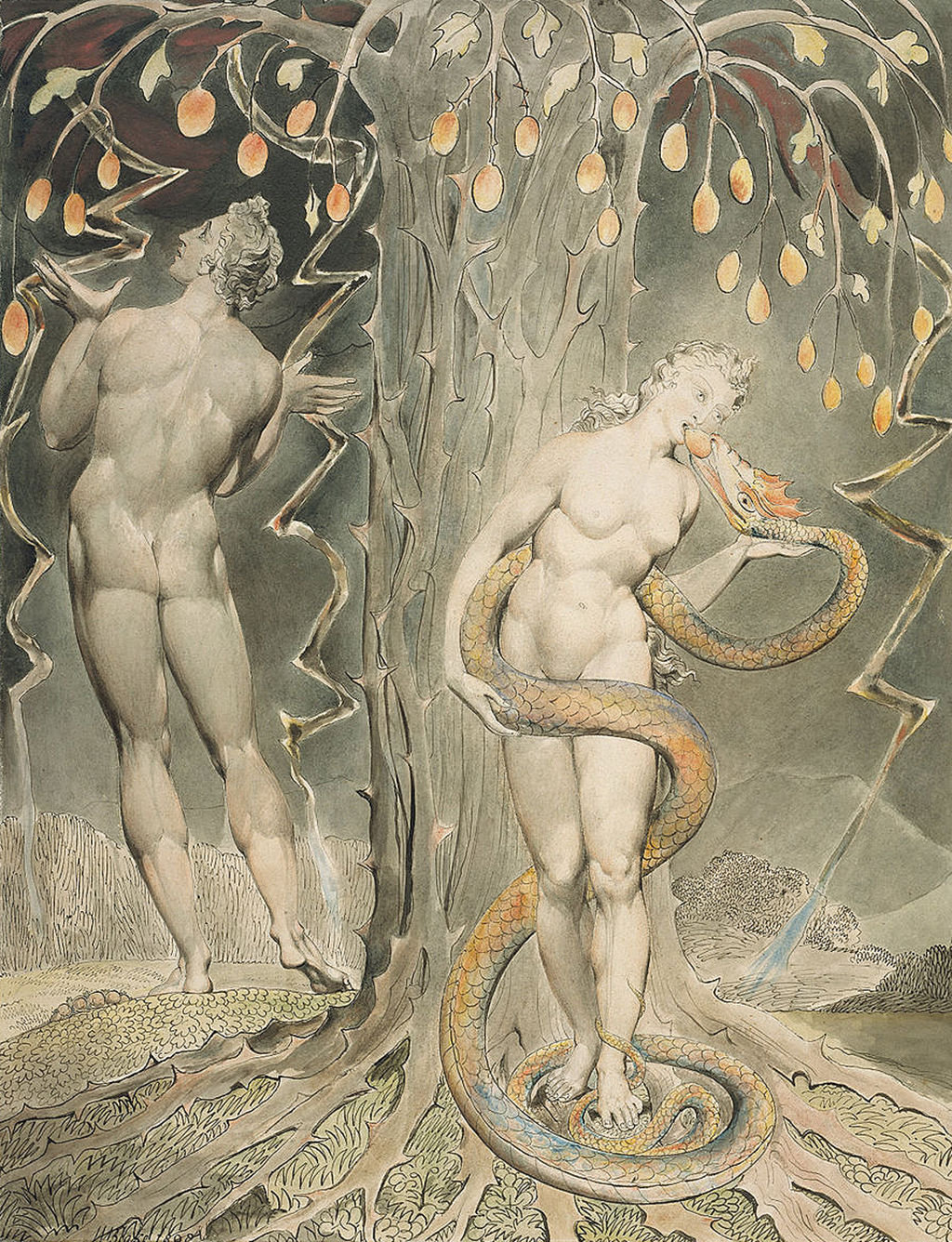
The Temptation and Fall of Eve. The larger 1808 Butts/Boston composition places Adam’s garland on the ground; it is distinct from the 1807 Thomas version discussed alongside it.
Judgement and the return of Sin and Death
The following subject brings Christ between the ashamed pair. Adam bows with hands joined, while Eve covers her face. Above them, Sin and Death occupy another zone of the composition, sending harm downwards. The Huntington’s account identifies this as another joining of separate narrative episodes: the human judgement and the consequences of the opened passage from Hell. Figures first encountered as a terrible family at the gate have reached the human world. [22]
Book X gives the judge two responsibilities. The Son carries out the judgement while acting as humanity’s mediator and future redeemer. After pronouncing the consequences of disobedience, he clothes the pair. Milton places care within the account of punishment. Meanwhile, Sin and Death construct a passage connecting Hell with the world Satan has entered. The new relationship between regions becomes a route for suffering. [11]
Blake’s divided picture makes that coexistence visible. The close encounter below can be read against the wider forces above. Following the series, the viewer recognises Sin and Death before treating them as general emblems. Their earlier confrontation and threatened hunger remain part of what they now bring. Repetition gives them a history within the drawings, and the picture’s judgement of two individuals opens onto a much larger human consequence.
Michael’s prophecy: a different use of the outstretched body
In Michael Foretells the Crucifixion, the central vertical body is Christ upon the cross. Michael stands at the left and raises an open hand towards him; Adam stands at the right with his hands joined. Beneath the cross lie the defeated forms of Sin and Death. A serpent winds towards Christ’s feet. At the bottom of the Thomas sheet, Eve sleeps in a shallow depression edged with small plants. The page gathers figures whose relationships have changed radically since the opening scenes. [23]
Blake makes Michael’s account of the future visible. The Crucifixion has not occurred within the human chronology of the poem. At the start of Book XII, Adam’s failing sight prompts Michael to continue by spoken narration. The angel explains how the promised deliverer will overcome the effects of Satan’s work through obedience, love, death and resurrection. He specifically warns Adam against imagining merely a physical duel with the serpent. Blake nonetheless makes the promise bodily, placing the serpent’s head at the nail through Christ’s feet. A verbal account of victory becomes a charged point of contact. [11][23]
The defeated figures below are central to that transformation. At Hell’s gate, Death stood upright and threatened a blow towards Satan’s head. Here, threatening forms have collapsed under the cross. The viewer can compare the former reach of the weapon with the stillness of the bodies beneath Christ. The sequence gives the promise of deliverance a visible memory: these are powers already encountered, whose activity we have watched move into the human world.
Christ’s outstretched arms also recall the series’ many gestures of force and appeal. The resemblance does not make every raised arm equivalent. It allows us to ask what the position accomplishes in each context. Satan’s initial display gathers followers beneath him; Sin’s extension interrupts a family combat; the crucified body becomes the focus of Michael’s revelation. The same anatomy acquires another significance through action, company and place.
Eve’s sleep remains a difficult part of the scene. Michael’s instructions in Book XI have explicitly left her below while Adam ascends into foreknowledge. Blake includes her bodily presence but does not give her Adam’s view of the cross. The resulting imbalance should remain visible. The picture’s promise concerns humanity, while access to its explanation is distributed unequally. [11][23]
Milton subsequently gives Eve a dream of reassurance. When Adam returns, she is awake and speaks of the promised restoration through her offspring. That later speech prevents the sleeping figure from becoming her final condition in the narrative. Her knowledge arrives by another means. Reading far enough beyond the illustrated prophecy lets the viewer preserve both facts: the exclusion within this scene and the consolation that follows it. [11]
Leaving Eden together
The last Thomas design brings Michael to the centre between Adam and Eve. He holds one hand of each as they step forward. Both look back and upwards towards a tremendous curling form of flame. Four bearded guardians on horses occupy the upper corners, while a serpent and spiny plants inhabit the ground. The simple human movement through the lower part of the page takes place beneath an extraordinary sky. [24]
The contrast in scale is affecting. Adam and Eve cannot control the great turns of flame above them, but the angel’s arms establish an intelligible connection at their own bodily level. One figure leads; two figures follow. Their open hands and turned heads preserve the hesitation involved in leaving. The shared movement has none of the commanding isolation of Satan standing above his followers in the first design.
Milton makes departure both painful and possible. Michael takes the lingering pair by the hand and brings them down from the garden. They look back at the barrier, shed tears and then move onwards into a world where they must choose their place of rest. Earlier in the same concluding passage, Michael has taught Adam to join knowledge with deeds, patience and charity. Leaving the place of innocence is accompanied by an account of how to live beyond it. [11]
Blake gives that departure a landscape already marked by consequence. The serpent has returned to the ground, and the plants no longer resemble the rounded abundance supporting the lovers. Yet the hands at the centre remain joined. The image can carry grief without making separation the only thing it shows. After so many destructive or self-enclosing attachments, the final act of guidance brings the pair into a common movement.
Reading across the drawings
Following the narrative establishes who appears and what happens. Looking backwards then exposes connections that a first passage can miss. Sin and Death beneath the cross recall the confrontation at Hell’s gate. Eve’s hand against the serpent recalls the earlier human embrace. The drawings reward a reader who remembers gestures as closely as events.
The different sets add another dimension to that looking. The Thomas drawings offer a complete, comparatively intimate sequence in one collection. The dispersed Butts sheets invite comparison with a larger and revised treatment. The Linnell works preserve a later return to selected compositions, whose incompleteness as a series leaves their intended extent uncertain. Each group has its own history; the familiar titles do not erase the individual sheets.
Institutional attention continues to bring that sustained encounter into view. The Morgan Library & Museum has announced William Blake: Paradise Lost for 26 February–23 May 2027, placing the watercolours within Blake’s wider engagement with Milton. Its published announcement uses the Boston Temptation and Fall of Eve, 90.99, dated 1808, to introduce the project. The exhibition is a future occasion to see these relationships brought together; the drawings already available offer ample reasons to begin looking. [25]
A serpent can appear as an intimate companion, an enclosing force or a defeated enemy. Sleep can shelter, expose or prepare the mind for another kind of understanding. Blake gives those changes concrete forms and lets the sequence gather their meaning. Reading beside the pictures makes the changes slower, clearer and more unsettling.
Works and designs directory
Browse separate works, impressions and book components. Dates distinguish versions; six Tate copies after Blake are labelled. These records are not a complete catalogue of unique designs.
| Name | Date | Medium |
|---|---|---|
| A Figure Standing in a Gothic Apse, perhaps the Empress Maud. Verso: Detailed Drawings for ‘The Empress Maud in Bed’ | c.1819 | Pencil drawing |
| A Rolling Stone Is Ever Bare of Moss, from Thornton's "Pastorals of Virgil" | 1821 | Wood engraving |
| A Title Page for The Grave | 1806 | Watercolour |
| A Vision of the Last Judgment | 1808 | Watercolour |
| A Vision: The Inspiration of the Poet (Elisha in the Chamber on the Wall) | c.1819–20? | Watercolour |
| Adam and the Beasts, Frontispiece to Hayley's "Ballads" | June 1, 1802 | Engraving |
| Age Teaching Youth | c.1785–90 | Watercolour |
| Alfred and the Neat-Herd’s Wife (after Henry Fuseli) | 1797, published 1798 | Etching and engraving |
| An Allegory of the Bible. Verso: The Shins of an Écorché Male Figure | c.1780–5, ?c.1780 | Watercolour |
| Angel of the Divine Presence Bringing Eve to Adam (The Creation of Eve: "And She Shall be Called Woman) (recto); Sketch for the same (verso) | ca. 1803 | Watercolour |
| Angel of the Revelation (Book of Revelation, chapter 10) | ca. 1803–5 | Watercolour |
| Antaeus setting down Dante and Virgil in the Last Circle of Hell | 1824–1827 | Watercolour |
| Bathsheba at the Bath | c.1799–1800 | Tempera |
| Beatrice Addressing Dante from the Car | 1824–7 | Watercolour |
| Behemoth and Leviathan | 1825–26 | Engraving |
| Behemoth and Leviathan | 1825, reprinted 1874 | Engraving |
| Behemoth and Leviathan | 1826 | Engraving |
| Blasted Trees and Flattened Crops, from Thornton's "Pastorals of Virgil" | 1821 | Wood engraving |
| Boy Returning Joyfully, with Plough and Oxen, from Thornton's "Pastorals of Virgil" | 1821 | Wood engraving |
| Boy Returning Joyfully, with Plough and Oxen, from Thornton's "Pastorals of Virgil" | 1821 | Wood engraving |
| Catherine Blake. Verso: A Man’s Head and Other Drawings | c.1805 | Pencil drawing |
| Cerberus | 1824–7 | Watercolour |
| Cerberus (second version) | 1824–1827 | Watercolour |
| Chaucer’s Canterbury Pilgrims | 1810, reprinted before 1881 | Engraving |
| Christ Appearing to His Disciples After the Resurrection | c.1795 | Colour print |
| Christ Appearing to the Apostles after the Resurrection | c.1795 | Watercolour |
| Christ Blessing the Little Children | 1799 | Tempera |
| Christ in the Carpenter’s Shop: The Humility of the Saviour (after William Blake) | Date not stated | Watercolour |
| Ciampolo the Barrator Tormented by the Devils | 1826–7, reprinted 1892 | Engraving |
| Ciampolo the Barrator Tormented by the Devils | 1826–7, reprinted 1968 | Engraving |
| Circle of Theives: Agnello Brunelleschi Attacked By a Six-Footed Serpent | ca. 1825–27 | Engraving |
| Clarence's Dream (Shakespeare, Richard III, Act 1, Scene 4) | 1774 | Etching and engraving |
| Colinet Mocked by Two Boys, from Thornton's "Pastorals of Virgil" | 1821 | Wood engraving |
| Colinet Rests by a Stream at Night | c.1821, printed 1830 | Wood engraving |
| Colinet Rests by a Stream at Night | 1821, reprinted 1977 | Wood engraving |
| Colinet with his Shepherd’s Pipe, Mocked by Two Boys | c.1821, printed 1830 | Wood engraving |
| Colinet with his Shepherd’s Pipe, Mocked by Two Boys | 1821, reprinted 1977 | Wood engraving |
| Colinet's Journey, Milestone Marked 'LXII Miles to London', from Thornton's "Pastorals of Virgil" | 1821 | Wood engraving |
| Colinet's Journey: Milestone Marked 'LXII Miles to London', from Thornton's "Pastorals of Virgil" | 1821 | Wood engraving |
| Colinet’s Fond Desire Strange Lands to Know | 1821, reprinted 1977 | Wood engraving |
| Colinet’s ‘Fond Desire Strange Lands to Know’ | c.1821, printed 1830 | Wood engraving |
| Composition Sketch for ‘The Fall of the Rebel Angels’? Verso: Standing Figure with Flaming Hair | ?c.1805–10 | Pencil drawing |
| Composition Sketch, Possibly a Subject from Dante. Verso: A Man Standing over a Figure Reclining on a Bed | ?1824–7, ?c.1800–10 | Pencil drawing |
| Composition Sketch. Verso: Standing Figure Holding a Spear | ?c.1805–10 | Pencil drawing |
| Dante and Virgil Approaching the Angel Who Guards the Entrance of Purgatory | 1824–7 | Watercolour |
| Dante and Virgil Penetrating the Forest | 1824–7 | Watercolour |
| Dante in the Empyrean, Drinking at the River of Light | 1824–7 | Watercolour |
| Dante running from the Three Beasts | 1824–1827 | Watercolour |
| Dante Striking against Bocca Degli Abati | 1826–7, reprinted 1892 | Engraving |
| Dante Striking Against Bocca degli Abati | 1826–7, reprinted 1968 | Engraving |
| David Delivered out of Many Waters | c.1805 | Watercolour |
| David Delivered out of Many Waters (after William Blake) | Date not stated | Watercolour |
| Detailed Drawings for ‘A Figure Standing in a Gothic Apse’ | 1819 | Pencil drawing |
| Elohim Creating Adam | 1795–c.1805 | Colour print |
| Enoch | 1806–7 | Lithograph |
| Epitome of James Hervey’s ‘Meditations among the Tombs’ | c.1820–5 | Watercolour |
| Europe. A Prophecy; Frontispiece | ca. 1820 | Relief etching |
| Evening | c.1820/1825 | Watercolour |
| Every Man also Gave him a Piece of Money | 1825, reprinted 1874 | Engraving |
| Every Man also Gave him a Piece of Money. Verso: God the Father with Attendant Angels | c.1821–3 | Watercolour |
| Every One also Gave Him a Piece of Money | 1826 | Engraving |
| Fertilization of Egypt, from Erasmus Darwin's "The Botanic Garden" | 1791 | Engraving |
| First Book of Urizen pl. 10 | 1796, c.1818 | Etching |
| First Book of Urizen pl. 11 | 1796, c.1818 | Etching |
| First Book of Urizen pl. 15 | 1796, c.1818 | Etching |
| First Book of Urizen pl. 17 | 1796, c.1818 | Etching |
| First Book of Urizen pl. 21 | 1796, c.1818 | Etching |
| First Book of Urizen pl. 6 | 1796, c.1818 | Etching |
| Frontispiece to Jerusalem, the Emanation of the Great Albion | [ca. 1804–20] (?) | Engraving |
| Frontispiece to ‘Visions of the Daughters of Albion’ | c.1795 | Relief etching |
| Frontispiece: Thenot and Colinet | c.1821, printed 1830 | Wood engraving |
| George Cumberland's Message Card | 1827 | Engraving |
| God Judging Adam | ca. 1795 | Relief etching |
| God Judging Adam | 1795 | Relief etching |
| Hiding of Moses, from "Remember Me!, or a Pocket Companion" | 1825 | Engraving |
| Homer and the Ancient Poets | 1824–7 | Watercolour |
| Illustration 1 to Milton’s On the Morning of Christ’s Nativity: The Descent of Peace | c.1814–1816 | Watercolour |
| Illustration 1 to Milton’s Paradise Lost: Satan Calling Up His Legions | 1807 | Watercolour |
| Job accepting Charity | 1825–26 | Engraving |
| Job and his Daughters | 1825–26 | Engraving |
| Job and his Daughters | 1825, reprinted 1874 | Engraving |
| Job and His Daughters | 1826 | Engraving |
| Job and His Family | 1825–26 | Engraving |
| Job and his Family | Reprinted 1874; engraved 1828 date is an error | Engraving |
| Job and His Family | 1826 | Engraving |
| Job and his Family Restored to Prosperity | 1825, reprinted 1874 | Engraving |
| Job and his Wife restored to Prosperity | 1825–26 | Engraving |
| Job rebuked by his Friends | 1825–26 | Engraving |
| Job Rebuked by his Friends | 1825, reprinted 1874 | Engraving |
| Job Rebuked by His Friends | 1826 | Engraving |
| Job's Comforters | 1825–26 | Engraving |
| Job's Comforters | 1826 | Engraving |
| Job's Despair | 1825–26 | Engraving |
| Job's Evil Dreams | 1825–26 | Engraving |
| Job's Evil Dreams | 1826 | Engraving |
| Job's Sacrifice | 1825–26 | Engraving |
| Job's Sons and Daughters Overwhelmed by Satan | 1826 | Engraving |
| Job, his Wife and his Friends: The Complaint of Job. Verso: Job’s Wife and Eight Other Sketches | c.1785 | Watercolour |
| Job’s Comforters | 1825, reprinted 1874 | Engraving |
| Job’s Despair | 1825, reprinted 1874 | Engraving |
| Job’s Evil Dreams | 1825, reprinted 1874 | Engraving |
| Job’s Sacrifice | 1825, reprinted 1874 | Engraving |
| Job’s Sons and Daughters Overwhelmed by Satan | 1825, reprinted 1874 | Engraving |
| John Linnell | 1825 | Pencil drawing |
| Joseph of Arimathea Preaching to the Britons | c.1794/1796 | Relief etching |
| Judas Betrays Him | c.1803–5 | Watercolour |
| King John Absolved by Pandulph (after Henry Fuseli) | 1797, published 1798 | Etching and engraving |
| Lamech and his Two Wives | 1795 | Colour print |
| Landscape near Felpham | c.1800 | Watercolour |
| Lear and Cordelia in Prison | c.1779 | Watercolour |
| Los and Orc | c.1792–3 | Watercolour |
| Lower Half of a Woman Playing a Harp. Verso: Seraphim and Other Drawings | c.1785, c.?1807 | Pencil drawing |
| Menalcus Watching Women Dance, from Thornton's "Pastorals of Virgil" | 1821 | Wood engraving |
| Menalcus Watching Women Dance, from Thornton's "Pastorals of Virgil" | 1821 | Wood engraving |
| Moses Indignant at the Golden Calf | c.1799–1800 | Tempera |
| Nebuchadnezzar | 1795–c.1805 | Colour print |
| Newton | 1795–c.1805 | Colour print |
| Oberon, Titania and Puck with Fairies Dancing | c.1786 | Watercolour |
| Pity | ca. 1795 | Relief etching |
| Pity | c.1795 | Colour print |
| Plate 2 of ‘Urizen’: ‘Teach these Souls to Fly’ | ?1796 | Relief etching |
| Plate 3 of ‘Urizen’: Oh! Flames of Furious Desires’ (after William Blake) | Date not stated | Watercolour |
| Plate 4 of ‘Visions of the Daughters of Albion’ | c.1795 | Relief etching |
| Plutus | 1824–7 | Watercolour |
| Preliminary Sketch for ‘Christ Girding Himself with Strength’. Verso: Standing Figure with One Arm Raised | c.1805, c.1805–10 | Pencil drawing |
| Preludium. "The shadowy daughter of Urthona stood before red Orc..." (Plate 3) | 1793 | Relief etching |
| Queen Elizabeth and Essex (after Henry Fuseli) | 1797, published 1798 | Engraving |
| Sabrina's Silvery Flood, from Thornton's "Pastorals of Virgil" | 1821 | Wood engraving |
| Sabrina's Silvery Flood, from Thornton's "Pastorals of Virgil" | 1821 | Wood engraving |
| Sabrina’s Silvery Flood | c.1821, printed 1830 | Wood engraving |
| Sabrina’s Silvery Flood | 1821, reprinted 1977 | Wood engraving |
| Satan Before the Throne of God | 1825–26 | Engraving |
| Satan before the Throne of God | 1825, reprinted 1874 | Engraving |
| Satan before the Throne of God | 1826 | Engraving |
| Satan calling up his Legions | c.1800–05 | Tempera |
| Satan Exulting over Eve | c.1795 | Colour print |
| Satan Going Forth from the Presence of the Lord, and Job’s Charity | 1825, reprinted 1874 | Engraving |
| Satan Going Forth fron the Presence of the Lord | 1825–26 | Engraving |
| Satan in his Original Glory: ‘Thou wast Perfect till Iniquity was Found in Thee’ | c.1805 | Watercolour |
| Satan Smiting Job with Boils | 1825–26 | Engraving |
| Satan Smiting Job with Sore Boils | 1825, reprinted 1874 | Engraving |
| Satan Smiting Job with Sore Boils | c.1826 | Tempera |
| Satan Smiting Job with Sore Boils | 1826 | Engraving |
| Shepherd Chases Away a Wolf, from Thornton's "Pastorals of Virgil" | 1821 | Wood engraving |
| Shepherd Chases Away a Wolf, from Thornton's "Pastorals of Virgil" | 1821 | Wood engraving |
| Sketch for the Title-Page of the Engraved Illustrations to the Book of Job | c.1823/1826 | Pencil drawing |
| Sketch for ‘The Four and Twenty Elders Casting their Crowns before the Divine Throne’. Verso: Standing Figure with Arms at his Side | c.1803, c.1805–10 | Pencil drawing |
| Sketch for ‘Tiriel Supporting the Dying Myratana’. Verso: Sketch for ‘Tiriel Supporting the Dying Myratana’ | c.1786–9 | Pencil drawing |
| Songs of Experience: A Little Boy Lost | [1794] printed ca. 1825 | Relief etching |
| Songs of Experience: A Little Girl Lost | [1794] printed ca. 1825 | Relief etching |
| Songs of Experience: A Poison Tree | [1794] printed ca. 1825 | Relief etching |
| Songs of Experience: Earth's Answer | [1794] printed ca. 1825 | Relief etching |
| Songs of Experience: Frontispiece | [1794] printed ca. 1825 | Relief etching |
| Songs of Experience: Holy Thursday | [1794] printed ca. 1825 | Relief etching |
| Songs of Experience: Infant Sorrow | [1794] printed ca. 1825 | Relief etching |
| Songs of Experience: Introduction | [1794] printed ca. 1825 | Relief etching |
| Songs of Experience: London | [1794] printed ca. 1825 | Relief etching |
| Songs of Experience: My Pretty Rose Tree, Ah! Sun-Flower, The Lilly | [1794] printed ca. 1825 | Relief etching |
| Songs of Experience: Nurses Song | [1794] printed ca. 1825 | Relief etching |
| Songs of Experience: The Angel | [1794] printed ca. 1825 | Relief etching |
| Songs of Experience: The Chimney Sweeper | [1794] printed ca. 1825 | Relief etching |
| Songs of Experience: The Clod & the Pebble | [1794] printed ca. 1825 | Relief etching |
| Songs of Experience: The Fly | [1794] printed ca. 1825 | Relief etching |
| Songs of Experience: The Garden of Love | [1794] printed ca. 1825 | Relief etching |
| Songs of Experience: The Human Abstract | [1794] printed ca. 1825 | Relief etching |
| Songs of Experience: The Little Girl Found (second plate) | [1789] printed ca. 1825 | Relief etching |
| Songs of Experience: The Little Girl Lost | [1789] printed ca. 1825 | Relief etching |
| Songs of Experience: The Little Girl Lost (second plate); The Little Girl Found | [1789] printed ca. 1825 | Relief etching |
| Songs of Experience: The Little Vagabond | [1794] printed ca. 1825 | Relief etching |
| Songs of Experience: The School Boy | [1789] printed ca. 1825 | Relief etching |
| Songs of Experience: The Sick Rose | [1794] printed ca. 1825 | Relief etching |
| Songs of Experience: The Tyger | [1794] printed ca. 1825 | Relief etching |
| Songs of Experience: The Voice of the Ancient Bard | [1789] printed ca. 1825 | Relief etching |
| Songs of Experience: Title-page | [1794] printed ca. 1825 | Relief etching |
| Songs of Experience: To Tirzah | [1794] printed ca. 1825 | Relief etching |
| Songs of Innocence and of Experience, Shewing the Two Contrary States of the Human Soul: Combined Title-page | [1789–94] printed ca. 1825 | Relief etching |
| Songs of Innocence and of Experience: Infant Sorrow | 1794, reprinted 1831 or later | Relief etching |
| Songs of Innocence: A Cradle Song | [1789] printed ca. 1825 | Relief etching |
| Songs of Innocence: A Cradle Song (second plate) | [1789] printed ca. 1825 | Relief etching |
| Songs of Innocence: A Dream | [1794] printed ca. 1825 | Relief etching |
| Songs of Innocence: Frontispiece | [1789] printed ca. 1825 | Relief etching |
| Songs of Innocence: Holy Thursday | [1789] printed ca. 1825 | Relief etching |
| Songs of Innocence: Infant Joy | [1789] printed ca. 1825 | Relief etching |
| Songs of Innocence: Introduction | [1789] printed ca. 1825 | Relief etching |
| Songs of Innocence: Laughing Song | [1789] printed ca. 1825 | Relief etching |
| Songs of Innocence: Little Boy Lost | [1789] printed ca. 1825 | Relief etching |
| Songs of Innocence: Night | [1789] printed ca. 1825 | Relief etching |
| Songs of Innocence: Night (second plate) | [1789] printed ca. 1825 | Relief etching |
| Songs of Innocence: Nurse's Song | [1789] printed ca. 1825 | Relief etching |
| Songs of Innocence: On Anothers Sorrow | [1789] printed ca. 1825 | Relief etching |
| Songs of Innocence: Spring | [1789] printed ca. 1825 | Relief etching |
| Songs of Innocence: Spring (second plate) | [1789] printed ca. 1825 | Relief etching |
| Songs of Innocence: The Blossom | [1789] printed ca. 1825 | Relief etching |
| Songs of Innocence: The Chimney Sweeper | [1789] printed ca. 1825 | Relief etching |
| Songs of Innocence: The Divine Image | [1789] printed ca. 1825 | Relief etching |
| Songs of Innocence: The Ecchoing Green | [1789] printed ca. 1825 | Relief etching |
| Songs of Innocence: The Ecchoing Green (second plate) | [1789] printed ca. 1825 | Relief etching |
| Songs of Innocence: The Lamb | [1789] printed ca. 1825 | Relief etching |
| Songs of Innocence: The Little Black Boy | [1789] printed ca. 1825 | Relief etching |
| Songs of Innocence: The Little Black Boy (second plate) | [1789] printed ca. 1825 | Relief etching |
| Songs of Innocence: The Little Boy Found | [1789] printed ca. 1825 | Relief etching |
| Songs of Innocence: The Shepherd | [1789] printed ca. 1825 | Relief etching |
| Songs of Innocence: Title Page | [1789] printed ca. 1825 | Relief etching |
| St Christopher, Copy from an Engraving? Verso:Part of a Face: Copy from a Plaster Cast: a Daughter of Niobe? | ?c.1779–80 | Pencil drawing |
| The Agony in the Garden | c.1799–1800 | Tempera |
| The Angel Appearing to Zacharias | 1799–1800 | Tempera |
| The Ascent of the Mountain of Purgatory | 1824–7 | Watercolour |
| The Baffled Devils Fighting | 1826–7, reprinted 1892 | Engraving |
| The Baffled Devils Fighting | 1826–7, reprinted 1968 | Engraving |
| The Bard, from Gray | ?1809 | Tempera |
| The Beggar's Opera, Act III | July 1, 1790 | Etching and engraving |
| The Beggar's Opera, Act III | July 1, 1790 | Engraving |
| The Beggar's Opera, Act III | 1790 | Engraving |
| The Blasphemer | c.1800 | Watercolour |
| The Blighted Corn | c.1821, printed 1830 | Wood engraving |
| The Blighted Corn | 1821, reprinted 1977 | Wood engraving |
| The Body of Abel Found by Adam and Eve | c.1826 | Tempera |
| The Body of Christ Borne to the Tomb | c.1799–1800 | Tempera |
| The Book of Job: Title Page | 1825 | Engraving |
| The Book of Thel pl. 6 | 1796, c.1818 | Etching |
| The Circle of Corrupt Officials: The Devils Mauling Each Other | ca. 1825–27 | Engraving |
| The Circle of Corrupt Officials: The Devils Tormenting Ciampolo | ca. 1825–27 | Engraving |
| The Circle of the Lustful: Francesca da Rimini (‘The Whirlwind of Lovers’) | 1826–7, reprinted 1892 | Engraving |
| The Circle of the Lustful: Francesca da Rimini (‘The Whirlwind of Lovers’) | 1826–7, reprinted 1968 | Engraving |
| The Circle of the Lustful: Paolo and Francesca | ca. 1825–27 | Engraving |
| The Circle of the Thieves; Buoso Donati Attacked by the Serpent | ca. 1825–27 | Engraving |
| The Circle of Traitors: Dante's Foot Striking Bocca degli Abbate | ca. 1825–27 | Engraving |
| The Complaint and the Consolation; or, Night Thoughts | 1797 | Etching and engraving |
| The Creation | 1825–26 | Engraving |
| The Crucifixion | c.1825–7 | Pencil drawing |
| The Crucifixion: ‘Behold Thy Mother’ | c.1805 | Watercolour |
| The Dance of Albion (Glad Day) | c.1803/1810 | Engraving |
| The Death of Lucretia, from Allen's "New and Impartial Roman History" | 1797 | Engraving |
| The Death of Saint Joseph | 1803 | Watercolour |
| The Death of the Virgin | 1803 | Watercolour |
| The Descent of Peace [recto] | c.1815 | Pencil drawing |
| The Destruction of Job's Sons | 1825–26 | Engraving |
| The Devils, with Dante and Virgil by the Side of the Pool | 1824–7 | Watercolour |
| The Entombment | c.1805 | Watercolour |
| The Fall of Rosamond (after Thomas Stothard) | 1783 | Etching and engraving |
| The Fall of Satan | 1825–26 | Engraving |
| The Fall of Satan | 1825, reprinted 1874 | Engraving |
| The Fall of Satan | 1826 | Engraving |
| The Four and Twenty Elders Casting their Crowns before the Divine Throne | c.1803–5 | Watercolour |
| The Ghost of a Flea | c.1819–20 | Tempera |
| The Good and Evil Angels | 1795–?c.1805 | Colour print |
| The Good Farmer, Probably the Parable of the Wheat and the Tares. Verso: Rough Sketch of Two or Three Figures in a Landscape | c.1780–5 | Watercolour |
| The Great Red Dragon and the Beast from the Sea | c.1805 | Watercolour |
| The Great Red Dragon and the Woman Clothed with the Sun | c.1805 | Watercolour |
| The Head of the Ghost of a Flea. Verso: A Profile and a Reduced Drawing of Milton’s First Wife | c.1819 | Pencil drawing |
| The Hermit’s Dog, from William Hayley’s "Ballads" | 1805 | Etching and engraving |
| The Hiding of Moses | 1824 | Engraving |
| The House of Death | 1795–c.1805 | Colour print |
| The House of Death | c.1790 | Watercolour |
| The Hypocrites with Caiaphas. Verso: Sketch of a Stooping Figure | 1824–7 | Watercolour |
| The Inscription over the Gate | 1824–7 | Watercolour |
| The Laborious Passage along the Rocks | 1824–7 | Watercolour |
| The Last Trumpet (recto); Two studies of a right eye, a profile of an open-mouthed young man, the head of an eagle, and the head of a lion (verso) | 1780–85 | Pencil drawing |
| The Lord Answering Job out of the Whirlwind | 1825–26 | Engraving |
| The Lord Answering Job out of the Whirlwind | 1825, reprinted 1874 | Engraving |
| The Man Who Taught Blake Painting in his Dreams (counterproof) (after William Blake) | after c.1819–20 | Pencil drawing |
| The Marriage of Heaven and Hell pl. 16 | 1796, c.1818 | Etching |
| The Messengers tell Job of his Misfortunes | 1825–26 | Engraving |
| The Messengers tell Job of his Misfortunes | 1825, reprinted 1874 | Engraving |
| The Night of Enitharmon’s Joy (formerly called ‘Hecate’) | c.1795 | Colour print |
| The Parable of the Wise and Foolish Virgins | ca. 1799–1800 | Watercolour |
| The Parable of the Wise and Foolish Virgins (after William Blake) | Date not stated | Watercolour |
| The Pastorals of Virgil, with a Course of English Reading, Adapted for Schools, Vol. I | 1821 | Wood engraving |
| The Penance of Jane Shore in St Paul’s Church | c.1793 | Watercolour |
| The Pit of Disease: The Falsifiers | 1826–7, reprinted 1892 | Engraving |
| The Pit of Disease: The Falsifiers | 1824–7 | Watercolour |
| The Pit of Disease: The Falsifiers | 1826–7, reprinted 1968 | Engraving |
| The Primaeval Giants Sunk in the Soil | 1824–7 | Watercolour |
| The Punishment of the Thieves | 1824–7 | Watercolour |
| The Raising of Lazarus (after William Blake) | Date not stated | Watercolour |
| The Rest on the Flight into Egypt (The Repose of the Holy Family in Egypt) | 1806 | Watercolour |
| The River of Life | c.1805 | Watercolour |
| The Rock Sculptured with the Recovery of the Ark and the Annunciation | 1824–7 | Watercolour |
| The Serpent Attacking Buoso Donati | 1826–7, reprinted 1892 | Engraving |
| The Serpent Attacking Buoso Donati | 1826–7, reprinted 1968 | Engraving |
| The Serpent Attacking Buoso Donati. Verso: A Man with a Transparent Hood (?) over his Head | 1824–7 | Watercolour |
| The Simoniac Pope | 1824–7 | Watercolour |
| The Six-Footed Serpent Attacking Agnolo Brunelleschi | 1826–7, reprinted 1892 | Engraving |
| The Six-Footed Serpent Attacking Agnolo Brunelleschi | 1826–7, reprinted 1968 | Engraving |
| The Soul Hovering over the Body Reluctantly Parting with Life | c.1805 | Pencil drawing |
| The Spiritual Form of Nelson Guiding Leviathan | c.1805–9 | Tempera |
| The Spiritual Form of Pitt Guiding Behemoth | ?1805 | Tempera |
| The Sun at His Eastern Gate | c.1816–1820 | Watercolour |
| The Temple of Mirth, after Thomas Stothard | 1784 | Engraving |
| The Temptation and Fall of Eve | 1807 | Watercolour |
| The Temptation and Fall of Eve (Illustration to Milton’s Paradise Lost) | 1808 | Watercolour |
| The Thieves and Serpents | 1824–1827 | Watercolour |
| The Vision of Christ | 1825, reprinted 1874 | Engraving |
| The Vision of Eliphaz | 1825–26 | Engraving |
| The Vision of Eliphaz | 1825, reprinted 1874 | Engraving |
| The Vision of God | 1825–26 | Engraving |
| The Wood of the Self-Murderers: The Harpies and the Suicides | 1824–7 | Watercolour |
| The Wrath of Elihu | 1825–26 | Engraving |
| The Wrath of Elihu | 1825, reprinted 1874 | Engraving |
| Thenot and Colinet | 1821, reprinted 1977 | Wood engraving |
| Thenot and Colinet at Supper | c.1821, printed 1830 | Wood engraving |
| Thenot and Colinet at Supper | 1821, reprinted 1977 | Wood engraving |
| Thenot and Colinet Converse Seated between Two Trees | c.1821, printed 1830 | Wood engraving |
| Thenot and Colinet Converse Seated between Two Trees | 1821, reprinted 1977 | Wood engraving |
| Thenot and Colinet Eat Their Evening Meal, from Thornton's "Pastorals of Virgil" | 1821 | Wood engraving |
| Thenot and Colinet Folding their Flocks together at Sunset | c.1821, printed 1830 | Wood engraving |
| Thenot and Colinet Folding their Flocks together at Sunset | 1821, reprinted 1977 | Wood engraving |
| Thenot and Colinet Lead Their Flocks Together, from Thornton's "Pastorals of Virgil" | 1821 | Wood engraving |
| Thenot and Colinet Lead Their Flocks Together, from Thornton's "Pastorals of Virgil" | 1821 | Wood engraving |
| Thenot Remonstrates with Colinet | c.1821, printed 1830 | Wood engraving |
| Thenot Remonstrates with Colinet | 1821, reprinted 1977 | Wood engraving |
| Thenot Remonstrates With Colinet, from Thornton's "Pastorals of Virgil" | 1821 | Wood engraving |
| Thenot Remonstrates With Colinet, from Thornton's "Pastorals of Virgil" | 1821 | Wood engraving |
| Thenot Remonstrates with Colinet, Lightfoot in the Background, from Thornton's "Pastorals of Virgil" | 1821 | Wood engraving |
| Thenot Remonstrates with Colinet: Lightfoot in the Distance | 1821, reprinted 1977 | Wood engraving |
| Thenot Remonstrates with Colinet; Lightfoot in the Distance | c.1821, printed 1830 | Wood engraving |
| Thenot Under a Fruit Tree, from Thornton's "Pastorals of Virgil" | 1821 | Wood engraving |
| Thenot, with Colinet Waving his Arms in Sorrow | c.1821, printed 1830 | Wood engraving |
| Thenot, with Colinet Waving his Arms in Sorrow | 1821, reprinted 1977 | Wood engraving |
| Title Page: Illustrations of the Book of Job | 1825–26 | Engraving |
| Title-Page of ‘The Book of Job’ | 1825, reprinted 1874 | Engraving |
| Tornado–Zeus Battling Typhon, from Erasmus Darwin's "Botanic Garden" | August 1, 1795 | Engraving |
| Tornado–Zeus Battling Typhon, from Erasmus Darwin's "The Botanic Garden" | August 1, 1795 | Engraving |
| Two Figures in a Decorative Border | c.1790 | Pencil drawing |
| Unyok'd Heifers, Loitering Homeward (Return of the Shepherd), from Thornton's "Pastorals of Virgil" | 1821 | Wood engraving |
| Virgil Girding Dante’s Brow with a Rush | 1824–7 | Watercolour |
| Wat Tyler and the Tax-Gatherer (after Henry Fuseli) | 1797, published 1798 | Etching and engraving |
| When the Morning Stars Sang Together | 1825, reprinted 1874 | Engraving |
| When the Morning Stars Sang Together | 1826 | Engraving |
| Winged Figure Flying Through Clouds, from Bell's "Poets" | 1790 | Etching and engraving |
| Winter | c.1820–5 | Tempera |
| ‘A Rolling Stone is ever Bare of Moss’ | c.1821, printed 1830 | Wood engraving |
| ‘A Rolling Stone is ever Bare of Moss’ | 1821, reprinted 1977 | Wood engraving |
| ‘And Unyok’d Heifers, Loitering Homeward, Low’ | c.1821, printed 1830 | Wood engraving |
| ‘And Unyok’d Heifers, Loitering Homewards, Low’ | 1821, reprinted 1977 | Wood engraving |
| ‘Europe’: Fragment of Pages 3 and 4 | 1794–c.1830–5 | Relief etching |
| ‘For him Our Yearly Wakes and Feasts We Hold’ | c.1821, printed 1830 | Wood engraving |
| ‘For him Our Yearly Wakes and Feasts We Hold’ | 1821, reprinted 1977 | Wood engraving |
| ‘Nor Fox, nor Wolf, nor Rat among our Sheep’ | c.1821, printed 1830 | Wood engraving |
| ‘Nor Fox, nor Wolf, nor Rat among our Sheep’ | 1821, reprinted 1977 | Wood engraving |
| ‘Songs of Innocence and of Experience’: ‘Infant Sorrow’ | 1794, reprinted 1831 or later | Relief etching |
| ‘Songs of Innocence and of Experience’: ‘Spring’ | 1794, reprinted 1831 or later | Relief etching |
| ‘Songs of Innocence’: Title-Page | 1789, reprinted 1831 or later | Relief etching |
| ‘Songs of Innocence’: Title-Page | 1789, reprinted 1831 or later | Relief etching |
| ‘With Songs the Jovial Hinds Return from Plow’ | c.1821, printed 1830 | Wood engraving |
| ‘With Songs the Jovial Hinds Return from Plow’ | 1821, reprinted 1977 | Wood engraving |
Frequently Asked Questions
Discussion
Look again at the images and ideas explored in William Blake’s Paradise Lost Illustrations. These editorial prompts invite your observations.
Reader Insights
A caress can join lovers or close around Satan himself. Repeated gestures acquire different meanings through their relationships.
The Son’s offer and Satan’s journey occupy separate levels of one sheet. The picture lets an ending appear before its consequences unfold.
Eve’s sleeping vulnerability changes the Butts series. The replacement subject takes the threat into imagination while the body rests.
Join the Conversation
Share a detail, comparison or question about William Blake’s Paradise Lost Illustrations below.
References
- The Huntington. Satan Watching the Endearments of Adam and Eve, 1807, 000.6; current metadata, catalogue discussion and label. Thomas image and comparison with the Butts version. View source.
- William Blake Archive, Morris Eaves, Robert N. Essick and Joseph Viscomi, editors. “Publication Announcement: Republication of illustrations to Milton,” 20 September 2011. Dates and separate electronic editions of the Thomas, Butts and Linnell projects. View source.
- Martin Butlin. “Blake’s Unfinished Series of Illustrations to Paradise Lost for John Linnell: An Addition,” Blake/An Illustrated Quarterly 51.1 (Summer 2017), complete article. Set history, collection distribution, transcription of Linnell’s 9 May 1822 journal entry and proposed fourth sheet. View source.
- The Huntington. William Blake Collection, current works list; Thomas Paradise Lost sheets and separate larger Satan, Sin and Death, 000.3. View source.
- William Blake Archive editors. Publication report on the Butts Paradise Lost designs, reprinted in NASSR Newsletter 17.1 (2008), p.17. Twelve drawings, probable commission, altered subject and sequence, enlarged format. View source.
- National Gallery of Victoria. Satan Watching the Endearments of Adam and Eve, 1822, 1025-3; current object record, Butlin 537.1. View source.
- National Gallery of Victoria. The Creation of Eve, 1822, 1024-3; current object record, Butlin 537.2; Paradise Lost VIII, 452–477. View source.
- The Fitzwilliam Museum. The Archangel Michael Foretelling the Crucifixion, PD.49-1950; current record, production begun in 1822, dated not before 1822, with Linnell provenance. View source.
- Robert N. Essick. “A Copy of Blake’s Adam and Eve Asleep,” Blake/An Illustrated Quarterly 51.2 (Fall 2017), complete article. Dissent from Butlin’s attribution, with explicit account of assessment from a digital image. View source.
- The Huntington. Satan, Sin and Death: Satan Comes to the Gates of Hell, 1807, 000.2; current catalogue text also discusses the larger Butts version, 000.3, its dating and differences. View source.
- John Milton. Paradise Lost, twelve-book text, Project Gutenberg ebook 26. Selected passages: I, 1–375; II, 629–897; III, the Father’s foreknowledge and the Son’s offer; IV, Satan’s approach, the pair’s meeting and embrace, evening and sleep, and the discovery at Eve’s ear; V, Eve’s dream and Raphael’s mission; VI, the Son’s defeat of the rebels; VIII, Adam’s account of companionship and Eve’s creation; IX, the separation, temptation, both acts of eating and mutual accusation; X, judgement and Sin and Death’s passage; XI, prayer, Michael’s commission and Eve’s sleep; XII, 1–40 and 355–649, the change from vision to spoken narration and the promised deliverer through the departure. View source.
- William Blake. The Marriage of Heaven and Hell, plates 4–6, E34–35; David V. Erdman’s text, digital edition. Energy, restraint and the comment on Milton. View source.
- National Trust Collections. Satan Calling Up His Legions, NT 486264, c.1800–1805, Petworth House; current record and discussion adapted from Andrew Loukes, ed., William Blake in Sussex: Visions of Albion (2018), p.93. View source.
- William Blake. A Descriptive Catalogue (1809), no.IX, E547; the exhibited experimental Satan Calling Up His Legions and the subsequent painting for a woman of high rank. View source.
- J. Paul Getty Museum. Satan Exulting over Eve, 1795, 84.GC.49; current object record and description. View source.
- Tate. The Fall of Satan, A00027, current collection record and Martin Butlin’s catalogue entry identifying illustration 16 of the Book of Job engravings. View source.
- The Huntington. Satan Calling Up His Legions, 1807, 000.1; current object record, catalogue commentary, label and institutional image. View source.
- The Huntington. Christ Offers to Redeem Man, 1807, 000.4; current metadata, catalogue, label and institutional image. View source.
- The Huntington. Satan Spying on Adam and Eve and Raphael’s Descent into Paradise, 1807, 000.5; current catalogue and institutional image. View source.
- William Blake Archive, Hell’s Printing Press. “Exploring Blake’s Satanic Serpents,” 26 August 2019; complete discussion, with embedded reproductions of Butts objects 536.4 and 536.9, both visually consulted for comparison. View source.
- The Huntington. The Temptation and Fall of Eve, 1807, 000.10; current catalogue, institutional image and comparison with the Butts version. View source.
- The Huntington. The Judgment of Adam and Eve: “So Judged He Man”, 1807, 000.11; current catalogue and label. View source.
- The Huntington. Michael Foretells the Crucifixion, 1807, 000.12; current catalogue, institutional image and label. View source.
- The Huntington. The Expulsion, 1807, 000.13; current catalogue, institutional image and label. View source.
- The Morgan Library & Museum. William Blake: Paradise Lost, current published announcement for 26 February–23 May 2027, including MFA Boston 90.99 lender caption. Prospective exhibition information. View source.


