William Blake.jpg)
 by Tom Gurney
Tom Gurney BSc (Hons) is an art history expert with over 20 years experience
Published on June 19, 2020 / Updated on November 3, 2026
Email: tomgurney1@gmail.com / Phone: +44 7429 011000
The Night of Enitharmon’s Joy (Hecate) by William Blake: Introduction
The woman has put a hand on the book, but she is looking somewhere else. Her head turns across a rocky slope towards an owl, a small open-mouthed creature and an ass whose muzzle almost touches the foreground. Behind her shoulders, two younger bodies bend away from our view. Above them a winged head hangs in the dark. William Blake makes a scene full of watchfulness in which scarcely anyone looks at anyone else. The creatures confront us more directly than the people do. [1]
The large colour print now called The Night of Enitharmon’s Joy has also been known as Hecate and The Triple Hecate. The names direct attention towards different parts of the scene. One suggests a goddess associated with witchcraft; the other brings the picture into Blake’s own poetry, where Enitharmon claims dominion by teaching people to distrust love and pleasure. Neither is a surviving title written on this print by Blake. The history of naming belongs to the work’s interpretation. [1][2]
Tate’s impression, N05056, provides the particular encounter discussed here. The museum dates it about 1795 and describes its medium as colour print, ink, tempera and watercolour on paper. Printing established a surface on which Blake continued drawing and painting. That combination is everywhere apparent: the rocky ground breaks into rough patches, while a few decisive lines can give a creature its expression or separate one finger from another. [1]
At a Glance
- Surviving impressionsTate, Huntington and National Galleries of Scotland [1][2]
- Title historyHecate is a later identification [1]
- Poetic contextEurope a Prophecy, 1794 [3]
This work across William Blake’s career
Gothic art and antiquarian study
Apprenticeship, 1772–1779 [4]Poetical Sketches
1783 [5]The Marriage of Heaven and Hell
Offered in the 1793 prospectus [7]Night Thoughts
Published selection, 1797 [9]The Ghost of a Flea
c.1819–1820 [11]Job engravings
Agreement 1823; issue 1826 [12]Dante illustrations
1824–1827 [13]Contents
- Three bodies, divided attention
- The creatures around the book
- A name that arrived after Blake
- Why Enitharmon’s joy is disturbing
- How far does Macbeth take us?
- A repeatable picture with an individual surface
- Why the printing order is disputed
- Reading the face again
Three bodies, divided attention
The human group occupies the right half of the picture. The central woman’s raised knees make an upright mass beneath dark drapery. Her bare shoulders and feet remain exposed around it, so that the cloth encloses the body without concealing its posture. One knee rises almost to her chin. Her face turns sideways above this compact arrangement, and a long strand of hair follows the curve of her shoulder. The pose gives her a substantial presence while leaving her remarkably folded in upon herself. [1]
The younger figure to the left is seen through a succession of partial disclosures: hair, shoulder, back, a bent leg, a hand resting near the ground. The head disappears behind the central woman. On the other side, a curly-haired figure turns its face into the darkness. Blake gives us the surfaces of their bodies while withholding the expressions that might explain their relationship. Their closeness offers no easy reassurance. They share a small space, yet we cannot see an exchange between them. [1]
Look at the two outward hands. The younger figure’s fingers descend beside the rock; the central woman’s extended arm leads to the open book. These separate contacts with the ground give the group a quiet physical stability. Emotionally, however, the arrangement remains unsettled. The bodies lean and overlap without opening towards us. The woman can seem to interpose herself between the younger figures, but her own posture also looks defensive. Authority and exposure coexist in the same body.
The book extends that uncertainty. Its pages are broad and pale enough to attract attention, but their broken dark marks yield no continuous statement to read. Her fingers make its presence purposeful without disclosing its contents. We can see a relationship to knowledge or authority before knowing what kind of knowledge it is. The direction of her head pulls away from the object her hand appears to indicate. Gesture and gaze offer different routes through the scene.
There is no visible lamp or moon to organise the illumination. Flesh, the ass’s pale coat and the book emerge against darker passages with an intensity that the surrounding space does not explain. The result feels less like a room lit from a single source than a field of selectively revealed forms. Each body becomes available to attention in its own way: the shoulders through modelling, the owl through its eyes, the flying creature through the spread of its wings.
 in Detail William Blake.jpg)
The Night of Enitharmon’s Joy (Hecate). A larger whole-image reproduction of the composition shown above.
The creatures around the book
The ass takes up almost the whole height of the left side. Its long neck bends down, its ears point towards the ground, and its muzzle meets the narrow strip of terrain running beneath the figures. That downward action gives the picture an ordinary bodily activity amid its stranger presences. The animal is occupied with the ground while the woman looks across it. Its rough coat also provides a striking contrast with the smoother modelling of human backs and shoulders. [1]
The owl remains almost perfectly upright. Its round eyes interrupt the coloured rock with two small points of red, and the fine lines of its body gather into a compact fringe of feathers. Beneath it, another head protrudes from a crevice, its mouth open and its red eye turned towards the human group. Butlin’s Tate catalogue describes this creature as a toad. Naming the visible form helps locate it without obliging us to assign it a single abstract meaning. [1]
Overhead, the largest flying being has a face surrounded by stiff, radiating hair and a pair of dark wings stretching far to either side. Its expression is more recognisably confrontational than the hidden faces below. A smaller silhouette passes behind the younger figure on the right. The two flying shapes place something active in the area that might otherwise have supplied empty background. Darkness keeps producing further occupants as the eye travels through it. [1]
Their differing attitudes matter. The owl confronts the viewer; the ass bends to the earth; the small creature looks from its opening; the winged head occupies the air above everyone. This distribution makes the place feel inhabited at several levels. It does not require all the animals to be members of one symbolic category. Their precise appearances and directions are more unsettling than a general announcement that they stand for evil.
A name that arrived after Blake
The question mark in Martin Butlin’s 1990 catalogue title, Hecate (?), is a useful starting point. Following Christopher Heppner, it traces that name to William Michael Rossetti’s lists in the 1863 Life of William Blake. Butlin reports no corresponding title on the mount or in the surviving accounts between Blake and Thomas Butts. He also records an earlier name, The Owls, used by John Ruskin around 1843 for the impression now at the Huntington. The familiar classical title therefore belongs to a later history of looking and collecting. [1]
The number three helped make Hecate attractive. Yet the human arrangement also prompted an objection. As Butlin explains it, the familiar triple goddess turns outwards, whereas Blake has placed three distinct figures together, with the younger pair partly concealed. The difference shifts attention from a supernatural being’s multiple aspects towards relations between separate bodies. A woman, a girl and a boy can suggest separation, shame or jealousy in ways that three outward-facing manifestations of one goddess would not. These are interpretive possibilities drawn from the arrangement. [1]
Butlin’s account preserves disagreement instead of producing a final substitution. He reports Hagstrum’s jealousy reading, Jones’s emphasis on institutional religion, and Heppner’s willingness to recognise a witch without identifying her specifically as Hecate. Butlin’s discussion shows how the same bodies can support differing accounts of the emotional action. The obscured faces and uncertain hand gesture remain important precisely because the print gives no explanatory inscription. [1]
The National Galleries of Scotland now favours Enitharmon, while acknowledging that the subject has received several plausible explanations. Its title retains The Triple Hecate as a former name. Tate likewise uses Enitharmon in its current title and display caption, alongside the older catalogue’s uncertainty. The changed wording represents a persuasive reading gaining institutional acceptance. It does not make Hecate and Enitharmon two interchangeable names for one mythological person. [1][2]
Why Enitharmon’s joy is disturbing
The title’s poetic force comes from Europe a Prophecy, whose title page bears 1794. Enitharmon announces her night of joy and asks which messengers she should send to establish women’s dominion. Her instruction is startling: teach humanity that women’s love is sinful, promise eternal life in an unreal allegorical abode, and forbid joy. The apparent celebration becomes a programme of deprivation. Her pleasure depends upon restrictions imposed on other lives. [3]
Now comes the night of Enitharmons joy! [3]
Blake gives that announcement a larger setting. Before the speech, a shadowy female protests against the solid forms Enitharmon imposes on what she brings forth. Life arrives as an energetic, painful process, then receives a determining stamp. The opening makes control over generation a problem before Enitharmon begins issuing commands. Her later prohibitions extend that problem into human intimacy: a power that shapes life also claims the right to decide which pleasures it may possess. [3]
Read beside the print, the speech makes the central woman’s position between the younger bodies especially charged. If the two are understood as lovers, their separation can become the visible consequence of a ban upon desire. The hand on the book then suggests the authority by which such a ban is maintained. The reading brings the interrupted intimacy and the book into a coherent relation. Its force depends on that connection: the painted pages and the young figures supply no labels of their own.
The poem’s books matter here. Later, Albion’s Angel sees Urizen’s brazen book, which kings and priests have copied on earth. As the night continues, London’s churches, palaces and towers disappear within mist, and its young people hide in gloom. The association allows the open volume in the print to be considered alongside systems of belief and command. Calling it Urizen’s book remains an identification made through comparison; the picture’s marks cannot independently establish the author or the material of its imaginary volume. [3]
Enitharmon sleeps for eighteen hundred years. Her night expands from a private scene into an immense history of enclosure. During that sleep, prohibition and fear appear across houses, and inhabitants become physically bound. The poem brings its extravagant powers into contact with homes, streets and institutions. The small group in the print can consequently acquire a wider pressure: intimate separation may be one place where a governing belief becomes bodily experience. [3]
The gendered language also needs to remain attached to its speaker and consequences. Enitharmon seeks power through a doctrine that condemns women’s love. The poem lets us hear her instructions and witness the constricted world around them. Her speech cannot responsibly be converted into a general claim that women are naturally deceitful or that female authority must be oppressive. The difficulty concerns a particular exercise of dominion, whose promises and effects the surrounding narrative exposes. [3]
Nor does Enitharmon occupy one unchanging emotional position. When morning approaches, the creatures of her night disperse and she weeps. In the closing movement, Orc’s appearance in France brings red light, blood and predatory violence; she cries in anguish. The poem carries her beyond the satisfaction of the announcing speech. The broader guide to Blake’s mythology follows such changes across his writings. Here, they keep the print’s modern title from hardening into a complete definition of the woman before us. [3]
Watch: William Blake’s world and working methods
Choose an introduction to Blake, a printing demonstration, or a discussion of his radical ideas.
William Blake: Poet, Artist & Visionary - a genius of early Romanticism in England
An introduction to Blake’s art, poetry and imaginative world.
Watch on YouTubeHow far does Macbeth take us?
The older Hecate interpretation also prompted Shakespearean comparisons, recorded in Tate’s catalogue. Macbeth, Act 4, scene 1, offers an immediate point of contact: the witches’ ingredients include a toad, bat and howlet, while Hecate enters to commend their work. The scene turns animal bodies into materials for an enchantment. Blake’s owl, small creature and winged presences can recall that atmosphere without reproducing the action. His people sit together beside a book; there is no cauldron or Macbeth receiving an apparition. [1][14]
The scene continues well beyond its spell. Apparitions appear, Macbeth seeks assurance about his future, and the ambiguous promises encourage a confidence that remains mixed with fear. He ends by planning violence against Macduff’s household. This is a particular dramatic sequence, not a universal explanation of nocturnal animals. Folger’s editorial note also identifies the Hecate material among passages widely considered later additions to the play. A comparison with the received dramatic text therefore needs more care than naming its goddess and announcing that Blake illustrated her. [14]
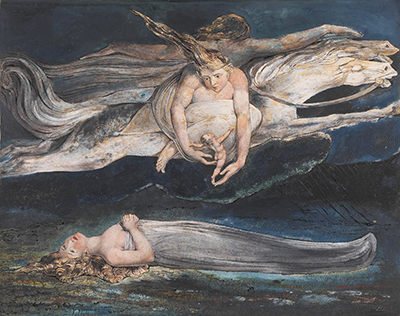
Butlin proposes that the design was a companion to Pity, noting similarities between the Tate impressions’ colouring and signatures. That suggested relationship is useful without making the present picture an established Shakespeare scene. It invites a reader to compare different human predicaments within Blake’s large prints, while leaving the specific source and meaning of each composition to be argued from its own evidence. [1]
A repeatable picture with an individual surface
The irregular colour is part of the design’s physical intelligence. Across the rock, flecks and short broken passages give the surface a grain that changes from place to place. Around the people, finer contours organise that variety into shoulders, fingers and hair. The book is particularly revealing: its recognisable leaves enclose marks that remain blurred and resistant to reading. Blake can make something materially definite while keeping what it communicates uncertain. [1]
Joseph Viscomi describes most of the large colour-print designs as painted on prepared millboard and transferred to paper. His 2017 study distinguishes a monoprint, which has a repeatable underlying design but individually varied colour and finish, from a wholly improvised monotype. His account helps explain why three impressions of this composition can preserve the same group and still differ in expression. Repeatability supplies the arrangement; renewed painting and work on the resulting sheet supply further decisions. [15]
In his 2022 essay, Viscomi describes the larger process through direct and indirect applications of paint. An engraver’s press brought the painted surface against dampened paper; after this transfer, Blake continued with colours and pen. Each transfer could generate a broken or netlike texture to be developed afterwards. Looking at the owl’s feathers against the speckled rock makes those different scales of work palpable. A broad coloured foundation and a tiny eye belong to successive kinds of attention. [16]
The exact support used for this design has also been discussed cautiously. The Huntington’s catalogue notes the absence of the indentations associated with relief plateaus and considers either an unincised copperplate or millboard. Viscomi’s prepared-millboard account is a more specific reconstruction. The surviving sheets combine transferred colour and handwork; the original printing surface is not available to settle every operation by direct inspection. The differing technical descriptions should remain attached to their sources. [15][17]
The Huntington impression, 000.126, provides a concrete example of the composition’s variability. Its catalogue describes a more downcast gaze, differences in hair and hands, and substantial trimming along the bottom. Its 2022 label identifies the development of transferred, netlike colour into vegetation. These are observations about that particular sheet. They show how the gesture or expression central to an interpretation can change through finishing, as well as how later alteration can change the space around the figures. [17]
Why the printing order is disputed
Three impressions survive, at Tate, the Huntington and the National Galleries of Scotland. Tate’s historical catalogue places its own sheet first, Edinburgh second and the Huntington last, all around 1795. The 2004 display caption similarly reads Tate’s dense colour as evidence of an early pull. Its paper carries a 1794 Whatman watermark. That paper date establishes a material boundary, but cannot by itself identify the order in which three impressions were printed. [1][2]
Viscomi’s 2017 reconstruction changes the sequence. He places the Huntington first and Edinburgh second in 1795, with Tate’s impression belonging to a separate printing around 1795–96. In that account, the darker and more finished Tate surface comes from a renewed act of printing, rather than occupying the beginning of one sequence of increasingly depleted transfers. The difference explains why greater density alone cannot settle the chronology: colours could be reapplied when a design was printed again. [15]
The scratched surname at Tate’s lower left contributes to Viscomi’s argument. He compares it with similarly incised signatures on Pity and Satan Exulting over Eve, proposing that Blake signed and sold the three together before the middle of 1796. This is a reconstructed history of transactions, not a surviving dated receipt for this print. It depends on comparing signatures, printing groups and patterns of ownership. His account also challenges the assumption that a signature invariably records the moment of completion. [15]
The distinction matters beyond an exact year. A design, a printed sheet, its further colouring and its sale are different events. Viscomi’s 2022 account places the Huntington Hecate among impressions still in Blake’s stock in 1818 and allows a possible later return to its finishing. Such an argument concerns the duration of an individual object’s life. It does not mean that the picture was invented in 1818, or that all twelve large designs were printed and finished together. [16]
Reading the face again
The modern name has a specific scholarly history. Gert Schiff’s catalogue entry appeared in Japanese for the 1990 Blake exhibition in Tokyo; his English text was published in Blake/An Illustrated Quarterly in 2002, with an introduction by Morton D. Paley. The entry concerns Edinburgh’s impression. Schiff proposes Enitharmon as the most persuasive explanation, drawing together the separation of the younger figures, an identification of the book with Urizen’s law, and the central woman’s apparent approach to sleep. His conclusion is an interpretation of those relations. [18]
Schiff also distinguishes the impressions. He sees the pointing forefinger as particular to Tate, while Edinburgh’s and the Huntington’s hands rest more passively on their books. He interprets their differing eyes through a progression towards drowsiness. This supplies a revealing connection with Enitharmon’s long sleep in Europe, while making clear how an argument about the composition can depend upon details of a particular sheet. [18]
Christopher Heppner disputed Schiff’s account of the woman’s indifference in 2002–03. He pointed to the frown lines and pronounced sideways turn of her head, details that complicate the suggestion of an untroubled controller. He also questioned how fully Schiff’s explanation accounted for her appearance as a witch. Heppner offered an alternative reading connected with Medea, while acknowledging that his own proposal remained hypothetical without a supporting text or inscription. The modern title did not bring interpretive disagreement to an end. [19]
At Tate, the extended finger gives the book a precise claim upon attention, while the head turns elsewhere. Heppner’s objection asks us to return to that divided movement and the tension in the face. Enitharmon’s possible presence can sharpen the encounter without dictating its emotional outcome. An apparent authority may also be anxious; a book can be possessed without bringing the person beside it peace. [18][19]
Tate’s sheet passed through the Butts family, was bought by W. Graham Robertson in 1906 and entered Tate as his gift in 1939. Its present title carries another kind of accumulated history: later viewers have recognised a goddess, a witch, jealousy, imposed shame and Enitharmon’s prohibited joy in the same arrangement. The compelling point of return is the woman’s divided attention. Her hand holds our eye to the book, her face turns across the rock, and the younger bodies remain withdrawn behind her. Every proposed explanation must answer to those particular, difficult relations. [1]
Works and designs directory
Browse separate works, impressions and book components. Dates distinguish versions; six Tate copies after Blake are labelled. These records are not a complete catalogue of unique designs.
| Name | Date | Medium |
|---|---|---|
| A Figure Standing in a Gothic Apse, perhaps the Empress Maud. Verso: Detailed Drawings for ‘The Empress Maud in Bed’ | c.1819 | Pencil drawing |
| A Rolling Stone Is Ever Bare of Moss, from Thornton's "Pastorals of Virgil" | 1821 | Wood engraving |
| A Title Page for The Grave | 1806 | Watercolour |
| A Vision of the Last Judgment | 1808 | Watercolour |
| A Vision: The Inspiration of the Poet (Elisha in the Chamber on the Wall) | c.1819–20? | Watercolour |
| Adam and the Beasts, Frontispiece to Hayley's "Ballads" | June 1, 1802 | Engraving |
| Age Teaching Youth | c.1785–90 | Watercolour |
| Alfred and the Neat-Herd’s Wife (after Henry Fuseli) | 1797, published 1798 | Etching and engraving |
| An Allegory of the Bible. Verso: The Shins of an Écorché Male Figure | c.1780–5, ?c.1780 | Watercolour |
| Angel of the Divine Presence Bringing Eve to Adam (The Creation of Eve: "And She Shall be Called Woman) (recto); Sketch for the same (verso) | ca. 1803 | Watercolour |
| Angel of the Revelation (Book of Revelation, chapter 10) | ca. 1803–5 | Watercolour |
| Antaeus setting down Dante and Virgil in the Last Circle of Hell | 1824–1827 | Watercolour |
| Bathsheba at the Bath | c.1799–1800 | Tempera |
| Beatrice Addressing Dante from the Car | 1824–7 | Watercolour |
| Behemoth and Leviathan | 1825–26 | Engraving |
| Behemoth and Leviathan | 1825, reprinted 1874 | Engraving |
| Behemoth and Leviathan | 1826 | Engraving |
| Blasted Trees and Flattened Crops, from Thornton's "Pastorals of Virgil" | 1821 | Wood engraving |
| Boy Returning Joyfully, with Plough and Oxen, from Thornton's "Pastorals of Virgil" | 1821 | Wood engraving |
| Boy Returning Joyfully, with Plough and Oxen, from Thornton's "Pastorals of Virgil" | 1821 | Wood engraving |
| Catherine Blake. Verso: A Man’s Head and Other Drawings | c.1805 | Pencil drawing |
| Cerberus | 1824–7 | Watercolour |
| Cerberus (second version) | 1824–1827 | Watercolour |
| Chaucer’s Canterbury Pilgrims | 1810, reprinted before 1881 | Engraving |
| Christ Appearing to His Disciples After the Resurrection | c.1795 | Colour print |
| Christ Appearing to the Apostles after the Resurrection | c.1795 | Watercolour |
| Christ Blessing the Little Children | 1799 | Tempera |
| Christ in the Carpenter’s Shop: The Humility of the Saviour (after William Blake) | Date not stated | Watercolour |
| Ciampolo the Barrator Tormented by the Devils | 1826–7, reprinted 1892 | Engraving |
| Ciampolo the Barrator Tormented by the Devils | 1826–7, reprinted 1968 | Engraving |
| Circle of Theives: Agnello Brunelleschi Attacked By a Six-Footed Serpent | ca. 1825–27 | Engraving |
| Clarence's Dream (Shakespeare, Richard III, Act 1, Scene 4) | 1774 | Etching and engraving |
| Colinet Mocked by Two Boys, from Thornton's "Pastorals of Virgil" | 1821 | Wood engraving |
| Colinet Rests by a Stream at Night | c.1821, printed 1830 | Wood engraving |
| Colinet Rests by a Stream at Night | 1821, reprinted 1977 | Wood engraving |
| Colinet with his Shepherd’s Pipe, Mocked by Two Boys | c.1821, printed 1830 | Wood engraving |
| Colinet with his Shepherd’s Pipe, Mocked by Two Boys | 1821, reprinted 1977 | Wood engraving |
| Colinet's Journey, Milestone Marked 'LXII Miles to London', from Thornton's "Pastorals of Virgil" | 1821 | Wood engraving |
| Colinet's Journey: Milestone Marked 'LXII Miles to London', from Thornton's "Pastorals of Virgil" | 1821 | Wood engraving |
| Colinet’s Fond Desire Strange Lands to Know | 1821, reprinted 1977 | Wood engraving |
| Colinet’s ‘Fond Desire Strange Lands to Know’ | c.1821, printed 1830 | Wood engraving |
| Composition Sketch for ‘The Fall of the Rebel Angels’? Verso: Standing Figure with Flaming Hair | ?c.1805–10 | Pencil drawing |
| Composition Sketch, Possibly a Subject from Dante. Verso: A Man Standing over a Figure Reclining on a Bed | ?1824–7, ?c.1800–10 | Pencil drawing |
| Composition Sketch. Verso: Standing Figure Holding a Spear | ?c.1805–10 | Pencil drawing |
| Dante and Virgil Approaching the Angel Who Guards the Entrance of Purgatory | 1824–7 | Watercolour |
| Dante and Virgil Penetrating the Forest | 1824–7 | Watercolour |
| Dante in the Empyrean, Drinking at the River of Light | 1824–7 | Watercolour |
| Dante running from the Three Beasts | 1824–1827 | Watercolour |
| Dante Striking against Bocca Degli Abati | 1826–7, reprinted 1892 | Engraving |
| Dante Striking Against Bocca degli Abati | 1826–7, reprinted 1968 | Engraving |
| David Delivered out of Many Waters | c.1805 | Watercolour |
| David Delivered out of Many Waters (after William Blake) | Date not stated | Watercolour |
| Detailed Drawings for ‘A Figure Standing in a Gothic Apse’ | 1819 | Pencil drawing |
| Elohim Creating Adam | 1795–c.1805 | Colour print |
| Enoch | 1806–7 | Lithograph |
| Epitome of James Hervey’s ‘Meditations among the Tombs’ | c.1820–5 | Watercolour |
| Europe. A Prophecy; Frontispiece | ca. 1820 | Relief etching |
| Evening | c.1820/1825 | Watercolour |
| Every Man also Gave him a Piece of Money | 1825, reprinted 1874 | Engraving |
| Every Man also Gave him a Piece of Money. Verso: God the Father with Attendant Angels | c.1821–3 | Watercolour |
| Every One also Gave Him a Piece of Money | 1826 | Engraving |
| Fertilization of Egypt, from Erasmus Darwin's "The Botanic Garden" | 1791 | Engraving |
| First Book of Urizen pl. 10 | 1796, c.1818 | Etching |
| First Book of Urizen pl. 11 | 1796, c.1818 | Etching |
| First Book of Urizen pl. 15 | 1796, c.1818 | Etching |
| First Book of Urizen pl. 17 | 1796, c.1818 | Etching |
| First Book of Urizen pl. 21 | 1796, c.1818 | Etching |
| First Book of Urizen pl. 6 | 1796, c.1818 | Etching |
| Frontispiece to Jerusalem, the Emanation of the Great Albion | [ca. 1804–20] (?) | Engraving |
| Frontispiece to ‘Visions of the Daughters of Albion’ | c.1795 | Relief etching |
| Frontispiece: Thenot and Colinet | c.1821, printed 1830 | Wood engraving |
| George Cumberland's Message Card | 1827 | Engraving |
| God Judging Adam | ca. 1795 | Relief etching |
| God Judging Adam | 1795 | Relief etching |
| Hiding of Moses, from "Remember Me!, or a Pocket Companion" | 1825 | Engraving |
| Homer and the Ancient Poets | 1824–7 | Watercolour |
| Illustration 1 to Milton’s On the Morning of Christ’s Nativity: The Descent of Peace | c.1814–1816 | Watercolour |
| Illustration 1 to Milton’s Paradise Lost: Satan Calling Up His Legions | 1807 | Watercolour |
| Job accepting Charity | 1825–26 | Engraving |
| Job and his Daughters | 1825–26 | Engraving |
| Job and his Daughters | 1825, reprinted 1874 | Engraving |
| Job and His Daughters | 1826 | Engraving |
| Job and His Family | 1825–26 | Engraving |
| Job and his Family | Reprinted 1874; engraved 1828 date is an error | Engraving |
| Job and His Family | 1826 | Engraving |
| Job and his Family Restored to Prosperity | 1825, reprinted 1874 | Engraving |
| Job and his Wife restored to Prosperity | 1825–26 | Engraving |
| Job rebuked by his Friends | 1825–26 | Engraving |
| Job Rebuked by his Friends | 1825, reprinted 1874 | Engraving |
| Job Rebuked by His Friends | 1826 | Engraving |
| Job's Comforters | 1825–26 | Engraving |
| Job's Comforters | 1826 | Engraving |
| Job's Despair | 1825–26 | Engraving |
| Job's Evil Dreams | 1825–26 | Engraving |
| Job's Evil Dreams | 1826 | Engraving |
| Job's Sacrifice | 1825–26 | Engraving |
| Job's Sons and Daughters Overwhelmed by Satan | 1826 | Engraving |
| Job, his Wife and his Friends: The Complaint of Job. Verso: Job’s Wife and Eight Other Sketches | c.1785 | Watercolour |
| Job’s Comforters | 1825, reprinted 1874 | Engraving |
| Job’s Despair | 1825, reprinted 1874 | Engraving |
| Job’s Evil Dreams | 1825, reprinted 1874 | Engraving |
| Job’s Sacrifice | 1825, reprinted 1874 | Engraving |
| Job’s Sons and Daughters Overwhelmed by Satan | 1825, reprinted 1874 | Engraving |
| John Linnell | 1825 | Pencil drawing |
| Joseph of Arimathea Preaching to the Britons | c.1794/1796 | Relief etching |
| Judas Betrays Him | c.1803–5 | Watercolour |
| King John Absolved by Pandulph (after Henry Fuseli) | 1797, published 1798 | Etching and engraving |
| Lamech and his Two Wives | 1795 | Colour print |
| Landscape near Felpham | c.1800 | Watercolour |
| Lear and Cordelia in Prison | c.1779 | Watercolour |
| Los and Orc | c.1792–3 | Watercolour |
| Lower Half of a Woman Playing a Harp. Verso: Seraphim and Other Drawings | c.1785, c.?1807 | Pencil drawing |
| Menalcus Watching Women Dance, from Thornton's "Pastorals of Virgil" | 1821 | Wood engraving |
| Menalcus Watching Women Dance, from Thornton's "Pastorals of Virgil" | 1821 | Wood engraving |
| Moses Indignant at the Golden Calf | c.1799–1800 | Tempera |
| Nebuchadnezzar | 1795–c.1805 | Colour print |
| Newton | 1795–c.1805 | Colour print |
| Oberon, Titania and Puck with Fairies Dancing | c.1786 | Watercolour |
| Pity | ca. 1795 | Relief etching |
| Pity | c.1795 | Colour print |
| Plate 2 of ‘Urizen’: ‘Teach these Souls to Fly’ | ?1796 | Relief etching |
| Plate 3 of ‘Urizen’: Oh! Flames of Furious Desires’ (after William Blake) | Date not stated | Watercolour |
| Plate 4 of ‘Visions of the Daughters of Albion’ | c.1795 | Relief etching |
| Plutus | 1824–7 | Watercolour |
| Preliminary Sketch for ‘Christ Girding Himself with Strength’. Verso: Standing Figure with One Arm Raised | c.1805, c.1805–10 | Pencil drawing |
| Preludium. "The shadowy daughter of Urthona stood before red Orc..." (Plate 3) | 1793 | Relief etching |
| Queen Elizabeth and Essex (after Henry Fuseli) | 1797, published 1798 | Engraving |
| Sabrina's Silvery Flood, from Thornton's "Pastorals of Virgil" | 1821 | Wood engraving |
| Sabrina's Silvery Flood, from Thornton's "Pastorals of Virgil" | 1821 | Wood engraving |
| Sabrina’s Silvery Flood | c.1821, printed 1830 | Wood engraving |
| Sabrina’s Silvery Flood | 1821, reprinted 1977 | Wood engraving |
| Satan Before the Throne of God | 1825–26 | Engraving |
| Satan before the Throne of God | 1825, reprinted 1874 | Engraving |
| Satan before the Throne of God | 1826 | Engraving |
| Satan calling up his Legions | c.1800–05 | Tempera |
| Satan Exulting over Eve | c.1795 | Colour print |
| Satan Going Forth from the Presence of the Lord, and Job’s Charity | 1825, reprinted 1874 | Engraving |
| Satan Going Forth fron the Presence of the Lord | 1825–26 | Engraving |
| Satan in his Original Glory: ‘Thou wast Perfect till Iniquity was Found in Thee’ | c.1805 | Watercolour |
| Satan Smiting Job with Boils | 1825–26 | Engraving |
| Satan Smiting Job with Sore Boils | 1825, reprinted 1874 | Engraving |
| Satan Smiting Job with Sore Boils | c.1826 | Tempera |
| Satan Smiting Job with Sore Boils | 1826 | Engraving |
| Shepherd Chases Away a Wolf, from Thornton's "Pastorals of Virgil" | 1821 | Wood engraving |
| Shepherd Chases Away a Wolf, from Thornton's "Pastorals of Virgil" | 1821 | Wood engraving |
| Sketch for the Title-Page of the Engraved Illustrations to the Book of Job | c.1823/1826 | Pencil drawing |
| Sketch for ‘The Four and Twenty Elders Casting their Crowns before the Divine Throne’. Verso: Standing Figure with Arms at his Side | c.1803, c.1805–10 | Pencil drawing |
| Sketch for ‘Tiriel Supporting the Dying Myratana’. Verso: Sketch for ‘Tiriel Supporting the Dying Myratana’ | c.1786–9 | Pencil drawing |
| Songs of Experience: A Little Boy Lost | [1794] printed ca. 1825 | Relief etching |
| Songs of Experience: A Little Girl Lost | [1794] printed ca. 1825 | Relief etching |
| Songs of Experience: A Poison Tree | [1794] printed ca. 1825 | Relief etching |
| Songs of Experience: Earth's Answer | [1794] printed ca. 1825 | Relief etching |
| Songs of Experience: Frontispiece | [1794] printed ca. 1825 | Relief etching |
| Songs of Experience: Holy Thursday | [1794] printed ca. 1825 | Relief etching |
| Songs of Experience: Infant Sorrow | [1794] printed ca. 1825 | Relief etching |
| Songs of Experience: Introduction | [1794] printed ca. 1825 | Relief etching |
| Songs of Experience: London | [1794] printed ca. 1825 | Relief etching |
| Songs of Experience: My Pretty Rose Tree, Ah! Sun-Flower, The Lilly | [1794] printed ca. 1825 | Relief etching |
| Songs of Experience: Nurses Song | [1794] printed ca. 1825 | Relief etching |
| Songs of Experience: The Angel | [1794] printed ca. 1825 | Relief etching |
| Songs of Experience: The Chimney Sweeper | [1794] printed ca. 1825 | Relief etching |
| Songs of Experience: The Clod & the Pebble | [1794] printed ca. 1825 | Relief etching |
| Songs of Experience: The Fly | [1794] printed ca. 1825 | Relief etching |
| Songs of Experience: The Garden of Love | [1794] printed ca. 1825 | Relief etching |
| Songs of Experience: The Human Abstract | [1794] printed ca. 1825 | Relief etching |
| Songs of Experience: The Little Girl Found (second plate) | [1789] printed ca. 1825 | Relief etching |
| Songs of Experience: The Little Girl Lost | [1789] printed ca. 1825 | Relief etching |
| Songs of Experience: The Little Girl Lost (second plate); The Little Girl Found | [1789] printed ca. 1825 | Relief etching |
| Songs of Experience: The Little Vagabond | [1794] printed ca. 1825 | Relief etching |
| Songs of Experience: The School Boy | [1789] printed ca. 1825 | Relief etching |
| Songs of Experience: The Sick Rose | [1794] printed ca. 1825 | Relief etching |
| Songs of Experience: The Tyger | [1794] printed ca. 1825 | Relief etching |
| Songs of Experience: The Voice of the Ancient Bard | [1789] printed ca. 1825 | Relief etching |
| Songs of Experience: Title-page | [1794] printed ca. 1825 | Relief etching |
| Songs of Experience: To Tirzah | [1794] printed ca. 1825 | Relief etching |
| Songs of Innocence and of Experience, Shewing the Two Contrary States of the Human Soul: Combined Title-page | [1789–94] printed ca. 1825 | Relief etching |
| Songs of Innocence and of Experience: Infant Sorrow | 1794, reprinted 1831 or later | Relief etching |
| Songs of Innocence: A Cradle Song | [1789] printed ca. 1825 | Relief etching |
| Songs of Innocence: A Cradle Song (second plate) | [1789] printed ca. 1825 | Relief etching |
| Songs of Innocence: A Dream | [1794] printed ca. 1825 | Relief etching |
| Songs of Innocence: Frontispiece | [1789] printed ca. 1825 | Relief etching |
| Songs of Innocence: Holy Thursday | [1789] printed ca. 1825 | Relief etching |
| Songs of Innocence: Infant Joy | [1789] printed ca. 1825 | Relief etching |
| Songs of Innocence: Introduction | [1789] printed ca. 1825 | Relief etching |
| Songs of Innocence: Laughing Song | [1789] printed ca. 1825 | Relief etching |
| Songs of Innocence: Little Boy Lost | [1789] printed ca. 1825 | Relief etching |
| Songs of Innocence: Night | [1789] printed ca. 1825 | Relief etching |
| Songs of Innocence: Night (second plate) | [1789] printed ca. 1825 | Relief etching |
| Songs of Innocence: Nurse's Song | [1789] printed ca. 1825 | Relief etching |
| Songs of Innocence: On Anothers Sorrow | [1789] printed ca. 1825 | Relief etching |
| Songs of Innocence: Spring | [1789] printed ca. 1825 | Relief etching |
| Songs of Innocence: Spring (second plate) | [1789] printed ca. 1825 | Relief etching |
| Songs of Innocence: The Blossom | [1789] printed ca. 1825 | Relief etching |
| Songs of Innocence: The Chimney Sweeper | [1789] printed ca. 1825 | Relief etching |
| Songs of Innocence: The Divine Image | [1789] printed ca. 1825 | Relief etching |
| Songs of Innocence: The Ecchoing Green | [1789] printed ca. 1825 | Relief etching |
| Songs of Innocence: The Ecchoing Green (second plate) | [1789] printed ca. 1825 | Relief etching |
| Songs of Innocence: The Lamb | [1789] printed ca. 1825 | Relief etching |
| Songs of Innocence: The Little Black Boy | [1789] printed ca. 1825 | Relief etching |
| Songs of Innocence: The Little Black Boy (second plate) | [1789] printed ca. 1825 | Relief etching |
| Songs of Innocence: The Little Boy Found | [1789] printed ca. 1825 | Relief etching |
| Songs of Innocence: The Shepherd | [1789] printed ca. 1825 | Relief etching |
| Songs of Innocence: Title Page | [1789] printed ca. 1825 | Relief etching |
| St Christopher, Copy from an Engraving? Verso:Part of a Face: Copy from a Plaster Cast: a Daughter of Niobe? | ?c.1779–80 | Pencil drawing |
| The Agony in the Garden | c.1799–1800 | Tempera |
| The Angel Appearing to Zacharias | 1799–1800 | Tempera |
| The Ascent of the Mountain of Purgatory | 1824–7 | Watercolour |
| The Baffled Devils Fighting | 1826–7, reprinted 1892 | Engraving |
| The Baffled Devils Fighting | 1826–7, reprinted 1968 | Engraving |
| The Bard, from Gray | ?1809 | Tempera |
| The Beggar's Opera, Act III | July 1, 1790 | Etching and engraving |
| The Beggar's Opera, Act III | July 1, 1790 | Engraving |
| The Beggar's Opera, Act III | 1790 | Engraving |
| The Blasphemer | c.1800 | Watercolour |
| The Blighted Corn | c.1821, printed 1830 | Wood engraving |
| The Blighted Corn | 1821, reprinted 1977 | Wood engraving |
| The Body of Abel Found by Adam and Eve | c.1826 | Tempera |
| The Body of Christ Borne to the Tomb | c.1799–1800 | Tempera |
| The Book of Job: Title Page | 1825 | Engraving |
| The Book of Thel pl. 6 | 1796, c.1818 | Etching |
| The Circle of Corrupt Officials: The Devils Mauling Each Other | ca. 1825–27 | Engraving |
| The Circle of Corrupt Officials: The Devils Tormenting Ciampolo | ca. 1825–27 | Engraving |
| The Circle of the Lustful: Francesca da Rimini (‘The Whirlwind of Lovers’) | 1826–7, reprinted 1892 | Engraving |
| The Circle of the Lustful: Francesca da Rimini (‘The Whirlwind of Lovers’) | 1826–7, reprinted 1968 | Engraving |
| The Circle of the Lustful: Paolo and Francesca | ca. 1825–27 | Engraving |
| The Circle of the Thieves; Buoso Donati Attacked by the Serpent | ca. 1825–27 | Engraving |
| The Circle of Traitors: Dante's Foot Striking Bocca degli Abbate | ca. 1825–27 | Engraving |
| The Complaint and the Consolation; or, Night Thoughts | 1797 | Etching and engraving |
| The Creation | 1825–26 | Engraving |
| The Crucifixion | c.1825–7 | Pencil drawing |
| The Crucifixion: ‘Behold Thy Mother’ | c.1805 | Watercolour |
| The Dance of Albion (Glad Day) | c.1803/1810 | Engraving |
| The Death of Lucretia, from Allen's "New and Impartial Roman History" | 1797 | Engraving |
| The Death of Saint Joseph | 1803 | Watercolour |
| The Death of the Virgin | 1803 | Watercolour |
| The Descent of Peace [recto] | c.1815 | Pencil drawing |
| The Destruction of Job's Sons | 1825–26 | Engraving |
| The Devils, with Dante and Virgil by the Side of the Pool | 1824–7 | Watercolour |
| The Entombment | c.1805 | Watercolour |
| The Fall of Rosamond (after Thomas Stothard) | 1783 | Etching and engraving |
| The Fall of Satan | 1825–26 | Engraving |
| The Fall of Satan | 1825, reprinted 1874 | Engraving |
| The Fall of Satan | 1826 | Engraving |
| The Four and Twenty Elders Casting their Crowns before the Divine Throne | c.1803–5 | Watercolour |
| The Ghost of a Flea | c.1819–20 | Tempera |
| The Good and Evil Angels | 1795–?c.1805 | Colour print |
| The Good Farmer, Probably the Parable of the Wheat and the Tares. Verso: Rough Sketch of Two or Three Figures in a Landscape | c.1780–5 | Watercolour |
| The Great Red Dragon and the Beast from the Sea | c.1805 | Watercolour |
| The Great Red Dragon and the Woman Clothed with the Sun | c.1805 | Watercolour |
| The Head of the Ghost of a Flea. Verso: A Profile and a Reduced Drawing of Milton’s First Wife | c.1819 | Pencil drawing |
| The Hermit’s Dog, from William Hayley’s "Ballads" | 1805 | Etching and engraving |
| The Hiding of Moses | 1824 | Engraving |
| The House of Death | 1795–c.1805 | Colour print |
| The House of Death | c.1790 | Watercolour |
| The Hypocrites with Caiaphas. Verso: Sketch of a Stooping Figure | 1824–7 | Watercolour |
| The Inscription over the Gate | 1824–7 | Watercolour |
| The Laborious Passage along the Rocks | 1824–7 | Watercolour |
| The Last Trumpet (recto); Two studies of a right eye, a profile of an open-mouthed young man, the head of an eagle, and the head of a lion (verso) | 1780–85 | Pencil drawing |
| The Lord Answering Job out of the Whirlwind | 1825–26 | Engraving |
| The Lord Answering Job out of the Whirlwind | 1825, reprinted 1874 | Engraving |
| The Man Who Taught Blake Painting in his Dreams (counterproof) (after William Blake) | after c.1819–20 | Pencil drawing |
| The Marriage of Heaven and Hell pl. 16 | 1796, c.1818 | Etching |
| The Messengers tell Job of his Misfortunes | 1825–26 | Engraving |
| The Messengers tell Job of his Misfortunes | 1825, reprinted 1874 | Engraving |
| The Night of Enitharmon’s Joy (formerly called ‘Hecate’) | c.1795 | Colour print |
| The Parable of the Wise and Foolish Virgins | ca. 1799–1800 | Watercolour |
| The Parable of the Wise and Foolish Virgins (after William Blake) | Date not stated | Watercolour |
| The Pastorals of Virgil, with a Course of English Reading, Adapted for Schools, Vol. I | 1821 | Wood engraving |
| The Penance of Jane Shore in St Paul’s Church | c.1793 | Watercolour |
| The Pit of Disease: The Falsifiers | 1826–7, reprinted 1892 | Engraving |
| The Pit of Disease: The Falsifiers | 1824–7 | Watercolour |
| The Pit of Disease: The Falsifiers | 1826–7, reprinted 1968 | Engraving |
| The Primaeval Giants Sunk in the Soil | 1824–7 | Watercolour |
| The Punishment of the Thieves | 1824–7 | Watercolour |
| The Raising of Lazarus (after William Blake) | Date not stated | Watercolour |
| The Rest on the Flight into Egypt (The Repose of the Holy Family in Egypt) | 1806 | Watercolour |
| The River of Life | c.1805 | Watercolour |
| The Rock Sculptured with the Recovery of the Ark and the Annunciation | 1824–7 | Watercolour |
| The Serpent Attacking Buoso Donati | 1826–7, reprinted 1892 | Engraving |
| The Serpent Attacking Buoso Donati | 1826–7, reprinted 1968 | Engraving |
| The Serpent Attacking Buoso Donati. Verso: A Man with a Transparent Hood (?) over his Head | 1824–7 | Watercolour |
| The Simoniac Pope | 1824–7 | Watercolour |
| The Six-Footed Serpent Attacking Agnolo Brunelleschi | 1826–7, reprinted 1892 | Engraving |
| The Six-Footed Serpent Attacking Agnolo Brunelleschi | 1826–7, reprinted 1968 | Engraving |
| The Soul Hovering over the Body Reluctantly Parting with Life | c.1805 | Pencil drawing |
| The Spiritual Form of Nelson Guiding Leviathan | c.1805–9 | Tempera |
| The Spiritual Form of Pitt Guiding Behemoth | ?1805 | Tempera |
| The Sun at His Eastern Gate | c.1816–1820 | Watercolour |
| The Temple of Mirth, after Thomas Stothard | 1784 | Engraving |
| The Temptation and Fall of Eve | 1807 | Watercolour |
| The Temptation and Fall of Eve (Illustration to Milton’s Paradise Lost) | 1808 | Watercolour |
| The Thieves and Serpents | 1824–1827 | Watercolour |
| The Vision of Christ | 1825, reprinted 1874 | Engraving |
| The Vision of Eliphaz | 1825–26 | Engraving |
| The Vision of Eliphaz | 1825, reprinted 1874 | Engraving |
| The Vision of God | 1825–26 | Engraving |
| The Wood of the Self-Murderers: The Harpies and the Suicides | 1824–7 | Watercolour |
| The Wrath of Elihu | 1825–26 | Engraving |
| The Wrath of Elihu | 1825, reprinted 1874 | Engraving |
| Thenot and Colinet | 1821, reprinted 1977 | Wood engraving |
| Thenot and Colinet at Supper | c.1821, printed 1830 | Wood engraving |
| Thenot and Colinet at Supper | 1821, reprinted 1977 | Wood engraving |
| Thenot and Colinet Converse Seated between Two Trees | c.1821, printed 1830 | Wood engraving |
| Thenot and Colinet Converse Seated between Two Trees | 1821, reprinted 1977 | Wood engraving |
| Thenot and Colinet Eat Their Evening Meal, from Thornton's "Pastorals of Virgil" | 1821 | Wood engraving |
| Thenot and Colinet Folding their Flocks together at Sunset | c.1821, printed 1830 | Wood engraving |
| Thenot and Colinet Folding their Flocks together at Sunset | 1821, reprinted 1977 | Wood engraving |
| Thenot and Colinet Lead Their Flocks Together, from Thornton's "Pastorals of Virgil" | 1821 | Wood engraving |
| Thenot and Colinet Lead Their Flocks Together, from Thornton's "Pastorals of Virgil" | 1821 | Wood engraving |
| Thenot Remonstrates with Colinet | c.1821, printed 1830 | Wood engraving |
| Thenot Remonstrates with Colinet | 1821, reprinted 1977 | Wood engraving |
| Thenot Remonstrates With Colinet, from Thornton's "Pastorals of Virgil" | 1821 | Wood engraving |
| Thenot Remonstrates With Colinet, from Thornton's "Pastorals of Virgil" | 1821 | Wood engraving |
| Thenot Remonstrates with Colinet, Lightfoot in the Background, from Thornton's "Pastorals of Virgil" | 1821 | Wood engraving |
| Thenot Remonstrates with Colinet: Lightfoot in the Distance | 1821, reprinted 1977 | Wood engraving |
| Thenot Remonstrates with Colinet; Lightfoot in the Distance | c.1821, printed 1830 | Wood engraving |
| Thenot Under a Fruit Tree, from Thornton's "Pastorals of Virgil" | 1821 | Wood engraving |
| Thenot, with Colinet Waving his Arms in Sorrow | c.1821, printed 1830 | Wood engraving |
| Thenot, with Colinet Waving his Arms in Sorrow | 1821, reprinted 1977 | Wood engraving |
| Title Page: Illustrations of the Book of Job | 1825–26 | Engraving |
| Title-Page of ‘The Book of Job’ | 1825, reprinted 1874 | Engraving |
| Tornado–Zeus Battling Typhon, from Erasmus Darwin's "Botanic Garden" | August 1, 1795 | Engraving |
| Tornado–Zeus Battling Typhon, from Erasmus Darwin's "The Botanic Garden" | August 1, 1795 | Engraving |
| Two Figures in a Decorative Border | c.1790 | Pencil drawing |
| Unyok'd Heifers, Loitering Homeward (Return of the Shepherd), from Thornton's "Pastorals of Virgil" | 1821 | Wood engraving |
| Virgil Girding Dante’s Brow with a Rush | 1824–7 | Watercolour |
| Wat Tyler and the Tax-Gatherer (after Henry Fuseli) | 1797, published 1798 | Etching and engraving |
| When the Morning Stars Sang Together | 1825, reprinted 1874 | Engraving |
| When the Morning Stars Sang Together | 1826 | Engraving |
| Winged Figure Flying Through Clouds, from Bell's "Poets" | 1790 | Etching and engraving |
| Winter | c.1820–5 | Tempera |
| ‘A Rolling Stone is ever Bare of Moss’ | c.1821, printed 1830 | Wood engraving |
| ‘A Rolling Stone is ever Bare of Moss’ | 1821, reprinted 1977 | Wood engraving |
| ‘And Unyok’d Heifers, Loitering Homeward, Low’ | c.1821, printed 1830 | Wood engraving |
| ‘And Unyok’d Heifers, Loitering Homewards, Low’ | 1821, reprinted 1977 | Wood engraving |
| ‘Europe’: Fragment of Pages 3 and 4 | 1794–c.1830–5 | Relief etching |
| ‘For him Our Yearly Wakes and Feasts We Hold’ | c.1821, printed 1830 | Wood engraving |
| ‘For him Our Yearly Wakes and Feasts We Hold’ | 1821, reprinted 1977 | Wood engraving |
| ‘Nor Fox, nor Wolf, nor Rat among our Sheep’ | c.1821, printed 1830 | Wood engraving |
| ‘Nor Fox, nor Wolf, nor Rat among our Sheep’ | 1821, reprinted 1977 | Wood engraving |
| ‘Songs of Innocence and of Experience’: ‘Infant Sorrow’ | 1794, reprinted 1831 or later | Relief etching |
| ‘Songs of Innocence and of Experience’: ‘Spring’ | 1794, reprinted 1831 or later | Relief etching |
| ‘Songs of Innocence’: Title-Page | 1789, reprinted 1831 or later | Relief etching |
| ‘Songs of Innocence’: Title-Page | 1789, reprinted 1831 or later | Relief etching |
| ‘With Songs the Jovial Hinds Return from Plow’ | c.1821, printed 1830 | Wood engraving |
| ‘With Songs the Jovial Hinds Return from Plow’ | 1821, reprinted 1977 | Wood engraving |
Frequently Asked Questions
Butlin reports no corresponding title on the mount or in surviving Butts accounts. The catalogue traces the name through later nineteenth-century lists. [1]
Discussion
Look again at the images and ideas explored in The Night of Enitharmon’s Joy (Hecate) by William Blake. These editorial prompts invite your observations.
Reader Insights
The woman touches the book while looking elsewhere. The creatures meet the viewer more directly than the human figures do.
A recognisable book contains unreadable marks. Material definiteness does not guarantee an accessible message.
Schiff’s explanation joins separated bodies, the book and apparent sleep. His conclusion remains an interpretation of their relations.
Join the Conversation
Share a detail, comparison or question about The Night of Enitharmon’s Joy (Hecate) by William Blake below.
References
- Tate / Martin Butlin. The Night of Enitharmon’s Joy (formerly called ‘Hecate’), N05056. Current collection fields and official image; September 2004 display caption; complete catalogue entry from William Blake 1757–1827, Tate Gallery Collections V, 1990, titled Hecate (?). Heppner, Hagstrum and Jones are used through this account. View the record. View source.
- National Galleries of Scotland. The Night of Enitharmon’s Joy (formerly called ‘The Triple Hecate’), P 7851. Collection fields and complete substantive interpretation, updated before 2020. View the record. View source.
- William Blake. Europe a Prophecy, complete text, E60–66; especially Preludium; plates 5.1–10, 9, 11–13 and 14–15. David V. Erdman, ed., The Complete Poetry and Prose of William Blake, digital transcription, Arizona State University. Read the poem. View source.
- Society of Antiquaries of London. “William Blake's drawings of Westminster Abbey,” collection highlight, apprenticeship and antiquarian drawings. View source.
- The Morgan Library & Museum. “175. Poetical Sketches,” 1783, copy X, PML 61487, William Blake's World. View source.
- William Blake. Songs of Innocence and of Experience , title pages; “Introduction,” “The Lamb,” both “The Chimney Sweeper” poems, “The Tyger” and “London,” Erdman digital transcription, Arizona State University. View source.
- William Blake. To the Public , prospectus dated 10 October 1793, E692–693. David V. Erdman edition, electronic transcription. View source.
- Tate; Martin Butlin. Newton , 1795/c.1805, N05058, collection record and catalogue entry in William Blake 1757–1827 , Tate Gallery Collections V (London: Tate Gallery, 1990). View source.
- Sir John Soane's Museum. Edward Young, The Complaint, and the Consolation; or, Night Thoughts (London: R. Noble for R. Edwards, 1797), library reference 3653, collection catalogue. View source.
- William Blake. Exhibition advertisements, conditions of sale and A Descriptive Catalogue , 1809, especially preface and nos. I–V, IX and XI–XVI, E527–550. David V. Erdman edition, electronic transcription. View source.
- Tate; Martin Butlin. The Ghost of a Flea , c.1819–20, N05889, collection record and catalogue entry in William Blake 1757–1827 , Tate Gallery Collections V (1990), including discussion of Varley and Cunningham's testimony. View source.
- Tate; Martin Butlin. Job and his Family , A00012, catalogue introduction to Illustrations to the Book of Job: Engravings , in William Blake 1757–1827 , Tate Gallery Collections V (1990), agreement, publication and textual borders. View source.
- Tate; Martin Butlin. Dante and Virgil Penetrating the Forest , 1824–27, N03351, collection record, 2023 display caption and catalogue entry in William Blake 1757–1827 , Tate Gallery Collections V (1990). View source.
- William Shakespeare / Folger Shakespeare Library. Macbeth, Act 4, scene 1, complete, especially lines 1–43 and 164–175; editorial note identifying disputed Hecate additions in Act 3, scene 5 and Act 4, scene 1. Barbara A. Mowat and Paul Werstine, editors. Read Act 4. View source.
- Joseph Viscomi. “Signing Large Color Prints: The Significance of Blake’s Signatures”, Huntington Library Quarterly 80.3 (2017), pp.365–402. Especially pp.366–370 on technique and terminology; pp.376–379, tables 1–3, on printing groups; pp.383–387 on the Tate Hecate and incised signatures. Read the article. View source.
- Joseph Viscomi. “William Blake’s 1818 Letter to Dawson Turner and Later Career as Graphic Artist”, BRANCH: Britain, Representation and Nineteenth-Century History, March 2022. Introduction on transferred and directly applied colour; sections I and III, including the stock list and possible later finishing of Hecate 318. The cited 2021 monograph has not been independently consulted. Read the essay. View source.
- The Huntington. The Night of Enitharmon’s Joy, 000.126. Collection fields, complete description and 2022 label; differences in gaze, hands, trimming and printed vegetation, with alternative matrix possibilities. View the record. View source.
- Gert Schiff / Morton D. Paley. “The Night of Enitharmon’s Joy: Catalogue Entry”, Blake/An Illustrated Quarterly 36.1 (Summer 2002), pp.38–39. Complete English entry and Paley’s introduction; first published in Japanese in the National Museum of Western Art’s 1990 Tokyo exhibition catalogue, pp.137–138. The described sheet is Edinburgh’s, Butlin 317. Read the preserved article. View source.
- Christopher Heppner. “Bathsheba Revisited”, Blake/An Illustrated Quarterly 36.3 (Winter 2002/03), especially p.84, note 32. The note responds directly to Schiff’s title proposal, facial interpretation and witchcraft argument; the surrounding discussion examines the difficulty of moving between pictorial groups and changing poetic mythology. Read the preserved article. View source.