


 by Tom Gurney
Tom Gurney BSc (Hons) is an art history expert with over 20 years experience
Published on / Updated on
Email: tomgurney1@gmail.com / Phone: +44 7429 011000
William Blake’s Illustrations to The Grave: Introduction
An old man stoops towards an open tomb. His head hangs low, his long robe folds around his legs, and a crutch carries some of his weight. Above the doorway, a young man sits upright on the rock, lifting his face towards the light. William Blake places these two bodies within one narrow composition. The entrance below is dark enough to conceal what follows; the figure above appears already to have emerged into another condition. In Death’s Door, the act of dying and the promise of renewal occupy the same small sheet. [1]
The design belongs to Blake’s illustrations for Robert Blair’s The Grave. Published in 1808, the illustrated book brought together an eighteenth-century poem, Blake’s inventions, the printmaking of Luigi Schiavonetti and the ambitions of the publisher Robert Hartley Cromek. The twelve illustrative plates were made after Blake’s designs. The portrait of Blake bound into the volume was a separate work, engraved by Schiavonetti after Thomas Phillips. Reading the pictures means following both a meditation on death and a collaboration whose arrangements changed as it developed. [2][3]
The most rewarding entrance is through the bodies themselves. Someone bends, hovers, reaches or rises. A face turns back towards a companion; hands open towards a returning soul. These movements give Blair’s reflections an immediate human scale. They also allow Blake to make visible something the living reader cannot observe: what happens when body and soul separate, and what their promised reunion might feel like.
At a Glance
- PoemRobert Blair’s The Grave, 1743 [4]
- Published illustration groupTwelve plates after revised plans [5]
- Drawings rediscoveredNineteen watercolours resurfaced in 2001 [5][6]
Contents
- The poem beyond the churchyard
- A soul unwilling to leave
- Death’s Door: darkness below, light above
- The reunion that answers the hovering soul
- Two deaths, two households
- Exploring and meeting again
- What the book puts first
- Cromek and the change of engraver
- The drawings after the book
The poem beyond the churchyard
Blair’s poem first appeared in 1743. Its blank verse begins by imagining the different roads people take through life, then names the grave as their common meeting place. From the outset, however, the speaker appeals to the eternal ruler who holds the keys of hell and death. Terror and the possibility of deliverance are present together before the churchyard has properly come into view. The ending grows from that initial appeal. [4]
The early landscape is wonderfully uncomfortable. A weak taper illuminates a damp vault; wind disturbs a church hung with the remnants of heraldic display; an owl interrupts the darkness. A schoolboy hurries across the graves, whistling to sustain his courage, then mistakes or encounters something behind him and runs. Blair lets reported ghost stories and the child’s fright enter his solemn subject. The narrator can almost enjoy a shiver before declaring that he has heard enough. [4]
Grief soon gives the grave a more intimate meaning. A widow lies against the turf covering her husband, revisiting the pleasures of their marriage. The speaker remembers friendship through a summer walk, birdsong, flowers and a conversation too full for the long day to contain. Death destroys particular forms of company. That account of attachment matters when Blake later makes immortality visible through recognition, touch and embrace. The poem has already taught its reader what separation costs. [4]
Blair also strips away the claims by which people distinguish themselves. Conquerors lose their power; ceremonial funerals conceal the decaying body they honour; monuments outlast their makers for a time, then crumble. The physician cannot evade the condition he has spent his life resisting. The eloquent speaker falls silent. These passages bring humour, satire and anger into the meditation. The grave exposes vanity and makes worldly hierarchies look small. [4]
The social criticism can be fierce. A tyrant who has fastened upon the poor becomes familiar with the dust, while the exhausted slave reaches a place beyond the oppressor’s arm. Elsewhere the poem gathers together people of different countries, religions, occupations and ages. Its equality is bodily and unavoidable. Wealth can enlarge the funeral procession, but cannot exempt its principal occupant from burial. [4]
Alongside that levelling runs a severe Christian explanation of mortality. Blair recalls humanity’s first happiness, Adam’s expulsion and the spread of sin through creation. He presents the grave’s immense appetite as a consequence within that history. His language about suicide is punitive, presenting death by one’s own hand as defiance of divine authority. That severity belongs to the speaker’s Christian account of judgement. [4]
The decisive change comes when the speaker orders Death to surrender its captives. Christ’s resurrection guarantees that the grave cannot retain them permanently. The final movement imagines the recovery of the body’s scattered parts, the soul recognising its own companion, and their joyful reunion. The last comparison turns burial into the weary bird’s sleep before morning flight. Blake therefore encountered a poem that travels through fear towards resurrection while repeatedly acknowledging how difficult it is to relinquish earthly life. [4]
A soul unwilling to leave
The Soul Hovering over the Body Reluctantly Parting with Life makes that difficulty visible. In Blake’s original watercolour, the dead man lies horizontally on a bed, his head at the right and his feet at the left. Above him a female figure inclines towards his face. Her toes remain near his feet, while her upper body has risen into the room. The two figures describe a widening interval: physical separation has begun, yet their arrangement preserves their connection. [7]
The soul’s hands rise beside her head. Her hair hangs towards the body, and her face turns down to look at him. Nothing in this pose resembles an effortless ascent towards a destination already chosen. The suspended figure seems to linger over the person she is leaving. Blake allows the feeling to remain in the space between them. The empty air above the dead man becomes the most emotionally active part of the room.
A window at the left opens onto water, distant hills and a sky marked by pale horizontal cloud. That little view gives the enclosed scene a world beyond the bed. Life outside continues to possess distance, weather and a horizon. The soul looks towards her former companion rather than towards the landscape. Her attention makes the separation intensely local, concentrated on one still face and the long shape beneath it. [7]
Blair calls body and soul a couple bound more closely than a married pair. He also describes the soul looking back upon what she must leave, seeking a little longer to prepare for departure. Blake’s personification draws on both ideas. The poem supplies the language of an intimate partnership as well as the anxiety of parting. The picture turns those verbal relations into two bodies whose positions can be compared. [4]
The original is a drawing in pencil, pen and black ink and watercolour, measuring 15.8 by 22.6 centimetres in Christie’s catalogue. The published composition survives in many individual impressions. The Huntington’s 1808 quarto copy, call number 54049, contains plates in second states tinted with watercolour. Its Soul Hovering keeps the principal arrangement, while the engraved shading gives the room and draperies a more continuously worked surface. The colouring belongs to this identified copy; the catalogue does not name its colourist. [7][8]
Comparison is especially revealing along the white garment. In the drawing, long contours and light washes leave broad passages open. In the tinted print, smaller strokes help describe the cloth’s weight and the surrounding shadow. The body still lies flat, the soul still rises diagonally, and the window still provides a distant view. The composition survives translation even as its surface acquires another rhythm. These are closely related images made through different kinds of work. [7][8]
Death’s Door: darkness below, light above
The original Death’s Door is taller and narrower than Soul Hovering. Christie’s records its pencil, pen and black ink and watercolour on a sheet measuring 23.9 by 13.6 centimetres. Blake makes the tomb fill almost the whole lower part. Its thick uprights and heavy lintel give the old man’s small advancing step a formidable destination. The door has opened, but its opening offers no reassuring view into a room beyond. [1]
The man’s body bends at the waist and knees. His head comes below the lintel; his beard points down; the crutch descends towards the foreground. Wind seems to press his hair sideways while the robe trails behind his movement. Even the act of entering requires effort. The picture gives age a physical duration: this body must negotiate the threshold one movement at a time.
Above, the youth occupies a very different space. One hand rests on the rock beside him, his torso opens, and his head lifts. The limbs that were gathered into the old man’s stoop now unfold into a relaxed but alert posture. Radiating light surrounds the upper figure. The two positions let the eye travel from contraction to expansion without leaving the outline of the tomb. [1][8]
The anonymous commentary printed at the back of the book identifies the upper figure as the renewed man seated in glory. It describes age being driven into the opening by a tempest. That explanation confirms the design’s simultaneous presentation of mortality and renovation. It also reveals how much Blake can accomplish through position. The youth need not perform an elaborate action: being above the grave, upright and exposed to light, already answers the old man’s descent. [9]
Blake’s dedicatory poem To the Queen, printed at the front of the volume, offers another way of approaching this door. Its first line declares, “The Door of Death is made of Gold.” The soul awakens to find keys in her hand, and the grave becomes the gate of heaven. The poem’s address to Queen Charlotte turns towards royal patronage, but its opening gives the threshold a larger imaginative meaning. Mortal sight cannot disclose everything that lies within the scene. [10]
Blake had used the stooping old man and dark doorway before this commission, including in The Gates of Paradise. For The Grave, the added youth makes renewal explicit within the composition. The earlier small emblem, this original watercolour, Blake’s separate white-line print and Schiavonetti’s published plate are distinct objects. A shared doorway does not give them a common medium or date. [1][5]
The distinction is particularly important because Blake himself did make a print of Death’s Door. That separate white-line etching was rejected for Cromek’s edition. The illustration actually published in the book was Schiavonetti’s work after Blake. The Huntington copy preserves the upright format and double figure, with the printed title beneath. Its added colours help distinguish sky, stone and clothing, while the engraved lines articulate the structure. The published image carries Blake’s invention through another artist’s execution. [8][5]
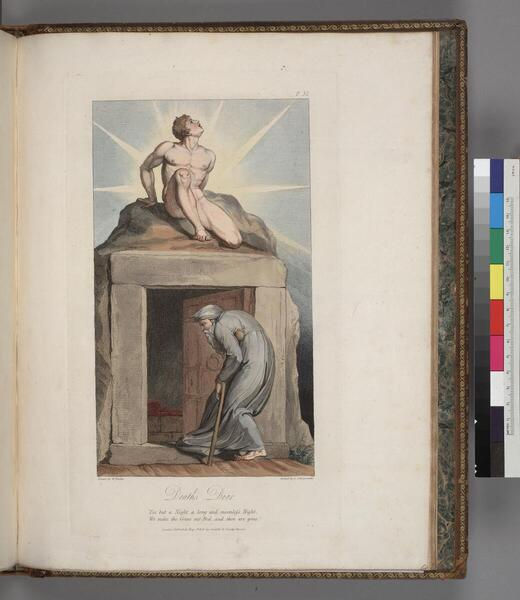
Death’s Door, Luigi Schiavonetti after William Blake, The Grave (1808), Huntington 54049. Second-state plate in a hand-tinted quarto copy; colourist and colouring date unspecified.
The reunion that answers the hovering soul
The Reunion of the Soul and the Body reverses the emotional and spatial terms of separation. In the original watercolour, a man rises from an opening in the ground, spreading both arms. A female figure descends head first through the clouds, her arms embracing his head and shoulders. Their faces meet. Movement from above and movement from below converge in the centre, where the two forms become almost impossible to separate. [11]
The soul’s cloth and hair carry the force of her descent. One foot extends towards the upper light; the other leg bends within the twisting drapery. Below, the man’s knees and shroud remain near the earth while his upper body reaches into the encounter. Blake lets the cloth sweep towards the right edge, carrying the eye away from the open grave. The picture is full of release, but the grave remains visible as the place from which the body has come.
A dark tomb stands at the right, its rectangular mouth set against flames and rolling cloud. The flames surround the meeting without preventing it. Pale blue, pink and grey passages move through the original’s restrained washes. Their delicacy allows the sharply drawn fingers, faces and curls of hair to retain their importance. The great promise of restored life becomes persuasive through the precision of a small bodily contact. [11]
Blair’s closing lines directly prepare this encounter. The soul will recognise its own partner amid the crowd and rush into its arms like someone newly returned home after a long absence. The poem gives the reunion domestic urgency. Blake intensifies it through the opposed directions of flight and rising, the embrace and the meeting faces. The desire belongs to the picture’s treatment, but the language of partners, impatient arrival and homecoming is already in the verse. [4]
Placed beside Soul Hovering, the scene becomes more affecting. Earlier, the female form looked down at a body that could not answer. Here the body has regained movement and receives her. Earlier the two outlines drew apart; here they cross and gather together. The relation can be understood before a reader has identified every emblem in the surrounding fire and cloud. Blake gives Christian resurrection the emotional shape of finding someone again.
The Huntington’s tinted engraving preserves this converging movement and sets the image above its engraved title. Schiavonetti’s shading gives the clouds a denser continuous field around the descending figure. In the original watercolour, broad light areas leave the central encounter comparatively exposed. Looking between them makes the persistence of the invention clear: the whole picture depends upon two trajectories meeting at one embrace. [8][11]
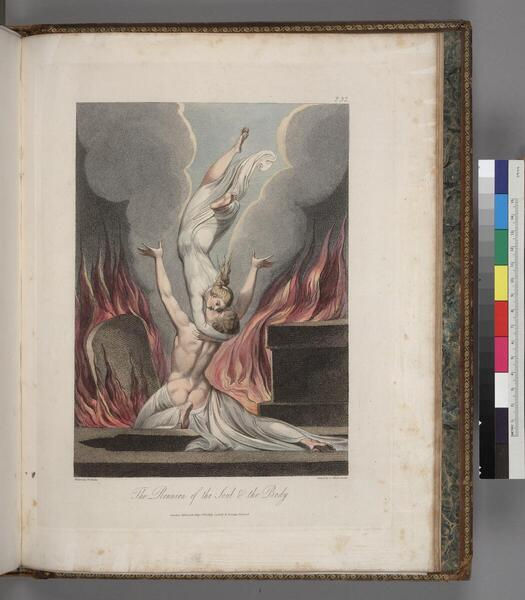
The Reunion of Soul and Body, Luigi Schiavonetti after William Blake, The Grave (1808), Huntington 54049. Second-state plate in a hand-tinted quarto copy; colourist and colouring date unspecified.
Two deaths, two households
The book also asks its reader to compare the strong wicked man’s death with the good old man’s. Blair first describes physical power collapsing into sickness. The broad chest cannot contain the struggle for breath; the limbs grasp at anything within reach. Near the poem’s end, the good man’s departure becomes quiet, compared with falling dew and expiring wind. These scenes give Blake sharply contrasting forms of bodily movement. [4]
In the Huntington’s Death of the Strong Wicked Man, the dying man lies across the foreground, twisting his muscular torso towards us. One hand clutches the cloth, while the head falls back into the pillow. A woman bends over him and another covers her face at the right. Above, a second male body sweeps horizontally through flame towards the window. The room contains both an agonised deathbed and the visible departure of its soul. [8]
That repeated anatomy changes the meaning of strength. The large chest and powerful arms command attention, yet they provide no means of remaining alive. Above, the soul’s extended body carries its terror through another part of the same space. The family’s gestures intensify the disturbance: one person presses towards the sufferer, another cannot bear to look. The picture makes dying something that happens among others, with consequences for those who remain.
In The Death of the Good Old Man, the horizontal movement becomes gentle. His body lies straight, the head at the left, while the long white form of his soul is carried above him by angels. Praying relatives gather at the bed. An open New Testament lies beneath his extended hand, giving his final gesture a definite object. The upper group moves across the room without the anguished twisting and flames of the wicked man’s departure. Both pictures show body, soul and family; their different movements create the contrast. [8]
The unsigned Of the Designs explains the wicked man’s departing soul as masculine and contrasts the scene’s confusion with the good old man’s repose. In its account of the latter, the old man rests his hand upon the Gospel, his soul ascends, and his children pray or hope that he still lives. These are the book’s own interpretive instructions. They present the paired designs as lessons about the manner of death, using the reactions of a household to make the difference legible. [9]
Fuseli’s signed preface helps explain why those reactions mattered to the publication. He argues that familiar emblems of eternity and moral choice have become too habitual to command attention. Blake, he says, renews sympathy by surrounding the subject with recognisable domestic feeling. The preface praises the figures’ attitudes while acknowledging invention that can approach the limits of artistic propriety. Its defence joins moral usefulness to the emotional power of a gesture. [12]
That argument suits the illustrations’ unsettling intimacy. The reader recognises a bed, a window, a grieving relative or an embrace; within that recognisable setting, an invisible soul acquires a visible body. Familiar experience carries the extraordinary claim. The same decision that makes the pictures emotionally accessible also gives them their strangeness: spiritual events possess limbs, weight, posture and desire.
Watch: William Blake’s world and working methods
Choose an introduction to Blake, a printing demonstration, or a discussion of his radical ideas.
William Blake: Poet, Artist & Visionary - a genius of early Romanticism in England
An introduction to Blake’s art, poetry and imaginative world.
Watch on YouTubeExploring and meeting again
The Soul Exploring the Recesses of the Grave gives uncertainty another form. Below the surface of the earth, a woman in a long white garment leans into a rocky passage. Her feet remain near its entrance while a small light illuminates the space before her. Fire glows at the back. Above the cave, a muscular figure stands against the night sky, bending to look down. The two figures occupy separate levels divided by the rock itself. [8]
The anonymous explanation places the soul’s exploration before the body has dissolved. It makes the image a search for the signs of mortality and immortality. Unlike the definite departure and return of the paired soul-and-body pictures, this subject pauses over an act of looking. The viewer watches someone approach a region whose meaning she is still discovering. The flame and the opening offer information without yielding a complete map of what lies beyond. [9]
That hesitation has a place in Blair’s poem. His speaker asks the dead to reveal their secret, then recognises that their silence leaves the living without the report they want. The poem eventually answers through Christian faith. Blake can give the earlier questioning its own space: a figure bends forward, carries a light, and investigates. The gesture sustains curiosity within a book that also makes confident promises. [4]
In The Meeting of a Family in Heaven, recognition becomes communal. Two adults embrace at the centre, children cling together at their feet, and another child reaches upwards towards the father. Above, angels lift their long wings into a pointed canopy. The composition places a series of smaller attachments around the central couple. Heavenly happiness takes the shape of people rediscovering their particular relations. [8][9]
The gestures have different scales. An adult can enfold another body; a small child can only reach towards a shoulder far above. The kneeling pair at the left form a close, rounded group beside the taller figures. These differences keep the meeting from becoming an assembly of interchangeable blessed souls. Each return asks for its own movement. Read after Blair’s grieving widow and remembered friend, the picture offers reunion as an answer to the loss of familiar company. [4][8]
What the book puts first
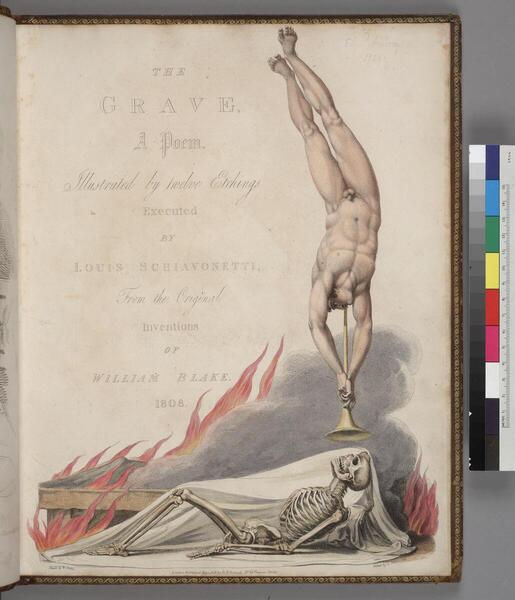
The published engraved title announces resurrection before the poem has begun. A muscular figure plunges down from above, blowing a long trumpet towards a skeleton stretched along the bottom of the sheet. Lettering occupies the open field beside the descending body. The skeletal remains, the urgent trumpet and the surrounding flames make the title itself an illustration. The book names its subject while showing the dead being summoned out of stillness. [8]
The accompanying explanation calls this composition The Skeleton Re-Animated. It draws upon the poem’s final trumpet and interprets the burning world as renewal at the end of time. Its position at the front allows the reader to encounter that promise before passing through the damp vaults and fearful deaths of Blair’s opening and middle passages. The title gives the printed book a different first experience from the poem’s uninterrupted opening. [9]
An unused title design at the Huntington offers another approach. Catalogued as A Title Page for The Grave, 1806, accession 000.30, it is executed in pen and blue watercolour. A female figure rises in prayer above an inscribed tomb, leaving drapery behind. At its base sit two winged figures, their heads lowered. The central tablet makes the lettering part of a funerary monument, while the rising figure carries the eye beyond it. [13]
The Huntington interprets the two seated figures through their contrasting bat-like and butterfly wings, suggesting bodily death and spiritual immortality. Its catalogue also reviews competing explanations of the sheet’s purpose. Evidence that it belonged to the Cromek family supports a connection with his publication scheme, perhaps as a title for the drawings shown to prospective subscribers. That proposed use remains a reconstruction. The drawing’s association with the commission is firmer than any single account of precisely how Cromek intended to employ it. [13]
The order of the book’s explanatory essay deserves similar care. Of the Designs arranges its twelve subjects into a progression towards eternal life, with the Last Judgement at the end. The plates bound through the poem follow a different arrangement. The Morgan’s catalogue notes that their placement can also vary slightly between copies, and attributes the unsigned commentary to Benjamin Heath Malkin following Bentley and Essick and Paley. It should be read as a contemporary interpretation, rather than automatically treated as Blake’s signed declaration of a definitive sequence. [2][9]
Cromek and the change of engraver
The commission began in 1805 with much larger proposals than the twelve illustrations eventually published. The Blake Archive’s editors distinguish plans for forty drawings and twenty engraved selections from the first November prospectus’s fifteen plates, naming Blake as both designer and engraver. A revised prospectus named Schiavonetti and reduced the published group to twelve. Those numbers record changing plans and different stages of production. They do not describe forty surviving finished watercolours. [5]
Blake’s separate Death’s Door print is central to accounts of the change. Its forceful white-line treatment differed from the fashionable finish Cromek sought for his subscribers. Yet a neat story of a single insulting encounter can conceal uncertainties in the surviving record. Aileen Ward’s documentary reassessment points out that the two prospectuses carry the same November date, while arguing that the revised version was probably issued later. The date printed on the advertisement is not a complete timetable of the decision. [14]
The loss mattered because engraving offered Blake further paid work beyond the designs. It also removed the published execution from an artist who placed great value on the union of invention and workmanship. In his 1809 Descriptive Catalogue, Blake complained that others had profited from his Grave designs while leaving him neglected. That passage establishes his public sense of injury. His large figure for their profits remains his accusation, rather than an audited account of the enterprise. [5][15]
Cromek’s work in bringing the book before readers belongs in the same history. Ward emphasises his exhibitions, advertising and pursuit of subscriptions, and challenges inflated calculations of his profit. The printed advertisement itself displays academic endorsements and gives conspicuous thanks to Schiavonetti. Promotion, financial interest and Blake’s disappointment coexisted within one undertaking. Recognising that conjunction makes the surviving book easier to understand than turning every participant into a fixed moral character. [12][14]
A further edition appeared in 1813 under Rudolph Ackermann. Its existence gives the same designs another publication date without moving their invention into that year. A drawing made for the commission, a plate prepared for the 1808 book and an impression issued in a later edition describe different moments. The title, paper and binding of an individual volume help place it within that continuing history. [3]
The drawings after the book
The finished drawings had a history separate from the copperplates and printed copies. Nineteen watercolours resurfaced in 2001 after a long disappearance from public knowledge. The Blake Archive presents a group of twenty finished designs, including the separately surviving widow at her husband’s grave. Its categories also distinguish preliminary sketches, wash drawings, finished watercolours, the published book and Blake’s own Death’s Door. The group’s extent depends upon which of those categories is being counted. [5][6]
Bentley’s catalogue records the nineteen in a red morocco portfolio and traces their appearance in the 1836 sale of Thomas Sivright’s collection. They were offered individually at Sotheby’s in New York on 2 May 2006, beginning the dispersal of the rediscovered group. Some designs had never appeared among Schiavonetti’s twelve illustrations. The drawings therefore enlarge the project beyond the familiar published selection, rather than merely supplying coloured originals for every printed plate. [6]
They also preserve decisions about finish and selection. The catalogue includes unused subjects concerned with friendship, mourners at a grave and ghosts before judgement. Related works can raise separate attribution questions: Robert N. Essick’s study of Death Pursuing the Soul through the Avenues of Life disputes Martin Butlin’s suggestion of later intervention in its washes. That disagreement concerns a particular related drawing and its physical execution. It need not unsettle the identification of the published illustrations or turn the entire watercolour group into one undifferentiated problem. [6][16]
A manageable route through The Grave begins with three encounters: the soul above the still body, the old man at the doorway, and the two forms rushing into reunion. Read Blair’s passages beside them, then compare a surviving watercolour with an identified printed copy. The pictures become more complex as their small movements acquire a history. A hovering body can retain attachment; a stoop can share a page with renewal; an embrace can make a doctrine of resurrection feel like an impatient homecoming.
For the larger setting, Blake’s Night Thoughts illustrations offer another sustained encounter with a poem about mortality. His engravings show the professional importance of executing a design oneself. Here, however, the lasting achievement lies in the particular sequence of departures and recognitions that Blair’s poem made possible. The grave remains frightening, but its threshold is repeatedly crossed by figures whose affection survives the crossing.
Works and designs directory
Browse separate works, impressions and book components. Dates distinguish versions; six Tate copies after Blake are labelled. These records are not a complete catalogue of unique designs.
| Name | Date | Medium |
|---|---|---|
| A Figure Standing in a Gothic Apse, perhaps the Empress Maud. Verso: Detailed Drawings for ‘The Empress Maud in Bed’ | c.1819 | Pencil drawing |
| A Rolling Stone Is Ever Bare of Moss, from Thornton's "Pastorals of Virgil" | 1821 | Wood engraving |
| A Title Page for The Grave | 1806 | Watercolour |
| A Vision of the Last Judgment | 1808 | Watercolour |
| A Vision: The Inspiration of the Poet (Elisha in the Chamber on the Wall) | c.1819–20? | Watercolour |
| Adam and the Beasts, Frontispiece to Hayley's "Ballads" | June 1, 1802 | Engraving |
| Age Teaching Youth | c.1785–90 | Watercolour |
| Alfred and the Neat-Herd’s Wife (after Henry Fuseli) | 1797, published 1798 | Etching and engraving |
| An Allegory of the Bible. Verso: The Shins of an Écorché Male Figure | c.1780–5, ?c.1780 | Watercolour |
| Angel of the Divine Presence Bringing Eve to Adam (The Creation of Eve: "And She Shall be Called Woman) (recto); Sketch for the same (verso) | ca. 1803 | Watercolour |
| Angel of the Revelation (Book of Revelation, chapter 10) | ca. 1803–5 | Watercolour |
| Antaeus setting down Dante and Virgil in the Last Circle of Hell | 1824–1827 | Watercolour |
| Bathsheba at the Bath | c.1799–1800 | Tempera |
| Beatrice Addressing Dante from the Car | 1824–7 | Watercolour |
| Behemoth and Leviathan | 1825–26 | Engraving |
| Behemoth and Leviathan | 1825, reprinted 1874 | Engraving |
| Behemoth and Leviathan | 1826 | Engraving |
| Blasted Trees and Flattened Crops, from Thornton's "Pastorals of Virgil" | 1821 | Wood engraving |
| Boy Returning Joyfully, with Plough and Oxen, from Thornton's "Pastorals of Virgil" | 1821 | Wood engraving |
| Boy Returning Joyfully, with Plough and Oxen, from Thornton's "Pastorals of Virgil" | 1821 | Wood engraving |
| Catherine Blake. Verso: A Man’s Head and Other Drawings | c.1805 | Pencil drawing |
| Cerberus | 1824–7 | Watercolour |
| Cerberus (second version) | 1824–1827 | Watercolour |
| Chaucer’s Canterbury Pilgrims | 1810, reprinted before 1881 | Engraving |
| Christ Appearing to His Disciples After the Resurrection | c.1795 | Colour print |
| Christ Appearing to the Apostles after the Resurrection | c.1795 | Watercolour |
| Christ Blessing the Little Children | 1799 | Tempera |
| Christ in the Carpenter’s Shop: The Humility of the Saviour (after William Blake) | Date not stated | Watercolour |
| Ciampolo the Barrator Tormented by the Devils | 1826–7, reprinted 1892 | Engraving |
| Ciampolo the Barrator Tormented by the Devils | 1826–7, reprinted 1968 | Engraving |
| Circle of Theives: Agnello Brunelleschi Attacked By a Six-Footed Serpent | ca. 1825–27 | Engraving |
| Clarence's Dream (Shakespeare, Richard III, Act 1, Scene 4) | 1774 | Etching and engraving |
| Colinet Mocked by Two Boys, from Thornton's "Pastorals of Virgil" | 1821 | Wood engraving |
| Colinet Rests by a Stream at Night | c.1821, printed 1830 | Wood engraving |
| Colinet Rests by a Stream at Night | 1821, reprinted 1977 | Wood engraving |
| Colinet with his Shepherd’s Pipe, Mocked by Two Boys | c.1821, printed 1830 | Wood engraving |
| Colinet with his Shepherd’s Pipe, Mocked by Two Boys | 1821, reprinted 1977 | Wood engraving |
| Colinet's Journey, Milestone Marked 'LXII Miles to London', from Thornton's "Pastorals of Virgil" | 1821 | Wood engraving |
| Colinet's Journey: Milestone Marked 'LXII Miles to London', from Thornton's "Pastorals of Virgil" | 1821 | Wood engraving |
| Colinet’s Fond Desire Strange Lands to Know | 1821, reprinted 1977 | Wood engraving |
| Colinet’s ‘Fond Desire Strange Lands to Know’ | c.1821, printed 1830 | Wood engraving |
| Composition Sketch for ‘The Fall of the Rebel Angels’? Verso: Standing Figure with Flaming Hair | ?c.1805–10 | Pencil drawing |
| Composition Sketch, Possibly a Subject from Dante. Verso: A Man Standing over a Figure Reclining on a Bed | ?1824–7, ?c.1800–10 | Pencil drawing |
| Composition Sketch. Verso: Standing Figure Holding a Spear | ?c.1805–10 | Pencil drawing |
| Dante and Virgil Approaching the Angel Who Guards the Entrance of Purgatory | 1824–7 | Watercolour |
| Dante and Virgil Penetrating the Forest | 1824–7 | Watercolour |
| Dante in the Empyrean, Drinking at the River of Light | 1824–7 | Watercolour |
| Dante running from the Three Beasts | 1824–1827 | Watercolour |
| Dante Striking against Bocca Degli Abati | 1826–7, reprinted 1892 | Engraving |
| Dante Striking Against Bocca degli Abati | 1826–7, reprinted 1968 | Engraving |
| David Delivered out of Many Waters | c.1805 | Watercolour |
| David Delivered out of Many Waters (after William Blake) | Date not stated | Watercolour |
| Detailed Drawings for ‘A Figure Standing in a Gothic Apse’ | 1819 | Pencil drawing |
| Elohim Creating Adam | 1795–c.1805 | Colour print |
| Enoch | 1806–7 | Lithograph |
| Epitome of James Hervey’s ‘Meditations among the Tombs’ | c.1820–5 | Watercolour |
| Europe. A Prophecy; Frontispiece | ca. 1820 | Relief etching |
| Evening | c.1820/1825 | Watercolour |
| Every Man also Gave him a Piece of Money | 1825, reprinted 1874 | Engraving |
| Every Man also Gave him a Piece of Money. Verso: God the Father with Attendant Angels | c.1821–3 | Watercolour |
| Every One also Gave Him a Piece of Money | 1826 | Engraving |
| Fertilization of Egypt, from Erasmus Darwin's "The Botanic Garden" | 1791 | Engraving |
| First Book of Urizen pl. 10 | 1796, c.1818 | Etching |
| First Book of Urizen pl. 11 | 1796, c.1818 | Etching |
| First Book of Urizen pl. 15 | 1796, c.1818 | Etching |
| First Book of Urizen pl. 17 | 1796, c.1818 | Etching |
| First Book of Urizen pl. 21 | 1796, c.1818 | Etching |
| First Book of Urizen pl. 6 | 1796, c.1818 | Etching |
| Frontispiece to Jerusalem, the Emanation of the Great Albion | [ca. 1804–20] (?) | Engraving |
| Frontispiece to ‘Visions of the Daughters of Albion’ | c.1795 | Relief etching |
| Frontispiece: Thenot and Colinet | c.1821, printed 1830 | Wood engraving |
| George Cumberland's Message Card | 1827 | Engraving |
| God Judging Adam | ca. 1795 | Relief etching |
| God Judging Adam | 1795 | Relief etching |
| Hiding of Moses, from "Remember Me!, or a Pocket Companion" | 1825 | Engraving |
| Homer and the Ancient Poets | 1824–7 | Watercolour |
| Illustration 1 to Milton’s On the Morning of Christ’s Nativity: The Descent of Peace | c.1814–1816 | Watercolour |
| Illustration 1 to Milton’s Paradise Lost: Satan Calling Up His Legions | 1807 | Watercolour |
| Job accepting Charity | 1825–26 | Engraving |
| Job and his Daughters | 1825–26 | Engraving |
| Job and his Daughters | 1825, reprinted 1874 | Engraving |
| Job and His Daughters | 1826 | Engraving |
| Job and His Family | 1825–26 | Engraving |
| Job and his Family | Reprinted 1874; engraved 1828 date is an error | Engraving |
| Job and His Family | 1826 | Engraving |
| Job and his Family Restored to Prosperity | 1825, reprinted 1874 | Engraving |
| Job and his Wife restored to Prosperity | 1825–26 | Engraving |
| Job rebuked by his Friends | 1825–26 | Engraving |
| Job Rebuked by his Friends | 1825, reprinted 1874 | Engraving |
| Job Rebuked by His Friends | 1826 | Engraving |
| Job's Comforters | 1825–26 | Engraving |
| Job's Comforters | 1826 | Engraving |
| Job's Despair | 1825–26 | Engraving |
| Job's Evil Dreams | 1825–26 | Engraving |
| Job's Evil Dreams | 1826 | Engraving |
| Job's Sacrifice | 1825–26 | Engraving |
| Job's Sons and Daughters Overwhelmed by Satan | 1826 | Engraving |
| Job, his Wife and his Friends: The Complaint of Job. Verso: Job’s Wife and Eight Other Sketches | c.1785 | Watercolour |
| Job’s Comforters | 1825, reprinted 1874 | Engraving |
| Job’s Despair | 1825, reprinted 1874 | Engraving |
| Job’s Evil Dreams | 1825, reprinted 1874 | Engraving |
| Job’s Sacrifice | 1825, reprinted 1874 | Engraving |
| Job’s Sons and Daughters Overwhelmed by Satan | 1825, reprinted 1874 | Engraving |
| John Linnell | 1825 | Pencil drawing |
| Joseph of Arimathea Preaching to the Britons | c.1794/1796 | Relief etching |
| Judas Betrays Him | c.1803–5 | Watercolour |
| King John Absolved by Pandulph (after Henry Fuseli) | 1797, published 1798 | Etching and engraving |
| Lamech and his Two Wives | 1795 | Colour print |
| Landscape near Felpham | c.1800 | Watercolour |
| Lear and Cordelia in Prison | c.1779 | Watercolour |
| Los and Orc | c.1792–3 | Watercolour |
| Lower Half of a Woman Playing a Harp. Verso: Seraphim and Other Drawings | c.1785, c.?1807 | Pencil drawing |
| Menalcus Watching Women Dance, from Thornton's "Pastorals of Virgil" | 1821 | Wood engraving |
| Menalcus Watching Women Dance, from Thornton's "Pastorals of Virgil" | 1821 | Wood engraving |
| Moses Indignant at the Golden Calf | c.1799–1800 | Tempera |
| Nebuchadnezzar | 1795–c.1805 | Colour print |
| Newton | 1795–c.1805 | Colour print |
| Oberon, Titania and Puck with Fairies Dancing | c.1786 | Watercolour |
| Pity | ca. 1795 | Relief etching |
| Pity | c.1795 | Colour print |
| Plate 2 of ‘Urizen’: ‘Teach these Souls to Fly’ | ?1796 | Relief etching |
| Plate 3 of ‘Urizen’: Oh! Flames of Furious Desires’ (after William Blake) | Date not stated | Watercolour |
| Plate 4 of ‘Visions of the Daughters of Albion’ | c.1795 | Relief etching |
| Plutus | 1824–7 | Watercolour |
| Preliminary Sketch for ‘Christ Girding Himself with Strength’. Verso: Standing Figure with One Arm Raised | c.1805, c.1805–10 | Pencil drawing |
| Preludium. "The shadowy daughter of Urthona stood before red Orc..." (Plate 3) | 1793 | Relief etching |
| Queen Elizabeth and Essex (after Henry Fuseli) | 1797, published 1798 | Engraving |
| Sabrina's Silvery Flood, from Thornton's "Pastorals of Virgil" | 1821 | Wood engraving |
| Sabrina's Silvery Flood, from Thornton's "Pastorals of Virgil" | 1821 | Wood engraving |
| Sabrina’s Silvery Flood | c.1821, printed 1830 | Wood engraving |
| Sabrina’s Silvery Flood | 1821, reprinted 1977 | Wood engraving |
| Satan Before the Throne of God | 1825–26 | Engraving |
| Satan before the Throne of God | 1825, reprinted 1874 | Engraving |
| Satan before the Throne of God | 1826 | Engraving |
| Satan calling up his Legions | c.1800–05 | Tempera |
| Satan Exulting over Eve | c.1795 | Colour print |
| Satan Going Forth from the Presence of the Lord, and Job’s Charity | 1825, reprinted 1874 | Engraving |
| Satan Going Forth fron the Presence of the Lord | 1825–26 | Engraving |
| Satan in his Original Glory: ‘Thou wast Perfect till Iniquity was Found in Thee’ | c.1805 | Watercolour |
| Satan Smiting Job with Boils | 1825–26 | Engraving |
| Satan Smiting Job with Sore Boils | 1825, reprinted 1874 | Engraving |
| Satan Smiting Job with Sore Boils | c.1826 | Tempera |
| Satan Smiting Job with Sore Boils | 1826 | Engraving |
| Shepherd Chases Away a Wolf, from Thornton's "Pastorals of Virgil" | 1821 | Wood engraving |
| Shepherd Chases Away a Wolf, from Thornton's "Pastorals of Virgil" | 1821 | Wood engraving |
| Sketch for the Title-Page of the Engraved Illustrations to the Book of Job | c.1823/1826 | Pencil drawing |
| Sketch for ‘The Four and Twenty Elders Casting their Crowns before the Divine Throne’. Verso: Standing Figure with Arms at his Side | c.1803, c.1805–10 | Pencil drawing |
| Sketch for ‘Tiriel Supporting the Dying Myratana’. Verso: Sketch for ‘Tiriel Supporting the Dying Myratana’ | c.1786–9 | Pencil drawing |
| Songs of Experience: A Little Boy Lost | [1794] printed ca. 1825 | Relief etching |
| Songs of Experience: A Little Girl Lost | [1794] printed ca. 1825 | Relief etching |
| Songs of Experience: A Poison Tree | [1794] printed ca. 1825 | Relief etching |
| Songs of Experience: Earth's Answer | [1794] printed ca. 1825 | Relief etching |
| Songs of Experience: Frontispiece | [1794] printed ca. 1825 | Relief etching |
| Songs of Experience: Holy Thursday | [1794] printed ca. 1825 | Relief etching |
| Songs of Experience: Infant Sorrow | [1794] printed ca. 1825 | Relief etching |
| Songs of Experience: Introduction | [1794] printed ca. 1825 | Relief etching |
| Songs of Experience: London | [1794] printed ca. 1825 | Relief etching |
| Songs of Experience: My Pretty Rose Tree, Ah! Sun-Flower, The Lilly | [1794] printed ca. 1825 | Relief etching |
| Songs of Experience: Nurses Song | [1794] printed ca. 1825 | Relief etching |
| Songs of Experience: The Angel | [1794] printed ca. 1825 | Relief etching |
| Songs of Experience: The Chimney Sweeper | [1794] printed ca. 1825 | Relief etching |
| Songs of Experience: The Clod & the Pebble | [1794] printed ca. 1825 | Relief etching |
| Songs of Experience: The Fly | [1794] printed ca. 1825 | Relief etching |
| Songs of Experience: The Garden of Love | [1794] printed ca. 1825 | Relief etching |
| Songs of Experience: The Human Abstract | [1794] printed ca. 1825 | Relief etching |
| Songs of Experience: The Little Girl Found (second plate) | [1789] printed ca. 1825 | Relief etching |
| Songs of Experience: The Little Girl Lost | [1789] printed ca. 1825 | Relief etching |
| Songs of Experience: The Little Girl Lost (second plate); The Little Girl Found | [1789] printed ca. 1825 | Relief etching |
| Songs of Experience: The Little Vagabond | [1794] printed ca. 1825 | Relief etching |
| Songs of Experience: The School Boy | [1789] printed ca. 1825 | Relief etching |
| Songs of Experience: The Sick Rose | [1794] printed ca. 1825 | Relief etching |
| Songs of Experience: The Tyger | [1794] printed ca. 1825 | Relief etching |
| Songs of Experience: The Voice of the Ancient Bard | [1789] printed ca. 1825 | Relief etching |
| Songs of Experience: Title-page | [1794] printed ca. 1825 | Relief etching |
| Songs of Experience: To Tirzah | [1794] printed ca. 1825 | Relief etching |
| Songs of Innocence and of Experience, Shewing the Two Contrary States of the Human Soul: Combined Title-page | [1789–94] printed ca. 1825 | Relief etching |
| Songs of Innocence and of Experience: Infant Sorrow | 1794, reprinted 1831 or later | Relief etching |
| Songs of Innocence: A Cradle Song | [1789] printed ca. 1825 | Relief etching |
| Songs of Innocence: A Cradle Song (second plate) | [1789] printed ca. 1825 | Relief etching |
| Songs of Innocence: A Dream | [1794] printed ca. 1825 | Relief etching |
| Songs of Innocence: Frontispiece | [1789] printed ca. 1825 | Relief etching |
| Songs of Innocence: Holy Thursday | [1789] printed ca. 1825 | Relief etching |
| Songs of Innocence: Infant Joy | [1789] printed ca. 1825 | Relief etching |
| Songs of Innocence: Introduction | [1789] printed ca. 1825 | Relief etching |
| Songs of Innocence: Laughing Song | [1789] printed ca. 1825 | Relief etching |
| Songs of Innocence: Little Boy Lost | [1789] printed ca. 1825 | Relief etching |
| Songs of Innocence: Night | [1789] printed ca. 1825 | Relief etching |
| Songs of Innocence: Night (second plate) | [1789] printed ca. 1825 | Relief etching |
| Songs of Innocence: Nurse's Song | [1789] printed ca. 1825 | Relief etching |
| Songs of Innocence: On Anothers Sorrow | [1789] printed ca. 1825 | Relief etching |
| Songs of Innocence: Spring | [1789] printed ca. 1825 | Relief etching |
| Songs of Innocence: Spring (second plate) | [1789] printed ca. 1825 | Relief etching |
| Songs of Innocence: The Blossom | [1789] printed ca. 1825 | Relief etching |
| Songs of Innocence: The Chimney Sweeper | [1789] printed ca. 1825 | Relief etching |
| Songs of Innocence: The Divine Image | [1789] printed ca. 1825 | Relief etching |
| Songs of Innocence: The Ecchoing Green | [1789] printed ca. 1825 | Relief etching |
| Songs of Innocence: The Ecchoing Green (second plate) | [1789] printed ca. 1825 | Relief etching |
| Songs of Innocence: The Lamb | [1789] printed ca. 1825 | Relief etching |
| Songs of Innocence: The Little Black Boy | [1789] printed ca. 1825 | Relief etching |
| Songs of Innocence: The Little Black Boy (second plate) | [1789] printed ca. 1825 | Relief etching |
| Songs of Innocence: The Little Boy Found | [1789] printed ca. 1825 | Relief etching |
| Songs of Innocence: The Shepherd | [1789] printed ca. 1825 | Relief etching |
| Songs of Innocence: Title Page | [1789] printed ca. 1825 | Relief etching |
| St Christopher, Copy from an Engraving? Verso:Part of a Face: Copy from a Plaster Cast: a Daughter of Niobe? | ?c.1779–80 | Pencil drawing |
| The Agony in the Garden | c.1799–1800 | Tempera |
| The Angel Appearing to Zacharias | 1799–1800 | Tempera |
| The Ascent of the Mountain of Purgatory | 1824–7 | Watercolour |
| The Baffled Devils Fighting | 1826–7, reprinted 1892 | Engraving |
| The Baffled Devils Fighting | 1826–7, reprinted 1968 | Engraving |
| The Bard, from Gray | ?1809 | Tempera |
| The Beggar's Opera, Act III | July 1, 1790 | Etching and engraving |
| The Beggar's Opera, Act III | July 1, 1790 | Engraving |
| The Beggar's Opera, Act III | 1790 | Engraving |
| The Blasphemer | c.1800 | Watercolour |
| The Blighted Corn | c.1821, printed 1830 | Wood engraving |
| The Blighted Corn | 1821, reprinted 1977 | Wood engraving |
| The Body of Abel Found by Adam and Eve | c.1826 | Tempera |
| The Body of Christ Borne to the Tomb | c.1799–1800 | Tempera |
| The Book of Job: Title Page | 1825 | Engraving |
| The Book of Thel pl. 6 | 1796, c.1818 | Etching |
| The Circle of Corrupt Officials: The Devils Mauling Each Other | ca. 1825–27 | Engraving |
| The Circle of Corrupt Officials: The Devils Tormenting Ciampolo | ca. 1825–27 | Engraving |
| The Circle of the Lustful: Francesca da Rimini (‘The Whirlwind of Lovers’) | 1826–7, reprinted 1892 | Engraving |
| The Circle of the Lustful: Francesca da Rimini (‘The Whirlwind of Lovers’) | 1826–7, reprinted 1968 | Engraving |
| The Circle of the Lustful: Paolo and Francesca | ca. 1825–27 | Engraving |
| The Circle of the Thieves; Buoso Donati Attacked by the Serpent | ca. 1825–27 | Engraving |
| The Circle of Traitors: Dante's Foot Striking Bocca degli Abbate | ca. 1825–27 | Engraving |
| The Complaint and the Consolation; or, Night Thoughts | 1797 | Etching and engraving |
| The Creation | 1825–26 | Engraving |
| The Crucifixion | c.1825–7 | Pencil drawing |
| The Crucifixion: ‘Behold Thy Mother’ | c.1805 | Watercolour |
| The Dance of Albion (Glad Day) | c.1803/1810 | Engraving |
| The Death of Lucretia, from Allen's "New and Impartial Roman History" | 1797 | Engraving |
| The Death of Saint Joseph | 1803 | Watercolour |
| The Death of the Virgin | 1803 | Watercolour |
| The Descent of Peace [recto] | c.1815 | Pencil drawing |
| The Destruction of Job's Sons | 1825–26 | Engraving |
| The Devils, with Dante and Virgil by the Side of the Pool | 1824–7 | Watercolour |
| The Entombment | c.1805 | Watercolour |
| The Fall of Rosamond (after Thomas Stothard) | 1783 | Etching and engraving |
| The Fall of Satan | 1825–26 | Engraving |
| The Fall of Satan | 1825, reprinted 1874 | Engraving |
| The Fall of Satan | 1826 | Engraving |
| The Four and Twenty Elders Casting their Crowns before the Divine Throne | c.1803–5 | Watercolour |
| The Ghost of a Flea | c.1819–20 | Tempera |
| The Good and Evil Angels | 1795–?c.1805 | Colour print |
| The Good Farmer, Probably the Parable of the Wheat and the Tares. Verso: Rough Sketch of Two or Three Figures in a Landscape | c.1780–5 | Watercolour |
| The Great Red Dragon and the Beast from the Sea | c.1805 | Watercolour |
| The Great Red Dragon and the Woman Clothed with the Sun | c.1805 | Watercolour |
| The Head of the Ghost of a Flea. Verso: A Profile and a Reduced Drawing of Milton’s First Wife | c.1819 | Pencil drawing |
| The Hermit’s Dog, from William Hayley’s "Ballads" | 1805 | Etching and engraving |
| The Hiding of Moses | 1824 | Engraving |
| The House of Death | 1795–c.1805 | Colour print |
| The House of Death | c.1790 | Watercolour |
| The Hypocrites with Caiaphas. Verso: Sketch of a Stooping Figure | 1824–7 | Watercolour |
| The Inscription over the Gate | 1824–7 | Watercolour |
| The Laborious Passage along the Rocks | 1824–7 | Watercolour |
| The Last Trumpet (recto); Two studies of a right eye, a profile of an open-mouthed young man, the head of an eagle, and the head of a lion (verso) | 1780–85 | Pencil drawing |
| The Lord Answering Job out of the Whirlwind | 1825–26 | Engraving |
| The Lord Answering Job out of the Whirlwind | 1825, reprinted 1874 | Engraving |
| The Man Who Taught Blake Painting in his Dreams (counterproof) (after William Blake) | after c.1819–20 | Pencil drawing |
| The Marriage of Heaven and Hell pl. 16 | 1796, c.1818 | Etching |
| The Messengers tell Job of his Misfortunes | 1825–26 | Engraving |
| The Messengers tell Job of his Misfortunes | 1825, reprinted 1874 | Engraving |
| The Night of Enitharmon’s Joy (formerly called ‘Hecate’) | c.1795 | Colour print |
| The Parable of the Wise and Foolish Virgins | ca. 1799–1800 | Watercolour |
| The Parable of the Wise and Foolish Virgins (after William Blake) | Date not stated | Watercolour |
| The Pastorals of Virgil, with a Course of English Reading, Adapted for Schools, Vol. I | 1821 | Wood engraving |
| The Penance of Jane Shore in St Paul’s Church | c.1793 | Watercolour |
| The Pit of Disease: The Falsifiers | 1826–7, reprinted 1892 | Engraving |
| The Pit of Disease: The Falsifiers | 1824–7 | Watercolour |
| The Pit of Disease: The Falsifiers | 1826–7, reprinted 1968 | Engraving |
| The Primaeval Giants Sunk in the Soil | 1824–7 | Watercolour |
| The Punishment of the Thieves | 1824–7 | Watercolour |
| The Raising of Lazarus (after William Blake) | Date not stated | Watercolour |
| The Rest on the Flight into Egypt (The Repose of the Holy Family in Egypt) | 1806 | Watercolour |
| The River of Life | c.1805 | Watercolour |
| The Rock Sculptured with the Recovery of the Ark and the Annunciation | 1824–7 | Watercolour |
| The Serpent Attacking Buoso Donati | 1826–7, reprinted 1892 | Engraving |
| The Serpent Attacking Buoso Donati | 1826–7, reprinted 1968 | Engraving |
| The Serpent Attacking Buoso Donati. Verso: A Man with a Transparent Hood (?) over his Head | 1824–7 | Watercolour |
| The Simoniac Pope | 1824–7 | Watercolour |
| The Six-Footed Serpent Attacking Agnolo Brunelleschi | 1826–7, reprinted 1892 | Engraving |
| The Six-Footed Serpent Attacking Agnolo Brunelleschi | 1826–7, reprinted 1968 | Engraving |
| The Soul Hovering over the Body Reluctantly Parting with Life | c.1805 | Pencil drawing |
| The Spiritual Form of Nelson Guiding Leviathan | c.1805–9 | Tempera |
| The Spiritual Form of Pitt Guiding Behemoth | ?1805 | Tempera |
| The Sun at His Eastern Gate | c.1816–1820 | Watercolour |
| The Temple of Mirth, after Thomas Stothard | 1784 | Engraving |
| The Temptation and Fall of Eve | 1807 | Watercolour |
| The Temptation and Fall of Eve (Illustration to Milton’s Paradise Lost) | 1808 | Watercolour |
| The Thieves and Serpents | 1824–1827 | Watercolour |
| The Vision of Christ | 1825, reprinted 1874 | Engraving |
| The Vision of Eliphaz | 1825–26 | Engraving |
| The Vision of Eliphaz | 1825, reprinted 1874 | Engraving |
| The Vision of God | 1825–26 | Engraving |
| The Wood of the Self-Murderers: The Harpies and the Suicides | 1824–7 | Watercolour |
| The Wrath of Elihu | 1825–26 | Engraving |
| The Wrath of Elihu | 1825, reprinted 1874 | Engraving |
| Thenot and Colinet | 1821, reprinted 1977 | Wood engraving |
| Thenot and Colinet at Supper | c.1821, printed 1830 | Wood engraving |
| Thenot and Colinet at Supper | 1821, reprinted 1977 | Wood engraving |
| Thenot and Colinet Converse Seated between Two Trees | c.1821, printed 1830 | Wood engraving |
| Thenot and Colinet Converse Seated between Two Trees | 1821, reprinted 1977 | Wood engraving |
| Thenot and Colinet Eat Their Evening Meal, from Thornton's "Pastorals of Virgil" | 1821 | Wood engraving |
| Thenot and Colinet Folding their Flocks together at Sunset | c.1821, printed 1830 | Wood engraving |
| Thenot and Colinet Folding their Flocks together at Sunset | 1821, reprinted 1977 | Wood engraving |
| Thenot and Colinet Lead Their Flocks Together, from Thornton's "Pastorals of Virgil" | 1821 | Wood engraving |
| Thenot and Colinet Lead Their Flocks Together, from Thornton's "Pastorals of Virgil" | 1821 | Wood engraving |
| Thenot Remonstrates with Colinet | c.1821, printed 1830 | Wood engraving |
| Thenot Remonstrates with Colinet | 1821, reprinted 1977 | Wood engraving |
| Thenot Remonstrates With Colinet, from Thornton's "Pastorals of Virgil" | 1821 | Wood engraving |
| Thenot Remonstrates With Colinet, from Thornton's "Pastorals of Virgil" | 1821 | Wood engraving |
| Thenot Remonstrates with Colinet, Lightfoot in the Background, from Thornton's "Pastorals of Virgil" | 1821 | Wood engraving |
| Thenot Remonstrates with Colinet: Lightfoot in the Distance | 1821, reprinted 1977 | Wood engraving |
| Thenot Remonstrates with Colinet; Lightfoot in the Distance | c.1821, printed 1830 | Wood engraving |
| Thenot Under a Fruit Tree, from Thornton's "Pastorals of Virgil" | 1821 | Wood engraving |
| Thenot, with Colinet Waving his Arms in Sorrow | c.1821, printed 1830 | Wood engraving |
| Thenot, with Colinet Waving his Arms in Sorrow | 1821, reprinted 1977 | Wood engraving |
| Title Page: Illustrations of the Book of Job | 1825–26 | Engraving |
| Title-Page of ‘The Book of Job’ | 1825, reprinted 1874 | Engraving |
| Tornado–Zeus Battling Typhon, from Erasmus Darwin's "Botanic Garden" | August 1, 1795 | Engraving |
| Tornado–Zeus Battling Typhon, from Erasmus Darwin's "The Botanic Garden" | August 1, 1795 | Engraving |
| Two Figures in a Decorative Border | c.1790 | Pencil drawing |
| Unyok'd Heifers, Loitering Homeward (Return of the Shepherd), from Thornton's "Pastorals of Virgil" | 1821 | Wood engraving |
| Virgil Girding Dante’s Brow with a Rush | 1824–7 | Watercolour |
| Wat Tyler and the Tax-Gatherer (after Henry Fuseli) | 1797, published 1798 | Etching and engraving |
| When the Morning Stars Sang Together | 1825, reprinted 1874 | Engraving |
| When the Morning Stars Sang Together | 1826 | Engraving |
| Winged Figure Flying Through Clouds, from Bell's "Poets" | 1790 | Etching and engraving |
| Winter | c.1820–5 | Tempera |
| ‘A Rolling Stone is ever Bare of Moss’ | c.1821, printed 1830 | Wood engraving |
| ‘A Rolling Stone is ever Bare of Moss’ | 1821, reprinted 1977 | Wood engraving |
| ‘And Unyok’d Heifers, Loitering Homeward, Low’ | c.1821, printed 1830 | Wood engraving |
| ‘And Unyok’d Heifers, Loitering Homewards, Low’ | 1821, reprinted 1977 | Wood engraving |
| ‘Europe’: Fragment of Pages 3 and 4 | 1794–c.1830–5 | Relief etching |
| ‘For him Our Yearly Wakes and Feasts We Hold’ | c.1821, printed 1830 | Wood engraving |
| ‘For him Our Yearly Wakes and Feasts We Hold’ | 1821, reprinted 1977 | Wood engraving |
| ‘Nor Fox, nor Wolf, nor Rat among our Sheep’ | c.1821, printed 1830 | Wood engraving |
| ‘Nor Fox, nor Wolf, nor Rat among our Sheep’ | 1821, reprinted 1977 | Wood engraving |
| ‘Songs of Innocence and of Experience’: ‘Infant Sorrow’ | 1794, reprinted 1831 or later | Relief etching |
| ‘Songs of Innocence and of Experience’: ‘Spring’ | 1794, reprinted 1831 or later | Relief etching |
| ‘Songs of Innocence’: Title-Page | 1789, reprinted 1831 or later | Relief etching |
| ‘Songs of Innocence’: Title-Page | 1789, reprinted 1831 or later | Relief etching |
| ‘With Songs the Jovial Hinds Return from Plow’ | c.1821, printed 1830 | Wood engraving |
| ‘With Songs the Jovial Hinds Return from Plow’ | 1821, reprinted 1977 | Wood engraving |
Frequently Asked Questions
No. The Archive’s account distinguishes changing proposals for drawings and plates. The numbers belong to different stages of production. [5]
Discussion
Look again at the images and ideas explored in William Blake’s Illustrations to The Grave. These editorial prompts invite your observations.
Reader Insights
The stooping old man and upright youth place dying and renewal within one narrow composition.
The hovering soul remains visually connected to the body even as separation widens between them.
In Reunion, rising and descending bodies meet at the centre. Their embrace reverses the space and feeling of reluctant departure.
Join the Conversation
Share a detail, comparison or question about William Blake’s Illustrations to The Grave below.
References
- Christie’s. William Blake, The Grave: Death’s Door, lot 39, object 6591751. Full catalogue entry and photograph of the original drawing; pencil, pen and black ink and watercolour, 23.9 × 13.6 cm. Earlier doorway compositions and distinction from Blake’s separate print. View the drawing. View source.
- The Morgan Library & Museum. Robert Blair, The Grave (1808), PML 145637. Quarto issue, engraved title, portrait after Phillips, plate arrangement and attribution of Of the Designs. View the book record. View source.
- Sir John Soane’s Museum. Robert Blair, The Grave (1808), reference 1708. Publication, twelve Schiavonetti illustrations after Blake, separate portrait, subscribers and 1813 edition. View the book record. View source.
- Robert Blair. The Grave (London: M. Cooper, 1743), complete poem, lines 1–767, in the Eighteenth-Century Poetry Archive. Especially lines 1–110, 123–236, 257–381, 447–540 and 541–767. Line numbers refer to this first-edition text. Read the poem. View source.
- Morris Eaves, Robert N. Essick and Joseph Viscomi, editors. “Publication Announcement—Works Related to Blake’s Illustrations to Robert Blair’s The Grave,” William Blake Archive, 22 May 2014. Complete announcement; production categories, changing proposals, rejected white-line print and later reputation. Read the editors’ account. View source.
- G. E. Bentley Jr. William Blake and His Circle, 2017 supplement, Part II, Drawings and Paintings, printed pp.626–641, PDF pp.7–22. Documents, nineteen rediscovered watercolours, additional designs, portfolio, 1836 sale and 2006 auction. Speculative private buyer identifications are not adopted. Read the catalogue supplement. View source.
- Christie’s. William Blake, The Grave: The Soul Hovering over the Body Reluctantly Parting with Life, lot 38, object 6591750. Full catalogue entry and original drawing photograph; pencil, pen and black ink and watercolour, 15.8 × 22.6 cm. View the drawing. View source.
- The Huntington. Robert Blair, The Grave (1808), call number 54049. Quarto issue, second-state plates tinted with watercolour. Visual discussion refers to this copy’s engraved title, Soul Hovering, Death’s Door, Reunion, Death of the Strong Wicked Man, Death of the Good Old Man, Soul Exploring and Meeting of a Family in Heaven; colourist and colouring date are not specified. View the book and plates. View source.
- Anonymous, attributed to Benjamin Heath Malkin. Of the Designs, in Blair’s The Grave (1808), original pp.33–36; consulted in the reset Methuen 1903 reprint, pp.33–37, complete introductory paragraph and entries I–XII. The attribution follows the Morgan record cited above. Read the digitised volume. View source.
- William Blake. To the Queen, dedication to Blair’s The Grave (1808), complete twenty-line poem; consulted in the Methuen 1903 reprint. Read the digitised volume. View source.
- Christie’s. William Blake, The Grave: The Reunion of the Soul and the Body, lot 106, object 6571779. Full catalogue entry and drawing photograph; pencil, pen and black ink and watercolour, 23.7 × 17.5 cm. View the drawing. View source.
- Robert Hartley Cromek and Henry Fuseli. Cromek’s advertisement dated July 1808 and Fuseli’s complete signed prefatory remarks in The Grave; consulted in Methuen’s 1903 reprint, pp.xvii–xx. Read the digitised volume. View source.
- The Huntington. William Blake, A Title Page for The Grave, 1806, accession 000.30. Pen and blue watercolour on paper, sheet 23.8 × 20 cm; complete catalogue description and image. Earlier scholarship and proposed portfolio use are reported through this record. View the drawing. View source.
- Aileen Ward. “Canterbury Revisited: The Blake-Cromek Controversy.” Blake/An Illustrated Quarterly 22, no.3 (Winter 1988/89): 80–88, especially the Grave documentary discussion on pp.82–83. Revised prospectus dating, promotion and profit calculations are Ward’s reassessment. Read the article. View source.
- William Blake. A Descriptive Catalogue of Pictures (1809), Canterbury Pilgrims entry, original pp.25–26, E537, in David V. Erdman, ed., The Complete Poetry and Prose of William Blake. Complaint concerning the profits and reception of his Grave designs. Read the primary text. View source.
- Robert N. Essick. “Attribution and Reproduction: Death Pursuing the Soul through the Avenues of Life.” Blake/An Illustrated Quarterly 45, no.2 (Fall 2011): 66–70. Complete main article, paragraphs 1–18, with relevant notes; Butlin’s 2009 position is consulted through Essick’s quotations and response. Read the article. View source.


