 by Tom Gurney
Tom Gurney BSc (Hons) is an art history expert with over 20 years experience
Published on June 19, 2020 / Updated on November 3, 2026
Email: tomgurney1@gmail.com / Phone: +44 7429 011000
William Blake Poetry: Songs, Voices and Prophecy: Introduction
A child asks a lamb who made it. Another voice faces a burning tiger and asks what kind of maker could have dared to bring it into being. The animals belong to the same poetic world, but they lead the reader into different experiences of creation: tenderness and kinship in The Lamb, wonder and terror in The Tyger. William Blake gives both poems memorable rhythms and plain, vivid words. Their apparent simplicity makes the questions easier to remember, while leaving their implications open. [1]
That combination offers a welcoming entrance to Blake’s poetry. A song may be short enough to read in a minute and unsettling enough to occupy the mind for years. Children speak, nurses answer them, a traveller walks through London, and a rose suffers a hidden injury. Elsewhere, the scale expands into heavens, furnaces, living continents and immense human figures. Across these different forms, Blake asks how people learn to see, how authority shapes desire, and how imaginative life survives the conditions that confine it. [1][2][3][4]
His poems also invite more than one kind of attention. Read them aloud for their changing voices and insistence; follow their arguments through a complete sequence; look at the individual printed books in which words and designs share the page. Blake names himself both author and printer on the title pages of Songs of Innocence and Songs of Experience. That double role matters to a poetry whose meaning can depend on the form of the book as well as the words collected in a modern edition. [1]
At a Glance
- Early collectionPoetical Sketches, title dated 1783 [5]
- Songs title datesInnocence 1789; Experience 1794 [1]
- Reading methodFollow actions before fixing mythic definitions [3]
Contents
- Early songs and living landscapes
- Innocence and experience: hearing the difference
- The Lamb and The Tyger
- Children, labour and the uses of consolation
- London: the city heard through its streets
- Love, secrecy and the growth of harm
- Reading the book as well as the poem
- The Marriage of Heaven and Hell: thinking through opposition
- Auguries of Innocence beyond its opening
- Entering the prophecies
Early songs and living landscapes
Poetical Sketches, dated 1783 on its title page, already contains the meeting of natural beauty and threatened freedom that will recur in Blake’s later poetry. The seasonal poems address Spring, Summer, Autumn and Winter as presences with bodies, voices and habits. Spring has dewy hair and angelic eyes; Summer rides with fierce horses and can be invited to bathe; Autumn sits down to sing before leaving his fruit behind. The landscape becomes a place of encounter, desire and conversation. [5]
Winter brings a different force. The speaker tries to keep him behind his northern doors, but the plea fails. He strides across the rocks, freezes vulnerable life and disregards the mariner’s cries. Even in these early poems, personification carries an emotional and ethical pressure: the seasons can nourish or overwhelm the beings exposed to them. Blake gives weather the bodily agency that he will later give to mental powers and historical forces. [5]
The song beginning “How sweet I roam’d from field to field” concentrates that pressure into a little story. A winged singer enjoys the summer until the prince of love leads it through his gardens. Pleasure becomes captivity when he catches the singer in a silken net and shuts it in a golden cage. The beautiful materials make the imprisonment more disturbing. The captor enjoys the song and plays with the captive’s wing, while mocking its lost liberty. [5]
The poem’s movement is easy to follow, yet its emotional terms remain complicated. Gifts, gardens and affection become means of possession. The language of sweetness persists after the freedom that made it possible has disappeared. This is a useful early example of Blake’s ability to make an attractive image turn against itself. A reader who follows the change from roaming to enclosure is already practising the attention required by his later songs about love, education and belief. [5]
Related viewing: Iain Sinclair discusses William Blake’s radicalism for the British Library.
Innocence and experience: hearing the difference
The combined title of Songs of Innocence and of Experience describes two contrary states of the human soul. The dates on the separate title pages are 1789 and 1794. The poems invite comparison between ways of perceiving and responding to life; their division cannot be reduced to a cheerful childhood followed by a uniformly miserable adulthood. The children of Innocence already encounter death, work, abandonment and fear. The voices of Experience can expose injuries that a reassuring story has concealed. [1]
The Introduction to Innocence begins with a piper whose music delights a child on a cloud. The child asks him to pipe again, then to sing, and finally to write. Each change preserves something of the earlier performance while making it available in another form. When the child vanishes, the piper makes a pen from a reed and writes songs for children to hear. The book begins by imagining its own passage from living encounter to written communication. [1]
The exchange also makes listening important. The child directs the adult artist, and tears can accompany joy. Neither age nor emotional expression provides a simple key to who knows most. That flexibility continues through the collection: a child may comfort another child, a nurse may listen generously or answer with bitterness, and an apparently authoritative conclusion may sit uneasily beside the events that precede it. Reading Blake well means noticing who speaks, what that speaker has witnessed, and how far the speaker’s explanation accounts for it. [1]
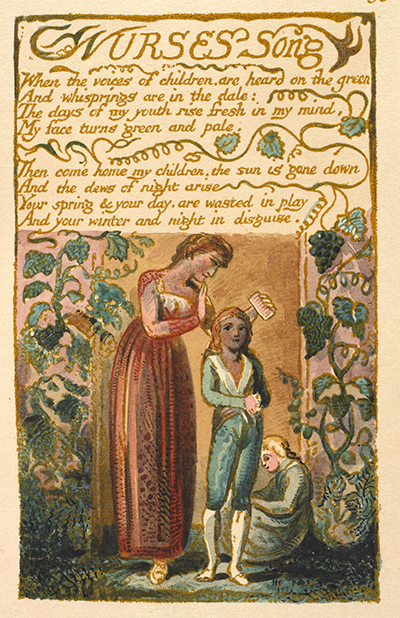
The two nurse poems offer a clear comparison. In Innocence, the adult initially calls the children home at sunset. They ask to continue playing, and she agrees until the light fades. Their response fills the landscape with laughter. In Experience, the children’s voices awaken the nurse’s memories of her own youth; her face changes, and she accuses them of wasting their day. The similar opening places different adult responses beside one another. The children’s play becomes a test of the listener’s freedom to welcome another person’s pleasure. [1]
In Infant Joy, the exchange of a name and a blessing makes new life an occasion of mutual delight. Infant Sorrow gives birth a struggling voice: the infant enters a dangerous world, resists the father’s hands and its swaddling bands, then settles wearily against the mother. The pair turns the same beginning towards different experiences of relation and constraint. These are imagined poetic voices, whose changes of rhythm and feeling give each infant a position within the human world. [1]
The Lamb and The Tyger
The Lamb moves from a question towards an assured answer. The child notices the animal’s food, clothing and tender voice before explaining that its maker is also called a lamb and became a child. Animal, child and Christ are brought into a shared name and a relationship of care. Repetition gives the exchange a gentle confidence. The speaker can bless the creature because creation appears to establish a kinship between them. [1]
The Tyger retains the question of making while changing its emotional temperature. Fire burns in the creature’s eyes; shoulders, hands and feet appear amid hammers, chains, furnaces and anvils. The maker seems at once an artist and a worker confronting dangerous material. The tiger’s body becomes an extraordinary achievement whose life cannot be separated from its capacity to terrify. Admiration and fear occupy the same act of looking. [1]
The poem never gives its speaker the kind of answer available to the child in The Lamb. Instead, the questions accumulate. They concern the origin of the fire, the strength required to shape the heart, and the courage needed to seize or contain the result. When the poem asks whether the maker of the lamb also made the tiger, the earlier song enters its field of vision. Tenderness has become part of the problem, because the same creation must somehow include both animals. [1]
The final stanza repeats the opening with a decisive alteration: the initial question about what power could frame the tiger becomes a question about what power would dare. Ability gives way to responsibility and audacity. It is therefore worth resisting the urge to supply a single answer before the poem has finished asking. Its rhythm makes the tiger feel insistently present, while the unanswered questions preserve the difficulty of judging the force that brought it into life. [1]
Children, labour and the uses of consolation
The two poems called The Chimney Sweeper show how sharply Blake can make a child’s language reveal an adult world. In Innocence, the speaker tells us that his mother died and his father sold him before he could properly pronounce his trade. He then comforts Tom Dacre after the boy’s hair is shaved. The children offer one another care within circumstances they did not choose. Their affection deserves attention before any explanation of what the poem means. [1]
Tom’s dream opens the black coffins that imprison thousands of sweepers. Released from their bags, they wash, run and rise into the sunshine. Yet the waking children return to work in the cold and dark. The concluding assurance that duty protects them from harm cannot erase the conditions already described. The contrast lets a reader feel both the emotional force of consolation and its possible service to a system that continues to exploit the consoled. [1]
The Experience poem makes the accusation more direct. A small child stands in the snow while his parents attend church. They interpret his singing and dancing as evidence that they have done him no injury. His own account overturns that interpretation: pleasure has been used to excuse harm, and religious observance accompanies parental neglect. The final charge joins God, priest and king in a heaven sustained by the child’s misery. The speaker’s anger clarifies something that the dream in Innocence leaves in painful tension. [1]
The two Holy Thursday poems produce another change of perspective. The first presents a procession of brightly dressed children whose song fills the dome of St Paul’s with extraordinary power. The children have a radiance of their own, while the poem ends by urging pity. The second asks whether such an occasion can be holy in a wealthy country where children remain poor. It turns attention from the public ceremony to the lives that make charity necessary. [1]
Taken together, these poems train the reader to examine reassuring appearances. A clean face, a beautiful song or a religious celebration may coexist with suffering. Blake’s children can speak with imaginative vitality, but that vitality does not prove that the world treats them well. His poetic form allows the charm and the injury to be heard together, making an easy expression of sympathy an insufficient response. [1]
The pairing of The Divine Image with The Human Abstract sharpens the question of care. The first gives mercy, pity, peace and love human features and asks for love of the human form across religious difference. The second asks why pity would be needed if people were not made poor. Its tree of mystery and deceit grows in the human brain. Compassion retains its value, while the conditions that make suffering seem inevitable come under scrutiny. Blake’s religious language can sustain fellowship and challenge its corruption within the same collection. [1]
London: the city heard through its streets
London places a wandering speaker among streets, the Thames and the faces of people passing through the city. The repeated act of marking gives the walk a gathering pressure. Weakness and woe appear everywhere, and the poem’s attention increasingly moves from sight to sound: cries, prohibitions, a soldier’s sigh and a young woman’s curse. The city is heard through the human consequences of its institutions. [1]
The famous manacles are forged in the mind, but the poem surrounds them with churches, palace walls and suffering bodies. Mental constraint and public power operate together. The image of a soldier’s sigh running in blood down the palace makes a quiet bodily expression stain the building associated with authority. The sweepers’ cries bring the church into the same charged field. Blake gives experiences that might be dismissed as private pain a visible relation to collective life. [1]
The closing movement brings marriage, birth, sexuality and death into a single disturbing encounter. The poem does not pause to explain each connection. Its compressed images make the reader carry one injury into the next until the promise of a new life is blighted. The force of London lies partly in that refusal to keep respectable institutions apart from the suffering occurring around them. The walker’s repeated observations become an accusation. [1]
Love, secrecy and the growth of harm
Blake’s short poems about love offer different situations rather than a single reassuring doctrine. In The Clod & the Pebble, a soft clod sings of love that gives itself for another, while a hard pebble answers with love that binds another to its own delight. The framing lines tell us that cattle tread the clod underfoot. Its generosity therefore has a material vulnerability, while the pebble’s polished self-possession carries a capacity to imprison. The poem asks the reader to hear both claims in relation to the bodies making them. [1]
The Sick Rose reduces a destructive relationship to eight lines. A hidden worm enters the rose’s bed, and secret love destroys its life. The imagery joins beauty, pleasure, concealment and injury without naming a single human situation that explains them all. A sexual reading is possible through the bed and crimson joy, but the poem’s force also depends on what remains unseen and unnamed. Its brevity makes the injury feel sudden while refusing to disclose every cause. [1]
The neighbouring poems on the plate containing My Pretty Rose Tree, Ah! Sun-flower and The Lilly offer another set of contrasts. A speaker rejects an offered flower, yet meets jealousy from the rose he tends. A sunflower longs for a destination beyond weary time. A lily delights in love without a thorn or threat. Read together, the poems let fidelity, possessiveness, longing and openness occupy a small space without collapsing them into one moral instruction. The three poems repay reading together after encountering any one of them separately. [1]
The Garden of Love makes restriction architectural. The speaker returns to a place of childhood play and finds a chapel, closed gates and a prohibition. Flowers have yielded to graves, and priests bind joy and desire with briars. The change can be followed as a sequence of physical obstructions. Blake gives the experience of forbidden pleasure a garden, a doorway and a set of walking figures, making an institution’s claim on life palpable. [1]
A Poison Tree turns inward to show a speaker cultivating anger. Wrath spoken to a friend comes to an end; wrath hidden from a foe is watered by tears and encouraged with deceptive smiles. The tree’s growth gives sustained attention and labour to a destructive feeling. When the enemy lies beneath it at the close, the speaker’s satisfaction implicates the voice telling the story. A reader can understand the mechanism without accepting that satisfaction as the poem’s own moral position. [1]
Reading the book as well as the poem
A Blake book may combine work from different years. The William Blake Archive’s editors explain that Songs copy E was assembled for Thomas Butts in 1806 using impressions from several printing sessions, including 1789 and 1794. Composition, printing and assembly therefore need separate dates. The book’s history gives the reader a reason to ask which operation a date describes. [6]
As Blake assembled it, copy E had fifty-four impressions, including a duplicate Laughing Song, while lacking The Clod & the Pebble. A later owner added a posthumously printed impression of that poem. The modern collection’s familiar sequence can conceal the different histories of individual surviving books. [6]
Blake also retraced weakly printed words and recoloured sheets. The Archive’s account shows how his later work restored legibility: making a poem present on paper could require renewed attention long after its first printing. The care of the printer remains part of the reader’s encounter with the poet. [6]
A transcription lets the reader follow a complete poem clearly. An image of a named copy invites attention to colour, spacing, neighbouring designs and the visible life of its pages. Moving between those forms of reading allows each to sharpen the other. When quoting, identify the edition or copy so that another reader can find the same words and assess their setting. [1]
 William Blake.jpg)
Songs of Innocence: title-page design. The exact monochrome impression reproduced here is unidentified.
The Marriage of Heaven and Hell: thinking through opposition
The Marriage of Heaven and Hell changes form as it proceeds. Verse, argumentative prose, numbered assertions, proverbs and scenes called memorable fancies follow one another. Its opening account of contraries names attraction and repulsion, reason and energy, love and hate as necessary to human existence. The book makes opposition productive by allowing statements to meet resistance. Its changes of voice are part of the thinking. [2]
The section spoken by the Devil attacks the division of body and soul into separate principles and identifies energy with life. The Proverbs of Hell then compress challenge into sayings that can sound like familiar wisdom abruptly reversed. Their creatures, tools and bodily actions give abstract claims memorable shapes. A proverb about standing water invites comparison with a later scene in which the refusal to change an opinion breeds mental stagnation. The book rewards connections between its separate forms. [2]
Its satire also turns interpretation into an event. An angel shows the narrator an appalling vision of the fate awaiting him. When the angel leaves, the scene changes into a pleasant riverbank with music. The narrator attributes the terror to his companion’s metaphysics, then subjects the angel to an alternative vision. Readers encounter the force of a world-picture through what it enables each character to perceive. The exchange ends with friendship defined through opposition. [2]
This makes isolated quotations hazardous. A provocative sentence may be a proverb collected in Hell, a character’s claim, a satirical reversal or one stage in a continuing dispute. The book’s attacks on religious authority coexist with its energetic rereading of biblical figures and its refusal to separate bodily life from soul. Following the whole sequence gives the famous sayings their pressure and their comedy. [2]
The book also has a changing material history. In their 2016 account of copy A, the Archive’s editors distinguish early copies from colour-printed and later copies, and note that copy G rearranges several plates. A reader comparing copies may therefore encounter a change of sequence as well as a change of colour. The text’s experiments in movement between forms belong to a work whose surviving books also require individual attention. [7]
Auguries of Innocence beyond its opening
The opening of Auguries of Innocence asks the reader to find a world in a grain of sand and infinity within the hand. The remaining poem tests that enlarged perception against injured animals, abused children, poverty, war and deceit. A caged robin agitates heaven; a starved dog predicts damage to the state. The leap from a small creature to a vast consequence makes acts of cruelty impossible to dismiss as trivial. [8]
The poem moves through couplets and linked assertions rather than developing one continuous story. Some statements expose domination, others join joy and sorrow, and others examine belief or perception. Their compression can feel absolute, but their accumulation matters. The celebrated opening becomes more demanding when read beside the suffering that follows: the capacity to see immensity in small things carries an obligation to attend to vulnerable life. [8]
The poem survives within the group conventionally called the Pickering Manuscript. The Morgan Library dates this fair copy to about 1807 and describes Blake’s reuse of blank margins from a publication by William Hayley. Its purpose remains uncertain. The Morgan’s account distinguishes the appearance of eight poems in the Gilchrists’ 1863 biography from the publication of all ten in 1866. His poetry includes handwritten works whose readership developed long after their composition and copying. [9]
Entering the prophecies
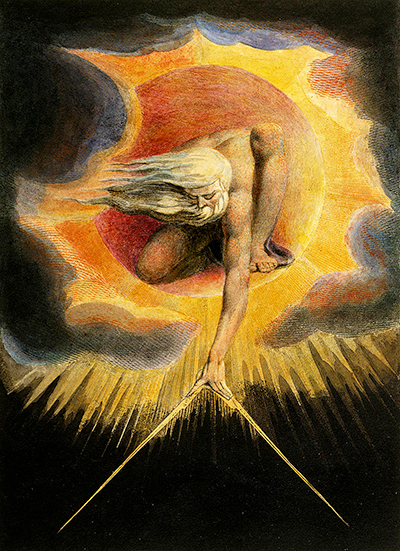
The longer poems can initially feel remote from the songs because their figures bear unfamiliar names and their events unfold across enormous spaces. A useful first step is to follow an action before trying to assign every character a permanent definition. In The First Book of Urizen, Urizen divides, measures, withdraws and writes laws in a metal book. Those verbs establish a situation that can be followed even before every part of its world is understood. [3]
His stated desire is for “a joy without pain” and “a solid without fluctuation”. The wish is comprehensible, but its demand for a single command, weight, measure, king, God and law turns stability into compulsion. Later, he discovers that his children cannot keep his laws. His sorrow spreads into a web called the Net of Religion, and the inhabitants’ perceptions narrow until their confinement appears ordinary. The poem gives the making of a restrictive world a history of acts and consequences. [3]
The family relations complicate an easy division between villain and liberator. Los and Enitharmon chain their child Orc to a mountain, with jealousy taking the form of the chain. Powers capable of making and sustaining life can also bind it. Attending to these changing relations is more useful than assuming that one name always guarantees freedom and another always supplies the same kind of evil. The poems make their powers act under particular conditions. [3]
Europe a Prophecy provides a bridge back to the shorter lyrics. Among its immense figures and periods of time, London’s houses acquire prohibitions over their doors and fear over their chimneys. The imagery recalls the closed chapel in The Garden of Love and the constraints heard by the walker in London. The expanded scale gives familiar injuries a visionary history, while the recognisable streets and buildings keep that history connected to human experience. [1][4]
The ending offers little comfort to a reader expecting a simple victory of liberation. Orc’s fire appears in France amid blood, predatory animals, anguish and the call to strife. Energy can break an enclosure while also producing terror. Earlier speeches must likewise be heard as speeches: Enitharmon’s commands about women, sin and forbidden joy belong to a dramatic voice whose dominion the poem exposes. The power of prophecy here comes from a transformed presentation of history and perception, with consequences that remain troubling. [4]
Milton and Jerusalem: poetry’s expanding task
The preface to Milton addresses the makers of a new age, calling on painters, sculptors and architects to defend imagination. Its lyric beginning “And did those feet in ancient time” moves from questions about a divine presence in England towards a vow to build Jerusalem through mental struggle. The questions should retain their force: the poem asks whether such a presence was there before declaring the speaker’s commitment to future work. [10]
The sixteen-line lyric belongs to Milton, whose title page names Blake as author and printer and bears the date 1804. It is distinct from the long poem Jerusalem: The Emanation of the Giant Albion. Keeping those works apart helps a reader move beyond a familiar opening without mistaking it for the whole of either book. The surrounding prose also places the lyric’s martial images within an appeal for imaginative and artistic exertion. [10][11]
Within Milton, the poet John Milton becomes a character who resolves to descend and confront his own selfhood. In plates 14–15, the journey passes through death, shadow and differing perceptions of the same being. What looks like repose from one position appears as wandering from another. The passage asks readers to hold several perspectives together, extending the discipline of listening to different voices that begins in the songs. [10]
Blake gives useful advice about poetic form in Jerusalem’s address to the public. He describes abandoning a uniform cadence in favour of varied rhythms and syllable counts fitted to different kinds of passage. Terrific, gentle and prosaic writing all have their places. The long lines therefore ask for flexible listening: their intensity changes with the action and the voice, and a rigid expectation of one recurring beat can obscure that movement. [11]
The opening of the main poem establishes sleep, death and awakening as its theme. A divine voice offers mutual love and friendship, while Albion answers through jealousy, possession and the desire to keep his mountains for himself. The scale is geographical, bodily and spiritual at once. A reader can begin with that exchange—an invitation to relation answered by an assertion of ownership—and then follow the conflict as its world expands. [12]
Finding a way through Blake
For a first sustained reading, the shorter poems offer manageable encounters with the habits that continue through the longer works. Read the two Chimney Sweeper poems together, then the two nurse poems. Let The Lamb and The Tyger retain their different ways of questioning. Follow A Poison Tree to its ending before deciding how to judge its speaker, and read Auguries of Innocence beyond its opening promise. These sequences reveal how much Blake can change a reader’s position within a small space. [1][8]
From there, The Marriage of Heaven and Hell offers a lively introduction to changing voices, satire and argument. Urizen supplies a relatively compact visionary narrative; Europe connects mythic action to recognisable scenes of restriction and conflict. In the longer poems, begin with a complete speech or encounter and let the relations emerge through reading. The unfamiliar names become easier to remember when attached to something a figure does. [2][3][4][10][12]
Blake’s poems continually return attention to living particulars: a child’s reply, an animal’s cry, a hand at work, a person turning towards or away from another. Their great imaginative spaces grow from the pressure of such encounters. Read with patience for the speaker, the rhythm and the consequences of the action, they offer both the immediate pleasure of memorable language and the deeper pleasure of discovering how much that language can ask us to see. [1][2][8][12]
Works and designs directory
Browse separate works, impressions and book components. Dates distinguish versions; six Tate copies after Blake are labelled. These records are not a complete catalogue of unique designs.
| Name | Date | Medium |
|---|---|---|
| A Figure Standing in a Gothic Apse, perhaps the Empress Maud. Verso: Detailed Drawings for ‘The Empress Maud in Bed’ | c.1819 | Pencil drawing |
| A Rolling Stone Is Ever Bare of Moss, from Thornton's "Pastorals of Virgil" | 1821 | Wood engraving |
| A Title Page for The Grave | 1806 | Watercolour |
| A Vision of the Last Judgment | 1808 | Watercolour |
| A Vision: The Inspiration of the Poet (Elisha in the Chamber on the Wall) | c.1819–20? | Watercolour |
| Adam and the Beasts, Frontispiece to Hayley's "Ballads" | June 1, 1802 | Engraving |
| Age Teaching Youth | c.1785–90 | Watercolour |
| Alfred and the Neat-Herd’s Wife (after Henry Fuseli) | 1797, published 1798 | Etching and engraving |
| An Allegory of the Bible. Verso: The Shins of an Écorché Male Figure | c.1780–5, ?c.1780 | Watercolour |
| Angel of the Divine Presence Bringing Eve to Adam (The Creation of Eve: "And She Shall be Called Woman) (recto); Sketch for the same (verso) | ca. 1803 | Watercolour |
| Angel of the Revelation (Book of Revelation, chapter 10) | ca. 1803–5 | Watercolour |
| Antaeus setting down Dante and Virgil in the Last Circle of Hell | 1824–1827 | Watercolour |
| Bathsheba at the Bath | c.1799–1800 | Tempera |
| Beatrice Addressing Dante from the Car | 1824–7 | Watercolour |
| Behemoth and Leviathan | 1825–26 | Engraving |
| Behemoth and Leviathan | 1825, reprinted 1874 | Engraving |
| Behemoth and Leviathan | 1826 | Engraving |
| Blasted Trees and Flattened Crops, from Thornton's "Pastorals of Virgil" | 1821 | Wood engraving |
| Boy Returning Joyfully, with Plough and Oxen, from Thornton's "Pastorals of Virgil" | 1821 | Wood engraving |
| Boy Returning Joyfully, with Plough and Oxen, from Thornton's "Pastorals of Virgil" | 1821 | Wood engraving |
| Catherine Blake. Verso: A Man’s Head and Other Drawings | c.1805 | Pencil drawing |
| Cerberus | 1824–7 | Watercolour |
| Cerberus (second version) | 1824–1827 | Watercolour |
| Chaucer’s Canterbury Pilgrims | 1810, reprinted before 1881 | Engraving |
| Christ Appearing to His Disciples After the Resurrection | c.1795 | Colour print |
| Christ Appearing to the Apostles after the Resurrection | c.1795 | Watercolour |
| Christ Blessing the Little Children | 1799 | Tempera |
| Christ in the Carpenter’s Shop: The Humility of the Saviour (after William Blake) | Date not stated | Watercolour |
| Ciampolo the Barrator Tormented by the Devils | 1826–7, reprinted 1892 | Engraving |
| Ciampolo the Barrator Tormented by the Devils | 1826–7, reprinted 1968 | Engraving |
| Circle of Theives: Agnello Brunelleschi Attacked By a Six-Footed Serpent | ca. 1825–27 | Engraving |
| Clarence's Dream (Shakespeare, Richard III, Act 1, Scene 4) | 1774 | Etching and engraving |
| Colinet Mocked by Two Boys, from Thornton's "Pastorals of Virgil" | 1821 | Wood engraving |
| Colinet Rests by a Stream at Night | c.1821, printed 1830 | Wood engraving |
| Colinet Rests by a Stream at Night | 1821, reprinted 1977 | Wood engraving |
| Colinet with his Shepherd’s Pipe, Mocked by Two Boys | c.1821, printed 1830 | Wood engraving |
| Colinet with his Shepherd’s Pipe, Mocked by Two Boys | 1821, reprinted 1977 | Wood engraving |
| Colinet's Journey, Milestone Marked 'LXII Miles to London', from Thornton's "Pastorals of Virgil" | 1821 | Wood engraving |
| Colinet's Journey: Milestone Marked 'LXII Miles to London', from Thornton's "Pastorals of Virgil" | 1821 | Wood engraving |
| Colinet’s Fond Desire Strange Lands to Know | 1821, reprinted 1977 | Wood engraving |
| Colinet’s ‘Fond Desire Strange Lands to Know’ | c.1821, printed 1830 | Wood engraving |
| Composition Sketch for ‘The Fall of the Rebel Angels’? Verso: Standing Figure with Flaming Hair | ?c.1805–10 | Pencil drawing |
| Composition Sketch, Possibly a Subject from Dante. Verso: A Man Standing over a Figure Reclining on a Bed | ?1824–7, ?c.1800–10 | Pencil drawing |
| Composition Sketch. Verso: Standing Figure Holding a Spear | ?c.1805–10 | Pencil drawing |
| Dante and Virgil Approaching the Angel Who Guards the Entrance of Purgatory | 1824–7 | Watercolour |
| Dante and Virgil Penetrating the Forest | 1824–7 | Watercolour |
| Dante in the Empyrean, Drinking at the River of Light | 1824–7 | Watercolour |
| Dante running from the Three Beasts | 1824–1827 | Watercolour |
| Dante Striking against Bocca Degli Abati | 1826–7, reprinted 1892 | Engraving |
| Dante Striking Against Bocca degli Abati | 1826–7, reprinted 1968 | Engraving |
| David Delivered out of Many Waters | c.1805 | Watercolour |
| David Delivered out of Many Waters (after William Blake) | Date not stated | Watercolour |
| Detailed Drawings for ‘A Figure Standing in a Gothic Apse’ | 1819 | Pencil drawing |
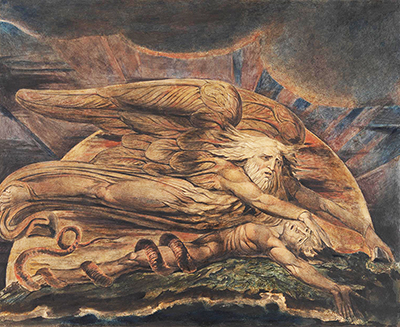
| Elohim Creating Adam | 1795–c.1805 | Colour print |
| Enoch | 1806–7 | Lithograph |
| Epitome of James Hervey’s ‘Meditations among the Tombs’ | c.1820–5 | Watercolour |
| Europe. A Prophecy; Frontispiece | ca. 1820 | Relief etching |
| Evening | c.1820/1825 | Watercolour |
| Every Man also Gave him a Piece of Money | 1825, reprinted 1874 | Engraving |
| Every Man also Gave him a Piece of Money. Verso: God the Father with Attendant Angels | c.1821–3 | Watercolour |
| Every One also Gave Him a Piece of Money | 1826 | Engraving |
| Fertilization of Egypt, from Erasmus Darwin's "The Botanic Garden" | 1791 | Engraving |
| First Book of Urizen pl. 10 | 1796, c.1818 | Etching |
| First Book of Urizen pl. 11 | 1796, c.1818 | Etching |
| First Book of Urizen pl. 15 | 1796, c.1818 | Etching |
| First Book of Urizen pl. 17 | 1796, c.1818 | Etching |
| First Book of Urizen pl. 21 | 1796, c.1818 | Etching |
| First Book of Urizen pl. 6 | 1796, c.1818 | Etching |
| Frontispiece to Jerusalem, the Emanation of the Great Albion | [ca. 1804–20] (?) | Engraving |
| Frontispiece to ‘Visions of the Daughters of Albion’ | c.1795 | Relief etching |
| Frontispiece: Thenot and Colinet | c.1821, printed 1830 | Wood engraving |
| George Cumberland's Message Card | 1827 | Engraving |
| God Judging Adam | ca. 1795 | Relief etching |
| God Judging Adam | 1795 | Relief etching |
| Hiding of Moses, from "Remember Me!, or a Pocket Companion" | 1825 | Engraving |
| Homer and the Ancient Poets | 1824–7 | Watercolour |
| Illustration 1 to Milton’s On the Morning of Christ’s Nativity: The Descent of Peace | c.1814–1816 | Watercolour |
| Illustration 1 to Milton’s Paradise Lost: Satan Calling Up His Legions | 1807 | Watercolour |
| Job accepting Charity | 1825–26 | Engraving |
| Job and his Daughters | 1825–26 | Engraving |
| Job and his Daughters | 1825, reprinted 1874 | Engraving |
| Job and His Daughters | 1826 | Engraving |
| Job and His Family | 1825–26 | Engraving |
| Job and his Family | Reprinted 1874; engraved 1828 date is an error | Engraving |
| Job and His Family | 1826 | Engraving |
| Job and his Family Restored to Prosperity | 1825, reprinted 1874 | Engraving |
| Job and his Wife restored to Prosperity | 1825–26 | Engraving |
| Job rebuked by his Friends | 1825–26 | Engraving |
| Job Rebuked by his Friends | 1825, reprinted 1874 | Engraving |
| Job Rebuked by His Friends | 1826 | Engraving |
| Job's Comforters | 1825–26 | Engraving |
| Job's Comforters | 1826 | Engraving |
| Job's Despair | 1825–26 | Engraving |
| Job's Evil Dreams | 1825–26 | Engraving |
| Job's Evil Dreams | 1826 | Engraving |
| Job's Sacrifice | 1825–26 | Engraving |
| Job's Sons and Daughters Overwhelmed by Satan | 1826 | Engraving |
| Job, his Wife and his Friends: The Complaint of Job. Verso: Job’s Wife and Eight Other Sketches | c.1785 | Watercolour |
| Job’s Comforters | 1825, reprinted 1874 | Engraving |
| Job’s Despair | 1825, reprinted 1874 | Engraving |
| Job’s Evil Dreams | 1825, reprinted 1874 | Engraving |
| Job’s Sacrifice | 1825, reprinted 1874 | Engraving |
| Job’s Sons and Daughters Overwhelmed by Satan | 1825, reprinted 1874 | Engraving |
| John Linnell | 1825 | Pencil drawing |
| Joseph of Arimathea Preaching to the Britons | c.1794/1796 | Relief etching |
| Judas Betrays Him | c.1803–5 | Watercolour |
| King John Absolved by Pandulph (after Henry Fuseli) | 1797, published 1798 | Etching and engraving |
| Lamech and his Two Wives | 1795 | Colour print |
| Landscape near Felpham | c.1800 | Watercolour |
| Lear and Cordelia in Prison | c.1779 | Watercolour |
| Los and Orc | c.1792–3 | Watercolour |
| Lower Half of a Woman Playing a Harp. Verso: Seraphim and Other Drawings | c.1785, c.?1807 | Pencil drawing |
| Menalcus Watching Women Dance, from Thornton's "Pastorals of Virgil" | 1821 | Wood engraving |
| Menalcus Watching Women Dance, from Thornton's "Pastorals of Virgil" | 1821 | Wood engraving |
| Moses Indignant at the Golden Calf | c.1799–1800 | Tempera |
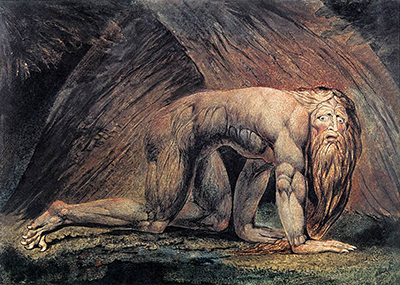
| Nebuchadnezzar | 1795–c.1805 | Colour print |
| Newton | 1795–c.1805 | Colour print |
| Oberon, Titania and Puck with Fairies Dancing | c.1786 | Watercolour |
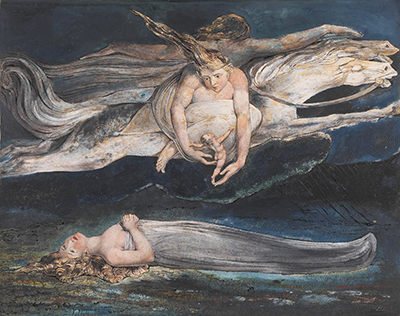
| Pity | ca. 1795 | Relief etching |
| Pity | c.1795 | Colour print |
| Plate 2 of ‘Urizen’: ‘Teach these Souls to Fly’ | ?1796 | Relief etching |
| Plate 3 of ‘Urizen’: Oh! Flames of Furious Desires’ (after William Blake) | Date not stated | Watercolour |
| Plate 4 of ‘Visions of the Daughters of Albion’ | c.1795 | Relief etching |
| Plutus | 1824–7 | Watercolour |
| Preliminary Sketch for ‘Christ Girding Himself with Strength’. Verso: Standing Figure with One Arm Raised | c.1805, c.1805–10 | Pencil drawing |
| Preludium. "The shadowy daughter of Urthona stood before red Orc..." (Plate 3) | 1793 | Relief etching |
| Queen Elizabeth and Essex (after Henry Fuseli) | 1797, published 1798 | Engraving |
| Sabrina's Silvery Flood, from Thornton's "Pastorals of Virgil" | 1821 | Wood engraving |
| Sabrina's Silvery Flood, from Thornton's "Pastorals of Virgil" | 1821 | Wood engraving |
| Sabrina’s Silvery Flood | c.1821, printed 1830 | Wood engraving |
| Sabrina’s Silvery Flood | 1821, reprinted 1977 | Wood engraving |
| Satan Before the Throne of God | 1825–26 | Engraving |
| Satan before the Throne of God | 1825, reprinted 1874 | Engraving |
| Satan before the Throne of God | 1826 | Engraving |
| Satan calling up his Legions | c.1800–05 | Tempera |
| Satan Exulting over Eve | c.1795 | Colour print |
| Satan Going Forth from the Presence of the Lord, and Job’s Charity | 1825, reprinted 1874 | Engraving |
| Satan Going Forth fron the Presence of the Lord | 1825–26 | Engraving |
| Satan in his Original Glory: ‘Thou wast Perfect till Iniquity was Found in Thee’ | c.1805 | Watercolour |
| Satan Smiting Job with Boils | 1825–26 | Engraving |
| Satan Smiting Job with Sore Boils | 1825, reprinted 1874 | Engraving |
| Satan Smiting Job with Sore Boils | c.1826 | Tempera |
| Satan Smiting Job with Sore Boils | 1826 | Engraving |
| Shepherd Chases Away a Wolf, from Thornton's "Pastorals of Virgil" | 1821 | Wood engraving |
| Shepherd Chases Away a Wolf, from Thornton's "Pastorals of Virgil" | 1821 | Wood engraving |
| Sketch for the Title-Page of the Engraved Illustrations to the Book of Job | c.1823/1826 | Pencil drawing |
| Sketch for ‘The Four and Twenty Elders Casting their Crowns before the Divine Throne’. Verso: Standing Figure with Arms at his Side | c.1803, c.1805–10 | Pencil drawing |
| Sketch for ‘Tiriel Supporting the Dying Myratana’. Verso: Sketch for ‘Tiriel Supporting the Dying Myratana’ | c.1786–9 | Pencil drawing |
| Songs of Experience: A Little Boy Lost | [1794] printed ca. 1825 | Relief etching |
| Songs of Experience: A Little Girl Lost | [1794] printed ca. 1825 | Relief etching |
| Songs of Experience: A Poison Tree | [1794] printed ca. 1825 | Relief etching |
| Songs of Experience: Earth's Answer | [1794] printed ca. 1825 | Relief etching |
| Songs of Experience: Frontispiece | [1794] printed ca. 1825 | Relief etching |
| Songs of Experience: Holy Thursday | [1794] printed ca. 1825 | Relief etching |
| Songs of Experience: Infant Sorrow | [1794] printed ca. 1825 | Relief etching |
| Songs of Experience: Introduction | [1794] printed ca. 1825 | Relief etching |
| Songs of Experience: London | [1794] printed ca. 1825 | Relief etching |
| Songs of Experience: My Pretty Rose Tree, Ah! Sun-Flower, The Lilly | [1794] printed ca. 1825 | Relief etching |
| Songs of Experience: Nurses Song | [1794] printed ca. 1825 | Relief etching |
| Songs of Experience: The Angel | [1794] printed ca. 1825 | Relief etching |
| Songs of Experience: The Chimney Sweeper | [1794] printed ca. 1825 | Relief etching |
| Songs of Experience: The Clod & the Pebble | [1794] printed ca. 1825 | Relief etching |
| Songs of Experience: The Fly | [1794] printed ca. 1825 | Relief etching |
| Songs of Experience: The Garden of Love | [1794] printed ca. 1825 | Relief etching |
| Songs of Experience: The Human Abstract | [1794] printed ca. 1825 | Relief etching |
| Songs of Experience: The Little Girl Found (second plate) | [1789] printed ca. 1825 | Relief etching |
| Songs of Experience: The Little Girl Lost | [1789] printed ca. 1825 | Relief etching |
| Songs of Experience: The Little Girl Lost (second plate); The Little Girl Found | [1789] printed ca. 1825 | Relief etching |
| Songs of Experience: The Little Vagabond | [1794] printed ca. 1825 | Relief etching |
| Songs of Experience: The School Boy | [1789] printed ca. 1825 | Relief etching |
| Songs of Experience: The Sick Rose | [1794] printed ca. 1825 | Relief etching |
| Songs of Experience: The Tyger | [1794] printed ca. 1825 | Relief etching |
| Songs of Experience: The Voice of the Ancient Bard | [1789] printed ca. 1825 | Relief etching |
| Songs of Experience: Title-page | [1794] printed ca. 1825 | Relief etching |
| Songs of Experience: To Tirzah | [1794] printed ca. 1825 | Relief etching |
| Songs of Innocence and of Experience, Shewing the Two Contrary States of the Human Soul: Combined Title-page | [1789–94] printed ca. 1825 | Relief etching |
| Songs of Innocence and of Experience: Infant Sorrow | 1794, reprinted 1831 or later | Relief etching |
| Songs of Innocence: A Cradle Song | [1789] printed ca. 1825 | Relief etching |
| Songs of Innocence: A Cradle Song (second plate) | [1789] printed ca. 1825 | Relief etching |
| Songs of Innocence: A Dream | [1794] printed ca. 1825 | Relief etching |
| Songs of Innocence: Frontispiece | [1789] printed ca. 1825 | Relief etching |
| Songs of Innocence: Holy Thursday | [1789] printed ca. 1825 | Relief etching |
| Songs of Innocence: Infant Joy | [1789] printed ca. 1825 | Relief etching |
| Songs of Innocence: Introduction | [1789] printed ca. 1825 | Relief etching |
| Songs of Innocence: Laughing Song | [1789] printed ca. 1825 | Relief etching |
| Songs of Innocence: Little Boy Lost | [1789] printed ca. 1825 | Relief etching |
| Songs of Innocence: Night | [1789] printed ca. 1825 | Relief etching |
| Songs of Innocence: Night (second plate) | [1789] printed ca. 1825 | Relief etching |
| Songs of Innocence: Nurse's Song | [1789] printed ca. 1825 | Relief etching |
| Songs of Innocence: On Anothers Sorrow | [1789] printed ca. 1825 | Relief etching |
| Songs of Innocence: Spring | [1789] printed ca. 1825 | Relief etching |
| Songs of Innocence: Spring (second plate) | [1789] printed ca. 1825 | Relief etching |
| Songs of Innocence: The Blossom | [1789] printed ca. 1825 | Relief etching |
| Songs of Innocence: The Chimney Sweeper | [1789] printed ca. 1825 | Relief etching |
| Songs of Innocence: The Divine Image | [1789] printed ca. 1825 | Relief etching |
| Songs of Innocence: The Ecchoing Green | [1789] printed ca. 1825 | Relief etching |
| Songs of Innocence: The Ecchoing Green (second plate) | [1789] printed ca. 1825 | Relief etching |
| Songs of Innocence: The Lamb | [1789] printed ca. 1825 | Relief etching |
| Songs of Innocence: The Little Black Boy | [1789] printed ca. 1825 | Relief etching |
| Songs of Innocence: The Little Black Boy (second plate) | [1789] printed ca. 1825 | Relief etching |
| Songs of Innocence: The Little Boy Found | [1789] printed ca. 1825 | Relief etching |
| Songs of Innocence: The Shepherd | [1789] printed ca. 1825 | Relief etching |
| Songs of Innocence: Title Page | [1789] printed ca. 1825 | Relief etching |
| St Christopher, Copy from an Engraving? Verso:Part of a Face: Copy from a Plaster Cast: a Daughter of Niobe? | ?c.1779–80 | Pencil drawing |
| The Agony in the Garden | c.1799–1800 | Tempera |
| The Angel Appearing to Zacharias | 1799–1800 | Tempera |
| The Ascent of the Mountain of Purgatory | 1824–7 | Watercolour |
| The Baffled Devils Fighting | 1826–7, reprinted 1892 | Engraving |
| The Baffled Devils Fighting | 1826–7, reprinted 1968 | Engraving |
| The Bard, from Gray | ?1809 | Tempera |
| The Beggar's Opera, Act III | July 1, 1790 | Etching and engraving |
| The Beggar's Opera, Act III | July 1, 1790 | Engraving |
| The Beggar's Opera, Act III | 1790 | Engraving |
| The Blasphemer | c.1800 | Watercolour |
| The Blighted Corn | c.1821, printed 1830 | Wood engraving |
| The Blighted Corn | 1821, reprinted 1977 | Wood engraving |
| The Body of Abel Found by Adam and Eve | c.1826 | Tempera |
| The Body of Christ Borne to the Tomb | c.1799–1800 | Tempera |
| The Book of Job: Title Page | 1825 | Engraving |
| The Book of Thel pl. 6 | 1796, c.1818 | Etching |
| The Circle of Corrupt Officials: The Devils Mauling Each Other | ca. 1825–27 | Engraving |
| The Circle of Corrupt Officials: The Devils Tormenting Ciampolo | ca. 1825–27 | Engraving |
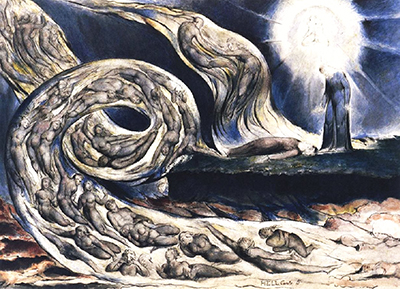
| The Circle of the Lustful: Francesca da Rimini (‘The Whirlwind of Lovers’) | 1826–7, reprinted 1892 | Engraving |
| The Circle of the Lustful: Francesca da Rimini (‘The Whirlwind of Lovers’) | 1826–7, reprinted 1968 | Engraving |
| The Circle of the Lustful: Paolo and Francesca | ca. 1825–27 | Engraving |
| The Circle of the Thieves; Buoso Donati Attacked by the Serpent | ca. 1825–27 | Engraving |
| The Circle of Traitors: Dante's Foot Striking Bocca degli Abbate | ca. 1825–27 | Engraving |
| The Complaint and the Consolation; or, Night Thoughts | 1797 | Etching and engraving |
| The Creation | 1825–26 | Engraving |
| The Crucifixion | c.1825–7 | Pencil drawing |
| The Crucifixion: ‘Behold Thy Mother’ | c.1805 | Watercolour |
| The Dance of Albion (Glad Day) | c.1803/1810 | Engraving |
| The Death of Lucretia, from Allen's "New and Impartial Roman History" | 1797 | Engraving |
| The Death of Saint Joseph | 1803 | Watercolour |
| The Death of the Virgin | 1803 | Watercolour |
| The Descent of Peace [recto] | c.1815 | Pencil drawing |
| The Destruction of Job's Sons | 1825–26 | Engraving |
| The Devils, with Dante and Virgil by the Side of the Pool | 1824–7 | Watercolour |
| The Entombment | c.1805 | Watercolour |
| The Fall of Rosamond (after Thomas Stothard) | 1783 | Etching and engraving |
| The Fall of Satan | 1825–26 | Engraving |
| The Fall of Satan | 1825, reprinted 1874 | Engraving |
| The Fall of Satan | 1826 | Engraving |
| The Four and Twenty Elders Casting their Crowns before the Divine Throne | c.1803–5 | Watercolour |
| The Ghost of a Flea | c.1819–20 | Tempera |
| The Good and Evil Angels | 1795–?c.1805 | Colour print |
| The Good Farmer, Probably the Parable of the Wheat and the Tares. Verso: Rough Sketch of Two or Three Figures in a Landscape | c.1780–5 | Watercolour |
| The Great Red Dragon and the Beast from the Sea | c.1805 | Watercolour |
| The Great Red Dragon and the Woman Clothed with the Sun | c.1805 | Watercolour |
| The Head of the Ghost of a Flea. Verso: A Profile and a Reduced Drawing of Milton’s First Wife | c.1819 | Pencil drawing |
| The Hermit’s Dog, from William Hayley’s "Ballads" | 1805 | Etching and engraving |
| The Hiding of Moses | 1824 | Engraving |
| The House of Death | 1795–c.1805 | Colour print |
| The House of Death | c.1790 | Watercolour |
| The Hypocrites with Caiaphas. Verso: Sketch of a Stooping Figure | 1824–7 | Watercolour |
| The Inscription over the Gate | 1824–7 | Watercolour |
| The Laborious Passage along the Rocks | 1824–7 | Watercolour |
| The Last Trumpet (recto); Two studies of a right eye, a profile of an open-mouthed young man, the head of an eagle, and the head of a lion (verso) | 1780–85 | Pencil drawing |
| The Lord Answering Job out of the Whirlwind | 1825–26 | Engraving |
| The Lord Answering Job out of the Whirlwind | 1825, reprinted 1874 | Engraving |
| The Man Who Taught Blake Painting in his Dreams (counterproof) (after William Blake) | after c.1819–20 | Pencil drawing |
| The Marriage of Heaven and Hell pl. 16 | 1796, c.1818 | Etching |
| The Messengers tell Job of his Misfortunes | 1825–26 | Engraving |
| The Messengers tell Job of his Misfortunes | 1825, reprinted 1874 | Engraving |
| The Night of Enitharmon’s Joy (formerly called ‘Hecate’) | c.1795 | Colour print |
| The Parable of the Wise and Foolish Virgins | ca. 1799–1800 | Watercolour |
| The Parable of the Wise and Foolish Virgins (after William Blake) | Date not stated | Watercolour |
| The Pastorals of Virgil, with a Course of English Reading, Adapted for Schools, Vol. I | 1821 | Wood engraving |
| The Penance of Jane Shore in St Paul’s Church | c.1793 | Watercolour |
| The Pit of Disease: The Falsifiers | 1826–7, reprinted 1892 | Engraving |
| The Pit of Disease: The Falsifiers | 1824–7 | Watercolour |
| The Pit of Disease: The Falsifiers | 1826–7, reprinted 1968 | Engraving |
| The Primaeval Giants Sunk in the Soil | 1824–7 | Watercolour |
| The Punishment of the Thieves | 1824–7 | Watercolour |
| The Raising of Lazarus (after William Blake) | Date not stated | Watercolour |
| The Rest on the Flight into Egypt (The Repose of the Holy Family in Egypt) | 1806 | Watercolour |
| The River of Life | c.1805 | Watercolour |
| The Rock Sculptured with the Recovery of the Ark and the Annunciation | 1824–7 | Watercolour |
| The Serpent Attacking Buoso Donati | 1826–7, reprinted 1892 | Engraving |
| The Serpent Attacking Buoso Donati | 1826–7, reprinted 1968 | Engraving |
| The Serpent Attacking Buoso Donati. Verso: A Man with a Transparent Hood (?) over his Head | 1824–7 | Watercolour |
| The Simoniac Pope | 1824–7 | Watercolour |
| The Six-Footed Serpent Attacking Agnolo Brunelleschi | 1826–7, reprinted 1892 | Engraving |
| The Six-Footed Serpent Attacking Agnolo Brunelleschi | 1826–7, reprinted 1968 | Engraving |
| The Soul Hovering over the Body Reluctantly Parting with Life | c.1805 | Pencil drawing |
| The Spiritual Form of Nelson Guiding Leviathan | c.1805–9 | Tempera |
| The Spiritual Form of Pitt Guiding Behemoth | ?1805 | Tempera |
| The Sun at His Eastern Gate | c.1816–1820 | Watercolour |
| The Temple of Mirth, after Thomas Stothard | 1784 | Engraving |
| The Temptation and Fall of Eve | 1807 | Watercolour |
| The Temptation and Fall of Eve (Illustration to Milton’s Paradise Lost) | 1808 | Watercolour |
| The Thieves and Serpents | 1824–1827 | Watercolour |
| The Vision of Christ | 1825, reprinted 1874 | Engraving |
| The Vision of Eliphaz | 1825–26 | Engraving |
| The Vision of Eliphaz | 1825, reprinted 1874 | Engraving |
| The Vision of God | 1825–26 | Engraving |
| The Wood of the Self-Murderers: The Harpies and the Suicides | 1824–7 | Watercolour |
| The Wrath of Elihu | 1825–26 | Engraving |
| The Wrath of Elihu | 1825, reprinted 1874 | Engraving |
| Thenot and Colinet | 1821, reprinted 1977 | Wood engraving |
| Thenot and Colinet at Supper | c.1821, printed 1830 | Wood engraving |
| Thenot and Colinet at Supper | 1821, reprinted 1977 | Wood engraving |
| Thenot and Colinet Converse Seated between Two Trees | c.1821, printed 1830 | Wood engraving |
| Thenot and Colinet Converse Seated between Two Trees | 1821, reprinted 1977 | Wood engraving |
| Thenot and Colinet Eat Their Evening Meal, from Thornton's "Pastorals of Virgil" | 1821 | Wood engraving |
| Thenot and Colinet Folding their Flocks together at Sunset | c.1821, printed 1830 | Wood engraving |
| Thenot and Colinet Folding their Flocks together at Sunset | 1821, reprinted 1977 | Wood engraving |
| Thenot and Colinet Lead Their Flocks Together, from Thornton's "Pastorals of Virgil" | 1821 | Wood engraving |
| Thenot and Colinet Lead Their Flocks Together, from Thornton's "Pastorals of Virgil" | 1821 | Wood engraving |
| Thenot Remonstrates with Colinet | c.1821, printed 1830 | Wood engraving |
| Thenot Remonstrates with Colinet | 1821, reprinted 1977 | Wood engraving |
| Thenot Remonstrates With Colinet, from Thornton's "Pastorals of Virgil" | 1821 | Wood engraving |
| Thenot Remonstrates With Colinet, from Thornton's "Pastorals of Virgil" | 1821 | Wood engraving |
| Thenot Remonstrates with Colinet, Lightfoot in the Background, from Thornton's "Pastorals of Virgil" | 1821 | Wood engraving |
| Thenot Remonstrates with Colinet: Lightfoot in the Distance | 1821, reprinted 1977 | Wood engraving |
| Thenot Remonstrates with Colinet; Lightfoot in the Distance | c.1821, printed 1830 | Wood engraving |
| Thenot Under a Fruit Tree, from Thornton's "Pastorals of Virgil" | 1821 | Wood engraving |
| Thenot, with Colinet Waving his Arms in Sorrow | c.1821, printed 1830 | Wood engraving |
| Thenot, with Colinet Waving his Arms in Sorrow | 1821, reprinted 1977 | Wood engraving |
| Title Page: Illustrations of the Book of Job | 1825–26 | Engraving |
| Title-Page of ‘The Book of Job’ | 1825, reprinted 1874 | Engraving |
| Tornado–Zeus Battling Typhon, from Erasmus Darwin's "Botanic Garden" | August 1, 1795 | Engraving |
| Tornado–Zeus Battling Typhon, from Erasmus Darwin's "The Botanic Garden" | August 1, 1795 | Engraving |
| Two Figures in a Decorative Border | c.1790 | Pencil drawing |
| Unyok'd Heifers, Loitering Homeward (Return of the Shepherd), from Thornton's "Pastorals of Virgil" | 1821 | Wood engraving |
| Virgil Girding Dante’s Brow with a Rush | 1824–7 | Watercolour |
| Wat Tyler and the Tax-Gatherer (after Henry Fuseli) | 1797, published 1798 | Etching and engraving |
| When the Morning Stars Sang Together | 1825, reprinted 1874 | Engraving |
| When the Morning Stars Sang Together | 1826 | Engraving |
| Winged Figure Flying Through Clouds, from Bell's "Poets" | 1790 | Etching and engraving |
| Winter | c.1820–5 | Tempera |
| ‘A Rolling Stone is ever Bare of Moss’ | c.1821, printed 1830 | Wood engraving |
| ‘A Rolling Stone is ever Bare of Moss’ | 1821, reprinted 1977 | Wood engraving |
| ‘And Unyok’d Heifers, Loitering Homeward, Low’ | c.1821, printed 1830 | Wood engraving |
| ‘And Unyok’d Heifers, Loitering Homewards, Low’ | 1821, reprinted 1977 | Wood engraving |
| ‘Europe’: Fragment of Pages 3 and 4 | 1794–c.1830–5 | Relief etching |
| ‘For him Our Yearly Wakes and Feasts We Hold’ | c.1821, printed 1830 | Wood engraving |
| ‘For him Our Yearly Wakes and Feasts We Hold’ | 1821, reprinted 1977 | Wood engraving |
| ‘Nor Fox, nor Wolf, nor Rat among our Sheep’ | c.1821, printed 1830 | Wood engraving |
| ‘Nor Fox, nor Wolf, nor Rat among our Sheep’ | 1821, reprinted 1977 | Wood engraving |
| ‘Songs of Innocence and of Experience’: ‘Infant Sorrow’ | 1794, reprinted 1831 or later | Relief etching |
| ‘Songs of Innocence and of Experience’: ‘Spring’ | 1794, reprinted 1831 or later | Relief etching |
| ‘Songs of Innocence’: Title-Page | 1789, reprinted 1831 or later | Relief etching |
| ‘Songs of Innocence’: Title-Page | 1789, reprinted 1831 or later | Relief etching |
| ‘With Songs the Jovial Hinds Return from Plow’ | c.1821, printed 1830 | Wood engraving |
| ‘With Songs the Jovial Hinds Return from Plow’ | 1821, reprinted 1977 | Wood engraving |
Frequently Asked Questions
The Lamb, The Tyger, London, both Chimney Sweeper poems and A Poison Tree offer short, vivid entrances. Read them in their Songs of Innocence and of Experience context, noticing the speaker and the poem’s final movement. [1]
Blake calls them contrary states of the human soul. They involve different ways of perceiving and responding to life. Innocence includes suffering, while Experience can expose the harm hidden by reassuring explanations. [1]
Discussion
Look again at the images and ideas explored in William Blake Poetry: Songs, Voices and Prophecy. These editorial prompts invite your observations.
Reader Insights
The Songs ask readers to compare ways of perceiving. Suffering already appears within Innocence, while Experience can expose the harm behind reassurance.
London gathers force through sound as well as sight. Cries, sighs and a curse reveal the effects of institutions.
Try following Urizen’s verbs—dividing, measuring and writing—before assigning every figure a permanent meaning.
Join the Conversation
Share a detail, comparison or question about William Blake Poetry: Songs, Voices and Prophecy below.
References
- William Blake. Songs of Innocence and of Experience, David V. Erdman, ed., The Complete Poetry and Prose of William Blake, electronic transcription hosted by Arizona State University, E7–32; title pages and poems cited by title in the text, including both Chimney Sweeper, Holy Thursday and nurse poems; The Lamb, The Tyger, London, The Clod & the Pebble, The Sick Rose, My Pretty Rose Tree, Ah! Sun-flower, The Lilly, The Garden of Love, A Poison Tree, Infant Joy, Infant Sorrow, The Divine Image and The Human Abstract. View source.
- William Blake. The Marriage of Heaven and Hell, plates 1–27, especially 3–4, 6–10 and 17–24; in David V. Erdman, ed., The Complete Poetry and Prose of William Blake, E33–45. View source.
- William Blake. The First Book of Urizen (1794), Preludium, chapters I–III and VII–IX; in David V. Erdman, ed., The Complete Poetry and Prose of William Blake, E70–83 (selected chapters). View source.
- William Blake. Europe a Prophecy (1794), especially plates 5, 9, 12 and 15, including Enitharmon’s commands, restrictions over London’s houses and the ending in France; in David V. Erdman, ed., The Complete Poetry and Prose of William Blake, E60–66. View source.
- William Blake. Poetical Sketches (1783), title page, To Spring, To Summer, To Autumn, To Winter and Song beginning “How sweet I roam’d from field to field”; in David V. Erdman, ed., The Complete Poetry and Prose of William Blake, E408–413. View source.
- Morris Eaves, Robert N. Essick and Joseph Viscomi, editors, William Blake Archive. Publication Announcement: Songs of Innocence and of Experience, Copy E, 1 November 2011. Printing sessions, 1806 assembly and refinishing, duplicate and missing poems, and the later addition distinguished. View source.
- Morris Eaves, Robert N. Essick and Joseph Viscomi, editors, William Blake Archive. The Marriage of Heaven and Hell Copy A, 30 August 2016; dated editorial account of surviving copies, printing histories and copy G’s variant plate order. View source.
- William Blake. Auguries of Innocence, lines 1–132; in David V. Erdman, ed., The Complete Poetry and Prose of William Blake, E490–493. View source.
- Sal Robinson, Morgan Library & Museum. William Blake’s Pickering Manuscript, introduction, 2021; fair-copy form, approximate date, reused paper, uncertain purpose, eight poems published in 1863 and all ten in 1866. View source.
- William Blake. Milton: a Poem in 2 Books, title page, preface and plates 14–15; in David V. Erdman, ed., The Complete Poetry and Prose of William Blake, E95–96 and E108–110. View source.
- William Blake. Jerusalem: The Emanation of the Giant Albion, plate 3, To the Public, especially the discussion of measure; in David V. Erdman, ed., The Complete Poetry and Prose of William Blake, E145–146. View source.
- William Blake. Jerusalem: The Emanation of the Giant Albion, plate 4 and 5:1–28, especially 4:1–35; in David V. Erdman, ed., The Complete Poetry and Prose of William Blake, E146–147. View source.