 by
Tom Gurney
Tom Gurney BSc (Hons) is an art history expert with over 20 years experience
Email:
tomgurney1@gmail.com
/ Phone:
+44 7429 011000
Cesare Alessandro Scaglia, Seated: Introduction
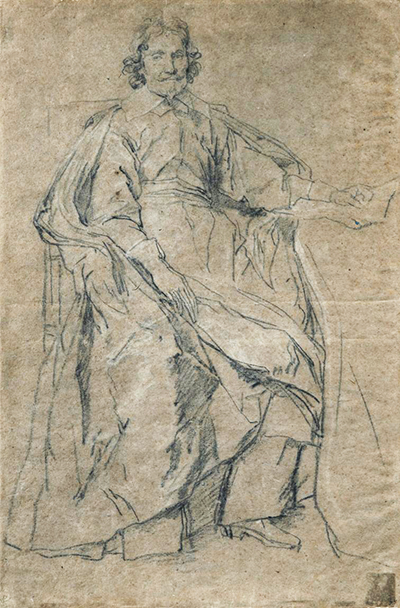
Scaglia sits with his robes spread about him, one hand extended towards a document and the other resting low across his lap. The chair and flowing cloth give his figure an almost enthroned presence. Anthony van Dyck drew this study in black and white chalk on brown paper around 1634. It may preserve an abandoned seated design for the imposing standing portrait now in London's National Gallery. The drawing belongs to the Frits Lugt Collection at the Fondation Custodia in Paris. [1]
At a Glance
- Artist Anthony van Dyck (1599–1641). [1]
- Title Cesare Alessandro Scaglia, Seated . [1]
- Date About 1634. [1]
- Medium Black chalk heightened with white chalk on brown paper. [1]
- Dimensions 48.6 × 32.4 cm. [1]
- Collection Frits Lugt Collection, Fondation Custodia, Paris. [1]
- Sitter Cesare Alessandro Scaglia di Verrua (1592–1641), diplomat, collector and patron. [2]
- Related painting Portrait of the Abbot Scaglia , 1634, National Gallery, London; the seated design may have preceded its standing composition. [1] [2]
This work across Anthony van Dyck’s career
Entry of Christ into Jerusalem
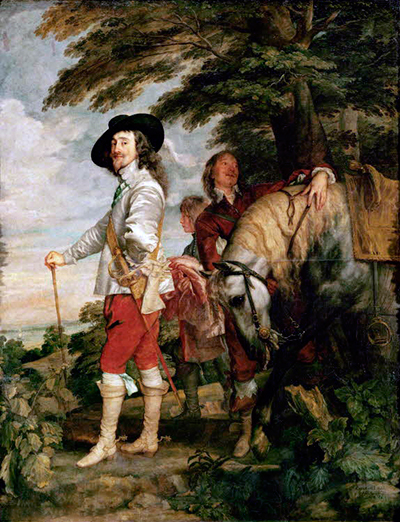
about 1617Frans Snyders
about 1620Rinaldo and Armida
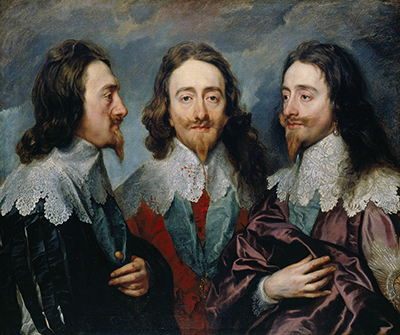
1629–1632; Louvre commentary proposes late1631–spring1632Charles I in Three Positions
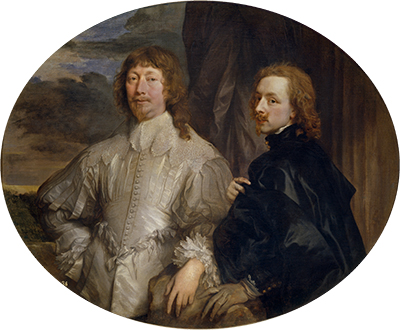
1635–before June 1636Lord John Stuart and his Brother
about 1638Cupid and Psyche
1639–40Self Portrait
c. 1640Contents
- A seated figure with room to move
- How brown paper becomes part of the figure
- The hands and the document
- A possible beginning for the standing portrait
- The patron behind the pose
- A study with its own priorities
A seated figure with room to move
The first thing to notice is how much space Scaglia occupies. His head sits high on the sheet, and his broad silhouette opens out below it. Cloth passes over the shoulders, descends beside the chair and gathers across the knees. Near the bottom, the hems break into uneven points around the shoes. The figure has weight, yet the drawing never becomes a solid, closed shape.
Van Dyck leaves passages of paper visible between the lines. A fold can begin sharply, dissolve into a faint suggestion and reappear farther down the body. We supply the connection. The chair works in the same way: a few long edges establish the support behind and beside the sitter without describing every joint or surface. The result is an arrangement that feels spacious even within a tall, narrow sheet.
There is a small but telling difference between the two sides of the pose. On the viewer's left, the arm descends towards the hand on the lap, linking shoulder, elbow and knee in a long diagonal. On the right, the other arm opens towards the edge. That spreading gesture gives the upper body breadth. The head remains comparatively upright above these unequal movements. Its stability helps hold the looser mass of drapery together.
The drawing rewards looking beyond the face. Its strongest decisions concern how a person sits, how far the limbs reach and how clothing enlarges the body. Those decisions give Scaglia presence before the finer detail of his appearance is considered.
How brown paper becomes part of the figure
The support is a warm brown, described by the Frick as buff paper. Its colour supplies a middle value between the dark chalk and the white heightening, a function also served by blue paper in other Van Dyck portrait sketches. [1] This is particularly useful in a figure whose clothing must convey both volume and movement.
Look at the spaces within the robes. Much of what reads as a lit surface is the paper itself. Black lines establish edges and creases, while darker clusters suggest folds that turn away from the light. White chalk lifts selected passages above the paper's tone. Van Dyck can move towards shadow or towards light from the same starting point, leaving much of the support exposed.
That economy creates several different kinds of mark. Along parts of the outer contour, the chalk is narrow and searching. Elsewhere, particularly beneath the drapery across the knees, it broadens into a dark patch. A contour tells us where fabric ends; a patch makes us feel the depth of a crease. The changing pressure and density keep these two jobs distinct.
The pale touches are restrained. They do not coat the figure in an even layer. Instead, they catch across particular folds, so that light seems to travel over a surface whose continuity is only partly drawn. The warm ground remains active around and within the body. It is worth following a single stretch of untouched paper from the background into the clothing: the same colour can read as empty space in one place and substantial fabric in another, depending on the marks beside it.
In a reproduction, paper colour and white heightening can be difficult to separate. The essential point is the relationship among all three values. Reading every pale area as an added white mark would give the chalk more of the work than it actually does. The paper helps build the figure.
The hands and the document
Scaglia's hands introduce a different rhythm from the long robes. The lower hand lies along a descending passage of cloth. Its slim, closely grouped fingers carry the eye towards the knee. The extended hand occupies a more open area at the right, beside the lightly indicated document identified in the Frick's description. [1]
The contrast is useful to the composition. One hand settles into the body; the other reaches beyond it. Between them lies a broad field of drapery. Their separation makes the seated figure legible, giving the arms distinct purposes without requiring a dramatic action.
The document offers a plausible association with Scaglia's professional life, but its precise contents cannot be identified here. There is no reason to turn it into a particular diplomatic dispatch or agreement. Its visible role is simpler: it gives the outstretched hand something to hold and creates a lighter, flatter shape beside the bulky clothing.
The face is worked at a smaller scale than these broad gestures. Curls frame the sides of the head, and the eyes, nose and mouth are established with short dark touches. The outline of the collar leads down towards the chest, where the marks become longer and more angular. Van Dyck moves between the compact information needed for a face and the sweeping information needed for a clothed body.
The image can suggest composure or authority, especially when the chair is read as a kind of throne. Those are effects of representation. The drawing does not tell us what Scaglia felt during a sitting, or how he and the artist discussed the pose. Its expressive power comes from things we can see: the upright head, the spread of the arms and the generous fall of cloth.
Watch: Van Dyck’s art and working methods
Choose a museum introduction, a specialist lecture or a conservation film to continue exploring Van Dyck’s work.
Stijn Alsteens: Drawing for Portraits
Stijn Alsteens explores how portrait drawings prepare and develop a likeness.
Watch on YouTubeA possible beginning for the standing portrait
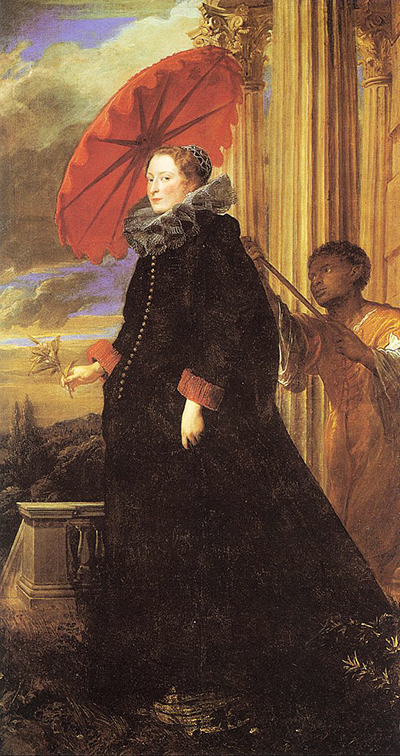
The painting associated with the sheet is Portrait of the Abbot Scaglia , dated 1634. It is an oil on canvas, 200.6 × 123.2 cm, in the National Gallery. There Scaglia stands leaning against a column; a chair remains behind him. [2] The Frick cautiously proposes that the drawing may record a seated design that Van Dyck subsequently abandoned. [1]
Set the two images beside each other and the change becomes substantial. A seated body concentrates weight around the lap and knees. A standing one stretches that weight along the length of the figure. The robes pull downwards almost uninterrupted, and the column gives the upper body another point of support. The National Gallery compares the standing pose and toga-like robes to Roman sculpture. [2] This offers a different image of authority from the seated drawing's almost enthroned figure.
The sheet makes it possible to imagine how differently the portrait might have addressed its viewer. Seated, Scaglia seems established in a place, with the chair anchoring his body and the document extending his reach. Standing, he occupies a more vertical relationship with us. The dark clothing becomes a long, mobile shape whose slight shifts matter greatly.
This comparison also shows why a preparatory drawing need not be a miniature version of a finished painting. A study can hold a convincing arrangement that is later transformed. Its usefulness lies partly in making an option visible. Here, the seated pose has enough coherence to be persuasive on its own, even though it differs from the surviving canvas.
The proposed relationship remains qualified. The drawing does not explain who preferred a standing figure, when the change was made or what prompted it. The surviving chair invites comparison without settling those questions.
The patron behind the pose
Scaglia served the House of Savoy and Philip IV of Spain as a diplomat and moved among European courts. He was also an experienced collector. His will records at least seven paintings by Van Dyck, possibly as many as ten. The two men may first have met in Turin in 1623, although that early meeting is uncertain. [2]
His familiar title, Abbot Scaglia, needs care. According to the National Gallery, he received income from abbeys but never took holy orders. [2] The robes should therefore not lead us to describe the sitter as an ordained priest or cardinal.
This background gives the document and imposing pose a useful context. Scaglia was accustomed to representation, negotiation and the collecting of images. Yet no single feature of the sheet fixes a particular public role. The clothing gives the body breadth, the chair offers support and the paper in the hand suggests purposeful occupation. Together they create an image capacious enough for a patron whose interests crossed diplomatic and artistic circles.
A study with its own priorities
In the opening of Van Dyck: The Anatomy of Portraiture , Stijn Alsteens considers the many choices involved in portraiture beyond recording a likeness: arrangement, execution and the presentation of the sitter all contribute to the result. He also discusses evidence for the practical economy of Van Dyck's drawing, including the contemporary writer Edward Norgate's account of the artist reserving time for painting. [3]
The Scaglia sheet makes those questions tangible. The portrait's scale on the paper is ambitious, but its detail is selective. The substantial robes receive long, forceful marks; portions of the chair remain lightly suggested. The document is enough to establish a gesture. Each area receives the information needed for its part in the whole.
Selective detail does not establish how many minutes the drawing took or whether every passage was made from life. It does help explain the sheet's continued interest. We can follow an image being resolved through unequal degrees of attention: some contours insist, others fade, and broad stretches remain open to change. Further examples in Van Dyck's drawings show how differently that balance could serve a pose, a costume or a likeness.
One related sheet belongs to a separate composition. The British Museum's Two Studies of Cesare Alessandro Scaglia is drawn in black chalk on blue paper and concerns the painting of Scaglia adoring the Virgin and Child. [4] Those devotional portrait studies explore another way of presenting the same patron. The Fondation Custodia sheet remains centred on the seated figure and the possible earlier design for his full-length standing portrait.
Artworks directory
A selected directory of paintings, drawings and prints, including works discussed in the articles and the Frick’s 2016 portraiture exhibition. It is not a complete catalogue of Van Dyck’s work. Print titles identify collaborators or later printmakers; disputed and workshop attributions are retained. The exhibition checklist supplies additional object records; current collection information governs the updated article entries. [5]
Frequently Asked Questions
The drawing belongs to the Frits Lugt Collection at the Fondation Custodia in Paris. It was included in the Frick Collection's 2016 exhibition Van Dyck: The Anatomy of Portraiture . [1]
Van Dyck used black chalk and white heightening on brown paper. The paper provides a middle tone, allowing dark marks and pale highlights to give the figure volume without covering the whole surface. [1]
Discussion
Look again at the images and ideas explored in Cesare Alessandro Scaglia, Seated. These editorial prompts invite your observations.
Reader Insights
Follow the figure from the upright head to the shoes. Where do changes in the direction of the chalk marks make the body feel most solid?
Compare the seated drawing with the standing portrait. How does each pose shape your sense of the sitter's presence?
Find an area where exposed brown paper appears to become clothing. Which nearby marks make that transformation possible?
Join the Conversation
Share a detail, comparison or question about Cesare Alessandro Scaglia, Seated below.
References
- The Frick Collection , Cesare Alessandro Scaglia, Seated , exhibition object entry, Van Dyck: The Anatomy of Portraiture , 2016. English. View source .
- National Gallery , London, Anthony van Dyck: Portrait of the Abbot Scaglia , NG6575, collection entry. English. View source .
- Stijn Alsteens , “A Portraitist's Progress”, opening pp. 1–5, in Stijn Alsteens and Adam Eaker, Van Dyck: The Anatomy of Portraiture , The Frick Collection in association with Yale University Press, 2016. Publisher's excerpt. English. View source .
- The Frick Collection , Second Antwerp Period , including Two Studies of Cesare Alessandro Scaglia , exhibition object descriptions, Van Dyck: The Anatomy of Portraiture , 2016. English. View source .
- The Frick Collection, Van Dyck: The Anatomy of Portraiture, online exhibition checklist (2016). View source.