 by
Tom Gurney
Tom Gurney BSc (Hons) is an art history expert with over 20 years experience
Email:
tomgurney1@gmail.com
/ Phone:
+44 7429 011000
Two Studies of Cesare Alessandro Scaglia: Introduction
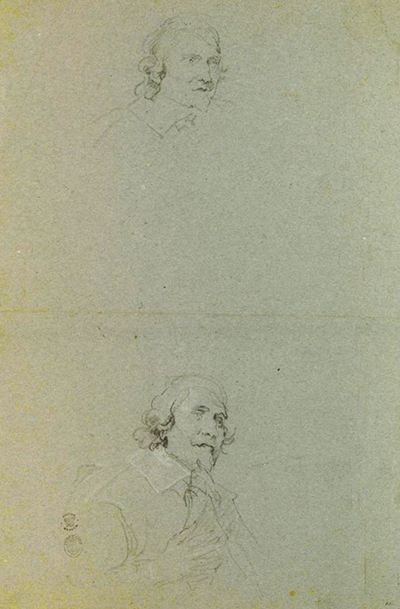
Cesare Alessandro Scaglia appears twice on this sheet by Anthony van Dyck: a lightly indicated head near the top and a larger study extending down to the chest below. The wide interval between them invites a slow comparison of face, neck and gesture. These are preparations for The Abbot Scaglia adoring the Virgin and Child , now in the National Gallery, London. [1]
At a Glance
- Artist Anthony van Dyck
- Date About 1634
- Medium Black chalk, heightened with white, on blue paper
- Dimensions 50.9 × 33.8 cm
- Collection British Museum, London
- Museum number 1845,1208.3, verso
- Other side A standing study of Johann of Nassau-Siegen wearing armour. [2]
This work across Anthony van Dyck’s career
Entry of Christ into Jerusalem
about 1617Frans Snyders
about 1620Rinaldo and Armida
1629–1632; Louvre commentary proposes late1631–spring1632Charles I in Three Positions
1635–before June 1636Lord John Stuart and his Brother
about 1638Cupid and Psyche
1639–40Self Portrait
c. 1640Contents
- Two heads, different emphases
- Chalk and the colour of the sheet
- The hand gives the pose its direction
- From a portrait study to a devotional encounter
- A patron accustomed to pictures
- A different design for the same sitter
- One sheet with two very different subjects
Two heads, different emphases
Start with the upper head. Small loops of hair gather beside the ear, while a few firmer marks pick out the eyes, nose and moustache. The jaw and pointed beard lead down towards a collar that is barely described. With so little surrounding detail, the angle of the face carries much of the drawing's interest. Scaglia looks across the paper towards the right, into a space containing no answering figure.
Below, Van Dyck gives the head more room and connects it to shoulders, collar and a hand laid across the chest. The face again turns towards the right, with the chin appearing slightly more lifted. Around it, the curls and beard make a recognisable pattern shared with the upper study. Yet the effect has changed: the lower figure's attention seems to involve his body as well as his eyes.
Neither head is enclosed by a uniformly firm outline. Features emerge through short strokes and small shaded passages; elsewhere the line dwindles. The shoulder at the left spreads into a broad, loosely bounded shape, giving the lower figure weight without enclosing every fold of his clothing. Looking between the two studies, we can follow Van Dyck's different emphases without assuming that their positions on the page establish the order in which he drew them.
Chalk and the colour of the sheet
The British Museum records white heightening as well as black chalk on this blue paper. [2] A coloured support gives the artist a tone between the dark and light marks. The Frick explains this practical advantage when discussing Van Dyck's separate seated study of Scaglia, made on brown paper: both brown and blue grounds could serve as a middle tone for his chalks. [3] The support therefore contributes to the figure before every part of it has been drawn.
Here, the marks around the lower collar stand out against the extensive areas left untouched. The shirt, shoulder and chest do not need an equally dense network of lines to remain legible. As the drawing spreads away from the face, more of the paper shows through. That uneven distribution of attention helps us distinguish the closely observed features from the broader indications of clothing and pose.
The hand gives the pose its direction
The lower study becomes especially engaging where the hand crosses the chest. Long, slanting finger marks gather beneath the collar. Their direction draws the eye inward, while the turned head directs it out towards the right. Those two movements give the lightly drawn body a sense of purpose.
The hand is less fully resolved than the face. Its fingers can be followed, but the surrounding sleeve and torso remain open and tentative. A passage can be clear enough to establish an action while leaving its final contour unsettled. Van Dyck connects face and gesture with comparatively little description of the intervening body.
Seen alone, a hand against the breast might suggest several kinds of address or acknowledgement. The Frick Collection's identification of the sheet as preparation for Scaglia's devotional painting supplies the more specific context. [1] It allows us to consider the gesture as part of an act of devotion, while the drawing itself preserves the practical problem of how an individual head and hand will work together.
Watch: Van Dyck’s art and working methods
Choose a museum introduction, a specialist lecture or a conservation film to continue exploring Van Dyck’s work.
Stijn Alsteens: Drawing for Portraits
Stijn Alsteens explores how portrait drawings prepare and develop a likeness.
Watch on YouTubeFrom a portrait study to a devotional encounter
The National Gallery dates The Abbot Scaglia adoring the Virgin and Child to 1634–35. Its account describes Scaglia kneeling before the Virgin and receiving the infant Christ's blessing. The painting was commissioned for the Recollect church in Antwerp by a patron who had served the House of Savoy as a diplomat. [4]
The Gallery also observes that Scaglia looks towards the Virgin, and that the hands of the three figures gather near the centre of the composition. [4] That description helps explain the value of this sheet's concentrated attention to a turning head and a hand. Here the surrounding figures are absent, allowing us to study the separate elements of Scaglia's participation.
According to the Gallery, the larger composition drew on a lost painting by Titian that Van Dyck had sketched in Italy. [4] The studies bring that inherited arrangement down to the particularities of a sitter: curls beside an ear, a sharply marked nose, a pointed beard and fingers crossing cloth. The devotional subject required a recognisable person whose attention could be directed towards someone beyond the limits of this drawing.
A patron accustomed to pictures
Scaglia brought considerable experience of art to his dealings with Van Dyck. The historian Toby Osborne describes his work acquiring pictures, sculpture and other objects for the House of Savoy, and finds evidence of independent judgement in his correspondence. Scaglia's collecting and his diplomatic service belonged to the same courtly world. [5] This was a sitter familiar with choosing artists and assessing their work, as well as with being represented by them.
His association with Van Dyck produced a substantial group of commissions during the 1630s. The National Gallery notes that his will records at least seven paintings by the artist, perhaps as many as ten, embracing portraits, religious subjects and a mythological scene. [6] The two studies thus belong within a continuing patronage relationship that crossed different kinds of painting. The same face could carry the public authority of a formal portrait or become the attentive participant in a sacred encounter.
The title “Abbot” also needs care. Although Scaglia drew income from abbeys, the National Gallery states that he never took holy orders. [6] The devotional subject presents a diplomat and collector in prayer. His carefully studied features keep that personal identity present within the religious scene.
A different design for the same sitter
The separate seated drawing in the Fondation Custodia, Paris, makes a useful comparison. The Frick connects it with Van Dyck's large formal portrait of Scaglia and suggests that its seated design may have been abandoned. It shows the sitter holding a document; in the finished portrait he instead leans against a pillar. [3] That drawing explores the disposition of an imposing public figure, while the present studies concentrate on a face and gesture destined for the Virgin and Child.
These were distinct commissions, each requiring its own arrangement of the sitter. A document supplies a visible object for a hand to hold. On the British Museum sheet, the fingers rest against clothing and the head turns towards an absent partner. Even before the surrounding sacred figures have been introduced, the pose makes the relationship beyond the sitter an essential part of the image.
One sheet with two very different subjects
These two studies occupy the verso, or reverse, of a sheet whose recto carries Johann of Nassau-Siegen standing in armour . They share one physical support and the British Museum number 1845,1208.3. [2] Turning the paper therefore takes us from Scaglia's paired studies to a different sitter and a full standing pose.
That relationship is useful when navigating Van Dyck's drawings : two titles can describe the two faces of one object. The separately surviving Cesare Alessandro Scaglia, Seated offers another approach to the same sitter. On the present sheet, the repeated head and the isolated gesture keep attention close to the small adjustments through which a figure begins to take shape.
Artworks directory
A selected directory of paintings, drawings and prints, including works discussed in the articles and the Frick’s 2016 portraiture exhibition. It is not a complete catalogue of Van Dyck’s work. Print titles identify collaborators or later printmakers; disputed and workshop attributions are retained. The exhibition checklist supplies additional object records; current collection information governs the updated article entries. [7]
Frequently Asked Questions
The sheet contains two studies of him, with the lower one developing the head into a larger upper-body pose. Their different levels of detail let us compare how the face works by itself and in relation to a hand and shoulders. Their arrangement does not establish a sequence of sittings.
The Frick Collection identifies them as preparation for The Abbot Scaglia adoring the Virgin and Child in the National Gallery, London. [1]
They are two studies on one side of a single sheet. The opposite side shows Johann of Nassau-Siegen standing in armour. [2]
The British Museum records blue paper. [2] The colour visible in a reproduction should be treated cautiously; it cannot by itself establish the original appearance of the support or explain any change in colour.
Discussion
Look again at the images and ideas explored in Two Studies of Cesare Alessandro Scaglia. These editorial prompts invite your observations.
Reader Insights
How does the lower study change your reading of the head when the shoulders and hand come into view?
Which few marks make Scaglia recognisable in both studies?
How does the empty space to the right affect the direction of his gaze?
Join the Conversation
Share a detail, comparison or question about Two Studies of Cesare Alessandro Scaglia below.
References
- The Frick Collection , Two Studies of Cesare Alessandro Scaglia, about 1634, exhibition object 28 verso. View source .
- British Museum , Johann of Nassau-Siegen, standing, wearing armour; verso: two studies of Cesare Alessandro Scaglia, 1845,1208.3. View source .
- The Frick Collection , Cesare Alessandro Scaglia, Seated, about 1634, exhibition object 25. View source .
- National Gallery , London, The Abbot Scaglia adoring the Virgin and Child, NG4889. View source .
- Toby Osborne , “Van Dyck, Alessandro Scaglia and the Caroline Court: Friendship, Collecting and Diplomacy in the Early Seventeenth Century”, The Seventeenth Century 22, no. 1 (2007), pp. 24–41, especially pp. 26–27; author-uploaded published text. View source .
- National Gallery , London, Portrait of the Abbot Scaglia, NG6575. View source .
- The Frick Collection, Van Dyck: The Anatomy of Portraiture, online exhibition checklist (2016). View source.