 by
Tom Gurney
Tom Gurney BSc (Hons) is an art history expert with over 20 years experience
Email:
tomgurney1@gmail.com
/ Phone:
+44 7429 011000
Standing Woman in a Nun's Habit: Introduction
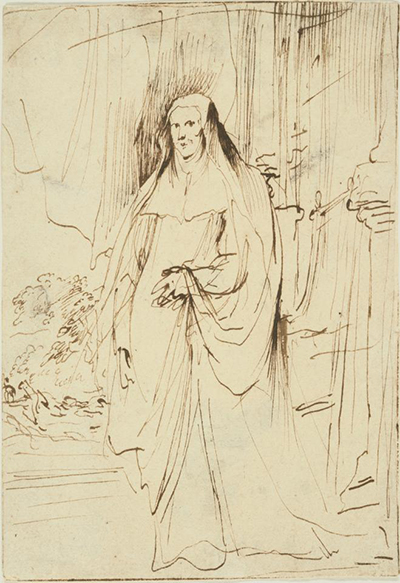
A few brown lines give this veiled woman a commanding presence. Her gown reaches almost to the bottom of the sheet, while a column and an opening towards trees establish a spacious setting around her. Anthony van Dyck's small drawing, dated about 1627, leaves her identity unresolved. [1] [2]
At a Glance
- Artist Anthony van Dyck. [1]
- Date About 1627. [1]
- Medium Pen and brown ink on paper. [1]
- Size 15.7 × 10.8 cm. [1]
- Collection Museum of Fine Arts, Boston; Helen and Alice Colburn Fund. [1]
- Inventory number 20.814. [2]
- Sitter Unidentified; the proposed identification as Isabella Clara Eugenia is disputed. [1] [2]
This work across Anthony van Dyck’s career
Entry of Christ into Jerusalem
about 1617Frans Snyders
about 1620Rinaldo and Armida
1629–1632; Louvre commentary proposes late1631–spring1632Charles I in Three Positions
1635–before June 1636Lord John Stuart and his Brother
about 1638Cupid and Psyche
1639–40Self Portrait
c. 1640Contents
- How the pen builds the figure
- A small sheet with the scale of a portrait
- A Genoese comparison
- Why the woman's name remains uncertain
How the pen builds the figure
Begin with the woman's head. Short marks register the eyes, nose and mouth within the pale enclosure of her headdress. Behind it, tightly gathered strokes make a dark wedge, separating her head from the background. The face remains readable without the dense modelling that might give each feature a rounded surface.
Below, the drawing opens out. Long, widely spaced lines carry the gown towards the floor. At the waist, a small concentration of angular marks catches the hands and gathered fabric. The curve of the sleeve then leads the eye outwards before returning towards that central knot. There is considerable variety in this apparently economical sketch: scratching vertical strokes overhead, loose hooks for leaves, long folds and a few firmer accents at the fingers.
The unworked paper is especially active across the broad covering beneath the chin and through the front of the gown. These areas allow the figure to emerge between the lines. The darkest passage lies beside the head, so the eye travels back upwards even after following the sweeping fabric to the hem.
The hands deserve a slower look. One extends across the body, its fingers indicated by separate short strokes; the other is drawn closer to the waist. Their outlines overlap with the hanging cloth, so that an exact account of each finger becomes difficult. What remains clear is the relationship between the outward gesture and the folds dropping beneath it. The hands gather the lines together, then release them down the front of the figure.
Around the shoulders, the pen describes several different edges: the outer veil, the inner clothing and the broad covering across the chest. At this scale, a single line can stand for the boundary of a garment, while several close strokes suggest a shaded hollow. Following those changes helps distinguish the woman's layered clothing without treating every mark as a separate accessory. The drawing offers enough information to establish her dress while leaving much of its surface open.
A small sheet with the scale of a portrait
The Frick places the drawing among Van Dyck's pen studies for initial portrait ideas and reads its format as suggesting aristocratic or high ecclesiastical rank. [1]
Its design certainly gives the woman room to command. The architecture rises behind her on the right, while foliage and a low horizontal edge open the space on the left. Her body occupies the interval between these contrasting surroundings.
Horst Vey's 1957 study of the sheet makes the arrangement more legible. He identifies two columns on a high pedestal and a high-backed chair between them, interpreting the chair as a sign of the sitter's dignity. He also reads a gathered curtain opening towards the landscape. [3]
Some of these furnishings are easy to overlook. The narrow shapes immediately beside the woman's shoulder receive much less emphasis than her sleeve. Further right, projecting architectural edges interrupt the long uprights, while the column base establishes a level above the floor. The figure partly screens this setting, so that the furnishings emerge in fragments around her. It is an economical way to suggest a room larger than the space the paper actually shows.
Look at how differently those surroundings are drawn. The column has long upright boundaries and projecting mouldings; the trees break into little restless loops. Neither receives enough detail to identify a particular place. They make an effective frame for the standing figure, whose long outline gathers the composition together.
Seen this way, the sheet offers something more specific than a costume record. It tests the relationship between a person, the fall of her clothes and the space a portrait might give her. That is a reading of the visible arrangement; it does not establish a particular commission. Other examples of this flexible thinking appear among Van Dyck's drawings .
Watch: Van Dyck’s art and working methods
Choose a museum introduction, a specialist lecture or a conservation film to continue exploring Van Dyck’s work.
Stijn Alsteens: Drawing for Portraits
Stijn Alsteens explores how portrait drawings prepare and develop a likeness.
Watch on YouTubeA Genoese comparison
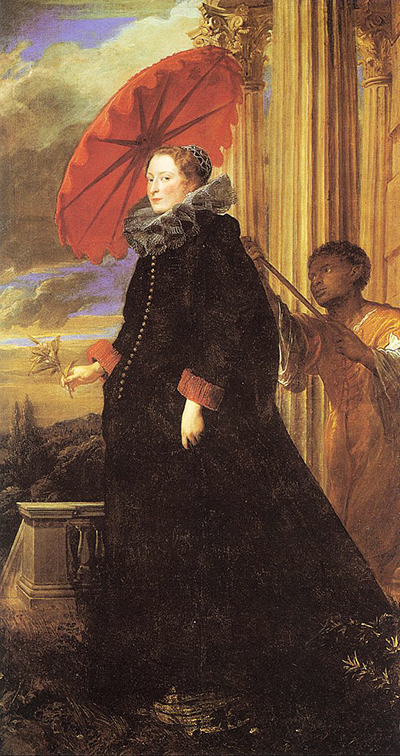
Vey connects the Boston figure with Van Dyck's standing portraits of Genoese women. [3] A useful comparison is the Frick's Genoese Noblewoman , dated about 1625–27. That painting also presents an unidentified woman at full length against loosely defined architecture. Its canvas measures 230.8 × 156.5 cm, giving a sense of the monumental scale that this kind of arrangement could attain. [4]
The difference in size matters when looking back at the drawing. A sheet only 15.7 cm high can establish the long silhouette, the position of the hands and the balance between figure and surroundings without supplying the finish of a large canvas. [1] Here, the gown spreads across the lower part of the design, while the head occupies a relatively small area above it. The impression of height depends as much on those proportions as on the column beside her. The face, hands and surrounding folds remain linked by the long outline, even where their separate details are barely indicated.
The Frick describes the painted noblewoman's luxurious clothing and notes that her sash and black-edged cuffs may indicate widowhood. [4] The Boston woman's plain religious dress creates a different appearance within a similarly spacious portrait format. The comparison shows how a commanding full-length format could accommodate sharply different clothes. It gives the drawing a place among Van Dyck's portraits of standing women, while leaving its sitter and intended painting unresolved.
Why the woman's name remains uncertain
The Frick tentatively names Archduchess Isabella Clara Eugenia and compares the religious dress with Van Dyck's full-length portrait of her in Turin, dated 1628. [1]
Blaise Ducos explicitly rejects the identification in his 2023 Louvre catalogue. He points to the small head, elongated body and division between palace architecture and landscape as features of Van Dyck's Genoese manner, unlike his images of Isabella. He places the sheet near the end of the Italian stay, around 1627. [2]
Isabella adopted the Franciscan Third Order's habit after her husband's death in 1621 while continuing to govern: membership accommodated duties incompatible with enclosed religious life. [2] Her example explains why such clothing need not mean withdrawal from public affairs; it does not supply the Boston woman's biography.
The doubts have a longer history. Vey's 1957 discussion observes that the drawn face is leaner than Isabella's known likenesses, but he cautions that a facial difference alone would not settle the question. He gives further weight to the different throat covering and the absence of the cord at the waist seen in her painted portraits. Taken together, these details lead him to look for another, probably Italian, sitter, while acknowledging how difficult it would be to identify her among the many religious communities. [3]
This disagreement also leaves the sheet's relationship to the Turin portrait unproven. [1] [2] With the sitter unnamed, the drawing invites us to give closer attention to its own proportions, gesture and setting.
Artworks directory
A selected directory of paintings, drawings and prints, including works discussed in the articles and the Frick’s 2016 portraiture exhibition. It is not a complete catalogue of Van Dyck’s work. Print titles identify collaborators or later printmakers; disputed and workshop attributions are retained. The exhibition checklist supplies additional object records; current collection information governs the updated article entries. [5]
Frequently Asked Questions
Her veil and broad throat covering give the image its descriptive title. Her precise religious status is unknown; the Frick allows either aristocratic or high ecclesiastical standing. [1]
That connection remains disputed. Ducos rejects the identification and the proposed relationship with her portraits. [2]
Compare the dark hatching beside the head with the open gown. Then follow the sleeve towards the hands: a handful of marks gives this small area much of the drawing's movement.
Discussion
Look again at the images and ideas explored in Standing Woman in a Nun's Habit. These editorial prompts invite your observations.
Reader Insights
How does the architecture change your sense of the woman's presence?
Where does Van Dyck use the fewest lines to suggest the greatest volume?
How does leaving the sitter unnamed affect your reading of her gesture and dress?
Join the Conversation
Share a detail, comparison or question about Standing Woman in a Nun's Habit below.
References
- The Frick Collection , Standing Woman in a Nun's Habit (Archduchess Isabella Clara Eugenia?), Van Dyck: The Anatomy of Portraiture , exhibition object 18. View source .
- Blaise Ducos , Portrait d'Isabelle Claire Eugénie (1566–1633), archiduchesse des Pays-Bas, en habit du tiers ordre des Clarisses, Antoon Van Dyck: Catalogue raisonné des tableaux du musée du Louvre (2023), catalogue entry 11, especially note 8 on the Boston drawing. French. View source .
- Horst Vey , Einige unveröffentlichte Zeichnungen Van Dycks, Bulletin des Musées royaux des Beaux-Arts de Belgique (1957), pp. 175–210, especially pp. 198–200 and figure 12. German, with French summary. View source .
- The Frick Collection , Genoese Noblewoman, Van Dyck: The Anatomy of Portraiture , exhibition object 17. View source .
- The Frick Collection, Van Dyck: The Anatomy of Portraiture, online exhibition checklist (2016). View source.