


 by
Tom Gurney
Tom Gurney BSc (Hons) is an art history expert with over 20 years experience
Email:
tomgurney1@gmail.com
/ Phone:
+44 7429 011000
Paolina Adorno Brignole-Sale by Anthony van Dyck: Introduction
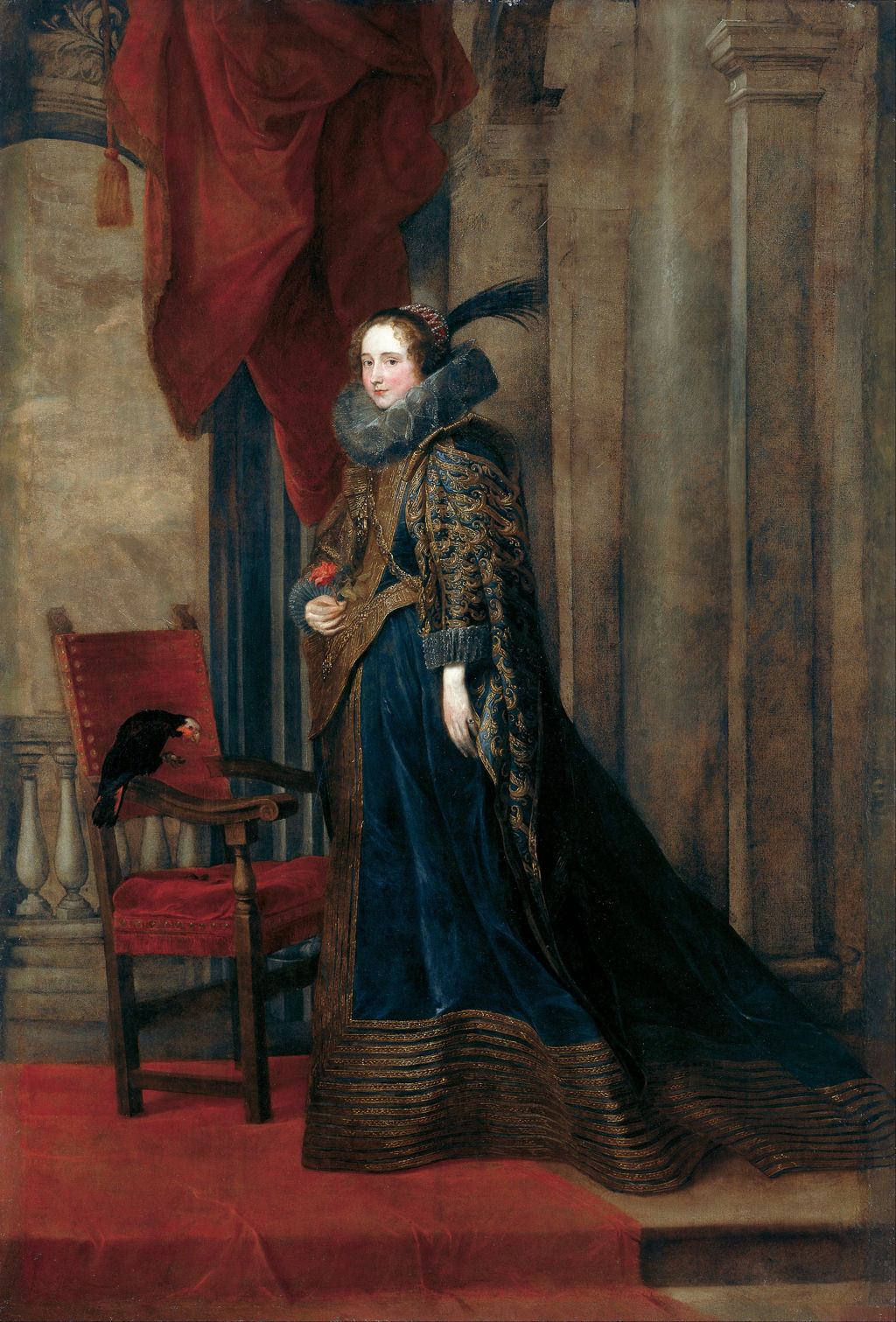
Paolina Adorno Brignole-Sale looks directly at us from a setting of towering columns, red drapery and deep blue cloth threaded with gold. Painted in 1627, when she was about twenty, her portrait gives a young woman the scale and architectural presence of a public monument. A rose in her hand and a parrot beside her introduce smaller, more fragile forms into this imposing display. The painting remains in Genoa with the portrait of her husband, Anton Giulio, for which it was conceived as a companion. [1]
At a Glance
- Artist Anthony van Dyck, recorded by the museum as Antoon Van Dyck.
- Title Portrait of Paolina Adorno Brignole-Sale .
- Date 1627.
- Medium Oil on canvas.
- Dimensions 286 × 198 cm.
- Collection Musei di Strada Nuova, Palazzo Rosso, Genoa.
- Inventory number PR 51.
- Companion portrait Anton Giulio Brignole-Sale on Horseback , also dated 1627.
- Acquisition Donation of Maria Brignole-Sale De Ferrari, 1874. [1] [2]
This work across Anthony van Dyck’s career
Entry of Christ into Jerusalem
about 1617Frans Snyders
about 1620Rinaldo and Armida
1629–1632; Louvre commentary proposes late1631–spring1632Charles I in Three Positions
1635–before June 1636Lord John Stuart and his Brother
about 1638Cupid and Psyche
1639–40Self Portrait
c. 1640Contents
- A direct gaze in an immense setting
- Blue fabric and the weight of gold
- The rose, the parrot and passing beauty
- A family commission in 1627
- Paolina and Anton Giulio as companion portraits
- From the family collection to Palazzo Rosso
A direct gaze in an immense setting
The first encounter is with Paolina's face. Its light tones stand out between her dark hair and the broad lace collar, while her eyes meet the viewer across the surrounding splendour. Her body turns at an angle, but her head turns back towards us. This small adjustment keeps the elaborate figure from becoming a remote silhouette. We see a particular person looking out from within the formal arrangement.
Her hands establish a second, quieter exchange. The right hand holds the flower near her waist; the left hangs beside the skirt, its pale fingers clear against the dark fabric. The two gestures give the eye places to pause between the face and the enormous sweep of the dress. Neither requires a large movement. Most of the composition's activity belongs to folds, embroidery and the upward thrust of the architecture.
At 286 centimetres high, the canvas gives the likeness a monumental field. The museum describes it as Van Dyck's largest portrait of a single woman from his Genoese years. [1] Its height is felt even in reproduction: Paolina's head sits well below the upper edge, leaving a great area of curtain and stone above her. Below, the skirt descends to the step and spreads across much of the width. The figure occupies the setting through the breadth of her costume as much as through her physical height.
The columns strengthen this effect. Their heavy bases and tall shafts suggest a space built on a grand scale. A red curtain gathers into deep folds above and to one side of Paolina, while a balustrade and a glimpse of sky open the other side of the scene. These different depths surround a figure placed close to the front. The architecture provides distance; the direct gaze bridges it.
This is a composed setting for a portrait, and no particular family room or loggia has been established by the museum account. Its purpose can be understood from what it makes visible: height, space, costly furnishing and a young woman able to command attention within them. [1]
Blue fabric and the weight of gold
Paolina's dress rewards a slower look. From a distance, the deep blue skirt forms one large, dark shape. Closer attention reveals long folds, a spreading train and a richly bordered hem. Gold-coloured lines run across the lower edge in bands that bend with the fabric. They give the skirt weight and make its turn across the step easier to follow.
The upper part of the costume is much more densely worked. Scrolling ornament crowds the sleeves and fitted bodice, catching light in short curves and broken accents. The sleeve nearest us projects from the body before narrowing towards the wrist. Its brightness and bulk help turn the torso into space. Paolina's lowered hand, emerging below a lace cuff, marks the point where the patterned surface gives way to skin.
The owning museum draws attention to the different ways Van Dyck painted these materials. It describes a thin application of blue for the cloth, with thicker yellow and white paint suggesting the gold embroidery. [1] This account explains a striking visual effect: the broad fabric can recede into darkness while its ornament seems to catch light close to the surface.
The lace collar makes another kind of boundary. It rises around the neck and spreads away from the head, setting the face apart from the embroidered body. Its pale edges and darker interior passages give it a crisp, folded structure. Above it, the pearl-trimmed head covering and long black feather extend the costume upwards without competing with the curtain's mass. [1]
Red gives the blue and gold a surrounding warmth. The curtain, chair upholstery and foreground carpet form separated areas of colour down the left side of the picture. They guide the eye from the upper space towards the parrot and then to the step beneath Paolina. The dress remains the largest continuous coloured form, but these red accents prevent its dark blue from becoming isolated.
The museum's family history interprets the portraits' monumental dimensions and sumptuous clothing as expressions of the Brignole-Sale family's economic power. [3] That interpretation is especially persuasive here because wealth has been translated into things the eye can experience: repeated ornament, carefully differentiated surfaces and fabric that takes up room. The picture makes the ceremonial costume an active part of Paolina's presence.
The rose, the parrot and passing beauty
The flower is small enough to be missed in an initial view of the whole canvas. Its pink bloom rests above Paolina's right hand, close to the densely decorated bodice. The fingers hold its stem with a lightness that differs from the weight of the surrounding cloth. Beside the heavy sleeve and gold ornament, the flower introduces a delicate, irregular form.
The parrot occupies the chair to her side. Its predominantly dark body merges with some of the shadow, while its pale and red head picks up colours found elsewhere in the painting. Perched on the armrest, the bird gives the chair a living occupant and creates another point of attention at about the level of Paolina's hands. The polished furniture, soft upholstery, bird and flower supply different kinds of surfaces within a relatively small area.
The museum attributes the painting of the parrot to Jan Roos. [1] This account of collaboration gives the animal a further interest when looking closely at the portrait, which is catalogued as a whole under Van Dyck's name.
The same entry reads the fully opened rose and the bird's fallen feathers on the cushion as reminders that beauty passes. [1] In this interpretation, the bloom has reached a stage from which it will fade, and the detached feathers bring a trace of loss into the richly furnished scene. The reading belongs to the museum's discussion of this painting; it need not turn every rose or parrot in another portrait into an identical emblem.
Here that interpretation places a limit within the image's abundance. Paolina is shown at the threshold of her twenties, surrounded by materials made to look enduring and expensive. [1] The flower and feathers allow the scene to contain the thought of change. They do so at a modest scale, leaving the face, costume and standing figure fully present. The picture gives us both the splendour of the occasion and details that invite reflection beyond it.
Watch: Van Dyck’s art and working methods
Choose a museum introduction, a specialist lecture or a conservation film to continue exploring Van Dyck’s work.
Van Dyck, The Anatomy of Portraiture
The Frick curators introduce Van Dyck’s portraits, drawings and prints.
Watch on YouTubeA family commission in 1627
Paolina's portrait formed part of a larger commission organised by Gio. Francesco Brignole. Van Dyck painted his wife, Geronima Sale, with their daughter Aurelia; their son Anton Giulio; and their daughter-in-law Paolina. The museum places the group in 1627, the final year of Van Dyck's Italian stay. [3] [4] The paintings brought two generations of the family into an ambitious set of full-length images.
The timing matters. The Brignole family had risen through commerce and the manufacture of wool and, later, silk. Marriage alliances helped consolidate its wealth and position. Gio. Francesco's marriage to Geronima Sale brought substantial resources and property into the family's history; the museum treats the Van Dyck commission as an early and conspicuous statement of the standing the family had acquired. [3]
Van Dyck had arrived in Italy in 1621. In Genoa he found patrons for whom an imposing portrait could communicate social distinction within the palace as well as preserve a likeness. The museum's account of his Genoese activity places the Brignole commission within this deliberate cultivation of family prestige. [4] Paolina's portrait gives that ambition a precise visible form: the grand scale belongs to her figure, her clothes and her encounter with the viewer.
Gio. Francesco's election as doge came later, in 1635. [3] The portraits therefore belong to the family's ascent before that office was attained. They should not be described as paintings commissioned by an already reigning doge. Nor does the commission require us to read Anton Giulio's later literary, diplomatic or religious career back into Paolina's appearance. Her portrait presents her as a young woman in 1627, with its own carefully developed vocabulary of dress, gesture and setting.
An unusually useful piece of documentary evidence accompanies the group. According to the owning museum, the Brignole-Sale account books record a total payment to Van Dyck of 747 lire for the three paintings in 1627: Paolina, Anton Giulio, and Geronima with Aurelia. [1] This is a combined sum. It does not establish an individual price for Paolina's canvas, and the museum's published account gives no division of the payment between the three works.
The entry suggests that these may have been among Van Dyck's last paintings in Genoa. [1] The documented year gives the commission a firm place at the end of his Italian period; a precise order of execution within the group remains unstated.
Paolina and Anton Giulio as companion portraits
Paolina's portrait survives alongside Anton Giulio Brignole-Sale on Horseback . The museum identifies them as a rare surviving pair of Van Dyck pendants still kept together. [1] [2] A pendant is a work conceived as the companion to another. Here the relationship is established through comparable scale, date and family purpose, while the two compositions offer markedly different ways of occupying space.
Anton Giulio rides a white horse that advances towards the viewer, turning its head slightly across the picture. He extends an arm with his hat, and the animal's lifted leg introduces movement into the lower half of the canvas. Paolina stands on a step with her dress spreading around her. Her flower and lowered hand keep the gestures close to the body. The horse supplies much of the bulk and light in his portrait; the blue and gold costume supplies the breadth and surface variety in hers.
Both figures look outwards. Both are accompanied by a living creature, and both inhabit architectural settings with red drapery. These shared elements help the pictures speak to one another even though they do not depict a continuous space. The curtain and columns provide a common ceremonial register; the small parrot and great white horse produce very different encounters within it.
Paolina's canvas measures 286 × 198 centimetres, while Anton Giulio's is recorded at 282 × 198 centimetres. [1] [2] The near match makes the scale of her standing portrait particularly striking. Its architecture and costume sustain a presence comparable to the equestrian image. Viewing the pair together allows us to recognise their shared family purpose while attending to the separate decisions that give each sitter an individual form.
From the family collection to Palazzo Rosso
The palace where Paolina's portrait is now displayed was built long after it was painted. Palazzo Rosso dates from 1671–77, roughly half a century after the commission. [3] Its rooms cannot have been the original destination in 1627. The museum records that Ridolfo, a son of Paolina and Anton Giulio, brought the portraits into the family's new residence. [1]
The family's determination to keep the pictures together also shaped their later history. In 1687, following Ridolfo's death without a male heir, his brother Gio. Francesco I bought them within the family to prevent their passing out of the Brignole-Sale collection. The museum's broader account connects the danger of dispersal with an inheritance that would have taken the paintings through a marriage into the Spinola family. [1] [4] By then, the portraits had become valued images of the dynasty's earlier generations.
They remained part of the collection subsequently given to Genoa. In 1874 Maria Brignole-Sale De Ferrari, Duchess of Galliera, donated Palazzo Rosso and its contents to the city; Paolina's object record names that donation as the painting's acquisition. [1] [3] Its public setting preserves a substantial part of the family's collecting history, although the building and its decoration belong to a later chapter than the portrait itself.
Artworks directory
A selected directory of paintings, drawings and prints, including works discussed in the articles and the Frick’s 2016 portraiture exhibition. It is not a complete catalogue of Van Dyck’s work. Print titles identify collaborators or later printmakers; disputed and workshop attributions are retained. The exhibition checklist supplies additional object records; current collection information governs the updated article entries. [5]
Frequently Asked Questions
Paolina Adorno was the wife of Anton Giulio Brignole-Sale and the daughter-in-law of Gio. Francesco Brignole, who commissioned a group of family portraits from Van Dyck in 1627. The museum describes her as about twenty when this portrait was painted. [1] [3] Her full-length likeness survives with Anton Giulio's equestrian portrait.
It belongs to the Musei di Strada Nuova and is in Palazzo Rosso, Genoa, under inventory number PR 51. The canvas entered the city's collection through Maria Brignole-Sale De Ferrari's donation in 1874. [1]
The owning museum interprets the fully opened rose and the parrot's fallen feathers as reminders of the passing of beauty. That is a reading of these details in this particular painting, alongside their decorative and visual roles. The museum also attributes the parrot's execution to Jan Roos. [1]
The museum reports a payment of 747 lire in 1627 for a group of three paintings: Paolina's portrait, Anton Giulio's portrait, and Geronima Sale with her daughter Aurelia. The published account does not assign a separate fee to Paolina's painting. [1]
Discussion
Look again at the images and ideas explored in Paolina Adorno Brignole-Sale by Anthony van Dyck. These editorial prompts invite your observations.
Reader Insights
How does your attention move between Paolina's face, hands and embroidered dress, and which details bring you back to her gaze?
How does the museum's interpretation of the rose and fallen feathers change your response to the portrait's display of wealth?
When Paolina's portrait is viewed beside Anton Giulio's, which shared elements make them a pair, and which differences give each sitter a distinct presence?
Join the Conversation
Share a detail, comparison or question about Paolina Adorno Brignole-Sale by Anthony van Dyck below.
References
- Musei di Genova , Ritratto di Paolina Adorno Brignole-Sale. Object record and interpretation, Italian. View source .
- Musei di Genova , Anton Giulio Brignole-Sale a cavallo. Companion portrait object record, Italian. View source .
- Musei di Genova , La Famiglia Brignole Sale. Family, collecting and palace history, Italian. View source .
- Musei di Genova , Antoon Van Dyck: L’attività genovese. Museum account of Van Dyck's Genoese activity and the Brignole-Sale commission, Italian. View source .
- The Frick Collection, Van Dyck: The Anatomy of Portraiture, online exhibition checklist (2016). View source.


